- Brieves, Asturias
While the conventional land lines in Asturias were defining themselves around the siege of Oviedo, the western rearguard of the province suffered a silent wave of targeted extrajudicial cleansings. One of the most heart-breaking examples of this violence occurred during early-to-mid October 1936 in the rural parish of Brieves, situated within the Valdés municipality, which had only a few dozen families in residence. The site, historically located in the Carcéu area, became the final resting place for six very young men whose lives were cut short by Nationalist paramilitary forces. Today, the case stands as a key focus of the regional government’s active democratic memory efforts.
In early October 1936, the western coastal-interior corridors of Asturias were being systematically secured by Nationalist columns advancing from Galicia. To suppress any potential local resistance or guerrilla activity in the rugged interior valleys, Falangist groups conducted local sweeps. The execution of the six young men in the Carcéu/Brieves area represents the terrifying reality of life in a Nationalist rearguard zone that had already been completely conquered. By early to mid-October 1936, the columns marching from Galicia under Colonel Teijeiro had already successfully punched their way eastward through western Asturias. They had already established the narrow Pasillo Gallego (Galician Corridor) to connect with the siege lines in Oviedo. Because the military occupation of the Valdés, Salas, and Tineo concejos was already complete, Falangist death squads and local Guardia Civilunits dominated the rearguard, operating far behind the active combat fronts.
The six victims targeted in this specific saca were exceptionally young, ranging in age from just 17 to 21 years old, just rural youths swept up in the ideological paranoia that followed the July coup. Official archival work and ancestral cross-referencing driven by the Asturian Government’s Democratic Memory Department have successfully identified all six individuals, mapping them back to their small home hamlets. Three came from Ouvés, population around 70, roughly 19km south of Brieves – Francisco González Prado, age 17, Bernabé Fernández Alonso, and Francisco García Rodríguez. Another three came from Brañalonga, just a hill climb away -Fernando González Peláez, age 21, and his brother Julio González Peláez, age 19, and their cousin Darío Peláez Cuervo, age 21.
The six young men formed a local folk band known as the Bandín de Brañalonga. They had drawn the ire of local conservative authorities and right-wing figures before the war because they routinely closed out their musical performances at local town festivals (romerías) by playing the Himno de Riego, the officially recognized national anthem of the left-leaning Spanish Republic.
In October 1936, believing they were entirely innocent of any real wartime crimes, the young men set off on foot to perform at a festival in the coastal town of Luarca. They were intercepted by a Guardia Civil patrol at the crossroads town of La Espina, loaded onto a truck, and taken back to the hamlet of Brieves (Valdés). They were locked away for days in an old blacksmith’s workshop known locally as the Casa del Ferreiro. Because local village lockups and the main prison in Luarca were completely overwhelmed by mass arrests, Nationalist paramilitary squads also frequently used isolated mountain caves as makeshift, hidden holding pens. Prisoners were kept and executed in these dark caves.
On 24 October 1936, after cruel displays of psychological torment, their captors forced the young musicians out into a field, made them physically dig up potatoes for the local garrison, and ordered them to play a final selection of songs on their instruments. As soon as they finished playing, a mixed execution squad composed of Falangists and Guardia Civil shot all six boys in the back of the neck. Because the public executions shocked local residents, the Nationalist authorities hired a local gravedigger known as Chamín de Brieves to load the bloody bodies onto his ox-cart. He secretly drove them uphill to the isolated municipal cemetery of Carcéu (Carcedo), dumping them into a shallow mass grave. The town only had around 80 inhabitants; what happened was no secret at any stage.
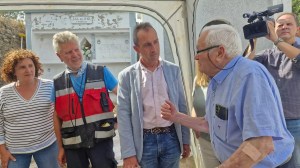
On 15 September, 2025, the remains of six young men were exhumed after a long battle, including José Antonio González Prado, the brother of Francisco González Prado, the youngest musician of the band who was executed at 17 years old. José Antonio was 9 years old when his brother was taken away by the Guardia Civil and Falange. He spent his entire adulthood carrying the memory of that trauma and searching for his brother’s final resting place.
By the time the exhumation officially launched in September 2025, José Antonio was 98 years old. His advanced age added a massive sense of urgency to the project, as memory associations and local authorities recognised this was the final window to grant him closure during his lifetime. Alongside two of his nieces, he personally sat at the edge of the Carcéu cemetery trenches, watching the dirt being cleared away until the bones of his brother were finally uncovered, alongside relatives of the other men found, and flowers were laid by their side. The gravedigger who had buried the men had shared his story with locals, and the information that they were in the cemetery had made its way back to families. But it was only once the Grupo Arqueos team from the University of Oviedo could deploy ground-penetrating radar to pinpoint the six skeletons were resting side-by-side could they officially be commemorated.
- San Juan de Aznalfarache, Seville, Andalucia
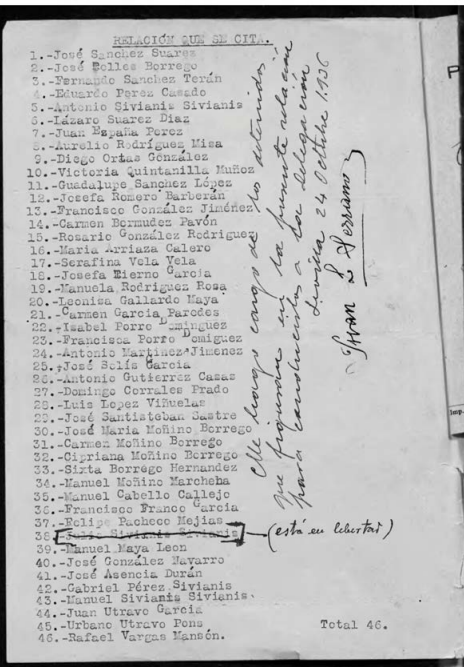
While the nine olive pickers of San Juan de Aznalfarache and six other women from surrounded areas were taken to San Fernando Cemetery to be murdered, the men of the region were also suffering too. All seven men also arrested on the same day – Antonio Anillo Marín (husband of the famous Guadalupe Sánchez López), José Sánchez Suárez, Francisco González Jiménez, Eduardo Pérez Casado, José Téllez Borrego, José María Castaño Sena, Diego Orta González, and Diego Bíter González were also taken from the prison ships on the Guadalquivir River where they had been trapped for more than two months.
At the last minute in the early hours of 24 October, José Sánchez Suárez was suddenly let go (and likely made a run for home very quickly), but many others were on the list for execution that night. Through an administrative error, Manuel Moñino Marchena, Manuel Cabello Callejo, Juan Utravo García, and Rafael Vargas Manzón were accidentally left behind (though were added to a later night’s saca), but another 18 men from the region were also loaded onto the trucks.
Alongside the men of San Juan de Aznalfarache were Aurelio Rodríguez Misa, José Téllez Borrego, Eduardo Pérez Casado, Lázaro Suárez Díaz (cousin of the man let go), Juan España Pérez, cousins Diego Orta González, Francisco González Jiménez, and Antonio Martínez Jiménez, plus José Solís García, Antonio Gutiérrez Casas, Domingo Corrales Prado, Luis López Viñuelas, José Santiesteban Sastre, José María Moñino Benítez (aged 15), Francisco Franco García, Felipe Pacheco Megino, Urbano Utravo Pons, Gabriel Pérez Sivianes, and brothers Antonio and Manuel Sivianes Sivianes.
José María Moñino Benítez was only 15, and arrested with his cousins, Carmen Moñino Borrego and her sister Cipriana Moñino Borrego, and their cousin Sixta Borrego Hernández. All were from El Garrobo, though had sometimes been working as far north as Fuente de Cantos in Badajoz, which was equally as dangerous for innocent labourers. All were trucked from El Garrobo the death ships and then were executed on 24 October 1936.
Diego Orta González, Francisco González Jiménez, and Antonio Martínez Jiménez, all of San Juan de Aznalfarache were related to Rosario González Rodríguez, one of the famous olive pickers, and likely had the same job as her. All died that night.
Antonio, Julio, and Manuel Sivianes Sivianes were three brothers from Camas, who fell victim to the sweeping Francoist repression during the opening months of the Spanish Civil War. Antonio was a 49-year-old bartender and Republican councillor, and his nephews (possibly sons, it’s complicated with them having double identical surnames, resulting from a small town intermarrying cousins over long periods) Manuel was a 19-year-old potter, and his brother Julio was just a few years older. Targeting whole families was very common, especially in small towns. Camas was unique; it was right on the outskirts of Seville city and was the location of the famous La Pañoleta ambush on 19 July 1936, when relief force of up to 150 miners, the Riotinto Mining Column rushed to Seville to try to stop the outbreak of war. The Republican government dispatched a detachment of the Guardias Civil from Huelva to escort them, led by Commander Gregorio Haro Lumbrera, but on the morning of 19 July, Commander Haro defected. He set up a heavy machine-gun trap at La Pañoleta, a critical crossroads choke-point at the foot of the hills leading into Seville. When their truck rolled, 25 men were burned to death in the explosion from the dynamite, and another 71 were captured all later were executed or died of wounds (expect one young boy was left in prison). The rest managed to escape, though would have been later killed in the Huelva round-ups around Riotinto (see 20 August 1936).
The town would have been swarmed with Nationalist supporters, and the Sivianes Sivianes men were rounded up, along with Gabriel Pérez Sivianes, a maternal cousin. All were scheduled for execution on 24 October 1936. Gabriel Pérez Sivianes and Manuel Sivianes Sivianes were killed that night, and the surnames may have caused admin problems, as Julio Sivianes Sivianes was marked as released, but he had actually be killed on 2 September. Antonio Sivianes Sivianes’ death date is just marked ¿? , but cannot have lived any longer than 24 October.
The reality is that the kill list of 24 October 1936 has survived, whereas many have long disappeared, but nothing is unusual about 24 October 1936. In Seville this had been a normal occurrence since the outbreak of war, and 90 years on, we still do not know how many people went into the pits in the city. The pit these men went into Fosa del Monumento / Alpargateros (Pico Reja was already full). The Spanish Government, the Regional Government of Andalucía, and local authorities signed a formal, multi-million euro joint protocol in June 2025 to officially begin the exhumation, bone-by-bone analysis, and genetic matching specifically for the Fosa del Monumento. Government projections indicate the complex excavation and DNA process for this grave is expected to run through 2029.
- Murillo de Gállego, Huesca, Aragon
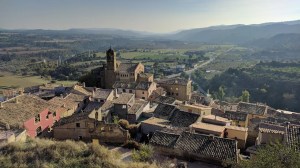
Murillo de Gállego was firmly in the Nationalist-controlled territory of Huesca in October and had been for most of the war. However, it sat dangerously close to the unstable, shifting front lines of Alto Aragón. The Republican militias, pushing from Catalonia and eastern Aragon, were actively attempting to siege the city of Huesca. Because it was a rearguard zone near active military operations, the local Nationalist authorities, military prosecutors, and Falangist death squads operated under constant paranoia of internal sabotage, espionage, or left-wing uprisings.
Murillo de Gállego had already been completely traumatised by earlier waves of terror. The most brutal localised purge happened just a month earlier on 18 September 1936, when Falangist squads and the Guardia Civil swept Murillo de Gállego, arresting 23 local residents. Twelve men were taken under the guise of giving statements but were executed in a field near Agüero. Four local women from Murillo were taken and murdered on the outskirts of neighbouring Biscarrués. In total, about 30 villagers had been executed before October even arrived, and population was only around 750 total.
Murillo de Gállego was a modest, rural municipality. Like much of the pre-war Aragon countryside, its population was highly politicised and divided. The region had strong agrarian collectivist movements and heavy representation from republican political parties and left-wing trade unions like the socialist UGT and the anarchist CNT. When the coup succeeded locally, anyone associated with these organisations became an immediate target for systemic elimination. July and August were characterised by raw, hot-blooded street violence and immediate local executions. By October, the military regime was formalising its control, managing overcrowded prisons, and streamlining what historians call a systematic cleansing of the rearguard. The prisons in the city of Huesca and nearby Ayerbe were completely bottlenecked with hundreds of political prisoners, union members, and republicans rounded up from surrounding villages over the summer. The authorities began staging larger, organised sacas to intentionally empty cell blocks.
José Auseré Lorés, age 71 years old, was a retired carabinero (border guard/customs officer), José Sanz Lasierra, age 58 and town councillor of Loscorrales, José Lasierra Carrey, age 41 and the socialist mayor of Loscorrales, Emilio Susín Garcés, age 36, Matías Botaya Sanz, age 33, Tomás Beltrán Gracia, age 33, Mariano Cristóbal Abad Lasierra, age 29 and town councillor in Loscorrales and cousin of the mayor, Mariano Constancio Lacambra Ascaso, age 39, José Enrique Crisanto Arregui Vicen, age 27, Enrique Nicolás, age 27, and Julián Gracia Otal, age 23, Pascual Arbúes Aguas, age 21, and Blas López Large, age 21 were taken from Ayerbe person in the small hours of 24 October 1936. Alongside them were three Murillo de Gállego – Valeriano Francisco Arbués Castrillo, age 30, and neighbours Luciano Gállego Nisarre, age 35, and Demetrio Nivela Navarro, age 42.
The 16 individuals executed at the La Lobarda site on 24 October were selected as part of a targeted operational sweep of Republican leadership from the surrounding rural districts.
The group was heavily comprised of local institutional leaders who had chosen to defend the legitimate Republican government or had run local committees. Notably, the truck included the Republican mayor and two town councillors from nearby Loscorrales, alongside trade unionists and political affiliates from Huesca, Ayerbe, Bolea, Quinzano, and Santa Eulalia. The three local victims from Murillo de Gállego, Demetrio Nivela, Luciano Gállego, and Francisco Arbués, were likely being held in the Ayerbe prison hub and were mixed into the execution squad.
Following the victory of the Popular Front coalition in the February 1936 elections, José Carrey assumed leadership of Loscorrales, population 500. When the military coup succeeded locally in July, he was immediately targeted and held in the Huesca provincial prison. Though briefly released, he was re-arrested as part of a targeted operational purge aimed directly at dismantling the rural institutional infrastructure of the Second Republic. In a cruel twist of local history, the right-wing Falangist repression in Loscorrales was heavily orchestrated by a local Falangist chief named Antonio Ordás, a former political chameleon who weaponised the local cleansing to violently erase his own past leftist associations.
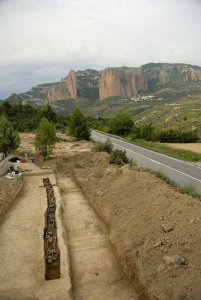
The group were driven out to the Campo Blasquico in the La Lobarda area of Murillo de Gállego to be executed. In a harrowing historical footnote, one of the local villagers forced by the Falangists to dig the mass grave recognised his own son and two neighbours among the dead. Because of this, he and fellow neighbours secretly ensured that the three local Murillo victims, Valeriano Francisco Arbués Castrillo, Luciano Gállego Nisarre and Demetrio Nivela Navarro, were transferred directly to the municipal cemetery, leaving the remaining 13 outsiders to rest in the wayside trenches. While of course the town knows the truth, the son and his father are still not publicly named, for their privacy. For decades, family members would place fresh flowers on the spot in the cemetery, and their descendants used these generational whispers to form the official Agrupación de Familiares de los Fusilados de Murillo de Gállego.
When historical memory teams and archaeologists arrived in 2008 to exhume the roadside trench at La Lobarda, only nine skeletons were recovered; the whereabouts of four of the victims remain unknown, but may have been moved by relatives, just like the Murillo de Gállego three. In 2010, archaeologists returned to the La Lobarda area and located separate, smaller graves, finding two more bodies under an old olive tree metres away. These were identified as Juan Coronas Ara and Ramón Lacasta Castán from the nearby town of Agüero, who died in an execution in September 1936. It could be that the Loscorrales four – mayor José Lasierra Carrey, councillors José Sanz Lasierra and Mariano Cristóbal Abad, and Matías Botaya Sanz, were removed in private and reburied.
On 17 March 2012, a public homage was held and remains of the nine outsider victims were permanently placed inside a newly constructed memorial pantheon inside the Murillo de Gállego Cemetery symbolically alongside the once-hidden grave of the three locals. The town lost 36 people to repression during the war.
- Tardienta, Huecsa, Aragon
The story of Tardienta provides a stark look at the parallel realities of rearguard violence during the Spanish Civil War. Located on the Republican side of the front lines in the Monegros region, Tardienta was a key rail and transit hub that became heavily militarised as a staging ground for Catalan columns and Republican militias launching operations against Nationalist-held Huesca. Within this highly charged frontline atmosphere, a collective grave in the centre of the Tardienta Municipal Cemetery holds the remains of eight individuals executed by Republican forces.
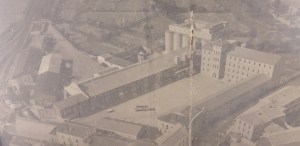
Carmen Paño Peleato was the co-owner (with her husband) and namesake of the premiere industrial facility Harinera del Carmen, the massive wheat milling plant capable of producing 40 tons of flour daily and employing dozens of local families. She co-managed and held a central stake in this vital economic hub, making her a high-profile figure of local enterprise in her own right.
But in the 1930s, towns like Tardienta were deeply fractured by agrarian class conflict. The Harinera del Carmen was not just a business; it was the dominant economic engine who could control the lives of the landless day-labourers and unionised mill hands, and its owners were the bourgeoisie, the elite class that profited directly from their heavy physical labour. When the revolution broke out, the local committees immediately collectivised the flour mill, declaring it the property of the people. Removing the original owners was a necessary political step to dismantle the capitalist hierarchy and prevent any counter-revolutionary attempts to reclaim the factory.
On 31 July 1936, Carmen’s husband’s Mariano Gavín Pradel was executed and she fled the town with her three daughters aged 5-16, to Senés de Alcubierre, 9km south of Tardienta where friends could look after them. Her sons, Mariano and Ramón Gavín Paño, in the twenties, had already been arrested. The head of the revolutionary committee took over the family’s milling business and set up his personal headquarters. Recognising Carmen’s personal authority and the threat her family’s legacy posed to the new order, he sent militia squads to track her down, arrest her, and bring her back to Tardienta to be imprisoned.
When the Republican forces suffered military losses nearby at Santa Quiteria in mid-October, the panicking local militias decided to perform a cleaning of their prisons, on a miniature scale done by the Nationalists. Carmen Paño Peleato was the only woman from Tardienta singled out, and hers sons were paced for execution with her. Four other men were placed in the family mass grave, on top of Carmen’s already dead husband – Alejandro Agulló Hernández, the local parochial coadjutor (assistant priest), Pascual Bernal Ruiza local who was a corporal)based out of Zaragoza, considered a fifth Column threat, and Julio Soro Pasiego and Mariano Llagues Marquet, local conservatives also considered fifth column threats. The mass grave was a proper grave in the local cemetery and did not need to be exhumed after the war.
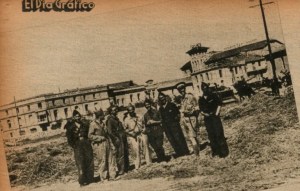
Under the leadership of the local political commissioner, Miguel Alcubierre, the factory was declared collective property. The committee set up its operational rearguard headquarters directly inside the mill’s administrative offices. As the front lines around the Monegros and the Alcubierre sierra solidified, the mill ceased to operate purely as an industrial plant and became a critical military point from 1937. Republican battalions launching counter-attacks used the vast grounds of the mill as a staging and assembly yard. Soldiers would sit out in front of the harinera waiting for troop transport trucks to shuttle them to the trenches. Because Tardienta was a vital railway junction and an industrial stronghold, it was heavily shelled and bombed throughout the conflict. The Harinera del Carmen suffered structural damage that rendered its machinery completely useless.
When the Francoist forces took the town at the end of the war, the mill was returned the three surviving daughters. However, the destruction from the war, combined with severe shortages of raw materials, metal, and machinery during the post-war Autarquía period, meant that the mill was forced to completely halt production for over ten years. The fact the Nationalists had murdered all the workers in the area was probably also an issue. In 1954, the family and partners officially restructured the enterprise, and today, under its modern name Harinera de Tardienta, the company still exists.

