- Teruel, Aragon
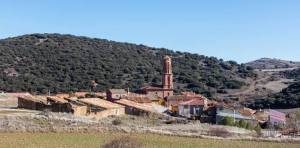
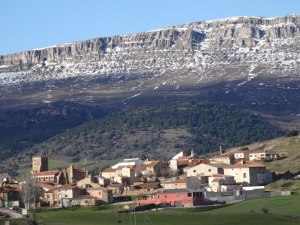
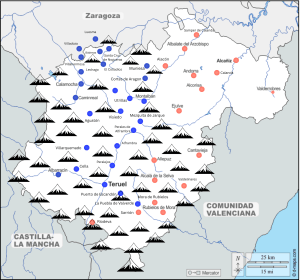
On 18 October 1936, Nationalist forces launched quick, localised incursions eastward and northward out of their secure Jiloca valley corridor, specifically striking the small villages of Aguatón and Visiedo, 87km south of Santa Cruz de Nogueras. These thrusts were designed to widen the narrow Nationalist salient, clear out Republican surveillance lookouts, and test the strength of the surrounding Republican forces. Visiedo, in particular, was located near the vital Alfambra river valley, a heavily Republican-dominated area. By pushing here, the Nationalists threatened to unhinge the Republic’s northern defence lines above Teruel city.
The narrow salient extending south to Teruel city was manned by approximately 4,000 to 5,000 active combatants split across the sector, a mix of regular army garrisons stationed in Teruel, local Guardia Civil, and Carlist Requetés and Falangist militias operating out of the secure Jiloca logistical corridor (like the Calamocha-Lechago axis). Encircling the Nationalist wedge on three sides was a highly fragmented force of roughly 7,000 to 9,000 Republican militia fighters. Because this was just prior to the October 18–20 centralisation decrees taking real effect in the remote regions, these forces were organised into completely separate ideological columns dispatched mostly from Valencia. They included the anarchist Columna Torres-Benedito, the communist Columna Eixea, and various socialist or loyalist regular army troops.
Instead of reinforcing the specific villages under attack, the Republican command, composed largely of columns dispatched from Valencia, moved swiftly to exploit the Nationalist faction’s overextension. On 19 October, they launched a spirited, aggressive counter-attack far to the south at the Puerto de Escandón, the critical mountain pass where the main highway and railway line from Valencia climbed toward the city of Teruel. By striking heavily here, the Republicans threatened to sever the city from its southern defences, potentially cutting off the main Nationalist garrison. It was a classic operational diversion; hit the enemy where they are vulnerable to force them to halt their own offensives elsewhere.
The immediate operational panic forced both commands to rapidly redirect resources. Between 20 and 25 October, the entire sector surrounding Teruel erupted into a frantic week of localised skirmishes and the rapid rushing of reinforcements to the line. Military dispatches from the era estimate several hundred casualties (killed and wounded) total across both sides during this five-day window. Neither side possessed the logistical strength, heavy artillery, or unified command structure required to achieve a clean breakthrough. The Republicans could not capture the Escandón pass, and the Nationalists could not expand their territory toward the Alfambra valley. Because no decisive territorial changes occurred, this heavy five-day window marked the exact moment the war in southern Teruel froze. The forces stopped trying to launch mobile manoeuvres and began digging the permanent, heavily fortified mountain trench and bunker lines that would lock the Teruel front into a bitter stalemate until the massive, historic winter battles of 1937.
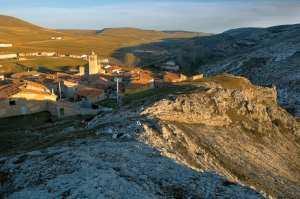
During the shifting combat around the Teruel salient, Visiedo’s old parish church was converted into a makeshift military depot. Both opposing sides, the advancing Nationalists and the local Republican militias, had used the thick, historic stone walls of the sacred building to amass a massive arsenal of high explosives and ammunition. The physical erasure of the village happened when this stockpile accidentally or strategically ignited. The resulting blast was a localised detonation of immense magnitude and completely levelled the parish church. The damage to the surrounding town was so severe, and the structural wreckage so complete, that the community chose never to rebuild the church on its original site. Multiple surrounding buildings and homes were demolished by the shockwave.
Miraculously, no local residents were killed in the massive blast. Because the front lines had become so volatile during the October actions, the entire civilian population of Visiedo had already been systematically evacuated from the combat zone, leaving behind a hollowed-out battlefield. While the civilians escaped the blast, a detachment of 38 Nationalist soldiers was caught directly in the explosion’s epicentre and killed instantly. The identities of these 38 fallen men were well documented, many of them were of Basque origin and members of the traditionalist Carlist Requeté columns or northern regular units that Franco had redirected south to anchor the vulnerable Teruel salient.
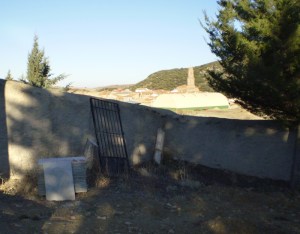
Following the disaster, their shattered remains were gathered and buried together in a large communal grave inside the municipal cemetery of Visiedo. In the decades following the conflict, the families of several of the Basque and Nationalist victims successfully located the grave, reclaiming and recovering the remains of their relatives to reinter them in their home provinces. Because of these individual family exhumations and subsequent municipal re-allocations of the cemetery grounds, there is no longer any physical trace remaining in Visiedo today. Like the church itself, the gravesite has completely vanished from the physical landscape. This is the case for many gravesite in the region, where the summer had seen multiples mass killings as the Nationalist took power, leaving many victims unearthed and unnamed to this day.
While the frontline combat accounted for hundreds of military casualties, the parallel wave of political repression in the immediate rearguard was far more systemic, intimate, and devastating. October 1936 marked the height of the extrajudicial purges on both sides of the Teruel line. In the Nationalist-held areas of the Jiloca valley, the military authorities used the frontline friction to aggressively execute suspected left-wing sympathisers. At the same time, in the Republican-held areas surrounding the Teruel wedge, the local defence committees and militias targeted right-wing civilians, landowners, and Catholic clergy trapped behind their lines. Any minor advance by the Nationalists (like the incursions at Aguatón and Visiedo on 18 October) triggered acute panic in nearby Republican towns, frequently leading to localised paseos, where right-wing prisoners were taken from local jails by armed militias and shot on roadsides under the suspicion of being a traitorous fifth column trying to aid the Nationalist advance.
(It is one of the greatest historical ironies of the Spanish Civil War that the Fifth Column started almost entirely as pure psychological warfare, but eventually became a very real, highly organised espionage network. When Nationalist General Emilio Mola coined the phrase in October 1936, boasting to journalists that he had four columns marching on Madrid and a fifth column waiting to rise up inside the city, he was lying. He was trying to spark a wave of panic, and it worked flawlessly, causing mass paranoia, sacas, and a defensive hysteria across the Republican zone. Once the front lines froze in 1937, professional Nationalist intelligence agencies, like the SIPM (Servicio de Información y Policía Militar), successfully built and funded massive, clandestine networks inside the Republican rearguard. These were real networks composed of thousands of agents, and they were devastatingly effective.)
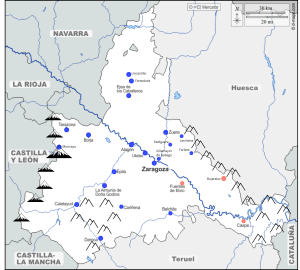
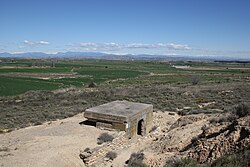
- Sierra de Alcubierre, Zaragoza, Aragon
By mid-October 1936, the vast, arid plains of the Aragon front had become a frustrating stalemate for the Republican forces. In the early weeks of the war, enthusiastic anarchist columns marching from Catalonia had swept across the region, eager to liberate Zaragoza. However, their momentum had ground to a violent halt against the rocky, barren ridges of the Sierra de Alcubierre, a strategic mountain range that formed the primary natural defensive shield protecting the Nationalist-held provincial capital. Between 17 and 20 October 1936, this desolate terrain became the stage for a savage, continuous cycle of heavy fighting and desperate counter-attacks. It was a bloody clash that would ultimately decide the structural format of the entire war in Aragon.
The crisis for the Republic began just days prior, when Nationalist forces launched a sharp, aggressive push that captured the strategic town of Leciñena. Perched on the western slopes of the Alcubierre range, Leciñena was a vital tactical node. For the Nationalists, holding the town secured their left flank and barred the gateway to Zaragoza. For the Republicans, primarily comprised of the battle-hardened but poorly coordinated anarchist Ascaso Column, the loss was a severe strategic and psychological blow.
On 17 October, the Republican command ordered a massive, immediate counter-offensive. The mandate was clear: recapture Leciñena at all costs, break the Nationalist line, and restore the momentum toward Zaragoza. The fighting that erupted over the next 48 hours was characterised by its extreme brutality and the punishing nature of the terrain. The Sierra de Alcubierre offered no cover; it was a landscape of jagged limestone ridges, deep ravines, and thin, chalky dust. Republican militiamen, driven by intense ideological conviction, launched spirited, frontal assaults up the steep slopes. They faced a well-entrenched Nationalist defensive line composed of regular army troops and deeply disciplined Carlist Requetés. Nationalist machine-gun nests, positioned on the high peaks, swept the open hillsides with devastating crossfire.
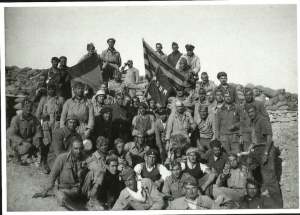
Despite suffering heavy casualties, the Republican columns threw localised reinforcements into the line, launching wave after wave of counter-attacks. The ridges changed hands multiple times in chaotic, close-quarters combat using rifles and hand grenades. Yet, without a unified military command, centralised radio communications, or heavy artillery support to suppress the Nationalist fortifications, the Republican attacks remained fragmented and painfully exposed.
By 20 October, the offensive capabilities of the Republican militias were completely exhausted. A final, desperate push to breach the Nationalist lines outside Leciñena was met with a devastating combination of Nationalist mortar fire and coordinated air strikes from Nationalist aircraft, which enjoyed near-total aerial supremacy over the sector.
The Republican forces were decisively repulsed, failing to recover a single foot of Leciñena or make a dent in the primary Nationalist defensive spine. The Nationalist lines held fast, and the fields surrounding the town were left littered with the bodies of fallen volunteers.
- Cartagena, Murcia
The coastal city of Cartagena served as one of the most vital strategic lifelines for the Second Spanish Republic. As the permanent home base of the Republican fleet and a critical port of entry for Soviet military aid, the Murcian city was a high-value target for the Nationalist faction. On 18 October 1936, the physical reality of the war struck, triggering an air raid that would unleash a wave of retaliatory violence within less than 24 hours.
On the morning of 18 October, a squadron of Nationalist bomber aircraft, supported by fascist Italian aviation elements, appeared over the horizon of the Mediterranean Sea. Exploiting the city’s vulnerable coastal topography and the Republic’s lack of coordinated anti-aircraft defences, the planes dropped their payloads directly onto Cartagena’s industrial port, military dockyards, and civilian urban centre. Thick columns of black smoke rose from the harbour as high-explosive ordnance ripped through residential blocks and naval facilities.
Contemporary and local historical records document a toll of 22 confirmed deaths among dockworkers and civilians. Dozens of severely wounded citizens who flooded the city’s makeshift medical clinics and hospitals.
In the early months of the Spanish Civil War, devastating Nationalist bombings on Republican cities frequently produced the desire for immediate, asymmetrical revenge against the enemy within. Inside Cartagena’s packed prisons and prison ships (buques-prisión) sat hundreds of right-wing sympathisers, military officers who had backed the July coup, and Catholic priests. To the local leftist militias and the traumatised populace, these prisoners were viewed as a dangerous fifth column that was actively guiding the Nationalist bombers to their targets.
As night fell on 18 October, militia squads, bypassing official Republican judicial channels, coordinated a saca. In the early hours of 19 October, dozens of right-wing prisoners were driven to isolated sites on the outskirts of the city, near the cemetery of San Antón, where 49 were executed by firing squad, including retired military officers, naval personnel, and right-wing political sympathisers. The number of those killed in the saca far exceeded the civilian casualties of the air raid, as local factions sought to send a message to any hidden Nationalist supporters in Murcian territory.

