- San Juan de Aznalfarache, Seville, Andalucia
In the scorching summer of 1936, the olive groves just west of Seville were sustained by a backbone of fierce, unbreakable women. The working-class town of San Juan de Aznalfarache was a tiny, closely-knit community of 3,500 residents. The adult working population was small enough that everyone knew their neighbours’ names, their families, and their doorsteps. These women lived lives of backbreaking physical endurance, balancing the relentless toll of manual field labour with the survival of their households. They were the anchors of their community, carrying the weight of generational poverty on their shoulders while raising at least nine children between them. Now, fascism had permission from General Gonzalo Queipo de Llano to exact revenge and punish those who had defied Christian morality, and their outlet was to hurt women.
When General Queipo de Llano seized the province, the Nationalist command issued a decree empowering local right-wing committees, conservative landowners, and the local clergy to act as the supreme arbiters of loyalty. Overnight, ordinary residents, local shopkeepers, rival day laborers, and wealthy estate overseers, were appointed as delatores (informants). They were given absolute, unchecked authority by the fascist military government to settle old village grudges, economic rivalries, and social scores under the guise of national security.
In a village of only 3,500 people, this caused an immediate, intimate betrayal, and some of the towns in the Aljarafe district were only a third the size (today, on a modern map, these towns looks more like outer Seville suburbs). The people who selected the 29 women and 46 men from the Aljarafe district for detention were the very neighbours who shared their streets and knew exactly who was active in the UGT union. This delegated authority transformed the local community into its own executioner, turning everyday grudges into state-sanctioned death warrants.
For three full weeks between 19 July and 10 August, the town was already under complete martial law. The locals in San Juan de Aznalfarache and other towns would have been fully, terrifyingly aware of the mass slaughter happening just across the Guadalquivir River in Seville city. From his headquarters in the captured capital, General Gonzalo Queipo de Llano delivered famous, highly aggressive radio addresses over Unión Radio Sevilla. His booming voice echoed out of radios in small-town plazas and homes across the province. He openly bragged about the violence and sexual assaults, using graphic language to describe how his troops were executing Reds, purging working-class neighbourhoods like Triana, and hunting down trade unionists.
For the families of San Juan de Aznalfarache, listening to those broadcasts was a form of psychological torture, they knew the machine was functioning just kilometres away, and they knew it was coming for them next. San Juan de Aznalfarache sits directly on the banks of the Guadalquivir River, looking right at Seville. In July and August 1936, the columns of the African Regulares and Legionnaires were systematically sweeping through the rural villages. Bodies of executed Republicans and union workers from nearby rural zones were routinely dumped in roadside ditches or thrown straight into the water upstream. For weeks, the people of San Juan de Aznalfarache watched smoke rising from burning working-class districts across the water and saw the literal human cost of the purge passing by their shores.
The military had been going through the towns, swiping groups of people and having them ‘disappear’ over the first weeks (the town’s mayor and all councillors had already disappeared), and locals had also turned one another without punishment, though the criteria for being pulled from your home and shot or imprisoned continued to evolve each day. This also gave the local right-wing committees and gave them the time to quietly observe the population. During these weeks, the local informants sat in the village, watched who was staying at home, gathered old union registries, and meticulously drew up lists of union members.
Local right-wing elites received wartime decrees issued by the Nationalist military command and used UGT trade union membership rosters and local strike records to blacklist families. Estate overseers (capataces) received authority to police the local agricultural workforce and targeted assertive female seasonal workers who had demanded better working conditions. Ideological neighbours could now used their right-wing social status rewarded under the new National-Catholic regime to settle intimate village rivalries, property disputes, and personal grudges by labelling targets as Reds. On 10 August 1936, it was exactly four years since the Sanjurjada, a failed right-wing military coup against the Spanish Republic in 1932. General Gonzalo Queipo de Llano and his direct delegated authority for political repression, Captain Manuel Díaz Criado, chose this symbolic date to celebrate the fascist uprising with a massive, highly visible display of absolute power, and began another purge of the Aljarafe district. A list was made up for 29 women to be disappeared, a high number even for the Seville killing fields, along with 46 men.
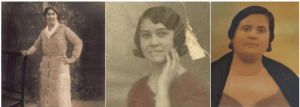
In San Juan de Aznalfarache, nine olive pickers and two other women were targeted, all UGT members: Leonisa Panadero Maya, age 19, María Arriaza Calero, age 21 (her brothers Diego and José were on a kill list on a separate date), Josefa Tierno García, age 24, Victoria Quintanilla Muñoz, age 24, Rosario González Rodríguez, age 28, Josefa Romero Barberán aka La Rojilla, the little red one, also 28, nicknamed for her vibrant red neckerchief.
Guadalupe Sánchez López, age 34, was mother of a 10-year-old son, and Gabina Isabel Porro Domínguez, age 36, a mother of two and worked alongside her sister, Francisca Porro Domínguez, age 43, a mother of six. Also grabbed in the town was Carmen García Paredes and Carmen Bermúdez Pavó, ages unknown.
Seven men were taken from the town that day too, sadly, not an usual number of men to be grabbed in a single day. Among them was Guadalupe Sánchez López’s husband Antonio Anillo Marín, alongside José Sánchez Suárez, Francisco González Jiménez, Eduardo Pérez Casado, José Téllez Borrego, José María Castaño Sena, Diego Orta González, and Diego Bíter González.
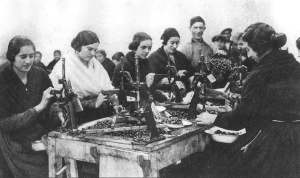
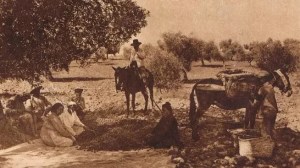
In the rural south of Spain, joining a socialist union like UGT was a survival strategy for agricultural labourers seeking fair wages. In the Andalusian olive groves of the 1930s, the capataces held absolute economic power over the jornaleras. A woman could be blacklisted, starved, or assaulted simply for expecting her day’s wages. The union card was their only shield against the people they worked for every single day. In San Juan de Aznalfarache, olive processing was a major local industry, meaning their shared labour in the groves was the thread that bound their lives, their neighbourhood connections, and their collective union activism together. Women in Andalusian olive crews often performed the gruelling task of recogida del suelo, spending hours on their knees gathering olives that fell to the ground, sorting out leaves, and cleaning the fruit so it arrived intact at the local oil mills and processing plants.
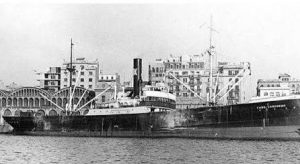
On the morning of 10 August 1936, The arrests were happening so fast across Seville province that the city’s prisons completely overflowed. To handle the human influx, the Nationalist authorities requisitioned merchant ships moored along the Guadalquivir River and converted them into floating cages. Within hours of their arrest, the nine olive pickers were marched into the dark, stifling belly of the Cabo Carvoeiro, the men into another ship. The same day were others from other towns.
Life below deck was a nightmare of overcrowding, foul sanitation, and uncertainty. Fearing the worst, families walked down to the docks, desperately trying to pass food and clean clothing to their loved ones. Ten-year-old Manuel Anillo Sánchez waited at the waterfront to see his mother, Guadalupe and give her food and she would peer through the barriers and tell him to be good boy.
Also arrested that day were women from other locations: From Seville city they grabbed Manuela Rodríguez Rosa, Rosario Cabrera Amado, Josefa Alfonso Ruiz, Manuela Alonso Fernández, and Isabel Mena Jiménez. From Mairena del Aljarafe Serafina Vela Vela (whose siblings Eloy, José and Adeilada were all killed in separate kill lists), alongside Rosario Gómez Jiménez from Mairena del Alcor (whose two sons were killed on a separate kill list). Antonia Luque Pleguezuelo was only 12, likely taken as bait for ‘fugitive’ parents. From Dolores Ordóñez Varello from Alcalá de Guadaíra, Luisa Velasco Caro from Tomares, Ana Carretero Muñoz from Morón de la Frontera, and Josefa Marrufo Caballero from Lebrija (whose 21-year-old son was also murdered). Also arrested without any location or other details were Antonia López Vidal, Carmen Rincón López, Carmen Moñino Borrego (who had several relatives added to different kill lists), Maximina Rodríguez Rey, María Gutiérrez Guerra, María de la Paz Cabrera García, Ángeles Fernández Martínez, and Antonia López Vidal.
Before prisoners were taken to the prison ships or executed, it was standard practice across Andalucía to subject female detainees to purification rituals. Historical memory projects documenting the region confirm that women arrested in these sweeps were almost universally subjected to having their hair was forcibly cut to the scalp, often leaving a tiny tuft tied with a mockery of a ribbon, to completely strip them of their identity and femininity. Detainees were forced to swallow large doses of castor oil, a severe laxative. The women were then marched or carted through the streets of their towns, soiled, bleeding, and bearing derogatory signs, to be spat on and humiliated by supporters of the coup before being moved to floating prisons or firing squads.
Even if a prisoner avoided the public streets, the stay aboard the requisitioned merchant ship was a form of physical torture. The women spent more than two months locked in suffocating, overcrowded cargo holds below deck. They endured extreme summer heat, starvation rations, a complete lack of plumbing, and the constant psychological terror of watching fellow inmates disappear in the nightly sacas. Historians emphasize that for Las Nueve Aceituneras, their shared path from the town to the ship, and ultimately to the cemetery wall, means they shared the same horrific cycle of abuse, and through testimony from Josefa Romero Barberán’s family stated that she was horrifically raped while on the ship, something all the women were unlikely to avoid.
In working-class Andalucía, mothers and sisters were the literal glue of the household. They managed the survival of the family on pennies, kept children fed during periods of seasonal unemployment, and maintained the domestic fabric. When the Nueve Aceituneras were executed, nine children were instantly orphaned or left without maternal care. A ten-year-old child like Manuel Anillo Sánchez didn’t just lose a parent; his childhood ended the moment his mother told him to be good from the side of a prison ship. He carried that haunting final interaction for the rest of his life and was deeply traumatised. He moved back to his hometown decades after the killings, only for his employer to find out what happened to his parents, meaning he and his family had to flee the area. For families like the Porro Domínguez sisters, who left behind a combined eight children, the loss was a structural catastrophe. In an era with no state welfare for the families of Reds, those children were often cast into severe poverty, stigmatised by neighbours, and forced into child labour just to eat.
When we look at it this way, 16 deaths is never just 16. It is an exponential math problem of human suffering. To truly understand the impact, you have to multiply those nine lives by every child who grew up without a mother, every grandchild who inherited the silence, and an entire town that was forced to forget its own heroes just to survive. Because the Franco dictatorship lasted for nearly forty years, the families of these women were forced to live in a state of frozen grief. You could not look for your mother’s body. You could not publicly cry for her. You could not even say her name in the street without risking arrest or social ruin. This enforced silence created a distinct psychological toll. Grandchildren grew up sensing a deep, unspoken terror and sorrow in their homes, inheriting a trauma that they didn’t fully understand until decades later when Spain’s historical memory movement finally allowed people to speak.
On a community level, executing these nine women was an act of social engineering. By targeting the most visible, politically active, and unionised women, the regime sent a chilling message to the entire town of San Juan de Aznalfarache: If we can do this to the women who feed this town, we can do it to anyone. It completely shattered the community’s collective bargaining power, breaking the spirit of the local labour movement and ensuring decades of compliance through absolute terror. For nearly forty years under the Franco dictatorship, a suffocating silence was enforced. The families of the Nueve Aceituneras carried their grief like a criminal secret. Francisca and Gabina’s husbands had to raise eight children in a town where speaking the sisters’ names was dangerous. María Arriaza Calero’s parents were utterly broken as the regime later hunted down and killed two of her brothers as well. And in the shadows, Josefa’s family quietly preserved a horrific oral tradition of La Rojilla ‘the little red one’ being raped and mutilated before her death. The call to humiliate and rape women came directly from Queipo de Llano’s pronouncements on Radio Sevilla, telling the men under his command they could, and should commit such acts. Sexual abuse of women was so commonplace at the beginning of the war in Andalucía that it is impossible to quantify, and likely simpler to calculate who was not raped.
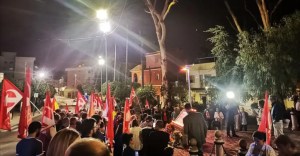
The ultimate act of reclamation took place on 24 October 2017, exactly 81 years to the day after the execution squad fired its volleys at the San Fernando Cemetery. In a major municipal shift, the town officially stripped the name of Calle Cardenal Segura, a Franco-era archbishop who had remained silent during the fascist atrocities, and renamed the avenue the Paseo de las Nueve Aceituneras.
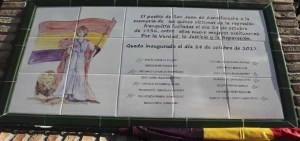
At the heart of the new Paseo, the town unveiled a permanent stone monolith. Embedded in the stone was a beautiful, traditional pane of hand-crafted ceramic tiles that meticulously listed the names of the nine olive pickers, and the locals alongside them who did not survive the night. The monument did not survive its first night.
Before dawn on 25 October 2017, less than twelve hours after the emotional inauguration, the monument was discovered completely defaced. Under the cover of darkness, far-right vandals had swarmed the site, using tools to violently shatter and rip the ceramic name tiles off the stone structure. The attack was an explicit, targeted attempt to re-erase these women from the town’s geography, proving that the ideological wounds of the Civil War remain a highly active, volatile battleground in modern Spanish society.
The reaction to the vandalism revealed that while ceramic tiles can be broken, the community’s resolve could not. The town council, local labour unions, and the memory platform fiercely condemned the attack and refused to back down. Within less than a month, by late November 2017, a team of local artisans had completely remade and re-installed the entire ceramic mural onto the stone monument. Today, that restored monument stands proudly on the avenue. Every year on the 24 October anniversary, the quiet streets of San Juan de Aznalfarache fill with hundreds of residents for a solemn memorial walk along the Paseo. The crowd walks the exact path where the women once carried their olive baskets, pausing at the monolith to light candles, recite poetry, lay fresh flowers, and read out all sixteen names.
What began in 1936 as a hidden, bureaucratic execution convoy has transformed into an unbreakable ritual of public dignity. The annual walk ensures that the names of the Aceituneras and their neighbors are no longer blank lines in a fascist prison registry, but a permanent, living anchor of the town’s collective conscience.
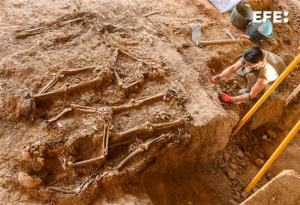
The nine olive pickers of San Juan de Aznalfarache are buried in a mass grave inside the Cementerio de San Fernando), historically documented by researchers as the Fosa del Monumento (or Fosa de los Alpargateros). It was the second major mass grave opened in the cemetery after the infamous Pico Reja grave reached maximum capacity in August 1936. Meticulous research by historians like José Díaz Arriaza indicates that this single mass grave holds the remains of up to 4,500 victims executed by the Francoist regime. None of the nine olive pickers have been individually identified through DNA testing or physical exhumation yet. Because they were executed at the cemetery walls and haphazardly thrown into a massive common trench alongside thousands of others, their skeletal remains are completely intermingled and the grave has not yet been opened.
Forensic teams spent three full years (opening the nearby Pico Reja mass grave, the largest Western European mass grave opened since Srebrenica. That massive task concluded with the discovery of over 10,000 bodies, 1,786 of whom showed signs of execution. In late 2023, geneticists achieved the historic milestone of identifying the very first victim from the Pico Reja grave using DNA: a Republican town councillor and teacher named José León Trejo. Following the closure of Pico Reja, the Spanish Government, the Regional Government of Andalucía, and local authorities signed a formal, multi-million euro joint protocol in June 2025 to officially begin the exhumation, bone-by-bone analysis, and genetic matching specifically for the Fosa del Monumento. Government projections indicate the complex excavation and DNA process for this grave is expected to run through 2029.