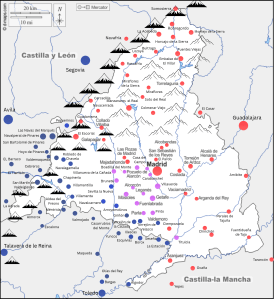
- Madrid
General Francisco Franco and his German and Italian advisors (the Condor Legion and Aviazione Legionaria) were operating under a relatively new military doctrine. The core theory was that by hitting densely populated working-class areas, the resulting terror and slaughter of families would cause the civilian population to panic. They hoped the traumatised public would pressure the Republican government into an immediate, unconditional surrender. Franco himself openly stated to journalists that he was willing to ‘destroy Madrid rather than leave it to the Marxists.’
Weeks prior to the late-October escalations, rebel aircraft dropped thousands of propaganda leaflets over Madrid. These leaflets delivered a blunt ultimatum: surrender the capital or face a merciless bombardment targeting the entire city. The subsequent dropping of six bombs on the Plaza de Colón would the intentional fulfilment of that threat.
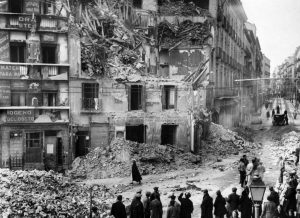
The morning of 27 October saw Nationalist aircraft, primarily German-supplied Junkers Ju 52s and Italian Savoia-Marchetti SM.81 bombers, penetrate Madrid’s airspace. Rather than targeting military barracks or government buildings, the ordnance fell directly into the dense civilian centre. The most devastating strike occurred in the heart of the city. Six bombs tore through the plaza. One detonated directly next to a long queue of women and children who had been waiting for hours outside a distribution point to buy milk. The blast killed 16 people instantly and mangled another 60.
Images and eyewitness accounts of severed limbs and spilled milk bottles on the cobblestones quickly circulated, sending shockwaves through the capital’s population. Other bombs struck residential apartment buildings across the central grid, igniting localised fires and trapping families beneath collapsed masonry.
Prior to late October 1936, cities during wartime were occasionally bombed, but usually under the guise of destroying infrastructure like factories, bridges, or railway hubs. The 27 October raid was fundamentally different. General Francisco Franco and his commanders believed that the Republican militias were undisciplined and prone to panic. The objective of hitting the city centre was to break the morale of the rearguard, trigger a massive refugee crisis, and force the Republican government to capitulate before the ground troops even entered the city.
The most damning proof of deliberate targeting lies in what the Nationalist bombers actively avoided hitting. Throughout the siege, the high-command ordered pilots to completely spare the wealthy, upper-class Salamanca district. The Nationalists correctly assumed that this bourgeois neighbourhood housed a significant number of secret right-wing sympathisers, the fifth column. By strictly carving out Salamanca from their bombing coordinates while repeatedly flattening the working-class centre, the Nationalists proved they possessed highly precise navigational maps and total control over where their payloads landed. Alongside later raids on Madrid and the eventual destruction of Guernica in 1937, this specific raid stands as one of the earliest modern historical examples of total war, where the line between combatant and civilian was erased.
Instead of breaking Madrid’s spirit, the tragedy on 27 October triggered a fierce mix of fury, defiance, and radicalisation. The images of the dead women at Plaza de Colón became immediate propaganda tools for the Republic. It solidified the rallying cry ¡No pasarán! Rather than fleeing, many citizens volunteered for fortification details, digging trenches and building barricades out of paving stones. The civilian deaths caused immense rage within the city’s armed factions.
The reality of the civilian casualties at the Plaza de Colón was erased by a dual-sided wall of wartime censorship. Inside the capital, the Republican press, including dailies like ABC and El Socialista, maintained absolute silence on the massacre to prevent mass urban panic and protect vulnerable food queues from collapsing. Conversely, the right-wing Nationalist press operating from the insurgent zone completely omitted any mention of civilian casualties, instead framing the day’s aerial operations as highly precise, surgical strikes against Marxist military nodes to preserve General Franco’s international reputation. This informational blackout extended directly to visual records: because the Republican Junta de Defensa heavily restricted graphic imagery of the central city to deny the enemy a psychological victory, no verified photographs of the milk queue tragedy exist in the public domain. Instead, the historical record of that day remains trapped in official municipal hospital logs, leaving the victims visually anonymous on the very day they lost their lives.
The terror in the city was mirrored by disaster in the skies just a few hours later. In the afternoon, five Republican Breguet XIX bombers flew a mission toward the front lines without fighter escorts. They were intercepted between Peguerinos and El Escorial by a squadron of nimble, Italian-built Fiat CR.32 fighters flown by Nationalist pilots. The faster Nationalist biplanes easily tore the outdated Republican bombers apart, shooting down four out of the five aircraft and cementing Nationalist air superiority over the province for the day.
Also on 27 October 1936, the arrival and immediate deployment of Soviet T-26 tanks in Madrid provided a massive psychological and tactical boost to the crumbling Republican defence. Republican forces had been practically defenceless against Nationalist armour, relying on desperate, improvised tactics like petrol bombs.
The tanks arrived at Madrid’s central railway station in the early hours of 27 October. They were shipped covertly from the Soviet Union to Mediterranean ports like Cartagena, loaded onto trains, and rushed inland to the capital just as General Varela’s columns breached the outer limits of the Madrid province. The arrival was treated with extreme urgency. The T-26 tanks were unloaded directly onto the platforms. Instead of being sent to a staging area for inspection or training, their engines were turned on and they were driven straight through the streets of Madrid toward the southern front lines. For the civilian population and local militias, seeing these heavy, modern machines rolling down the city streets provided an immediate shot of hope. It was tangible proof that the Republic was no longer fighting Franco’s regular army with nothing but light rifles and enthusiasm.
Because the Spanish Republican crews had not yet completed their training, the Soviet Union sent their own professional tankers to operate the vehicles disguised as volunteers. On 27 October, a small, ad-hoc detachment of these newly arrived tanks was organized under Soviet commander Komrot A. Novak. On the night of 27 October, Novak’s detachment moved out into the darkness of the southern sector near the Madrid-Toledo border. Their objective was to scout enemy positions and stall Varela’s advancing infantry, who had just captured Torrejón de Velasco and Torrejón de la Calzada earlier that day. While this initial deployment was small and served more as a chaotic, night-time blocking action, it was historically vital. It served as the immediate operational dress rehearsal for the massive, formal tank counter-attack at Seseña just 48 hours later (on 29 October), which would be led by Soviet Captain Semyon Krivoshein.
The physical presence of the T-26 completely shifted the technical balance of power on the Madrid front. The T-26 featured a 45mm cannon, which completely outclassed anything the Nationalists possessed. The German Panzer I (supplied to the Nationalists via the Condor Legion) and the Italian CV-33 tankettes were only armed with light machine guns. They literally did not possess weapons capable of piercing the T-26’s armour, meaning that on 27 October, the Republic suddenly held tactical superiority in armoured warfare.
As General Varela’s Nationalist troops captured towns just a few kilometres south and civilian blood stained the Plaza de Colón, the capital became a pressure cooker of paranoia. The morning’s devastating air raid on the Plaza de Colón sparked immediate, violent rumours across the city. Republican militias claimed that right-wing Nationalist prisoners inside the Ventas and San Antón jails were using matches and hidden mirrors to signal enemy bombers from their cell windows.
The revolutionary Provincial Committee of Public Investigation (Comité Provincial de Investigación Pública, CPIP) took direct administrative control of the prison infrastructure. Terrified that a Nationalist breakthrough on the southern front would lead to thousands of fascist prisoners being liberated to fight from within, the CPIP began compiling highly classified lists of military officers, falangists, and conservative politicians held in the municipal prisons. The bureaucratic systems, inmate logging protocols, and evacuation lists organised on 27 October created the exact operational framework used just a few weeks later during the infamous Paracuellos massacres, where thousands of these prisoners were evacuated and summarily shot in trenches outside the city.
The term fifth column, coined by Nationalist General Emilio Mola to describe secret right-wing sympathisers hiding within Madrid, became a massive priority. By the evening of 27 October, various anarchist (CNT) and communist (fifth regiment) militias established hundreds of ad-hoc checkpoints across Madrid’s major intersections. Armed revolutionary squads carried out aggressive, unauthorised searches of private apartments, focusing heavily on middle-class families or anyone suspected of lacking enthusiasm for the Republic. Possession of a religious icon, a conservative newspaper, or an unapproved radio set was enough to warrant immediate arrest and transport to a checa (secret revolutionary tribunal).
- La Sagra, Toledo
The La Sagra counter-attack on 26–27 October 1936 was a decisive military turning point in the Drive on Madrid, allowing the Nationalist forces to retake the initiative and permanently break the Republican southern defence lines. Commanded by General José Enrique Varela, the insurgent advance culminated in the occupation of key regional towns and concluded the major Nationalist offensive through the Toledo province before pushing directly into the capital’s provincial borders.
In the closing days of October 1936, the desperate race for the Spanish capital reached a bloody inflection point. Following a series of uncoordinated Republican attempts to disrupt the rebel vanguard, the Nationalist Army of Africa unleashed a devastating, highly coordinated response. Across 26 and 27 October, a crushing Nationalist counter-attack swept through the La Sagra region, wresting away any remaining Republican momentum and clearing the final obstacles on the southern road to Madrid. The rapid operational breakthrough effectively shattered the Republican southern shield and signalled the conclusion of the war of movement across the Toledo plains.
Throughout mid-October, Republican militias attempted to orchestrate counter-blows to isolate the rebel vanguard. However, their lack of tactical cohesion left them highly vulnerable to the combined-arms and motorised superiority of the Nationalist forces. On 26 October, General Varela’s columns seized the initiative with overwhelming force.
Over a frantic 48-hour period, Nationalist units systematically enveloped and occupied a network of strategic towns guarding the provincial border. Esquivias and Seseña had fallen rapidly, severing vital regional transit links.
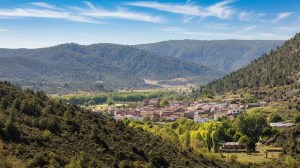
Simultaneous with the broader La Sagra offensive, General Varela’s column achieved a vital geographic milestone on 26 October by reaching and occupying the elevated town of El Viso de San Juan, just 10km west of Illescas. Situated on high ground overlooking the surrounding river valleys, the town provided an exceptional tactical vantage point for the advancing insurgent forces. The occupation of El Viso de San Juan carried profound operational weight. The capture of the town stood as the final major insurgent conquest in the Toledo province before Varela’s seasoned troops crossed the provincial boundary lines to begin the direct, bloody assault on Madrid itself.
The collapse of the La Sagra sector had altered the landscape of the war’s early months. By eliminating the Republican presence in these key frontline towns, the Nationalists secured their logistical rear guard and established a unified launching pad for the Siege of Madrid.
For the civilian populations of Toledo and the southern plains, the end of the provincial campaign gave way to a rigid, occupying military authority. For the Republic, the loss of La Sagra was a harsh lesson in the realities of modern industrial warfare, forcing the government to realise that enthusiastic resistance alone could not halt a highly professional, aggressive military machine.
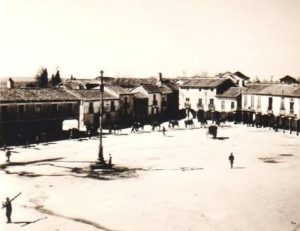
Torrejón de Velasco, situated just across the provincial border in the community of Madrid, is was is a broad, open, and arid agricultural plain. It offered zero natural cover, making it a highly volatile combat zone for infantry without fortified trenches. Torrejón de la Calzada, adjacent to Torrejón de Velasco along the main historic road connecting Toledo to Madrid was entirely flat, characterised by wide fields that heavily favoured motorised and mechanised movement. Torrejón de Velasco and Torrejón de la Calzada were quickly overrun, collapsing the Republic’s outer defensive perimeter. The speed of the offensive left the fragmented volunteer militias unable to consolidate their positions, triggering a swift retreat toward Madrid’s immediate municipal borders. Because the open terrain offered minimal natural defence against Varela’s artillery and air superiority, retreating militia columns suffered severe casualties from strafing Nationalist aviation. Entire battalions were effectively dismantled as they fell back toward Parla and Fuenlabrada, though they would manage a stiffer resistance just days later during the famous Republican armoured counter-attack at nearby Seseña on 29 October once the tanks arrived at the front.
- The Garibaldi Battalion
On 27 October 1936, prominent exiled Italian anti-fascists, socialists, and communists met in Paris to sign an official accord. This agreement formally established the Italian Legion, which would quickly be renamed the Garibaldi Battalion. This highly motivated, highly disciplined unit of Italian volunteers immediately began mobilising to travel to Spain. They would soon join the XII International Brigade, arriving just in time to participate in the brutal, street-by-street defence of Madrid, transforming the local conflict into an international ideological war.
The Garibaldi Battalion (later elevated to the Garibaldi Brigade) holds a unique, profound place in interwar history. Its broader existential purpose was to launch the first organised armed resistance against Benito Mussolini’s Fascist regime. For over a decade, Italian leftists, liberals, and republicans had been driven into exile, fractured by intense ideological infighting that had effectively paralysed any resistance against Mussolini. The creation of the Italian Legion marked a historic truce. Italian Republicans, Socialists, and Communists agreed to put aside their deeply rooted factionalism under a unified military command.
Naming the unit after Giuseppe Garibaldi, the 19th-century hero of Italian unification, was a deliberate, brilliant propaganda stroke. Garibaldi was a historical symbol of volunteer transnational warfare who fought for freedom over political dogma. By invoking his name, the volunteers reframed themselves not as stateless Marxist rebels, but as the true, patriotic heirs to Italy’s freedom-fighting legacy.
The battalion was driven by an extraordinary collection of leaders who would go on to shape modern European history. Major Randolfo Pacciardi, a decorated World War I veteran and staunch centrist liberal-republican. His leadership ensured the unit maintained professional, regular-army discipline rather than operating like a loose, chaotic militia. Luigi Longo (who would later lead the entire Italian anti-fascist partisan resistance during WWII and head the Italian Communist Party) and Antonio Roasio served as political commissars. They balanced the ideological education of the troops while respecting Pacciardi’s non-communist leadership. Figures like Carlo Rosselli (founder of the Giustizia e Libertà movement) heavily cross-pollinated the unit’s recruitment, famously broadcasting from Barcelona with the definitive anti-fascist motto: Oggi in Spagna, domani in Italia (Today in Spain, tomorrow in Italy).
The true historical weight of the Garibaldi Battalion extends far past the Siege of Madrid, peaking spectacularly at the Battle of Guadalajara in March 1937. Mussolini, eager to showcase the power of his fascist empire to the world, deployed 35,000 regular Italian troops (the Corpo Truppe Volontarie, or CTV) to spearhead a fresh offensive toward Madrid. Stationed directly in their path was the Garibaldi Battalion. In a surreal turn of events, Italian anti-fascist volunteers fought hand-to-hand against Italian fascist conscripts. The Garibaldi troops used loudspeakers to blast anti-fascist songs across the trenches and dropped leaflets urging their countrymen to desert a dictator’s war. The Garibaldi Battalion successfully routed Mussolini’s forces, capturing hundreds of prisoners, heavy artillery, and secure tactical ground. Guadalajara was a catastrophic public relations humiliation for Mussolini and provided a massive moral victory for the global anti-fascist movement.
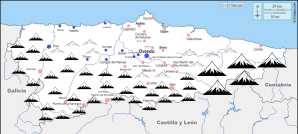
- Puerto de Somiedo, Asturias
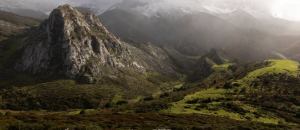
In October 1936, the war in the north was a brutal battle for geography. Republican forces in Asturias (largely composed of fierce, highly motivated Asturian miners) were attempting to break south into the province of León, which was held by the Nationalists. To do this, the Republicans had to seize the strategic high-altitude mountain passes cutting through the Cantabrian Mountains. The valleys and villages of Babia, San Emiliano, Candemuela, Piedrafita de Babia, and Puerto de Somiedo formed one single, deeply interconnected mountain front.
On the morning of 27 October, the Republicans launched a major offensive to capture the Puerto de Somiedo pass. Two vanguard companies of the Republican Batallón Guerra Pardo pushed hard against the Nationalist defensive lines. The raw firepower and momentum of the attackers successfully overran the Nationalist advanced outposts. The remaining Nationalist garrison was forced to retreat and fortify themselves within their main position at the pass, near the village of Santa María del Puerto. Completely surrounded by Republican miners, the defenders frantically radioed and wired back to the rear military bases in León and Villablino pleading for immediate reinforcements. These surviving communication logs make this battle highly prized by military historians today.
During the chaos of the breakthrough, Republican militia forces overran a small, temporary Nationalist field hospital located on the Asturian side of the pass. Stationed at this medical post were three young Red Cross volunteer nurses: María Pilar Gullón Yturriaga, Octavia Iglesias Blanco, and Olga Pérez-Monteserín Núñez. They were from prominent families in Astorga in León who had volunteered to head to the mountain front to tend to the wounded. Following the capture of the post, the three nurses, along with the military commander, the unit doctor, and the military chaplain, were stripped of their medical protections and marched down the mountain as prisoners toward the Republican-controlled town of Pola de Somiedo between 27 and 28 October.
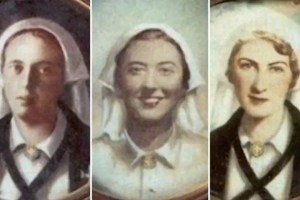
The execution of the three volunteer Red Cross nurses from Astorga became one of the most intense propaganda battles of the northern campaign. Following their deaths between 28 and 29 October 1936, both sides framed the women and their demise through radically different ideological lenses to serve their respective wartime narratives. For General Francisco Franco’s regime and the Catholic Church, the three nurses were framed as absolute symbols of pure, innocent Christian victimhood crushed by godless Marxist barbarism. Nationalist propaganda portrayed the nurses not as military participants, but as holy caretakers. The state media heavily emphasised their virginity, their upper-class backgrounds from Astorga, and their absolute devotion to the Red Cross.
Nationalist accounts claimed that after being captured at the Puerto de Somiedo hospital, the women were subjected to a horrific night of physical abuse and psychological torture. They were framed as refusing multiple offers of freedom in exchange for renouncing their Catholic faith or cheering for the Republic. The regime used their deaths to justify the Holy Crusade against the Republic. Their bodies were exhumed and reburied with massive state honours in the Cathedral of Astorga in 1948. This framing eventually culminated in their official beatification by the Vatican as Martyrs of the Church in June 2021.
For the Republican government and the Asturian mining militias, the framing was designed to strip the women of their saintly status, presenting them instead as active components of the fascist war effort. Republican newspapers and militia bulletins framed the women not as neutral humanitarians, but as wealthy, right-wing elitists, bourgeois aristocrats, who had actively volunteered to assist the rebel army. In the highly polarised class-war context of 1936, a Red Cross uniform on the Nationalist side was viewed by the militias as a political uniform, not a symbol of neutrality. Left-wing accounts strictly denied the allegations of torture and ritualistic abuse, framing those claims as gross Nationalist fabrications designed to hide rebel atrocities (such as the bombing of civilians).
Secular and left-wing narratives framed the executions as a rapid, lawless consequence of a chaotic frontline retreat. The militias argued that in the heat of a brutal mountain battle, where their own comrades were being executed upon capture by Nationalist columns, the nurses were treated as high-value prisoners of war whose execution was a harsh, retaliatory act of wartime justice rather than a religious purge.
Following their execution on 28 October 1936 on a prairie outside Pola de Somiedo, Republican militias ordered local village men, along with two captured Falangist prisoners, to dig a crude mass grave. The bodies of the three nurses, alongside the medical personnel and soldiers executed with them, were buried there on the night of the massacre.
Because the International Red Cross launched an immediate, formal investigation into the murder of its personnel, the location of the grave was meticulously tracked. As soon as Nationalist forces pushed the frontline forward and captured that sector of Asturias, a recovery team moved in. On 30 January 1938, the mass grave was officially opened. Because of the soil conditions and the relatively short time that had passed, the bodies were easily identified. The remains of María Pilar, Octavia, and Olga were placed into symbolic white coffins covered by the Spanish flag and repatriated to their home city of Astorga with full military honours. They were initially placed in temporary niches in the local church of San Bartolomé.
On 28 June 1948, at the official request of the National Assembly of the Spanish Red Cross, the bodies were moved to their permanent resting place. They were interred inside a specially constructed marble mausoleum in the Chapel of San Juan Bautista inside the Cathedral of Astorga. The nurses were executed late in October and buried high in the Cantabrian Mountains. Because of the intense winter cold, freezing mountain temperatures, and specific soil conditions of the Somiedo pass, meant when the recovery teams exhumed the bodies, the remains were described as unusually well-preserved. For the Nationalist authorities and the families, the preservation of the bodies was immediately viewed through a religious lens, bordering on the divine.
The military doctors recorded multiple bullet wounds, blunt force trauma, and evidence that the bodies had been dragged or treated violently before burial. Nationalist accounts claimed the state of the clothing and bodies verified that the women had been stripped and sexually assaulted before execution. However, it is crucial to note that forensic science in 1938 Spain was highly politicised. The medical examinations were conducted under military jurisdiction specifically to build the legal and ideological file against the Republic.
Decades later, independent historians and surviving local witnesses gave a completely different explanation for the physical condition of the bodies. A local eye-witnesses who were present in the village stated that the women were shot immediately after arriving in a truck as a chaotic act of vengeance by local widows of executed Republican men. According to this secular perspective, the bullet holes and fractures found on the bodies were not the result of prolonged, systemic torture, but rather the standard, brutal trauma caused by a close-range firing squad and the subsequent hasty throwing of bodies into a rough, rocky mountain pit.
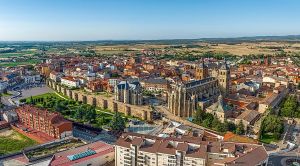
The fighting in Asturias during the last week of October 1936 was defined by extreme desperation, brutal mountain conditions, and a dramatic transition from static siege warfare to a fluid, violent war of attrition. Just days prior, on 16–17 October, a Nationalist relief column marching from Galicia had finally pierced the Republican lines, carving out a narrow logistical corridor to lift the three-month Siege of Oviedo. Rather than ending the battle, this breakthrough turned the final week of October into an explosive struggle for control over the province. The Asturian miners, furious at having their prize snatched away at the last second, launched frantic counter-offensives, while the Nationalists fought tooth and nail to widen their fragile lifeline.
The fighting during the last week of October 1936 was heavily weighted in manpower toward the attacking Republican coalition, though the Nationalists held a drastic advantage in professional cohesion and heavy relief logistics. Spearheaded by the Antifascist Worker, Peasant, and Confederal militias, the Republic deployed approximately 10,000 to 12,000 combatants across the central Asturias basin. The vast majority were organised into makeshift, politically aligned columns (Socialist UGT, Anarchist CNT, and Communist Fifth Regiment units).
Inside the urban stronghold of Oviedo, Colonel Antonio Aranda had commanded a defensive core of around 3,000 men, consisting of regular army infantry mutineers, Civil Guards (Guardia Civil), and local right-wing Falangist volunteers. However, by the final week of October, any of who had survived the Siege of Oviedo was swallowed into the Galician Relief Column, which introduced 4,000 to 5,000 highly trained regulares troops into the immediate operational sector.
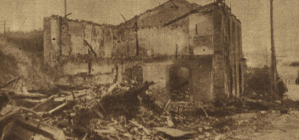
The combat across the province during these final days of October was shaped by three brutal operational realities. Between 25 and 27 October, the fighting centred on the immediate outskirts of Oviedo. The Nationalist garrison under Colonel Antonio Aranda, newly reinforced by Galician troops, launched aggressive sweeps to push the Republican forces back and secure the city’s perimeter. Unlike the improvised infantry skirmishes of July, the final week of October saw both sides deploy heavy machinery in the mud. The Nationalists utilised their local Trubia light tanks, while the Republicans counter-attacked with older French Renault FT-17 tanks and heavily armored Landesa tractors outfitted with machine guns.
Pitched battles raged across the rugged heights of Monte Naranco and the village of San Claudio. Combat was a mix of mechanised thrusts and vicious hand-to-hand trench clearing. In a testament to the chaotic, close-quarter nature of the week’s fighting, a Nationalist tank crew successfully captured a disabled Republican Landesa armored tractor that had been marooned in no-man’s-land since September.
Inside the urban fringes, the fighting retained the terrifying characteristics of the earlier siege. Lacking heavy artillery, the Republican militias, predominantly Asturian coal miners, used their professional knowledge of explosives as a primary combat tactic. Small squads of dynamiters routinely crept through sewer pipes, rubble-filled basements, and collapsed apartment blocks under the cover of autumn fog. They launched close-range night assaults, physically hurling crude sticks of mining dynamite into fortified Nationalist machine-gun nests hidden in civilian homes and church steeples around the city centre. The combat was loud, unpredictable, and highly destructive, reducing Oviedo’s outer neighbourhoods to a scarred landscape of hollowed stone.
Simultaneous with the urban fighting in Oviedo, the war expanded violently into the Cantabrian mountain peaks along the León-Asturias border. The last week of October marked the onset of freezing mountain temperatures, wrapping the front in sleet, snow, and dense fog. The Batallón Guerra Pardo overran the vanguard outposts, entirely encircling the Nationalist garrison at Santa María del Puerto. Fighting in these mountain passes was defined by extreme isolation. Troops were completely cut off from main supply lines, fighting in sub-zero winds, and forced to rely on desperate wireless radio transmissions to beg for reinforcements from the valleys below.
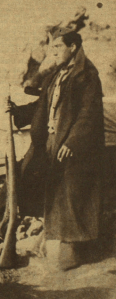
The multi-month siege and its subsequent late-October breakout battles resulted in massive casualties, reflecting the intimate, claustrophobic nature of the urban and alpine warfare. The Republic suffered devastating casualties, with historians estimating approximately 5,000 wounded or killed over the course of the campaign and its immediate aftermath. A significant spike occurred in the final two weeks of October; immediately after breaking the encirclement, Nationalist relief troops rounded up and summarily executed at least 370 Republican prisoners in the field.
In Oviedo, the Nationalist garrison paid a steep price to hold the city. Aranda’s forces suffered around 2,500 casualties. By late October, the original defending garrison had lost over half its active manpower to direct combat, shrapnel, and a raging outbreak of typhoid caused by severed water lines. The Galician relief columns paid an incredibly high price to pierce the encirclement of Oviedo, and their casualties during the final week of October 1936 were severe. The Galician force, totalling roughly 19,000 men organsed into multiple columns under commanders like Colonel Martín Alonso and Lieutenant Colonel Teijeiro, had already been heavily depleted by months of constant guerrilla ambushes and mountain skirmishes on their march from the west. However, the fighting grew far bloodier after they reached Oviedo on 17 October.
During the final week of October, the Galician troops were tasked with holding and widening the narrow, 3-kilometre-wide choke point that connected Oviedo to Galicia. The Asturian miners threw everything they had at this bottleneck, using human-wave dynamite assaults to try and snap the corridor shut. Defending this narrow corridor against relentless Republican counter-attacks cost the Nationalist forces, predominantly the newly arrived Galician units and Morrocan Regulares attached to them, between 1,500 and 2,000 casualties during the latter half of October alone. The vanguard of the Galician columns relied heavily on Moroccan Regulares (specifically the IV Tabor of Tetuán) and Legionnaires. In individual actions to clear the strategic heights around Oviedo, like the slopes of Monte Naranco and local villages, these frontline Galician assault units routinely suffered massive attrition. For example, in the immediate push to consolidate positions just outside the city, individual tabors lost dozens of officers and over a hundred regular troops to concentrated machine-gun fire in less than 48 hours. The volume of Galician casualties in late October was so unsustainably high that it completely paralysed General Franco’s ability to launch a broader offensive into the rest of Asturias. Colonel Aranda was forced to halt all outward advances and order the surviving Galician conscripts to rapidly dig in and transition to permanent defensive fortification just to keep from being pushed back.
The early months of the Spanish Civil War in Asturias created a uniquely fragmented and devastating landscape of violence. The military coup largely failed across the province, with the critical exception of the provincial capital, Oviedo, where Colonel Juan Yagüe and Colonel Antonio Aranda successfully locked down the city for the Nationalist insurgents. Meanwhile, Gijón and the vast mining basins remained staunchly Republican.
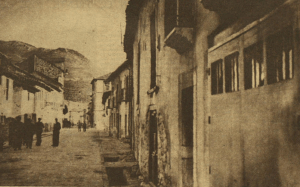
Consequently, during the first three months of the war, Asturias experienced a violent double-sided rearguard repression. In the Republican-controlled valleys, local revolutionary worker committees overran traditional municipal bodies, executing clergy, landowners, and right-wing political figures. Concurrently, inside the besieged Nationalist enclave of Oviedo, Aranda’s forces ruthlessly purged leftist militants and unionists to secure their internal perimeter. This multi-layered wave of violence inflicted profound statistical and socioeconomic trauma on the local population.
Data compiled by the Historical Archive of Asturias and the Database of Victims of the Civil War quantifies the human toll of this initial period, showing approximately 2,000 deaths occurred in the Republican zone during the first three months of the conflict. The vast majority of these extrajudicial executions took place during the peak chaos of August and September 1936 before the Republican government formalised the Tribunales Populares (Popular Tribunals) to restrain ad-hoc militia violence.
Within Oviedo itself, Nationalist forces carried out sweeping purges against suspected leftist sympathisers, resulting in around 1,000 executions during the initial months. This figure would escalate exponentially to over 4,000 executions and summary reprisals after the entire province fell to Franco in late 1937.
While the complete conflict in Asturias eventually claimed over 26,000 lives (including nearly 15,000 combat deaths), the first 90 days established Asturias, population 815,000, as having one of the most concentrated rates of political rearguard violence in Spain. The immediate execution or disappearance of thousands of breadwinners during the summer and autumn of 1936 triggered an acute economic and structural collapse that fundamentally altered family dynamics.
A central mechanism of wartime repression was the systematic financial destruction of the families of the accused. Nationalist military authorities implemented immediate asset seizures through the Comisiones de Depuración (Cleaning Committees). If a worker was executed, imprisoned, or fled to the mountains as a fugao (guerrilla), their family faced, if they had any, asset freezes, immediate blocking of family bank accounts and agricultural holdings. There were punitive fines, arbitrary, unpayable civil liability fines levied against widows and parents to pay for the war effort. That was on top to property expropriation of family livestock, tools, vehicles, and homes, leaving families entirely destitute.
In the mining basins and rural mountain villages of Asturias in 1936, the vast majority of the population were proletarian labourers, sharecroppers, and subsistence miners. They did not have bank accounts to freeze, properties to expropriate, or vast estates to lose. They lived entirely hand-to-mouth. For this impoverished majority, the repression did not strip them of wealth; it stripped them of the absolute bare minimum required to stay alive. For a mining or factory family, losing a day’s wage meant hunger; losing the job permanently meant starvation. • In areas re-taken by the Nationalists, or inside besieged Oviedo, companies compiled political registries. If a worker had nothing but his physical labour to sell, blacklisting him from the mines or industrial docks was a economic death sentence for his entire family. Many miners lived in cheap, basic housing owned directly by the mining conglomerates (like the Duro Felguera company). When a miner was executed or fled to the mountains, his widow and children were left without an income and instantly evicted from their company-owned shack.
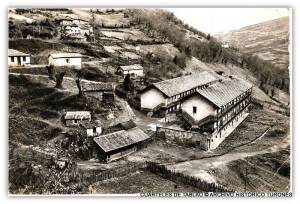
When Nationalist cleaning committees or rogue militias raided the homes of poor workers, they practiced what historians call micro-expolio, the theft of everyday survival items. Because there was no property to seize, they took a single pig or a few chickens kept a family from starving through the winter. Militias routinely slaughtered or confiscated these animals to feed themselves. Raiding squads stripped poor households of woollen blankets, winter coats, sewing machines, and iron pots. For a poor labourer, his only asset was his shovel, his pickaxe, or his scythe. Confiscating these tools effectively castrated their ability to ever earn an independent living again.
If an affluent child lost their parents, they might still have extended family networks or hidden assets. For an Asturian mining orphan, the loss was absolute. Without a breadwinner, children as young as eight or nine were pulled out of the rudimentary school systems to work in the unregulated black market, collect scraps of coal from slag heaps, or beg outside church doors. The repression effectively locked these children into permanent, generational illiteracy and institutionalized poverty.
Even when a family had no money, the fascist military courts still handed down arbitrary civil liability fines. Because the widow had no cash to pay the fine, she was forced into domestic servitude or agricultural labour for wealthy right-wing landowners in the valley. She would work twelve-hour days just to pay off the ideological debt of her dead husband, essentially turning poor survivors into legal indentured servants.
The job market in Asturias, deeply anchored by the state-controlled mining basins, metallurgy factories, and shipping docks, was heavily purged. Every worker remaining in industrial sectors had to undergo political vetting. Anyone suspected of union membership (UGT or CNT) or leftist voting histories was summarily terminated. Terminated miners and factory hands were not left just unemployed; thousands were forced into Nationalist penal labour battalions or concentration camps, forced to rebuild the infrastructure shattered by military operations. Widows and children of executed leftists were explicitly barred from securing formal employment or receiving state pensions. They were forced into extreme margins of survival, relying on the unregulated agricultural black market or domestic servitude.
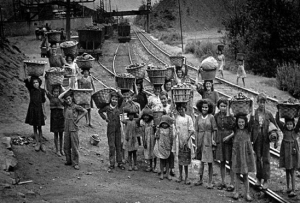
In the Asturian mining basins of 1936, women’s work was the literal foundation of the domestic economy. While a 1897 mining regulation officially barred women from descending into the underground shafts, they were never absent from the mining complex. When the first three months of the war systematically removed male breadwinners through executions, mobilisation, or flight, the survival of entire communities collapsed onto an unofficial, heavily exploited, and underpaid female workforce.
The architecture of women’s laboor and its manipulation during the early repression of 1936 is defined by several key areas. Hundreds of women worked above ground at the sorting screens and wash-houses. Their job was backbreaking, filthy, and highly dangerous, manually sorting slate and rock from raw coal as it poured out of the pits. During the war and the subsequent occupation, authorities explicitly altered job titles. To preserve the legal fiction of the 1897 prohibition, women working in and around the mine infrastructure were classified as producers rather than miners. This administrative trick allowed mining companies to use them for industrial labour while paying them a fraction of a standard male wage.
As the front lines ate up manpower between July and October, the ban completely eroded. In the chaotic border zones and understaffed basins, women secretly worked underground tasks, handling haulage carts and clearing debris, out of sheer necessity to keep the family unit alive. Because they were barred from formal, union-protected positions, women’s work was largely piece-work. They took in laundering for wealthier families, sewed military uniforms, or performed domestic servitude. In the textile sector, while men were paid hourly, women were paid per unit or kilo produced, forcing them to work at frantic speeds to secure pennies.
In an environment without running water or centralised supply networks, women spent hours performing manual household maintenance. They travelled miles to local wells to haul water, manufactured their own basic soap from fat scraps, and spent hours foraging for firewood. As men moved to the frontline trenches or fled into the Cantabrian peaks as fugaos, the entire burden of subsistence farming shifted to women. Propaganda posters explicitly acknowledged this shift, stating that the harvesting of crops is assured now that women have ‘joined’ the workforce.
When official employment was denied to the wives, mothers, and daughters of executed leftists, survival forced them into a illegal shadow economy. Women became the primary agents of the rural black market. They smuggled small bags of coal, individual blocks of lard, or scraps of tobacco through mountain paths, trading them to keep their children fed. In tight-knit mining valleys, local grocery shop owners, often women themselves, operated a parallel banking system. They ran informal credit tabs, writing down food purchases in hidden notebooks with the implicit understanding that the debt would be settled only when the war ended or a new source of income was found.
Women from left-wing families were routinely rounded up by Falangist squads, had their heads publicly shaved, and were forced to ingest castor oil before being marched through town. The psychological intent was to visually brand these women as pariahs. A woman with a shaved head was instantly recognisable as red, meaning no respectable business, farm owner, or upper-class household would dare hire her for domestic or laundry work, cutting off her last line of economic defence.
The social fabric of Asturian communities fractured under the weight of thousands of missing parents. Children of executed or missing individuals were branded as offspring of reds. This social stigma effectively barred orphans from formal education or apprenticeships. Many orphans were separated from surviving mothers who were imprisoned or politically blacklisted. These children were placed into state- or Church-run institutions designed to systematically strip away their families’ political backgrounds. Because many executions were paseos, families had no legal death certificates. Widows could not legally remarry, settle inheritance claims, or access basic municipal aid, trapping entire generations in legal and financial limbo.
The single largest and most notorious mass grave site in Asturias is located inside the municipal San Salvador Cemetery in Oviedo. This single grave covers an area of roughly 250 square metres. University of Oviedo registries led by historian Carmen García have documented at least 1,316 identified Republican bodies interred inside it, along with over a hundred completely unidentified individuals. Because Oviedo was tightly locked down as an isolated Nationalist stronghold during the first three months of the war, the early victims were initially thrown here after quick street purges or field executions. However, once the entire province fell to Franco’s forces later in the war, the military command turned this site into a bureaucratic, industrial execution repository. Systemic burials from the nearby prisons continued here all the way until 1952.
The second massive epicentre of rearguard burials sits on the coast inside the El Sucu Cemetery in Gijón. Mirroring the scale of Oviedo, this site contains the remains of hundreds of victims. During the first three months of the war, Gijón was the heart of Republican and anarchist administration. Initially, the site was used by left-wing worker committees to bury executed right-wing sympathisers, clergy, and military mutineers. However, after the fall of the north, Francoist authorities repurposed the cemetery to systematically execute and bury local left-wing militants, trade union leaders, and miners from the surrounding basins.
In the mining basins, executing squads utilised natural and industrial architecture to build massive, hidden graves that required zero digging. The El Pozu Fortuna (Turón, Mieres) was a deep, vertical mining extraction shaft that was entirely transformed into an ad-hoc mass grave. Because it was a literal black hole in the ground, executing squads from both sides could march prisoners to the edge of the shaft, shoot them, and let the bodies drop hundreds of meters into the earth. It is estimated to hold hundreds of bodies and was recently declared an official Site of Democratic Memory by the regional government.

