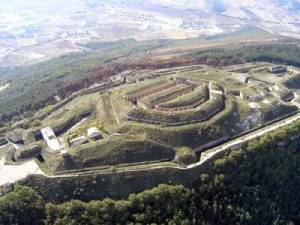
- Mount Ezkaba, Navarra
On 25 October, a prominent cross-provincial execution took place in Navarra that perfectly illustrated the coordinated nature of this political cleansing. Ángel Arizmendi Irastorza, a highly influential lawyer from the Basque coastal city of Donostia (San Sebastián), and Leoncio Aranburu, a politically active resident of Oiartzun (Gipuzkoa). Both men had been rounded up following the Nationalist capture of the Basque provinces and transferred to the infamous San Cristóbal fort-prison atop Mount Ezkaba in Navarra. On 25 October, they were subjected to a common Nationalist execution tactic: a sham release from prison, only to be immediately intercepted at the gates by a waiting right-wing death squad.
Arizmendi and Aranburu were driven into the countryside and summarily executed in the Navarrese municipality of Muniáin de Guesálaz. This joint execution highlighted the deep logistical coordination between Basque and Navarrese Nationalist authorities in identifying, transporting, and liquidating high-profile Republican, Basque nationalist, or leftist intellectuals far away from their home provinces to suppress regional resistance.
By October 1936, the campaign of repression in Navarra had evolved from chaotic summer bloodletting into a cold, logistically organised apparatus designed to permanently root out leftist, Socialist, and Republican elements. The initial months were characterised by frantic, public, and highly performative violence. Carlist Requetés and Falangist squads, heavily supported by the local oligarchy, hunted down mayors, councillors, and union organisers. In cities like Pamplona, early executions were even treated by some right-wing upper-class sectors as public spectacles. August alone accounted for over 32% of the province’s entire wartime death toll.
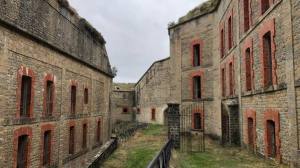
By the time autumn arrived, the arbitrary roadside killings began to drop slightly in absolute numbers as the violence became institutionalised. The Nationalist authorities shifted to using official structures, such as the Provincial Prison of Pamplona and the San Cristóbal Fort-Prison atop Mount Ezkaba, to hold thousands of political detainees. October became the month of the highly organised saca. By October, the terror was a bureaucratic routine. High-ranking military authorities, Carlist Juntas, and Falangist leaders coordinated daily to clear out overcrowded prisons. The most common execution template of October 1936 was the falsa puesta en libertad (false liberation). Prisoners would be called forward, told their release papers had arrived, and marched out the front gate. Waiting just outside were right-wing execution squads. The victims were loaded onto trucks, driven to isolated spots like the ravine of Valcaldera, the Raso de Urbasa pit caves, or remote rural fields, and shot.
Modern archival research by the Fondo Documental de la Memoria Histórica de Navarra has shattered decades of Francoist silence, documenting between 3,000 and 3,500 total fatalities from the rearguard repression in Navarra. The geographic and demographic focus of the killing in October highlights who the Nationalists considered exterminable. The repression targeted the political foundations of the Republic. Approximately 80% of socialist mayors, 75% of socialist councillors, and 60% of socialist directors in Navarra were executed.
The violence was heavily concentrated in the agrarian south of the province such as the Ribera region. In the village of Sartaguda, frequently called the town of widows, the Nationalists executed at least 86 men. The deliberate objective was to eliminate young, married day-labourers who had unionised and demanded access to communal lands during the Republic, effectively wiping out an entire generation of working-class fathers to protect the wealth of large landowners.
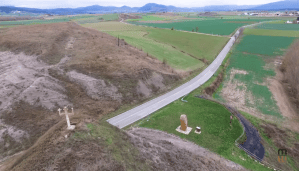
- Cendea de Olza/Oltza Zendea, Ibero, Navarra
The Alto de las Tres Cruces in Cendea de Olza/Oltza Zendea, Navarra, was selected for executions due to its isolated location and its proximity to detention centres and prisons in nearby Pamplona. Victims were transported to the hill by truck, often in the dead of night, where they were executed and buried in makeshift ditches. To date, nine mass graves have been located in the area, containing at least 77 people, originally from towns such as Berbinzana, Burlada, Caparroso, Larraga, Mélida, Obanos, Ondarroa, Pamplona, Uharte Arakil, and Villava. The remains of 39 people murdered have been recovered in exhumations carried out during the Franco regime, in 1978, and in recent years.
At the Cendea de Olza/Oltza Zendea site itself, the 46 identified individuals were not residents of Cendea de Olza but because the area sits quietly just outside Pamplona, Nationalists used its isolated hillsides as convenient execution grounds for prisoners dragged from Pamplona’s central detention centres. Out of the 46 victims, 20 were neighbours from the single town of Larraga. Their disappearance left a devastating generational scar on the community.
They were all ‘released’ from prison, seemingly without warning. Many of the men wrote home to Larraga regularly, saying they were doing well enough, and requested fresh clothes, blankets, food. Upon released between the night of 25 October and the early hours of 26 October, the men were all loaded onto to truck and driven 16km to the lonely rural area of Cendea de Olza, where they were lined up in two groups of ten and shot. All the men had been given a chance to make confession, and several priests in Ibero were brought out foer the occasion, including Martín Anaut Tellechea and Alberto Oficialdegui. They had given confession, and begged for their lives, though widows were told they received calm deaths were they were ready to go, lies not accepted by anyone.
The locals in nearby Ibero could hear the men screaming for their lives the night of the killings, and refused to help bury the bodies for three days. But those who did visit the sites over the coming days made note of what and who they saw, so that the families could get information. One recalled seeing the killings: ‘the murderer Santesteban was there, and that famous guy who owned a quarry, a top-tier thug from Pamplona, who has a son with taxis, died a couple of years ago, he lived on the Miluce bridge, Apesteguía. These two were there.’ The execution dates are confused, some thinking the men were killed in two groups of ten on different dates, which stems from the confusion on their later prison ‘release’ papers and witness accounts of the men be lined up in two groups.
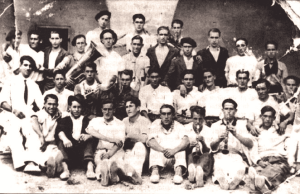
The Larraga men of 26 October 1936 were:
- Manuel Andía Zufía, 38, and brother-in-law to Isidoro Gabari Fadrique, 51, shearer
- Amado Ochoa Hierro, 34, and his brother brother to Félix Jesús Ochoa Hierro, landowners and owners of the local olive press. Their elder brother, Lucas Ochoa Hierro, was a famous pianist who also photographed the assassination attempt of King Alonso.
- Pedro Zufía Zufía, 37, local councillor and his brother Tobías Zufía Zufía, 47, Rural Field Guard
- Babil Rodríguez Suescun, 40, shoemaker, and his cousin Sebastián Suescun Corera, 63, who was not issued a death certificate until 1962, and all it said was ‘he left Larraga on 26 October 1936’
- Another cousin of the men, Jesús Nieto Suescun, 20, whose namesake nephew was the one to publicly fight Ibero to have the bodies exhumed
- Rufino Macaya Andía, 36, deputy mayor of Larraga
- Félix Sotés Sada, 43, Rural Field Guard, a father of six whose wife found out she was pregnant when he was arrested
- Domingo Vidarte Fernández, 61, whose shop was seized after his death, and nephew Lorenzo ‘Trubuco’ Urriza, 24
- Félix Leuza Legorburu, 20, whose brother had been killed in Larraga on 24 October, believed to be the same people involved in the the Ibero murders
- Martín García Mañeru, 19, and his brother Jesús García García Fallero, 35, night watchman
- Victorino Hernández Macaya, 27, whose brother died fighting fascists in Bizkaia
- Félix Morales Acebedo, 26, whose his father Gregorio was murdered in Etxauri on 24 October and his paternal uncle Sebastián was murdered in Astrain, on 26 July
- Miguel Ardanaz Pita, 23, one of eight children
- Francisco Rodríguez Rodríguez, who had been held in the infamous Fort San Cristóbal
- Francisco’s mother (Gregorio’s widow) and her daughters had been dragged from home and shaved and forced to drink castor oil. One of the daughters, Braulia, age 20, tried to see her father and brother in prison, and whatever the guards there did to her, she died as a result of her ‘shock’ two months later. The other daughter, Eusebia Morales Acevedo refuse to remain silent. She was only on holiday with her eldest daughter in Larraga when the war broke out, and her husband and two youngest daughters with him at home in Bilbao. Her husband was imprisoned and her younger girls shipped away to Belgium for their safety. Eusebia survived the public humiliation rituals with her mother and sisters, and the murder of her brother, father and uncle, and fled back to Bilbao and then Catalonia, and then France, where they lived in concentration camps. Post war, Eusebia returned to Larraga, and pointed out her family’s killer’s home. Then, while in Pamplona, she saw another of the murderers on a bus, publicly naming him, the infamous Pedro Díez Terés, Chato de Berbinzana, who was widely feared and remembered in historical accounts and regional memory as a brutal figure responsible for numerous arrests, executions, and acts of political violence (also later vandalism of victims’ gravesites was done in his ‘honour’). Eusebia refused to be silent, causing a scene on the bus as she publicly recounted his crimes, resulting in a local scandal as his anonymity was blown.
In 1978, Jesús Nieto, nephew of Jesús Nieto Suescun, could not wait anymore and started demanding the exhumation of El Alto de las Tres Cruces. the locals of Ibero claimed they were tired to digging trenches in 1936, but they had little choice now. After finding the witnesses and priests from 1936, Jesús Nieto got the families of Larraga together and they personally dug up their relatives and returned them to be buried in Larraga cemetery.
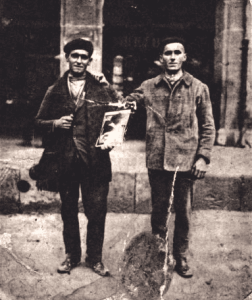
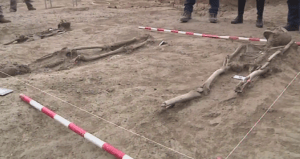
But since El Alto de las Tres Cruces was a popular dumping site, there was still much more work to be done. In December 2015, pushed again by Jesús Nieto, the Aranzadi Society carried out exhumation work at the site, finding seven bodies so far, and three have been identified using DNA: Víctor Martirena, José Roa, and Gregorio Angulo. In 2020, a survey was conducted to locate any potential remains that had not yet been exhumed, but no the final victims are yet to be found. The area suggests several marked sites, but there Araken Memoria de las Cuentas knows which 46 men (including the Larraga men of 26 October) are taken to the site.
Back on 6 August 1936, Tiburcio Osácar Echalecu of Pamplona, 67, a typographer, journalist, and director of the socialist newspaper ¡¡Trabajadores!! Tiburcio frequently spoke at rallies held in towns and villages, standing out for his positions in line with the PSOE. He had been arrested soon after the outbreak of war and was the first known victim at the site, and has not been found. Sometime later in the month, Rafael Ros Gosas of Obanos, 45, a day labourer was also ‘released’ from prison and his burial site was listed elsewhere, but it was untrue and is believed to be at Victorino Ros Gosas also disappeared, and neither men have been recovered.
On 17 August, brothers Pedro Iturria Elizalde, 31, (CNT), Victoriano Anselmo Iturria Elizalde, 34, (UGT) were killed on the site just outside the town. The men were known as extremely generous, taking in orphans and feeding the homeless despite having almost nothing themselves. They lived in Pamplona working on the railway, and had joined a group of seven RENFE workers who tried to stand up against the military uprising, hiding friends and workers who were in trouble, and refused to escape to France. They were caught and their sister went looking for them and she was threatened with shaving and castor oil, and they were never seen again. Their bodies have not been recovered.
Two days after the Larraga group, on 28 October 1936, two more men were murdered. Silverio Astiz Lacunza, 54, a farmer and the mayor of Uharte-Arakil, 28km northwest of the site, and his son, Silverio Astiz Ezcurdia, 21, a clerk and student. When the war broke out, the family fled into the mountains to hide, but when one of the six children of the family, the 14-year-old son, returned home, the Carlists were waiting for him, and forced the boy to show his family’s hiding place. Father and son, along another local man, Nicolasa Ezkurdia Garciandia, were arrested and were part of a saca on the night of 27 October/early hours of 28 October, where they were murdered.
A witness, Cruz Aznar, later testified alongside Silverio Astiz Lacunza’s widow, saying he knew they were at the Ibero site, and were possibly exhumed in 1978 with the Larraga men, who had not been buried when their murder occurred a few days later. Constantino Salinas, a socialist politician from nearby Altsasu who was exiled to Argentina, claimed El Chato de Berbinzana, the same man Eusebia Morales Acebedo accosted on the Pamplona bus over the murders of her family only days earlier.
Also from the town was Víctor Martiarena Alegría Iraneta, 26, a farmer. Víctor had been accused of graffiti and placing a Republican flag on the pelota court, and then a robbery at the shop of fascist leader, which never happened. The young man basically disappeared, but in 2016, DNA testing revealed he was one of the 2015 bodies that was discovered.
Only one day later, on 29 October 1936, with the bodies of the Larraga and Uharte-Arakil men still lying uncovered, El Chato de Berbinzana and his thugs were back, this time to murder another six men from Obanos and Berbinzana, almost 55km south of the site. Abdón de Luís Basterra of Berbinzana, 31, a witty and cheerful man, was a day labourer and member of the UGT. Some records says he died 9 August 1936, yet his release from prison was 29 October 1936. One witness claimed he saw the man beaten and ailing near Alloz reservoir outside Obanos and a farmer tried give him water and help him, but the Carlists returned and killed him. Another account claims to have seen him at nearby Garisoain. But Obanos researchers have found he was part of the six men of Obanos who were taken to the Ibero site on 29 October and murdered. No trace of him has been recovered, but his death certificate said he cut the phone lines at Berbinzana when the military coup happened in July 1936 in an attempt to save the town from the fascist uprising.
The other men of Obanos were also day labourers and farmers – Benjamin Zabaldegui Vallejo, 27, Jesús Astrain Aget, 29, and his brother Rogelio Astrain Aget, 31, who was arrested at home and his young daughter witnessed and forever remembered the Carlist storming their home, Pedro Lategui Santamaría, 58, whose brother Santos was also killed on an unknown date at another location, and Teodoro Jaurrieta Beaumont, 31.
On 27 November 1936, it was the town of Puente la Reina, right beside Obanos, to suffer. Blacksmith brothers Emilio Reta López, 25, and Jesús Reta López, 21 were taken to the Ibero site and killed, and five days later on 2 December, their father Clemente Reta Viguria, 50, landowner and councillor for Izquierda Republicana was murdered at the site, along with Mariano Aldave Molinet, a 19-yea-old fisherman, who older brother was a member of Basque political party.
On 15 December, three men were taken from Pamplona out to the site: Fermín Castillo Sánchez, 39, a painter, Juan Ilundain Viscarret, 37, a carpenter, and Cruz Juan Osinaga Ibáñez, 32, bricklayer and member of the Communist party. They were soon joined by Eugenio Chocarro Elío of Berbinzana, 35, a day labourer. Eugenio had been allegedly spotted in the nearby Carlist prison at Escolapios, and another witness claimed he was killed in Pamplona (Mutilva road) or in Oricain (Ezkabarte) on 8 October 1936, but he is still believed to be at the Ibero site today.
José Roa Garcia, 49, was a churro vendor, a member of the UGT and PSOE, and had served on the Governing Committee of the Pamplona City Council and the committee of the Pamplona branch of the Pablo Iglesias Spanish Cooperative of Low-Cost Housing. He was in the Úriz Bar in Pamplona when he was arrested by a group of Falangists and, after spending eight days in the Pamplona jail, was sent to the infamous San Cristóbal fort on 23 July 1936. There he was subjected to various forms of torture, including soaking him in a wet sheet and leaving him out in the snow in winter for an hour at a time. On 26 January 1937, despite regular pleas from his family, Galo Egués, Faustino Escribano, and Jesús Gracia de la Ribera, three men from Ibero, collected José from the prison and drove him to Ibero and murdered him, and later went to snacks with their friends and boasted about how José cried as he was killed.
Jose’s sister saw the men wearing her brother’s jacket and boots two days after the killing. Galo Egués later visited José’s churro shop, and his sister caused a massive scene, knowing he was the one who killed her brother, and made sure everyone knew. Both José’s wife and daughter was severely mistreated after his death, shaved and filled with castor oil, but refused to ever let go of the churro shop. José’s sons, one who fought for the Republicans, and another who was actually released from prison, wound up in a French concentration camp before fleeing to South America. In 2016, José Roa Garcia was identified throughout DNA testing, having been found at the Ibero site.
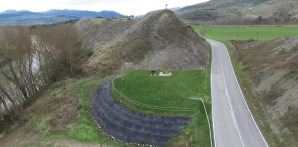
Miguel Marín Goñi, 25, a painter was killed the same time at the Ibero site. Very little is known about him, only that in 1944, a witness, Faustino Torregrosa Goñi, stated he had seen Miguel’s body at the Ibero site on 25 January 1937.
On 2 June 1937, Gregorio Angulo Martinena of Pamplona, 68, city councillor, and Founder/President of the Pamplona PSOE and UGT, was murdered at the site. He had been in hiding in Ponferrada in El Bierzo in León since the outbreak of war, but made the mistake of being seen on a balcony on 22 May 1937. He was soon arrested and imprisoned for two weeks in Iruña. He was then transported 90km south to the Ibero site, and gave confession to the local priest Alberto Oficialdegui, who risked his safety by writing to Gregorio’s daughter so she would know where he was, and said her father was brave in the face of everything.
José Garmendia Iriondo, 44, was a fisherman from Ondarroa in Bizkaia, Basque Country. he had got into an argument with another fisherman and was arrested on 15 February 1937. The court heard he was a member of Izquierda Republicana and witnessed claimed he was an extremist for the Popular Front. A shocked José was sent at once to a military tribunal and was sentenced to 30 years in the infamous San Cristóbal fort. On 22 May 1938 was the famous prison break, and José was unwittingly caught up and managed to escape, but handed himself in a day later at Orobia. On the night of 23 May or the early hours or 24 May, he was picked up in a taxi by a group of Carlists and driven 117km south to Ibero, and Norberto Echevarne the priest of Orobia who travelled with them, took his confession, the man still stunned at all that had happened for an argument over fish transport. The priest travelled into Ibero and asked local priest Alberto Oficialdegui to get him a proper burial, and this testimony was passed on to José’s wife Trinidad, as the Orobia priest believed the family should avenge the death. She travelled to the area to see the burial site, and spoke to the taxi driver, she said had grown thin under his clothes from the stress of driving men to their deaths. She tried to speak with female relatives of the murderers, but was kept back in case they shot her too. Testimony in 1978 showed that the local gravedigger had been seen wearing José’s clothing. his remains have not yet been found.
The specific death toll for the rearguard repression in Navarra has been meticulously pieced together by decades of grassroots research and academic documentation. Because the Francoist regime completely buried, falsified, or ignored these records for forty years, the true scale only came to light when local communities and families began breaking the silence. The most authoritative figure comes from the Public University of Navarra’s official database, the Fondo Documental de la Memoria Histórica en Navarra (FDMHN), which has verified 3,507 victims of Francoist repression. Independent historic collectives, such as the prominent Altaffaylla Kultur Taldea, place the total slightly higher at 3,634 individuals.
The overwhelming majority of the victims, 2,934 people, were directly assassinated, rounded up from their homes or pulled out of local detention hubs through sacas and shot by Falangist and Carlist death squads. Their bodies were dumped into fields, deep mountain fissures, or mass graves. Over 1,000 people in Navarra remain missing to this day, their remains still hidden in undocumented clandestine graves across the countryside.
A total of 448 people died while being held in prisons or concentration camps across the province. The vast majority of these occurred within the damp, disease-ridden stone walls of the San Cristóbal Fort-Prison atop Mount Ezkaba. Detainees succumbed to malnutrition, extreme cold, tuberculosis, and systematic physical abuse. This specific figure excludes the massive slaughter that occurred later in May 1938, when hundreds of prisoners attempted a desperate mass breakout from San Cristóbal and were subsequently hunted down and shot in the surrounding hills.
The remaining 125 deaths are attributed to secondary repressive measures. This includes individuals who died due to injuries inflicted during torture in detention centres (like the Carlist-run Escolapios school or the Falangist Salesianos centre), people shot at checkpoints for failing to salute the fascist flag quickly enough, or those who committed suicide out of sheer terror before an impending arrest.
The most haunting aspect of these 3,500 deaths is that they occurred in a territory where the war front never existed. For comparison, the entire province of Navarra lost roughly 4,540 men fighting on the actual battlefields for Franco’s army throughout the three whole years of the war. The fact that the regime executed almost the exact same number of unarmed, local civilians in their own rearguard during the opening months underscores that the violence was a deliberate politicide to structurally erase a segment of society.
- Basque Country / Navarra
The killings of Basque people in Navarra during 1936 represent one of the most politically complex and tragic aspects of the rearguard terror. There is an immense linguistic, cultural, and historical overlap between the Basque provinces (Gipuzkoa, Bizkaia, and Álava) and Navarra; northern and western Navarra are historically Basque-speaking (Euskaldun).
However, during the Spanish Civil War, this cultural overlap became a deadly fault line. The Nationalists, particularly the Carlist Requetés, who were themselves devout, traditionalist Navarrese Catholics, viewed Basque nationalism and the Basque language as a betrayal of Spanish unity.
The Basque Nationalist Party (EAJ-PNV) was deeply Catholic, which created a profound ideological paradox for the Nationalists. Franco’s rebellion framed itself as a Holy Crusade to save Catholic Spain from ‘godless Marxism.’ Yet, the Basque national movement chose to remain loyal to the secular Spanish Republic because the Republic promised them regional autonomy. To the Navarrese Carlists, this was the ultimate sin. The regime invented the contradictory term Rojo-Separatista (Red Separatist) to lump conservative, devout Basque Catholics in with radical anarchists and communists.
In Navarrese towns with strong Basque nationalist presence (like Estella-Lizarra or Alsasua), PNV members, local business owners, and cultural leaders were systematically hunted down. The most famous example was Fortunato Aguirre, the PNV mayor of Estella-Lizarra. He was arrested immediately during the July coup and summarily executed by a Falangist squad in September 1936. The Basque language (Euskera) was viewed by the military high command as an anti-Spanish dialect that bred subversion. In Navarra, the repression sought to erase the public visibility of Basque culture: Speaking Euskera in public spaces, markets, or government buildings was strictly banned. Signs were erected stating, Speak Christian (meaning Spanish).
Teachers who taught in Basque or promoted Basque cultural history were systematically stripped of their positions, imprisoned, or executed. Because the local Basque clergy frequently supported the linguistic rights and regional autonomy of their flock, they were fiercely targeted. While the Catholic hierarchy openly blessed Franco’s crusade, Nationalist death squads in Navarra executed at least 16 Basque priests (such as Father Celestino Onaindia) for their regionalist sympathies, throwing their bodies into unmarked graves.
Because Navarra was securely in Nationalist hands from day one, it was used as a logistical dumping ground and execution site for Basque dissidents captured in the neighbouring province of Gipuzkoa. When Nationalist forces captured San Sebastián (Donostia) and the surrounding Basque territory in late summer 1936, thousands of Basque republicans, nationalists, and union workers were rounded up. These prisoners were transferred out of their home provinces into Navarra’s prison system, specifically the San Cristóbal Fort-Prison. By moving Basque prisoners into Navarra, the regime could execute them far away from their families and local communities. This prevented local Basque uprisings or protests and allowed Navarrese death squads to bury the bodies in remote locations like Muniáin de Guesálaz, ensuring the families would spend decades searching for their missing loved ones.
For a very large segment of the Navarrese population, particularly in the rural valleys, small towns, and the capital of Pamplona, there was genuine, passionate agreement with the military uprising. Navarra was the historical heartland of Carlism, a hyper-conservative, militant Catholic movement. To these ordinary citizens, the Second Spanish Republic was an existential, godless threat that was destroying the Catholic Church, traditional family structures, and the unity of Spain. When the coup happened, thousands of ordinary Navarrese men, farmers, shopkeepers, and artisans, did not wait to be conscripted. They voluntarily rushed to enlist as Requetés, donning their red berets.
In July and August 1936, ordinary families gathered in village squares to watch their sons march off to the front lines as if they were going to a religious festival, complete with crucifixes and banners reading Deus Vult (God wills it). For this large group, the political cleansing in the rearguard was viewed as necessary weed pulling to protect their holy crusade.
For the thousands of Navarrese citizens who held moderate republican, socialist, or Basque-nationalist views, or those who simply had no political alignment, the primary driver of daily behaviour was likely fear. The terror was intentionally designed by General Mola to be highly visible. Everyone knew someone who had been dragged from their bed at 2:00am. In a tight-knit society where privacy was non-existent, ordinary people realised that a single word, an old trade union card, or a failure to attend Sunday Mass could result in a death sentence. To survive, everyday people engaged in desperate, public displays of loyalty to the new regime. People who had voted for the left suddenly wore Falangist blue shirts, contributed their savings to the Nationalist war fund, and hung the monarchist flag from their balconies. Going to Church became a life-saving performance; parish priests kept meticulous logs of who attended confession, and missing a service was a red flag for local death squads.
When the execution trucks rumbled through the villages in the middle of the night, ordinary people pulled their shutters tight, covered their children’s ears, and pretended not to hear the gunshots in the distance. The fear of being associated with the victims meant that people systematically avoided the houses of newly made widows, isolating them completely to protect their own families.
The most corrosive aspect of everyday life in Navarra during October 1936 was how the regime weaponised personal grievances, turning ordinary citizens into active participants in the slaughter. The Falange and Carlist militias did not know every day-labourer’s political history. They relied entirely on local denunciations. Everyday people began using the political climate to settle old, non-political feuds. Neighbours denounced neighbours over property boundary disputes; business owners denounced competitors to steal their market share; and individuals denounced former lovers out of jealousy. In every village, small-town elites, the local doctor, the wealthy landowner, the priest, and the pharmacist, formed informal information committees. They sat at desks, casually writing out the lists of names that would dictate who would be pulled out in the next saca.
Despite the overwhelming pressure to conform, a significant undercurrent of quiet, terrified resistance existed among ordinary people who refused to accept the violence. At immense risk to their own lives, some ordinary Navarrese families engaged in quiet acts of humanity. Farmers hid left-wing day-labourers in haylofts or mountain caves for months. Women secretly left bread and milk on the doorsteps of widows whose husbands had been shot, executing these acts of solidarity under the cover of total darkness.
In the northern mountains bordering France, local Basque-speaking smugglers (muga-larrism) used their intimate knowledge of the rugged Pyrenees to guide fleeing republicans, Basque nationalists, and escaped prisoners across the border to safety, knowing that if the Guardia Civil caught them, they would be shot on the spot.
Post-war, Navarra transitioned from the bloody, extrajudicial wild shootings of 1936 into a highly bureaucratic, legalised system of state persecution that lasted into 1975. Once the war officially ended, the Francoist state institutionalised the hunt for leftists under martial law, which remained active in Spain until 1948. The Law of Political Responsibilities retroactively criminalised anyone who had supported the Republic, belonged to a left-wing union, or even remained politically passive before 1936. In Navarra, thousands of people who had managed to survive the initial 1936 massacres hidden away were systematically hunted down, arrested, and put before military tribunals.
Across Spain, around 50,000 people were executed after the war ended. In Navarra, the executions slowed down compared to the slaughter of 1936, but the prisons remained completely choked. Leftists were rounded up to serve years in concentration camps, or forced into slave labour battalions (batallones de trabajadores) to rebuild infrastructure or fortify the nearby Pyrenees mountains.
By the mid-1940s, a new wave of roundups struck Navarra. Republican fighters who had fled to France at the end of the war formed anti-fascist guerrilla units known as the Maquis.
When thousands of Spanish guerrillas crossed the French border into the Aran Valley and the Navarrese Pyrenees to spark a rebellion against Franco, the regime responded with massive military sweeps. The Guardia Civil and military forces cordoned off entire Navarrese mountain valleys. They rounded up local leftists, shepherds, and suspected sympathisers who were believed to be giving food, shelter, or information to the guerrillas. Anyone caught helping the Maquis was summarily shot or imprisoned, extending the violent atmosphere of the civil war well into the late 1940s.
By the 1950s, the physical executions had largely ceased, but the structural rounding up of leftists remained an active part of daily life. The dictatorship created the Brigada Político-Social (a dreaded secret police force) to monitor the population. In the 1960s and early 1970s, the roundups targeted a new generation of leftists in Navarra, young factory workers organizing illegal strikes, university students distributing underground pamphlets, and Basque activists resisting the cultural ban. They were routinely arrested, tortured in police basements, stripped of their livelihoods, and sent to prison right up until the regime collapsed after Franco’s death in late 1975.
The period known as the Spanish Transition to Democracy (1975–1983) was actually one of the most volatile and bloody eras in modern Spanish history. While the formal, bureaucratic state apparatus slowly began dismantling its laws against leftists, ordinary people, activists, and workers faced immense danger from three distinct sources of violence. Sections of the military, the police, and fascist paramilitary groups, collectively known as El Búnker, were determined to preserve Franco’s legacy. They targeted leftists, trade unionists, and regional nationalists to terrorise the population and halt democratic reforms. Just months after Franco’s death, right-wing gunmen (including international neo-fascists) opened fire on a gathering of left-wing Carlists on the Montejurra mountain in Navarra. A far-right death squad stormed a legal office in Madrid and assassinated five labour lawyers affiliated with the Communist Party. Police forces, trained under the dictatorship, continued to use lethal force against protests. In March 1976, police shot into a church in Vitoria-Gasteiz where striking workers were meeting. During Pamplona’s San Fermín festival in July 1978, police intervention left one youth dead and over 150 injured.
On the other side of the political spectrum, radical groups argued that the transition was a sham and that the old Francoist elite still held true power. They escalated their campaigns of bombings and assassinations. ETA (Basque Homeland and Liberty) intensified its campaign dramatically after Franco died. ETA killed far more people during the democratic transition than it did during the dictatorship itself, targeting police, military officers, and politicians. GRAPO and FRAP, Marxist-Leninist guerrilla groups, carried out bombings and kidnappings across major cities, keeping the country in a constant state of tension.
As the 1970s bled into the early 1980s, the violence evolved into a clandestine dirty war. Elements within the newly democratic Spanish government and security forces illegally established death squads known as the GAL (Antiterrorist Liberation Groups). Operating largely in the Basque Country and southern France, the GAL assassinated suspected ETA members, but frequently targeted innocent civilians and leftists by mistake, ensuring that fear remained a daily reality well into the late 1980s.

