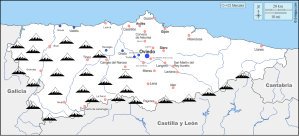
- Oviedo, Asturias
By mid-October 1936, the northern front of the Spanish Civil War had reached its most dramatic climax. For three months, thousands of Republican Asturian miners had kept the provincial capital of Oviedo under a suffocating, legendary siege. The Nationalist garrison, commanded by Colonel Antonio Aranda, was on the absolute brink of collapse. Everything changed on 16 October 1936. Slicing through the rugged western mountains from Galicia, a Nationalist relief column broke through the Republican encirclement. They established a precarious, 30km-long logistical bottleneck known as the Pasillo de Grado (the Grado Corridor), connecting Oviedo to rebel-held Spain. What followed over the next eight days was a terrifying explosion of high-casualty infantry combat and structural rearguard terror.
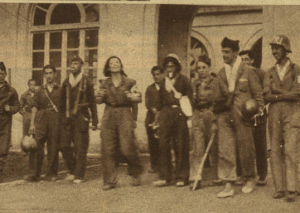
Refusing to accept the breach of their lines, the Republican Interprovincial Council ordered an immediate, desperate counter-offensive. They threw roughly 10,000 milicianos and miners into a furious bid to slice the narrow Nationalist corridor back in half. The combat concentrated on the strategic high ground flanking the supply route, specifically around El Escamplero, San Claudio, and the jagged ridges of Las Regueras. If the Republicans could seize these heights, their artillery could physically deny the Nationalists use of the road. The battle quickly mutated into a primitive meat-grinder. The Asturian miners deployed their signature weapon: the dinamiteros. Squads of miners crawled through mud and rocks under heavy machine-gun fire to hurl crates of industrial dynamite directly into Nationalist trenches. In response, the Nationalists used their superior heavy artillery and tactical aviation, systematically pounding the exposed Republican assault columns as they attempted to charge down the open valley slopes.
By 24 October, the Republican counter-attacks had broken. While they managed to squeeze the corridor to a width of less than 4 kilometres in certain sectors, they could not sever it. The lines hardened into a permanent network of trenches that would isolate Oviedo from the rest of the province for another full year. Because these eight days consisted of raw, unshielded frontal infantry charges against deeply fortified mountain positions, the density of casualties was staggering. The miners’ battalions and leftist militias bore a devastating blood quota. During the peak of the counter-attacks (18–22 October), individual assaults frequently cost hundreds of lives per day.
By the close of the operation on 24 October, overall Republican casualties since the breakthrough neared 5,000 dead or wounded. The arriving Galician relief columns were already heavily depleted from their long, embattled march. Defending the fragile corridor against the dynamite assaults cost the Nationalists roughly 1,500 to 2,000 casualties during this narrow window, forcing Colonel Aranda to rapidly transition from offensive pushes to permanent defensive fortification.
The thousands of bodies buried hastily in frontline common graves and field-hospital pits across the corridor were systematically emptied. In 1964, under direct orders from the regime, trucks cleared out major battlefield burial sites across Asturias, such as the massive communal trenches at the Cementerio de San Pedro de los Arcos in central Oviedo. Exactly 1,142 bodies were exhumed from San Pedro de los Arcos alone and secretly transported to Madrid. Alongside them, another pit containing 150 individuals was cleared out. The regime did not check, organise, or identify these remains before moving them. As a result, frontline combatants, executed rearguard victims, and civilians caught in the crossfire were completely mixed together. While the major communal plots were emptied for the monument, isolated frontline combat graves still remain scattered across the rugged Asturian terrain. During the frantic retreat or sudden shifts of the Grado Corridor fighting, small squads often buried their comrades where they fell, in mountain passes, deep ravines, or the corners of rural properties. Because these graves hold only one or two nameless soldiers, they completely escaped the post-war Francoist quotas.
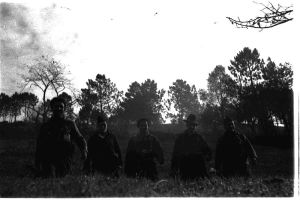
The lifting of the siege on 16 October radically shifted the balance of power inside the province, instantly triggering structural waves of political violence behind both lines. Inside the newly relieved city, Colonel Aranda no longer had to conserve ammunition or manpower. Nationalist forces immediately launched a systematic sweep of working-class districts, such as San Lázaro and El Milán, which had actively supported or harboured Republican infiltrators during the siege. Firing squads against the walls of the San Salvador cemetery became a daily, institutionalised occurrence. Hundreds of local leftists, trade unionists, and symmetric sympathisers were summarily executed or thrown into makeshift concentration camps. In the immediate 48 to 72 hours after breaking the encirclement, Nationalist troops rounded up and summarily executed 370 Republican prisoners. Over the course of the war and the immediate post-war tribunals, Nationalist forces executed nearly 6,000 Republicans in Asturias. Modern databases managed by the Historical Archive of Asturias push that comprehensive figure even higher, documenting 7,164 fatalities strictly tied to Francoist executions, prison deaths, and paseos across the province. During the months that the Republic controlled the vast majority of the Asturian countryside and mining valleys, rearguard revolutionary violence and retaliatory execution squads killed around 2,000 right-wing prisoners, clergy, and suspected rebel sympathisers.
Across the remaining Republican-held mountain valleys, the failure to maintain the siege caused a wave of bitter defeatism and paranoia. Retreating, traumatised militia units returning from the failed frontlines frequently took out their anger on right-wing prisoners, Catholic priests, and suspected Fifth Columnists held in local facilities. The fighting between 16 and 24 October 1936 did not end the war in Asturias, but it permanently altered its character. The epic, fluid siege of the summer was over; in its place, a gruelling, deeply traumatising war of positions had begun.
- Basque Country
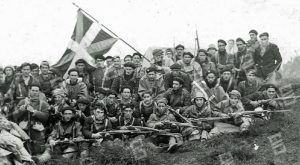
Following the catastrophic fall of Irún and San Sebastián in September, Basque defenders had retreated west, drawing a desperate defensive line to protect the industrial crown jewel of Bilbao. On the morning of 21 October, the action rippled across the coastal sector.
Nationalist units, bolstered by Navarrese Carlist brigades, launched operations aimed at testing the Republican shoreline defences and pushing the frontline further toward the Biscay border. For the Basque militias, who were under immense pressure and newly organised into the fledgling Euzko Gudarostea (the Basque Army), holding these coastal ridges was paramount. Any significant collapse on the coast would allow Nationalist forces to outflank the mountain networks protecting the interior valleys. The day saw intense artillery duels and probing actions, but no grand territorial breakthroughs materialised; the lines held, hardening into concrete trenches.
Further inland in the province of Álava, the focus shifted to the mountainous village of Elosu. Located near the strategic hub of Legutiano (Villarreal), Elosu sat directly on the fault line between Republican-leaning territory and the rebel-held strongholds of Álava.
Between 21 and 26 October, Elosu became a bloody microcosm of the war’s bitter infantry actions. Republican militias, desperate to seize the high ground and disrupt Nationalist supply lines running toward Vitoria, clashed fiercely with Nationalist defenders embedded in the village. The terrain, steep, foggy, and fractured, made coordinated manoeuvres impossible. The fighting quickly broke down into house-to-house combat and sniper duels.
Tragically, the tactical chaos of 21 October birthed immense rearguard paranoia. Suspecting that local villagers were actively spying or signalling positions to the Nationalist forces, an armed Republican militia faction rounded up and executed 17 local civilians in Elosu. It was a grim reminder that even on a static front, the rearguard remained hyper-vigilant and highly volatile.
Extensive historical research, including works from local historians and the Instituto Valentín de Foronda, has uncovered the personal, political, and tragic details of what remains the single largest wartime massacre of civilians in the history of Álava. The victims were ordinary villagers caught in the chaotic no man’s land between Republican Bizkaia and Nationalist Álava. There were 17 victims in total, spanning ages from 17 to 70 years old.. The group included five women, making the event distinct from standard executions of military-aged men.. The vast majority were local baserritarras (small-scale farmers and agricultural workers) who worked the land on the slopes of the Gorbea massif. Despite later Francoist propaganda attempting to paint them all as ultra-right martyrs or religious crusaders, records show they held varied, mainstream views. Some were Carlist traditionalists, but others were voters for the Basque Nationalist Party (PNV) or moderate Republican parties. They were essentially an cross-section of everyday Basque rural society.
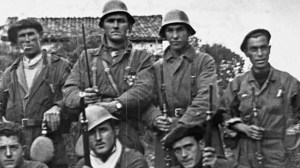
The massacre was driven by a toxic mix of military paranoia and toxic local feuds rather than a top-down strategic order. On 20–21 October, the communist-aligned Facundo Perezagua Battalion (part of the Basque militia forces) was operating in the area. After two Perezagua soldiers were killed in an ambush nearby, the unit lashed out in blind retaliation, suspecting the village of harbouring Nationalist sympathisers or signalling Nationalist positions. A local man named Marcelino Urquiola, nicknamed El Buey (The Ox), acted as a guide for the militiamen. Driven by personal animosities and long-standing local grudges, El Buey drafted a targeted list of neighbours from Elosu. Under the command of a Portuguese militiaman named Texeira, the listed men and women were rounded up from their homes, looted, severely mistreated, taken to a farmhouse in nearby Ollerías, and shot.
Immediately following the massacre on 21 October 1936, the 17 bodies were hurriedly buried together in a common mass grave at the actual scene of the crime, near the pottery workshops in Ollerías (a tiny hamlet directly adjacent to Elosu). Because the area remained a dangerous combat zone, a proper, dignified burial was impossible at that moment. After Nationalist forces fully secured the region and the Spanish Civil War ended, the Francoist authorities sought to highlight the crimes committed by Republican forces. The bodies were exhumed from the field in Ollerías and transferred to the official Elosu Cemetery. They were reinterred together in a communal plot within the consecrated ground of the parish cemetery.
For decades, a large stone cross and a highly politicised Francoist plaque marked this specific collective grave, and the crime was heavily weaponised. A plaque placed in the village explicitly claimed they were assassinated by Marxist hordes. Because the perpetrators were uncomfortable (Republican milicianos rather than fascists), the deep trauma was often hushed up by local families during and after the transition to democracy to protect community peace. In 2006, marking the 70th anniversary, the old politicised monument was replaced with a dignified, neutral memorial stone in both Basque and Spanish. It reads: ‘Here lie the mortal remains of 17 neighbours of the town of Elosu, victims of the barbarism of war. In memory of your relatives and town.’
Beyond Elosu, the month of October 1936 was a notoriously bloody period for Álava, marking the transition into organised mass executions and clandestine sacas in the province. Because Álava was primarily captured by Franco’s Nationalist forces early in the coup, most other mass graves from this specific month contain victims executed by Francoist paramilitaries (Falangists and Carlists).
The primary civil war graves and execution sites in Álava tied to October 1936 include the Portillo de Azazeta Massacres (Border of Álava). While the most famous mass execution at the Portillo de Azazeta mountain pass occurred later (April 1937), the pass began its dark history as a primary Nationalist dumping ground in the autumn of 1936. Throughout October 1936, prisoners from the Vitoria-Gasteiz provincial prison were systematically driven out to this remote mountain pass at night and shot, their bodies left in roadside ditches or shallow ravines that were later exhumed.
The Labastida Road Grave Network (Rioja Alavesa) had seen intensive Francoist repression, including the Saca de la Fuga of 14 October 1936. While some managed to flee, those caught, alongside others swept up in the immediate aftermath, were executed over the following days and buried in a network of roadside ditches along the Labastida highway. At around the same time was the Fosa de Las Auchas, a site containing victims from nearby towns like Haro and Rodezno who were executed and buried in the countryside just outside Labastida.
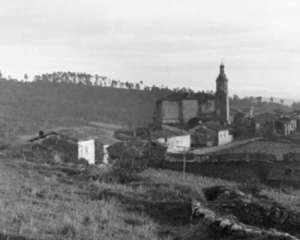
Because the front lines solidified near Legutio and the Gorbea massif in late October 1936, the surrounding valleys contain numerous unexcavated, isolated graves of both soldiers and locals caught in crossfires or swift rearguard executions. Towns like Zestafe, Echaguen, and Eribe are formally recognised by the Basque Government as historical memory pathways due to the high concentration of skirmish-era burials dating to October and November 1936.
Located at the historic Santa Isabel Cemetery in the Zaramaga neighbourhood of Vitoria-Gasteiz, Fosa en el cementerio de Santa Isabel de Vitoria-Gasteiz I and II represent the focal point of Nationalist execution and reburial logistics in Álava. Between 1936 and 1945, the exterior walls of Santa Isabel were used by Francoist firing squads as a primary execution site, where at least 196 people were shot.
Fosa de Santa Isabel I execution site and common trench (Fosa 18) represents the active wartime common trench, primarily Fosa Número 18, used by the Nationalist authorities to bury those executed against the cemetery wall. It held local Republican leaders, moderate politicians, and leftist militants captured on the Alavese front lines. Most notably, it held Alfredo Espinosa, the Basque Government’s Minister of Health (referred to historically as the doctor of the poor). The revered Basque poet and journalist Estepan Urkiaga, known as ‘Lauaxeta,’ was also shot against these walls and initially laid to rest here. In 1979, the division separating the Catholic and Civil sections of the cemetery was demolished. During subsequent restructuring in the 1980s, the remains of the wall-execution victims were systematically exhumed; most were permanently transferred to the communal osario at the newer El Salvador Cemetery in Vitoria, while others were relocated to private family pantheons.
Fosa de Santa Isabel II records a specific subset of remains that were officially expropriated from Santa Isabel by the Francoist regime. In 1959, ahead of the inauguration of the Valle de los Caídos, Franco ordered municipalities across Spain to dig up regional graves to populate his massive mausoleum. Under Fosa II, the regime targeted both local Nationalist martyrs and unidentified Republican casualties buried in the common grounds. A documented example includes Constancio Allende y Sancho, a Falangist labourer whose transfer papers linked his remains to the Santa Isabel logistics registry before dispatch to Madrid. Of the 47 individuals stolen, 33 were identified by name in the transfer papers, while 14 were transferred as unidentified casualties of the war. The bodies from the Santa Isabel cemetery were boxed and shipped later, arriving at the basilica crypts on 25 March 1961. They were deposited into the massive lateral chapels of the basilica, where roughly 33,800 victims from all over Spain rest.
Today, the exterior wall of the Santa Isabel Cemetery where these executions took place is preserved as an official Memoriagune (Space of Memory) by the Vitoria-Gasteiz City Council. A memorial plaque lists the names of the victims killed there to explicitly recognise those executed for their ideas opposing the 1936 military coup.
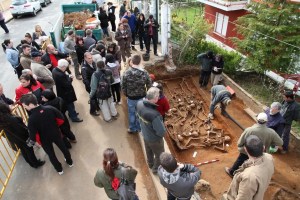
Digging work at the men’s graves in Burgos, via Óscar Rodríguez, Aranzadi
- Espinosa de los Monteros, Burgos
While the local civilian population was being terrorised in the rearguard, the actual frontline in the Espinosa / Northern Burgos sector remained locked in a tense, violent stalemate. Following a fierce series of fluid advances and counter-offensives earlier in October, the lines had frozen solid. The municipality of Espinosa de los Monteros was literally split down the middle. Nationalist rebel forces held the fortified town centre of Espinosa itself, while Republican loyalist forces, primarily composed of local Santander Popular Militias and scattered Basque detachments, held the high-altitude ridges and mountain passes directly overlooking the town from the north.
Throughout 20 October, heavy tactical skirmishing continued around the edges of this divided sector. The Republicans used their superior height advantages to shell Nationalist positions, while Nationalist forces used mortar fire to deter Republican infantry probes attempting to breach the town limits. Neither side gained ground. The front-line activity continued unabated into 21 October, but the nature of the fighting shifted entirely away from major troop movements toward a gruelling war of positions. The front line remained rigidly fixed along the divided municipal territory. With both armies unable to mount a decisive offensive breakout due to the rugged terrain and tightening autumn weather, the day was dominated by reciprocal artillery barrages, deep trench fortification work, and continuous sniper fire across the mountain valleys.
While military units clashed in the adjacent mountains, an armed Falangist death squad carried out a brutal, pre-planned sweep targeting local civilians inside the Nationalist-controlled town centre, based on denunciations, envy, and ideological hatred. Forensic excavations led by the Aranzadi Science Society ultimately uncovered two distinct mass graves just 200 metres apart. The Fosa de La Riva (The Men’s Grave) on was opened on 20 October 1936, Uncovered inside a private domestic garden in the town and contains the remains of nine male victims. They were found buried face-down in a small, tight rectangle, a position proving they were buried hastily by their executioners. All nine skulls exhibited clear entry bullet wounds to the back of the head. Many skeletons showed severe fractures to the arms and legs, proving they were severely beaten and tortured prior to being shot. Claudio Sainz, a 15-to-16-year-old adolescent who was swept up in the executions and accused of passing information to Republicans. His remains were emotionally identified by his surviving relatives due to the unique preservation of his leather boots. Laureano de Fernández Gómez was 64-year-old unmarried farmer from nearby Barcenillas del Cerezo, documented as missing on this date. Basilio Gómez Fernández was a 40-year-old resident of Espinosa. Celestino Zorrilla was local resident and owner of an espadrille factory, executed by local Falangists for being a socialist. The other four men in the grave remain unnamed.
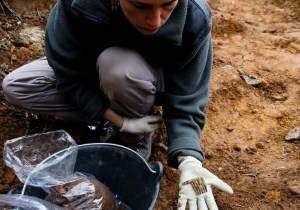
The Fosa de las Cuatro Mujeres (The Women’s Grave) was opened on 21 October 1936, located just 200 metres away from the garden pit, and held the the remains of four local women. According to oral testimonies passed down by town elders, these women committed no crime other than being the wives or sisters of left-wing locals. Like the men, their bones revealed pre- and post-mortem fractures indicating severe physical abuse before their execution. One of the skulls was famously unearthed with a traditional hair comb (peineta) still resting intact against the bone, providing a powerful visual anchor that verified decades of whispered town rumours. Amelia Cano Calleja was 27-year-old woman from Espinosa. She was the wife of Donato Zorrilla (the son of Celestino Zorrila killed on 20 October). Her husband had successfully escaped the execution squad that killed the men the previous day; the paramilitaries executed Amelia in retaliation. The other three women’s names have been closely guarded since their deaths and remain private today, but have been identified and reunited with their families.
- Tafalla, Navarra
When General Emilio Mola launched the Nationalist military coup on 18 July 1936, the northern province of Navarre became an immediate stronghold for the rebellion. The territory was deeply conservative, dominated by Carlist traditionalism and the fierce clerical militancy of the Requetés. It also gave rise to a systematic, unilateral political cleansing targeting anyone affiliated with the Second Spanish Republic, left-wing parties, or agrarian unions like the Federación de Trabajadores de la Tierra (FTT-UGT). Because there was no war zone within the province, victims were not killed in combat; they were systematically rounded up, held in local district prisons, and subsequently executed in sacas.
On 18 October 1936, news reached the town of Tafalla that Julián Castiella Sánchez, a prominent 25-year-old Lieutenant and chief of the local Requetés, had been killed in combat on the Sigüenza front. Castiella was a highly visible figure among local traditionalists. His death transformed the political tension in Tafalla into a desire for immediate retribution.
Following his burial, an angry right-wing crowd attempted to storm the local prison to lynch the Republican detainees. While local authorities initially held back the mob, the regional Carlist leadership, specifically the Tercio Móvil, a mobile Requeté unit stationed at the Escolapios college in Pamplona specialised in punitive actions, planned a coordinated, mass execution as direct retaliation.
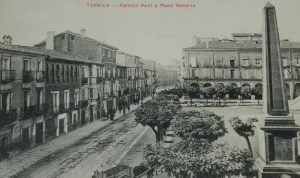
Historical accounts indicate that a committee of local Carlists immediately sought and received formal approval from the Junta Central Carlista de Guerra de Navarra (the central Carlist wartime governing body) to execute a sweeping cleansing of the prison. During the late hours of 20 October and the early morning of 21 October 1936, a heavily armed detachment, arrived at the Tafalla prison, where Republican affiliates from across the surrounding judicial district had been rounded up and detained over the preceding weeks. During the early hours of 21 October 1936, 65 prisoners were systematically chosen and pulled from their cells. Anyone belonging to left-wing parties, the Republican Left (Izquierda Republicana), or agrarian labour unions like the UGT, or public servants, municipal inspectors, and local committee members who had taken up positions under the democratic Republican government were chosen to die. Landlords, caciques, and right-wing elements used the chaos to eliminate active, organised labour voices, such as railway workers, agricultural organisers, and outspoken tradespeople, to re-establish absolute economic dominance over the rural workforce. They were bound in pairs by wire or handcuffs and loaded onto one or two civilian buses requisitioned from the local transport company, La Tafallesa.
The buses drove 35km north to La Tejería in the municipality of Monreal (Elo), located along the road between Urroz and Campanas. This isolated location, named after an old tileworks, had already been used for smaller extrajudicial killings since August. Upon arrival, trenches had already been dug by advance teams, proving premeditation. Local witnesses later recounted that several priests were brought to the site to offer last rites. The prisoners were lined up in groups of six and shot by a hidden firing squad. A veterinarian accompanying the executioners administered the final tiro de gracia (coup de grâce) to ensure none survived.
The mass grave at La Tejería ultimately held over 90 individuals (with modern estimates reaching up to 106) murdered across seven execution dates between August and November 1936. The 65 victims of the 21 October saca represented a cross-section of ordinary Republican society across eight towns. Because most of these places were so small, the impact of the purge was devastatingly visible. When 12 people were taken from a village like Berbinzana, or 15 from Peralta, it meant an entire generation of local leadership, trade workers, and family providers vanished overnight. In these small communities, denunciations were often fuelled by intimate, local grudges over land use or labour wages, attacking people aged 20-63.
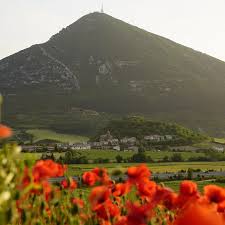
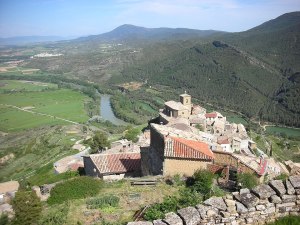
The core group was of 27 victims, including local professionals and trade unionists, from Tafalla itself, plus 15 victims from Peralta, a town heavily targeted for its robust agrarian labour movements, another 12 from Berbinzana, mostly small-scale agricultural laborers, and from the small medieval villages, there were 3 victims each from Cáseda and Gallipienzo, two victims each from Caparroso and Murillo el Cuende, and one from San Martín de Unx. The majority of these towns fall within the historical district (Merindad) of Olite, which has the city of Tafalla acting as its commercial and administrative capital. San Martín de Unx, Berbinzana, and the farming settlement of Murillo el Cuende all directly border or sit immediately adjacent to the municipality of Tafalla, within 15 minutes of each other. Caparroso and Peralta sit just slightly further south along the major river valleys, which historically served as connected agricultural and trade corridors. Cáseda and Gallipienzo sit tightly clustered together along the Aragón River just to the east.
While decades of forced silence under the Franco dictatorship suppressed detailed documentation, specific individual cases highlight the human cost of the massacre. Esteban Pérez Alegría (Tafalla) served as the Municipal Veterinary Inspector of Tafalla. As an educated, local public official working under the Republican administration, he was viewed by the insurgent forces as an institutional collaborator of the Republic. His professional status made him a primary target for institutional cleansing. Tomás Alfaro Díez (Tafalla) was 27 years old, representing the younger generation of Republican sympathisers executed that morning. He was an ordinary civilian whose youth and working-class alignment made him vulnerable to the sweeping arrests carried out by local Requeté networks. Ramón Gota was working-class resident whose descendants have been highly active in modern memorial movements. His identity, along with dozens of shepherds, railway workers, house painters, and field hands, underscores that the Monreal massacre was fundamentally a purge designed to terrorise and decapitate ordinary working-class households rather than just targeting prominent high-ranking politicians.
Historical investigations into the mass grave confirm that the victims included an unidentified female teacher from the Escuela Normal de Iruñea (the Teacher Training College of Pamplona). Decades after the war, her exact name remains officially unknown. She is recorded in modern memory archives simply as la maestra (the teacher). Women targeted in Navarre during the 1936 purges were typically singled out for their secular or progressive teaching methods under the Second Republic, or for being active in political and labour organisations. Her remains were buried alongside the other victims at the site. Modern research conducted by memorial groups like Teileriako Ahaztuak (The Forgotten of La Tejería) has raised the total estimated count of individuals buried in this fosa to 106 victims, encompassing at least seven separate execution dates between August and November 1936.
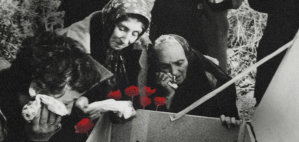
Dolores Orduña and her daughter Josefina Campos identified the remains of Dolores’ brother, José Orduña, after she was ure she would recognise him from his missing tooth, and Orduña was the very first person located. Other locals shared distinctive traits about their relatives, and as a result, 85 people have been identified by name. In total, 52 residents of Peralta were murdered by the Nationalists, out of a population of only 3,500, and among them was their priest Eladio Celaya, who had opposed the violence.
For years, the site was marked by a sign placed by the parish priest: ‘Respect this place. It is a cemetery from 1936.’ It was exhumed in 1978 by the victims’ own relatives and neighbours, as part of the ‘Operation Return’ campaign, an early exhumation (exhumación temprana) plan to recover the remains from the trenches of Monreal before formal state-backed protocols existed, part of a wave of exhumations that took place on both sides of the Ebro River. Grainy amateur footage shows men and women personally digging up their relatives, finding their skulls with gunshot wounds to the forehead and/or back of the skull. Today, the original location lies at the tail end of the reservoir for the Navarre Canal. Today, the site has been converted into the official La Tejería de Monreal Memorial Space, managed alongside the Navarra Institute of Memory, where commemorative tiles and monolits preserve the names of those executed.
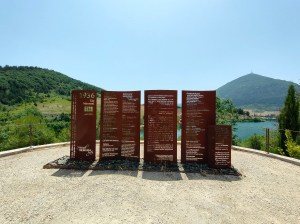
- Naval, Huesca, Aragon
In October 1936, El Grado and the surrounding Sobrarbe and Somontano regions sat firmly within the Republican rearguard, just west of the stagnant Aragon frontline. Following the July coup, large columns of anarcho-syndicalist (CNT-FAI) and Marxist (POUM) militias had swept from Catalonia into Aragon, establishing local revolutionary committees. In these rural districts, traditional authority collapsed, and anyone perceived as a conservative, a landowner, a practicing Catholic, or a sympathiser with the military uprising became a target for immediate arrest. On 21 October, Republican militiamen executed two men and two women near the local cemetery of El Grado. They had been taken from the nearby village of Naval, located roughly 10km west. Isidro Salas Lisa, Josefa Almanzor Casanovas, María Castillón Pardina, and Melchor Saludas Mur, were buried together, and have since been exhumed and placed in proper graves away from their initial cemetery site.
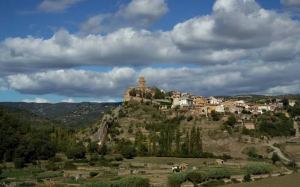
- Teruel, Aragon
As the frontline shifted across the province of Teruel, both factions in the Spanish Civil War carried out executions of civilian populations within hours of each other. On 21 October 1936, the towns of Camañas and Torrevelilla became micro-theatres of this dual rearguard repression, demonstrating how both Nationalist and Republican units used roadside executions and cemetery burials to eliminate suspected political opponents.
In the Alfambra valley sector, Nationalist insurgent forces advanced through Teruel, systematically cleansing villages immediately upon entry to secure their rear lines. Shortly after Francoist columns entered and secured the small village of Camañas, local right-wing elements and military security units initiated a immediate sweep for Republican sympathisers, leftist committee members, or agrarian unionists. Five local residents were rounded up and taken to a site known as La Cerrada, situated along the road leading toward Santa Eulalia del Campo. There, they were executed by a Francoist squad. Following the roadside shooting, the bodies of the five victims were moved and buried in a makeshift grave located near the main entrance of the Camañas cemetery. Andrés Martín Ros, Celestino Herrero Andrés, Remigio Conejero, Luis Moliner, and José Ibáñez have not been recovered, not even given a marker, but in 1938, a local resident, Miguel Juan Herrero Andrés, was killed in an aerial bombing and buried on top of them.
Roughly 80km northeast, in the Bajo Aragón region, the town of Torrevelilla sat deep within the Republican-controlled zone. Here, revolutionary militias, largely influenced by anarcho-syndicalist columns operating out of Catalonia, managed local security and targeted anyone suspected of conservative, religious, or pro-coup leanings. On the exact same day as the Camañas massacre, Republican militiamen extracted four local residents from Torrevelilla. They were taken to the local road junction heading toward Castelserás and executed next to the highway. Mirroring the logistics of the Nationalist executioners, the Republican militiamen subsequently transferred the remains of the four victims from the roadside to the local Torrevelilla cemetery for summary burial.
Castelserás has two large mass gravesites. There is a large common grave containing the remains of up to 32 people killed by Republicans, including 18 victims of the massacre that took place at La Venta earlier in the war, out on the road to Alcañiz, in a building that once stood just outside the town. All have since been recovered and reburied. There is another mass grave in the same cemetery, which held 109 Nationalist, 77 Italians and 32 Spaniards, who died during the Aragon offensive in the spring of 1938. The Italians were transferred to Zaragoza but the Spaniards were moved to an unknown location. It is extremely rare to have any grave containing Nationalists or their supporters to remain unexhumed (if you know of one, let me know).
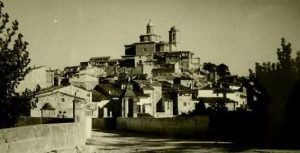
- Valencia
On 21 October 1936, this manifested in a major mass execution at El Picadero in Paterna, targeting members of the state’s own security apparatus. Unlike civilian purges, this specific operation was an internal purge directed at the Cuerpo de Seguridad (the Security Corps/Assault Guards). This urban paramilitary police force had been vital in holding Valencia for the Republic during the initial July coup. However, by October, as the military situation grew desperate, the Republican security committees began systematically filtering out personnel deemed politically unreliable or suspected of harbouring secret right-wing or fifth-column sympathies.
The executions took place at El Picadero in Paterna. This site had already been transformed into a highly active, high-volume killing site, used repeatedly by revolutionary tribunals and execution squads from August 1936 onward.Among those killed was Perfecto Rey Castiñeira, whose identity was later recovered through surviving historical reconstructions of the military police purges, but almost nothing else remains, not even the number killed.
Paterna occupies a uniquely tragic position in the history of the Spanish Civil War. Because of its close proximity to the city of Valencia (less than 10km) and its open spaces like El Picadero and the Terrer, it became the primary execution ground for the region. In October 1936, the killings at El Picadero were driven by the Republican rearguard’s intense fear of internal subversion as Nationalist troops closed in on Madrid. After the war ended in 1939, the Francoist regime would seize these exact same execution sites in Paterna, using them to execute over 2,200 Republican prisoners in the decades that followed.

