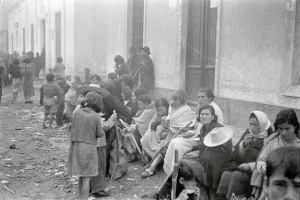
Receiving personal threats or hostile attacks simply for documenting verified historical records, using primary archival sources like municipal registries and provincial memory records, is not ideological extremism. Unfortunately, topics around the Spanish Civil War still trigger intense, bad-faith hostility online, and people often throw labels like Marxist or communist alongside threats to intimidate writers into silence. You can flood my site and social media with threats all you like, you are being filtered away from me, and I can rest easy knowing that I am going to write twice as much just to upset you.
- Huelva Province
When Nationalist columns occupied the mining basin of Riotinto and the surrounding towns of El Andévalo in late July and August 1936, thousands of people had only two choices; stay and face summary execution, or run into the hills. Those who ran became known in Spanish history not as criminals, but as los huidos (those who fled). They were unionised miners from Riotinto, Nerva, and La Zarza; Socialist and Republican town councillors; rural day labourers; and young men who simply refused to fight for fascism. For months, they survived in small, scattered bands along the banks of the Odiel River and in the rugged scrubland of the Sierra, hunted by Guardia Civil patrols and Falangist militias.
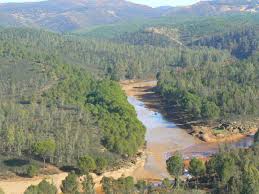
By late November 1936, their situation had become desperate. As cold weather set in, living off the land was no longer possible. Relying on relatives to smuggle food out of the villages put entire families in mortal danger, women caught bringing bread to the hills were publicly humiliated, tortured, and shot. In some mining villages, such as La Zarza, local authorities and priests sent messages into the hills promising the huidos that if they turned themselves in voluntarily, nothing would happen to them. Those who trusted the promise were arrested and executed in mass graves weeks later.
Rather than wait to freeze, starve, or be hunted down one by one, the scattered groups began to organise. According to the memoirs of surviving miner Santiago Rodríguez Delgado, a miner from Cueva de la Mora named Miguel López Pereira took on the perilous task of gathering the isolated groups hiding along the Odiel River and across El Andévalo. By late November 1936, he led them north into the Sierra de Aroche, where they linked up with another large group of escapees from the Pata del Caballo mountains.
Together, they formed an organised column of more than 300 men. The Republican Army, which had lost control of Huelva months earlier, sent military commanders, a doctor, a mechanic, rifles, and a machine gun across enemy lines to help organise them. In the final days of November 1936, this column of 300 ordinary workers and neighbours began a gruelling, perilous overland march across Nationalist-held territory to reach the safety of the Republican front lines, where they intended to enlist as formal soldiers in the Republican Army.
Because Huelva was completely cut off from the rest of Republican Spain by November 1936, staying in the hills meant slow starvation or capture. Once the scattered huidos gathered in the Sierra de Aroche, their plan unfolded in three stages. Instead of moving as a chaotic crowd of civilians, they organised into a disciplined, self-defending column of over 300 men. Travelling mostly at night through rugged mountain terrain to avoid Nationalist garrisons and Civil Guard patrols, the column planned to cross northern Huelva and southern Badajoz/Córdoba (near the Peñarroya–Pozoblanco front) to reach territory still held by the Republic.
Those who survived the trek and crossed into Republican territory did enlist together in the Republican People’s Army, forming the Batallón de Riotinto (and later integrating into mixed brigades) to keep fighting against Franco’s forces on the Andalucían and Extremaduran fronts. However, not everyone made it out, some groups were intercepted by Nationalist sweeps along the way, and a smaller number of huidos remained behind in the Sierra de Aroche and Aracena, evolving into the local anti-Francoist guerrilla resistance that survived in the mountains into the 1940s. But the vast majority did survive, and became part of the almost 1,000 men who managed to get to Republican territory to lay there part in fighting the fascists.
For the people who helped them, the price remained fatal. Rodríguez Delgado recorded that at least thirteen locals, including a man known only as Juan ‘Catorce’, were executed for helping the huidos regroup. And Miguel López Pereira, the miner who helped bring the 300 men together, was eventually captured years later and executed in Huelva on 22 January 1941, his body thrown into a mass grave in the Cementerio de la Soledad.
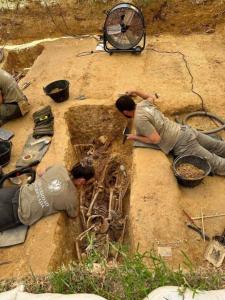
The families left behind, mostly mothers, wives, children, and elderly relatives, bore the brunt of Nationalist retaliation through executions, imprisonment, public humiliation, and deliberate economic destitution. Because the men had escaped to the hills or crossed into Republican territory, Nationalist authorities and local Falangist militias turned their vengeance directly onto the relatives who stayed in the villages of Huelva across four devastating fronts. When patrols failed to find huidos in the mountains, they frequently arrested and shot their wives, mothers, sisters, or adolescent sons instead. More than 300 women were murdered in Huelva province, often dumped into mass graves in neighbouring towns so their families could not find them. Women were tied by their feet and hung upside down in public wells until they drowned because they refused to reveal where their husbands, sons, or brothers were hiding. In towns like Zufre, Almonaster, and Puebla de Guzmán, entire groups of female relatives of huidos and Republican soldiers were rounded up and executed together, such as the 15 women known as the Rosas de Guzmánor the 17 women from Zufre executed together in Higuera de la Sierra.
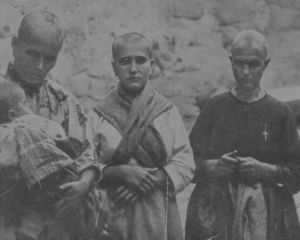
Women whose husbands had fled were routinely subjected to public shaming ritualsl their heads were shaved bare (leaving a single tuft tied with a ribbon in the colours of the Republic or Franco’s flag), they were forced to drink castor oil, and they were paraded through the streets while defecating in public. Hundreds of women were locked in the Provincial Prison of Huelva or makeshift village jails, sometimes with their babies and toddlers, some of whom died inside prison walls.
Under Franco’s Law of Political Responsibilities (and its earlier 1936 decrees), the property, livestock, and savings of fled men were confiscated. In the mining towns, the Rio Tinto Company immediately evicted the families of huidos and executed miners from company-owned housing, cutting off their access to company stores and medical care. Left with zero income and blacklisted from local employment, widows and wives of huidos had to beg, scavenge acorns and wild herbs in the fields, or send young children to work for pennies just to survive.
As long as the huidos remained in the hills before the November breakout, their wives and mothers risked their lives at night to smuggle bread, clothes, or tobacco out of the towns. Being caught with extra food was treated as aiding rebellion and frequently ended in arrest or execution. By the end of the year, Nationalist executions and disappearances in Nerva had left a documented toll of 246 widows and 570 orphans, and more than 2,000 dependents in a single mining town stripped of all means of survival. Because Nerva was a company-dominated mining town with almost no independent agriculture, the sudden elimination of hundreds of male breadwinners created an immediate humanitarian catastrophe, one that was actively worsened by both the Nationalist authorities and the British-owned Rio Tinto Company Limited. Because their husbands and fathers were labelled Marxist traitors or died without official death certificates (many were simply dumped in the Nerva cemetery mass graves), widows were denied state or company pensions.
With mothers unable to feed their families, many Nerva widows made the heart-breaking decision to send their young orphans away to neighbouring agricultural villages, such as El Madroño (across the provincial border in Seville), to work herding livestock or doing farm chores in exchange for scraps of food and a place to sleep, simply to reduce the number of mouths to feed at home. Working as porqueros (swineherds), shepherds, or domestic servants meant the children were usually given scraps of bread, soup, or acorns to eat, keeping them from starving to death. Being away from Nerva removed them from the immediate daily sight of the local Falangists who knew their executed fathers by name and routinely harassed their mothers.
Neighbouring towns were not safe havens. El Madroño suffered brutal Francoist repression of its own; Nationalist radio commander Queipo de Llano had personally threatened the town over the airwaves, and scores of its residents were executed or hunted down. Children as young as 7 to 12 years old worked from dawn until dusk in harsh winter weather, often sleeping in barns or stables alongside animals. Because everyone knew they were hijos de rojos (children of reds), they had zero legal protection against beatings, unpaid labour, or mistreatment by landowners. If a widowed mother was arrested, killed, or completely unable to care for her children, the regime’s Auxilio Social (Social Aid) and religious orphanages frequently seized custody of Republican orphans, subjecting them to hunger, cold, abuse, and forced ideological re-education, and in many cases severing their ties to their surviving families permanently.
Historians documenting the Francoist repression in Andalucia, including Pura Sánchez (Individuas de dudosa moral) and Francisco Espinosa Maestre, have extensively documented how Falangists, Civil Guards, and employers used rape, sexual coercion, and threats of execution against girls from defeated Republican families, knowing victims could never report the crimes without risking their own lives or their mothers’ lives. Adolescent girls were not spared the regime’s public shaming rituals (forced head-shavings, castor oil purges, and street parades), and those placed in state or religious Auxilio Social institutions and reformatories (such as the Patronato de Protección a la Mujer) often suffered harsh physical punishment, forced labour, and severe psychological abuse aimed at purifying them of their parents’ political beliefs. Rape could be used against women and girls of all ages as a weapon, or simply as a form of cruelty, with no chance of any justice.
Those who stayed in Nerva survived by scavenging acorns, wild thistles, and discarded scraps around the mining slag heaps, while enduring constant surveillance, head-shavings, and public humiliation from local Falangists. Hundreds of Nerva’s widows could not legally remarry, claim inheritance, or settle basic legal affairs for decades because their husbands were listed as disappeared rather than dead, buried in what archaeologists later identified as the largest rural mass grave in Spain inside Nerva’s municipal cemetery, holding between 221 named victims and over 500 bodies in total.
Because Nationalist-controlled Andalucia was an agricultural region, there was no general food shortage for regime supporters, and starvation was selective. Blacklisted families in Nerva and Riotinto, barred from company stores, evicted from housing, and denied relief, suffered severe malnutrition. Infants, toddlers, and elderly dependents died at spiking rates from what local doctors recorded on death certificates as enterocolitis, gastroenteritis, atrepsia (severe infant wasting), or tuberculosis triggered by extreme undernourishment. Political prisoners held in Huelva’s Provincial Prison, makeshift village jails, and forced labour camps (such as Isla Saltés and Peguerillas) were kept on near-starvation rations, leading to widespread deaths from malnutrition, dysentery, and untreated disease.
What began as starvation of blacklisted families in 1936 turned into a nationwide catastrophe after the war ended. Historians estimate that roughly 200,000 people died directly or indirectly from starvation across Spain between 1939 and 1944.a period known as los años del hambre (the years of hunger), as Franco’s economic policies, rationing, and black-market hoarding hit impoverished southern provinces like Huelva hardest. Starvation deaths between 1939 and 1944 were treated either as an acceptable price for absolute control or as a tool to break the defeated population. Keeping millions of defeated Spaniards on the brink of starvation ensured they were too weak, exhausted, and focused on daily survival to organise resistance.
The regime’s rationing system and economic autarky policies created massive shortages while rewarding regime loyalists, landowners, and black-market profiteers. Food, jobs, and basic relief were routinely withheld from families labelled rojos, meaning the famine fell disproportionately on the defeated working class and rural poor in provinces like Huelva. Because the dictatorship controlled all newspapers, radio, schools, and death registries, starvation was never officially acknowledged. Deaths from malnutrition were recorded as routine illnesses, while state propaganda celebrated Franco’s ‘Victory’ and blamed any economic hardship on the defeated Republicans or foreign powers.
Spain actually produced enough food to prevent mass starvation, and big landowners still had labourers working their estates. People starved because the regime controlled who got to eat, how much workers were paid, and where the food went. In provinces like Huelva, tens of thousands of the most experienced agricultural workers and miners were executed, imprisoned in concentration camps, conscripted into the army, or forced to flee into the mountains as huidos. Hundreds of thousands of households lost every working-age man overnight, leaving mothers, children, and elderly grandparents with no one to earn a wage or tend family plots.
Under the Second Republic, landless peasants had been given small plots to farm for themselves. Franco immediately returned that land to wealthy estate latifundistas, leaving millions of rural workers landless again. The regime abolished all labour unions and outlawed strikes. Landowners slashed daily wages back to pre-1931 starvation levels while food prices skyrocketed, meaning even men who did work the land could no longer afford to buy the food they harvested.
Franco adopted an economic policy of autarquía (forced self-sufficiency) and refused foreign food aid. At the exact same time Spaniards were dying of hunger, the regime exported huge quantities of Spanish olive oil, wheat, oranges, and minerals to Nazi Germany and fascist Italy to pay off its Civil War debts.
The regime forced farmers to sell their crops to the state at artificially low fixed prices. Rather than lose money, wealthy landowners hid their harvests and sold them illegally on the black market at ten times the official price, making huge fortunes while the poor could not afford bread. Official ration books provided barely enough calories to survive, and local Falangist authorities routinely delayed, reduced, or denied rations and work permits to the widows and families of executed Republicans.
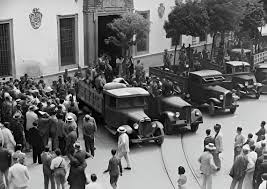
- Seville Province
Seville province was undergoing the exact same terror in November 1936, serving as the regional nerve centre from which General Gonzalo Queipo de Llano directed the purges across both Seville and Huelva. According to historian José María García Márquez’s exhaustive study, at least 6,614 people were executed in Seville province during 1936 (out of a documented provincial minimum of 11,287 to 11,500+ victims across the war and post-war period). Just like in Huelva, roughly 60% to 70% of all executions happened in the second half of 1936 under Queipo de Llano’s law decrees) before formal courts-martial even began. Seville was not just executing its own residents, it was also where dozens of Huelva prisoners were transported and shot.
The Sierra Norte of Seville (towns like El Castillo de las Guardas, El Madroño, Cazalla de la Sierra, and Alanís) bordered directly onto Huelva’s Cuenca Minera and Sierra de Aracena.
Thousands of Seville workers, miners from El Castillo de las Guardas, and rural labourers fled into those same hills as huidos. Several Huelva huidos columns linked up with Seville escapees as they moved northeast through the Sierra Morena toward the Republican lines in Córdoba and Extremadura.
Historians describe Queipo de Llano’s rule in Seville as a system built on a dialectic of violence and destitution. Latifundistas immediately took back farmland distributed during the Republic, slashed farmworker wages, and confiscated the homes and belongings of executed or fled Republicans. Just as in Huelva, at least 759 women and 160 minors were executed in Seville province, many of them mothers, wives, and daughters killed when their male relatives escaped to the hills, or swept up in mass executions at sites like the Cementerio de San Fernando in Seville city and the concentration/extermination site at La Algaba.
Across Seville’s towns, women from Republican families were routinely subjected to forced head-shavings, castor oil purges, beatings, and public parades designed to break community solidarity through shame and fear. Stripped of their breadwinners, denied widow pensions, and blacklisted from local employment, thousands of Seville mothers and orphans were pushed into acute malnutrition. Infants and elderly dependents died from hunger-related illnesses masked on official death certificates as routine digestive or respiratory diseases, while children as young as seven or eight were sent to work from dawn until dusk in fields or wealthy households in exchange for scraps of food.
Before the war, working-class women, teenagers and children, and the elderly all worked, and that is precisely why Franco’s labour laws were so devastating. From a purely economic standpoint, letting widows and surviving women and children fill the massive labour shortage left by dead, imprisoned, and fled men would have been far wiser. Instead, the Franco regime deliberately chose political punishment and Catholic-fascist ideology over economic survival, legally stripping working-class women of their right to earn a living at the exact moment they needed it most.
Before July 1936, working-class women in Andalucía worked extensively in agriculture (harvesting olives, grapes, and grain), canning factories, textiles, domestic service, and surface sorting at mines. Under the Second Republic, women had gained legal equality and labour protections. Franco’s regime abolished those rights and declared its goal to ‘liberate married women from the workshop and the factory.’ Laws banned married women from almost all formal employment, removed women from civil service and teaching positions, and allowed employers to fire any woman who got married. ‘Stay-at-home housewife’ was an upper-class luxury. By forcing that ideal onto working-class widows whose husbands had just been shot by firing squads, the regime trapped them in an impossible bind: the state forbade them from taking a man’s job, while simultaneously denying them any pension because their husbands were labelled traitors.
Even in the few low-paid jobs still open to poor women (such as domestic service, cleaning, laundry, or seasonal field labour), employers and town halls required a Certificate of Good Political and Moral Conduct signed by the local Falange chief, the Guardia Civil, and the parish priest. Any woman whose husband, father, or brother had been executed, imprisoned, or fled as a huido was automatically denied this certificate, meaning she was legally barred from formal hiring, state relief, and public work programmes.
Rather than paying widows to fill labour shortages, Falangist authorities and the Sección Femenina forced red women to perform unpaid forced labour, scrubbing churches, barracks, and Falange headquarters, washing soldiers’ uniforms, and sewing military garments for free as penance for their families’ politics. Because they were shut out of formal wages, hundreds of thousands of widows and daughters survived in a desperate underground economy, foraging wild greens and acorns, taking under-the-table piecework sewing at home for pennies, smuggling small amounts of food on the black market , or, for many destitute women with starving children, being forced into prostitution just to buy bread. Rather than treating this as a crisis caused by its own policies, the regime branded these women caídas (fallen women) or individuas de dudosa moral (individuals of dubious morality), subjecting them to police raids, fines, and forced confinement in religious reformatories while their clients faced zero consequences.
Local Falangist officials, Civil Guards, police officers, and wealthy landowners routinely demanded sexual favours from defeated women in exchange for basic survival necessities, like signing a travel pass, issuing a ration card, allowing a mother to visit her imprisoned husband, sparing a relative from a firing squad, or simply letting a blacklisted woman keep a low-paid cleaning or farm job. Rape was currency. Young girls and widows forced to work inside the homes of regime supporters or estate owners had no legal rights or union protection, leaving them completely vulnerable to sexual assault by male employers, and if they became pregnant or spoke out, they were fired on the spot and blacklisted as immoral. Under Franco’s martial law, a woman from a red family had zero legal standing. Reporting rape or extortion by a Falangist, soldier, or landowner was impossible, as the authorities were the perpetrators, and accusing a regime supporter invited immediate arrest or execution. Sexual exploitation was not an accidental by-product of wartime chaos; it was structurally built into a system that stripped defeated women of every legal and economic right while granting unchecked power to the men who ruled their towns.
In civil registries, prison intake logs, and death certificates across 1930s Spain, clerks almost universally wrote ‘housewife’ for every married or adult woman, regardless of how many hours she worked in the fields, factories, or mines. Under Spanish administrative custom, which became even stricter under Francoism, a man’s identity on official forms was defined by his trade, while a woman’s identity was legally defined by her marital and domestic role. Unless a woman held a rare, state-licensed profession like schoolteacher or midwife, clerks defaulted to housewife without ever asking what work she did.
Working-class women in Huelva and Seville (and everyone else, none of these issues are confined to these provinces) worked constantly, harvesting olives, grapes, and almonds; gleaning grain; sorting ore at mine surfaces; canning fish on the coast; doing piecework sewing; or taking in laundry and cleaning. Because this work was seasonal, informal, or paid by the day/piece rather than a salaried contract, state registries refused to count it as an occupation. Recording executed women as housewives served Francoist propaganda. It reinforced the regime’s claim that women belonged strictly in the home, and allowed authorities to portray executed women not as independent workers, union members, or political actors, but either as passive dependents or as unnatural women who had abandoned their proper domestic sphere. When you see housewife on the execution record of a woman, you are almost certainly looking at a woman who worked every day of her life to keep her family fed, whose labour was simply erased by the clerk who signed her death certificate.
- Málaga Province
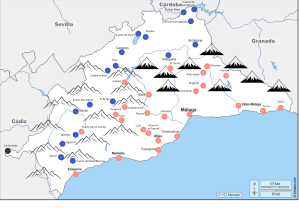
Málaga province was a trapped, overcrowded coastal pocket, cut off from the rest of Republican Spain except by sea and the narrow mountain road east to Almería, where intense air and naval bombardments repeatedly triggered retaliatory prison massacres, while Nationalist troops wiped out the last Republican mountain holdouts on the western border.
While the front lines around the central mountains temporarily stalled during these two months, the province was tearing apart from within and from the air across major fronts.
Right on the border between Málaga and Cádiz, thousands of Republican refugees and milicianos had gathered in the remote forested valley of La Sauceda after the fall of Ronda and western towns. In early November 1936, Nationalist columns, backed by Moroccan Regulares, Falangists, Civil Guards, and aerial bombing, launched a full-scale assault on La Sauceda. Hundreds were killed in the attack or captured and taken to the nearby Cortijo de El Marrufo, where men were locked in a warehouse, women and children in a chapel, and between 300 and 600 prisoners were executed and buried in mass graves over the following weeks.
Unlike Almería, who had successfully ended killings in November, Málaga’s Republican authorities struggled to control armed anarchist and socialist militia committees, especially every time Nationalist bombs killed children in the streets. As Scottish zoologist Sir Peter Chalmers Mitchell documented from his villa in El Limonar (My House in Málaga), immediately after major bombing raids, angry crowds and militia squads marched to the Provincial Prison and the prison ship Marqués de Chávarri. They pulled out right-wing detainees, priests, and military officers and shot them at the Cementerio de San Rafael in direct retaliation, reportedly matching the exact number of children killed by the bombs. Across the seven months of Republican control, roughly 1,000 to 1,100 right-wing prisoners were killed in Málaga, with these late-1936 bombing reprisals among the deadliest episodes.
Along the mountain passes separating Nationalist Antequera, Archidona, and Ronda from Republican Álora, Casarabonela, Yunquera, Colmenar, and Alfarnate, neither side launched a major offensive in November or December. Instead, Republican militias, organised into local battalions like the Batallón Pablo Iglesias, México, Fermín Salvochea, and Alicante, held scattered mountain outposts, exchanging sporadic rifle, machine-gun, and artillery fire across ridges like Puerto del Viento and El Torcal.
Republican Málaga had virtually no modern fighter planes or anti-aircraft artillery. Throughout November and December 1936, Italian Savoia-Marchetti bombers and German/Nationalist aircraft bombed Málaga city, the port, and frontline towns like Álora and Estepona with near-total impunity, aiming to break civilian morale before the ground invasion. Inside Málaga, Colonel José Villalba Rubio tried to reorganise the fragmented party and union militias into a regular army structure, but the province suffered from severe shortages of rifles, ammunition, trucks, and unified command, with Madrid and Valencia focused almost entirely on saving the capital.
While the mountain front stayed quiet in November, by December 1936 Franco’s high command, reinforced by the first disembarkations of Mussolini’s Italian Corpo Truppe Volontarie (CTV) in Cádiz, began massing troops, tanks, and artillery around Antequera, Campillos, and Ronda. Queipo de Llano openly boasted on the radio that he was closing a circle of iron around Málaga, preparing the three-pronged offensive that would launch in mid-January 1937.
According to historian Antonio Nadal Sánchez’s archival breakdown of the Republican zone in Málaga province, November and December 1936 show a dramatic collapse in rearguard killings, with 52 people were killed in the Republican zone (of whom 48 were recorded as unidentified), down sharply from 103 in October and the hundreds killed in August–September. Only 2 people were killed in the Republican zone across the entire month. By November 1936, the Tribunal Popular and the Comité de Salud Pública had largely ended the uncontrolled street paseos and mass prison sacas of August–September. However, starting in mid-December 1936, German and Italian bombers launched a relentless wave of air raids on Málaga city and whenever bombs killed civilians in working-class districts, angry crowds and militia groups repeatedly tried to storm the Cruz de Humilladero prison to take revenge on right-wing detainees, though Republican authorities and prison guards prevented attempted killings. But slowing it did not erase the fact that 3,406 people were killed in the Republican zone of Málaga province across the seven months the city stayed in Republican hands, including 106 priests and religious figures and roughly 270 prisoners killed in organised prison removals.
In the towns already occupied by Franco’s forces in August and September 1936, the extrajudicial purges under General Queipo de Llano’s martial law were in full swing throughout November and December 1936. In Antequera alone (including Bobadilla, Cartaojal, and Villanueva de Cauche), 508 residents were executed, with the overwhelming majority shot without trial in the final months of 1936. Nightly executions took place against the walls of Antequera’s cemetery and along rural roads, targeting day labourers, railway workers from Bobadilla, and local union members.
After Ronda fell in mid-September 1936, Falangist squads and Civil Guards carried out continuous nightly sacas from Ronda’s prison and makeshift detention centres throughout November and December 1936, shooting prisoners at the Ronda cemetery and along mountain passes toward El Burgo, Arriate, and Cañete la Real, while hunting down huidos hiding in the Serranía. Just as in Huelva and Seville, during November and December 1936 women in Antequera, Campillos, Archidona, and Ronda whose husbands had fled to Republican Málaga were subjected to property confiscation, public head-shavings, castor oil purges, and arrest as hostages. Historians estimate that between 1,500 and 2,000 people were killed by Nationalist repression during 1936, occurring in the northern plains and western Serranía towns occupied by Franco’s forces between August and December 1936.
In November and December 1936, the Republican-held coastal strip of Málaga province was buckling under a severe humanitarian crisis, hosting between 35,000 and 80,000 internal refugees who had fled Nationalist advances across western Andalucia, leaving towns like Marbella and Málaga city severely overcrowded, short of food, and struggling to shelter thousands of displaced peasants in freezing winter conditions.
By November 1936, displaced families had poured into Republican Málaga from two directions, from the north and west of Málaga province when thousands of residents who fled the August–September 1936 Nationalist capture of Antequera, Campillos, Archidona, Teba, and Ronda, and tens of thousands more had fled east from Cádiz (especially the Campo de Gibraltar, San Roque, La Línea, and Los Barrios), Seville (Morón, Osuna, Ecija), Huelva, and Córdoba, creating an estimated 35,000 to 60,000+ refugees concentrated in Málaga city and coastal towns by the end of 1936, with broader provincial estimates reaching up to 80,000 displaced people inside the Republican pocket. In Marbella alone, a surviving December 1936 refugee registry shows that displaced people, predominantly rural peasant families from the Campo de Gibraltar and western Serranía, swelled the town’s population by nearly 40% in autumn and winter 1936.
Enforcing the National Refugee Decree: Following the Republican government’s creation of the Comité Nacional de Refugiados in late October 1936, local municipal committees across Málaga spent November and December 1936 compiling formal refugee registries and enforcing compulsory billeting. Because the volume of arrivals far exceeded public shelters, authorities requisitioned confiscated bourgeois villas, closed churches and convents, hotels (such as in Málaga’s El Limonar and Caleta districts), schools, and warehouses, while also ordering local residents with spare rooms to take in displaced families. Hundreds of poorer refugees without space slept in caves, parks, and port sheds.
Because Franco’s forces held the fertile northern plains of Antequera and Campillos while the Nationalist navy blockaded the coast, Republican Málaga was cut off from its main wheat, olive oil, and livestock supplies. By November and December 1936, displaced peasant families, who had arrived on foot carrying almost nothing, faced severe shortages of bread, milk, warm clothing, and medicine. Malnutrition, poor sanitation in overcrowded buildings, and winter cold caused sharp spikes in gastrointestinal and respiratory illnesses, hitting displaced children and elderly refugees hardest.
As aerial bombardments on Málaga intensified in November and December 1936 and food supplies grew critical, Republican authorities began organising early maritime evacuations, sending boatloads of refugee children, mothers, the elderly, and the sick east along the Mediterranean coast toward Almería, Alicante, Valencia, and Catalonia to relieve pressure on the trapped city.
In the northern plains and western Serranía, life had already been forcibly normalised into Franco’s new order. Churches reopened with mandatory Sunday Masses, old street names and monarchist/Catholic symbols returned, and Falangist blue shirts and Civil Guard patrols controlled every plaza. For wealthy latifundistas, merchants, and conservative families, life felt safe, orderly, and triumphant, their confiscated land was returned, and agricultural production continued uninterrupted on the fertile Antequera plains. For rural labourers and railway workers in towns like Antequera, Bobadilla, Archidona, and Ronda, daily life was governed by curfew, passes, and fear of the nightly knock on the door. Left-wing unions were wiped out, wages were slashed, and widows and wives of men who had fled to Málaga endured head-shavings, property seizures, and constant surveillance.
Inside the coastal strip and mountain towns like Álora, Coín, and Vélez-Málaga, daily life was defined by revolution, scarcity, and isolation. Trade unions (CNT and UGT) ran collectivised farms, fishing fleets, factories, and transport. Churches were closed and converted into refugee shelters or warehouses, and titles like Don were replaced with Comrade. At the same time, cut off from Antequera’s wheat and blockaded by sea, residents spent hours in ration queues for bread, coal, and olive oil, while right-wing residents who hadn’t escaped lived in terror of militia searches or lay hidden in attics and foreign consulates. Without anti-aircraft defences, every air-raid siren sent families and refugees running for railway tunnels or into the Montes de Málaga hills to sleep outdoors in the winter cold.
Every night at 10:00pm, residents across Republican Málaga gathered around radios to hear General Gonzalo Queipo de Llano broadcasting from Seville, openly boasting that he was closing a circle of iron” around Málaga and promising merciless reprisals once his troops broke through. Local commanders and union leaders knew they were starving for rifles, ammunition, artillery, and aircraft while the central Republican government poured almost every weapon into defending Madrid. Every refugee arriving from Ronda or Cádiz brought first-hand stories of what happened when Nationalist columns entered a town, fuelling intense anxiety that Málaga was next. At the same time, because the frontline passes around Ronda, El Torcal, and Antequera had held steady through October, November, and December 1936, many in Málaga convinced themselves that the rugged mountains made the city naturally impregnable, not realising that in December 1936, thousands of motorised Italian troops (CTV) were landing in Cádiz to smash straight through those passes in January.
- Almería Province
In November and December 1936, Almería experienced a sharp collision of two realities. Inside the province, the newly appointed Republican Civil Governor was forcibly shutting down the rogue militia killings of autumn, while from the outside, Nationalist air and naval bombardments began hitting the city for the very first time.
Following months of sacas carried out by revolutionary committees and militias, which had peaked in August (133 deaths) and September (167 deaths), the Republican government sent Socialist leader Gabriel Morón Díaz to Almería in late October to restore state control. On 5 November 1936, Morón had issued a sweeping public decree reasserting the exclusive legal authority of mayors, municipal councils, and state courts, stripping rogue committees of the power to arrest or remove prisoners. Across November and December 1936, extrajudicial removals from Almería’s overcrowded jails, the Provincial Prison, the Adoratrices convent, the El Ingenio sugar factory, and the prison ships Capitán Segarra and Astoy Mendi, plummeted. Over 84% of the 465 total Republican rearguard killings in Almería during the entire war had already occurred before November 1936; by November and December, arrests and trials were increasingly channelled into formal Popular Tribunals rather than night-time firing squads.
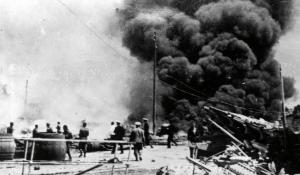
Just two days after Morón’s decree, the war struck Almería city directly from the air and sea for the first time. Around 12:00 PM on 7 November, a Nationalist seaplane had flown over Almería and dropped bombs targeting the city’s power plant (Fábrica de la Luz), gasworks, and the CAMPSA fuel depots, and the following day, the heavy Nationalist cruiser Canarias steamed within 400 metres of the western breakwater, right beside a German Non-Intervention Committee ship, and shelled the CAMPSA fuel depots, igniting massive fires and spreading panic across the port. In direct response to the 7–8 November attacks, municipal architect Guillermo Langle designed a massive network of underground air-raid shelters, with excavation work starting in December 1936 to protect the civilian population.
While fewer prisoners were being taken out to be shot in November and December 1936, hundreds of right-wing detainees, priests, and suspected Nationalist sympathisers remained packed inside the toxic, mineral-dust-coated holds of the Capitán Segarra and Astoy Mendi or in makeshift camps like Turón and Murtas. Winter cold, severe overcrowding, and poor sanitation caused widespread illness, while their families lined up at the docks daily to pass food baskets to relatives inside. By late November and early December 1936, Almería, cut off from normal overland trade with western Andalucia and hosting growing numbers of displaced people fleeing fighting in Granada and Málaga, began experiencing acute bread and fuel shortages, forcing local authorities to introduce strict rationing and price controls before the massive refugee wave of February 1937 arrived.
Because the massive underground shelter network was only just being planned and dug in late 1936, thousands of Almería city residents abandoned their homes every evening at dusk to sleep in rural farmhouses, nearby villages, or old mining caves in La Chanca and beneath the Alcazaba. At night, the city enforced strict blackouts, leaving streets pitch-dark. Unlike later in the war, basic food (fish from the port, vegetables from the vega, and grain arriving by sea) was still available in late 1936, the immediate crisis was that currency had stopped circulating normally. People hoarded silver coins, forcing municipalities and unions to issue local paper vouchers. Locals had to spend hours standing in ration queues for bread, olive oil, sugar, and coal, while authorities imposed price ceilings to stop hoarding, in between finding hiding places in the night.
Daily life looked visually unrecognisable from six months earlier. Trade unions (CNT and UGT) had collectivised farms, fishing boats, transport, and workshops. Every church in the province was closed, converted into warehouses, union halls, schools, or makeshift prisons. Religious processions, church bells, and public Catholic rituals vanished overnight. In the streets, traditional titles like Don or Señor disappeared, replaced by Comrade or Salud. Blue worker overalls became common street wear, and bourgeois families hid any outward signs of wealth to avoid drawing suspicion from militia patrols.
For hundreds of conservative, middle-class, and Catholic families in Almería, daily life in November and December 1936 centred on the port and makeshift jails. Every day, wives, mothers, and children lined up along the docks carrying baskets of food, clean clothes, and blankets to pass to husbands, fathers, and brothers imprisoned aboard the steamships Capitán Segarra and Astoy Mendi or inside the Adoratrices convent. While Civil Governor Gabriel Morón’s 5 November decree drastically curtailed the night-time firing squads, dropping clergy deaths from 13 in October to just 2 in November and 4 in December, isolated atrocities still occurred in rural towns (such as the murder of two cathedral priests on 8 December and Carmen Godoy in Adra on New Year’s Eve), keeping conservative families in constant fear.
While men were mobilised for the front or working in collectivised industries, women in Almería took on visible public roles, running neighbourhood supply committees, sewing uniforms in union workshops, staffing refugee aid kitchens, and organising literacy and childcare drives through groups like Mujeres Libres and the Agrupación de Mujeres Antifascistas. Women’s organisations in Almería transformed from small political clubs into the backbone of the civilian home front, organising war production, refugee aid, literacy classes, and food distribution while navigating sharp ideological divides. Because Almería remained in Republican territory, women experienced the exact opposite of what was happening in Francoist Huelva and Seville; instead of being driven out of public life and barred from working, working-class women were actively mobilised into public leadership and war work.
Agrupación de Mujeres Antifascistas (AMA — Association of Antifascist Women) were linked primarily to the Communist Party (PCE) and Socialist (PSOE/UGT) networks, the AMA was the largest women’s organisation in Republican Spain, with an active provincial committee in Almería city and local branches in towns like Cuevas del Almanzora, Berja, and Vélez-Rubio. They set up sewing and knitting workshops in confiscated buildings where hundreds of Almerían women produced winter coats, boots, blankets, and uniforms for Republican soldiers freezing on the Madrid and Granada fronts. In late 1936, AMA members staffed auxiliary military hospitals, organised blood drives, and ran nurseries and soup kitchens for displaced families arriving from Málaga and Granada.
Mujeres Libres (Free Women), the autonomous anarcho-feminist organisation aligned with the CNT-FAI could flourish, because Almería had a strong anarchist movement (especially in the port, fishing, and agricultural sectors). Mujeres Libres quickly established groups in Almería capital and rural villages. Mujeres Libres argued that defeating fascism meant nothing if women remained enslaved at home or treated as second-class citizens by male union members. Their goal was to free women from what they called the triple enslavement to ignorance, to capital, and to men. Recognising that illiteracy kept working-class women trapped in low-paid domestic work, Mujeres Libres ran evening literacy classes, basic math, hygiene, and childcare workshops, as well as technical training so women could take on skilled trades in transport, health, and collectivised workshops. They campaigned for maternal healthcare, sex education, and dignity for working-class mothers, challenging centuries of Catholic social control.
Across Almería’s vega (farmland) and coastal towns, women joined UGT and CNT collectives, harvesting grapes, oranges, and esparto grass, running cooperative bakeries, and serving on neighbourhood supply committees that managed rationing in November and December 1936. Even in Republican Almería, women still fought an uphill battle against traditional sexism. Male union leaders often expected women to stick to feminine wartime roles (sewing, nursing, cooking, and fundraising) rather than holding top seats on municipal councils, and women were frequently paid lower daily wages than men for the exact same agricultural work, a gap Mujeres Libres and the AMA fiercely protested.
By late 1936, Almería province was already hosting up to 57,000 refugees (alongside a local population of 358,000), with roughly 10,000 registered inside Almería capital alone. According to research by Almerían historians Eusebio Rodríguez Padilla and Juan Francisco Colomina Sánchez, between October and December 1936 waves of displaced families arrived from Madrid (evacuated during the November siege), Granada (including abandoned school colonies from Almuñécar), Córdoba, and Málaga. Because Almería had no purpose-built refugee camps, municipal authorities, trade unions, and aid committees (Socorro Rojo Internacional and women’s committees) housed them across every available space in the city and surrounding towns:
Authorities seized the Gran Hotel Continental on Calle Marqués de Heredia (housing 300 people) and the bourgeois mansion Chalet Batlles (today Almería’s City Hall), alongside smaller inns and boarding houses. Displaced families were billeted inside confiscated churches and convents, including the Convent of Las Claras and the Cathedral, as well as the School of Arts, the Carabineros Barracks on Calle de la Reina, and the Bodegas El Patio on Calle Real.
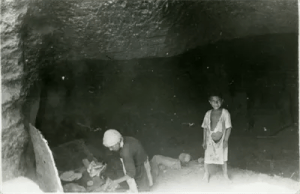
Thousands of poorer refugees lived in natural and man-made caves around the Alcazaba and the La Chanca–Pescadería hillside neighbourhood, as well as inside the mineral loading pier f the Compañía Andaluza de Minas. All vacant private houses in the city were confiscated for refugee families, while hundreds of displaced children and mothers were sent out to rural estates (such as the Cortijo de los Torrecillas, which housed over 250 people) and distributed across inland towns and villages where local families took them in.
The refugees arriving in Almería between October and December 1936 were the first living witnesses to bring direct, personal testimony of what had happened inside the Nationalist zone, telling neighbours, union halls, and local newspapers (Adelante, Lucha, and Diario de Almería) about the mass executions in Granada (including the thousands of workers at the Víznar ravine), the purges in Córdoba and Seville, and the terror bombing of Madrid. Hearing these stories sparked an outpouring of solidarity across Almería, with women’s groups, unions, and Socorro Rojo Internacional organising donation drives, soup kitchens, and host families for orphaned children.