- Madrid
The final week of November 1936 marked a major turning point in Madrid’s civilian crisis; the transition from chaotic, spontaneous flight to organised, state-directed mass evacuation by the Junta de Defensa de Madrid, alongside acute housing, food, and shelter emergencies caused by hundreds of thousands of internal refugees.
Before the November assault even began, Madrid’s pre-war population of roughly 1 million had swollen by 400,000 to 500,000 internal refugees fleeing the Nationalist advances through Extremadura, western Andalucía, and Toledo during August–October 1936. When Nationalist troops reached the western suburbs and the Condor Legion firebombed residential districts in mid-November, panic triggered a massive, uncoordinated civilian flight. By the final week of November 1936, over 250,000 women, children, and elderly residents, roughly one-fifth of the city’s population, had already fled eastward toward Valencia and Catalonia.
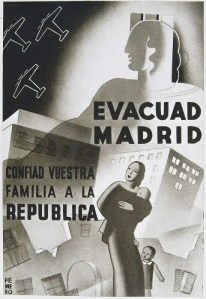
Because spontaneous flight clogged military supply roads and strained rail capacity, the Junta Delegada de Defensa de Madrid (established after the Republican government relocated to Valencia on 6 November) formalised a dedicated Evacuation Department (Consejería de Evacuación), working with the Red Cross, International Red Aid (Socorro Rojo), and labor unions, to register non-combatants and move them systematically by train and truck to Levante provinces of Valencia, Alicante, Murcia, Castellón, and Albacete. Once the direct frontal assault stalled in University City around November 23–25, voluntary departures slowed down immediately, forcing the Junta de Defensa to launch an aggressive propaganda and administrative campaign at the end of November urging non-essential civilians to leave so the remaining garrison could be fed.
By the last week of November, thousands of families whose homes in working-class districts, such as Argüelles, Rosales, Usera, Carabanchel, and Tetuán, had been destroyed by aerial incendiary bombs or frontline artillery were living permanently underground inside Madrid Metro stations (such as Sol, Gran Vía, and Goya) and basements, creating severe sanitation and public health challenges as winter temperatures set in.
To house refugees displaced from the western front lines and bombed neighbourhoods, the Junta de Defensa and local union committees requisitioned abandoned upper-class apartments and palaces in central and eastern districts, such as Salamanca, moving working-class families and rural refugees from Extremadura and Toledo into emptied residences.
With main highway and rail arteries from the west and south cut off, leaving only the Valencia road open as Madrid’s lifeline, the final week of November saw severe shortages of coal, firewood, milk, and bread, forcing municipal authorities to tighten rationing systems and prioritize food distribution for frontline troops and children’s colonies. By the end of November 1936, over 250,000 non-combatants, primarily women, children, and elderly residents, representing roughly one-fifth of Madrid’s swelled wartime population, had left the capital for Valencia, Alicante, Murcia, and Catalonia, and roughly 200,000 additional evacuees left between December 1936 and February 1937 after the late-November slowdown.
By the final week of November 1936, Madrid’s hospital system was operating past maximum capacity under active bombardment, forced to convert hotels, convents, and schools into emergency blood hospitals after its largest modern hospital became a battlefield. On 17 November, Moroccan Regulares and Spanish Legionnaires breached the massive, newly built Hospital Clínico San Carlos in University City, turning its wards, operating rooms, and stairwells into the epicentre of hand-to-hand trench warfare through late November. Because the Hospital Clínico and the nearby Asilo de Santa Cristina were lost to combat, Madrid’s medical services had to absorb thousands of casualties into older, central facilities that were themselves within range of Nationalist artillery.
Remaining major hospitals, such as the Hospital Provincial de San Carlos (in Atocha, now the Reina Sofía Museum) and the Hospital Obrero de Maudes (in Cuatro Caminos), received continuous waves of both military casualties from the western suburbs and civilian victims pulled from bombed apartment blocks. At Maudes, staff had to excavate underground tunnels connecting the wards to nearby air-raid shelters so patients could be wheeled underground whenever sirens sounded. By late November, Madrid had mobilized roughly 6,000 hospital beds across the city, supplemented by requisitioned hotels (such as the Palace and Ritz), schools, and convents converted into makeshift surgical wards by the Ministry of War, the Red Cross, International Red Aid (Socorro Rojo), and union committees.
The Republican military health service had lost most of its pre-war army medical corps in the July coup and possessed only around 60 dedicated ambulances across the entire front, forcing hospitals to rely on requisitioned city taxis, delivery vans, and open-bed trucks to move wounded soldiers and civilians from classification posts to operating theatres. Surgical teams faced acute shortages of anaesthetics, catgut sutures, sterile gauze, X-ray film, and stretchers. Because beds filled immediately after each artillery barrage, surgeons were forced to practice rapid triage, performing only life-saving emergency operations (such as stopping haemorrhages, abdominal surgery, and guillotine amputations) before loading stabilised patients onto evacuation trains bound for Valencia and Alicante to free beds for incoming casualties. Because shrapnel and street-fighting wounds in Madrid’s dirt trenches rapidly developed lethal infections, medical authorities established a dedicated 250-bed gas gangrene hospital in the capital by late 1936, achieving a 75 percent recovery rate despite daily shelling.
- Mahora, Albacete, Murcia (Castilla La-Mancha)
On 25 November, a contingent of 400 International Brigade volunteers marched out of the rural training camp in Mahora, the small town 28km north of the International Brigades’ central headquarters in Albacete, bound for the besieged Madrid front. Organized provisionally as the Franco-Belgian 7th Battalion (Batallón nº 7), the men were dispatched to replenish the XI International Brigade, whose frontline battalions had been decimated during two weeks of ferocious street-to-street and campus fighting in Madrid.
By late November, following relentless close-quarters combat in the Casa de Campo and the University City, the XI Brigade had lost roughly half of its original 1,900 men to death, wounds, and exhaustion. The Commune de Paris battalion, which bore the brunt of the defence around the Faculty of Philosophy and Letters and the Casa de Velázquez, was particularly depleted and urgently needed French-speaking replacements to remain combat-effective. The 400 men from Mahora functioned as a structured reinforcement draft. Upon reaching the Madrid sector, the contingent was broken up and absorbed directly into the surviving ranks of the XI International Brigade, primarily bolstering the battered Commune de Paris battalion alongside other French and Belgian-speaking companies. Their arrival on the front lines allowed the exhausted survivors of the November 8–23 defensive battles to hold the stabilized trench lines in University City through the brutal winter of 1936–1937.
- Jaca, Huesca, Aragon
In the high Pyrenees of Aragon, the municipal cemetery of Jaca holds six vast zones of collective burials containing the remains of at least 312 people murdered by Nationalist insurgents during the Spanish Civil War. Many of those wartime trenches now rest beneath newer family plots, rendering them, for all practical purposes, unreachable.
In the section catalogued as Mass Grave 4, historical records confirm the presence of Modesto Campo Lacasta, a 36-year-old tailor from the neighbouring village of Castiello de Jaca. He was killed in the early hours of 25 November 1936. Civil registries show five other local men were executed alongside him – Antonio Escar Gracia, an 18-year-old day labourer from Jaca; Ignacio Lacasta Sierra, a 19-year-old musician; Ángel Lledó Rodríguez, from the nearby town of Berdún; and two fellow Jaca residents, Manuel Mayayo Aznárez and Manuel Oncíns Grasa. Because their deaths were logged together, historians suspect all six were victims of the same execution detail and buried side by side, though without forensic excavation, though technically they could be in any of the Jaca pits.
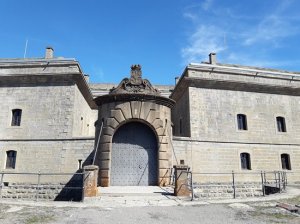
Six years earlier, in December 1930, Jaca had been the cradle of a premature military uprising against the monarchy, and in April 1931, it became the first municipality in Spain to hoist the flag of the Second Republic. When Nationalist forces seized the town in July 1936, the retaliation against Jaca’s working class and Republican community was swift. Throughout the autumn of 1936, arrests filled Jaca’s old district jail, its seminary, and the imposing stone barracks of Fuerte de Rapitán on the hill above town. In the dead of night, trucks would arrive for sacas. Archival death records place all six at Fuerte de Rapitán on the day they died, tying their final hours directly to the fortress’s grim wartime role. Today, a memorial sculpture in the Jaca cemetery, created by the local Círculo Republicano, inscribes the names of the comarca’s victims onto the landscape.
- Etxauri, Navarra
The mass execution of November 25, 1936, in Etxauri was one of the deadliest episodes of political repression in Navarre during the Spanish Civil War. Nineteen prisoners, all residents of the town of Falces, were removed from the Provincial Prison of Pamplona, driven to the abandoned old cemetery of Etxauri, shot, and buried in a mass grave.
The nineteen men killed at Etxauri on November 25 represented the political leadership and working-class backbone of Falces, a population of 2,900 inhabitants. The town lost 31 locals to repression, 19 on one night in Etxauri.
- Eugenio Eduardo Biurrun Napal, 52, bricklayer and mayor of Falces.
- Jesús Mendaza Torres, town councillor.
- Teodoro Jiménez Juguera, municipal employee.
Recaredo Biurrun Alemán, 22, bricklayer. - José Preciado García, 50, self-employed farmer.
- Melchor Armendáriz Resano, 32, Nicolás Alfaro Jiménez, 42, José García Abaurre, Francisco Ibáñez Egea, and Julián Jaime Navarro, all day labourers.
- Adolfo Fernández Martínez and his brothers, Agustín Fernández Martínez and José Fernández Martínez, and their cousin, Teodoro Taínta Martínez, all day labourers.
- Luis Moreno Rincón and his cousin Eladio Rincón Moreno, and their cousin Ignacio Moreno Martínez, all day labourers.
- Demetrio Juguera Allo and his cousin Marcelino Laguardia Allo, both day labourers.
In Falces, as in neighbouring towns across the Ribera region, local authorities, union members, and progressive neighbours were rounded up and imprisoned in Pamplona. The 25 November killing at Etxauri, 13km west of Pamplona, was repeatedly chosen as a killing ground. Its old cemetery, which had been out of regular use since the early 20th century, offered a secluded site where bodies could be hastily buried out of public sight. Between 1936 and 1937, at least 51 prisoners were murdered and buried there.
For nearly four decades under Francisco Franco’s dictatorship, the mass graves at Etxauri remained officially unacknowledged. Following Franco’s death in 1975, families from Falces, Caparroso, and Lerín organised early exhumations grassroots efforts conducted without state forensic support to recover their loved ones and give them proper burials in their hometown cemeteries. While relatives from Falces managed to recover several bodies from the 25 November massacre, the lack of systematic archaeological protocols meant that many skeletal remains were left behind in the soil.
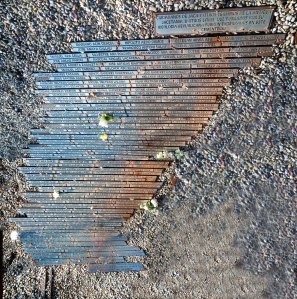
In the decades that followed, the old cemetery of Etxauri was demolished and built over during local urban development. When forensic experts and the Government of Navarre conducted an official assessment of the site in April 2017, documented in RTVE’s Fosas de Navarra, they confirmed that the urbanisation had permanently destroyed the burial grounds, making any future archaeological recovery impossible. Today, the site is remembered through the Parque de la Memoria de Etxauri, established near the former cemetery by the local council and officially designated as a Place of Historical Memory by the Government of Navarre in 2019. A stone monolith created by sculptor Pello Iraizoz stands at the park to honour the victims whose remains were lost to the demolition.
- Cartagena, Murcia
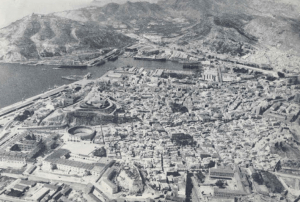
The Bombardeo de las cuatro horas (Four-Hour Bombing) on 25 November 1936, was a devastating aerial assault on Cartagena during the Spanish Civil War and marked the operational debut of Germany’s restructured Condor Legion, which had been operating as multiple independent units until now. Designed to cripple the Republican Navy’s primary base and block incoming Soviet arms shipments, the four-hour attack largely missed its military objectives, instead inflicting heavy civilian casualties, widespread urban destruction, and deep psychological trauma across the port city.
The raid began just before dusk at approximately 5:30pm and continued in relentless waves until 9:30m. After initial high-explosive runs targeted the port and rail infrastructure, subsequent waves dropped incendiary bombs to illuminate the city for night-time passes.
For four straight hours, air-raid sirens, anti-aircraft fire from the surrounding hills and harbor ships, and the detonation of roughly 25 tons of ordnance echoed continuously across the city. Because Cartagena still lacked its later network of rock-cut tunnels, thousands of residents spent the night huddled in makeshift basements and hastily dug shelters.
Despite targeting strategic military sites, the high-altitude night passes scattered bombs across working-class neighbourhoods and public transit hubs, resulting in severe human losses. Official historical counts recorded at least 58 civilians killed and dozens more gravely wounded. One of the single deadliest strikes hit directly beside the railway station just as a commuter train bound for La Unión was preparing to depart, killing and maiming numerous passengers. The sustained terror of the four-hour bombardment broke the city’s sense of security. Beginning that very night, thousands of families fled Cartagena for surrounding rural districts (Campo de Cartagena), Mazarrón, and the Mar Menor, a larger single-event displacement than any other raid during the war.
Neither the Republican fleet anchored in the bay nor the shipyards of the naval Arsenal suffered decisive damage, and port operations for Soviet supply vessels resumed shortly afterward. Heavy impacts struck the Alfonso XII commercial pier, the Santa Lucía waterfront district, and the railway station. Bombs tore through residential blocks and shops in the city centre, including Calle del Duque and Puertas de Murcia, where commercial storefronts and the Hudson garage were destroyed. In the working-class neighbourhood of San Antón, a night-time strike demolished the local Republican social centre (Centro Republicano) and surrounding homes, causing multiple fatalities. Shrapnel and blast waves scarred historic facades across the old town, including the medieval Cathedral of Santa María la Vieja, whose ruins still bear marks from the war’s aerial bombardments.
The 25 November raid altered daily life in Cartagena. Recognizing that anti-aircraft batteries alone could not shield the population from night raids, municipal authorities and local miners began excavating dozens of deep subterranean air-raid galleries into the city’s hills in early 1937, most notably the massive shelters beneath Cerro de la Concepción on Calle Gisbert, capable of holding over 5,000 people during the more than 100 air raids Cartagena endured before the war’s end.
- Logroño (La Rioja)
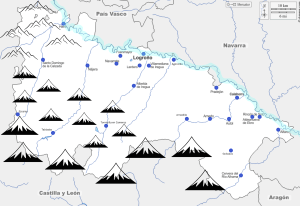
La Barranca (historically the barranco de Barrigüelo) is a ravine located within the municipal boundaries of Lardero, approximately five kilometres south of Logroño, the provincial capital of La Rioja. Situated in the Iregua river valley immediately adjacent to both Lardero and Logroño, the site functioned from September to December 1936 as the primary execution and mass burial ground for detainees held in Logroño’s makeshift prisons, such as the Frontón Beti-Jai, the Provincial Prison, and the Escuela Industrial, after the municipal cemetery in Logroño reached capacity. In total, 407 people were buried in the common grave at La Barranca during this period.
All 24 men executed at La Barranca across the nights of 25 and 26 November 1936, were residents of Villamediana de Iregua, a municipality situated roughly five kilometres southeast of Logroño. At the time of the 1930 census, Villamediana had a registered population of 1,500 inhabitants, making it a compact rural community whose economy relied almost entirely on irrigated agriculture, viticulture, and day labour on surrounding estates and wineries. Because Villamediana sat on the immediate periphery of the provincial capital, its workforce was heavily integrated into Logroño’s labour and political networks. During the Second Republic, the town developed a strong presence of the CNT and UGT alongside local Republican organisations, resulting in a left-leaning municipal government.
On 25 November 1936, nine victims were taken from the prison to be killed –
- Pedro García García, 44, was Republican Mayor of Villamediana de Iregua. His wife and eldest son were also detained; his wife later became one of the founding Mujeres de Negro who kept the memory of La Barranca alive.
- Cándido Lasanta Pascual, 19, farm worker, member of the CNT, who managed t sent a letter from prison, asking his parents to care for his pregnant 17-year-old fiancée.
- Félix Martínez Sáenz, 25, farm worker, whose brother Daniel was also murdered in a separate killing.
- Francisco Fernández Sotés, 57, Hermenegildo Martínez Fernández, 32, Martín Mena Vicente 39,Eloy Patricio Santolaya Martínez, 20, Prudente Sarabia Ruiz, 32, Alivio Toyas Martínez, 28, all local day labourers.
On 26 November, another 15 victims were taken –
- Germán Albelda Ubis, 20, teaching student and secretary of the Ateneo Cultural, a local educational and cultural centre.
- Ignacio Bretón Chandro, 40. He was the brother in his family to be murdered; his brothers Segundo, 42, and Fermín, 34, were executed in July and August 1936.
- Pedro Bretón Jaén, 40. His grandson Pedro Navarro later testified to visiting the trench as a five-year-old.
- Demetrio Díaz Ibáñez, 40, and cousin, Florencio Díaz Sáenz, 42, both farm workers.
- Pascual Pascual Pascual, 26, and cousin Germán Lapuente Pascual, 21, both day labourers.
- Nicolás Benito Zapata, 25, Basilio Flaño Díez, 19, Alberto Pascual Díez, 20, Cirilo Miranda Chicote, 26, all farm workers.
- Alfonso Ibáñez Aréjula 19, farm worker and mason.
- Godofredo Santolaya Marín, 34, farm worker and a board member of the Izquierda Republicana in 1935.
- Lucio Vallejo García, 39, farm worker, executed alongside his younger brother Restituto Vallejo García; their brother Estanislao, 24, had already been murdered at the Viguera tunnel in August.
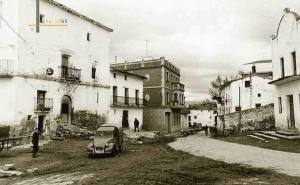
The loss of 24 men in 48 hours accounted for roughly 40 percent of Villamediana’s total wartime death toll. Over the course of the repression, 61 residents of Villamediana were executed, the highest per-capita execution rate of any municipality in La Rioja. The executions across 1936 left 64 women widowed (and up to 100 children fatherless) in a town of roughly 350 to 370 households, a demographic shift so pronounced that Villamediana became regionally known as The Village of Widows. Under the subsequent Francoist administration, the surviving families faced systematic economic hardship, asset seizures, and exclusion from local public employment, forcing widows and older children into subsistence agricultural work. At the same time, the women of Villamediana formed the core of the group later known as las Mujeres de Negro, who maintained regular visits to the unmarked trench at La Barranca throughout the dictatorship despite official prohibition and fines, eventually securing the preservation of the site as a civil cemetery in 1979.
The repression in the province of Logroño stands out in historiography for both its extreme per-capita intensity in a non-combat zone and its deep, long-term socioeconomic restructuring of the province. According to regional historical studies, especially the work Aquí nunca pasó nada: La Rioja 1936, coordinated by Jesús Vicente Aguirre, and databases from the Asociación La Barranca, several factors make La Rioja’s experience different from everywhere else.
Logroño was a small province (roughly 203,000 inhabitants in 1936) and despite zero resistance to the uprising, more than 2,000 people were executed—roughly 1 percent of the entire provincial population. Logroño’s repression was heavily concentrated along the fertile Ebro River corridor and the lower valleys of its tributaries such as the Iregua, Najerilla, and Cidacos. Towns with strong agricultural unions and Republican majorities, like Villamediana de Iregua, Cenicero, Fuenmayor, Alfaro, Haro, and Calahorra, bore a disproportionate share of the death toll, while conservative, smallholding mountain districts saw far fewer executions.
Because Logroño consisted of small, interconnected rural communities, denunciations, arrests, and executions were rarely carried out by anonymous outsiders. Victims were always identified by local neighbours, landowners, clergy, or municipal rivals, and taken to execution sites just kilometres away, like La Barranca (Lardero), the Viguera tunnel, the bridges over the Ebro, or local cemetery walls. Across most of Spain, mass graves were either paved over, built upon, or left abandoned until the 21st century. In La Rioja, the widows, mothers, and daughters of the 407 men buried at La Barranca maintained an unbroken, visible presence at the ravine throughout the 40 years of the Franco dictatorship, defying Guardia Civil harassment and fines to tend the site. Because of their persistence, La Barranca was officially consecrated as a civil cemetery in 1979, making it one of the earliest and best-preserved mass grave memorials in Spain.
Before July 1936, Logroño possessed a vibrant, well-organised working class centred on viticulture, canning factories, and irrigated agriculture, with high membership in the CNT and UGT. The physical elimination of over 2,000 union organisers, Republican mayors, councillors, teachers, and skilled workers erased a generation of civic and labour leadership, neutralising labour movements in the province for decades (since women were already shut out of that). The Nationalist regime successfully promoted the narrative that Logroño had been a peaceful, monolithically conservative region untouched by the war, a myth captured in the title of Aguirre’s landmark history, Aquí nunca pasó nada (Nothing ever happened here). For decades, public acknowledgment of the 2,000+ executions was suppressed, creating an intense local taboo even compared to neighbouring regions.
In small municipalities, the sudden loss of working-age men created severe demographic imbalances (such as Villamediana’s 64 widows). Under the Ley de Responsabilidades Políticas, surviving families faced property confiscations, crushing fines, and blacklisting. These women were not housewives, all women worked. In towns like Villamediana and across the Ebro valley, women worked alongside men in seasonal farm labour, vineyards, and canning plants, while also managing household economies. However, their wages were legally a fraction of men’s wages, meaning a family’s subsistence depended on two wages, though children from the age of 10-12 could also work alongside their mothers to earn another wage. Because authorities refused to register executions as death, widows were left in legal limbo, unable to access the limited charitable relief, ration allocations, or wartime subsidies distributed to Nationalist widows, and barred from remarrying or settling basic property matters, just to make things harder.
Combined with post-war economic hardship, the social stigma and lack of opportunities contributed to heavy rural depopulation in Logroño’s smaller towns during the 1950s and 1960s, as families migrated to Logroño, the Basque Country, or Zaragoza to escape local surveillance and reputational ostracism. In a booming industrial city or a larger urban neighbourhood, employers hired workers without knowing their village family history. Women and children could find factory work, domestic service, or construction jobs based on availability rather than being automatically turned away by a local landowner who knew their executed husband or father. In a village, families of the executed lived side by side with the neighbours who had denounced or shot their relatives. Leaving town broke that daily psychological and social pressure, allowing children to grow up without being singled out at school or in the street as ‘children of the shot man.’ Moving did not erase official state records. Any job requiring a certificado de buena conducta (certificate of good conduct), such as civil service, municipal work, or certain regulated industries, still required sign-off from the Guardia Civil and parish priest of the person’s hometown. Likewise, pending fines or asset seizures under the Ley de Responsabilidades Políticas followed families across provincial lines.
Historians of the Spanish Civil War and the Francoist dictatorship, such as Peter Anderson, Conxita Mir, Ángela Cenarro, and Julián Casanova, have extensively studied both perpetrator psychology and the role of civilian denunciations, including those made by women.
The archival record drawn from military tribunal files, post-war judicial archives, and oral history interviews shows a complex reality in which open expressions of guilt around denunciations and murders were rare, largely because the regime built an entire moral, legal, and religious framework to prevent perpetrators and informers from feeling guilty. Denouncing a leftist neighbour was presented not as betrayal or murder, but as a patriotic and Christian duty to cleanse the community. In small towns where denunciations were rampant, informing on a neighbour was sometimes a pre-emptive move to prove one’s own loyalty to the new regime, especially for families with borderline or ambiguous political pasts, though even then, guilt appears near-invisible.
While Nationalist women did not serve on firing squads or sit on tribunals, archives show that Nationalist civilian women played a major role as informers and witnesses in post-war denunciations, often targeting other women as well as men. Historians note several dynamics behind female denunciation. Under Francoism, women were assigned the role of guardians of traditional Catholic morality. Women frequently denounced female neighbours not only for pre-war union or Republican activity, but for perceived moral transgressions, such as civil marriages, wearing pants, cutting their hair short, failing to attend Mass, or speaking openly in public.
Because the regime solicited denunciations from ordinary citizens to fill out tribunal files, everyday village conflicts, disputes over inheritance, land boundaries, unpaid debts, romantic rivalries, or family feuds, were routinely repackaged as political accusations. Some women who denounced neighbours were widows or mothers of right-wing victims killed in the Republican zone during the first weeks of the war, viewing their denunciations as legitimate vengeance rather than a source of remorse.
During the 40 years of the dictatorship, and through the Transition, public apologies or admissions of guilt from informers or executioners were virtually non-existent. Because Francoism never faced a reckoning or truth commission, informers remained respected members of their towns, and admitting guilt meant admitting to murder or complicity in murder. What does appear in oral histories and local testimonies from villages in La Rioja, Aragon, and Andalucía are isolated, private cracks in that armour, like elderly informers who refused to leave their houses in later life, former members of firing squads who suffered severe alcoholism or psychological breakdowns, or individuals who asked parish priests or family members for forgiveness on their deathbeds, often begging their children not to repeat what they had done, without ever making restitution or even accepting blame.
More common than guilt among the original perpetrators was shame or denial among their children and grandchildren decades later, when local historians began publishing the names of both the victims and the signatories on the archival denunciations. Children and grandchildren of informers or perpetrators had zero involvement in the crimes of 1936, yet they inherited the social stigma, family secrets, and moral burden of actions their parents or grandparents refused to acknowledge. In small towns where everyone knew which families had signed denunciations or taken part in sacas, descendants were often caught between defending their relatives’ memory out of filial loyalty and confronting archival proof of what those relatives had done to their neighbours. After all, you would have to go school with the children who have no father, because your own father shot him and got away with it (if that child did not leave school to work in the fields or the laundry rooms to prevent starvation). Contemporary Spanish historical memory initiatives emphasise that criminal and moral responsibility is strictly individual, it dies with the perpetrator, while historical truth belongs to the community. Separating those two is the only way to relieve descendants of a guilt that was never theirs to carry, while still restoring the names and dignity of the victims.
Historians of gender and Francoist repression such as Pura Sánchez, Maud Joly, and Mirta Núñez Díaz-Balart show that Nationalist authorities viewed men and women through ideological lenses. Nationalist commanders and local Falangists operated under a deeply traditional Catholic view that denied women full political or intellectual agency. Unless a woman was a prominent union leader, teacher, politician, or militiawoman, authorities often viewed her political activity as merely following her husband or father, meaning executing the man was seen as sufficient to neutralise the household’s threat.
Francoist ideologues, including psychiatric theorists like Antonio Vallejo-Nágera, viewed women primarily as biological vessels for repopulating Spain and raising future generations. Rather than shooting every leftist woman, the regime favoured re-educating or breaking them through imprisonment, Catholic indoctrination, and, in thousands of cases, seizing their infants and children to be raised by Nationalist families or religious institutions.
Even among hardened perpetrators, mass firing squads of large groups of women carried a higher risk of social backlash in conservative rural towns than executing men. Though women were certainly shot in mass graves, they typically accounted for roughly 2-5 percent of total execution victims nationwide, depending on the province.
Rather than mass sacas, the regime subjected tens of thousands of women to gendered repression designed to strip them of bodily autonomy, social standing, and maternal rights. Women’s prisons such as Ventas in Madrid, Saturrarán in the Basque Country, and Les Corts in Barcelona held tens of thousands of women in lethal overcrowding, where disease and starvation killed thousands without a single bullet fired. In small towns like Villamediana or Jaca, women suspected of Republican sympathies were routinely subjected to head-shaving, forced ingestion of castor oil, and being paraded through the streets, punishments specifically engineered to destroy their femininity and social dignity in front of neighbours while leaving them alive as visible warnings to the rest of the town.
The women who were executed, such as the Trece Rosas in Madrid, or local union organisers, schoolteachers, and pregnant women shot in provincial ravines, were often targeted specifically because they had stepped outside traditional female boundaries by speaking publicly, organising workers, or holding civic authority. So while women were rarely swept up in the large all-male truckloads sent to ravines like La Barranca on a single night, it was not because they were spared, it was because the regime chose public humiliation, prison, economic destitution, and child separation as its primary weapons against them.
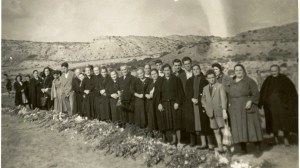
In La Rioja (which became its name in 1982) , 17 of the 45 to 47 registered mass graves have been exhumed (roughly 36-38 percent), leaving 28 to 30 graves unopened, though the province’s largest burial site, La Barranca, has been intentionally left unexcavated by choice of the families. Because the Mujeres de Negro defended the ravine throughout the dictatorship and converted the entire site into a consecrated Civil Cemetery and Memorial in 1979, the Asociación La Barranca and the victims’ families decided collectively to leave the 407 men resting together undisturbed in their dedicated memorial cemetery rather than excavate the trenches. (By contrast, the association actively supports excavating isolated roadside ditches elsewhere in the province so those victims can be moved to dignified graves.)
Unlike provinces where exhumations began in the 2000s, La Rioja experienced a major wave of grassroots, family-led exhumations between 1978 and 1981, immediately following Franco’s death. Armed with picks, shovels, and local municipal permissions, but zero state forensic funding, families opened numerous rural roadside ditches and village graves, such as the grave at El Carrascal de Villarroya, where 29 victims were recovered, to transfer their relatives into local municipal cemeteries. For the 28 remaining unopened roadside and rural graves, memory groups have criticised slow regional administration. In 2025, for example, La Rioja forfeited national Democratic Memory exhumation funds because the regional government (led by the conservative PP) failed to spend the prior year’s allocated budget, leaving pending excavation requests, such as a grave of Iregua Valley victims, stalled. While there is little open hostility toward memorialisation in Logroño or Lardero, families searching for unmarked ditches in smaller Ebro Valley towns report the same quiet obstacle seen across rural Spain: elderly witnesses who know the exact location of 1936 burial pits often remain reluctant to speak publicly out of fear of reviving neighbourly friction in tight-knit villages.
Early excavations had ceased abruptly after the failed 23 February 1981 coup attempt, 23F, when fear of retaliation returned. The 1978–1981 excavations were unprotected, grassroots actions carried out in small rural towns where the local power structures of the dictatorship were still intact. While 23F chilled historical memory work across Spain, its impact in La Rioja, where families had been opening ditches at an extraordinary pace since 1978, was abrupt. When Lieutenant Colonel Antonio Tejero stormed the Congress of Deputies on 23 February 1981, families realised instantly that if the military seized power, the names of every person who had signed an exhumation permit or dug up a ditch would serve as an immediate arrest list.
Because La Rioja was a province of small, tight-knit agricultural towns (1,000 to 5,000 inhabitants) that had fallen without combat in July 1936, the local perpetrators, informers, and Civil Guard commanders were still living down the street. In 1979–1980, opening a roadside grave meant physically confronting the local hierarchy that had ruled the village unchallenged for forty years. On the night of 23F, families watched conservative neighbours celebrate or quietly prepare for a return to authoritarian rule, proving how fragile their safety was in isolated rural communities.
In La Rioja, people remembered how fast July 1936 had unfolded. Logroño and its surrounding towns fell within 48 hours, with zero military front, and mass arrests began immediately. Seeing tanks on the streets of Valencia and troops occupying the parliament in Madrid triggered an immediate, visceral survival reflex among elderly widows and their children, many of whom had already survived one sudden military takeover. Even after the coup failed the next morning, the shock of 23F fundamentally altered Spain’s political climate. Both the governing UCD and the Socialist Party (PSOE), which won power in 1982, concluded that stirring up Civil War graves risked provoking the military and destabilising Spain’s young democracy. Informal municipal approvals dried up, national authorities offered zero support for excavations, and the silence returned for nearly twenty years until the modern historical memory movement emerged in 2000. As historian Jesús Vicente Aguirre documented in Aquí nunca pasó nada, families in La Rioja literally put down their shovels on 23F, and did not pick them up again for two decades.
- Palencia Province
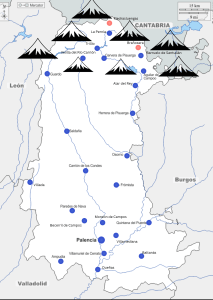
Palencia province followed the same overall pattern as Logroño, a rapid Nationalist takeover followed by systematic rear-guard purges, but had a striking exception regarding women. While women elsewhere were rarely rounded up in large groups for mass execution, Palencia is the site of one of Spain’s most notorious mass shootings of women. On a single night in September 1936, 25 women from the nearby town of Dueñas were pulled from their homes in front of their children, taken to jail, and executed the following day. In 2009–2010, the ARMH exhumed the remains of 11 of those women alongside two men from Dueñas. Dueñas was an active agricultural and industrial hub with strong socialist and union organisation. Unlike in towns where executing male heads of household was deemed sufficient, local Falangists and landowners in southern Palencia treated politically active working-class women, many of whom had participated in strikes, demonstrations, or Republican civic life, as direct targets for physical elimination.
Almost the entire province of Palencia fell to Nationalist insurgents within days of the July 1936 coup (with only a narrow northern strip along the Cantabrian mountains seeing a front line). As a result, the vast majority of the roughly 1.300-1,500 documented deaths in Palencia occurred through rear-guard executions. According to ARMH Palencia, roughly 80 percent of the victims executed between late 1936 and early 1937 were union organisers, mayors, municipal councillors, and agricultural or railway workers, concentrated heavily in the southern Tierra de Campos and Cerrato plains, from towns like Venta de Baños, Dueñas, Baltanás, and Villaviudas.
Just as Logroño’s detainees were dumped at La Barranca, hundreds of prisoners from Palencia’s provincial jail were executed and buried in mass trenches at the city’s old cemetery, now Parque de la Carcavilla, where 110 bodies were exhumed from a single trench, out of 66 registered mass graves across the province. Palencia’s main mass grave site at La Carcavilla was deconsecrated, levelled, and turned into a public park with playgrounds and sports courts, requiring major archaeological excavations in the 2000s and 2010s to recover remains from beneath the park grounds. Historians studying Palencia also note that the province’s prison and police records were heavily purged in the 1960s and 1970s, with many entry and exit logs destroyed to erase traces of the 1936 sacas.
Historian Pablo García Colmenares documents 1,322 victims of Nationalist repression in Palencia across the 1936–1945 period, of whom roughly 900 to 1,000 (70-75 percent) were killed between July and December 1936. Broken down by method, that total saw 867 paseos and sacas, virtually all carried out during the second half of 1936, 348 executions following the sham courts-martial (which began in late July 1936 and continued into the post-war years), and 107 deaths in prison from torture, starvation, and disease. Additionally, 19 victims of Republican violence were recorded during 1936 in the narrow northern mountain strip bordering Cantabria before it fell to Nationalist forces.
Palencia shared the core structure of rear-guard repression across Old Castile, but had several differing characteristics in its geography, targets, and post-war erasure. Palencia was split geographically with the southern plains, the Tierra de Campos and El Cerrato immediately in nationalist hands, while the northern mining basins around Barruelo de Santullán and Guardo resisted, leaving a narrow northern strip bordering Cantabria under Republican control. Repression in the south was immediate rear-guard cleansing, whereas the north experienced prolonged front-line warfare followed by intense post-occupation purges in 1937–1938. Roughly 100 women were murdered in Palencia during the early months of the war, an unusually high figure for a province of roughly 210,000 inhabitants. García Colmenares notes that only one of those women, Catalina Muñoz, was tried and sentenced by a sham military court.
Beyond agricultural day labourers, Palencia’s repression targeted two major industrial workforces; the coal miners of the northern mountains and the railway workers centred at Venta de Baños, one of northern Spain’s most critical rail junctions and a stronghold of the socialist UGT union. Execution squads in southern Palencia routinely transported prisoners across provincial lines into neighboring Valladolid or Burgos to dump bodies in roadside ditches, like taking twelve men from Hornillos de Cerrato across the border into Valladolid to shoot them along the L-111 highway, complicating civil death registrations and family searches. Before 1936, Palencia was dominated politically by conservative agrarian landowners (Acción Popular Agraria), challenged primarily by socialist unions in the capital, the mining valleys, Venta de Baños, and towns like Dueñas and Baltanás. Eliminating over 1,300 union organisers, mayors, teachers, and doctors permanently crushed organized agrarian and industrial labour, restoring unchallenged economic control to large estate owners across Tierra de Campos.
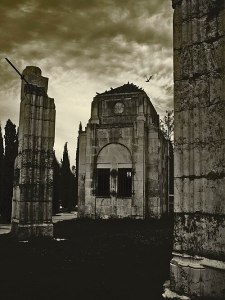
In Palencia province, 25 of the 66 registered mass graves have been exhumed, recovering the remains of only 287 victims, while 41 graves remain unopened. The largest excavation took place at the former cemetery, now Parque de la Carcavilla, in Palencia capital, where forensic teams from the Sociedad de Ciencias Aranzadi and the ARMH recovered 108 to 110 individuals across multi-year campaigns (identifying 57 through DNA and archival cross-referencing). Other high-profile recoveries include the Dueñas victims and 27 Palencia victims whose remains had been transferred to the Valle de los Caídos/Cuelgamuros in 1959 without family consent. Many of the 41 unopened graves, such as the Carcavilla III trench or roadside graves along widened highways, lie beneath paved urban parks, modern cemetery niches, or road infrastructure, making excavation technically difficult or impossible without major municipal works.
Public and institutional sentiment in Palencia mirrors the broader divide across Castilla y León and Spain, split along generational, familial, and political lines. For children and grandchildren of the victims, and local groups like the Asociación para la Recuperación de la Memoria Histórica (ARMH) de Palencia, exhumations are viewed strictly as a humanitarian duty and a race against time. Because the last surviving children of the 1936 victims are now in their late eighties and nineties, families express acute frustration over bureaucratic delays, emphasising that recovering bones for a proper burial is about closing a 90-year family wound rather than partisan politics.
While national funding under Spain’s 2022 Democratic Memory Law accelerated excavations, memory policies in Castilla y León have been politically contested. Conservative and far-right parties (PP and Vox) have frequently opposed Democratic Memory legislation, arguing that exhumations reopen old divisions, leading to recurring debates in Palencia over funding, the installation of memorial plaques at sites like La Carcavilla, and street-name changes.
In Palencia capital, the installation of memorials at Parque de la Carcavilla has gained broad civic normalisation, with annual tributes drawing families, unions, and local officials. In smaller rural villages across Tierra de Campos and El Cerrato, however, memory workers note that a deep-seated culture of silence persists, where elderly neighbours still hesitate to point out unmarked roadside ditches out of fear of offending local families whose relatives were involved in the 1936 denunciations.
For families whose grandparents were shot and dumped in unmarked ditches, the trauma was not left behind in 1936, it was kept alive every single day by not having a grave to visit, a death certificate, or basic certainty about where their relatives’ bones lay. Over 25 years of exhumations across Spain and thousands of skeletons recovered, not a single exhumation has led to vigilante retaliation, street violence, or prosecutions , which remain barred by the 1977 Amnesty Law. When remains are identified and handed back to families for a quiet burial in a municipal cemetery, the overwhelming reaction recorded at reburial ceremonies is relief and peace, not anger.
Even though the evidence shows exhumations bring closure rather than conflict, resistance persists for three deeply ingrained reasons. For decades, Spain’s democratic transition was built on an unspoken consensus that peace depended on leaving the Civil War untouched in the ground. Many Spaniards raised under that narrative genuinely internalised the fear that looking back at 1936 threatens social stability, confusing silence with reconciliation.
In small towns and conservative institutions, acknowledging a mass grave forces a community to admit that respected local figures, mayors, landowners, or priests took part in extrajudicial killings, and that some families still hold property or status acquired after 1936. For people invested in preserving that reputation, keeping the soil undisturbed feels safer than confronting the physical proof.
Politicians on the right often frame exhumations as a partisan tactic by the left to score electoral points or revive guerracivilismo (Civil War-era polarisation), while victims’ families watch their loved ones’ bones get treated as political ammunition rather than human remains. As forensic teams in Spain often point out, every family on the Nationalist side was allowed to exhume, identify, and honour their dead starting in 1939, and nobody argued that burying those victims stoked division. The demand today is simply extending that same basic human dignity to the other half of the country, ninety years late.

