- Valencia
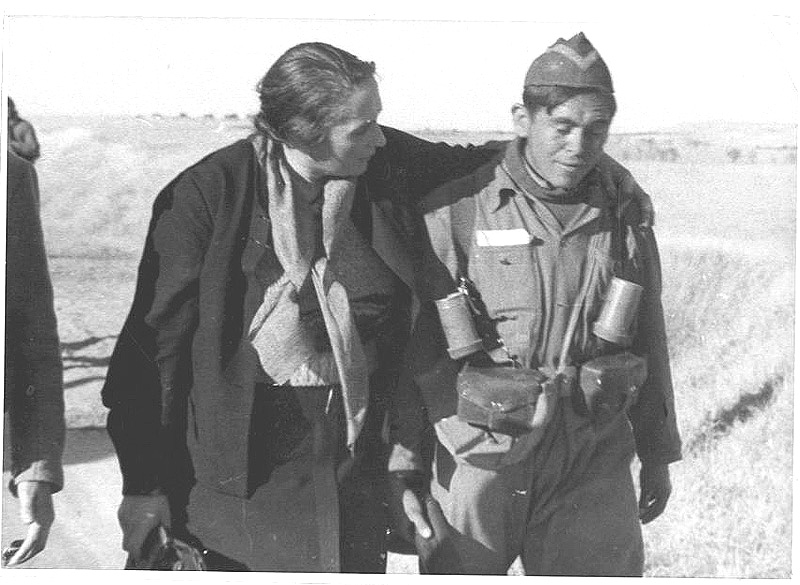
During the second half of August, Dolores Ibárruri, La Pasionaria, travelled through the Republican positions in the Sierra de Guadarrama. Ibárruri was already one of the most recognisable political figures in Republican Spain. A Communist deputy for Asturias, she had become nationally associated with the defence of Madrid after her broadcasts during the first days of the military rebellion and the popularisation of the cry ¡No pasarán!
A contemporary account dated Navalperal, 21 August, describes Ibárruri visiting the front while fighting continued through the Sierra. Navalperal de Pinares was one of the principal Republican positions inside Ávila province, occupied by the forces associated with Julio Mangada. The front lay among the wooded slopes, rocky heights, roads, and villages west of Madrid, with rebel positions sometimes only a few kilometres away. The account described artillery fire echoing through the valleys throughout the day and small groups of fighters moving across the slopes, attempting to gain another hill, rock position, or ravine from which they could observe or fire upon the opposing side. Navalperal itself had become a Republican military centre behind these positions.
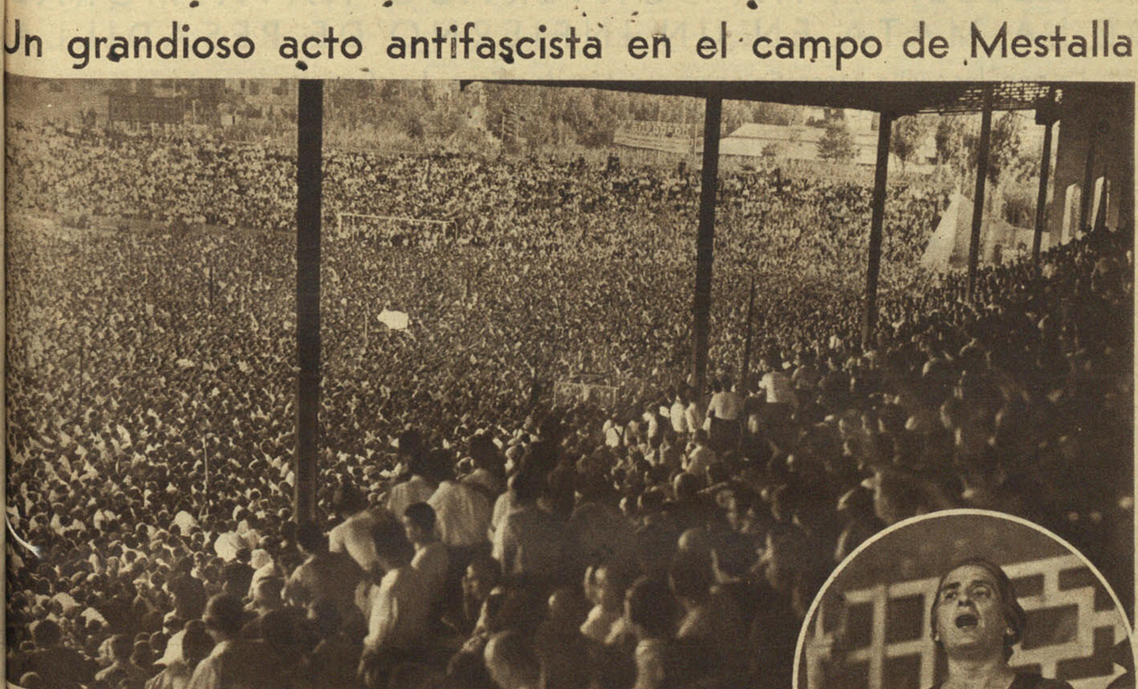
Ibárruri left the Madrid front for Valencia, where the Popular Front organised an enormous public meeting at the Mestalla stadium on 24 August, and well publicised in in Madrid near the front on 25 August, as a morale boost. Thousands filled the football ground to hear representatives of the organisations supporting the Republic. When Ibárruri addressed them, the Guadarrama front was still fresh in her mind. She told the crowd that she had come to Valencia with the acrid taste of gunpowder still with her and spoke about the men and women fighting on the summits and slopes of Guadarrama.
Her purpose in Valencia was mobilisation, as Madrid and its surrounding fronts required a continuing supply of people, weapons, ammunition, food, medical material, vehicles, and money. Ibárruri argued that the rebellion could not be defeated by Madrid alone and called for unity between the political parties, unions, workers, and other supporters of the Republic. The war in the mountains outside Madrid was presented to the Valencian audience as something that concerned them directly, that if the rebel armies broke through the Sierra, they would threaten the government and capital of the Republic.
Ibárruri also addressed women specifically. She called on them to participate in the struggle and presented the defence of the Republic as extending beyond those carrying rifles at the front. Women were already fighting, working in hospitals, transport, political organisations, supply networks, and militia units, and Ibárruri repeatedly used her public appearances to demand their participation.
For the volunteers occupying Navalperal, Guadarrama, Cercedilla, Buitrago, and the other approaches to Madrid, visits by figures such as Ibárruri also connected their isolated positions to the political struggle taking place across Republican Spain. They were not simply armed groups holding anonymous mountain ridges. Their defence of the roads into Madrid had become one of the Republic’s principal public symbols during the first full month of the war.
- Aragón
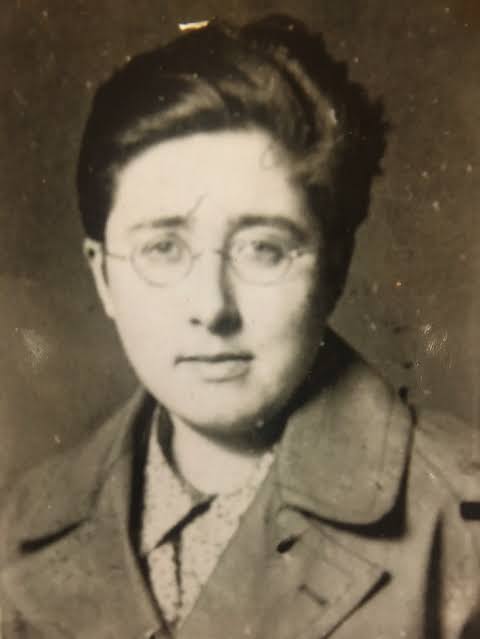
Born in London in 1904, Felicia Browne was an accomplished painter, sculptor and political activist whose artistic career became increasingly intertwined with her anti-fascist beliefs. Having studied at the Slade School of Fine Art and later in Berlin, she witnessed first-hand the rise of Nazism during the early 1930s. Her experiences in Germany reinforced her commitment to left-wing politics, and by the mid-1930s she was an active supporter of anti-fascist causes, believing that artists had a responsibility to oppose dictatorship and political repression.
In July 1936, Browne travelled to Barcelona intending to participate in the People’s Olympiad, the international sporting and cultural festival organised as an anti-fascist alternative to the Berlin Olympic Games. Athletes, artists and political activists from across Europe had gathered in the city when General Emilio Mola’s military uprising reached Catalonia on 19 July. As barricades appeared across Barcelona and workers took up arms against the rebellion, the Olympiad was cancelled before it could begin. While many foreign visitors left Spain, Browne chose to remain, convinced that the defence of the Spanish Republic had become part of the wider struggle against European fascism.
Determined to play an active role rather than simply observe events, Browne volunteered with the Karl Marx Column, one of several workers’ militias organised in Barcelona during the first weeks of the war. The column, associated with the Unified Socialist Party of Catalonia (PSUC), travelled west towards the Aragón Front, where Republican militia columns hoped to seize Zaragoza and prevent the Nationalists from consolidating their control of northern Spain. Like thousands of Spanish volunteers and the first wave of foreign supporters, Browne served before the creation of the International Brigades in October 1936. The militia columns were often poorly equipped, lacking uniforms, military training and sufficient weapons, yet they formed the backbone of the Republic’s defence during the opening months of the conflict.
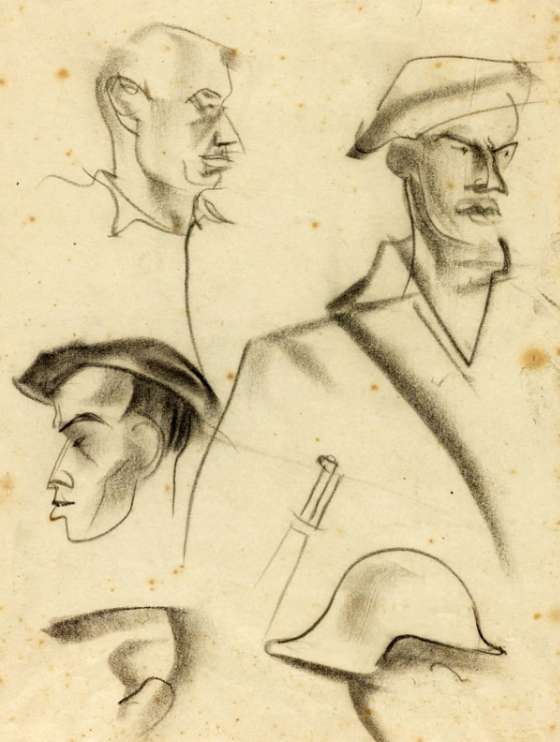
Even while serving at the front, Browne continued to sketch the people around her. She drew fellow volunteers, local villagers, military camps and everyday life behind the lines, producing some of the earliest surviving artistic records of the Republican war effort. Unlike many later depictions of the conflict, her work captured the uncertainty and improvisation of the war’s opening weeks, when civilian volunteers still fought alongside professional soldiers and enthusiasm frequently compensated for the lack of military experience.
On 25 August 1936, Browne joined a small reconnaissance and sabotage patrol near Tardienta, north of Huesca. Their objective was to damage the Zaragoza–Huesca railway, an important Nationalist supply route carrying troops, ammunition and equipment towards the Aragón Front. Before the explosives could be placed, the patrol encountered Nationalist forces and came under heavy rifle and machine-gun fire. During the withdrawal, one of the volunteers, an Italian anti-fascist fighting with the column, was seriously wounded. According to the most widely accepted contemporary accounts, Browne stopped to help carry or rescue him instead of retreating with the rest of the patrol. She was shot and killed during the attempt, while the surviving volunteers were forced to withdraw without recovering either body.
Felicia Browne became the first British volunteer of either gender to die fighting for the Spanish Republic and remains the only known British woman killed in combat during the Spanish Civil War. Her death attracted considerable attention among British anti-fascist organisations, occurring several weeks before the International Brigades began recruiting volunteers in earnest. As a result, Browne came to symbolise the earliest phase of international solidarity with Republican Spain, when individuals crossed Europe independently to join improvised militia units rather than organised international formations.
Her artistic legacy survived, as comrades recovered many of the drawings and sketches she had produced on the Aragón Front, preserving works that might otherwise have been lost with her. They were later exhibited in Britain to raise money for Spanish medical aid and refugee relief, while also introducing British audiences to the realities of the conflict through the eyes of someone who had experienced it first-hand. Today, Browne’s sketches remain an important visual record of the Civil War’s opening weeks, documenting militia volunteers, civilians and the landscapes of Aragón before the conflict developed into the large-scale industrial war that would follow with the arrival of regular armies and the International Brigades.
- Aragon
Among the thousands of foreign volunteers who travelled to Spain during the opening weeks of the Civil War, few have left a more enduring account than the French philosopher Simone Weil. Although she spent little more than a week on the Aragón Front, the diary she kept during that time has become one of the most valuable eyewitness descriptions of life inside the Republican militias during the summer of 1936.
Born in Paris in 1909, Weil had established herself as a philosopher, teacher, trade union activist, and committed supporter of workers’ rights long before the outbreak of the Spanish Civil War. She believed that intellectuals should experience the lives of ordinary working people rather than simply write about them. During the early 1930s she deliberately left teaching to work in French factories, believing that first-hand experience was essential to understanding social injustice. When the military uprising began in Spain during July 1936, she viewed the conflict not only as a struggle against fascism but also as an opportunity to witness what many believed was a genuine social revolution.
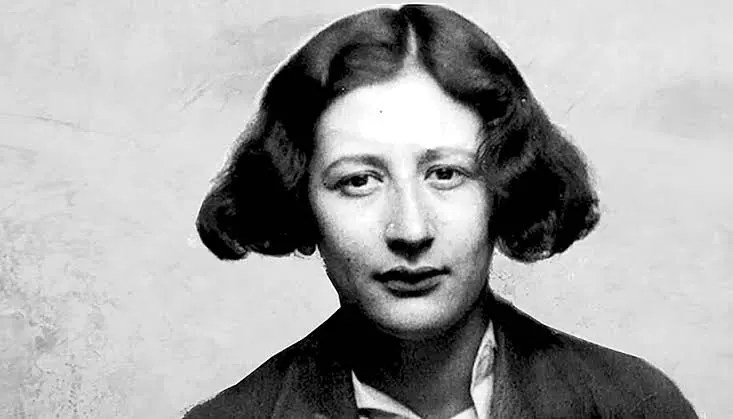
On 8 August 1936, Weil crossed the French border at Portbou and travelled to Barcelona. The city was unlike anything she had experienced. Much of the normal machinery of government had been replaced by revolutionary committees, armed workers patrolled the streets, churches stood abandoned or damaged after the fighting of July, and militia columns departed almost daily for the Aragón Front. Foreign journalists often described Barcelona as a city in the middle of a revolution rather than merely at war.
Weil initially approached the leadership of the POUM, hoping to undertake a dangerous mission to locate the imprisoned revolutionary leader Joaquín Maurín. Julián Gorkin rejected the proposal, considering it far too dangerous. Instead, Weil sought permission to join the anarchist militias of the CNT-FAI.
During the following days she was accepted into the French-speaking Sébastien Faure Centuria, part of the International Group attached to Buenaventura Durruti’s famous Durruti Column. Unlike many foreign visitors, she did not travel as a journalist, observer, or political delegate. She joined as an ordinary volunteer, accepting the same living conditions, duties, food, and dangers as the Spanish militia members around her.
Around 14 August she reached Pina de Ebro, one of the Durruti Column’s principal forward positions on the Zaragoza Front. The Republican advance had already carried the militia to within roughly thirty kilometres of Zaragoza, but the offensive had stalled against increasingly organised Nationalist resistance. But instead of witnessing dramatic advances, Weil entered a front that was slowly becoming static and the reality surprised her. Like many volunteers arriving from abroad, she expected almost continuous combat. Instead, she found that much of military life consisted of waiting. Days passed repairing equipment, standing guard, cleaning weapons, attending meetings, discussing politics, helping with cooking, or waiting for orders that never seemed to arrive. The contrast between revolutionary enthusiasm in Barcelona and the quiet uncertainty of the front became one of the strongest themes running through her diary.
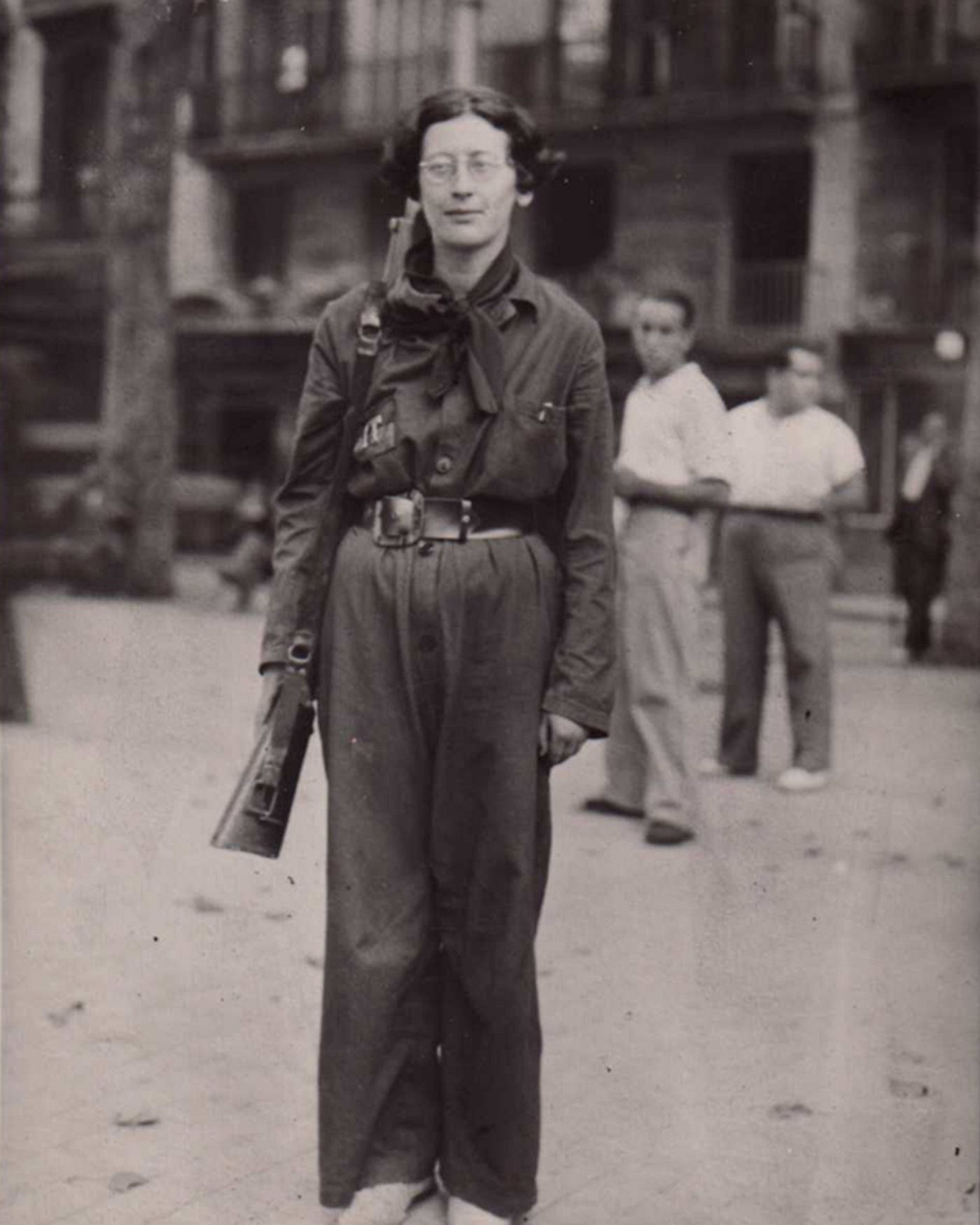
Her first impressions focused less on military operations than on ordinary existence. Volunteers slept on bundles of straw in requisitioned buildings, often sharing crowded rooms with little privacy. Nights were disturbed by arguments over lamps, guard rosters, or sleeping arrangements. Equipment was inconsistent. Some men possessed modern rifles while others carried older weapons or had to wait for machine guns to be released from stores before operations could begin. Food occupied much of each day. Local villages could not easily support several hundred hungry volunteers, and tensions quickly emerged between revolutionary ideals and military necessity. Weil witnessed Durruti personally ordering his men not to requisition food from local peasants or sleep in civilian houses without permission. His orders provoked heated arguments. Many militia members believed revolutionary solidarity entitled them to share whatever resources existed, while Durruti recognised that an army living directly off the countryside would soon alienate the very population it claimed to defend. The incident revealed the constant balance between political ideals and practical military administration.
The front itself was often deceptively quiet. Weil later remarked that she had hardly heard a shot fired before Nationalist aircraft suddenly appeared overhead. Bombs fell around Pina, forcing the militia to scatter into nearby fields. Armed only with rifles, many volunteers instinctively fired at aircraft flying far beyond effective range. The bombing caused relatively little physical damage, but it demonstrated how exposed the Republican positions were to attack from the air and how few effective anti-aircraft weapons were available during the first months of the war.
Guard duty formed another routine part of life. Weil recorded complaints from local peasants that exhausted sentries sometimes fell asleep during the night. Such failures could have serious consequences. A small Nationalist patrol needed only one unguarded approach to enter a village, attack sleeping militia, or gather intelligence before disappearing again into the darkness.
Although large battles were uncommon during her stay, patrols into enemy territory carried genuine danger. On one occasion Weil accompanied a reconnaissance party across the Ebro. After crossing by boat, the group searched for bodies left from earlier fighting before advancing cautiously through scrub towards an isolated farmhouse believed to be occupied by Nationalist forces. Some of the volunteers crawled forward while others waited concealed in drainage ditches, uncertain whether they had already been seen. Weil later admitted that this was the only occasion during her time in Spain when she experienced real fear. The operation illustrated the reality of much of the Aragón campaign, where small patrols, reconnaissance missions, and uncertainty often replaced large set-piece battles.
The diary also reveals the chronic shortages affecting the Republican militias. Before one proposed operation, Weil’s international group spent hours attempting to obtain light machine guns from the War Committee at Pina. The request was initially refused. Only after repeated intervention were two weapons finally issued, and neither had been tested before the patrol began. The episode illustrates how even famous formations such as the Durruti Column struggled with shortages of automatic weapons, ammunition, and equipment.
Medical care was another recurring concern. Weil described wounded men awaiting evacuation, shortages of doctors, administrative confusion, and the ever-present danger of infection. One particularly striking episode involved an Italian volunteer suffering from gangrene. Bureaucratic delays, mechanical failure, and poor coordination between hospitals left him stranded for hours before another Republican vehicle eventually found him. The account demonstrates that disease, transport problems, and inadequate medical organisation could be almost as dangerous as enemy fire.
Only a few days after reaching the front, Weil’s military service came to an abrupt end. Around 20 August, while helping prepare food, she accidentally stepped into a container of boiling cooking oil, suffering severe burns to her left foot and lower leg. The injury was so serious that she had to be evacuated from the front despite her protests. She was transferred to a military hospital at Sitges, south of Barcelona, where she was later reunited with her parents, who had travelled to Spain after learning she had joined the fighting.
Though her military career had lasted barely a week, Weil remained in Spain while recovering from her injuries. During the following month she continued observing the revolutionary transformation of Catalonia, visiting factories and reflecting upon the relationship between violence, political idealism, and human responsibility. On 25 September 1936 she crossed back into France through Portbou with her parents. She never returned to Spain.
The brevity of Weil’s service has often surprised readers. Many assume, because of the influence of her diary, that she spent months at the front. In reality, nearly all of her observations were recorded during roughly a single week between the middle and end of August 1936. Their importance lies not in the length of her service but in the clarity with which she described everyday life. Rather than concentrating on troop movements or military strategy, Weil recorded what it felt like to live on the Aragón Front: the endless waiting between operations, the oppressive summer heat, inadequate food and equipment, uncertainty over orders, fear during patrols, arguments over discipline, and the difficult relationship between revolutionary ideals and the practical realities of war. Read alongside the photographs of Agustí Centelles and the observations of Franz Borkenau, Simone Weil’s diary remains one of the clearest windows into the ordinary experience of Republican militia life during the first summer of the Spanish Civil War.
Simone Weil: Chronicles from the Spanish Civil War, in: ‘Le Libertaire’, a French anarchist magazine, 1936

