By 23 July 1936, both sides now faced a new reality, that they were not merely fighting isolated battles, but attempting to construct functioning systems of authority amid the collapse of the old state.
On this day, the rebels formally established the National Defence Junta in Burgos. The Junta was intended to provide a central governing structure for territories under Nationalist control and to coordinate military operations across the rebellion. General Miguel Cabanellas became its president, partly because he was the most senior surviving rebel general. The creation of the Junta is important because the Nationalist movement in July 1936 was not a unified dictatorship under Franco. The rebellion consisted of multiple right-wing factions with different goals, traditions, and political visions. Conservative army officers, monarchists, Carlists, Falangists, conservative Catholics, and authoritarian republicans all supported the uprising, but many disagreed about what kind of Spain should emerge afterward.
General Francisco Franco was becoming increasingly important because of his command over the Army of Africa, but he was not the undisputed leader of the rebellion. General Emilio Mola remained central to planning operations in the north, while General José Sanjurjo had originally been intended as the symbolic leader of the uprising before his death in the plane crash on 20 July.
The establishment of the Junta reflected both strength and uncertainty. The rebels had survived the opening days of the conflict, but they still lacked unified political leadership. Despite the continued presence of Republican warships in the Strait of Gibraltar, the first elements of the Army of Africa were beginning to reach mainland Spain. Aircraft carried officers, specialists, and small groups of troops across from Morocco, while rebel commanders worked urgently to expand transport capacity. The numbers remained modest, but these early crossings marked the beginning of a process that would eventually bring thousands of experienced Legionnaires and Regulares into the conflict.
The choice of Burgos as the headquarters of the National Defence Junta was also significant. Located within a secure rebel-held zone and connected to other Nationalist territories in northern Spain, the city quickly became the political centre of the takeover. Government offices, military staffs, communications services, and administrative departments increasingly concentrated there. Although no one knew who would ultimately lead the Nationalist cause, Burgos was already beginning to function as the capital of an emerging rival state.
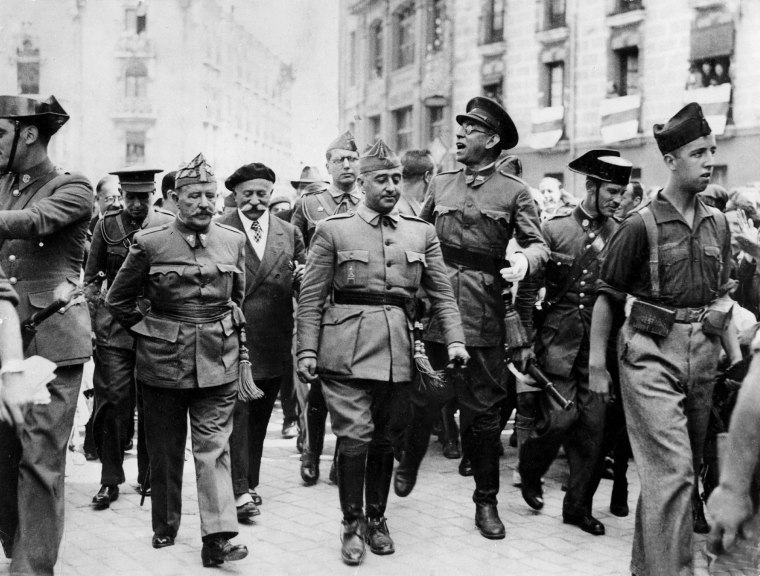
From 23 July 1936, Nationalist authorities in Granada began using San José Cemetery as one of the principal sites for the execution and burial of prisoners. Following the successful military uprising in the city on 20 July, hundreds of people suspected of supporting the Republic were arrested, including trade unionists, left-wing politicians, municipal officials, teachers, intellectuals and ordinary civilians denounced as opponents of the new regime.
Prisoners were removed from jails, police stations and improvised detention centres, often during the night, and transported to the cemetery. There, many were executed without trial by firing squad or summary shooting before being buried in mass graves within or near the cemetery grounds. The killings quickly became systematic, with executions occurring almost daily. Though the exact number of victims during the final week of July cannot be determined with certainty, modern historians estimate that several hundred people were killed at San José Cemetery in the days following 23 July. The cemetery remained one of the principal centres of Nationalist repression throughout the Civil War, and thousands of men and women are now believed to have been executed there. Today, San José Cemetery stands as one of the most significant sites of Civil War memory in Andalucía, with ongoing historical and archaeological work continuing to identify those who were killed there.
In Asturias, attention increasingly centred on Oviedo. While much of the province remained loyal to the Republic and armed miners, workers and loyal security forces controlled most of the surrounding territory, Colonel Antonio Aranda had organised the Nationalist garrison inside the city for defence. Oviedo was now effectively encircled, and fighting was beginning to settle into a siege that neither side expected to end quickly. Read all about the Siege of Oviedo in depth HERE
On 23 July, Republican commander Captain Fernando Condés Romero, infamous to the Nationalists for leading the arrest of José Calvo Sotelo eleven days earlier, was killed while directing the defence of the Somosierra front, 100km north of Madrid.
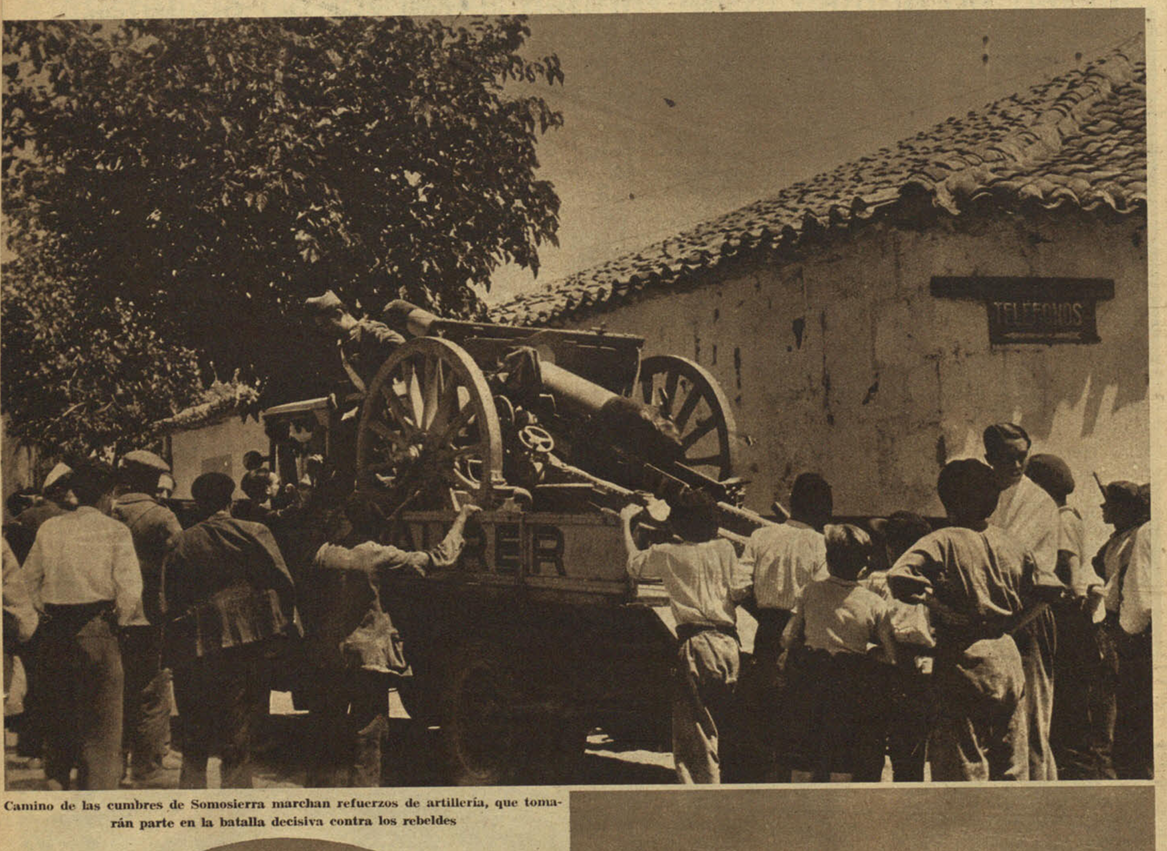
In Toledo, the Siege of the Alcázar continued. Republican forces tightened their encirclement around Colonel José Moscardó and the defenders inside the fortress, and he received a call from the Republicans, announcing they had his son, Luis. Moscardó and his son were allowed a goodbye phone call, before Moscardó said he was prepared to let his son die rather than surrendering. Despite all the mythology surrounding the event, Luis Moscardó was not murdered for another month.
Artillery positions were strengthened while militia groups attempted to isolate the Alcázar from possible outside support. Conditions inside the fortress were becoming increasingly difficult as food, medical supplies, and ammunition were carefully rationed. The siege was already beginning to gain symbolic importance far beyond Toledo itself. Nationalist newspapers and radio broadcasts portrayed the defenders as heroic patriots resisting revolution and anti-Christian violence, while Republican supporters viewed the Alcázar as a dangerous rebel stronghold threatening the defence of Madrid. Read all about the siege of Toledo in depth HERE
Across both Republican and rebel zones, violence and reprisals intensified. In Republican-held areas, priests, right-wing activists, landowners, and suspected fascist sympathisers faced growing danger from revolutionary groups and uncontrolled militias. In Nationalist territory, left-wing activists, trade unionists, teachers, and Republican officials were arrested or executed as military rule hardened. In many parts of Spain, ordinary legal systems had ceased functioning. For civilians, uncertainty remained overwhelming. Railway lines were disrupted, newspapers contradictory, and communications unreliable. Families were often separated by suddenly shifting front lines and political boundaries. Many still hoped the conflict might somehow end quickly, but by 23 July the creation of rival military and political administrations suggested something far more permanent and destructive was emerging.
The military uprising in Guadalajara began on 21 July 1936, when elements of the local garrison joined the Nationalist revolt. Rebel officers occupied key positions in the city, hoping to establish control over one of the principal routes northeast of Madrid. Their success would have threatened Republican communications with Aragón and opened another avenue towards the capital.
The coup quickly met determined resistance. Assault Guards, Guardia Civil units that remained loyal to the Republic, railway workers, local militia organisations and armed civilians rallied against the insurgents. Reinforcements were also dispatched from Madrid, tipping the balance in favour of the Government.
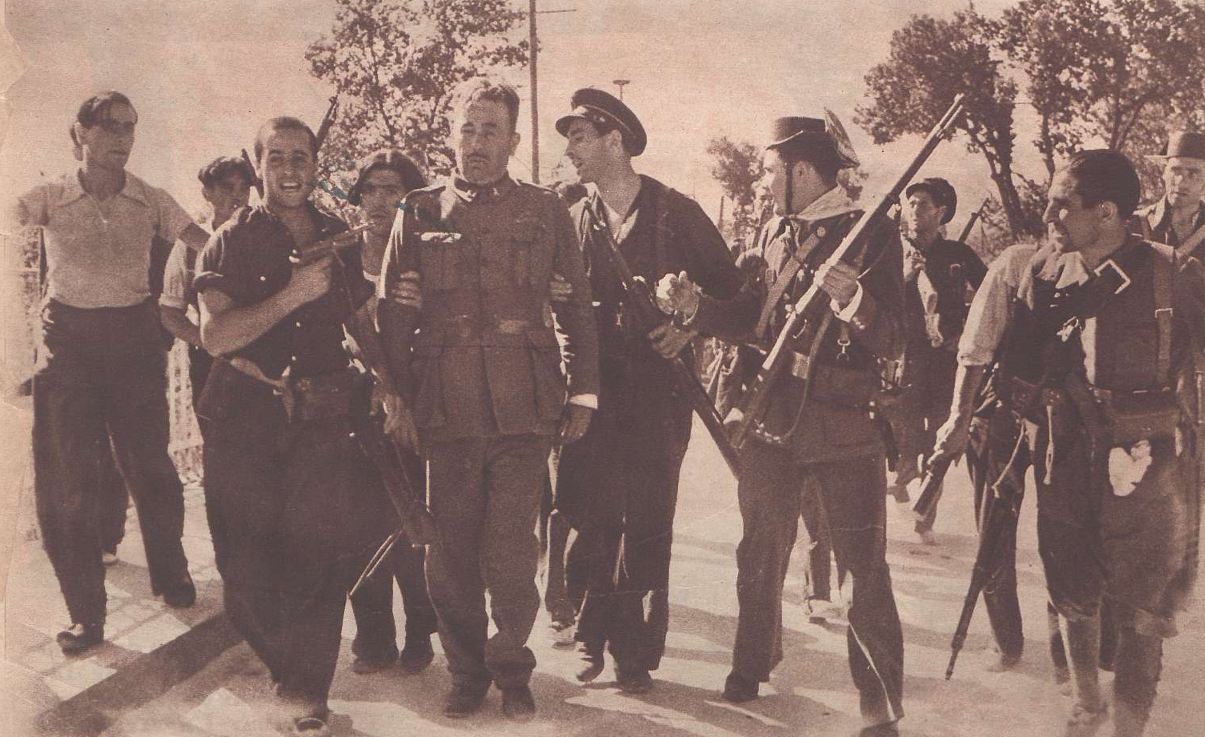
Fighting continued over the next two days as Government forces attacked rebel-held positions. Contemporary newspaper photographs show Assault Guards advancing under fire towards the city, while another image records the aftermath, with a captured rebel officer being escorted under guard by loyal Guardia Civil and militiamen after Government forces regained control.
By 23 July, organised resistance had collapsed. The surviving insurgents were killed, captured or dispersed, and Guadalajara remained firmly under Republican control. The victory secured the important road and railway links between Madrid and eastern Spain, allowing troops and supplies to continue moving towards the developing fronts in Aragón and the Sierra de Guadarrama.
Although later overshadowed by the famous battle fought there in March 1937, the defeat of the July uprising at Guadalajara denied the Nationalists another strategic foothold in central Spain during the crucial opening week of the Civil War.
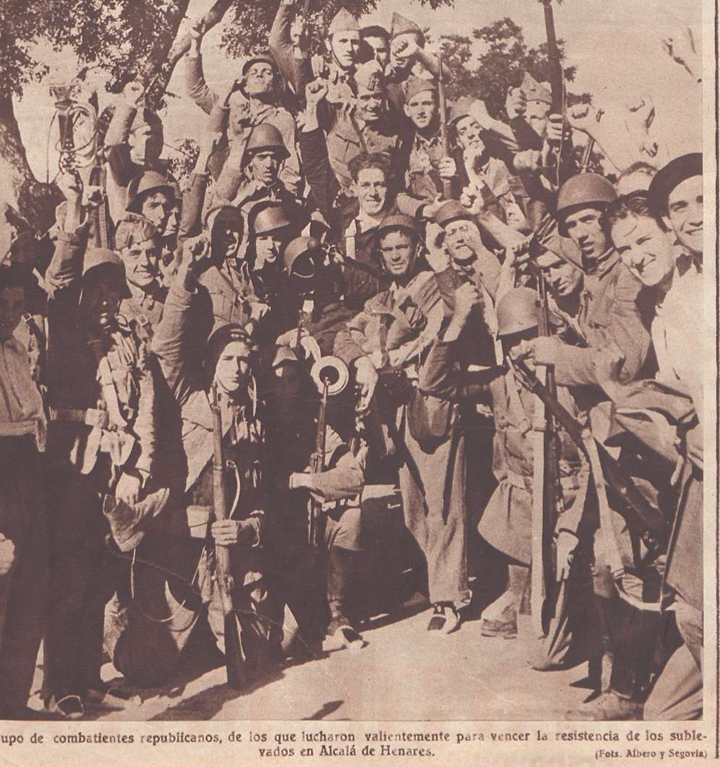
Following the defeat of the military uprising in Madrid, fighting spread to nearby Alcalá de Henares, 40km northeast of Madrid city, an important garrison town controlling the main road and railway northeast towards Guadalajara and Zaragoza. Rebel officers attempted to rally the local garrison, but they faced resistance from loyal Assault Guards, Civil Guards who remained faithful to the Republic, and armed workers and militia from the town and Madrid.
After several hours of fighting, the insurgents were surrounded and forced to surrender on 21 July. Republican newspapers celebrated the victory, publishing photographs of the militia and loyal security forces who had overcome the rebellion. The defeat of the uprising at Alcalá ensured that Madrid’s northeastern communications remained open and prevented the rebels from establishing a foothold within easy striking distance of the capital.
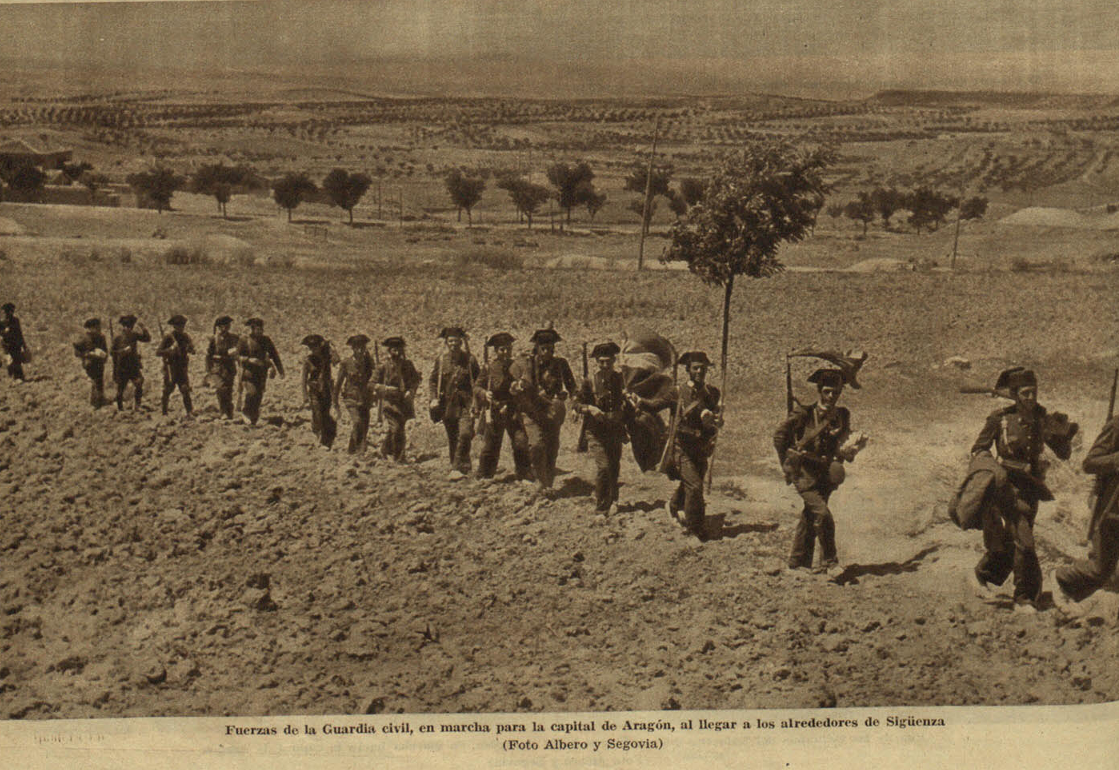
In the days that followed 23 July, Alcalá became an important assembly point for Republican columns moving east another 30km towards Guadalajara, plus Sigüenza, Somosierra, and the Aragón front. Although often overshadowed by the fighting at the Cuartel de la Montaña and later battles around Madrid, the recovery of Alcalá formed an important part of the rapid suppression of the uprising around the capital and helped secure the Republic’s control of central Spain during the opening week of the war. Sigüenza was less than 15km from the border with Aragon, and General Emilio Mola had Nationalist troops as close as Medinaceli, only 15km over the border. Towns along the border of the provinces were being attacked in the region, and the foothold in these areas were close to the only thing stopping the rebels from surging into Guadalajara and Madrid.
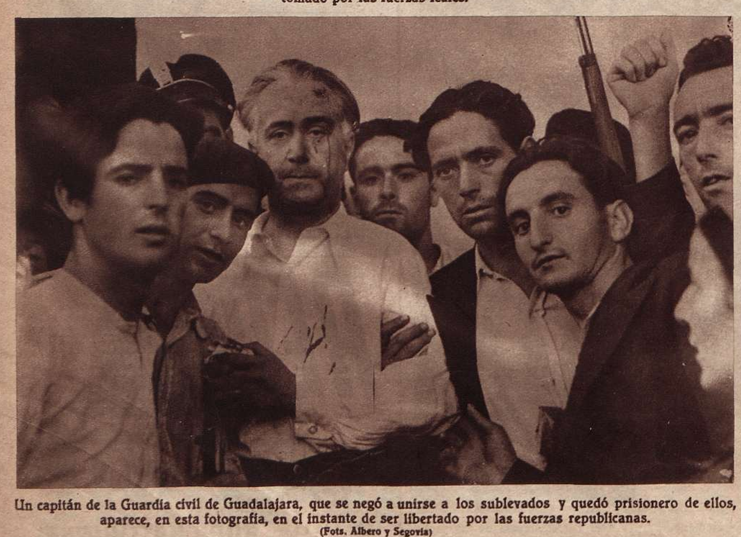
Captain José Rubio García Roby, a native of Alcalá de Henares and commander in the Civil Guard at Guadalajara, refused to join the military uprising of July 1936. On 21 July he had organised the defence of the Republic from the Civil Government building with a small group of loyal Civil Guards and Assault Guards, helping to defeat the rebellion in the city. Rubio remained with the Republic throughout the Civil War and when incorporated into the People’s Army, he was promoted first to major and later lieutenant colonel. He eventually became Chief of Staff of the III Army Corps and briefly served as acting commander of the IV Army Corps. Following the Republican defeat, Rubio was arrested and tried by a Francoist military court in Guadalajara on 18 May 1940. Sentenced to death, he was executed by firing squad in Guadalajara municipal cemetery on 8 January 1941. He was the only prisoner executed that morning, reportedly as an example to other former Republican officers. At his family’s request, his body was transferred to his hometown of Alcalá de Henares for burial. The reprisals continued after his death and as late as 1963, Francoist authorities rejected his widow’s application for a military widow’s pension because of his service to the Republic.
On 24 July 1936, the most significant events of the day was the departure of the Durruti Column from Barcelona toward the Aragón front. Led by the anarchist militant Buenaventura Durruti, the column consisted largely of workers, trade unionists, and anti-fascist volunteers affiliated with the Confederación Nacional del Trabajo and allied organisations. The departure of the column symbolised the revolutionary atmosphere that had emerged in Catalonia after the defeat of the military uprising in Barcelona. Many volunteers believed they were fighting not only to defend the Second Spanish Republic, but to build a fundamentally new society based upon workers’ control, anti-fascism, and social revolution. Militia members often rejected traditional military hierarchy, electing officers and emphasising political equality within their ranks. Read all about Aragón’s uprising in depth HERE
At the same time, the column’s departure also revealed some of the weaknesses facing Republican Spain. Many militia groups possessed enormous enthusiasm but limited military training, inconsistent discipline, and shortages of ammunition, transport, and heavy weaponry. The Republic was increasingly dependent upon improvised forces formed during the chaos of the uprising rather than a unified professional army.
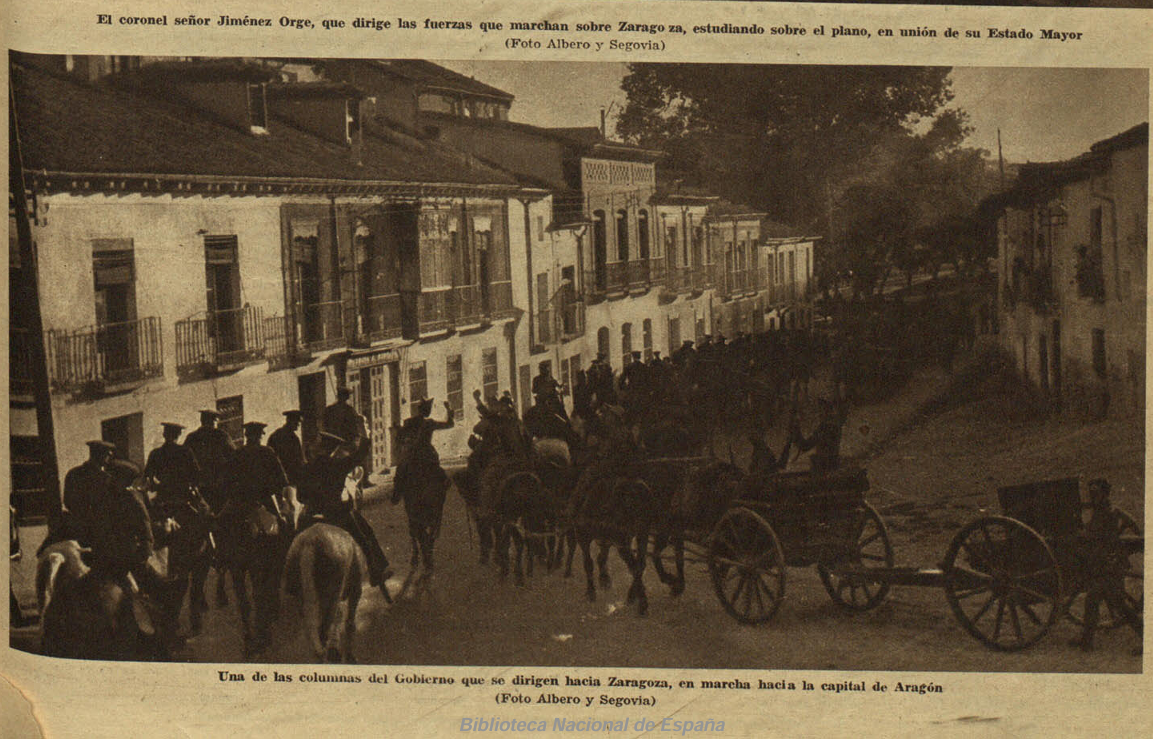
While Catalonia’s militia columns continued to advance on Zaragoza from the east, the Republican Government in Madrid attempted a parallel offensive from the west. Following the defeat of the military uprising in Madrid and the recovery of Guadalajara, loyal Army officers, Civil Guards, Assault Guards and militia volunteers were assembled into improvised columns for an advance along the Madrid–Zaragoza highway. Their objective was to secure the Henares valley, relieve isolated Republican garrisons and, if possible, converge on Zaragoza with the Catalan forces.
The advance, however, soon encountered the realities of the war. Although Republican newspapers continued to confidently describe the columns as marching on Zaragoza, their immediate task was to secure the road and railway through Guadalajara before any major offensive into Aragón could be attempted. The Nationalists, meanwhile, reinforced Soria and the approaches from Calatayud, while many of the Republican volunteers lacked military training, transport and heavy weapons. Jiménez Orge also struggled to exercise authority over the numerous militia groups attached to his command, particularly anarchist volunteers who often operated independently of regular Army discipline. Rather than reaching Zaragoza, the Republican columns found themselves holding an increasingly extended front across northern Guadalajara province. During the following weeks this mobile campaign gradually gave way to static warfare, culminating in the prolonged fighting around Sigüenza later in the summer. Although overshadowed by the famous Catalan columns, the Guadalajara–Aragón expedition represented the Republic’s principal attempt to open a western route towards Zaragoza during the opening weeks of the Civil War.
Fuentes de Andalucía, 60km east of Seville had fallen to Nationalist forces on 19 July, one day after the military uprising began in Seville. The Guardia Civil had secured the town with little organised resistance and arrested many of the leading Republican officials, trade unionists and left-wing activists. Prisoners were removed from the town in successive groups and executed over the following weeks, while others were shot locally. Modern memorial research carried out by the Junta de Andalucía has identified 116 victims buried in the municipal mass graves between 24 July and 29 September 1936, although only 103 deaths were officially registered. The killings formed part of the systematic campaign of political repression that followed the Nationalist occupation of much of Seville Province.
 CAROLINE ANGUS