In the days before the failed rebel uprising, the greatest concern of Barcelona’s trade unions and political organisations had been survival. The CNT, UGT, Republican parties and left-wing groups feared that Barcelona might share the fate of cities such as Zaragoza, Seville or Valladolid, where rebel officers had seized control and crushed resistance. By 20 July that fear had disappeared. What should happen next? The Republican government still existed in Madrid, but its authority had been badly shaken. Across much of Spain, local committees, trade unions and militia groups were making decisions for themselves. In Barcelona, the balance of power had shifted to the workers who had helped defeat the uprising and were now armed.
The capture of military barracks and arsenals had placed enormous quantities of weapons into civilian hands. The most important prize was the arsenal at Sant Andreu, where thousands of rifles and large stocks of ammunition were seized. Exact figures vary between historians, but contemporary estimates and later studies suggest that tens of thousands of rifles became available in Catalonia during the days following the uprising. For the first time, the workers’ organisations possessed not only political influence but military force.
The victory in Barcelona also created a rare moment of optimism. Many people believed that the rebellion might still be crushed if loyalist forces acted quickly enough. Cities had fallen to the rebels, but others continued to resist. The outcome of the conflict was far from certain. Only around 300 kilometres from Barcelona lay Zaragoza, the largest city in Aragón. Before the war it had been one of the strongest centres of anarchist organisation in Spain, with a large CNT membership and a long tradition of labour activism. But Zaragoza had fallen into rebel hands during the opening days of the coup. News of its loss was received with shock and anger by many Catalan workers, but maybe it could still be a city that could be rescued.
The belief was understandable. The uprising was only days old. Thousands of volunteers were offering their services; weapons had been captured. Few could yet see the long war that lay ahead. Within days, trucks, buses, cars and lorries began assembling across Barcelona. Men and women who had fought in the city’s streets, along with many who had not, prepared to leave Catalonia and carry the struggle into Aragón. The columns leaving Barcelona in late July 1936 were not setting out on a brief expedition. They were creating a front line that would shape the Spanish Civil War for almost two years. In the process, they would carry the revolution into the villages and towns of Aragón, confront the realities of modern warfare, and become part of one of the most remarkable experiments in social and military organisation in twentieth-century Europe. Only none of them knew it.
In 1936, Zaragoza had a population of approximately 170,000 – 180,000 people, making it one of the most important urban centres in the country. Situated on the River Ebro, roughly halfway between Madrid and Barcelona, it occupied a strategic position at the heart of northeastern Spain as roads and railways converged there. Whoever controlled Zaragoza controlled a vital communications hub linking Catalonia to central and northern Spain. For military planners the city’s importance was obvious. For the workers and trade unionists of Barcelona, , Zaragoza represented something more than geography.
Before the Civil War, Zaragoza had been one of the strongest centres of anarchist organisation in Spain. The CNT had deep roots in the city and throughout much of Aragón. Railway workers, labourers, factory workers and craftsmen had built a substantial union movement over many years. By the mid-1930s, the CNT claimed tens of thousands of members across Aragón, with Zaragoza serving as one of the movement’s principal strongholds. The city regularly hosted union meetings, strikes and political activity. Many anarchists in Barcelona regarded Zaragoza as a sister city, but in July 1936, the city’s military governor, General Miguel Cabanellas Ferrer, joined the uprising and quickly secured control of key installations. Troops occupied strategic points throughout the city, while potential opponents were arrested or forced into hiding. For many anarchists, the loss of Zaragoza came as a profound shock. Many union activists found themselves imprisoned, in hiding, or facing arrest.
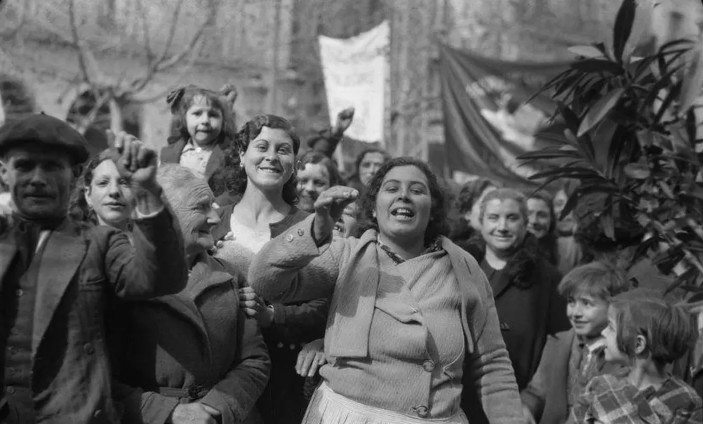
The distance between Barcelona and Zaragoza was approximately 300 kilometres by road, a substantial journey across varied terrain. Volunteers could plausibly imagine reaching Aragón within days and entering Zaragoza shortly afterwards. The city stood at the centre of Aragón, commanded vital transport routes, and contained thousands of workers who had long been part of the same movement that had just defeated the coup in Barcelona.
As trucks began assembling in Catalonia and volunteers prepared to head west, Zaragoza became their destination, their symbol and their objective. Whether they were motivated by military necessity, political conviction or revolutionary idealism, most believed the road to Aragón would ultimately lead them there. Aragón occupied a vast area of northeastern Spain between Catalonia and Castile of 47,000 square kilometres, larger than many European countries. In 1936 it contained three provinces, Zaragoza, Huesca and Teruel, and a population of roughly one million people. Outside Zaragoza itself, much of the region remained overwhelmingly rural. The densely populated industrial districts of Catalonia gave way to smaller towns, agricultural settlements and long stretches of open countryside. Beyond Lleida, the terrain became increasingly dry. Large areas of central Aragón were characterised by broad plains, scattered villages and harsh climatic conditions. Summers were intensely hot. Rainfall was often limited. Agriculture could be difficult and uncertain. Many villages contained only a few hundred inhabitants. Others had populations measured in the low thousands. In numerous communities, daily life changed little from one generation to the next. Wheat, barley, olives, grapes and livestock formed the backbone of local production. Some families owned substantial amounts of land, while others possessed only small plots or no land at all. Throughout parts of Aragón, especially in poorer rural districts, seasonal labour remained common. Many agricultural workers depended upon temporary employment and could face periods of unemployment during the year. The social tensions created by this system had existed long before the Civil War. Some communities supported Republican parties, while others favoured socialist organisations, and many remained deeply religious and conservative. Areas that would later embrace collectivisation sometimes existed only a short distance from communities that viewed revolutionary changes with suspicion or hostility. Yet significant areas of eastern Aragón, particularly those closest to Catalonia, lay beyond effective Nationalist authority. In many places state institutions weakened or disappeared altogether. Local officials fled, were arrested or simply ceased functioning. The result was a patchwork landscape in which power often depended upon whoever possessed the weapons and organisation to exercise it.
It was across this landscape that the militia columns would advance. Within weeks they would transform parts of Aragón into one of the most famous centres of revolutionary experimentation in modern European history. Yet in July 1936, none of that was certain. The region remained what it had long been: a vast rural land caught between competing visions of Spain’s future.
The atmosphere inside Barcelona during these early days of the war is difficult to overstate. Few people yet understood that Spain was entering a prolonged civil war. There was widespread confidence that the momentum generated by the victory in Barcelona could be carried directly into Aragón. This confidence was reinforced by events on 21 July when the CNT, FAI, Republican parties, socialists and other organisations met with the President of Catalonia, Lluís Companys i Jover. The meeting led to the creation of the Central Committee of Anti-Fascist Militias (Comitè Central de Milícies Antifeixistes), usually known simply as the CCMA. The new body would become one of the most important institutions of the early war in Catalonia. Although the Generalitat formally continued to exist, the committee coordinated military, transport, supply and recruitment efforts during the first weeks of the conflict.
Among the most influential figures were Juan García Oliver, Diego Abad de Santillán, Buenaventura Durruti Dumange, and Mariano Rodríguez Vázquez. But the creation of the CCMA did not establish a conventional chain of command. The committee could coordinate, encourage, provide vehicles, fuel and supplies, but it could not order thousands of armed volunteers to remain where they were.
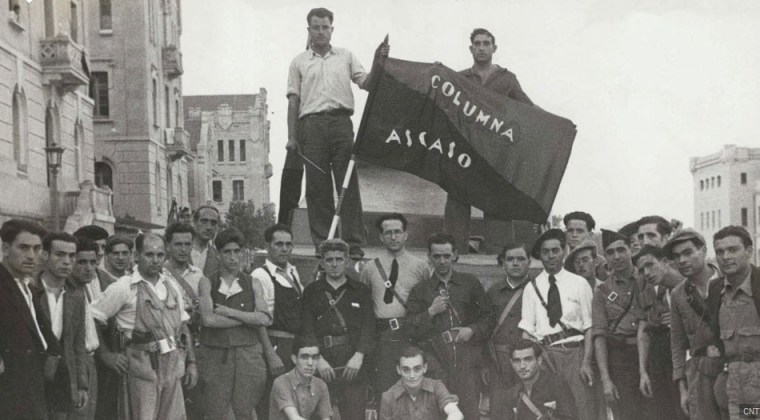
In factories, union halls, neighbourhood committees and barricades across Barcelona, workers demanded an offensive against the rebels. Many had lost friends and relatives during the fighting. Others feared that hesitation would give the insurgents time to regroup. Volunteers appeared in growing numbers, offering themselves for service. Many had never fired a rifle before July 1936 but they were eager to leave. The CCMA helped arrange transport and supplies while union organisations handled recruitment. Individual leaders gathered followers around them and volunteers joined formations associated with particular organisations or personalities. The best known was Buenaventura Durruti Dumange, whose name was already famous among Spanish anarchists long before the war. A veteran organiser, revolutionary activist and frequent target of police surveillance, Durruti possessed enormous prestige within the movement. Alongside Durruti stood figures like Antonio Ortiz Ramírez, Gregorio Jover Cortés, Ricardo Sanz García. Most hoped to advance through eastern Aragón and ultimately capture Zaragoza, and some followers expected Zaragoza’s workers to rise once outside assistance arrived. Few anticipated the difficulties they would encounter – inadequate maps, unreliable communications, limited intelligence on the enemy, and lack of coordination.
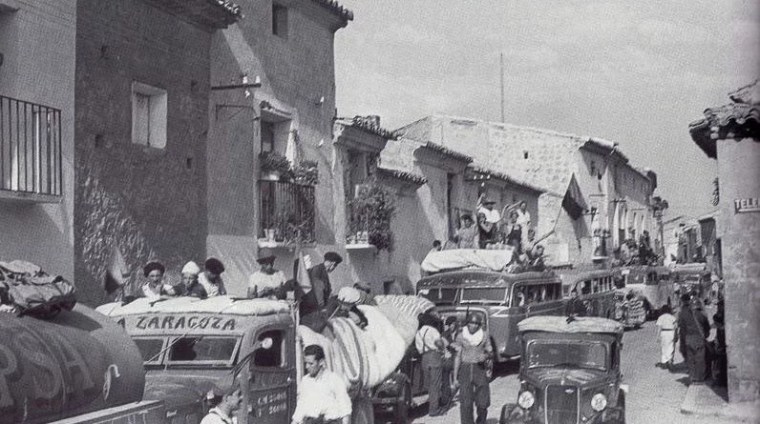
By the final week of July, Barcelona’s attention was turning westward. Vehicles were being requisitioned, weapons distributed, volunteers saying farewell to families and friends. Political banners appeared alongside rifles and ammunition. Ahead lay Aragón, Zaragoza and a war that almost none of them understood. Many had spent 19 and 20 July fighting in the streets of Barcelona. Others had manned barricades, transported ammunition, cared for the wounded or guarded captured buildings. Some had not participated in the fighting at all but volunteered immediately afterwards. The result was an extraordinary mixture of backgrounds, ages and experiences. Historians differ on precise numbers, but by the end of July 1936 approximately 10,000 to 15,000 militia volunteers from Catalonia were operating on the Aragón Front. This force was assembled in little more than a week. The largest individual formations contained thousands of men and women, making them comparable in size to regular military brigades despite their improvised nature. The largest group consisted of industrial workers, from factories, workshops, warehouses and transport systems provided much of the manpower for the columns. Metalworkers, mechanics, textile workers, printers, electricians and construction labourers were heavily represented. Employees from the city’s tramways and railway networks volunteered in significant numbers, as did dockworkers from the port. Not all volunteers came from industrial backgrounds, as students joined, teachers joined, clerks and office workers joined alongside shop assistants, journalists and professionals. Some had spent years engaged in political activism; others had little political experience but felt compelled to act after the military uprising. Most volunteers appear to have been young adults in their late teens, twenties and thirties. Contemporary photographs frequently show remarkably youthful faces. Some recruits were still teenagers. Others were veteran trade unionists who had spent decades involved in labour struggles and viewed the civil war as the defining political struggle of their lives. Some first handled military weapons only after the capture of Barcelona’s barracks.
The famous International Brigades did not yet exist and would not arrive until the autumn. Nevertheless, a small number of foreigners found themselves drawn into events during the summer of 1936. Some had travelled to Barcelona to participate in the People’s Olympiad, the anti-fascist sporting event organised as an alternative to the Berlin Olympics. When the uprising began, a number remained in Spain rather than return home. Others arrived independently because of political commitments or personal connections. Their numbers were small, probably measured in dozens, but they represented the beginning of the international anti-fascist involvement that would later become one of the most famous aspects of the war.
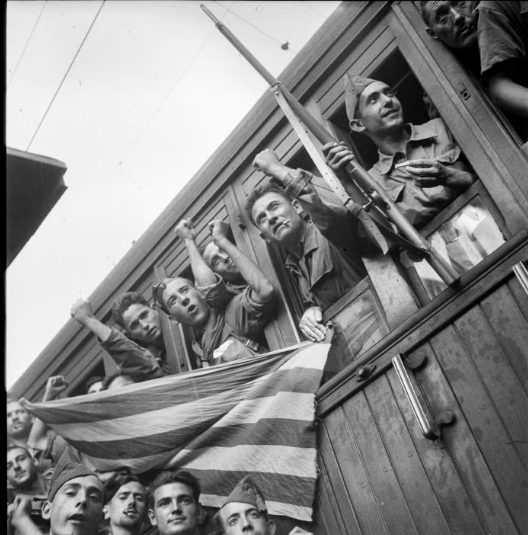
Women also joined the columns. This fact attracted enormous attention at the time and remains one of the most distinctive features of the war’s opening months. Women had already played important roles in the defence of Barcelona. They carried messages, transported supplies, staffed medical posts, organised food distribution and, in some cases, fought directly against rebel troops. When the militia columns formed, some chose to continue to the front rather than remain behind. Their numbers were relatively small compared to male volunteers, probably numbering in the hundreds across the various formations, but their visibility far exceeded their numerical strength. Photographs of armed milicianas rapidly became some of the most recognisable images of Republican Spain. Women wearing overalls, militia uniforms or workers’ clothing appeared carrying rifles, standing beside trucks or posing with male comrades before departure for the front. For supporters of the Republic, these images symbolised profound social change. For critics, they became evidence of revolutionary upheaval. Some women served in combat roles, while others worked as nurses, drivers, organisers, cooks or communications personnel, and sometimes multiple duties depending upon circumstances.
Among the best-known figures was Mika Feldman de Etchebéhère, an Argentine anti-fascist who would later become one of the very few women to command a militia unit during the war. Born in Argentina, she and her husband Hipólito Etchebéhère had travelled through Europe as committed anti-fascists before arriving in Spain. Following the outbreak of war, they joined a militia formation linked to the anti-Stalinist POUM. After her husband’s death in combat near Madrid later in 1936, Mika eventually assumed command of the unit herself, becoming one of the very few female commanders in the conflict. Although her most famous experiences occurred elsewhere, she represented the broader spirit of the early militias: a belief that traditional social barriers could be broken down by revolutionary struggle.
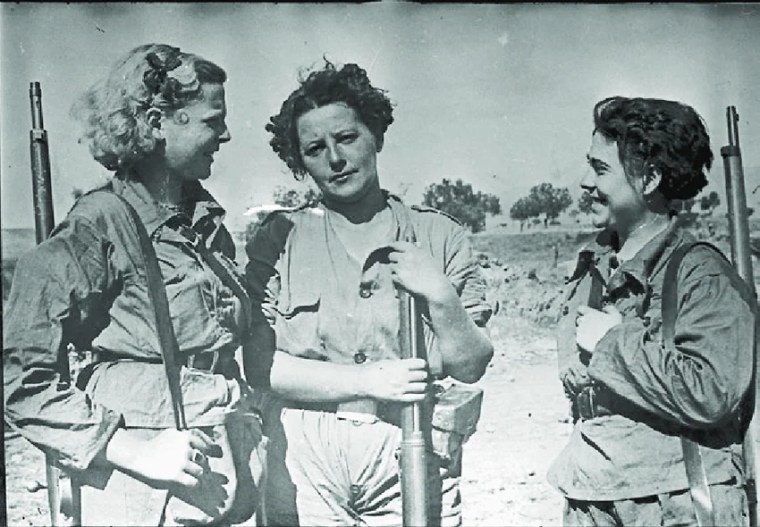
A more direct connection to the Aragón Front can be found in Pepita Laguarda Batet. Born in Barcelona in 1919, Pepita joined the anarchist militias and travelled to Aragón as a volunteer. In September 1936 she was killed near Tardienta in the Huesca sector, becoming one of the most widely remembered female militia casualties of the war. She was only seventeen years old and her death became symbolic for many supporters of the Republic, representing both the sacrifices made by young volunteers and the prominent role women had played during the conflict’s opening months.
The French philosopher Simone Weil, who joined the Durruti Column in Aragón, encountered a world very different from conventional military organisations. In her writings she described the mixture of revolutionary enthusiasm, political idealism and military improvisation that characterised the early militias. Journalists and photographers likewise recorded women carrying rifles, standing guard, travelling in military convoys and participating in daily camp life. But women were universally accepted within the militias. Some male volunteers welcomed their participation, but others remained sceptical or openly hostile. These tensions would become increasingly important as the war continued.
But in July 1936, to outside observers, the columns looked like armies. Thousands of men and women travelled west in convoys of buses, trucks and cars. They occupied villages, established front lines and prepared for offensive operations. Newspapers referred to them as military formations. Foreign journalists described them as armies on the march. Yet the people inside the columns often saw themselves very differently, as many had joined precisely because they distrusted traditional armies. The columns that emerged from Barcelona were therefore organised according to principles that were as political as they were military. Men who had spent years attending union meetings and workers’ assemblies brought those habits with them to the front. The revolution did not stop when they climbed aboard a truck.
The most famous of these formations was the Durruti Column, which departed Barcelona with approximately 2,000 to 3,000 volunteers. Others soon followed. The Ortiz Column, the Ascaso Column and the Jover Column each numbered roughly between 1,000 and 2,000 volunteers. Together they represented a force larger than many regular army brigades. In many columns, traditional ranks were abolished or ignored. The titles of captain, major and colonel carried little prestige among people who associated them with the old military order. The word most commonly heard was comrade. The Durruti Column, for example, was divided into smaller units known as centurias. A centuria generally contained around one hundred volunteers and was itself divided into smaller groups. This system provided a practical way of organising thousands of people while still preserving a degree of local autonomy. Friends, relatives, neighbours and fellow workers often remained together within the same units. Daily life reflected the same ideals, as leaders usually ate the same food as ordinary volunteers, pay was often equal, living conditions were shared, and privileges that existed in conventional armies were frequently rejected. The goal was not merely to defeat the military rebellion but to demonstrate that people could organise themselves differently. Workers, intellectuals and activists lived together under conditions that many participants regarded as the first glimpse of a new society.
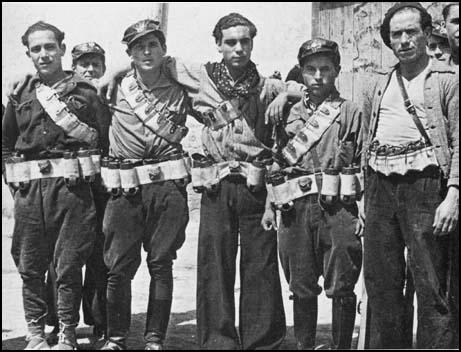
Professional officers who encountered the militias often complained that too much time was spent debating decisions that should simply have been obeyed. Meetings were common. Discussions about tactics, politics and strategy could involve ordinary volunteers as well as leaders. Some officers saw this as dangerous indiscipline. Many militia members saw it as democracy. The columns had attracted volunteers in huge numbers. Morale was often extraordinarily high. Men and women endured exhausting journeys, primitive living conditions and constant uncertainty because they believed they were fighting for a cause that belonged to them personally. Individuals frequently acted without waiting for orders, yet the weaknesses became apparent almost as quickly. There was no single commander directing all operations across Aragón. Coordination depended upon cooperation between independent formations that often possessed different political loyalties and military objectives. This mattered little when occupying villages or establishing outposts, but a successful assault on a major urban centre required careful planning, reliable communications, artillery support and coordinated movements across multiple sectors. These were precisely the areas in which the militia system was weakest.
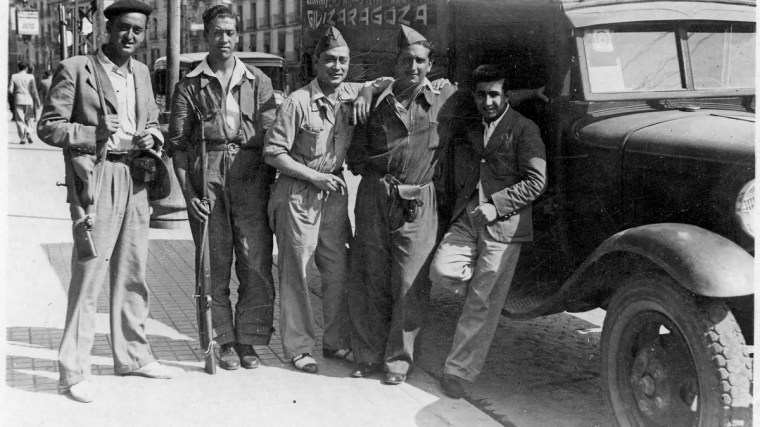
By the end of July, volunteers were already beginning to discover a difficult truth. The same principles that had made the columns so attractive also made them difficult to use as instruments of large-scale warfare. Only a few days earlier, most of these men and women had been workers, students, clerks, drivers or labourers. Now they were travelling west carrying military rifles captured from the very army they had just defeated. Exact figures vary between historians, but estimates commonly suggest that between 20,000 and 30,000 rifles became available in Catalonia during the days following the defeat of the coup. Alongside them came machine guns, ammunition, pistols, revolvers and other military supplies. Additional weapons were seized from other military installations throughout the region. By the end of July, approximately 10,000 to 15,000 volunteers were operating on the Aragón Front. In simple numerical terms, there may have been more rifles available in Catalonia than there were volunteers immediately ready to carry them. Many volunteers heading towards Aragón had never handled a military weapon before July 1936. Some learned the basics while travelling west in trucks and buses. Others received instruction from former conscripts or veterans of Spain’s campaigns in Morocco. Improvisation was common and photographs from July and August 1936 show little uniformity. Military uniforms were absent. Workers’ overalls, civilian jackets, shirts and caps appeared alongside captured military equipment.
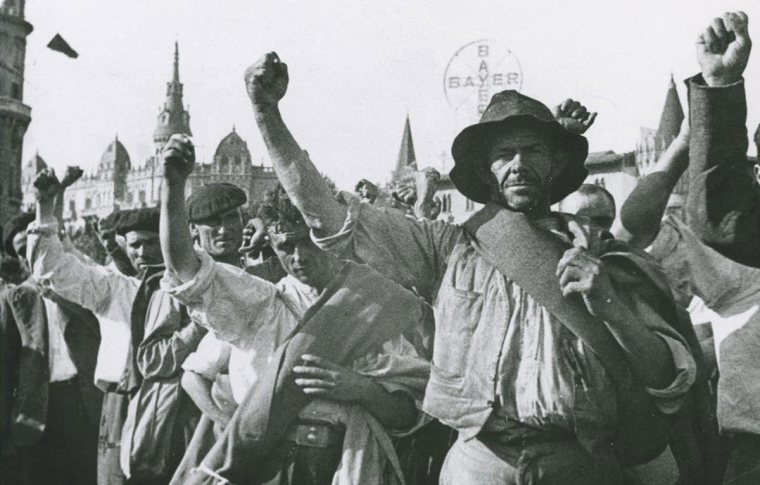
The machine guns captured in Catalonia were particularly valuable. While exact totals remain uncertain, hundreds were seized from military installations during the defeat of the coup. Unlike rifles, which could be distributed to almost anyone, machine guns required trained crews and careful handling. A single machine gun positioned correctly could dominate roads, crossroads and open ground. Columns fortunate enough to receive several machine guns possessed a considerable advantage. Those that did not often found themselves dependent almost entirely upon rifle fire. Even more important was artillery, and some pieces had been captured during the fighting in Barcelona, but artillery remained scarce compared with the needs of a rapidly expanding front. The columns also had to move weapons, ammunition, food and supplies across hundreds of kilometres. Vehicles were requisitioned from every available source. Buses, trucks, lorries, cars and motorcycles appeared in long convoys stretching out of Barcelona and across Catalonia. Many of the most famous photographs of the early war show volunteers sitting in the backs of open trucks with rifles across their knees and CNT flags fluttering overhead. The same trucks carrying volunteers often carried ammunition, food and medical supplies. Mechanical breakdowns were common. Fuel supplies required constant attention. Roads became crowded with military and civilian traffic moving in both directions. Moving people and artillery had a common companion – ammunition. The captured arsenals provided substantial stocks, but consumption could be rapid once fighting began. Different weapons sometimes required different ammunition. Distribution systems remained improvised. As the front expanded, maintaining supply lines would become increasingly complicated.
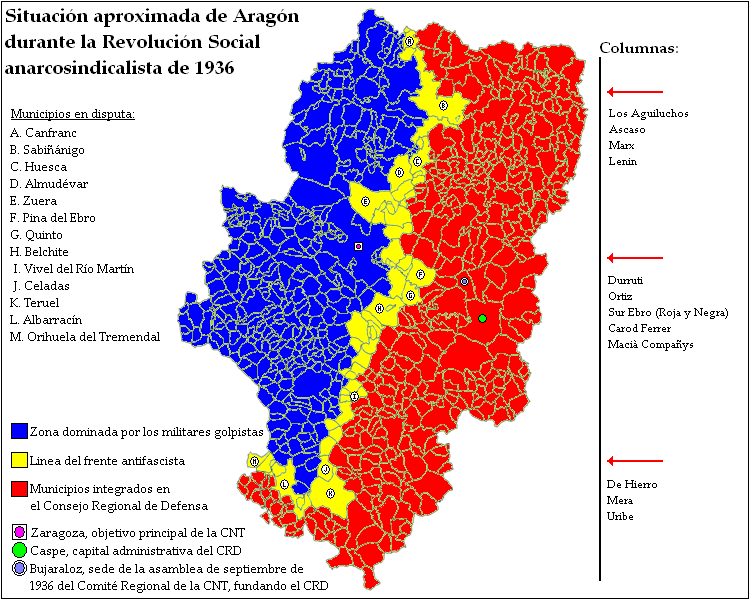
But still, in late July 1936, thousands of volunteers left Barcelona convinced they were heading towards a decisive victory. Thousands of volunteers were eager to fight, and some believed the campaign would be over within weeks. With crowded roads, military traffic and frequent delays, the trip could take many hours and often required a full day or longer depending on conditions. Most columns moved west through Catalonia towards Lleida before crossing into Aragón and then the geography began to shape events. The town of Caspe lay roughly 100 kilometres southeast of Zaragoza and became one of the principal entry points into Aragón. Further northwest stood Bujaraloz, approximately 75 kilometres from Zaragoza. Between them ran roads across dry plains broken by scattered villages and agricultural settlements. Pina de Ebro, another important objective, lay only about 35 kilometres east of Zaragoza itself. But the roads were often poor, communications remained unreliable, and the columns moved at different speeds and frequently pursued different objectives. Some headed towards the Zaragoza sector while others moved north towards Huesca. Still others spread across villages and strategic positions between the two cities and so the front expanded almost immediately, and by the end of July, militia positions stretched across a broad arc of eastern Aragón.
The Huesca sector presented its own challenges. Huesca lay roughly 70 kilometres north of Zaragoza and became another major Nationalist stronghold. Between Huesca and Zaragoza stretched open countryside, small settlements and strategic road connections. Capturing either city would have dramatically altered the military situation in north-eastern Spain. Both remained in rebel hands, and this was not immediately obvious to the volunteers arriving from Catalonia. Many expected local workers to rise in support of the columns, while others believed Nationalist resistance would collapse once sufficient revolutionary forces appeared. Others imagined Zaragoza’s defenders were isolated and demoralised. In reality, the rebels had already consolidated their position more than many in Barcelona understood.
General Miguel Cabanellas and his officers controlled Zaragoza. Military installations remained in their hands and the city possessed trained troops, organised command structures and defensive positions. The first warning signs appeared almost immediately as volunteers advancing through Aragón encountered logistical difficulties, shortages of transport, poor communications and stronger resistance than anticipated. Columns often found themselves operating independently. Information about neighbouring units could be incomplete or outdated. Coordinating large-scale operations proved difficult. By the final days of July, many leaders already understood that Zaragoza would not fall through a simple advance along the roads from Catalonia. The city would require a major offensive and by early August, that conclusion had become increasingly difficult to avoid.
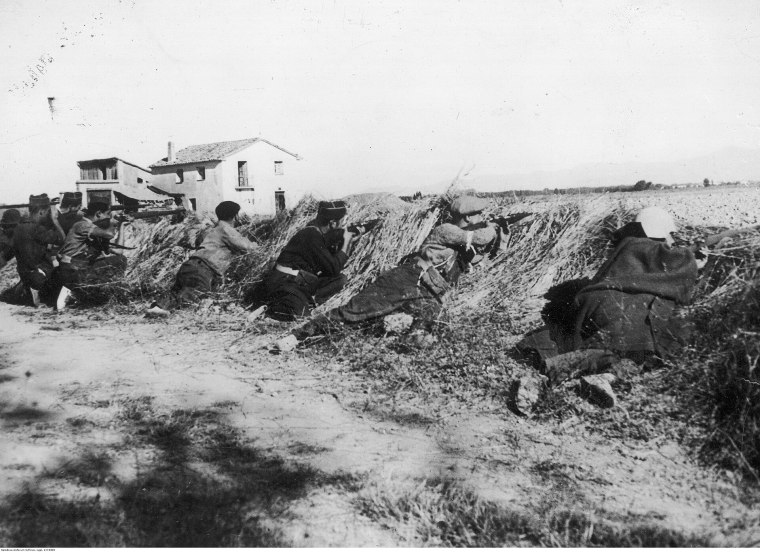
The consequences the volunteers face became apparent during the first clashes around villages and road junctions east of Zaragoza. These engagements were generally small compared to the battles that would follow later in the war, but they revealed important truths. A handful of determined defenders armed with machine guns could halt far larger groups of attackers. Roadblocks proved difficult to overcome and strongpoints that appeared insignificant on maps could delay advances for hours or days. Many volunteers had entered Aragón expecting a rapid campaign and instead encountered the slow, frustrating reality of military operations. Elsewhere across the front, similar experiences unfolded, as villages changed hands, roads were secured, outposts were established local committees emerged. In many places, the arrival of the columns was greeted enthusiastically by supporters of the Republic and the labour movement. CNT members who had spent years organising in Aragón suddenly found themselves backed by armed forces from Catalonia. Meanwhile, landowners had started to flee. Conservative families worried about what the arrival of armed revolutionaries might mean and priests and religious institutions faced uncertain futures depending on local circumstances. Reactions to the worker volunteers varied enormously from village to village.
The fighting lacked the concentrated intensity of later battles, and record-keeping was often poor. Volunteers were killed and wounded in skirmishes, ambushes and exchanges of fire across the front. Mechanical accidents, weapons mishandling and transport incidents also claimed victims. By the final days of July, most column leaders had already begun adjusting their expectations. The confidence that had accompanied the departure from Barcelona was beginning to change, though the militias had achieved genuine successes. Large areas of eastern Aragón now lay under anti-fascist control. Strategic towns such as Caspe had been secured. Supply routes remained open and thousands of volunteers occupied positions stretching across a widening front. At the same time, every day brought fresh evidence that the campaign would be harder than expected, well-organised rebels, huge distances, logistical problems were more severe. Volunteers ended July constructing positions, guarding roads, organising supply depots and preparing for a struggle that was already beginning to look far longer than anyone had imagined. By the end of July 1936, the militia columns advancing from Catalonia had failed to reach Zaragoza. But soon, in the summer of 1936, collectivisation would start appearing across parts of Aragón. They would find themselves at the centre of one of the most ambitious social experiments in modern European history.

