- Seville
On 1 September 1936, twelve prisoners had been executed in Sevilla as Nationalist repression continued to operate through the city’s prisons and execution sites, particularly the San Fernando cemetery. The executions formed part of the systematic killing of political prisoners that had followed the Nationalist seizure of Sevilla in July.
On 2 September, General Gonzalo Queipo de Llano broadened the confiscation measures already being applied against supporters of the Republic. Under the expanded provisions, political activity dating back to 1932 could be taken into consideration when property was seized. The measure therefore extended beyond people who had taken an active part in the Republican resistance during the July fighting, allowing earlier political involvement to become grounds for economic punishment. Confiscation became another component of the repression taking place alongside imprisonment, executions, and dismissals from public employment.
- Segovia, Old Castile
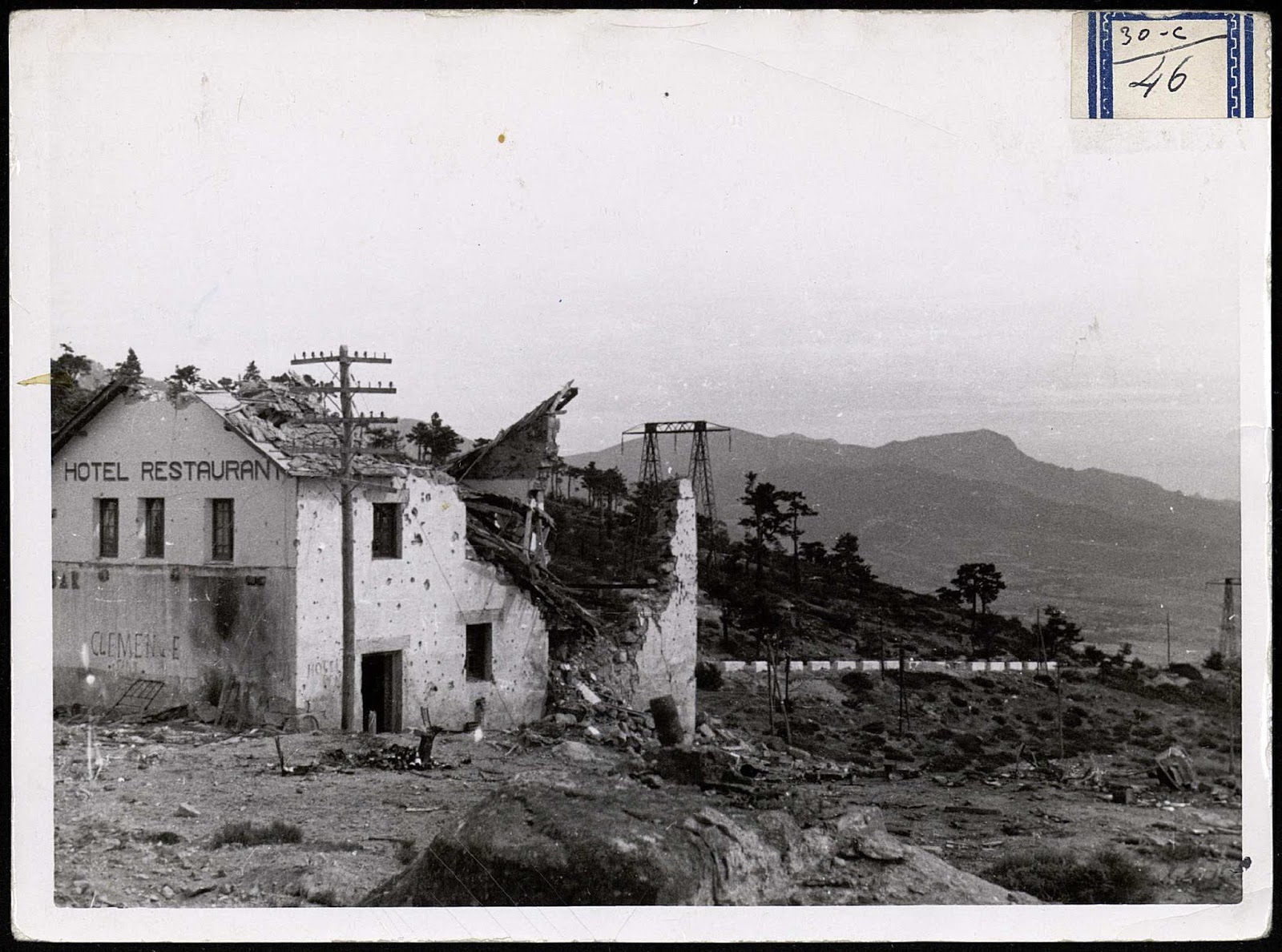
During the first half of September, the southern edge of Segovia province remained an active front. The Nationalists controlled Villacastín, El Espinar, San Rafael, and the Alto del León, while Republican troops held positions on the Madrid side of the Sierra de Guadarrama. The major fighting of July and August had subsided, but both sides continued to reinforce their positions, exchange artillery fire, patrol the mountains, and contest individual heights.
Around 2–3 September, Villacastín was crowded with Nationalist soldiers and Falangist militiamen moving towards or returning from the mountain front. The town lay on the route connecting the Castilian rear with El Espinar and San Rafael, making it an important staging point for troops, vehicles, ammunition, food, and other supplies being sent towards the Alto del León.
Republican aircraft were also operating over this route during early September. Contemporary reports describe aircraft appearing almost daily around the Villacastín–Aldeavieja sector, bombing Nationalist-held territory and damaging houses and crops. Aldeavieja lay just across the provincial boundary in Ávila, while Villacastín was inside Segovia, so the raids affected the network supplying the Nationalist positions in the Sierra rather than an isolated front-line village.
Further south, El Espinar and San Rafael stood immediately behind the Nationalist mountain positions. Soldiers arriving from the interior passed through these towns before continuing towards the front, while military vehicles and supplies travelled along the same roads. San Rafael, lying directly below the Alto del León, was particularly important for supporting the men holding the pass.
At the front itself, the Nationalists occupied the Alto del León, which they had captured on 22 July. Republican troops remained close enough for artillery fire, patrols, and local attacks to continue throughout the first half of September. Both sides were increasingly digging trenches, constructing shelters and observation posts, and improving communications between positions as it became apparent that neither was about to drive the other out of the mountains.
One remaining contested position was Cabeza Líjar, a summit west of the Alto del León at the meeting point of the Segovia, Ávila, and Madrid areas. Fighting for the heights had continued since the opening weeks of the war. On 15 September, Nationalist troops completed their occupation of Cabeza Líjar, securing the western side of their position around the Alto del León.
After 15 September, the front became increasingly fixed. The Nationalists strengthened their positions on the Segovian side around El Espinar, San Rafael, Alto del León, and Cabeza Líjar, while Republican troops fortified the opposing side towards Madrid. Trenches, shelters, observation positions, and protected communications gradually replaced the more fluid fighting of the first weeks of the war.
Segovia remained both a Nationalist rear area and a front-line province. Only a relatively short distance separated the troop and supply traffic passing through Villacastín from the fortified positions in the mountains and the Republican troops beyond them.
- Burgos, Old Castile
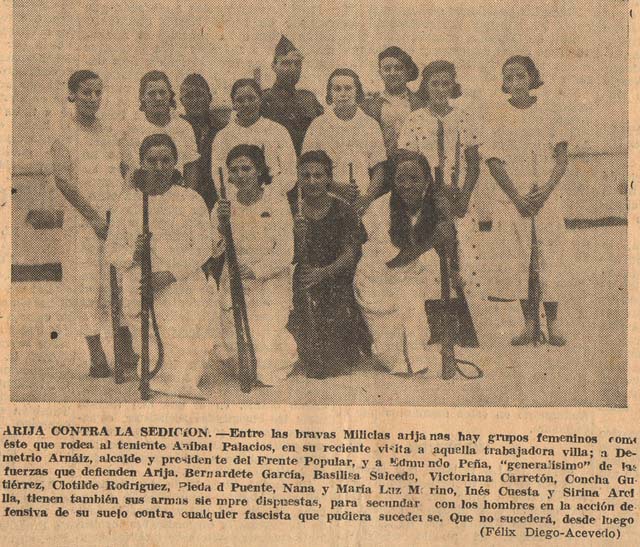
While most of Burgos province was securely under Nationalist control, Arija, close to the Cantabrian border, remained on the Republican side of the front. During September, the Santander newspaper La Voz de Cantabria provided an unusually detailed photographic record of the community and the people living there.
On 2 September, the newspaper published a feature entitled ‘Arija contra la sedición’, which included photographs of women serving with the Republican militias. The images are useful evidence for the presence of milicianas in this small section of the northern front rather than only in the much better photographed militias around Madrid, Barcelona, or Aragón.
Further photographs and reports appeared before 23 September, showing male and female militia members alongside the civilian life continuing around them. The series included agricultural labour, a comedor popular providing communal meals, the Casa del Pueblo, members of the local Frente Popular committee, and other scenes from the town. Arija was living simultaneously as a front-line Republican enclave and a working community. People still had to produce food and organise meals and local government while armed militia units operated nearby. The photographs also preserve the faces of women who participated directly in the Republican mobilisation during the first months of the war, before women’s presence in combat roles became increasingly restricted.

- Logroño (La Rioja)
On 2 September 1936, 29 people from Cervera del Río Alhama, in south-eastern Logroño, were taken to El Carrascal, in the neighbouring municipality of Grávalos, and killed by men carrying out the Nationalist repression. The victims were civilians from an area already controlled by the Nationalists, not people killed during fighting between the two sides of the war.
At least twenty-two victims can be identified from the records: Benigno González Calahorra, Canuto Forcada Garijo, Cosme Vidorreta Jiménez, Cándido Alfaro Morales, Cándido Berdonces Santamaría, Emilio Gutiérrez Jiménez, Francisco Igea Vidorreta, Gregorio González Berdonces, Gregorio Martínez Ladrón, Hilario Cruz Igea, José Jiménez Zapatero, Juan Gil Álvarez, Manuel Pérez González, Máximo Díez González, Miguel Garijo Sáinz, Pedro Alfaro Moreno, Pedro Santamaría Madurga, Santiago Moreno Gómara, Saturnina Gil Álvarez, Segundo Ágreda Jiménez, and Víctor Forcada Toledo, with further victims recorded for the same date. The group included people targeted because of their real or suspected connections with the Republican political and labour organisations that had operated in Cervera before the military uprising. They were taken away after Nationalist control had already been established and killed outside their town, at El Carrascal. Their deaths formed one of the largest single documented episodes of Nationalist repression in La Rioja during September 1936.
Armando Rubio, son of the then-mayor of Cervera del Río Alhama, was a child when the massacre took place. At a 2004 memorial service for the victims, he described that day – ‘On the 2nd, we brought them breakfast. Some took it, and others were told, ‘You don’t need it anymore.’ That’s how we learned that between the night of the 1st and the early morning of the 2nd of September, 29 prisoners were taken out and murdered in the holm oak grove of Villarroya, buried as if they were animals.’ In 1977, a memorial service was held for the first for the victims of Francoism in La Rioja. Exactly 42 years after their murder, their families exhumed their remains, which were transferred to the Cervera cemetery in a large public ceremony. Every September 2nd, the region remembers what was one of the largest massacres in the history of La Rioja.
The cemetery at Alfaro became a burial and memorial site for victims of Francoist repression from the surrounding area. Some of those commemorated there had originally been buried elsewhere and were recovered by their families during the first years after the dictatorship, when relatives across La Rioja were beginning to locate graves and bring the dead back to local cemeteries. On 23 March 1980, Alfaro held a public funeral tribute to those described at the time as the humiliated and murdered in 1936. Eight coffins were carried to the cemetery on the shoulders of local people, each reportedly containing the remains of eight victims. If the contemporary account is accurate, the ceremony therefore represented the reburial of approximately 64 people. It was a substantial public act of remembrance only five years after Franco’s death and more than four decades after the killings. The cemetery subsequently became the location of a large memorial to those killed in 1936. Searches have also continued there for individual victims whose burial places remain uncertain. Among them is Valentín Plaza, who was mayor of nearby Castejón, Navarre, in 1936. Searches for his remains were conducted in 2010, 2012 and again in 2022, concentrating on an area near the present memorial, but none succeeded in locating him.
- Soria, Old Castile
Though most of Soria province was securely controlled by the Nationalists, its southern boundary faced territory where Republican troops were still operating in Guadalajara province. During September, Nationalist units guarded the roads and bridges through this area against the possibility of a Republican advance northwards into Soria.
The first Soria Falange bandera, numbering approximately 200 men, held positions around the Puente Ullán–Cuesta de Paredes road. These were Falangist militia fighting for the Nationalist side rather than Republican troops approaching from the south. A second Falange bandera, commanded by Captain Hernando, operated further towards Hiendelaencina, across the provincial boundary in Guadalajara. The Nationalists also prepared for the possibility that their forward positions might have to retreat. Plans were made to destroy bridges on the approaches into Soria if Republican columns advanced, slowing their movement along the roads into the province.
- Plasencia, Cáceres
By 2 September, the authorities in Plasencia were reporting serious problems caused by the large number of political prisoners being held in the municipality. The arrests followed the Nationalist takeover of the city and formed part of the wider repression directed against people suspected of supporting the Republic, left-wing organisations, or the Popular Front. The sudden expansion of the prison population created difficulties in finding accommodation, maintaining the prisoners, and managing the detention system. The situation in Plasencia reflected the wider wave of arrests taking place across Nationalist-controlled Cáceres province during the first weeks of the war.
In 1985, a mass grave was privately exhumed at the Plasencia cemetery where approximately 100 republicans were murdered during the Francoist repression. A plaque paid for by the city council was placed at the request of retired teacher Antonio Sánchez-Marín, author of the book Maestros de la República.
- Tierz, Huesca
On 2 September 1936, Republican forces occupied Tierz, a village immediately east of Huesca. The advance was carried out by POUM militia units approaching from the Sariñena–Novales direction, bringing the Republican line closer to the Nationalist positions defending Huesca. Tierz was strategically important because it lay on the approaches to the city and its occupation increased pressure on the Nationalist defensive positions at Estrecho Quinto and Montearagón. The Republican forces were attempting to tighten the encirclement of Huesca, which had remained in Nationalist hands since the July uprising.

