The military uprising brought a rapid reversal of the secular policies associated with the Second Republic throughout the provinces of Old Castile, León, and Galicia, Navarre, Logroño, and Álava in the Basque Country that came under Nationalist control. During the first months of the war, changes appeared not only in churches but also in schools, municipal institutions, public ceremonies and everyday civic life. Catholicism, which had never disappeared from local society during the Republic, was restored to an official position from which Republican legislation had attempted to separate it.
Education provided one of the clearest signs of the change. The Republic had promoted secular state education, restricted the role of religious orders in teaching and removed compulsory religious instruction and Catholic symbols from public schools. After the July uprising, Nationalist authorities began reversing those policies. Religious instruction returned, crucifixes were restored to classrooms, Republican educational material was removed or scrutinised, and the political and religious attitudes of teachers became grounds for investigation. Teachers identified with Republican parties, trade unions, secular education or other organisations considered hostile to the new regime could face suspension, dismissal, imprisonment or more severe repression.
Religious orders also began recovering educational roles and, in some cases, property they had lost under Republican legislation. Valladolid provides a particularly clear example. The Society of Jesus had been dissolved in Spain in 1932 and its Colegio San José confiscated and incorporated into the Instituto Núñez de Arce. By approximately mid-September 1936, the Jesuits had received permission from the Nationalist educational authorities to reoccupy part of the building. The restoration was incomplete — sections of the premises were simultaneously required for wartime purposes, including accommodation for Guardia Civil personnel arriving from Republican-held territory — but the return of the Jesuits to a building from which the Republic had removed them demonstrated how quickly the institutional position of the Church was changing.
Municipal and military authorities participated openly in Masses, religious funerals, processions, blessings and other Catholic ceremonies. Religious services accompanied military and political occasions, while funerals for Nationalist soldiers, Falangists and other supporters of the uprising could combine Catholic ritual with political commemoration. Flags, military units, political organisations and religious representatives increasingly appeared together at public ceremonies.
This represented more than the revival of religious practices that had supposedly disappeared under the Republic, because many of them had never disappeared. People throughout Castile and León had continued attending Mass, celebrating feast days and participating in Catholic organisations during the Republican period. What changed after July 1936 was the relationship between religion and public authority. Catholic observance again received official sponsorship, while the secular principles of the Republican state were systematically removed from institutions controlled by the Nationalists.
The change was especially visible in provincial capitals and larger towns, where military authorities, municipal governments, Falange, Carlist organisations and the Church could participate in the same public occasions. Religious imagery returned to civic spaces, ceremonies acquired explicitly Catholic elements, and public expressions of the Nationalist cause increasingly presented the conflict in religious as well as political terms. This process developed at different speeds from one province and municipality to another, but the direction was broadly consistent across territory securely controlled by the Nationalists.
When the Republic was proclaimed in April 1931, Spain still had a severe educational deficit. Roughly 30-60% of adults were still illiterate, the figure varying enormously by region, sex, age and social class. Illiteracy was much higher among rural labourers and women and in poorer southern provinces, while Madrid, Catalonia and parts of northern Spain had substantially better rates. Many villages had inadequate schools, overcrowded classrooms or no functioning school at all. Thousands of new schools were opened during the following five years, although the original target of 27,000 schools was never achieved. Teacher recruitment and training expanded alongside construction, and teachers’ salaries were improved. The 1931 Constitution made state education secular. Religious instruction was removed from state schools, and the Republic attempted to reduce the enormous role that Catholic religious orders had traditionally played in education, but full implementation proved extremely difficult. But the Republic associated education with its wider attempt to modernise rural Spain. Secondary education remained much less accessible. Instituto places were concentrated in larger towns and cities, and continuing beyond primary school was considerably easier for middle-class families than for labouring families. Universities represented an even smaller social world. For many working-class and rural children, education still ended early because their labour contributed to the family economy. Agricultural work affected attendance in rural communities, children might be withdrawn temporarily for harvesting or other work. Republican educational reformers favoured greater equality between boys and girls, but mixed schooling remained limited before the war. Girls’ education had traditionally placed greater emphasis on domestic preparation, while boys were more likely to continue into secondary and higher education. The Republic had begun challenging these divisions, but five years was nowhere near enough to eliminate them.
For ordinary residents in Nationalist-held zones, the transformation was now encountered through familiar institutions. Children returned to classrooms in which religious teaching and Catholic symbols were being restored; Republican teachers faced investigation, detention and execution under the new authorities; religious communities recovered public roles; municipal representatives appeared at Catholic ceremonies; and religious observance became increasingly intertwined with demonstrations of loyalty to the emerging Nationalist order. Within months of the uprising, the secular institutional culture promoted by the Republic was being replaced across Nationalist-held Castile and León by one in which Catholicism again occupied a central place in education and public life.
Meanwhile, by September 1936, life in the Republican rear had settled into an uneasy mixture of ordinary routine, war mobilisation, and social revolution. Madrid, Catalonia, Valencia, New Castile, and Murcia remained far from direct ground fighting, although Madrid was increasingly threatened by the Nationalist advance. The failed military uprising had transformed who exercised power, how businesses operated, what people saw in the streets, and increasingly what they could buy. The Republican government remained the legal government of Spain, with Manuel Azaña as president. In September, Socialist trade-union leader Francisco Largo Caballero became prime minister, heading a broad government containing Socialists, Communists and Republicans. His appointment marked an attempt to bring the political and military power created by the July revolution back within a functioning state
Town councils and provincial authorities still existed, but so did committees created by the CNT, UGT, PSOE, PCE, POUM and other organisations. They could control factories, transport, food distribution, buildings, armed patrols and militia recruitment. Their importance varied enormously. Barcelona had undergone a particularly far-reaching revolution, while in other Republican towns conventional municipal government survived more strongly. During September the general movement was towards restoring government authority rather than allowing every armed committee to operate independently. Catalonia was distinctive because the Generalitat remained a powerful autonomous government. In September, Lluís Companys formed a new government that brought the CNT into the Generalitat alongside ERC, the PSUC and POUM. Revolutionary organisations were therefore increasingly being incorporated into government rather than simply operating alongside it.
The men seen leaving Republican towns during July and August had mostly been volunteers, recruited through political parties, unions and militia organisations. CNT, UGT, Communist, Socialist and other headquarters became recruitment centres, and departing columns were frequently accompanied by bands, flags and crowds, roughly 75,000–100,000 volunteers across Republican Spain during the early period, and estimates of the initial militia strength are generally around 100,000. Large numbers of military-age men remained civilians. By September, the weaknesses of the militia system were becoming obvious. Units had different organisations, weapons, pay arrangements and standards of discipline. The Largo Caballero government increasingly pushed towards a centrally controlled army. Recruitment therefore began changing from the image of an individual walking into a union headquarters and joining a political militia towards formal mobilisation, military organisation and ultimately conscription. The transition was still incomplete in September.
Women had joined militia units during the first revolutionary months, but the majority of women’s wartime work was already occurring behind the lines; medical treatment, clothing production, transport, administration, keeping factories running, refugee assistance and political organisation. Women also increasingly filled jobs vacated by men who had gone to the fronts.
There were more schools, more teachers, improved teacher training, greater public expenditure, expanding literacy and a much stronger conception of education as a state responsibility than there had been in 1931, but shortages remained substantial and Catholic schools continued educating large numbers of children, which was now to be phased out with secular classes to begin for all. In Republican territory, the destruction or closure of religious institutions suddenly accelerated a process that the pre-war Republic had been trying to achieve gradually and with considerable difficulty. Thousands of pupils who had previously attended Catholic schools now needed places in a secular system immediately. Buildings could be requisitioned relatively quickly; finding enough trained teachers, books, equipment and money was considerably harder.
Catalonia went much further than most regions. The restored Generalitat promoted Catalan-language education and developed its own educational institutions within the constraints of the Republic. The use of Catalan in schools expanded after decades in which Castilian Spanish had dominated official education. This meant that educational reform there involved not only secularisation and expansion but also language and Catalan cultural autonomy. The Consell de l’Escola Nova Unificada (CENU) was attempting to construct a universal, secular public school system. Former convents, religious schools and other confiscated buildings became schools. Thousands of teachers had to be found, including temporary teachers where qualified staff were unavailable. Catalan, coeducation, secular teaching and broader access to education were central parts of the programme. In September, Tarragona officials were counting children, finding suitable buildings and organising teachers with the stated objective that every child in the city should attend school. The process was difficult and the new term did not everywhere begin normally, but education had certainly not ceased.
The division of Spain had also broken traditional food networks almost overnight. Madrid had lost access to livestock and produce from large parts of Old Castile, Galicia and western Spain. Local authorities and unions organised supply committees, imposed price controls and attempted to prevent hoarding. Some Madrid districts were already experimenting with food cards during September. Valencia and Murcia were major agricultural regions, and their fruit, vegetables and other produce became increasingly important to Republican supply. Catalonia initially had better access to food than Madrid, although it depended heavily upon imports from surrounding agricultural regions. People encountered queues and occasional shortages, but the familiar image of the starving Republican cities belongs principally to a later stage of the war. In September 1936, the greater immediate problems were disrupted distribution, transport, price rises, hoarding and sudden movements of population.
For many people, the greatest change was at work. In Catalonia, particularly Barcelona, workers took control of factories, workshops, transport companies and other businesses after owners fled or were removed. Management committees elected by workers could replace the old employer. Trams, buses, factories, hotels and other services operated under various forms of worker control. The extent of this transformation made Barcelona visually and socially different from most other Republican cities. Valencia also experienced extensive collectivisation, particularly where the CNT was strong, although private businesses and individual farms certainly did not disappear. New Castile saw major changes in land ownership and agricultural organisation. Land belonging to people associated with the uprising was seized, while agricultural workers occupied estates and established collectives or divided land for cultivation. Historians’ estimates of the exact extent of collectivisation vary considerably, partly because confiscated, collectively cultivated and redistributed land were not the same thing.
The most conspicuous social change was the collapse of the Catholic Church’s public presence across much of Republican Spain. Churches and convents had been burned, closed, confiscated or converted to hospitals, warehouses, barracks, schools and political premises. Public Mass largely disappeared in many areas, religious processions ceased, and clergy frequently went into hiding. At the same time, Republican towns became saturated with political imagery. Union and party flags hung from buildings, political organisations occupied former hotels, clubs and religious buildings, militia uniforms were common, and posters called for enlistment, production and resistance. The transformation was particularly visible in Barcelona, where revolutionary organisations exercised exceptional influence. But large numbers of ordinary people just continued working, caring for children and trying to avoid political trouble. Catholics practised privately where possible, small proprietors attempted to protect their businesses, and many people who supported the Republic had little enthusiasm for revolutionary collectivisation.
The refugee problem was already becoming substantial across the country. Nationalist advances through Andalucía, Extremadura, Toledo and the north pushed civilians into the remaining Republican territory. Madrid, Valencia, Alicante, Murcia and towns further east began receiving people who had escaped occupied areas, often with little more than what they could carry.

GC-CAJA/98/21
- Asturias
At the beginning of September, the Nationalist columns advancing from Galicia were still a long way from the men they had been sent to relieve. Colonel Antonio Aranda and several thousand soldiers, Guardia Civil, Assault Guards and armed volunteers remained surrounded inside Oviedo, while between them and the Galician relief force lay some seventy kilometres of western Asturias, several substantial rivers and increasingly determined Republican opposition. What looked like a relatively short distance on a map had already taken the Nationalists weeks to cross.
Colonel Pablo Martín Alonso coordinated several columns assembled from regular infantry, Guardia Civil, Assault Guards, Falangists and other volunteers, with machine guns and mountain artillery and some support from Nationalist aircraft and ships offshore. Jesús Teijeiro, who had replaced the wounded Commander Ceano, commanded one of the principal groups. Their combined strength fluctuated as reinforcements arrived and units separated to use different roads, but by September several thousand Nationalist troops were involved in the advance across western Asturias.
On 1 September, the leading troops had reached Soto de Luiña, a small settlement west of Cudillero. Progress from here depended heavily upon the roads. Western Asturias offered few easy alternatives: steep wooded slopes descended towards the coast, rivers cut across the line of advance, and a destroyed bridge or Republican position overlooking a road could stop vehicles, artillery and supply lorries even if infantry found a way around it.
The Nationalists reached the Cudillero area on 5–6 September, with contemporary accounts differing by a day over exactly when the town and neighbouring El Pito passed fully into their hands. Republican aircraft were still attacking the advancing columns, but the Republican defenders could not prevent them continuing east. Pravia, approximately twenty kilometres further on, was occupied by Teijeiro’s men on 7 September, while another Nationalist group took Muros de Nalón and San Esteban de Pravia nearer the coast.
The withdrawal from Pravia brought the Republicans behind one of the strongest natural barriers in the area. The Narcea and Nalón rivers cut across the routes the Nationalists needed, and bridges now mattered as much as towns. Republican troops attempted to destroy crossings as they withdrew, forcing the advancing columns to search for usable bridges, repair damage or find places where men could cross while heavier equipment followed.
During 8–9 September, the Nationalists crossed the Narcea in the Cornellana area and pushed into the town and surrounding positions. Fighting continued around the locality, so the surviving accounts do not support treating the occupation as a perfectly clean event occurring at one hour on one day. What mattered was that the river had failed to stop Martín Alonso’s columns. In little more than a week they had moved from Soto de Luiña through Cudillero and Pravia and had crossed another major obstacle.
But the road ahead was now rising towards La Cabruñana. There the Republicans had something they had repeatedly lacked during the withdrawal from the coast: high ground from which they could dominate the road the Nationalists needed to reach Grado. The retreat across western Asturias was about to become a much more concentrated battle.
- Zaragoza, Aragón
The first days of September brought another concentrated wave of Nationalist killings in Zaragoza. The victims continued to be overwhelmingly people regarded as ‘political enemies’ of the fascist uprising: CNT and UGT members, socialists, republicans, communists, local political figures, trade unionists, workers, and people denounced by neighbours or local enemies. Within the first week of September, mass killings were occurring 1-20 per day. People who disappeared after being taken away, whose bodies were abandoned without immediate identification, and were never added to the ‘official’ death toll, likely making figures much higher in every part of the province. The Ayuntamiento de Zaragoza currently identifies 3,096 people killed by the repression during the Civil War, within a memorial listing of victims of the wider period, and by the end of September, the majority of these people would have already lost their lives.
The Torrero prison in Zaragoza city was central to the process. It held large numbers of political prisoners, and detainees were repeatedly removed in groups known as sacas. The prisoners were taken out of the prison, often in the early morning, and transported by vehicle to places where they were to be killed. One contemporary account describes Guardia Civil personnel beginning around 6:00am by binding the prisoners’ hands before they were loaded into a camioneta and taken to the rear wall of the Cementerio de Torrero. The prisoners were accompanied by a priest and placed in a line facing the wall. A firing squad shot them, after which the priest administered absolution and extreme unction to the dead and wounded, while an officer went along the line giving survivors the coup de grâce.
Victims recorded on 3 September included people from Zuera, Fuentes de Ebro, Figueruelas, Paniza, Erla, La Almunia, Letux, Jatiel. The 3 September killings were particularly severe at Valdesparta. The mass-shooting reconstruction identifies at least 34 people murdered that day alone. The victims included workers, local political figures, trade unionists, and people brought from towns around Zaragoza. Some records connect individual deaths with Valdespartera, while others are associated with the cemetery or with Zaragoza without specifying the exact execution site. The Registro Civil reconstruction records 447 repression deaths in Zaragoza during September, following 732 in August.
- Huesca, Aragón
On 1 September 1936, the 17-year-old anarchist militiaman Pepita Laguarda Batet was mortally wounded during fighting on the Aragón front outside Huesca. A native of Barcelona who lived in L’Hospitalet de Llobregat, Laguarda had joined the Ascaso Column with her partner, Juan López Carvajal, and travelled to the front on 15 August. She had enlisted against her family’s wishes and insisted on taking part as a combatant.
The fighting around Huesca began early that morning. At about 5 a.m., after several hours in the forward positions, Laguarda was struck by a bullet. She was taken to a Red Cross post, then transferred to the hospital at Vicién and subsequently to the blood hospital at Grañén. She died there at about 9.30 a.m., aged seventeen.
Laguarda’s death was reported prominently in the anarchist press, which portrayed her as one of the young women who had chosen to fight at the front. Her story is particularly notable because she was not simply attached to a militia column in a medical or auxiliary capacity: she had deliberately enlisted as a fighter and was killed in the fighting around Huesca.
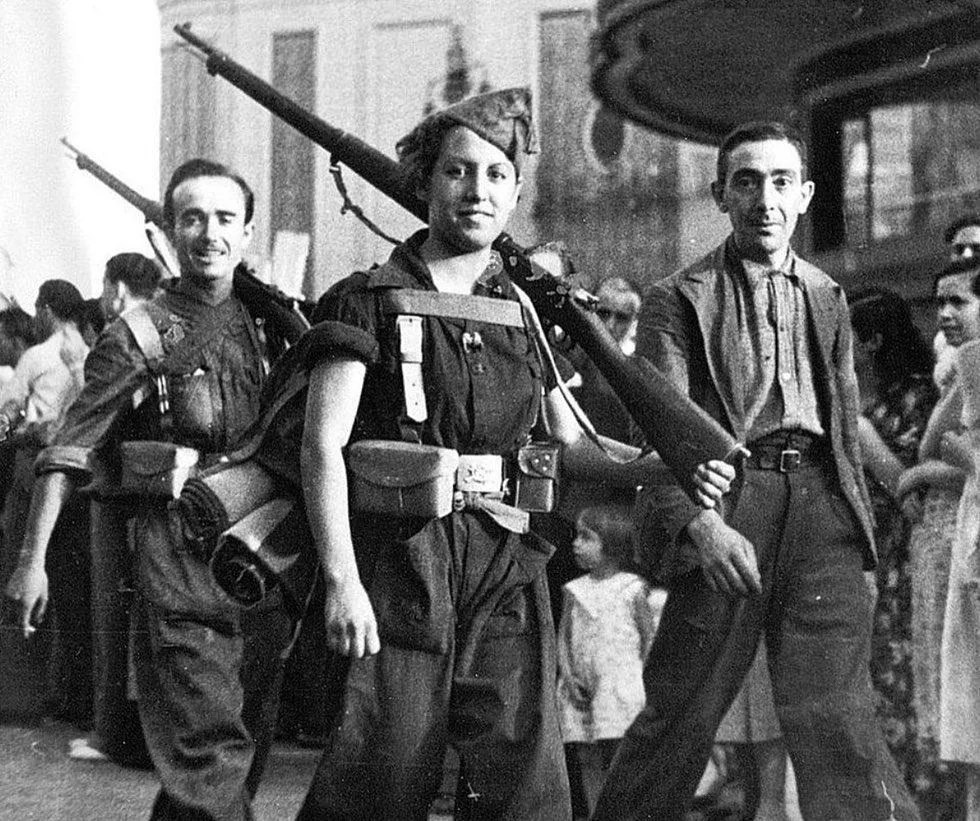
Before dawn on 1 September 1936, Republican forces began a major attack on Huesca, the Nationalist-held provincial capital that had been under pressure from Republican forces since the opening weeks of the war. Republican aircraft appeared over the city before daylight, while artillery opened fire against Nationalist positions around Huesca. The bombardment formed part of a wider assault intended to tighten the pressure on the isolated Nationalist garrison.
The attack developed on several sides of the city as Republican infantry attempted to advance against the Nationalist defensive positions. Fighting continued throughout the day, with artillery and aircraft supporting the Republican ground forces. Nationalist positions around Huesca were subjected to sustained bombardment, while Republican troops attempted to exploit their positions around the city’s approaches. By this stage, Republican forces had established themselves around much of Huesca. Contemporary Republican reports described the city as effectively encircled, although the Nationalist garrison still held the urban centre and maintained communications with the outside world. The Republican forces surrounding Huesca included militia and military units operating from positions to the north, east, and south of the city.
The fighting also produced an unusual episode in the Nationalist air effort. Nationalist records state that three large trimotor bombers appeared over the Huesca sector during the afternoon. They were operating without fighter escort, something specifically noted in the contemporary accounts and described as the first occasion on which these aircraft had operated over the sector in that manner. Their appearance provided the Nationalist defenders with air support while the Republican attack was still underway. The Nationalist garrison retained control of the city, and the Republican forces remained outside its defences.
- Balearic Islands
The final battle for the Republican beachhead on the east coast of Mallorca began on 1 September 1936, when Nationalist forces launched a major counter-offensive against the positions established by Captain Alberto Bayo’s Republican expeditionary force. The Republican landing had begun on 16 August, when Bayo’s troops came ashore near Porto Cristo and subsequently occupied a stretch of coastline extending north and south of the town. For more than two weeks, the Republican force had attempted to expand its foothold inland, but the advance had stalled as Nationalist troops, supported by Italian aircraft and reinforcements from the island’s garrisons, concentrated against the beachhead.
On 1 September, the Nationalists attacked along the Republican positions in the eastern sector. Their offensive was supported by artillery and aircraft, while infantry pushed against the Republican lines and began recovering ground that had been held by Bayo’s men. The Republican position was increasingly difficult to sustain, particularly as Nationalist forces had been reinforced and the beachhead remained dependent upon supplies and communications across the sea.
The Nationalist pressure continued over the following two days. On 3 September, Bayo received orders for the expedition to withdraw from Mallorca. The decision effectively ended the Republican attempt to conquer the island. During the night of 3–4 September, Republican troops began evacuating the eastern coast. Men, equipment, and wounded were taken towards the waiting vessels while the Nationalists continued advancing against the abandoned positions.
The evacuation was not completed successfully. Forty-five Republican prisoners were left behind when the expedition withdrew. They fell into Nationalist hands as the beachhead collapsed and were subsequently subjected to execution. The killings formed part of the repression that followed the defeat of the expedition and will be treated separately where the individual victims can be assigned to specific dates.
By 4 September, Nationalist forces had recovered the Republican beachhead on the eastern coast. The remaining Republican troops had been evacuated by sea, leaving the Nationalists in control of the territory that Bayo’s expedition had occupied since August. The withdrawal brought the Republican attempt to establish a permanent bridgehead on Mallorca to an end.
The collapse of the expedition also marked the failure of the Republican strategy of capturing territory in eastern Mallorca and using it as a base from which to advance towards the interior of the island. Nationalist control of Mallorca was consequently restored, while the surviving Republican forces returned to Menorca, which remained under Republican control for the rest of the war.
- Segovia, Old Castile
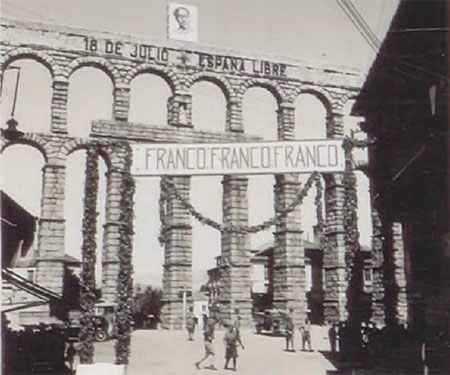
During the night of 31 August–1 September 1936, seven prisoners were removed from the Prisión Provincial de Segovia by men acting for the Nationalist authorities. They were supposedly being transferred to Valladolid, but instead were taken to Puente Oñez, near Anaya, west of Segovia city, where they were killed without trial.
Six of the seven were prominent members or supporters of the political organisations that had backed the Republic. The group included members of Izquierda Republicana and the PSOE, as well as men connected with the Casa del Pueblo. Their occupations and backgrounds included a teacher, a doctor, a municipal secretary, and a retired Guardia Civil lieutenant. Among them were Antonio Hernanz and Manuel González, both leading figures in Segovia’s Casa del Pueblo. The prisoners were already in Nationalist custody when they were taken from the prison. The claim that they were being moved to Valladolid provided a reason for removing them from Segovia, but they never reached the city. They were driven instead to the Puente Oñez area and shot. Their deaths came at the end of the first and most intense phase of extrajudicial repression in Segovia. 137 people had been killed extrajudicially across the province during August. Another 30 were killed during September, even as the Nationalist authorities increasingly began using military courts, prison sentences, and formal executions against people accused of supporting or defending the Republic.
Nationalist repression in Segovia province ultimately killed approximately 360–370 people. Historian Santiago Vega Sombría’s later reconstruction identifies 370 victims, comprising 215 people killed extrajudicially and 155 executed following military proceedings. Thousands more passed through prisons or suffered other forms of political punishment. The violence was directed principally against people associated with the Republic, PSOE, Izquierda Republicana, trade unions, Casas del Pueblo and Republican local government, as well as others whom the new Nationalist authorities considered politically unreliable.
Repression was particularly severe in the Sierra and southern frontier belt, where Nationalist-held Segovia faced Republican territory across the Guadarrama. Vega Sombría calculated that 48.8 per cent of the province’s repression victims came from this zone. The proximity of the front increased Nationalist suspicion of residents considered sympathetic to the Republic or capable of assisting Republican troops.
By September,, the machinery of repression was changing. Extrajudicial killings continued, but the Nationalists increasingly channelled prisoners through military courts. Large collective proceedings were opened against residents of El Espinar, Nava de la Asunción, La Granja, Coca, Bernardos, Cuéllar, Navas de Oro, Carbonero el Mayor and Vegas de Matute, among other municipalities. Defendants could be prosecuted for supporting Republican organisations, participating in strikes or workers’ groups, holding office under the Republic, or attempting to resist the July military uprising.
This produced a rapidly growing prison population. Political detainees were held in the Prisión Provincial de Segovia and the Cárcel Vieja, while others were distributed among prisons in the province’s judicial districts. By late September the system contained both prisoners facing formal military charges and people simply being held at the disposal of the military authorities, contributing to severe overcrowding.
During September and October, roadside killings, imprisonment, military trials, death sentences and long prison terms existed alongside one another. What changed was their relative importance: the mass extrajudicial killing that had characterised August declined, while prisons and military courts became increasingly central to the persecution of the Nationalists’ political opponents.
Across the wider period of repression, the resulting death toll reached approximately 370 documented victims in Segovia province: about 215 killed without judicial proceedings and 155 executed through the Nationalist military justice system. The September transition did not mark the end of lethal repression; it marked a shift from the intense sacas and roadside shootings of the first weeks towards a system in which imprisonment, military prosecution, and formal execution played a much larger role.
In the countryside, repression was enforced partly through mobile Falange units sent from municipality to municipality. These were armed members of the Falange on the Nationalist side, operating under the direction of the Nationalist Civil Governor of Segovia rather than simply acting as independent local groups. The Civil Governor established itineraries for the units, which travelled through rural communities to disarm residents considered politically unreliable, investigate local political loyalties, and reinforce Nationalist organisations in the villages.
Their arrival brought the machinery of the Nationalist takeover into villages that had little permanent military presence of their own. Falangists could work with local authorities and supporters to identify former Republican officials, trade unionists, members of left-wing organisations, and others regarded as opponents of the uprising. People identified during these operations could be disarmed, detained, or transferred into the provincial prison system. The mobile units had begun operating after the July uprising and continued travelling through Segovia’s municipalities during September.
- Madrid
On 1 September 1936, twelve brothers of the Hospitaller Order of Saint John of God were arrested at the Instituto-Asilo San José in Carabanchel Alto, where they cared for children and people with disabilities. The institution had already been taken over by Republican authorities on 29 August, and the brothers had been ordered to cease their religious activities. They remained at the institution while arrangements were made for them to leave.
At about midday on 1 September, armed men arrived at the institution while the brothers were preparing and serving food to the patients. The brothers were ordered to accompany them, searched, and placed in an autocar. They were taken away from the institution together, with the convoy travelling from the Carabanchel Alto area towards Boadilla del Monte.
The brothers were taken to Charco Cabrera, where they were removed from the vehicle and taken to a prepared fosa. They were lined up beside it and shot. Their bodies were then placed in the fosa. The twelve men killed were members of the Hospitaller community who had been engaged in caring for patients at the San José institution. The killing therefore involved a sequence that began with the seizure of the religious institution, followed several days later by the arrest of the brothers at their place of work, their collective removal by vehicle from Carabanchel Alto, and their execution at Charco Cabrera in Boadilla del Monte. The brothers were exhumed in 1942 and reburied in the crypt of the San José institution. The twelve were later recognised by the Catholic Church as martyrs of the Spanish Civil War.
- Valladolid, Old Castile
By September 1936, repression in Valladolid had moved well beyond the killings and arrests that accompanied the Nationalist takeover in July. Military courts were processing hundreds of prisoners from the capital and provincial towns, often prosecuting civilians for rebelión militar (military rebellion) because they had resisted the military rebellion of 18–19 July. The scale of the proceedings meant that entire groups from individual towns or political organisations could be tried together.
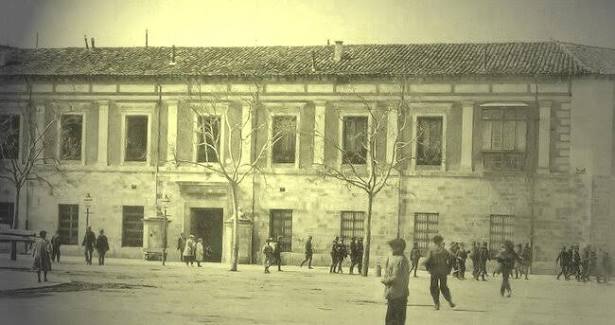
The largest case began at 8.30 am on 2 September inside Valladolid’s Cárcel Nueva, where 448 people arrested after the resistance at the Casa del Pueblo were brought before a single court martial. More than 500 people had originally been detained there after the building surrendered on 19 July. The hearing involving the 448 defendants was completed within one day; one reconstruction places its nominal duration at only about six and a half hours. Seventeen defendants were acquitted and two aged under sixteen were excluded from criminal responsibility, but 363 received thirty-year prison sentences, twenty-seven defendants aged sixteen to eighteen received twenty years, and forty people were sentenced to death. Thirteen of those prosecuted were women.
The sentences show how military justice was also being used to dismantle the political organisations of the Republic. The judgment ordered the dissolution of the UGT- and CNT-affiliated organisations implicated in the case, together with the Communist Party, Izquierda Republicana, Unión Republicana, and other organisations associated with the Frente Popular, and provided for the disposal of their property. The forty death sentences were approved by the military authorities on 7 September. Two were subsequently commuted, while thirty-eight prisoners were executed at the Cascajal or Campo de San Isidro during the second half of September. Surviving reconstructions differ slightly over the precise dates, placing the executions either around 18–20 September or between 20 and 23 September. They occurred during Valladolid’s September fair, while religious ceremonies, bullfights, and verbenas continued elsewhere in the city.
Other collective trials brought the repression of provincial towns into Valladolid. On 3 September, Ángel Salgado Pérez and thirteen other defendants from Labajos were tried over the circumstances surrounding the death of Falange leader Onésimo Redondo and five related killings. Five men were ultimately condemned to death and executed on 14 September. On 19 September, thirteen residents of Peñafiel were tried for their part in opposition to the Nationalist takeover of their town; all thirteen were condemned to death and executed before the end of the month.. On 24 September, fifty-three residents of Villalón de Campos appeared before the Audiencia Territorial for events surrounding the attempt to seize the town on 19 July, during which a Falangist had been killed and Captain Ortiz wounded. The prosecution requested thirty-six death sentences; seventeen of those eventually condemned were executed between 24 and 30 October. Two days later, at 3 p.m. on 26 September, another mass proceeding began against 102 residents of Nava del Rey, including agricultural labourers and local political figures accused of attempting to obtain weapons from the Guardia Civil post and resisting the Nationalist takeover. The prosecution initially requested twelve death sentences, though the number executed in October was higher.
These large cases existed alongside a continuous stream of smaller courts martial. Proceedings involving civilians and military personnel are recorded on nine days throughout September, for accusations ranging from rebellion and possession of weapons to firing on Falangists and offences against the new authorities. On 26 September the Valladolid press announced another three consejos de guerra de oficiales generales for the same day, separate from the mass Nava del Rey trial. Newspapers had also been publishing lists of detainees from Valladolid and provincial towns since July; by 24 September the published lists contained 1,067 names, while historian Jesús María Palomares considers the actual number arrested to have been higher.
The military courts consequently formed only one part of a much wider system of repression. Prison, execution, political proscription, confiscation, and detention operated together, while collective prosecutions converted the resistance of July into criminal cases against hundreds of people. September was the month in which many of those arrested during the first days of the uprising learned whether they would be released, imprisoned for decades, or taken from prison to be shot. Approximately 2,600 people were killed by Nationalist repression in Valladolid province, the great majority during 1936–37. More than 10,500 people have now been identified as having suffered some form of repression in the province.
- Burgos, Old Castile
During September 1936, prisoners were repeatedly removed from the Prisión Central de Burgos and taken west of the city towards the Monte de Estépar, where groups were shot and buried in mass graves. The killings formed part of a longer sequence of sacas from Burgos prison during the first months of Nationalist control. Rather than a single massacre, Estépar became a recurring execution site, with prisoners being removed in successive groups on identifiable dates throughout September and again in October.
The first September saca documented by the modern investigation took place on 1 September, when nineteen prisoners were removed from the prison. Further groups followed on 4, 5, and 6 September. Among those taken on 5 September was Félix Lalinde Martínez, a doctor from Quintana Martín Galíndez in the Valle de Tobalina, together with the municipality’s mayor, Miguel Ortiz Garmendia. The 6 September removal was smaller, but formed part of the same continuing system of extrajudicial killing.
The killings increased in scale during the following days. On 8 September, two separate groups were removed from the Prisión Central. One documented group consisted of seventeen prisoners, a number which corresponds exactly with the seventeen bodies subsequently recovered from Fosa IV at Monte de Estépar. The correspondence between the prison records and the archaeological evidence provides unusually strong evidence connecting a particular saca with an individual grave.
On 9 September, another twenty-seven prisoners were removed. Archaeologists associate this group with Fosa III, which contained twenty-seven bodies. DNA analysis has positively identified five of the victims: Mauricio Gómez Diego, Rafael Laserna Elena, Nicolás Neira Fernández, Plácido Pérez Barriuso, and Juan Quintana Alarcia. The following day, 10 September, another twenty-three prisoners were taken from the prison. This group has been associated with Fosa II, where twenty-six bodies were recovered; Luis Gutiérrez Zorrilla has been positively identified by DNA.
After a short interruption in the documented sequence, another substantial saca took place on 15 September, involving approximately twenty-one prisoners. Among them was Alberto Millán Cebrián, whose wife, teacher Pilar López Veganzones, had herself been imprisoned in Burgos on 1 September. The group also included veterinarian Pompeyo Arnáiz Vicario and other civilians.
The removals continued towards the end of the month. A further large group was taken from the prison on 29 September. Among the prisoners recorded in this saca were teachers Antonio Caballero Armas, Gregorio Díez Rodríguez, and Leoncio Hernández García, together with doctor Vicente Peraita Cardero. Another group followed on 30 September, the final September saca identified by the modern investigation, though killings connected with Estépar continued into October.
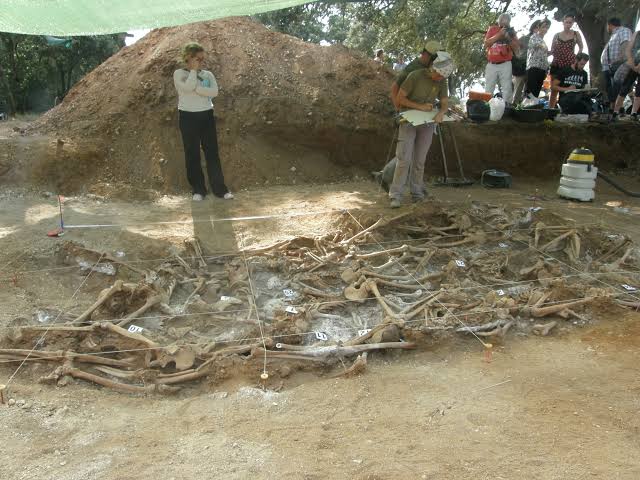
The archaeological investigation of Monte de Estépar has recovered ninety-six bodies from four mass graves, while historical research indicates that the total number of people killed in the area was considerably greater. The September records demonstrate how the site functioned: prisoners already held under Nationalist control in Burgos were selected in groups, removed from the prison, transported towards Estépar, killed without the formal execution procedure used for prisoners condemned by military courts, and buried in graves in the surrounding countryside.
The sequence also shows the intensity of the killing within a relatively short period. For the groups where numbers are preserved in the material — nineteen on 1 September, seventeen in one of the 8 September groups, twenty-seven on 9 September, twenty-three on 10 September, and approximately twenty-one on 15 September — these alone account for at least 107 prisoners, before adding the second group of 8 September and the groups whose numbers are not specified for 4, 5, 6, 29, and 30 September. Around 400 people are believed to have been murdered at Monte de Estépar, making it the principal site of Nationalist mass killing in Burgos province. The executions were concentrated between late July and mid-October 1936. Archaeologists have recovered 96 bodies from four graves, but at least fourteen graves are believed to have existed across the area.
Pilar López Veganzones, a teacher at the Escuela Unitaria de Párvulos in Medina de Pomar and a member of FETE-UGT, was admitted to the women’s provincial prison in Burgos. She had been detained with her husband, Alberto Millán Cebrián, as the new Nationalist authorities arrested teachers, trade union members, local officials, and others associated with the Republic. The couple were separated by their imprisonment. Millán remained in the Prisión Central de Burgos until 15 September, when he was taken out with approximately twenty other prisoners in one of the sacas to Monte de Estépar and killed. Pilar remained a prisoner.
On 1 September, Republican aircraft carried out the first air raid on Burgos since the beginning of the war. The city was now one of the most important centres of Nationalist power: the Junta de Defensa Nacional was based there, and senior military and political figures were using Burgos as their administrative headquarters. The raid brought the air war directly to a city which lay well behind the main fighting fronts. It was the beginning of a series of Republican attempts to bomb Burgos during the war, though the distance from Republican airfields and the limitations of the aircraft available made sustained attacks difficult.
José María Gil Robles, leader of the right-wing CEDA, arrived in Burgos on the same day, after returning to Nationalist-held Spain from Portugal. Gil Robles had been one of the most important conservative politicians of the Second Republic, and CEDA had been the largest party in the Spanish parliament following the 1933 election. His arrival came as Burgos was becoming the principal political centre of the Nationalist zone. Gil Robles, , would not recover the political position he had held before the war. The military leadership was creating a new political order in which the parliamentary parties of the Republic, including the pre-war parliamentary right, had little independent role.
- Valencia
On 1 September 1936, prisoners held in Valencia were taken to Paterna, where the Picadero de Paterna, a military riding and shooting ground, was being used for executions. Among those killed was Alfonso Sebastiá Viñals, a 26-year-old Catholic priest and director of the Escuela de Formación Social in Valencia.
Sebastiá had been arrested on 20 August. He was initially held at the Gobierno Civil in Valencia before being transferred to San Miguel de los Reyes prison. On the morning of 1 September, his mother and sister were at the prison waiting to visit him when they saw him being taken away with a group of prisoners. He was loaded onto a vehicle and transported towards Paterna. At the Picadero, the prisoners were ordered out of the vehicle. Sebastiá and two young men from Carlet attempted to escape across the surrounding fields. The armed guards opened fire, killing Sebastiá and one of the Carlet men. José Peiró Linares, the other man who attempted to escape, managed to get away. The remaining prisoners were then executed at the site.
Another identified victim killed at Paterna that day was Alfonso Pellicer Vanaclocha, aged 43, from Carlet. Pellicer had been the first secretary of the Ayuntamiento de Carlet and belonged to Derecha Regional Valenciana. He was taken from his home in Carlet on 27 or 28 July, held in the town, and transferred to Valencia on 17 August before being taken to Paterna and executed on 1 September.
 Alcalá la Real, Jaén
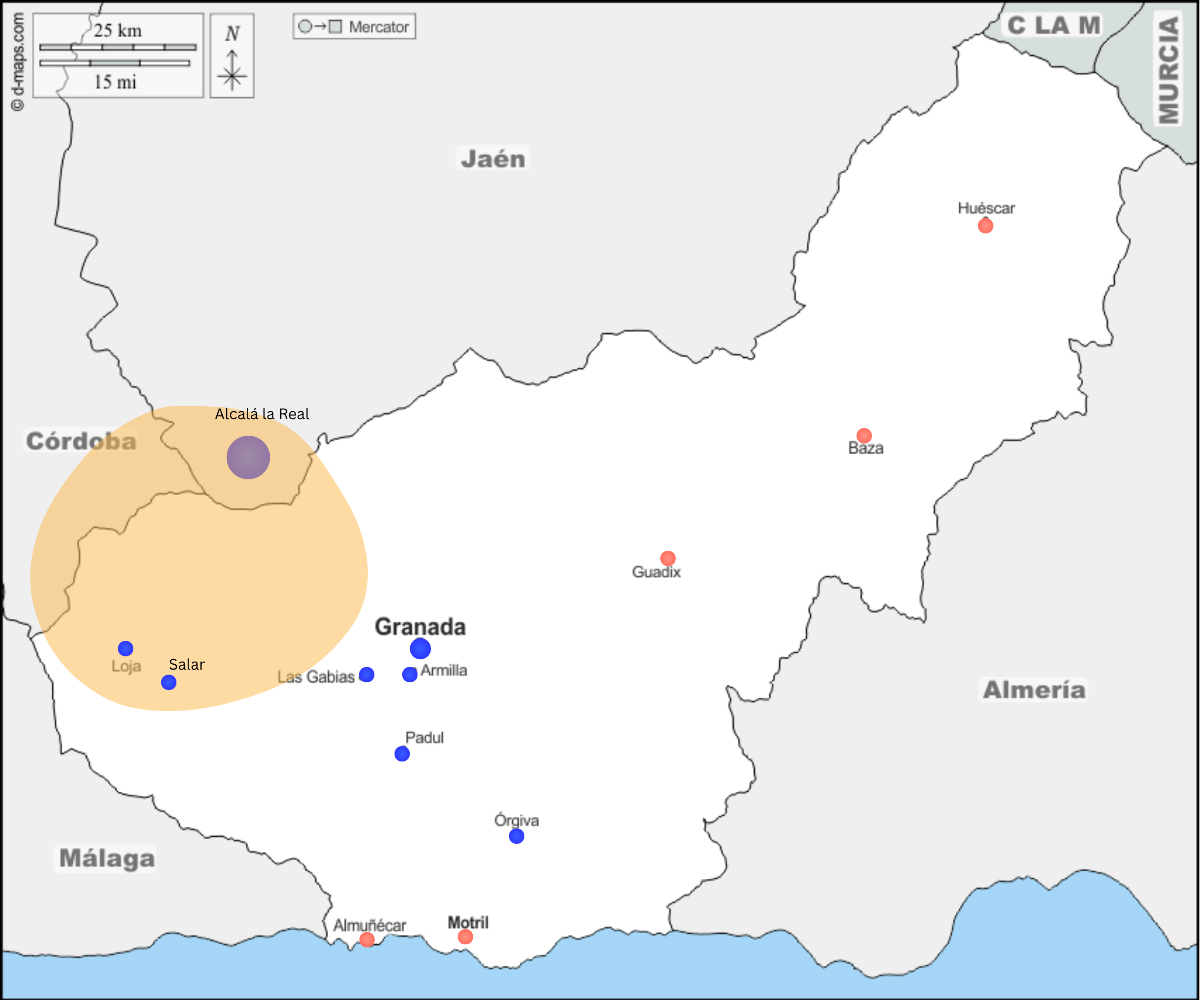
On 1 September 1936, Nationalist forces began an offensive from the Granada sector towards Alcalá la Real and southern Jaén. The operation was intended to push northwards from Nationalist-held Granada and establish a secure connection towards the Nationalist positions in Córdoba province, through the corridor of Alcalá la Real, Priego de Córdoba and Cabra.
The attacking forces advanced in columns from the Granada side, supported by the military authorities and right-wing formations operating in the sector. The available evidence does not provide a reliable total for the number of men committed on 1 September, so no precise troop strength can be established for the opening attack. The Nationalist forces included regular military personnel alongside Guardia Civil, Falangists, requetés and other right-wing volunteers, with additional formations being brought into the sector as the fighting continued through September.
Republican militia and organised units from outside the immediate area were operating around the town. On 2 September, Columna Lillo was recorded at Alcalá la Real, with one of its companies detached to Montefrío for supply duties before moving towards Puerto López and Moclín. Republican forces were therefore able to maintain a substantial defensive presence in the area despite the Nationalist offensive. The fighting spread across the countryside around Alcalá la Real, Montefrío and the approaches towards southern Jaén. The terrain was dominated by hills and agricultural country, with numerous small settlements and rural communities between the principal towns. Control of the roads was particularly important because they connected the Granada front with the approaches to Alcaudete and the rest of southern Jaén.
Alcalá la Real municipality had roughly 25,000 inhabitants in the 1930s, although only around 11,000 lived in the main town; the remainder were distributed among numerous aldeas and rural settlements. The fighting took place across a densely populated agricultural district rather than an empty frontier.
- Salar, Granada
On 1 September 1936, Nationalist forces occupied Salar, a small town in the Poniente Granadino, about 30 kilometres west of Granada and on the main route towards Loja. The occupation followed the Nationalist capture of Loja on 18 August and extended their control along the Granada–Loja corridor. The forces operating in the area included a squadron of Regulares de Ceuta, fighting on foot; a company of the Spanish Foreign Legion; a company of Infantry Regiment Granada No. 6; and 20 Guardia Civil. A Legion machine-gun section also occupied the heights overlooking Salar. These forces were operating as part of the Nationalist column advancing through the Loja sector.
The importance of Salar had already been demonstrated during the Nationalist advance on Loja. When the Nationalist columns under General José Enrique Varela and Colonel Basilio León Maestre joined at Venta del Pulgar, about 10 kilometres from Loja, the Legion machine-gun section moved onto the heights overlooking Salar. Republican groups fleeing from Loja were still in the area. The occupation placed Salar firmly within the Nationalist-controlled territory extending westwards from Granada. From the town, the Nationalists could control movement along the route towards Loja and the surrounding countryside, strengthening the communications corridor between Granada and the western section of the front.The advance also had immediate consequences for the civilian population. As Nationalist forces moved through the Poniente Granadino, many inhabitants of the Republican-held settlements abandoned their homes and fled towards areas that remained under Republican control, fearing reprisals when the Nationalist troops arrived. The same pattern had already been recorded during the occupation of Loja, where large numbers of working-class residents left their homes before or during the Nationalist advance.

