


- Seville
For supporters of the Republic, Seville was one of the most devastating cities in Spain on 18 July 1936, as Seville was the place where many Republicans first witnessed how quickly a military rebellion could seize a major city. News of the uprising in Spanish Morocco had reached Seville during the previous night. Workers gathered in union offices belonging to the CNT and UGT, discussing reports arriving from Melilla, Ceuta and Tetuán. Few knew exactly what was happening elsewhere in Spain, but many believed that a wider military rebellion was imminent. Seville was one of the largest and most politically divided cities in the country. Its working-class districts, particularly Triana, Macarena, San Bernardo and San Julián, contained thousands of organised workers. The city had experienced years of strikes, political violence and social unrest. Many labour activists expected that if a coup came, Seville would be one of its principal battlegrounds.
At just after midnight on 18 July, General Miguel Núñez of the Ministry of War called Tablada Air Base near Seville and ordered bombs and explosives prepared for aircraft arriving from Madrid. Aircraft near Madrid were ordered to proceed to Tablada, knowing the city would be the first place attacked by the uprising. By 5:00am, bombers were dispatched from Getafe arrived at Tablada Air Base and crews begin mounting additional weapons and loading bombs. At approximately, 8:00am, military pilot attached to the Seville aviation staff opened fire on aircraft being prepared for bombing missions against Morocco, apparently attempting sabotage.
Responsibility for defending the Republic rested with José María Varela Rendueles (Republican Civil Governor of Seville) and General José Fernández de Villa-Abrille (Republican commander of the II Organic Division). Their goal was to preserve order and maintain control through existing institutions, and throughout the morning they received repeated requests from labour organisations demanding weapons, which they refused.
This decision reflected the dilemma facing Republican authorities throughout Spain. Arming workers might help defeat a military uprising, but it could also place enormous power in the hands of organisations that many politicians feared they would later be unable to control. For workers gathered outside government offices, however, the refusal appeared increasingly dangerous. Every hour that passed seemed to strengthen the rebels, let by General Gonzalo Queipo de Llano (Nationalist rebel). His presence in Seville had initially caused some alarm. Although he had been involved in earlier Republican movements against the monarchy, he had secretly joined the military rebellion against the Republic.
Around midday and into the early afternoon, Queipo and a small group of rebel officers entered military headquarters. Through a combination of bluff, surprise and support from sympathetic officers, they arrested Villa-Abrille and seized control of the command structure.
Reports spread through the city that the army had moved against the government. Workers poured out of factories, workshops and union offices. Many headed toward the centre expecting rifles to be distributed while others attempted to organise resistance in their own neighbourhoods. Messengers travelled constantly between union headquarters trying to determine which buildings remained under Republican control.
At the same time, elements of the security forces were making their own decisions. Some Assault Guards remained loyal to the Republic. The Guardia Civil moved toward the rebels. During the afternoon, starting at around 2:00pm, rebel troops occupied key points throughout the city. General Gonzalo Queipo de Llano arrived at headquarters of the II Military Region and arrested General José Fernández de Villa-Abrille without resistance.
Queipo declared a state of war throughout the II Military Region at 3:00pm and he called conspirators in Cádiz and Córdoba, informing them that he has assumed command of the military region and ordered them to begin their own uprisings immediately. Meanwhile, fighting broke out between Seville troops under his command and forces remaining loyal to the government, especially units of the Guardia de Asalto.
Through the afternoon, left-wing militants begin gathering in working-class districts, only to find military patrols blocking access to the city centre. Communications centres, government offices and strategic buildings were brought under military control. The capture of the Civil Government effectively isolated and crippled the Republican administration. At 4:30pm, left-wing militants attempted to seize the artillery depot on Paseo de Colón in order to obtain weapons and soldiers defending the depot open fire, killing fifteen. These are recorded as the first deaths caused by enemy fire on the Spanish mainland during the Civil War.
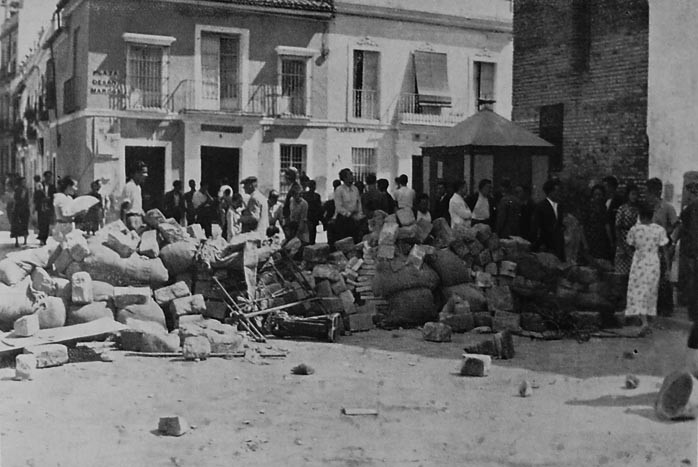
The city’s defenders found themselves divided into disconnected pockets rather than a coordinated force. In working-class districts, workers began constructing barricades and organising local defence groups. Many possessed little more than pistols, hunting guns or improvised weapon, but as evening approached, the centre of Seville was effectively in rebel hands. The city’s working-class neighbourhoods remained hostile to the uprising, and resistance would continue in some areas, but the balance of power had shifted dramatically. What had begun as a day of uncertainty was ending as a major victory for the rebels, and the city was about to undergo heavy fighting.
By 5:00pm, Tablada Air Base continued to operate as a servicing, refuelling and armament centre for aircraft carrying out bombing missions against rebel positions in Morocco. Civil Governor José María Varela Rendueles and loyal Assault Guards continued resisting from inside government buildings, but at 6:30pm, Rebel artillery was deployed against government-held buildings in central Seville. By 7:00pm, Varela Rendueles ordered surrender to stop the fighting within their city centre, and soon after Varela, municipal officials and other Republican authorities are arrested and there were casualties on both sides. At the same time, districts such as Triana, San Julián and Macarena descend into revolutionary disorder, with looting, church burnings and attacks on perceived political enemies. The city centre and key administrative buildings were now under rebel control.
At 9:45pm, Queipo de Llano delivered his first major radio address from Unión Radio Sevilla, the first of nightly tirades. He announced that the army had taken control of Seville and declared a state of war across the country, claimed the military was acting to save Spain from revolution and disorder. He said other cities had joined the uprising and attempted to frame the uprising as that had succeeded nationwide, in an effort to persuade any who had not joined the rebellion. The famous obscene broadcasts for which Queipo later became notorious came later, especially in August and September 1936. One specific claim often associated with the first broadcast is that Queipo exaggerated or outright invented rebel successes elsewhere, including suggestions that Madrid was already under control or that the government was collapsing. Such misinformation became a hallmark of his nightly broadcasts.
Click here to read more –Seville Falls to the Rebels
- Málaga
If Seville represented one of the Republic’s greatest defeats on 18 July, nearby Málaga represented one of its first successes. Málaga was a strongly Republican city. The Socialist Party, Communist Party, CNT and UGT all possessed significant support among the population. The city’s port, railways and industries had created a large and politically organised working class. Many residents had watched the increasing political violence of the previous months with growing concern, and few were surprised that sections of the army had chosen rebellion. The city’s Republican authorities faced the same dilemma confronting officials across Spain. Arming the population might strengthen resistance to the military, but it also meant relinquishing some control over events. Throughout the day, discussions took place between government officials, labour leaders and security force commanders as everyone tried to understand the rapidly changing situation. At just after midnight on 18 July, General Miguel Núñez in Madrid ordered naval aircraft based in Murcia transferred to Málaga for operations against Morocco, meaning the city was not under any illusions of the seriousness of the uprisings, something people in other cities were not being told so early in the day.
The key military figure in Málaga was General Francisco Patxot (commander of the Málaga military district). Unlike some officers elsewhere in Spain, Patxot did not immediately declare for the uprising. Although he had conservative sympathies and was viewed with suspicion by many on the left, he hesitated at the crucial moment. The Nationalist rebels in Málaga had expected that once the military moved, much of the city’s security apparatus would follow, but the response was fragmented. Several crucial organisations remained loyal to the Republic, including large elements of the Assault Guards and Carabineros. Without unified support from the security forces, the rebels struggled to impose their authority.
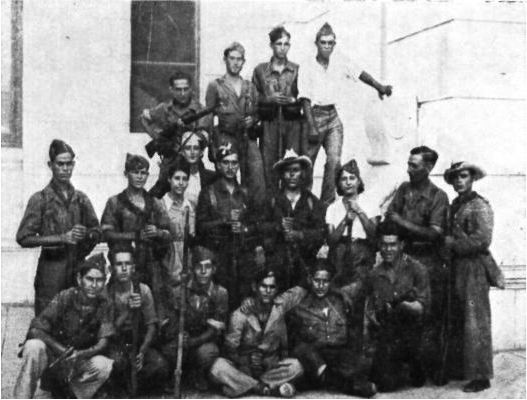
Meanwhile, ordinary citizens were moving faster than many officials, and workers began organising local defence committees. Union offices became centres of information and coordination. Messengers travelled between neighbourhoods carrying reports about troop movements and political developments. Many people in Málaga were preparing before the rebels could fully seize the initiative. Málaga’s urban layout and dense working-class neighbourhoods made it difficult for a small number of officers to dominate events quickly. Any military uprising required cooperation from multiple institutions, and that cooperation never fully materialised. By evening, it had become clear that the uprising was failing as workers continued to patrol the streets and security forces loyal to the Republic remained active. The rebels found themselves isolated rather than supported. Málaga’s continued loyalty denied the Nationalists another major port on the Mediterranean coast and ensured that a large area of southern Spain remained connected to the Republic.
- Córdoba
Republicans in Córdoba occupied an uneasy middle ground. The city contained many people willing to defend the Republic, but when the decisive moment came, they found themselves outmanoeuvred by a military command that acted first. By midday, politically active workers understood that the Republic was facing a serious challenge. The question was no longer whether a military uprising existed, but whether Córdoba’s own garrison would join it.
The city was governed by Antonio Rodríguez de León (Republican Civil Governor of Córdoba), who remained loyal to the Republic. Around him stood a mixture of Republican politicians, Socialist activists, trade union leaders and local officials attempting to determine the true situation. Some reports suggested that loyal military units were suppressing the rebellion. Others claimed that major cities had already fallen.
Among the population, anxiety spread rapidly. Córdoba had a substantial organised labour movement, particularly among agricultural workers, railway employees and urban labourers. Members of the UGT and CNT gathered in union offices throughout the day, discussing events and demanding action. Delegations approached the authorities seeking weapons. Many workers believed that if the army rose, only an armed population could stop it.
The key figure in the city’s military establishment was Colonel Ciriaco Cascajo (Nationalist rebel and commander of the Córdoba garrison. Unlike some officers elsewhere who delayed or wavered, Cascajo had already committed himself to the rebellion. Throughout the day he worked to secure the support of other military officers and, crucially, the Guardia Civil. Across Spain, the loyalty of the Guardia Civil often determined the outcome of local struggles. A city with a divided military command might still be saved if the Guardia Civil remained loyal to the government.
At approximately 5:00pm, Cascajo openly declared for the uprising and proclaimed martial law. The military moved quickly to occupy strategic points. When artillery was directed against the Civil Government building, the situation became hopeless. Rodríguez de León had little means of resisting a military force that possessed trained troops, artillery and the support of key security forces. Workers attempted to organise resistance, but they faced the same problem that had crippled Republican efforts in Seville. There were thousands of people willing to fight, but very few possessed the weapons necessary to challenge the army. The city therefore fell before any large-scale popular resistance could properly develop.
While Córdoba city entered Nationalist hands on 18 July, much of the surrounding countryside remained contested. Large rural areas contained strong Socialist and Republican support, and many villages did not immediately accept the authority of the rebels. In some places local committees emerged and resistance continued. The capture of the city marked the beginning of a struggle for the province rather than its conclusion. For supporters of the Republic, the city became another example of a painful pattern emerging across Spain; where military commanders acted decisively and workers remained unarmed, the uprising could succeed with alarming speed. In the weeks that followed, the city would become one of the principal centres of Nationalist repression in southern Spain.
- Cádiz
For Republicans in Cádiz, 18 July was a day in which events seemed to accelerate with alarming speed. Cádiz found itself caught between the rebellion in Morocco and the uprising spreading across Andalucía. By the end of the day, the city had become one of the first major Nationalist successes on the mainland.
The significance of Cádiz was immediately obvious to everyone involved. The city occupied a strategic position on Spain’s southern coast, facing the Strait of Gibraltar and lying only a short distance from Spanish Morocco. For military rebels, control of Cádiz would help connect the rebellion in North Africa with the uprising on the mainland. The Republican authorities in Cádiz remained loyal to the government. The city’s Civil Governor, Mariano Zapico Menéndez (Republican Civil Governor of Cádiz, attempted to maintain control as reports from elsewhere in Andalucía became increasingly alarming. Among the city’s workers, support for the Republic remained strong. The port, shipyards and maritime industries had created a substantial labour movement, and both the CNT and UGT possessed significant influence. Throughout the day, workers demanded information and increasingly called for weapons. Many believed the city would soon have to defend itself.
One of the key figures was General José Enrique Varela (Nationalist rebel and veteran officer). Although officially under government supervision because of his suspected involvement in anti-Republican plotting, Varela was already committed to the uprising. As events unfolded on 18 July, he emerged as one of the principal military leaders of the rebellion in Cádiz. The rebels moved rapidly to secure the city’s strategic points. Military installations were occupied, communications networks were targeted, and efforts were made to isolate loyal officials before they could organise resistance. As the military strengthened its position, Governor Zapico Menéndez attempted to continue exercising authority. Yet authority without force meant little once key military units had declared for the rebellion. The Civil Government became a symbol of Republican legitimacy, but legitimacy alone could not stop trained troops supported by sympathetic officers. At 3:30pm, General Queipo de Llano phoned Varela from Seville, and told him they had assumed command of the II Military Region in Seville and informed Cádiz the uprising was going to be a success.
One of the most important actions taken by the rebels was the securing of the narrow isthmus connecting Cádiz to the mainland. This reduced the possibility of organised Republican reinforcements reaching the city and helped ensure that the uprising could not easily be reversed. The city’s geography, normally a defensive advantage, now worked in favour of those who controlled the military.
The importance of the city’s fall extended far beyond its local politics. Together with Seville, Cádiz provided the rebellion with a crucial foothold in southern Spain. It strengthened communications across western Andalucía and helped create the conditions that would later allow troops from the Army of Africa to establish themselves on the mainland.
Meanwhile, in nearby Huelva, between Seville and Cádiz, lacked the large military presence found elsewhere, meaning that its fate depended heavily on the behaviour of security forces and developments in neighbouring provinces. The growing success of the uprising in Seville cast a long shadow over the region. Huelva remained Republican on 18 July, but many residents understood that its future would be strongly influenced by whichever side controlled western Andalucía.
- Granada
For the people of Granada, 18 July 1936 it was a day of uncertainty, rumours and political paralysis, as Republicans, workers and government officials watched events unfold elsewhere in Spain and tried to determine whether Granada’s own garrison could be trusted. Granada’s experience on 18 July was very different from that of Seville or Cádiz. There were no major street battles, no immediate seizure of government buildings, and no declaration of martial law.
The highest military authority in Granada was General Miguel Campins (Republican military commander of the Granada garrison). Campins was a professional officer and a personal acquaintance of General Francisco Franco, but on 18 July he remained loyal to the legal government. This fact would prove enormously significant. Had Campins joined the uprising immediately, Granada might have followed Seville’s example. Instead, his loyalty delayed the rebellion and created a temporary opportunity for Republican authorities to organise a response.
Civil authority rested with César Torres Martínez (Republican Civil Governor of Granada). Throughout the day, Torres Martínez received reports from across Spain indicating that the situation was deteriorating rapidly. Among Granada’s working-class population, these developments produced growing anxiety. The city contained active branches of the UGT, the CNT, Socialist organisations and Republican parties. Labour leaders understood that if the army rose, they would be among its first targets. Throughout the day, representatives of these organisations repeatedly demanded weapons from the authorities, though were refused.
Campins, meanwhile, attempted to preserve order and prevent violence. He resisted pressure from rebel officers and maintained formal loyalty to the Republic. This delayed the uprising but did not eliminate the rebellion developing within the garrison. Several officers under his command were already committed to the rebellion and remained in contact with rebels elsewhere. By nightfall, Granada remained under Republican control. The Civil Governor still occupied his office. The military commander remained loyal to the government. The uprising that had been delayed on 18 July would finally be launched on 20 July, leading to the capture of Granada by Nationalist forces and the beginning of one of the most extensive waves of repression in southern Spain.
In Jaén, an hour north of Granada, there remained strong Republican and Socialist support, particularly among agricultural workers. News of the uprising spread rapidly through towns and villages, prompting meetings among labour organisations and local officials. Many workers feared that the rebellion threatened the land reforms and political gains achieved under the Republic. Unlike nearby Córdoba, Jaén did not immediately fall to the uprising. Republican authorities retained control, and local organisations began discussing how to defend the province. The city ended the day still loyal to the Republic, helping create a belt of Republican territory across parts of eastern Andalucía.
- Almería
was one of the smaller provincial capitals of southern Spain, a port city whose economy depended upon trade, agriculture and mining. Politically, it had followed many of the same trends seen elsewhere in Andalucía. Republican, Socialist and labour organisations possessed significant support among workers and small farmers, while conservative landowners and right-wing groups remained influential in other sectors of society. The divisions that characterised Spain as a whole were clearly visible within the province. As evening approached, Almería’s position became clearer. The city remained firmly under Republican control. The military had not risen. Local authorities continued exercising power. Labour organisations remained active and organised.
Workers gathered in union offices and party headquarters discussing the latest reports. Republican authorities remained in control, and unlike Pamplona, the military had not openly declared for the uprising. The city therefore retained something increasingly rare on 18 July, time to plan.
Emilio Mola, who had said, ‘we must sow terror… we must leave a feeling of dominance, eliminating without scruple or hesitation all those who do not think like us.’
- Extremadura
Extremadura occupied a unique position in Republican Spain. The region was overwhelmingly rural, dominated by vast agricultural estates and a large population of landless labourers. For decades, disputes over land ownership, wages and working conditions had shaped local politics. By 1936, many agricultural workers supported Socialist organisations, trade unions and the Republic itself because they associated it with land reform and social change. Many landowners, meanwhile, viewed the Republic with increasing hostility and looked favourably upon any movement that promised to restore order and reverse reform. As news arrived on 18 July that military units in Spanish Morocco had rebelled, the political tensions that had existed for years suddenly acquired a new significance.
The most important centres in Extremadura were Badajoz, Cáceres, Mérida, Plasencia and Don Benito, but on 18 July nowhere dominated events. In Badajoz, the provincial capital, Republican authorities initially remained in control. The city was governed by officials loyal to the Republic, and there was no immediate military takeover. Authorities remained committed to the idea that the crisis should be handled by the state rather than by armed civilians. Governors, mayors and military commanders hoped that loyal security forces could contain the rebellion. For many workers, this position appeared dangerously optimistic. Republican supporters in Extremadura were numerous but dispersed. The region’s population was spread across hundreds of towns and villages, and while labour organisations were strong, especially in rural areas, they often lacked access to weapons and depended heavily upon decisions made by provincial authorities.
Among conservative landowners and right-wing groups, the reaction to the uprising was markedly different. Although open support for rebellion remained cautious on 18 July, many viewed developments with hope rather than fear. Years of political conflict had convinced them that the Republic was unable to maintain order. Reports of military action elsewhere suggested that change might finally be coming.
- Murcia
Note: Here, Murcia is defined as the provinces of Murcia and Albacete, though Albacete left Murcia to join Castilla La-Mancha in 1982.
For Republicans, Cartagena in Murcia was one of the most important cities in Spain, even though little fighting occurred there on 18 July. The city contained Spain’s principal Mediterranean naval base and a large concentration of warships, dockyards and military facilities. Whoever controlled Cartagena would possess a significant advantage at sea. News of the uprising in Morocco reached the city quickly. Sailors, dockworkers and naval personnel followed developments closely. Unlike many army officers, large sections of the navy remained uncertain about the rebellion or openly hostile to it. Republican authorities therefore retained an opportunity that did not exist in many inland cities. It was here that a naval officer received Franco’s message at just after 7:00am, as the rebellion sought control of the naval and port, and alerted Madrid instead.
Throughout 18 July, tension grew inside naval installations as officers and ratings watched one another carefully. Rumours circulated that some senior officers supported the uprising, while sailors increasingly discussed how they might respond if the fleet attempted to join the rebellion, but by midnight, Cartagena remained firmly Republican. Its importance lay not in what happened that day, but in what did not happen. The Nationalists failed to secure the fleet, and the Republic retained one of its most valuable strategic assets.
Murcia helped form a secure Republican zone along Spain’s south eastern coast. It provided agricultural production, manpower, transport links and a relatively stable rear area at a time when much of the country was descending into conflict and was one of the reasons the Republic survived the coup instead of collapsing in July 1936.
Albacete remained under Republican control as news of the military uprising spread across the country. The local garrison did not succeed in launching a rebellion, and civil authorities continued to function while political parties, trade unions and workers’ organisations monitored events elsewhere in Spain. Although the province was spared the immediate fighting, uncertainty and political tension increased as it became clear that the uprising was developing into a nationwide conflict. By the end of July, Albacete remained securely within the Republican zone and served as an important link between Madrid, Valencia and south eastern Spain. The province’s central location and good rail connections would later make Albacete an important Republican military centre. In the opening weeks of the war, however, it remained largely quiet compared with many other provinces, with Republican authority surviving the initial military uprising.
While centres in each province either fell prey to the Nationalist rebels or remained free, it did not mean an entire province came under the control of the victors. Urban and rural loyalties could be, and often were very different. In the early days and weeks of the war, individual areas and villages would have remained starkly opposed to one another, and arrests and killings would be constant.

