In July 1936, Seville was the largest city in Andalucía and one of the most important urban centres in Spain. The city sat astride the Guadalquivir River, controlled key rail and road connections across southern Spain, and served as the administrative centre of much of the region. Whoever controlled Seville would possess a vital strategic position from which to influence events throughout Andalucía.
Politically, the city reflected the divisions that had come to dominate Spain during the final years of the Second Republic. Working-class districts like Triana, Macarena and San Julián contained strong support for trade unions and left-wing political parties. The CNT, UGT and Communist Party all maintained significant followings among labourers, dock workers, railwaymen and artisans. At the same time, conservative landowners, monarchists and right-wing organisations remained influential in other sectors of society. The result was a city where political disagreements increasingly spilled onto the streets.
The Popular Front’s victory in the February 1936 elections was greeted enthusiastically by much of Seville’s working class. Yet rather than easing tensions, the months that followed saw political violence increase across the province. Murders, strikes and clashes between rival political groups became increasingly common. By the summer of 1936, many Sevillanos sensed that Spain was moving towards a major confrontation, even if few could predict exactly how or when it would arrive.
The city also possessed considerable military importance. Seville served as headquarters of the 2nd Organic Division, responsible for military forces across Andalucía. Several infantry, artillery and engineering units were stationed in and around the city, while the nearby Tablada airfield was one of the most important aviation facilities in southern Spain. If a military uprising occurred, control of Seville would almost certainly become one of its principal objectives.
Unknown to most residents, a group of officers within the city’s garrison had spent months preparing for precisely such an event. Led by Commander José Cuesta Monereo and linked to General Emilio Mola’s wider conspiracy, they quietly built support among fellow officers while outwardly maintaining their loyalty to the Republic. Their plans depended upon speed, surprise and the assumption that many of their superiors would hesitate when the moment came.
The civilian authorities remained confident that they could maintain order. Civil Governor José María Varela Rendueles trusted the assurances of military commanders who repeatedly declared their loyalty to the Republic. Looking back years later, he admitted that this trust would prove one of the greatest mistakes of his life. Like many Republicans in Seville, he believed that whatever political disagreements existed, the army would ultimately respect its oath to the constitutional government. But during the evening of 17 July 1936, that assumption began to collapse. Reports arrived from Spanish Morocco indicating that elements of the Army of Africa had risen in rebellion against the Republic. For the first time, the possibility of a military coup ceased to be a rumour and became a reality. As news spread through government offices, barracks and political organisations, the people of Seville entered one of the most decisive weekends in the city’s history.
During the afternoon of 17 July 1936, reports began arriving in Seville that something unusual was happening in Spanish Morocco. At approximately 4:00pm, a coded telegram informed military authorities that the garrison at Melilla had risen in rebellion. Soon afterwards, additional reports suggested that the uprising had spread throughout much of the Army of Africa. By around 5:00pm, the government in Madrid had confirmed that a serious military revolt was underway. For many residents of Seville, but, these developments remained largely invisible.
The military commander of the 2nd Organic Division, General José Fernández de Villa-Abrille, received news of the uprising but took no decisive action. Unable to verify some of the reports arriving from Morocco, he returned home without ordering arrests or placing suspect officers under close supervision. The Civil Governor, José María Varela Rendueles, adopted precautionary measures by deploying mixed detachments of Assault Guards and left-wing militants around several military installations. Yet he remained convinced that the situation could still be contained.
Orders arrived from Madrid directing that aircraft be prepared at the nearby Tablada airfield for bombing missions against the rebels in North Africa. Leaflets demanding surrender were printed, bombs were requested, and preparations began for air operations against the conspirators. Yet even these measures were quietly undermined. During the night, rebel sympathisers at Tablada sabotaged aircraft and disrupted preparations, ensuring that only limited operations could proceed.
Trade union offices, political headquarters and workers’ organisations closely followed developments from Morocco. Many left-wing activists had long suspected that elements of the army were preparing a coup. News of the uprising appeared to confirm their fears. Members of the CNT, UGT, Socialist organisations and the Communist Party increasingly demanded weapons from the authorities. If soldiers had rebelled in Morocco, many believed that the same thing could happen in Seville at any moment, but the Civil Governor refused. Varela feared that distributing weapons would provoke panic, undermine public order and possibly trigger the very violence he hoped to avoid. Like many Republican officials across Spain, he still believed that loyal military officers and security forces would be sufficient to maintain control. The decision reflected both caution and trust that much of the army remained loyal to the Republic.
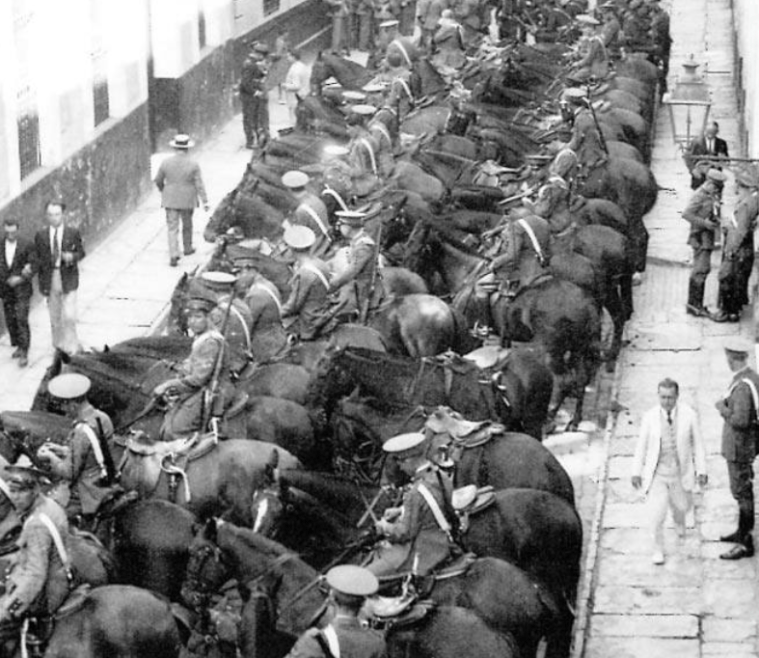
Among those pressing most strongly for weapons was the Communist leader Saturnino Barneto. Throughout the crisis, Barneto repeatedly argued that workers should be armed so they could defend the Republic if the military attempted to seize the city. Similar demands emerged from trade unions and left-wing organisations across Seville. Yet the requests continued to be rejected.
The morning of 18 July passed in an atmosphere of uncertainty. Although news of the uprising in Morocco had reached Seville the previous day, many officials still believed the situation could be contained. Civil Governor José María Varela Rendueles remained at his post, receiving reports and attempting to assess the scale of the crisis. General José Fernández de Villa-Abrille, commander of the 2nd Organic Division, continued to exercise authority over the military garrison. Governor Varela informed journalists that normality prevailed throughout the province.
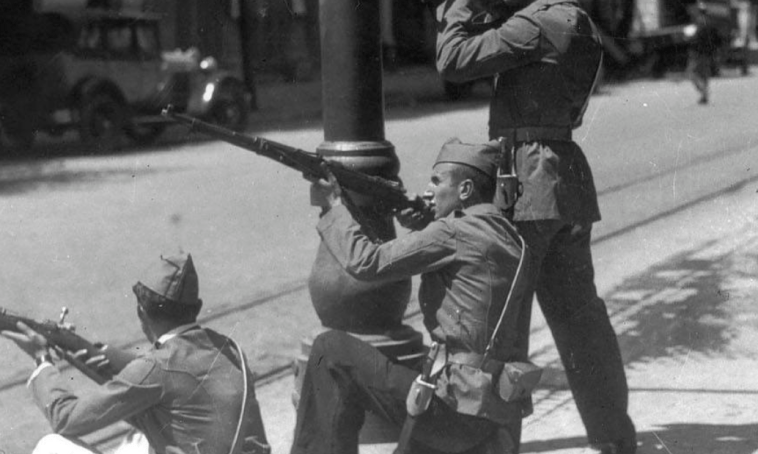
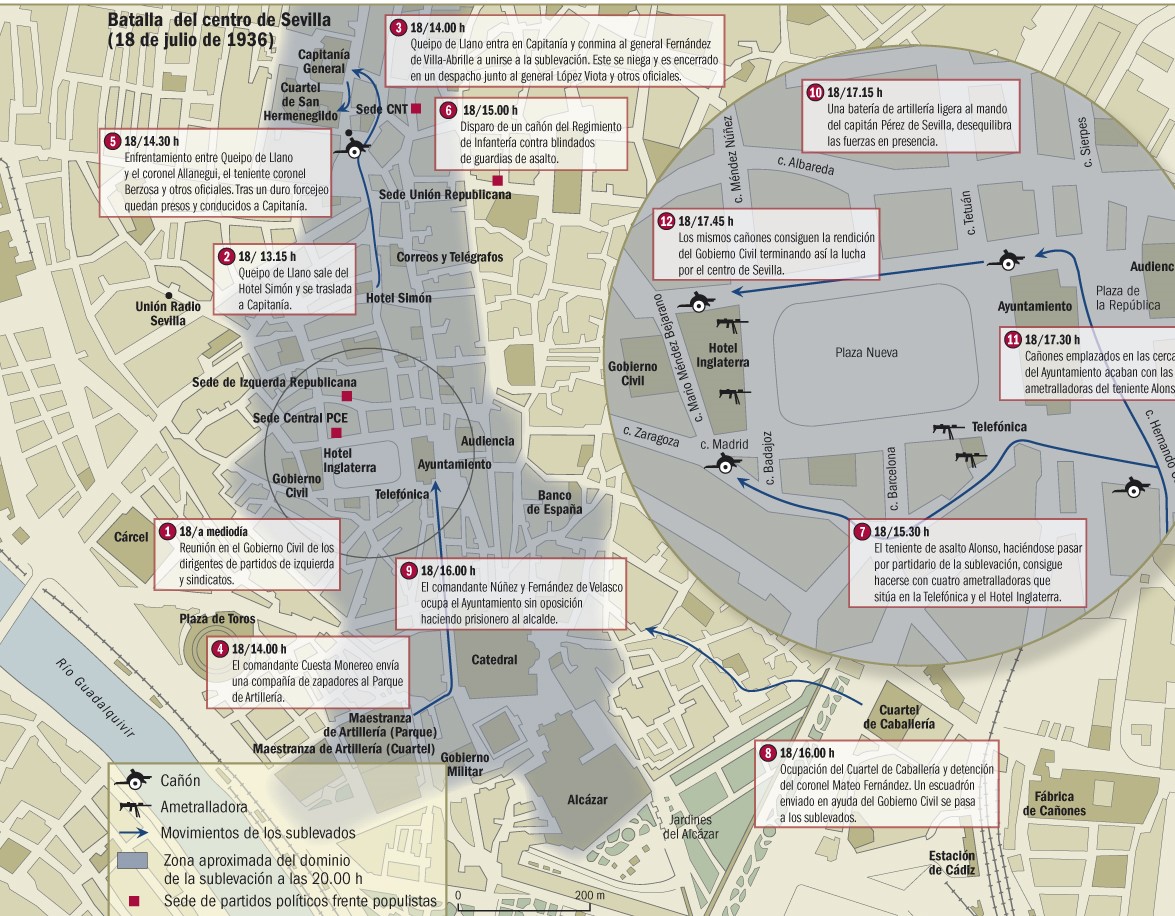
During the early afternoon, that uncertainty vanished. A group of rebel officers confronted General Villa-Abrille and demanded that he join the uprising, which he refused. Within minutes, he was removed from command and placed under arrest alongside several other officers who remained loyal to the Republic. For months, the Republican authorities had assumed that any military rebellion would be opposed by the official chain of command, but now officers who had publicly professed loyalty to the Republic now sided with the conspirators. Others found themselves isolated, imprisoned or cut off from communication. The military institution upon which the government depended was being turned against it from within.
Outside, workers continued gathering at union offices demanding weapons. Members of the CNT, UGT and Communist Party waited for instructions that never seemed to arrive. Saturnino Barneto and other left-wing leaders continued pressing the authorities to arm the population, convinced that military action was imminent. As the afternoon progressed, reports reaching the Civil Government became increasingly alarming. Officers could no longer be contacted. Orders went unanswered. Information arriving from different parts of the city often contradicted itself. Some military units appeared loyal. But the rebels had 4,000 troops ready to overthrow the city, accompanied by Falangist and Carlist militiamen.
One of the key figures in the defence was Assault Guard commander José Loureiro. Loureiro remained loyal to the Republic and needed to organise the defence of government positions in the city centre. At approximately 2:45pm, around eighty rifles were issued to civilians from the Artillery Park. Eighty weapons for a city of more than 300,000 people. Many were forced to rely upon pistols, hunting weapons or whatever arms they could obtain privately. Others possessed no weapons at all but remained determined to assist in the defence of the city.
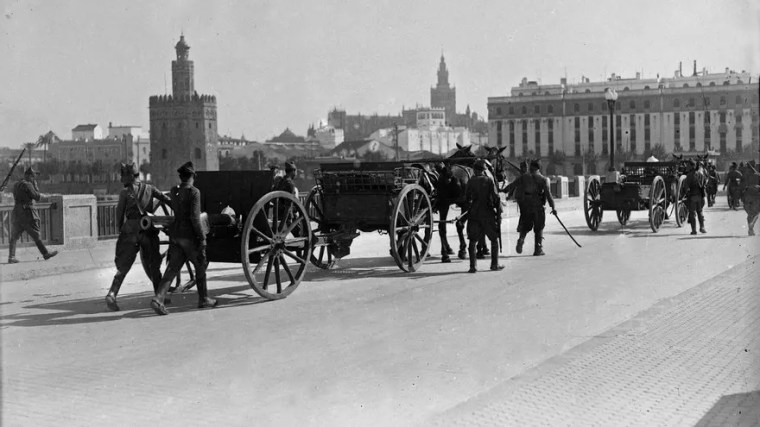
As military units moved through central Seville, fighting erupted around several key locations. Government buildings, communications centres and major intersections became contested spaces. Assault Guards exchanged fire with rebel troops while civilians attempted to establish defensive positions, but the conspirators possessed a clear objective. Their immediate goal was to seize the institutions through which authority was exercised. Control of military headquarters, communications networks and major government buildings would allow them to present themselves as the legitimate power in the city. As the afternoon progressed, the balance increasingly shifted against the Republic. Artillery pieces were brought into the city centre and their presence demonstrated how uneven the struggle had become. The defenders possessed courage, local support and determination. Their opponents possessed artillery, trained troops and control of much of the military establishment. By early evening, but the outcome was becoming increasingly clear. The military conspiracy had succeeded in gaining control of the instruments of force. The Republic still possessed supporters but support alone could not compensate for the absence of rifles, artillery and coordinated command. By the evening of 18 July 1936, neither side controlled all of Seville.
As news of the fighting spread, working-class districts across Seville began organising their own defence. In neighbourhoods Triana, Macarena, San Julián, San Marcos and San Bernardo, residents erected barricades, blocked roads and prepared for further fighting. The collapse of Republican authority in the centre did not mean that the population had accepted the coup. The district of Triana quickly emerged as one of the principal centres of resistance. Situated on the western side of the Guadalquivir and linked to the city centre by a small number of bridges, Triana possessed a long tradition of working-class organisation. CNT influence was particularly strong. As news of the coup spread, residents began constructing barricades and organising patrols. Streets were blocked with carts, paving stones, timber and whatever other materials could be found.

In Macarena and San Julián, workers and political activists prepared defensive positions while attempting to coordinate with neighbouring districts. The process was often improvised. There was no central command directing the defence of Republican Seville. Instead, resistance emerged from local organisations, trade unions, political parties and neighbourhood networks. During the evening and into the night, sporadic fighting continued across the city. Small groups attempted to move between districts carrying information, ammunition and supplies. Women played an important role in these efforts, transporting messages and supplies between defensive positions.
During the night of 18-19 July, the conspirators also worked to consolidate their gains. Control of the city centre allowed them to move troops, secure key buildings and prepare operations against the remaining Republican districts. Reinforcements became increasingly available as military units that had remained uncertain during the afternoon committed themselves to the rebellion. Most importantly, the conspirators controlled artillery and the majority of the city’s organised military forces. General Gonzalo Queipo de Llano, the mastermind behind the rebel uprising, gave his first delivered over the radio the first of his notorious charlas at around 9:00pm, the news of the Seville’s overthrow sent out to install terror across the country. These broadcast would become a regular affair, reminding Nationalists they fought for Spain and God, and no amount of rape and violence was too much for left-wing Spaniards.
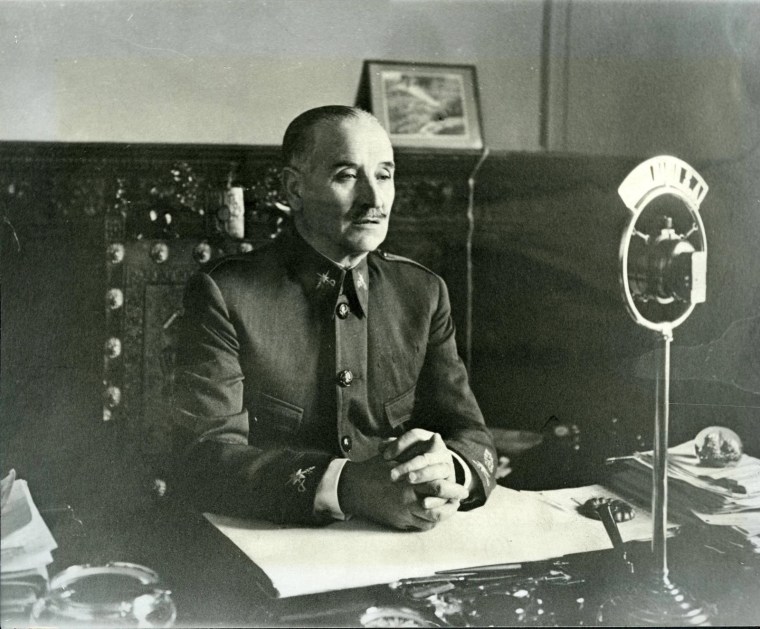
By the morning of 19 July, the city centre belonged to the conspirators, but the surrounding neighbourhoods did not. A column of miners and workers from the Riotinto mining basin in Huelva Province was already moving towards Seville. Many hoped it would bring the reinforcements and explosives needed to reverse the course of the battle. The Riotinto mines had long been a centre of labour militancy and trade union organisation. News of the military uprising was met with anger throughout the mining communities. Miners understood the significance of what was happening in Seville. If the city remained in rebel hands, much of western Andalucía might follow. On 18 July, Guardia Civil commander General Sebastián Pozas authorised the formation of a relief column to assist the defenders of Seville. The force consisted largely of miners and workers from Riotinto and neighbouring communities. Although precise figures vary between sources, approximately 200 to 250 men joined the expedition. miners loaded trucks with large quantities of dynamite and prepared to travel east towards Seville. Their mission was to reinforce the city’s defenders and help crush the uprising before it could fully consolidate its position. For the people resisting in districts like Triana and Macarena, the arrival of armed reinforcements could have transformed the situation. The defenders desperately lacked weapons, ammunition and trained personnel.
As the miners approached Seville on the morning of 19 July, they were accompanied by Guardia Civil men who had been assigned to escort them. Many of the workers assumed they were travelling under the protection of forces loyal to the Republic. But near La Pañoleta, west of Seville, the column encountered forces that had joined the uprising. At a critical moment, members of the Guardia Civil escort turned against the miners. Gunfire erupted among the vehicles. During the fighting, the dynamite being transported by the miners exploded. The resulting blast devastated the column. Men who had volunteered to save Seville were killed before they ever reached the city. The exact casualty figures vary according to different sources, but around twenty-five miners and supporters were killed during the ambush and explosion. Many more were wounded and approximately seventy prisoners were taken. In the days that followed, many of those captured faced military tribunals, imprisonment or execution.
Many residents of the city’s working-class districts did not learn the full details immediately. Rumours circulated that the miners had been delayed yet continued believing help might arrive. But as the hours passed and no reinforcements appeared, the reality became increasingly difficult to ignore. The miners’ defeat left the defenders of Triana, Macarena, San Julián and other Republican strongholds more isolated. They would now face the full weight of the rebel military forces with little prospect of outside assistance.
Situated across the Guadalquivir from the city centre, Triana residents had dragged carts into the streets. Pavement stones were torn up and piled across roadways. Furniture, timber, barrels and construction materials were used to block approaches. The district’s narrow streets and dense housing favoured defenders familiar with the area, and without back-up, now the rebel forces began probing Triana district’s defences. Army units, Guardia Civils who had joined the rebellion, Falangists and other supporters of the uprising tested barricades and exchanged fire with defenders. Machine guns and rifles gave the attackers a clear advantage in firepower. Yet progress proved slower than many had expected.
The defenders knew which alleys connected to courtyards, which buildings overlooked intersections and which routes could be used to move unseen between positions. Men who only days earlier had worked on docks, in workshops or at construction sites now found themselves acting as scouts, sentries and fighters. Many residents fought simply because they refused to abandon their homes. But as fighting between locals and the rebel military intensified, casualties mounted. The wounded were often carried from the barricades by neighbours or relatives. Medical supplies were scarce. Doctors, nurses and volunteers worked under increasingly difficult conditions.
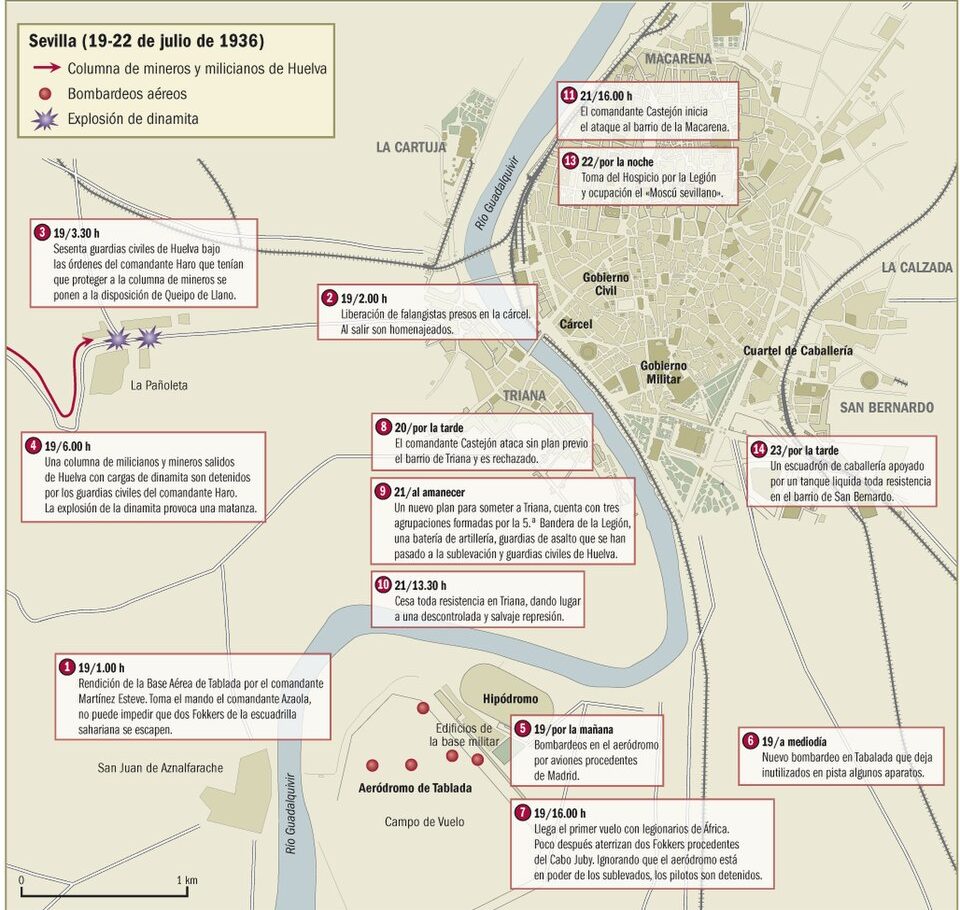
By 20 July, the balance of forces was becoming increasingly unequal. The conspirators possessed artillery, professional soldiers and growing confidence. Reinforcements from the Army of Africa were beginning to arrive in Andalucía. The defenders still possessed determination and local support, but determination could not replace ammunition. Artillery was eventually brought against the district. These were familiar streets where families lived, worked and raised children. For several days, one of the most powerful military forces in Spain found itself fighting street by street against men and women who, in many cases, had never expected to become combatants.
By 21 July, few could seriously believe that victory over the military would come easily. In districts like Macarena and San Julián, resistance was organised through a mixture of trade unions, political organisations and local initiative. There was rarely a clear chain of command. A carpenter might find himself defending a barricade alongside a tram worker, a mechanic, a bricklayer and a young labourer who had never fired a rifle before. Men who only days earlier had been discussing wages, employment or local politics now found themselves discussing fields of fire and ammunition shortages.
As the fighting intensified, civilians found themselves increasingly trapped. Families sheltered inside houses while gunfire echoed through nearby streets. Food became harder to obtain in some areas. The distinction between combatant and civilian blurred as entire neighbourhoods became battlefields. Rumours of arrests, executions and reprisals were already spreading through the city. Whether every story was true mattered less than the fear they created. For many defenders, laying down their weapons did not necessarily mean safety. It simply meant facing an uncertain future under the authority of those who had overthrown the Republic.
One by one, the remaining Republican districts began to fall. Barricades that had held for days were overwhelmed. Defensive positions were abandoned. Survivors slipped away through side streets or attempted to blend back into the civilian population. Others were captured where they stood.
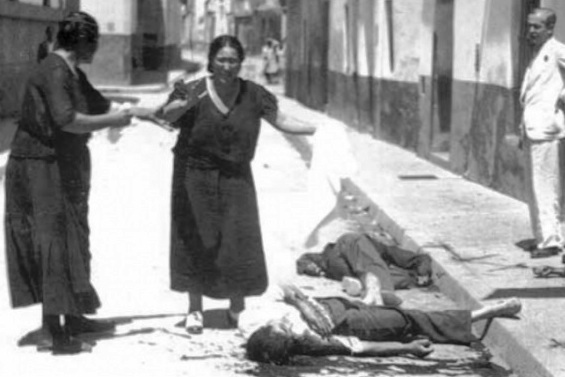
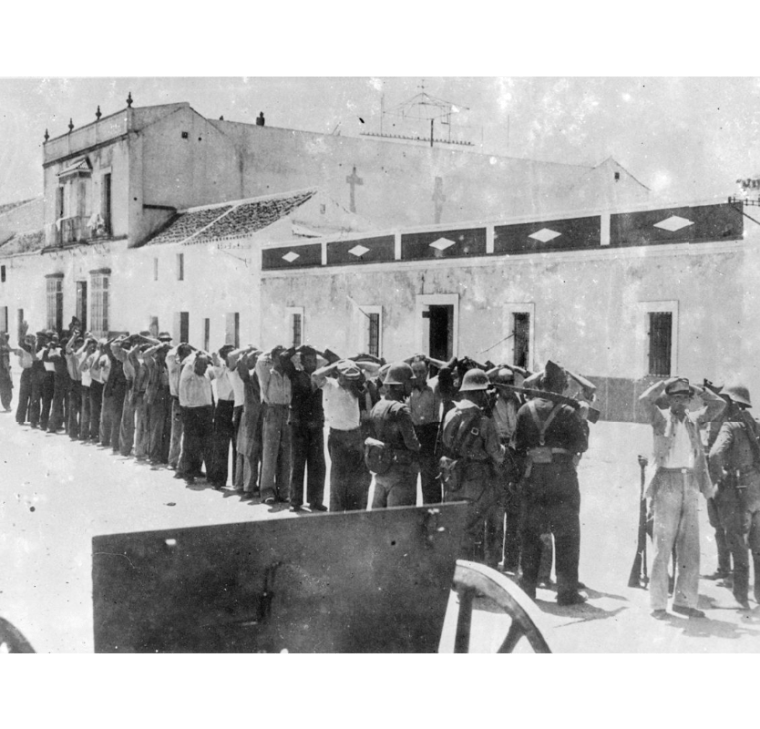
By 22 July 1936, organised Republican resistance within Seville had largely collapsed. Across the city, families emerged cautiously from homes that had become shelters during days of gunfire and shelling. Streets that had echoed with rifle fire now filled with soldiers, patrols and checkpoints. The physical damage varied from district to district. Some streets bore clear signs of combat. Arrests began immediately – Assault Guards, trade union activists, political leaders, municipal officials and known supporters of the Republic became targets for detention. Homes were searched. Men who had fought behind barricades attempted to hide weapons, destroy documents or disappear among relatives and friends. Membership in a trade union, participation in a strike or public support for the Popular Front could suddenly become dangerous.
José Loureiro Sellés, the Assault Guard commander and the actual leader of Republican troops during the coup, was executed in July 1936, and José Manuel Puelles de los Santos, the president of the Provincial Council was executed in August 1936. Mayor Horacio Hermoso Araujo, was executed in September 1936, and Santiago Mateo Fernández, despite being a conservative monarchist, was executed in September 1936, after failign to live up to expectation on 18 July. But Saturnino Barneto Atienza, a PCE leader who had fought for workers to receive weapons, escaped to the Republican zone, and left Spain in 1939. General José Villa-Abrille also survived, but was expelled from the army and given six years in prison. Rafael Martínez Esteve, commander of the Tablada airport, was condemned to death but got his sentence commuted to prison, and died free in 1965. Manuel Delicado Muñoz, another Seville PCE leader who led the revolutionaries in Macarena, escaped and became a director in the Agriculture Ministry department. The loyal civil governor, José Maria Varela Rendueles, had his death sentence commuted to 30 years in prison, and published a book on the coup, Rebelión en Sevilla: Memorias de su gobernador rebelde, in 1982 once Franco was nice and cold in the ground.
The city’s prisons rapidly filled with the local population; some detainees were prominent political figures, others were ordinary workers, labourers, railwaymen, dock workers and trade union members whose names rarely appeared in official records. Families searched desperately for information about arrested relatives. Wives, mothers and sisters often moved from prison to prison seeking news of husbands, sons and brothers. In many cases, they found none.

Throughout late July, rumours spread constantly through Seville. Stories circulated of executions at dawn, prisoners being removed from their cells during the night and bodies appearing on roads outside the city. Not every rumour proved true, but enough did to create a climate of fear that settled over the city. Triana, Macarena, San Julián and other neighbourhoods had paid heavily for their opposition to the coup. Many residents mourned relatives killed during the fighting. Others worried about family members who had vanished into prisons or military custody. Between 4,000-6,000 died within those first weeks of the war in Seville, while the rebels only counted 13 losses.
By the end of July, Seville had become one of the most important strongholds of the military uprising in southern Spain. Its airfields, railway connections and strategic position would help sustain operations throughout Andalucía and beyond. The city that had resisted the coup now formed part of the infrastructure that allowed the rebellion to expand. Strategically, the city provided the conspirators with a major urban centre, important communications links, the Tablada airfield and a gateway to much of western Andalucía. Combined with their control of Cádiz and the Army of Africa in Morocco, possession of Seville gave the rebels a foundation from which to expand their authority across southern Spain.
Many Republican supporters later argued that the refusal to arm the population during the critical hours of 17 and 18 July proved disastrous. Looking from the perspective of later events in Madrid and Barcelona, the argument is understandable. In those cities, the distribution or seizure of weapons played a decisive role in defeating the coup. In Seville, the defenders never received comparable quantities of arms. Seville is a story of dock workers who built barricades in Triana, railway workers who joined local defence groups, miners who travelled from Riotinto hoping to save the city, Assault Guards who remained loyal to their oath, women who carried messages through dangerous streets and families who found themselves trapped between rival forces. Many of their names never entered the historical record; some were killed during the fighting, while others ‘disappeared’ into prisons or military custody. Many survived but rarely spoke publicly about their experiences in the decades that followed. Their contribution is therefore harder to trace than that of generals or politicians.
For many families, the search for answers lasted generations. In the weeks and months following the city’s capture, hundreds and eventually thousands of people were executed, imprisoned or disappeared throughout Seville and the surrounding province. Many were buried in unmarked graves, often without their families being informed of their fate. Others were recorded only in fragmentary official documents or not at all. Today, historians, archaeologists and families continue to investigate what happened during and after the fall of Seville. Mass graves have been identified in cemeteries and other locations across the province, while archival research has helped restore the names of many victims whose stories were nearly lost. The work remains unfinished. The battle for Seville ended in July 1936. The effort to identify the dead and understand their fate continues into the twenty-first century. Pico Reja in Seville has been largely unearthed, with the bodies of 1,786 people located but not all identified. Most adults died of a gunshot wound, usually to the head, while children died of malnutrition. Read about the work at Pico Reja here.

