When the right-wing military coup erupted on 17 July 1936, Sigüenza, a deeply traditional, religious medieval town of about 5,000 people, initially stayed under the control of the Second Spanish Republic. However, the central government in Madrid had effectively collapsed, leaving local power in the hands of radical, armed left-wing militia units (milicianos). In late July and early August, Republican militias unleashed a wave of repression violence. They (rightly) viewed the Catholic Church as an ideological ally of Franco’s rebels. Militias burned and looted local churches and set fire to parts of the historic Cathedral of Santa María. They arrested the 70-year-old Bishop of Sigüenza, Eustaquio Nieto y Martín. He, along with the diocese’s Dean and Chancellor, was executed by a firing squad. Their bodies were burned and dumped outside the town, which roughly 60 other local conservatives and clergy members were similarly executed.
.
The formal Battle of Sigüenza began on 7 August 1936. General Emilio Mola, directing the Nationalist forces in the north, recognised Sigüenza as a vital tactical prize. It sat directly on the railway and highway spinal cords connecting Soria, Zaragoza, and Madrid. Taking it would allow the Nationalists to sever Madrid’s northern supply lines and form a giant C shape encirclement around the capital. Throughout August, the Republican defence remained highly decentralised. A mix of regular soldiers, railway workers, and political volunteers (including a significant number of milicianas) built barricades and launched guerrilla raids against nearby Nationalist outposts.
.
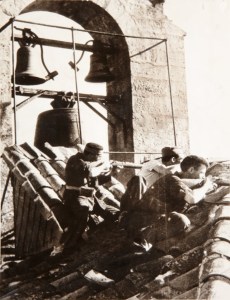
Republican troops entrenched in the bell tower of Sigüenza Cathedral, via Wikimedia Commons
.
By September, Nationalist columns, heavily reinforced by battle-hardened Carlist requetés, began a systematic push to isolate the town. On the morning of 12 September, Nationalist motorized units launched a coordinated heavy offensive that broke through the Republican lines at the nearby village of Barbatona. By bypassing the main defensive lines, the Nationalists seized absolute control of the primary highways to Soria and Madrid. The operational encirclement of Sigüenza was complete. No food, ammunition, or medical supplies could get in, leaving 800 militia and civilians inside were trapped.
.
Crucially, the Republican commanders made a fatal tactical error. Believing reinforcements from Madrid would eventually arrive to push the Nationalists back, they failed to properly fortify the outer hills surrounding the town, leaving Sigüenza’s geographic basin exposed to high-ground artillery. In a desperate bid to loosen the noose, the Republicans launched a fierce counter-offensive on the town’s southern flank. For four brutal days, the forces clashed in heavy, continuous combat over the rugged high ground of Huérmeces and Jodra and the Republicans successfully delayed the Nationalist timeline, but at a catastrophic cost. The offensive completely exhausted what little ammunition and manpower the defenders had left. The front line froze into a static, permanent trench line, sealing the fate of the town.
.
In the days immediately preceding the German bombing, the situation inside Sigüenza turned apocalyptic. The Republican defenders were completely cut off from the world. Clean water was scarce, food rations vanished, and ammunition was counted bullet by bullet. Morale disintegrated as the town was subjected to sporadic artillery fire from the surrounding hills. The defenders knew they were entirely surrounded, setting the stage for the massive 28 September German air raids to act as the final psychological and physical sledgehammer.
.
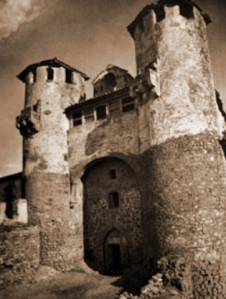
Sigüenza Castle, via unknown
.
On 28 September, the battle dramatically shifted into a tactical assault. According to historical records, including the accounts of Nationalist General Ramón Salas Larrazábal, 28 September was the official launch date of the Nationalist final offensive to conquer the city.
While sporadic Nationalist artillery had targeted the city before, the entry of Nazi Germany’s early intervention forces (the deployment that became the Condor Legion) transformed the scale of violence on 28 September. Early that morning, German Junkers Ju 52 bombers arrived from their airbase in Salamanca. Instead of targeting the trenches, they focused on urban infrastructure to destroy the defenders’ command posts and shatter civilian morale. This served as a literal warm-up raid for the even larger, catastrophic 23-plane bombing run that followed the next day on 29 September.
.
Simultaneously, the ground forces under General Emilio Mola launched a highly coordinated pincer movement. Heavily armed Nationalist columns, led by veteran Carlist requetés and regular infantry units, breached the outer urban perimeter. Using the cover provided by the morning air raids, they overran the hasty checkpoints and barricades that Republican milicianos had set up on the outskirts of town. For the defenders, 28 September was the day they realized no help was coming from Madrid. The sheer weight of the combined aerial and ground assault forced the 700–800 surviving militias and civilians out of the city streets and forward trenches. The primary Republican commander, anarcho-syndicalist leader Feliciano Benito, began pulling his forces back toward the city’s medieval stone core, specifically the Sigüenza Cathedral and the ancient castle, setting up the famous architectural siege.
.
On 29 September, Sigüenza experience the most violent and catastrophic day of the siege. While the previous day marked the launch of the Nationalist ground offensive, the 29th was the day the Republican urban defence was completely broken by an unprecedented wave of modern aerial warfare. Following a small two-plane reconnaissance and strike mission the day prior, the Nationalist command unleashed total air superiority. Early on the morning of 29 September, a fleet of 23 German Junkers Ju 52 bombers took off from their primary airbase in Salamanca. The planes systematically saturated the historic city centre with high-explosive payloads, turning narrow medieval streets into impassable rivers of rubble.
.
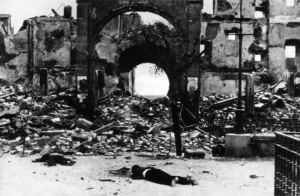
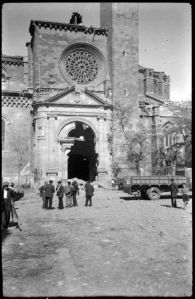
After the bombing of Sigüenza, via Archivo Histórico Provincial de Guadalajara
The most devastating event of the day, and a major historical focal point, was a direct hit on the Hospital and Hospice of the Bishopric (Hospital del Obispado). The building was heavily packed with wounded militias (milicianos), children, and sheltering civilian refugees who had fled into the city from outlying occupied villages. The bombing completely demolished the structure, killing approximately 70 people outright and wounding more than 150 others.This disaster highlighted the tactical blunders of the local Republican command. Marxist POUM militia leader Mika Etchebéhère recorded her absolute horror upon spotting the 23 planes circling the sky. The primary Republican commander, Comandante Martínez de Aragón, had stubbornly refused to evacuate the wounded from the hospital despite the clear and looming aerial threat, leaving them to be killed in their beds.The raid also claimed the life of Captain Martínez Vicente, the prominent leader of the local POUM (Workers’ Party of Marxist Unification) column, throwing the left-wing militia chain of command into further disarray.
.
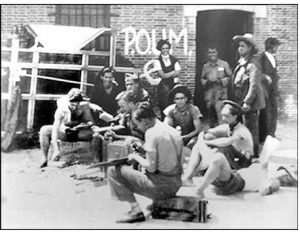
POUM militia leader Mika Etchebéhère and her men in Sigüenza, via unknown
.
By the afternoon of 29 September, the sheer weight of the German ordnance triggered a total psychological and structural collapse of the Republican outer lines. With communication wires severed, key infrastructure completely destroyed, and a mounting mass of civilian casualties, the barricades could no longer be reinforced. Realising that the city streets were entirely defenceless against the skies, the remaining 300+ armed combatants and hundreds of terrified civilians abandoned their positions. They began a frantic retreat into the thick, fortress-like stone walls of the Sigüenza Cathedral Complex. By the evening of 29 September, the streets of Sigüenza were virtually abandoned to the approaching Carlist requetés, and the tragic, final 16-day siege inside the dark, claustrophobic cathedral had officially begun.
.
On 30 September 1936, the battle for the streets of Sigüenza ended as the Nationalist ground forces officially seized control of the city, forcing the final, total collapse of the Republican urban defence. The events of this specific day solidified the tragedy, transitioning the conflict from an open urban battle into a claustrophobic, medieval-style siege inside the city’s grandest monument. Following the devastating German aerial blitz of the previous two days, Nationalist columns led by battle-hardened Carlist requetés (right-wing Catholic monarchists) and regular infantry met little resistance as they surged into the city centre.The Nationalists systematically occupied the ruined streets, clearing out abandoned Republican barricades and setting up firing positions around the remaining pockets of resistance. By the end of the day, the Nationalists had successfully captured the historic Castle of Sigüenza (the ancient bishops’ palace), which had served as a primary Republican stronghold, leaving only one building left un-captured.
.
After the bombing of Sigüenza, via Archivo Histórico Provincial de Guadalajara
.
With the castle gone and the streets occupied, the remaining 300 to 500 Republican militia and roughly 300 civilians (including women, children, and wounded survivors from the bombed hospital) completely sealed themselves inside the Sigüenza Cathedral. Under the direction of anarcho-syndicalist leader Feliciano Benito and POUM militia captain Mika Etchebéhère, the defenders used heavy wooden benches, altarpieces, and stone rubble to completely block the cathedral’s massive wooden doors. The militias hauled their remaining heavy weaponry up into the cathedral’s medieval bell towers and along the high clerestory windows, preparing to fire down on any Nationalist troops attempting to breach the perimeter.
.
On 30 September, the isolation of the defenders became absolute. The Nationalists intentionally cut the city’s remaining water lines and electrical grids. Inside the cathedral, the trapped defenders and civilians were plunged into near-total darkness, forced to rely on a single internal well and highly restricted food rations. By nightfall, Nationalist forces had completely surrounded the cathedral complex, setting up artillery and machine-gun nests in the surrounding plazas. This marked the official day the infamous 15-day siege of the Cathedral began, which would last until a desperate, bloody breakout attempt on 15 October.
.
Zaragoza, Aragon
The repression inside the city of Zaragoza in September 1936 exposes one of the darkest realities of the Spanish Civil War. Because the military coup completely succeeded in Zaragoza within the first days of July, there was never any active combat, frontline, or urban destruction within the city limits. Yet, behind this veneer of absolute military control, the Nationalist authorities unleashed an industrialized campaign of sacas to permanently eliminate the city’s vast left-wing and unionist working class, creating an quiet, eerie police state. Historical and civil registries indicate that the killing reached a continuous, daily rhythm by September. In September 1936 alone, at least 523 people were officially executed in the city. Historians note that because many bodies were dumped extrajudicially without registration, the true monthly number is significantly higher. Zaragoza’s municipal memorial lists a total of 3,096 victims executed inside the city during the course of the war. Crucially, the vast majority of these 3,096 individuals were rounded up and shot during the initial purge of July, August, and September 1936.
.
By late September 1936, the repression in Zaragoza operated like an assembly line, localised entirely within two main structures: Torrero Prison and the back walls of the Torrero Cemetery. Every evening, Falangist militias or military police arrived at Torrero Prison with lists of names. Prisoners were pulled from their cells under the guise of being released. Bound by their wrists, the victims were loaded into open-backed cargo trucks in the dead of night. They were driven a short distance down the road directly to the outer stone wall of the cemetery.Firing squads executed groups of 10 to 20 people at a time against the cemetery wall, finishing them off with a shot to the head. The bodies were immediately rolled into massive, pre-dug mass trenches on the cemetery grounds.
.
On 29 September 1936, a cohort of more than 600 forced recruits and working-class men from neighbouring northern regions were brought to the San Gregorio military camp just outside Zaragoza, intended to serve as frontline infantry units. Fearing a mass desertion or an internal uprising if these men were sent anywhere near the nearby anarchist lines, the Nationalist military authorities ordered a pre-emptive, exemplary punishment. In the first days of October, an estimated 224 of these men were summarily executed at San Gregorio, and their bodies were secretly carted in trucks to be dumped in the Torrero mass graves.
.
Father Gumersindo de Estella (the religious name of Martín Zubeldía Inda), is one of the most significant and complex witnesses to the White terror in the Spanish Civil War.
As a Capuchin friar forced into the role of a prison chaplain in Zaragoza, he became an accidental chronicler of state-sponsored slaughter. He secretly documented the execution of approximately 1,700 people between 1936 and 1942. His background, his horrific daily duties, and his enduring historical legacy offer a powerful angle for an article on the frontless repression in Zaragoza. Father Gumersindo was born in Navarre and was originally stationed in Pamplona. When the military coup erupted in July 1936, Pamplona fell immediately to right-wing Carlist forces. Gumersindo was suspected of harbouring Basque nationalist or defeatist sympathies and was deemed insufficiently enthusiastic about Franco’s ‘Glorious National Movement.’ Under intense pressure from local right-wing Carlist authorities, his religious superiors effectively exiled him to Zaragoza in September 1936 to keep him out of trouble. Upon arriving at the Capuchin Convent of San Antonio in the Torrero neighbourhood, his community assigned him to provide spiritual assistance to the local hospital and Torrero Prison.
.
Because the regular prison chaplain was in failing health, Father Gumersindo volunteered to assist with the capilla, the final, agonizing hours a prisoner spent locked in a cell after being read their death sentence. Under Nationalist military rules, prisoners facing execution were required to be offered the Catholic sacrament of confession and the last rites. Gumersindo was forced to sit with these terrified men and women, listening to their final wishes, crying with them, and riding alongside them in the open-backed cargo trucks that transported them 400 metres down the road to the cemetery walls.Gumersindo watched hundreds of executions first-hand. He described walking like an automaton after watching a firing squad of 24 men execute three local women, Selina Casas, Margarita Navascués, and Simona Blasco, administering the last rites before the military commander delivered the coup de grâce (final pistol shot to the head). One of his most agonizing diary entries details guards forcibly ripping screaming babies from the arms of Republican mothers right before the women were marched out to be shot, providing early evidence of the regime’s systematic child-theft system.
.
Gumersindo was deeply disgusted by what he was forced to participate in. Convinced that the institutional Catholic Church’s enthusiastic backing of Franco was a betrayal of Christian morality, he began keeping a meticulous, highly illegal secret journal. He meticulously wrote down the names, dates, and final words of the victims. He tracked how the vast majority of executions were the result of petty village revenges, denouncements, or simple trade-union affiliation. Because he was one of the very few religious figures who rejected the regime’s total dehumanisation of left-wing prisoners, Gumersindo secretly tracked down the families of those shot. He passed on their final letters, rings, watches, and last testaments, acts of profound subversion in a police state.
.
The emotional weight of his duties took a massive physical toll, causing him severe chronic gastritis and profound moral crises. In 1942, he was finally removed from Zaragoza and later moved to Argentina, where he attempted to publish his memoirs under the title Fusilados en Zaragoza (1936–1939). Franco’s dictatorship and institutional church censorship successfully blocked the text for decades. The book was released under the title Fusilados en Zaragoza (1936–1939): Tres años de asistencia espiritual a los reos (Shot in Zaragoza (1936–1939): Three Years of Spiritual Assistance to the Prisoners). It was published by the Spanish company Mira Editores, in a joint collaboration with the City Council of Zaragoza in October 2003.
.
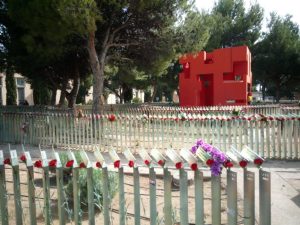
3,543 individual plaques commemorate all those who were murdered and whose remains were thrown into the mass graves of the Torrero Cemetery, via ARMHA
Massamagrell, Valencia
On 29 September 1936, the wave of Republican repression reached a grim peak with targeted executions in the municipalities of Massamagrell and Paterna. In Massamagrell, a town situated in the Horta Nord region just north of Valencia city, the violence targeted a local group of ten men, strictly identified with the Carlist or Traditionalist movement, who were rounded up and summarily killed. The Carlists, staunchly Catholic, monarchist, and traditionalist, were viewed by local revolutionary committees as an immediate threat to the Republican cause. Their execution in Massamagrell reflected a systematic effort to eliminate the local leadership and social fabric of right-wing opposition. Simultaneously, a few kilometres to the west, the execution walls of Paterna became the backdrop for further politically motivated killings. Paterna’s proximity to the capital made it a primary site for the disposal of political detainees, a grim distinction it would hold throughout the war and its aftermath. On 29 September, several notable detainees who had been swept up in the continuing September sweep were brought to Paterna to face firing squads.
.
Among the high-profile victims executed that day was Father Darío Hernández Morató. Born in Buñol in 1880, Father Hernández Morató was a prominent Jesuit priest who had served as the rector of the primary house of the Society of Jesus in Valencia since 1928. Following the secularization decrees and the official suppression of the Jesuits by the Second Republic years prior, his ministry had been forced underground. Despite the inherent dangers of the escalating conflict, he remained in the region under a false identity, continually moving residences to evade capture. Arrested in mid-September by revolutionary forces, his identity was eventually uncovered. His execution on 29 September alongside other unnamed detainees highlighted the anti-clerical dimension of the ongoing rearguard purges, where religious figures were systematically equated with political subversion. Decades later, figures like Father Darío Hernández Morató would be recognized by the Catholic Church, culminating in his beatification by Pope John Paul II in 2001, preserving the memory of a dark day in the history of Valencia.
.
Fuentes de Andalucía, Seville
The final documented phase of repression at Fuentes de Andalucía in Seville province, population 7,300, came on 29 September, when the organised sequence of killings that had begun in July reached its recorded endpoint. By then the town had been under Nationalist control for more than two months, yet the repression had continued throughout that period. Approximately 116 people has been killed in the small town, including 25 women since the outbreak of ‘war.’ The endpoint of 29 September in Fuentes de Andalucía directly followed the notorious August atrocities in the area, such as the tragic case ofLas Niñas del Aguaucho (young women kidnapped, abused, and murdered by Falangists). Given that 25 of those killed were women, historians often note that Fuentes de Andalucía suffered one of the highest proportions of female executions relative to male victims in the entire province of Seville.
.
Fuentes de Andalucía via unknown
.
The same day brought one of the most politically prominent executions in Seville city itself. Horacio Hermoso Araujo, a member of Izquierda Republicana and the last Republican mayor of Seville, was shot at San Fernando cemetery on 29 September. Hermoso had been detained after the military uprising and had remained in Nationalist custody despite having held the city’s mayoralty during the Republic. His execution demonstrated that political prominence offered no protection once the Nationalist authorities had decided to eliminate the remaining Republican leadership.
.
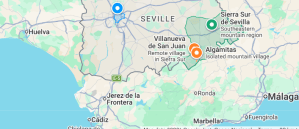
By the end of September, the military map of Seville province had been transformed. The final Republican enclave in the Sierra Sur had disappeared with the capture of Algámitas and Villanueva de San Juan (populations of 1,500 and 2,000 respectively), Republican civilians and militia had fled towards Málaga, and the entire province had become a Nationalist rear area. At the same time, the machinery of repression was becoming deeply embedded in the administration of the province: prisons were filled, executions continued, public employees were purged, property was confiscated, and Seville itself had become the command and logistical centre from which the Nationalist war effort in southern Spain was directed. With the collapse of the final pockets in the Sierra Sur, no locations in the entire province of Seville remained under Republican control by the close of the month. The geographic borders of the province had been entirely sealed, absorbing every town and village into the expanding Nationalist footprint and trapping those who could not escape over the mountainous frontier toward Málaga. While the area has known mass grave sites, many would have been shipped towards Seville for execution, and most graves in the area remain undignified.
The human cost of this rapid conquest was staggering. Historians estimate that in the opening weeks of the conflict between July and late September 1936, over 3,000 people were systematically murdered across the province. This initial wave represented nearly a third of the estimated 11,000 victims who would ultimately perish from Francoist repression in Seville throughout the course of the war. These thousands of anonymous bodies, clogging municipal mass graves and the San Fernando cemetery, were the result of an intentional, top-down bureaucratic purge designed to physically eradicate the social and political networks of the Second Republic.
Behind these vast numbers lay a deeply gendered reality of suffering, as women endured distinct and agonising forms of violence. For many, the penalty was immediate and fatal; as seen in towns like Fuentes de Andalucía, women made up a significant portion of those led to the execution walls, including pregnant victims whose deaths served as the ultimate exercise in political cleansing. For the thousands who survived, the repression took on a cruel, living dimension. Nationalist forces systematically used public humiliation, forced head-shaving, and the ingestion of castor oil to degrade women associated with left-wing or unionist families. Combined with the widespread confiscation of property, the sudden execution of husbands and fathers left countless women destitute. They were forced to navigate a newly militarised society as social outcasts, bearing both the psychological trauma of their family’s elimination and the economic ruin imposed by the state. By October, the conquered province of Seville was defined by a deeply entrenched architecture of fear, grief, and silent endurance.
.
Large, organised movements of civilians on roads, resembling the structured columns that had fled the Campiña plain earlier in the summer, became impossible after 11–12 September 1936. During those days, a Carlist Requeté column commanded by Luis Redondo aggressively pushed through the mountain passes to permanently capture Algámitas and Villanueva de San Juan. When these final urban enclaves fell, any remaining communal coordination collapsed. The towns were occupied, and the surrounding exit roads to neighbouring regions were heavily guarded by Nationalist cavalry and checkpoints. Mass evacuations were replaced by desperate, small families or individual Republican sympathisers attempting to filter through lines under darkness. Refugees abandoned all visible pathways, scrambling across the treacherous, limestone peaks of the Peñón de Algámitas. For most, the flight ended in capture. Those who could not navigate the vertical wilderness were forced to remain hiding in their homes or the surrounding olive groves.
.
By the end of the month, the machinery of the rearguard purge was processing those trapped by the sealed border. In the mountain cemeteries of Villanueva de San Juan and nearby villages, immediate executions, including groups of local women stripped of any chance of escape, symbolised the absolute closure of the Seville gateway. The thousands of refugees who did manage to escape earlier were already deep inside Málaga province, completely cut off from their home villages. For those who didn’t make it all the way to Málaga city and instead hunkered down in cross-border villages like Almargen, Campillos, and Villanueva de Cauche, the relief was short-lived. When Nationalist forces pushed further south to conquer Málaga, right-wing identification committees from Seville towns travelled behind the front lines. Armed with lists of names, these committees toured the newly captured Málaga prisons and villages, explicitly hunting down the ‘reds’ who had slipped out of Seville months earlier.
.
Burgos
On 29 September, the Nationalist leadership formally placed General Francisco Franco at the head of both its emerging government and its armed forces. The decision followed highly contentious meetings between senior Nationalist generals at a field airstrip near Salamanca, where they discussed the immediate need for a unified commander as the war expanded and the temporary, collective arrangements established after the July uprising became increasingly inadequate.
.
In the administrative capital of Burgos, General Miguel Cabanellas, acting as the president of the Junta de Defensa Nacional, signed Decree 138. This historic document officially appointed Franco as Jefe del Gobierno del Estado Español (Head of the Government of the Spanish State). Crucially, Franco was also designated Generalísimo of the Nationalist land, sea, and air forces, making him the supreme commander-in-chief of all active operational armies. This move effectively concentrated absolute military command and political authority into the hands of one man.
.
General Cabanellas maintained deep personal reservations about granting Franco such extensive, unchecked power, famously warning his peers that Franco would never willingly relinquish it. However, isolated and outvoted by senior generals like Emilio Mola and Gonzalo Queipo de Llano, Cabanellas was unable to block the decision. The appointment instantly made the Junta de Defensa Nacional, which had governed the rebel zone from Burgos since July, entirely obsolete, paving the way for a brand-new administrative structure built purely around Franco’s personal authority.
.
Though drafted on 29 September, the decree was officially published in the government gazette on 2 October 1936. Franco’s formal, theatrical investiture took place in the throne room of the Capitanía General of Burgos on 1 October 1936. From this point forward, Franco was the recognized head of an emerging totalitarian state and the supreme leader of its military apparatus, laying the structural foundation for the absolute personal dictatorship he would retain throughout the rest of the war and, following his ultimate victory, until his death in 1975.


You must be logged in to post a comment.