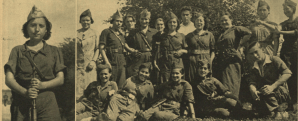
- Oviedo, Asturias
When the failed military uprising in Asturias morphed into the intense, multi-month Siege of Oviedo in July 1936, the lack of regular Republican army units forced the Popular Front to rely almost exclusively on makeshift worker and miner militias. Within this highly mobilised working-class resistance, hundreds of politically active women stepped into operational roles to tighten the encirclement of Colonel Antonio Aranda’s revel garrison. The combat and logistical contributions of these female volunteers during the opening months of the northern campaign broke down into multiple operational areas. Women frequently operated as mobile lookouts and messengers, navigating hazardous open terrain between isolated leftist positions while under heavy artillery shelling and aerial bombardment from Nationalist positions. were responsible for moving forward to the advanced trench lines to distribute ammunition, transport hot food, and deliver motivational political speeches to sustain the morale of the volunteer units.
.
On 20–21 September 1936, a diplomatic attempt was made to allow civilians to evacuate the besieged city of Oviedo through the direct intervention of the Cuban consul. The humanitarian initiative was accepted by the Republican forces surrounding the city, resulting in a temporary suspension of hostilities to allow the consul to safely cross the front lines and approach the rebel leader, Colonel Antonio Aranda Mata.
.
The proposal explicitly concerned the departure of the civilian population, described in Republican reporting as the pueblo indefenso (defenceless people), rather than the surrender or evacuation of Aranda’s Nationalist garrison. Ultimately, Aranda refused to permit the proposed evacuation, and the civilians remained trapped inside the siege perimeter.
A Republican government account published on 21 September claimed that desperate civilians subsequently attempted to flee independently, prompting Aranda to order the Guardia Civil to forcefully prevent them. The war ministry’s report also described widespread internal unrest inside Oviedo, presenting the Nationalist garrison as on the verge of total collapse. However, these additional claims heavily mirrored the sensationalised nature of Republican wartime propaganda and cannot be treated as established historical details of the negotiations.
.
What remains definitively established is the diplomatic intervention itself: the Cuban consul initiated the negotiations, the Republican besiegers agreed to a temporary ceasefire while he approached the city, and Colonel Aranda rejected the request to let civilians out. With the siege continuing unabated and the Galician Nationalist relief columns still fighting their way toward the city from the west, the humanitarian attempt produced no evacuation.
.
By the third week of September, the strategic situation around Oviedo was becoming tied increasingly closely to military events unfolding west of the city. The Galician Nationalist columns had successfully entered Grado on 15 September, while Republican troops fought desperately to contain them around the bottlenecks of Trubia and Peñaflor. Although Aranda’s garrison remained strictly surrounded, Nationalist relief was considerably closer than it had been at the beginning of the month.
.
Around 21 September, Republican military reports described repeated Nationalist attempts to launch sorties outward from Oviedo. While these communiqués claimed that the rebel pushes were successfully driven back with heavy losses, the precise troop numbers and casualty figures given in the immediate wartime reports cannot be verified as accurate historical metrics.
.
Meanwhile, the Republicans maintained their offensive from the air. On 21–22 September, a force of seven Republican aircraft carried out a bombing raid on Oviedo. Government reporting claimed that the strikes successfully hit a Nationalist artillery battery and ignited a significant fire inside the Civil Government (Gobierno Civil) building.
.
Despite the aerial pressure, Aranda’s troops achieved a localised success on 23 September at Abuli, situated just southeast of the city. Nationalist infantry captured the position in a surprise attack, successfully extending the garrison’s defensive perimeter. While the breakthrough failed to open a direct escape route out of Oviedo, it effectively denied the Republican besiegers an advantageous tactical position close to the city. The attempted negotiations on 20–21 September to evacuate the civilian population are best analysed separately from the front-line combat. They represent an isolated, tragic chapter regarding the non-combatant population trapped within the machinery of the siege rather than a shifting tactical stage of the military engagement itself.
.
- Gipuzkoa, Basque Country
Bergara had approximately 12,000 inhabitants at the outbreak of the war, and roughly 11.5 per cent of the population, around 1,300 to 1,400 people, fled the municipality before Nationalist troops entered on 21 September 1936. The town’s internal political divisions were substantial. Later archival research identified approximately 700 Bergara residents who actively fought during the conflict: around 200 integrated into the Republican forces, while roughly 500 sided with the Francoist faction, though many of the latter entered the rebel ranks later as conscripts.
.
Republican troops withdrew westward before Lieutenant-Colonel Ángel Tejero’s Nationalist vanguard group entered Bergara, leaving behind little organised fighting inside the town itself. Tejero commanded six companies of the América infantry regiment, though not every company entered the urban center simultaneously. Upon arrival, he established his operational headquarters directly inside the Ayuntamiento (Town Hall).
.
Nationalist soldiers and their local right-wing supporters began systematic house-to-house searches on the very day of occupation. Residents associated with Republican parties, left-wing trade unions, and Basque nationalist organisations were aggressively sought out, while non-combatants who remained behind in Bergara were intensely questioned about neighbours who had fled. Arrests began immediately, and detainees were placed under the absolute authority of the new military and political administration.
.
The occupation also brought immediate lethal repression. Executions began during this opening phase of Nationalist control, though surviving document totals should be separated from later systematic purges rather than attributed wholesale to the single date of 21 September. Falangists, Carlist Requetés, and military personnel all participated in identifying and detaining local political opponents, while the property belonging to displaced refugees was summarily seized.
.
Within days, a new municipal council headed by Luis Ruiz de la Prada began removing or investigating municipal employees and teachers associated with the previous democratic administration. Women connected to Republican or left-wing families were subjected to brutal public humiliations, including forced head-shaving (rapado). For the estimated 10,500 to 11,000 residents who remained in Bergara, the occupation meant armed soldiers in the streets, immediate property searches, and arbitrary arrests, while more than a thousand of their neighbours were already displaced elsewhere as refugees.
.
The Nationalist coastal column advancing westward from Zumaia encountered organised Republican resistance around Itziar and Deba, where the advance route was heavily restricted by steep slopes sandwiched between the mountains and the Cantabrian coast. To stall the advance, Republican militias prepared sandbag barricades and fortified road bottlenecks, supported by improvised armored lorries (tiznaos) manufactured directly by the Orbea small-arms works in Eibar.
.
Deba had around 4,000 inhabitants, with the smaller hill settlement of Itziar controlling an important strategic approach directly overlooking the coastal town. The Republican defensive lines included local and Gipuzkoan militias, reinforced by a group of anarchist militiamen recently deployed from Bilbao. Because surviving historical evidence does not provide a dependable total for either the entire Republican force or the exact Nationalist column, assigning invented numerical strengths to either side would distort the tactical action.
.
On 22 September 1936, the Nationalist column launched its assault towards Itziar. Intense fighting developed around the prepared Republican positions before the defenders were ultimately outgunned and forced to withdraw westwards. At least thirteen Republican militiamen were killed in action during this specific engagement, giving the battle a measurable human cost beyond the subsequent occupation of Deba.
.
Nationalist troops entered Deba shortly after the breakthrough, while surviving Republican forces executed a full tactical withdrawal towards Mendaro, Elgoibar, and the primary defensive lines protecting the industrial stronghold of Eibar. Civilians were left behind in a town through which armed units had fiercely fought and withdrawn within a matter of hours; surviving local documentation does not establish a reliable civilian casualty metric for this immediate action.
.
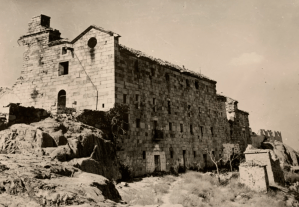
- Nuestra Señora de la Cabeza, Jaen
By late September 1936, the Santuario de Nuestra Señora de la Cabeza, a remote mountaintop sanctuary nestled deep within the Sierra Morena near Andújar (Jaén), had transformed into one of the most symbolic and fiercely contested isolated outposts of the Spanish Civil War. Under the unyielding command of Civil Guard Captain Santiago Cortés González, a garrison of roughly 200 Guardia Civil mutineers, along with their families and local right-wing civilians, totalling over 1,200 people, had fortified the religious sanctuary. Refusing to submit to the Second Spanish Republic, this isolated enclave became the target of a relentless, multi-pronged siege operations as Republican forces sought to liquidate the pocket of rearguard resistance.
.
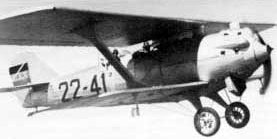
Unable to easily breach the rugged, high-altitude terrain through conventional infantry assaults, the Republican military high command heavily weaponised raw airpower to break the garrison’s resolve. Between 21–24 September 1936, Republican Breguet XIX warplanes, operating from the nearby military airfield at Andújar, launched a sustained, multi-day aerial bombardment campaign targeting the sanctuary complex and the nearby auxiliary outpost at Lugar Nuevo. On 21 September alone, the assault reached a devastating peak when two separate air formations, totalling approximately fourteen aircraft, swarmed the mountain. The planes systematically dropped more than 130 bombs directly onto the stone complex. Despite the thick, protective stone walls of the sanctuary, the heavy tonnage of ordnance inflicted immediate casualties inside the crowded enclave, leaving one person dead and several others severely wounded. By 24 September, the total ordnance dropped during this aggressive opening phase of the siege had risen to several hundred bombs, reducing much of the peripheral infrastructure to rubble.
.
.
Recognising that the relentless aerial pounding was causing severe humanitarian distress among the hundreds of women and children trapped inside, and eager to free up front-line troops for the advancing Madrid front, the Republican command attempted a high-level diplomatic intervention. On 24 September 1936, Lieutenant-Colonel Juan Hernández Saravia, the Minister of War and the senior military official responsible for coordinating the Republican forces in the southern sector, became directly involved in the operations. Seeking an immediate end to the costly stand-off, Hernández Saravia initiated formal contact with the enclave, offering terms of safe passage for non-combatants and honourable surrender for the mutinous guards.
.
To allow the diplomatic channels a chance to function and to prevent further civilian bloodshed, Republican authorities ordered a temporary halt to the offensive.
Between 25 September and 28 September 1936, a strict four-day aerial bombing truce was enacted. All Republican flight operations over the Sierra Morena were temporarily suspended while negotiators made exhaustive, final attempts to secure a peaceful, negotiated surrender of the compound. However, Captain Cortés, fiercely holding out in the naïve belief that General Franco’s advancing southern columns would break through to rescue them in a matter of days, completely refused the Republican terms. With the expiration of the truce on 28 September, the diplomatic window slammed shut, and the mountaintop sanctuary was plunged back into a brutal, prolonged siege of attrition that would drag on tragically until the following spring.
.
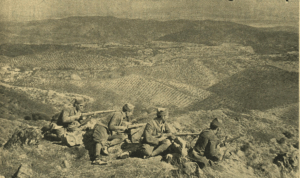
- Córdoba, Andalucía
On 21 September 1936, the Córdoba-Seville high command officially ordered the offensive against the heavily fortified Republican salient at Espejo. To ensure an absolute breakthrough, Queipo de Llano organised two massive, multi-pronged columns under the unified command of Colonel Eduardo Sáenz de Buruaga. The columns were heavily equipped, combining elite shock troops with local paramilitaries. The force included colonial African Regulares, regular infantry, mobile cavalry detachments, right-wing Falangists, Carlist Requetés, the Guardia Civil, and specialised artillery and engineering units.
.
While columns mobilised for the front lines, the Nationalist rearguard underwent a dark administrative restructuring. On 22 September 1936, Bruno Ibáñez Gálvez, infamously known as Don Bruno, was officially appointed as the provincial chief of public order (Jefe de Orden Público) for Córdoba. Replacing the previous commander, Luis Zurdo, Don Bruno became instantly associated with a severe and clinical intensification of Nationalist repression across both Córdoba city and the surrounding province. Under his bureaucratic supervision, daily prison clearances (sacas) and summary executions reached an unprecedented, clinical velocity.
.
.
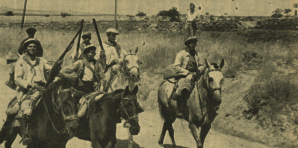
Between 22 and 25 September 1936, the southern agricultural plains were consumed by the bloody Battle of Espejo. Sáenz de Buruaga’s columns launched a fierce, direct assault against the Republican-held territory southeast of Córdoba. The engagement lasted several gruelling days and produced exceptionally heavy casualties on both sides, as Republican militias fought desperately from entrenched positions across the olive groves before their lines ultimately collapsed.
.
On 23 September, Nationalist columns achieved a major tactical breakthrough by capturing the strategic position of Torres Cabrera. The loss of this sector stripped the Republic of a vital forward base that had actively threatened Córdoba city from the southeast. At the same time,
Nationalist infantry swept into and occupied the village of Santa Cruz, systematically extending rebel control over the highway corridor connecting Córdoba with the Espejo front. Recognising the impending danger, the local civilian population largely fled into the hills before or during the physical takeover.
.
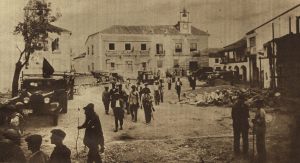
The tactical campaign culminated on 25 September 1936 when Nationalist forces successfully captured the town of Espejo. Outmanoeuvred and facing total encirclement by Buruaga’s artillery, Joaquín Pérez Salas ordered a full evacuation of his remaining regular troops and militias. The fall of the town removed the closest remaining Republican threat to Córdoba city, permanently securing the capital for the Nationalist faction. From 25 September onward, the military defeat triggered a massive, desperate humanitarian crisis across the region. A vast wave of civilian refugees, retreating militiamen, and left-wing political activists embarked on a gruelling exodus eastward. Fleeing the impending White Terror, thousands retreated through Castro del Río and Bujalance, eventually crossing the provincial border into the temporary sanctuary of Republican-held Jaén province. They left behind fractured communities and empty villages that were instantly subjected to the clinical purges directed by Don Bruno.
.
- Badajoz, Extremadura
By late September 1936, the Republican rearguard in the south-western pocket of Badajoz province faced total collapse. As General Francisco Franco’s columns pushed relentlessly toward the Portuguese border, thousands of everyday citizens, unionised workers, and left-wing activists found themselves physically trapped. With all escape routes to the broader Republican zone severed, their only hope for survival lay in a desperate exodus across the international frontier into Portugal.
.
On 21 September 1936, as the thunder of Nationalist artillery signaled that occupation was imminent, a panicked mass flight erupted from the strongholds of Jerez de los Caballeros and Oliva de la Frontera. Thousands of civilians fled westwards, crossing the border into the rugged hills around Barrancos, Portugal. Under strict orders from the right-wing dictatorship of António de Oliveira Salazar, Portuguese border guards were instructed to arrest Spanish refugees and deport them back across the lines directly into the hands of Francoist execution squads. A remarkable act of humanitarian defiance occurred on 21 September, when Lieutenant António Augusto de Seixas, the Portuguese officer commanding the border detachment, chose to violate his government’s orders.
.
Seixas permitted the vast wave of Spanish refugees to enter and remain in safely improvised camps established at Coitadinha and Russianas. By actively shielding them from forced repatriation to Nationalist territory, Seixas saved thousands of lives from the impending White Terror. From 22 September onward, this humanitarian sanctuary grew rapidly as hundreds more refugees from newly fallen municipalities like Valencia del Mombuey and Zahínos slipped across the border to gather in the crowded Barrancos camps.
.
While the civilian exodus grew, Nationalist columns executed a rapid tactical sweep to liquidate the remaining border pockets On 22 September, the fall of Valencia del Mombuey and Zahínos came through the south-western border plains, when Nationalist troops occupied both municipalities. These twin captures triggered the structural collapse of the remaining Republican-controlled territory west of the main La Serena zone. The following day, Nationalist forces successfully eliminated the last operational Republican positions in the Jerez de los Caballeros and Oliva de la Frontera sector. This tactical victory completed absolute Nationalist control over the entire south-western corner of Badajoz province, forcing the principal Republican front lines to concentrate strictly in the eastern half of the province.
.
Further east, in the agricultural hub of Azuaga, the agony of the war manifested in a brutal sequence of rearguard violence from both factions. As Nationalist troops approached, radicalised elements within the local Republican militias carried out a pre-evacuation purge of right-wing hostages held in the municipal jail. Across 21 and 22 September, a group consisting of local Franciscan friars and seven right-wing civilian prisoners was marched out and executed at the prison and the municipal cemetery. At least thirteen identified victims were murdered during this two-day span of rearguard violence.
.
The front line shifted permanently when Nationalist forces captured Azuaga (historical sources differ on the exact day by 24 hours). The fall of the town was a severe blow to the Republic, removing the most vital economic and political centre in the Campiña Sur district and pushing the active front line further east towards Granja de Torrehermosa.
.
Following the occupation, the incoming Nationalist military authorities and local Falangists initiated an intense, systematic campaign of political cleansing. Firing squads and arbitrary sweeps targeted Republican municipal officials, agrarian unionists, local miners, and left-wing activists who had failed to flee, permanently altering the demographic fabric of the Campiña Sur through a wave of executions and property seizures.
.
Jerez de los Caballeros was part of the first cycle of exhumations in the 1970s, organised by relatives of those killed in the town. In April 1979, the relatives submitted a formal request to the City Council asking to relocate the remains of their loved ones, then lying in two mass graves, to a plot within the cemetery donated by the municipality, where a dignified burial site could be constructed. Both mass graves were on private estates at Finca La Nava and Finca Monte Lobo. These two homes held the remains of 29 people who had been murdered in 1936 by the owners and their employees on the property. The surviving families carried out the dig themselves but ere unable to identify individuals, as no scientific methodology or anthropological assistance was supplied. The remains were placed in coffins and transported to the cemetery, where they were reburied in the plot donated by the City Council.
.
Also in 1980, clandestine mass graves located in the local cemetery of Oliva de la Frontera was carried out as families in the area became ready to look for victims ad as socialist leaders were being elected in areas, meaning councils would more easily give permission. Socialist Mayor Idelfonso Gata stated that municipal workers were responsible for opening the graves and unearthing the skeletal remains, and the remains of approximately 100 victims were located and recovered, alongside various personal items and belongings such as combs, marbles, medals, and crucifixes. The recovered remains were taken to the Casa del Pueblo (local Socialist party headquarters), so residents could claim any items they believed had belonged to their deceased loved ones. These victims were individuals who had been murdered in September 1936, when over 200 townspeople were killed without cause.
.
The remains of the 100 people located were transported in seven or eight coffins on October 26, 1980, cited five coffins)to the cemetery, where they were given a dignified reburial on land donated by the municipality. Furthermore, according to Idelfonso Gata, the municipality also covered the costs of the memorial monument erected during the period the process was underway.
.
On September 21, 1980, the 44th anniversary of the occupation, a headstone was placed for the victims who died defending their ideals during the Spanish Civil War (1936–1939). People chose the word ‘died’ because they dared not use the term that truly described what had happened: ‘murdered. They referred to it as a civil war, but people were victims of a military coup. In Oliva, as in the southwest and across more than half the country, there was no civil war, but rather an uprising followed by repression.


You must be logged in to post a comment.