Grado – Oviedo, Asturias
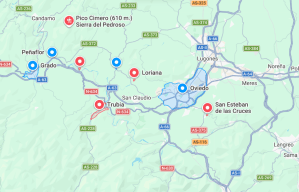
In the autumn of 1936, the war on Spain’s isolated Northern Front pivoted around a single the Grado Corridor outside Oviedo. Six weeks earlier, on 17 October, Nationalist relief columns advancing from Galicia had broken through Republican lines to reach the besieged Asturian capital of Oviedo, establishing a thin road and rail corridor linking the city through El Escamplero and Peñaflor to Grado. To strangle that lifeline, retake Oviedo, and draw Nationalist reserves away from the desperate fighting around Madrid, the newly reorganized Republican Ejército Popular del Norte, advised by Soviet military specialists, launched a major multi-sector offensive at dawn on 26 November 1936.
Under Operations Order No. 1, the Republican high command assembled between 25 and 30 battalions, supported by artillery, mortars, machine-gun companies, and newly arrived Soviet BA-6 armoured cars, facing roughly 7,000 Nationalist defenders (including reinforced units of the Spanish Foreign Legion and Moroccan Regulares, backed by German and Italian aircraft). Phase One on 26–27 November planned to seize the high ground and river crossings controlling the Grado Corridor, principally Monte Los Pinos, the bridge at Peñaflor, Valduno, and Monte Cimeru, to seal Oviedo off once again. Phase Two on 27–28 November, once the corridor was severed, launch a concentric assault directly into Oviedo’s suburbs from Lugones, San Esteban de las Cruces, and Monte Naranco.
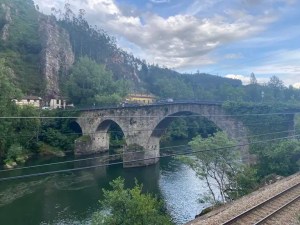
The entire offensive happened inside a narrow 20km strip running east-to-west between Grado and Oviedo, defined by one major obstacle: the Nalón River. The corridor lifeline (Grado – Peñaflor – El Escamplero – Oviedo), was a narrow finger of Nationalist territory poking east into Republican-held Asturias. Grado sits at the western base (connected back to the Nationalist Galicia trail), and Oviedo sits at the eastern tip. The single road and railway connecting them had to cross the Nalón River at the Bridge of Peñaflor, then run along the north bank through El Escamplero into Oviedo.
Peñaflor and Monte Cimeru (Pico Cimero) meant everything because the Peñaflor bridge was the choke point of the entire corridor, controlling the hills right above it meant you could cut Oviedo off completely. Pico Cimero sits immediately north of the bridge, while Monte Los Pinos sits right across from it, so whoever held those ridges controlled the bridge below.
Trubia was a major Republican arms factory town, and sits just south of the corridor across the Nalón River. Republican troops attacked north from Trubia toward the river crossing at Valduno to cut the corridor from the south at the same time Monte Cimeru was attacked from the north. Lloriana sits right above the narrow neck between El Escamplero and Oviedo, which allowed Republicans to fire down on supply trucks, while San Esteban de las Cruces is on Oviedo’s southeastern edge, used to keep Colonel Aranda’s garrison pinned inside the city so he could not send troops west to rescue Peñaflor.
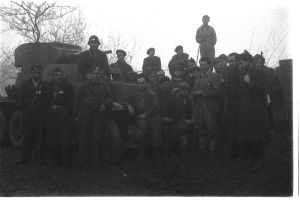
Republican artillery opened fire at first light on 26 November against Nationalist positions along the Nalón valley and the corridor’s road junctions. At Monte Los Pinos and Peñaflor, Captain Claudio Martín Barco’s column, three battalions (Onofre and Máximo Gorki leading), 33 machine guns, four mortars, and three BA-6 armoured cars, attacked the wooded slopes of Monte Los Pinos to reach the Peñaflor bridge. Nationalist machine-gun nests and fortified posts halted the armoured cars on the road and pinned down the infantry on the lower slopes. When Nationalist troops briefly withdrew from exposed forward posts on the ridge under pressure, local Republican reserve commander Major Taboada refused to advance without explicit orders from headquarters, allowing Nationalist units to reoccupy the ground.
Seven Republican battalions with 30 machine guns attacked entrenched Nationalist defenders at Valduno and Monte La Parra at the southwestern and northen flanks. Though Republican units briefly severed the southern Trubia–Oviedo road and placed demolition charges on a secondary bridge, open fields of fire and Nationalist counter-fire prevented them from capturing the main Nalón bridge at Valduno. North of the corridor, five battalions seized Lloriana to harass traffic between Oviedo and El Escamplero, while the Rapín, Fuentes, and Cubedo battalions nearly captured Picu l’Árbol before Nationalist artillery firing from Picu Paisano drove them back, killing Captain Rapín.
Another three battalions with three BA-6 armoured cars probed La Cadellada and El Villar on Oviedo’s western edge, while five battalions and 27 machine guns mounted diversionary fire around San Esteban de las Cruces, pinning Aranda’s city garrison in place.
The main breakthrough attempt occurred on the morning of 27 November at Monte Cimeru, a hill north of the Nalón River overlooking Grullos and the Peñaflor bridge. The assault began at 6:00am, and following a short barrage by 155 mm and 105 mm guns that suppressed Nationalist machine-gun nests, 160 Republican shock troops, 112 men from the 1st Company of the Izquierda Republicana 22nd Battalion and 50 regular soldiers from the 3rd Mountain Chasseurs Battalion, led by Lieutenant José Manuel Mansilla with four machine guns, assaulted the slope with bayonets and hand grenades. After close-quarters trench fighting against determined Nationalist resistance, they captured the summit at 10:30am.
Mansilla conscripted 25 local villagers from Villar to dig trenches, while detaching his 50 Mountain Chasseurs to a neighbouring ridge (La Escrita) to cover an expected flanking attack against Monte Los Pinos that never materialized. Meanwhile, two of his four machine guns were destroyed during the morning climb, a third jammed while firing on Nationalist troops massing at Peñaflor, and field telephone lines failed.
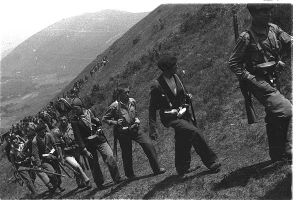
By 2:00pm, Nationalist commanders had concentrated reinforcements at the Peñaflor bridge, 1,500 metres away. At 3:00pm, local Nationalist units launched two frontal assaults up Monte Cimeru, both of which were repulsed with heavy Nationalist losses. Aranda then committed a full tabor of Moroccan Regulares and two companies of the Foreign Legion, supported by artillery and mortars, attacking multiple flanks simultaneously. With only around 100 exhausted men, no working machine guns, and dwindling hand grenades, the defenders held for 45 minutes in close combat among the rocks before Regulares and Legionnaires began encircling the right flank. The 3rd section broke without orders; unable to rally the retreat, Mansilla ordered a general withdrawal at 4:30pm across a kilometre of open slope under heavy fire. Promised Republican reinforcements from Major Taboada’s sector did not arrive until 6:00pm, ninety minutes after the hill had fallen.
Casualty figures for 26–27 November recorded heavy losses on both sides, including the repulsed Nationalist assaults on Monte Cimeru and the near-annihilation and dispersal of Mansilla’s 160-man detachment during its open-ground retreat. By the evening of 27 November, Nationalist forces had repelled every major Republican thrust against the Grado Corridor, keeping Oviedo’s supply link open and preventing the Army of the North from isolating the city. Another attempt would come on 30 November.
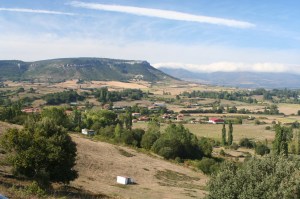
- Gayangos, Las Merindades, Burgos, Old Castile (Castilla y Leon)
The systematic wave of political repression was continuing through rural villages in the Las Merindades region. Unlike much of Burgos, which fell immediately to the military coup in July 1936, Las Merindades sat directly on the rugged border between Nationalist-held Castile and Republican-controlled Santander (Cantabria) and the Basque Country. Because the Northern Front cut right through these mountains, the region was treated as a paranoid, heavily militarized war zone where any perceived disloyalty was met with immediate lethal force. The violence disproportionately high and relentless wave of repression in 1936, with local historical memory groups cataloguing over 100 mass graves across the district alone (my 14 November article on the topic has many links to other events I have covered). In the municipality of Merindad de Montija alone, a tiny district, at least six mass graves have been officially registered, including another execution of 22 villagers just a month earlier on 27 October 1936.
On 26 November 1936, that terror arrived in the small towns of Gayangos, Baranda, and again at Loma de Montija, resulting in a massacre that would remain an open secret for 75 years, all because one man refused to die. Armed Falangist squads conducted a pre-planned collection of appointed victims who were taken from their homes; with 10 victims from Gayangos, five from Baranda, one from Barcenillas del Rivero, one from Quintanilla de Pienza, and one Loma de Montija itself, alongside several unidentified detainees (though could likely all be Gayangos,; paperwork is not specific). With their hands bound behind their backs with wire, the villagers were loaded onto trucks and driven roughly 10 kilometres north to Espinosa de los Monteros. There, they were held briefly in a makeshift detention centre, used as a temporary staging point while the squads finished collecting everyone on their list. Their destination was El Cerezo, an isolated agricultural plot 500 metres off the main road on the outskirts of Loma de Montija.
In rural regions like Las Merindades, the goal of late-1936 sacas was not secret policing, it was public exemplarity. The perpetrators weren’t trying to hide the killings from the neighbours; they wanted the neighbours to know, and they wanted the fear to paralyse the community for generations. The perpetrators made little effort to conceal the sweeps from locals; trucks arrived in broad daylight or early evening, neighbours saw who was taken, and in 1937 locals literally stood guard to stone a widow who tried to leave flowers at El Cerezo. What they did hide was the official paper trail, falsifying death dates in civil registries. n tightly knit rural valleys where families had lived side-by-side for centuries, everyone knew who vanished on 26 November 1936, who compiled the lists, and where the bodies lay.
As the volley of gunfire rang out in the dark field at El Cerezo, one of the detainees was struck, fell into the trench, and feigned death. Though wounded, he survived the initial shots. Waiting until the militias finished covering the shallow grave and drove away, the survivor clawed his way out of the earth and staggered back toward the village in the dark.
Upon reaching safety, he recounted the horror of what had happened at the end of the track in El Cerezo. Because of his testimony, the villagers of Loma de Montija always knew the location of the trench where their neighbours lay buried.
Of the identified victims with recorded ages, the average age is 49 years old. Because Merindad de Montija sat right on the northern border with Republican-held Cantabria and the Basque Country, men of military age (roughly 18 to 35) had either already been conscripted into the Nationalist army or had fled across the nearby mountains into Republican territory when the coup happened in July, so militias arrested and executed the fathers, older brothers, and mothers left behind at home as collective punishment, or simply targeted the established older generation of farmers who had voted for the Popular Front or organized local agricultural societies before the war.
From Gayangos (most of whom have no occupation listed, by where either likely farmers or day labourers given the town’s economy) –
- Severina Gómez Sel, 62, widowed, was the only woman in the grave. Her death listed under a different date in an effort to keep her fate hidden.
- Juan Díez Gómez, 57, was likely a cousin of Severina.
- Juan Antonio Brizuela Vivanco, 55, a local farmer.
- Estanislao Corrales González, 40.
- Francisco Ezquerra García, 60.
- Pedro Fernández Martínez, 57.
- Eulogio González Sáinz, 50, and his cousin, Justo Pereda Sáinz, 33.
- Calixto Villasante Migimuelle, 35, and his cousin, Gregorio Villasante Zaraín, 41, whose brother had also been executed two months earlier in Espinosa de los Monteros.
From Baranda came Gaspar Pereda González, 51, a farmer who had been forced by local Falangist squads to dig the trenches at El Cerezo a few days earlier. Also, Domingo Pereda Pereda, either his son or nephew. They were arrested with Enrique Pérez Gutiérrez, 53, and his brother Fermín Pérez Gutiérrez, 43, and Joaquín Rojo González, 65, who had moved to town from Manzanedillo.
From Barcenillas del Rivero was Manuel Angulo Mena, 53; from Quintanilla de Pienza was Manuel Martínez Rueda, 26. All the other victims remain unnamed.
One among those who are unnamed is also the victim was was shot and did not die, digging himself out of the ground and running back into town. His name has never been publicly revealed, both out of a deliberate pact of silence made by the villagers in 1936 to protect him and his relatives, and to safeguard his family’s privacy in the decades since. What is documented about him comes from the oral testimonies of the victims’ descendants, especially Ana Pereda, granddaughter of victim Gaspar Pereda González. The survivor was a local resident rounded up alongside the 24 victims who died. After surviving the firing squad, he reached the village to tell families where their loved ones were buried, and no one ever repeated the tale of of his survival, and he immediately fled into exile and never returned to Spain (Loma de Montija is 200km from the French border).
In April 2011, a team of 25 archaeologists and forensic anthropologists from the Aranzadi Science Society arrived at the field in Loma de Montija based on the information given by the survivor, which had been given to children and grandchildren. The team only needed to dig 50cm from the surface to find the 24 victims. More than half of the skeletons still had their hands bound behind their backs with wire, all shot in the head at close range.
The remains were taken to the University of the Basque Country, where forensic anthropologists and geneticists from the Aranzadi Science Society conducted osteological studies and DNA matching against living relatives. Nearly two years after the excavation, a public handover and memorial ceremony took place in the main square of Gayangos.
- Villava (Atarrabia) and Ripa, Navarra
Villava (Atarrabia) is a small industrial town on the outskirts of Pamplona, once a working-class stronghold centred around the Papelera Española paper mill (later Onena), with an active UGT union presence and a left-leaning municipal council. After the July 1936 military coup immediately secured Navarra for the Nationalists, Pamplona’s provincial prison were still packed with unionized factory workers and local officials from surrounding towns.
On the night of 26 November 1936, armed militias arrived at the Prisión Provincial de Pamplona with a list of 17 male prisoners, almost all of them young factory workers and residents of Villava. As with other prison sacas across Navarre, prison authorities handed them over their ‘transfer’ papers and called out the names.
One of the men called out that night was Miguel Labat Velasco, the municipal bailiff of Villava. His daughter, Margarita, was also being held inside the Pamplona prison. Realizing as he was being led out to the waiting truck that they were being taken to be shot, Miguel ran away to try to say goodbye to his daughter. He was shot dead on the spot at the prison entrance before the convoy departed in front of everyone. The remaining 16 prisoners were loaded onto a truck and driven roughly 20km north into the rural Valle de Odieta (Ultzamaldea). They were taken to the secluded Cemetery of Ripa, a tiny hamlet far from Villava with only a few dozen inhabitants, so that locals would not witness the executions. At the outer wallsof the Ripa cemetery, the 16 men were shot by firing squad and buried in an unmarked communal grave in or immediately beside the cemetery grounds. All of the victims were from Villava, a town of 1,600 people.
- Cruz Bubea Cenoz, a factory worker, was executed alongside his brother Fermín Bubea Cenoz, a printer (their brother, Isaac Bubea Cenoz, had already been executed in Pamplona on 29 October).
- Ángel Esparza Goldaraz, 39, executed alongside his brother Silvestre Esparza Goldaraz, 27, both factory workers.
- Julio Gariza Elkarte, 24, executed alongside his brother Teodoro Gariza Elkarte, 34, both factory workers.
- Máximo Iroz Arriola, 27 , a printer, Joaquín Ruiz Martínez, 20, a printer, Benigno Pérez de Nanclares Martínez, 43, a railway/station master.
- Lino Goñi Loperena, 24, Cruz Ameztoy Ecay, 30, Eusebio Igarabide Ostiz, 22, Saturnino Induráin Llorente, 22, Blas Noáin Izura, 21, Felipe Nuin Esaín, 21, Cecilio Villanueva Izura, 23, all local factory workers.
- Miguel Labat Velasco, 44, a municipal bailiff and tax collector for the Villava town council for 14 years, killed at the prison before departure.
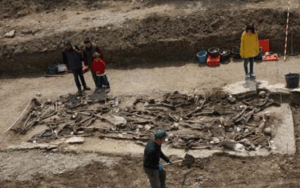
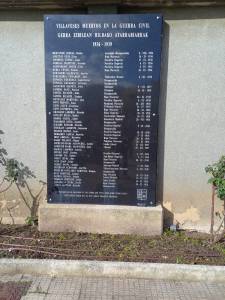
In 2012, forensic archaeologists investigated inside the Ripa cemetery walls and recovered one set of remains. Because DNA extraction failed to yield a match, those remains were reburied in the dedicated memorial pantheon at the Cemetery of Pamplona. In September 2023, the Navarre Institute of Memory and the Aranzadi Science Society returned to Ripa and exhumed the remains of two additional individuals. However, the main communal trench holding the 16 Villava workers, believed by local residents and families to lie in the fields just outside the cemetery perimeter, has still not been definitively located. Because northern Navarre has wet, acidic soil and the remains had been buried for 76 years, the genetic material in the bones and teeth was too degraded to extract a usable DNA profile, making identification impossible. On 26 November 2024, Villava inaugurated the Muro de la Vida (Wall of Life) memorial in honour of the town’s Civil War victims.
Mariano Sáez Morilla, killed 10 February 1937, was as a Pamplona city councillor and director of the Escuela Normal in Pamplona before his arrest in July 1936. Francoist authorities told his widow he was buried in Ripa, but his body may actually have been left between Ibero and Etxauri west of Pamplona, which explains why DNA from the 2023 Ripa excavation did not match him. So whether Ripa holds more than 16 victims remains uncertain.
- Seville, Andalucía
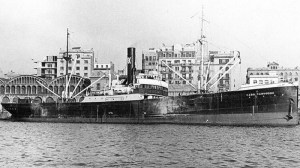
Immediately after General Queipo de Llano’s forces seized Seville in July 1936, the city’s main prison, La Ranilla, became hopelessly overcrowded. To handle the overflow, rebel authorities requisitioned the Cabo Carvoeiro, a merchant steamship owned by the Seville shipping company Ybarra (linked to prominent local families such as Ybarra, Pickman, and Osborne), and moored it along the Guadalquivir River at the Muelle de la Sal / Muelle de Las Delicias and Tablada. Between 28 July and 8 December 1936, up to 500 prisoners a day were packed into its unventilated steel cargo holds without trials or formal charges, serving as a direct death row staging area for night sacas.
Because the ship’s internal prisoners and transfer ledgers were never preserved only partial reconstructions from survivor testimonies and scattered municipal death records. One the night of 26 November 1936, among the names was Alberto Barrera Macías, a 34-year-old day labourer from Cantillana, a town roughly 30km northeast of Seville, which had been violently occupied by Nationalist troops on 30 July 1936 (his brother Manuel Barrera Macías had already been executed by firing squad in nearby Brenes three months earlier). Barrera, knowing he was being led to his death, broke away on the ship’s gangway and jumped overboard into the Guadalquivir River in a desperate bid to swim to freedom. He drowned in the river during the escape attempt and 17 days later, on 13 December 1936, his body washed up downstream near Tablada (on the southern edge of Seville’s port). Like thousands of other execution victims in Seville, his body was taken to the Cementerio de San Fernando in Seville and buried in its massive communal graves, the Fosa Monumento / Fosa de Pico Reja complex), while official records logged his death under the Bando de Guerra with the date of his removal from the ship on 26 November 1936. Because the Cabo Carvoeiro shut down as a prison ship less than two weeks later, on 8 December 1936, Barrera was among the final wave of prisoners held aboard the vessel.
- Córdoba, Andalucia
On 26 November 1936 the relentless pursuit of destroying northern Córdoba’s working-class heart continued as the processing machine of Córdoba city was still busy. The night before, nine men and three women were signed out for ‘transfer’ from Córdoba Provincial Prison to be executed at Cementerio de San Rafael. They were signed out as unknowns to be thrown in the anonymous mass pits, but through oral histories from hometowns, at least their names are not known –
Alejandro Carmona Cabello, 30, from Herrera (Seville), Andrés Domínguez Alameda, 30, from Cabra, Francisca Arroyo Varo, 38, from Cabra, Antonio Alguacil Pulgarín, details unknown, Cristóbal Ramírez Rodríguez, 26, Diego López Gutiérrez, 21, Félix Nadales García, 55, Francisco Prieto Tena, 43, Juan Camacho Baena, details unknown, Juan de Dios Millán Ponte, 32, María Aroca Muñoz, details unknown, María Vega Remujo, details unknown.
On the evening of 27 November, another 17 victims were signed out, and logged as executed and buried in the early hours of 28 November –
Antonio Jurado Molina, Antonio Marmolejo Monje, Antonio Muñoz Cobos, Antonio Ojeda Moreno, Cayetano Murillo Sánchez, a day labourer, Esmeraldo Fernández Galván, 21, from Aldea de Doña Rama, Evaristo Granados Rodríguez, Francisco Almenara Gallardo, 32, Francisco Luján Rodríguez, Gerardo Gómez Blanco, 22, from Aldea de Doña Rama, Gregorio Guisado Carmona, Juan Manuel González Sánchez, 45, from Aldea de Doña Rama, Juan Otero Méndez, 24, Manuel Luján Benavente, Pedro Vizcuete Martínez, Rafael Monterroso Moreno, 63, a farmer from La Granjuela, and Tiburcio Cabrera Moreno, 25, from Pueblonuevo.
None of these victims have been recovered. Rhe large-scale exhumations at the Cementerio de San Rafael in Córdoba, the Asociación Dejadnos Llorar and forensic teams have been taking DNA samples and oral testimonies directly from descendants who came forward looking for relatives from the sacas, and these victims are among the 2,252 victims whose names were recovered only on paper by municipal researchers who cross-referenced the Provincial Prison release logs with the cemetery burial books.
Archaeological surveys by the Aranzadi Science Society in 2022 and excavations by Themis Arqueología in Zone 6 in 2023–2024 confirmed the location of the massive trenches and exhumed 49 sets of remains in total across the initial intervention phases. While teams focused primarily on Córdoba’s other major cemetery of Nuestra Señora de la Salud, where 189 victims were exhumed, the institutional funding agreement expired at the end of 2025. As of November 2026, the trenches at San Rafael remain covered over, with the Córdoba City Council stating that full-scale excavation of the estimated 860+ victims still buried there will not resume until early 2027.
Historians and historical memory associations estimate that between 4,000 and 5,000 victims were executed and buried in the mass graves of Córdoba’s two municipal cemeteries. Of those 2,252 named victims, 1,452 were from Córdoba capital and towns across Córdoba province, 342 were from other provinces in Andalucía, 145 were from elsewhere in Spain, and 313 had no hometown recorded. According to the Junta de Andalucía’s cemetery study, 575 of those documented victims were taken out directly from the Prisión Provincial de Córdoba between July and December 1936 alone, including 98 in November 1936.
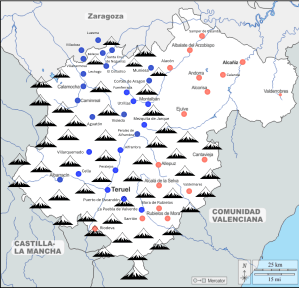
- Montalbán, Teruel, Aragon
Situated in the Cuencas Mineras coal-mining district of Teruel province, Montalbán sat directly on the contested Aragon Front, changing hands during the early months of the war before being occupied by Nationalist forces (and later fought over heavily during the Battle of Teruel in winter 1937–1938). Because it was an active front-line garrison town, civil authority was subordinated to the local Comandancia Militar (Military Command). Between July 1936 and January 1937, property confiscations in Nationalist-held zones were carried out directly by local military commanders under Decree No. 108 (13 September 1936). After the Decree-Law of 10 January 1937 created formal Comisiones Provinciales de Incautación de Bienes, front-line Comandancias Militares like Montalbán continued issuing circulars and executing seizures on the ground on behalf of the provincial commission and military courts.
When the Military Command at Montalbán published a circular in the Boletín Oficial de la Provincia de Teruel (BOPT) on 26 November, it legally notified individuals declared disaffected (desafectos al Movimiento Nacional), many of whom had fled to Republican territory, been imprisoned, or already been executed, that a confiscation file had been opened against them, giving them a brief window (typically 8 to 15 days) to appear before the Military Command to present a defence. It authorized local guards and municipal authorities to freeze and inventory all real estate, movable property, crops, tools, and livestock belonging to the targeted residents. In agricultural and mining towns like Montalbán, this meant seizing family homes, farmland, harvested grain, mules, and personal savings.
The circular served as a binding order to banks, local merchants, tenants, and neighbours, requiring anyone holding money, debts, grain, or livestock belonging to the accused, to declare and surrender it to the Military Command under threat of prosecution for aiding the rebellion. Publication in the Boletín Oficial de la Provincia acted as an official blacklist, publicly branding the named individuals and their families as enemies of the state. Even when the targeted ‘head of household’ was already dead or in exile, the circular stripped widows, elderly parents, and children of their home and means of subsistence, turning administrative paperwork into a tool of long-term economic punishment (again, women, children, and the elderly all already had jobs, but this took away everything they had built up with their husbands and fathers).

