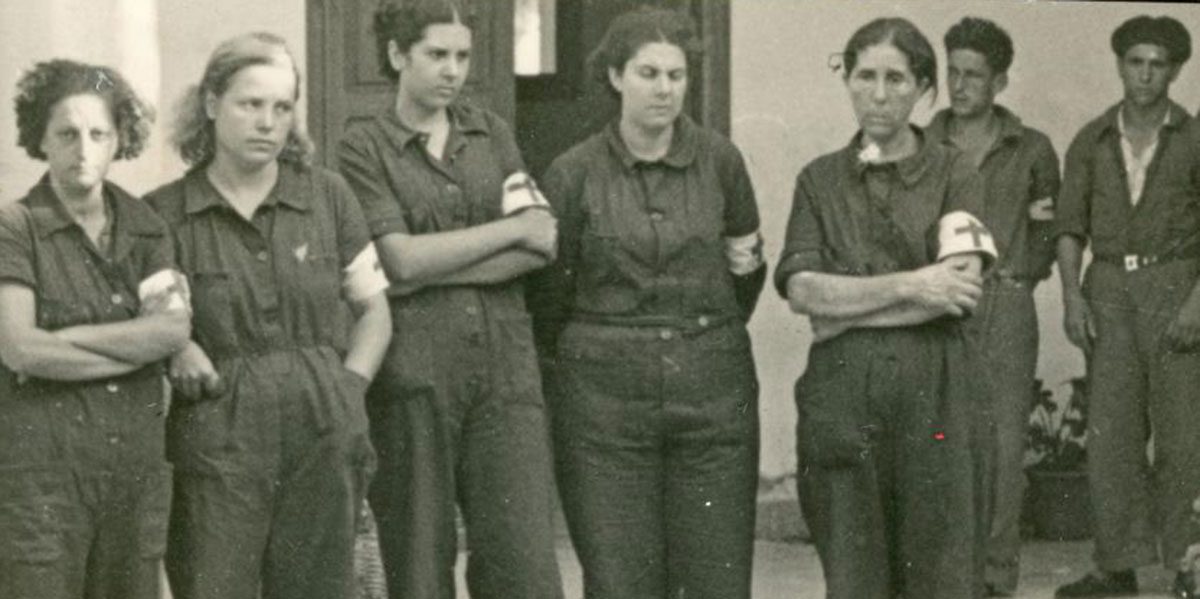
On 16 August 1936, five young women left Barcelona with the Republican expedition bound for Mallorca. Members of the Partit Socialista Unificat de Catalunya (PSUC) and attached to the Republican Red Cross, they volunteered to accompany Captain Alberto Bayo’s ambitious attempt to recapture the island from Nationalist control. They expected to care for the wounded, assist the expedition and, if necessary, share the dangers faced by the militia columns advancing inland, and none of them returned.
When the Republican evacuation collapsed in early September, the five women were left behind on Mallorca. Captured by Nationalist forces, they were imprisoned, subjected to humiliation and, according to the conclusions of most modern historians, probably suffered sexual violence before being executed at Son Coletes Cemetery, near Manacor, on 5 September 1936. Their deaths became one of the most notorious episodes of repression associated with the Mallorca campaign.
For decades, however, they remained almost anonymous. Histories of the Civil War referred simply to las cinco milicianas (the five militiawomen) while attention focused instead on the military failure of the expedition or the growing influence of Italian fascist intervention on the island. Their own lives, motivations and identities were largely forgotten. Only in recent years have historians, archivists and researchers begun to reconstruct who these women were. Through painstaking work in archives, military records, family documents and contemporary newspapers, four have now been identified them as Teresa Bellera Cemeli, Daria Buxadé Adroher, Mercedes Buxadé Adroher, and María García Sanchís. A fifth woman, long known only through the diary she kept during the expedition, is now believed to have been Josefina García Prats. Their a story of political conviction, voluntary service, comradeship and courage during one of the Republic’s earliest offensive operations. It is also a story of historical disappearance and recovery. For nearly eighty years these women survived in public memory only as anonymous victims.
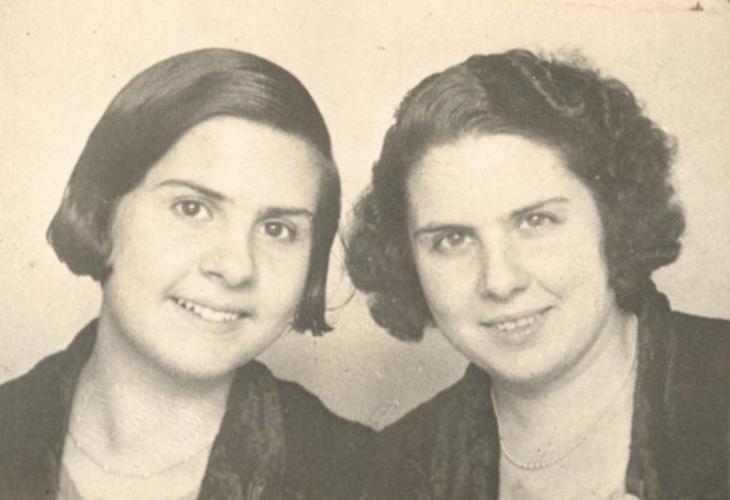
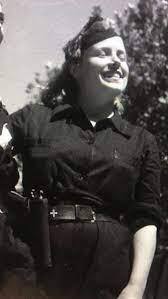
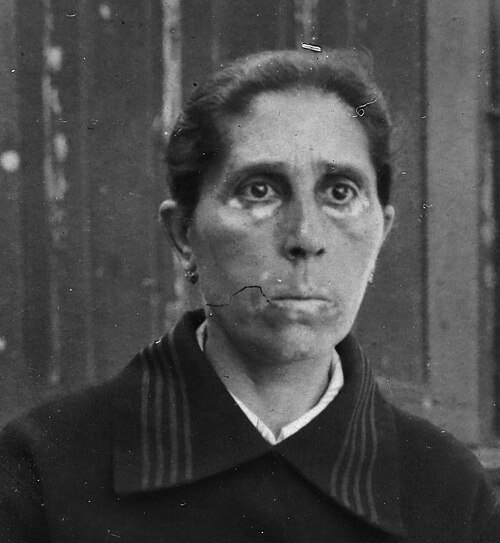
The five women who joined the Mallorca expedition came from the revolutionary atmosphere that transformed Barcelona after the defeat of the military uprising in July 1936. In the days following the collapse of the coup in the city, political parties, trade unions and militia organisations mobilised thousands of volunteers to defend the Republic and carry the fight into territories that had fallen under Nationalist control. Among them were women who refused to confine themselves to traditional support roles and instead volunteered to accompany armed expeditions as militia members, nurses and political activists.
All five women belonged to the Partit Socialista Unificat de Catalunya (PSUC), the communist party created only weeks earlier, on 23 July 1936, through the unification of several socialist and communist organisations in Catalonia. Their membership placed them within one of the Republic’s newest political movements, whose leaders argued that defeating the military rebellion required disciplined organisation, military coordination and unwavering anti-fascist unity.
The women were attached to the Republican Red Cross, but travelled with the expedition in militia uniform, received political instruction alongside other volunteers and expected to work close to the fighting. Their responsibilities included treating casualties, assisting with evacuations and supporting the Republican advance wherever required. Like many milicianas during the first months of the war, they crossed the increasingly blurred boundary between medical service and military participation. The surviving diary repeatedly describes the women as participants in the campaign against fascism rather than detached medical personnel. Writing shortly before the expedition sailed, the anonymous diarist explained that they were leaving Barcelona to take part in the operations against the fascists.
The departure of the expedition generated enormous enthusiasm throughout Barcelona. Newspapers celebrated the coming liberation of Mallorca, while crowds gathered along the waterfront to watch ships carrying volunteers towards the Balearic Islands. Few doubted that the operation would succeed. Like many of the militia columns leaving for Aragón or the Sierra de Guadarrama during the same period, the volunteers believed they were participating in a campaign that would help crush the military rebellion before it could become a prolonged civil war.
On the morning of 16 August 1936, the five PSUC militiawomen departed Barcelona aboard the Ciudad de Tarragona, one of the vessels carrying troops, supplies and medical personnel for Captain Alberto Bayo’s expedition to Mallorca. The operation represented the Republic’s largest amphibious offensive of the opening months of the Civil War, and among the volunteers there was widespread confidence that the island could be liberated within a matter of days. The anonymous diarist recorded the mixture of excitement and determination that accompanied the voyage. The women spent the crossing preparing medical equipment, organising their quarters and discussing the campaign ahead. Like many of the volunteers around them, they believed they were taking part in an offensive that would strike an important blow against the military rebellion. Although attached to the Republican Red Cross, they regarded themselves as active participants in the expedition rather than merely observers.
The convoy reached the eastern coast of Mallorca as Republican troops established beachheads around Porto Cristo. While the first assault waves had already landed, the arrival of reinforcements, including the five militiawomen, strengthened the Republican position during the crucial early stages of the operation. None of the women had previous experience of amphibious warfare, yet within hours of reaching the island they found themselves working close behind an active front line, where the optimism that had filled the voyage from Barcelona would soon give way to the realities of war.
For the five PSUC militiawomen, the Mallorca campaign quickly became a test of endurance rather than the swift victory they had expected when they left Barcelona. The women lived within range of Nationalist artillery, while aircraft periodically appeared overhead to bomb Republican positions. Nights were often interrupted by gunfire or the arrival of fresh casualties, leaving little opportunity for uninterrupted sleep. Yet the entries rarely dwell on fear. Instead, they describe an overwhelming determination to continue working despite exhaustion and the constant uncertainty surrounding the campaign.
One of the diary’s most striking features is its humanity. The author recorded conversations with wounded soldiers, moments of humour between comrades and expressions of concern for families left behind in Catalonia. She wrote of washing clothes, preparing meals when circumstances allowed and trying to create some sense of normality amid the confusion of war. These ordinary moments stand alongside descriptions of bloodied uniforms, overcrowded dressing stations and the steady arrival of men injured in the fighting. As the days passed, the tone gradually changed. The optimism that had characterised the voyage from Barcelona gave way to frustration as casualties mounted and the hoped-for breakthrough failed to materialise. Without dramatic comment, the diary quietly documents a growing awareness that the expedition was becoming a prolonged struggle rather than the rapid liberation of Mallorca that so many had anticipated.
By the beginning of September 1936, the Republican position on Mallorca had become increasingly precarious. Weeks of fighting had failed to achieve the hoped-for breakthrough, while Nationalist resistance stiffened with the arrival of additional reinforcements and growing Italian assistance. Air attacks became more frequent, artillery fire intensified, and Captain Alberto Bayo concluded that the expedition could no longer be sustained.
During the night of 3–4 September, Bayo ordered a general evacuation of the Republican bridgehead. The withdrawal had to be carried out under pressure and within a limited number of hours before daylight exposed the beaches and evacuation vessels to attack. Men, weapons, vehicles, ammunition, medical equipment and wounded personnel all had to be moved to the waiting ships as quickly as possible. The expedition had never possessed a unified command structure, and communications between different sectors of the beachhead were often unreliable. Darkness, the movement of large numbers of exhausted troops and the urgency of the evacuation made coordination increasingly difficult. Some units received orders late, others misunderstood where they were to assemble, and transport along the narrow coastal routes became heavily congested.
Exactly how the five militiawomen became separated from the main evacuation remains uncertain. Historians have proposed several explanations, including failures in communication, transport delays and the general disorder accompanying the withdrawal. No surviving contemporary document records a deliberate decision to leave them behind, and there is no convincing evidence that they were intentionally abandoned. Rather, the available evidence suggests that they became isolated during one of the most chaotic moments of the entire expedition.
When daylight broke on 4 September, approximately twenty Republican personnel, including the five PSUC militiawomen, remained on Mallorca. Cut off from the departing fleet and surrounded by rapidly advancing Nationalist forces, they had little prospect of escape. Within hours they were captured. They were taken prisoner and transported to Porto Cristo, where they were held at the Drac School. It is here that the last known photograph of the women alive was taken. The image, now one of the most recognisable photographs associated with the Mallorca campaign, shows them under guard shortly after their capture. Tired and dishevelled after weeks at the front, they remained together, a poignant reminder that they were no longer volunteers on a military expedition but prisoners awaiting an uncertain fate.
The women were interrogated and remained in custody until their execution on 5 September 1936. They were publicly displayed before their deaths, reflecting a practice that served both practical and propagandistic purposes by demonstrating the defeat of the Republican landing. Contemporary Nationalist publications portrayed them as dangerous ‘reds,’ using their capture to reinforce narratives about the supposed immorality and criminality of the Republican forces. The women were subjected to humiliation and sexual violence while in captivity. They endured serious abuse before their deaths in line with the punishment forced on female militia and civilians, of the public humiliation, beatings during interrogation, sexual assault, head shaving, and forced ingestion of castor oil.
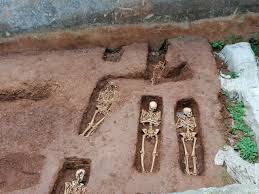
One day after their capture, the five PSUC militiawomen were taken from captivity to Son Coletes Cemetery, on the outskirts of Manacor. There, together with other Republican prisoners captured during the collapse of the Mallorca expedition, they were executed by firing squad. Numerous Republican prisoners, civilians and suspected political opponents were killed in the same location during the months that followed. The five militiawomen were buried anonymously alongside many of the expedition’s other victims, their graves unmarked and their identities gradually disappearing from public memory.
For decades, little was known about the circumstances of their burial. Following Spain’s return to democracy, historians and local researchers began identifying the victims of Son Coletes through archival research and witness testimony. Archaeological excavations undertaken as part of the Balearic Islands’ programme of democratic memory have since uncovered human remains believed to include victims of the Mallorca expedition. While the identification of individual remains continues through forensic and DNA analysis, the work has helped restore the women to the historical record after decades in which they were remembered only as anonymous milicianas.
Among the most remarkable legacies of the Mallorca expedition is the small handwritten diary kept by one of the five militiawomen. Few first-hand accounts written by Republican women serving so close to the front have survived from the opening months of the Civil War. After the capture of the Republican prisoners, the diary fell into Nationalist hands along with other personal belongings abandoned during the evacuation. Rather than destroying it, the Nationalists recognised its propaganda value. Extracts were published in the Falangist press, accompanied by editorial commentary intended to mock the Republican expedition and portray its participants as naïve revolutionaries whose ambitions had ended in defeat. The original handwritten manuscript has since disappeared and is believed to have been lost. Had the Nationalists not reproduced substantial portions of its contents for propagandistic purposes, the text would almost certainly have vanished with it. Ironically, an attempt to discredit the Republican expedition became the means by which one of its participants was able to speak to future generations.
- Irún, Gipuzkoa, Basque Country
Around 2,000–3,000 Republican defenders remained around Irún at the beginning of September, drawn from CNT, Socialist and Communist militias, Basque nationalists, Carabineros, Asturian miners and other volunteers under the Republican command headed by Lieutenant Antonio Ortega. Facing them, Colonel Alfonso Beorlegui had more than 2,000 Nationalist troops and was receiving reinforcements from Navarra. His force included regular infantry, Requetés and Falangists, together with a particularly important reinforcement of approximately 700 Legionaries. The Nationalists also had heavy artillery, including 155-mm guns, aircraft and a small number of armoured vehicles.
Irún sat beside the Bidasoa and the French frontier. As long as the Republicans held the town and its crossings, the Republican-held northern provinces retained a direct land connection with France. By 1 September, Beorlegui’s troops were already close to the town and the Republican defence depended heavily upon the heights of San Marcial, overlooking Irún and the frontier approaches. The Nationalists renewed their assault on 1–2 September, bringing artillery, machine guns and aircraft against the Republican positions. On the 2nd, Mola ordered a general bombardment while the defenders replied with artillery and fire from an armoured train. Fighting also developed around Mount Turiarte and towards Behobia. Contemporary reports described the 2 September attack as one of the heaviest yet seen on the Irún front, with infantry fighting at close quarters around Republican machine-gun positions.
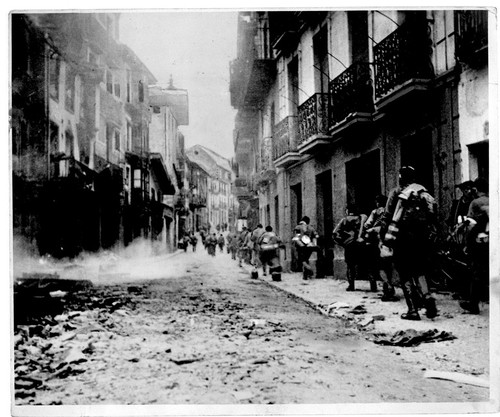
By the evening of 2 September, the Nationalists had captured San Marcial. The loss was serious because the heights dominated Irún, but the Republican defence did not collapse immediately. On 3 September, militiamen were digging in behind sandbags and turning houses into firing positions around Behobia, where fighting came to within about 400 yards of the international bridge. Republican artillery continued shelling the Nationalists on San Marcial, while Nationalist aircraft bombed Irún and nearby Hondarribia; one bomb struck an emergency hospital. Bullets and shells were also crossing the Bidasoa into France, where several people were wounded. The defenders were now running increasingly short of ammunition. Beorlegui, meanwhile, was being reinforced from Pamplona and elsewhere and could use his artillery and aircraft to support repeated infantry attacks. The Republican forces prepared to fight inside Irún itself, barricading streets and fortifying buildings rather than abandoning the town as soon as San Marcial was lost.
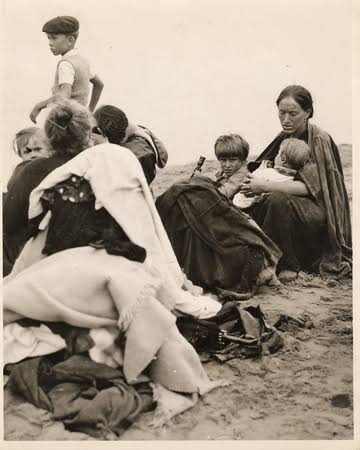
The decisive assault began before dawn on 4 September. Nationalist troops attacked from more than one direction, with Moroccan troops and Legionaries prominent in the assault. Contemporary reporting described storming parties entering the town while other troops worked around Behobia. One group of about 400 Moroccan soldiers supported by two armoured vehicles fought towards the Popular Front headquarters, while infantry cleared barricades and defended buildings at close range. The fighting continued from house to house as Republican units withdrew towards the Bidasoa crossings. The civilian flight that had been developing for days now became an exodus. Thousands of people left Irún and Hondarribia, crossing the bridges into Hendaye or using boats from the coast. By the final fighting, contemporary reports placed about 5,000 refugees in Hendaye alone. French soldiers guarded the frontier, and Republican combatants who crossed into France were disarmed.
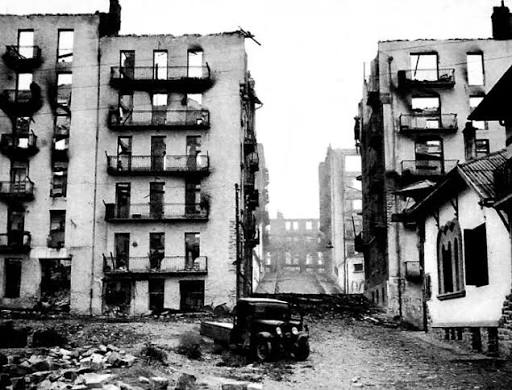
Parts of Irún were already damaged by artillery and aerial bombardment when fires spread through the town during the Republican withdrawal. Retreating militiamen deliberately burned or destroyed some buildings and supplies rather than leave them to the Nationalists; contemporary observers on the French side could see extensive fires across the town. The destruction resulted from both the preceding bombardment and deliberate burning during the evacuation, rather than from a single cause.
Nationalist troops completed the occupation on 5 September, though fighting continued around remaining Republican positions and the approaches to the international bridge as the last defenders escaped towards France or withdrew west. Beorlegui was wounded in the leg during the final fighting; the wound later became infected and caused his death on 29 September. Irún’s capture closed the principal land route between Republican northern Spain and France. The Nationalists now controlled the frontier around Irún, while the surviving Republican and Basque forces withdrew towards San Sebastián. Hondarribia and Fort Guadalupe remained in Republican hands until the following day, when the fighting moved westwards towards the next line of defence.
- Logroño (La Rioja)
On 5 September 1936, the Nationalist Civil Governor of Logroño province, Emilio Bellod, ordered mayors and other local authorities to examine the books held in public and school libraries throughout La Rioja. Books, pamphlets, and other publications considered politically or ideologically unacceptable to the new Nationalist authorities were to be removed. The order began a province-wide purge that continued through September and into October. Teachers and municipal authorities were required to inspect collections and identify works that could no longer remain available. Material associated with the political left, trade unionism, Republican ideas, secular education, or other ideas regarded as hostile to the Nationalist cause was removed. Instructions issued as the purge developed went beyond simply withdrawing books from circulation; prohibited material could be physically destroyed.
Teachers were investigated according to their political activities, affiliations, and conduct during the Republic. Those considered politically unreliable could be suspended or removed from their posts. One local example came on 16 September, when Consolación Martínez Sánchez, a teacher with a post at Cervera del Río Alhama, was formally removed from teaching service. She had been detained after the Nationalist capture of San Sebastián and was later returned to La Rioja as a prisoner. By 25 September, new regulations were also changing what children were expected to learn. Provincial newspapers carried Nationalist educational instructions increasing the place of Catholic religious teaching, including weekly religious conferences for pupils, while teaching staff continued to be examined through political reports. These changes reversed the secular direction of education under the Second Republic and brought schools into line with the Catholic and Nationalist values being imposed in territory controlled by the military uprising. Within a few weeks, the changes had reached both the people teaching in La Rioja’s schools and the material available to their pupils: teachers could lose their positions because of their politics, books were being removed or destroyed, and Catholic religious instruction was being restored to the classroom.
- Lugo, Galicia
Though Lugo province saw no sustained military front after the Nationalists secured control in July 1936, the absence of conventional fighting did not mean an absence of violence. María Jesús Souto Blanco’s detailed study of the province identified 625 people killed by Nationalist repression between 1936 and 1940. The repression was systematic rather than confined to the first days of the uprising, and it fell particularly heavily on workers in Lugo and Monforte, railway employees, and agricultural labourers in the south and south-east of the province, where agrarian organisations had developed considerable strength during the Republic. Republican parties, the PSOE, anarchist organisations, unions, and local agrarian societies were dismantled through executions, imprisonment, dismissals, fines, and confiscation of property.
Lugo’s prisons and military courts formed another part of this system. The Provincial Prison in Lugo city, designed for only about 140 prisoners, became one of the principal centres for political detention in the province. Men and women arrested in surrounding municipalities were brought into the prison system, while military courts dealt with hundreds of cases arising from alleged opposition to the uprising. Surviving research has identified 378 military cases from Lugo for the period 1936–39 alone. By 1937, almost 1,000 prisoners would pass into a prison built for a fraction of that number, demonstrating how rapidly political imprisonment expanded after the Nationalist takeover.
September’s killings also formed only the lethal edge of a considerably larger repression. People who were not executed could lose employment, be imprisoned, investigated, fined, have property seized, or be removed from public positions. In the Ribadeo military district, for example, hundreds of political fines were being imposed during August and September on people classified by the new authorities as left-wing or hostile to the rebellion. Such measures were particularly significant in a largely rural province because punishment imposed upon one agricultural worker or household could affect the income and property on which an entire family depended.
The roughly 625 documented deaths in Lugo between 1936 and 1940 are especially significant because the province never became a battlefield comparable with neighbouring Asturias. By September, Nationalist military control was already established across Lugo. The agricultural labourers, sailors, employees, Republican politicians, union members, and other civilians still being killed were victims of a continuing effort to eliminate the political and labour organisations that had operated openly in the province before July and to consolidate the new Nationalist order.
- Badajoz, Extremadura
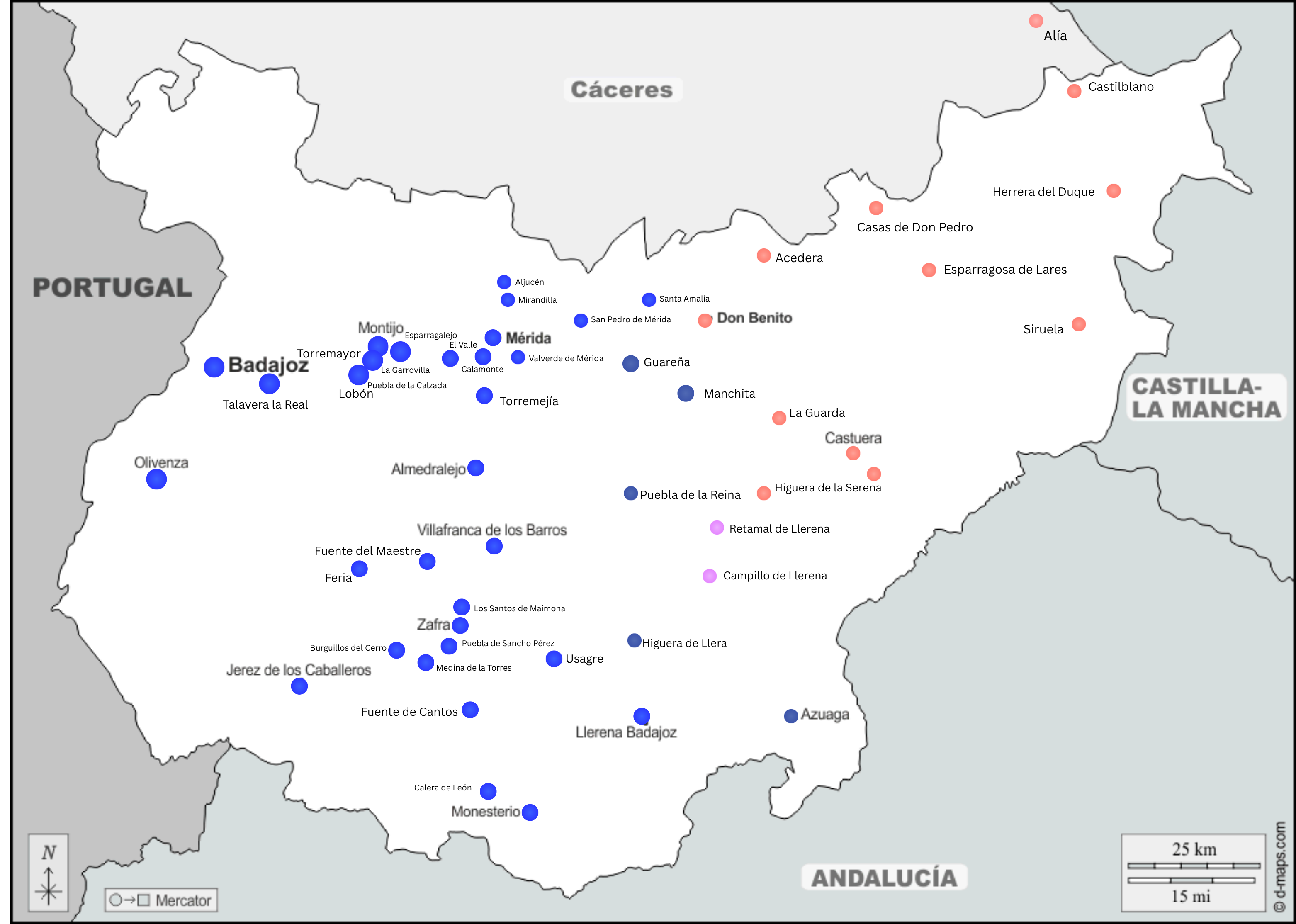
After the rapid Nationalist advance through Mérida and Badajoz during August, the military situation in Badajoz province temporarily settled during the first days of September. The Nationalists held the western and central parts of the province, including Badajoz and Mérida, while Republican forces still controlled a large area farther east and south-east. The principal Republican-held centres included Don Benito, Villanueva de la Serena, Castuera, and Azuaga. These towns formed the core of the remaining Republican territory in Badajoz and provided bases from which Republican forces could continue resisting the Nationalist advance.
The Nationalist command was now preparing for the next stage of the campaign of eliminating the remaining Republican-held areas and securing the province before continuing the advance towards Madrid. The opening days of September therefore brought a temporary pause in the rapid movement of the front, but not an end to the fighting or preparations for further operations.
During the first days of September, thousands of refugees gathered in the remaining Republican-held pocket around Fregenal de la Sierra and Jerez de los Caballeros. They included civilians and Republican supporters who had fled towns already captured by Nationalist forces in western and southern Badajoz and neighbouring Huelva. The continuing Nationalist advance had pushed people progressively eastwards and southwards, while the shrinking Republican territory left fewer places in which displaced civilians could seek safety. Towns that had suddenly received large numbers of refugees were faced with shortages of accommodation, food, and transport. The concentration of refugees also reflected the continuing military uncertainty. The Republican-held pocket was increasingly surrounded by Nationalist territory, and many of those who had fled the earlier fighting had little reason to believe that the area would remain secure for long.
The front around Medellín and Santa Amalia settled into more fixed positions during the first days of September. Republican forces held Medellín, an important position on the Guadiana, while Nationalist forces occupied Santa Amalia and the surrounding territory to the west.
The two positions faced one another across the developing front between Republican-held La Serena and the Nationalist zone of western Badajoz. The Republican retention of Medellín prevented the Nationalist advance from immediately sweeping across the whole of eastern Badajoz, while the Nationalist position around Santa Amalia provided a base from which further attacks could be mounted. Though the rapid advances of August had temporarily slowed, both sides continued strengthening their positions and preparing for renewed operations. The Medellín–Santa Amalia sector consequently became one of the fixed fronts separating the two zones.
During the opening days of September, Republican and Nationalist forces also consolidated their positions around the Don Benito–Guareña sector. Don Benito remained in Republican hands and formed one of the principal centres of Republican resistance in eastern Badajoz, while Nationalist forces held territory farther west around Guareña.
The developing front separated the Republican-held towns of La Serena from the Nationalist territory that had been captured during the August advance. Republican forces continued to hold Don Benito and the surrounding countryside, while the Nationalists prepared to resume their advance once their forces had been reorganised and supplied. The line would remain an important military boundary after the rapid Nationalist conquest of western Badajoz had come to an end.
On 5 September 1936, Nationalist forces in Miajadas, Cáceres arrested a group of Republican supporters and executed them. The group consisted of eight men and one woman, Valentina Velarde, whose husband, José Rubio Correa, had also been sought by the authorities but managed to escape. Valentina was killed alongside her son Agustín Rubio Velarde.
The identified victims included Lázaro Galeano Sierra, his sixteen-year-old son Pedro Galeano Hernando, Antonio ‘el Segador,’ Agustín Rubio Velarde, Valentina Velarde, José Naranjo Carmona, Julio Jiménez Vázquez, Francisco Carmona Eugenio, and Leandro Nieto Liste. The available victim documentation independently records several of the men as having been executed at Miajadas on 5 September, including Leandro Nieto Liste, a UGT member and former councillor of nearby Escurial.
The killings took place after Miajadas had come under Nationalist control. The town was already being used as a place where prisoners from the surrounding area were brought and executed, and the events of 5 September formed part of the wider repression extending through eastern Cáceres as Nationalist forces consolidated their control.
- Aracena, Huelva, Andalucía
On 1 September 1936, executions continued in Aracena following the Nationalist occupation of the town in August. Prisoners detained after the capture of the Sierra town were taken from local places of detention and killed at the cemetery and other execution sites. The killings formed part of the repression that accompanied the Nationalist advance through the Sierra de Aracena. The occupation had brought arrests of people associated with the Republic, the left, and local organisations, and executions continued after the fighting had moved away from the town.
The principal historical reconstruction estimates that more than 1,000 people were killed during the roughly two-week period extending from the final days of August through the first week of September. Executions took place in towns and villages across the province as prisoners were removed from jails and temporary detention centres and taken to cemeteries, roadsides, and other execution sites. The scale of the killings was particularly severe because Nationalist forces were not even fighting for control of individual towns. Most of Huelva province was already under their authority, allowing the repression to spread systematically through the newly occupied territory. By the beginning of September, a Portuguese diplomatic report estimated that approximately 2,500 people had been killed in Huelva province during the repression.
But during the first days of September, opposition developed in Huelva city to the activities of the Falangist Escuadra Negra, a squad involved in the detention and killing of prisoners. Residents had become increasingly disturbed by the conspicuous movement of prisoners through the city towards execution sites. The regularity of these operations, together with the apparent impunity enjoyed by the men carrying them out, generated protests and opposition among sections of the local population.

