22 September 1936 is a classic example of how the Spanish Civil War was not really a war in most locations, instead a failed coup of violent repressions.
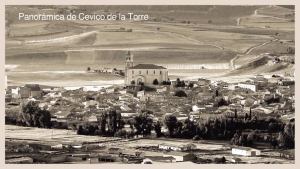
Cevico de la Torre, Palencia, Old Castile
Catalina Muñoz Arranz, a small woman about thirty-seven years old and the mother of four children, lived in the village of Cevico de la Torre, 27km south of Palencia city, and got caught up in the Nationalist repression in the region. She had been detained on 24 August 1936 and remained a prisoner as the Nationalist military authorities prepared a case against her. The town had only 500 households, and around 1,500 people, and she was collected because of a personal vendetta held against her husband, who reportedly had a grudge against the Guardia Civil.
On 5 September, Catalina gave and signed a formal statement, where she acknowledged having taken part in a left-wing fiesta back in May 1936, and had been accused of washing blood off her husband’s clothes, after he had been in an altercation. Her husband was later arrested and sentenced to jail, leaving Catalina an easy target for fascists. Her case passed into the Nationalist military justice system, where civilians accused of opposing the July uprising could be prosecuted for military rebellion and related offences. There had initially been a request that Catalina receive a prison sentence rather than be put to death, but the military proceedings resulted in a death sentence for rebellion. She remained imprisoned in Palencia while the sentence awaited execution.
At approximately 5.30am on 22 September, Catalina was taken out and shot by the Nationalist authorities by firing squad, her skull completely shattered, and she was doused in quicklime in put in a burial pit. Her body was buried in the Cementerio del Carmen in Palencia. Catalina’s case was unusual among the women killed in Palencia, as she is the only woman currently known in the province to have been formally tried by a Nationalist military court, condemned to death, and judicially executed. Other women killed during the repression in Palencia, more than 100, including the eleven women buried at Fuentincho, were murdered rather than sentenced to death.
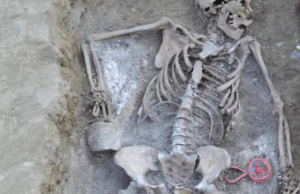
In 2011, graves of dozens of people murdered by the Nationalists was being excavated near the old Palencia cemetery, and a public, park, La Carcavilla, had been built over the bodies. Under a set of swings, volunteers found a flower-shaped toy, in bright pink, yellow and green colours. Catalina Muñoz Arranz had facing the firing squad with her infant son’s baby rattle in her apron pocket. She had been arrested in her backyard with her baby in her arms when the fascists came for her. Eighty-three years later, Catalina’s baby, Martín, was given back the rattle.
The remains of Catalina Muñoz and the baby rattle found in Palencia, via Sociedad de Ciencias Aranzadi
Meanwhile, 25km north of Palencia city, near the town of Santoyo, in an area named Fuente de la Fragua, in Tierra de los Muertos (Land of the Dead), 25 residents of Torquemada were executed by firing squad near Santoyo. According to investigations, the victims included the Socialist mayor of Torquemada, several councillors, day labourers, and even a boy who delivered the Popular Front newspaper La Libertad, who died alongside his father.
Albacete and Villarrobledo, Albacete, Murcia (now Castilla-La Mancha)
During the opening months of the Spanish Civil War, the Republican rearguard was defined by intense political instability. Following the defeat of the short-lived July Nationalist mutiny in the region, local revolutionary committees and armed militia factions established a parallel system of security. By September 1936, as Francoist columns advanced elsewhere across the country, this atmosphere of paranoia culminated in sacas, in this region, the systematic removal and execution of political, military, and right-wing prisoners from institutional custody.
On 22 September 1936, Albacete city witnessed its most lethal single-day event of rearguard violence. An angry, armed mob of leftist militiamen forcibly descended upon the city’s primary detention facilities. The armed group successfully breached the security vectors of the Provincial Prison and the Hospital de San Julián, demanding the immediate turnover of specific high-value detainees.A total of 53 prisoners were forcibly dragged from their cells and summarily executed. A significant portion of these individuals were right-wing sympathisers, civilian professionals, and rebel military personnel who had actively participated in the failed July uprising. Many had already faced formal trials and were serving sentences under the state judicial apparatus, but the militia execution squads bypassed the legal bureaucracy to inflict immediate rearguard vengeance.
.
The systemic violence quickly rippled outward from the provincial capital into the surrounding agrarian municipalities. In the large town of Villarrobledo, 80km north-west of Albacete city, the local prison network underwent a massive and clinical political cleansing that mirrored the methodology used in the capital. Armed militia units targeted the improvised detention facility established inside the Villarrobledo Town Hall (Ayuntamiento). In one of the single most numerous sacas recorded across the entirety of Albacete province, 42 prisoners were systematically removed from custody. The victims, which historical datasets confirm included local landowners, agrarian merchants, lawyers, and Catholic figures, were driven straight to the exterior walls of the municipal cemetery. They were summarily shot by the firing squads and thrown into a massive, elongated communal trench known locally as la zanja (the ditch).
.
While post-war Francoist military tribunals explicitly calculated the death toll of this specific execution group at 42, independent municipal research by local historians registers more than 30 residents killed in the immediate event, noting that four individuals miraculously survived the gunfire and fled in the darkness. In both mass events, the bodies were moved into proper burial sites after the war, and are not in Villarrobledo mass grave pits, one of which contains approximately 240 unidentified Republican victims.
.
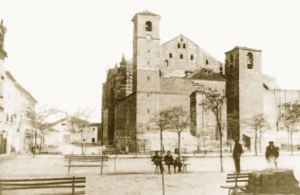
Plaza Ramón y Cajal in Villarrobledo, via unknown
Related
Got a comment, question or suggestion? Know who took a photo? Have questions about a particular date or event? Cancel reply