The British Rio Tinto Company (RTC) did not merely stand by out of fear when the Spanish Civil War broke out; they weaponised the fascist uprising to execute a thorough cleansing of their workforce. Despite possessing immense diplomatic, financial, and corporate power, they actively chose to channel those assets into facilitating a massacre to secure their bottom line.
.
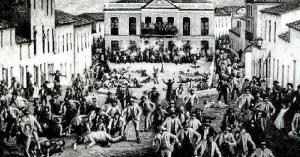
For decades leading up to 1936, the Riotinto-Nerva mining basin served as the cradle of radical Spanish trade unionism. For nearly fifty years, the miners and their families engaged in a fierce, generational struggle against the corporation. The RTC management had fought bitter, bloody strikes against anarchist and socialist miners long before 1936. Most notably, during the infamous ‘Year of the Shots’ (Año de los Tiros), miners, local farmers, and agricultural workers united on 4 February 1888 to march on the municipality Workers’ Liberty. Historians consider this the first recorded environmentalist protest in history, as the crowd demanded an end to the toxic open-air calcination pollution (teleras).
.
The 1888 El año de los tiros, via La Izquierda Diario
The Spanish military, acting directly to protect British corporate assets, opened fire with rifles and bayonets into the dense crowd of men, women, and children gathered in the Rio Tinto square Workers’ Liberty. While the state and the company systematically covered up the true casualties, historians estimate that between 100 and 200 people were slaughtered, their bodies covertly dumped into common graves or abandoned mine shafts Workers’ Liberty.
.
Miners had repeatedly brought production to a standstill ever since the company purchased the site from the Spanish government in 1873 Global – Rio Tinto. The golden age of Riotinto’s workforce occurred at the turn of the 20th century, driven by the massive expansion of the famous Corta Atalaya open-cast pit in 1908. This regional boom attracted vast waves of migration, causing towns like Nerva to swell rapidly.
.
However, major general strikes completely paralysed the basin in 1913 and 1920. During the massive 1920 general strike, workers walked out for nine months. To survive the severe starvation tactics deployed by the company, families organised community soup kitchens and even sent roughly 3,000 of their own children to be hosted by sympathetic working-class families across Spain. Throughout this dispute, the RTC refused to negotiate, actively weaponising hunger by cutting off credit at the company stores and evicting striking families from corporate housing. The company finally broke the strike through sheer physical attrition in January 1921. In the aftermath of this defeat,as with every previous conflict, the RTC management systematically fired union organisers and blacklisted them across the province, forcing thousands of families into permanent destitution.
.
The miners had repeatedly brought production to a standstill since the mine had opened in 1873. The golden age of Riotinto’s workforce occurred at the turn of the 20th century, driven by the massive expansion of the famous Corta Atalaya open-cast pit in 1908, and the regional boom attracted vast waves of migration, causing towns like Nerva to swell rapidly. But major general strikes paralysed the basin in 1913 and 1920. During the massive 1920 strike, workers walked out for months, and to survive the starvation tactics used by the company, families organised community soup kitchens and even sent 3,000 of their own children to be hosted by sympathetic working-class families across Spain. During the nine-month strike of 1920, the RTC refused to negotiate, actively weaponising hunger. The company cut off credit at the company stores and evicted striking families from their homes, eventually breaking the strike through sheer physical attrition in January 1921. Following the strike, as with every strike, the RTC management systematically fired union organisers and blacklisted them across the province, forcing thousands of families into permanent destitution.
.
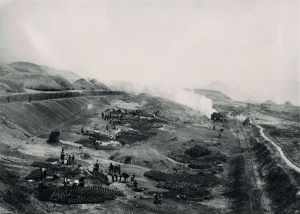
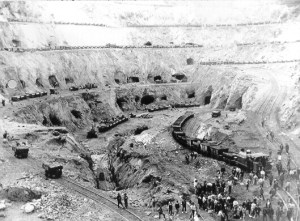
Open-air mineral extraction at Riotinto, via El Pais
.
The miners had made the RTC as rich as robber barons, and in turn, RTC management viewed the democratic Second Spanish Republic in 1931 and its left-leaning Popular Front governments as weak enablers of trade unions that threatened corporate profits. But the demands of the Riotinto miners evolved from basic survival needs in the 19th century into a highly organised political movement during the Second Spanish Republic (1931–1936).
.
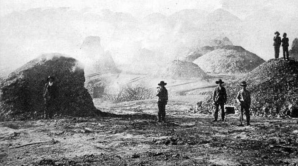
Early on, the company extracted copper by burning pyrite in massive, open-air calcinations (teleras). This released massive clouds of toxic sulphur dioxide that destroyed local crops, killed livestock, and caused chronic respiratory disease among workers and their children, and workers demanded they be abolished. Miners endured exhausting, highly dangerous shifts in the open-cast pits and underground shafts for minimal pay, and demanded regular pay increases to match inflation and a cap on working hours at eight hours per day. They fought for the right to unionise under the socialist UGT and anarchist CNT, seeking workplace committees that could challenge the absolute authority of the British engineers and managers.
.
The RTC controlled the local infrastructure, owning the workers’ housing, the stores, and the local police forces. The miners wanted an end to this colonial-style corporate dictatorship, with freedom to live and work as they chose. When the right-wing entered the Republic’s government in October 1934, sparking the Asturian Miners’ Strike, the Riotinto miners immediately launched solidarity strikes and localised sabotage to support their northern comrades, cementing their status as anti-fascists.
.
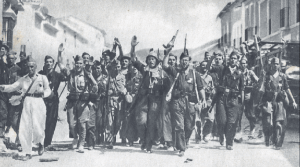
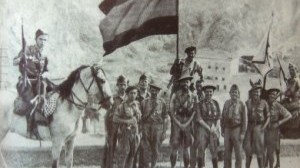
Murderers rolling into town like it’s normal to be a fascist, via Diario de Huelva
.
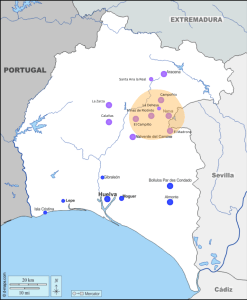
But then war broke out in July 1936 – the workers and the civilians of Spain versus the military, the fascists, the monarchists and the super rich. This was a disaster waiting to happen for the 10,000-11,000 active miners and workers employed directly by RTC. When including their immediate families, the total population living within the small, dense cluster of towns in the mining district (such as Nerva, Minas de Riotinto, El Campillo, and Zalamea la Real) exceeded 40,000-50,000 people. This dense concentration of workers is precisely why the area was such a powerful stronghold for the Spanish labour movement, but when the military coup occurred, it meant thousands of highly unionised, politically active men were concentrated in one single basin, making them an immediate, prime target for the sweeping ‘cleansing’ operations that the Nationalists and RTC management orchestrated.
.
The ultimate authority of the company at the time was Sir Auckland Geddes, who served as the Chairman of the Board of Directors from 1925 to 1947. Geddes was a high-profile British aristocrat, a former Member of Parliament, and a wartime cabinet minister.Geddes was the man who openly justified the company’s alignment with fascism. At the RTC annual general meeting in London, he famously reassured shareholders by stating that since Franco’s forces had occupied the mines, ‘there have been no further labour problems.’ He openly admitted and accepted the human cost by adding, ‘miners found guilty of troublemaking are court-martialled and shot.’
.
On the ground in Spain, the man directing the local company administration was Alexander Hall, the General Manager of the Rio Tinto mines. When the civil war erupted, Hall briefly evacuated to nearby British-controlled Gibraltar but returned to manage operations directly under the Nationalist occupation. It was Hall and his direct staff of British engineers and HR personnel who made the tactical decisions to open the company’s archives and surrender the payrolls, union logs, and roster files to Franco’s executioners, directly enabling the systemic purge of their employees.
.
Open-air calcinations (teleras), via Mi Ruta
.
The Nationalist fascist movement offered something the Republic never could: the absolute, violent erasure of the labour movement. By backing Franco’s war, the company could legally slash wages, abolish the right to strike, and work a captive labour force under strict military discipline. The directors of RTC were elite British capitalists who feared that a Republican victory would eventually lead to the total collectivisation or nationalisation of the mines by ‘Marxist’ or ‘anarchist’ workers. To corporate headquarters in London, the Nationalists represented the preservation of private property rights and capitalist hierarchy, and siding with them ensured that British assets and investments were protected from ‘revolutionary seizure.’ RTC was an apex economic power in Spain, they had the ear of the British Foreign Office, and held the keys to the minerals Franco desperately needed to build bombs. They did not lack power; they lacked conscience.
.
When Nationalist troops marched into the mining basin in late August 1936, British managers did nothing to stop the slaughter of their own workers. Instead, RTC management cooperated directly with the Guardia Civil and Falange. Legally and physically, the British managers were operating in a war zone controlled by a ruthless military dictatorship. The Nationalists possessed the firepower to seize the infrastructure and nationalise the mines instantly. Alexander Hall functioned as a diplomatic buffer and regularly met with military commanders and Guardia Civil officers to negotiate the security of the company’s British employees, to instead allow the Nationalist execution squads to systematically round up and shoot thousands of miners during the September consolidations. The most intimate interaction between British management and fascist authorities occurred within the company’s human resources and administrative offices. British engineers and administrative staff lived in the executive colony of Bella Vista remained free and in charge of the mines. Bella Vista was a luxurious, walled Victorian colony where the British managers lived, complete with tennis courts, manicured lawns, and English tea. Just a few miles outside the walls of this idyllic English enclave, the air was thick with the smell of gunfire, and the bodies of the miners who generated RTC’s wealth were being dumped into mass graves at the San Sebastián and La Soledad cemeteries. The British staff heard the shots, drank their tea, and counted the profits.
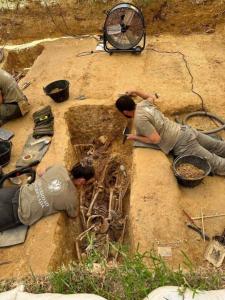
Work began on a new dig at Nuestra Señora de La Soledad in Huelva, in June 2026, to continue searching for missing civilians, via 1MinutoHuelva
On the economic front, British managers worked hand-in-hand with Nationalist authorities to pivot the entire output of the mines toward Franco’s war effort. Management coordinated closely with Nationalist logistics officers to ensure that vital shipments of pyrites and copper were diverted away from Republican ports and sent directly to Nationalist territory or to international buyers who funded Franco. Hall facilitated the financial arrangements dictated by the Nationalist high command, offering inflated artificial exchange rates dictated by Burgos (the Nationalist capital) for the Nationalist pesetas while ensuring hard sterling flowed where it was needed to sustain the rebellion. Pyrite and copper from Huelva were vital for the manufacture of explosives and munitions. RTC dutifully diverted its massive mineral exports away from the Republic and toward Nationalist territory, effectively fuelling the fascist military machine.
.
The British government’s policy of Non-Intervention did not just starve the Spanish Republic of weapons; it provided perfect political cover for British corporate capital to back the Nationalists. When the Non-Intervention Committee met for the first time in London on 9 September 1936, it established a legal fiction of absolute neutrality. For the directors of the Rio Tinto Company (RTC), this policy was a green light. Because Downing Street refused to formally condemn Franco or restrict British corporate operations in rebel territory, RTC could claim they were simply following the law of the local authorities in Huelva. In reality, the British Foreign Office was fully aware that RTC was financing Franco with hard currency and supplying his war machine with Huelva pyrite. However, because British elites feared a left-wing revolution more than a fascist dictatorship, the government intentionally looked the other way. Non-Intervention allowed London to protect its 40% stake in foreign investment in Spain while washings its hands of the human cost.
.
For the working-class population of Huelva, particularly the unionised miners of the Riotinto basin, Britain’s official stance felt like a lethal betrayal. Prior to September 1936, many Spanish Republicans held a naïve belief that Western democracies, especially Great Britain, would step in to defend a democratically elected Republic against a fascist military coup.
As September progressed and British ships simply patrolled the coastline to enforce the arms embargo, the local population realised no help was coming. The very miners who had generated millions in profits for British shareholders watched those same British managers collaborate with Falangist death squads.
.
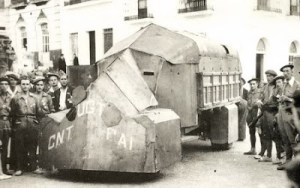
Armoured car made in the Riotinto workshops at the outbreak of war
While August saw massive, explosive violence as the primary mining regions were conquered, September marked only the completion of the territorial conquest. The peak era of execution and systemic cleansing was just hitting its full stride. Historians like Paul Preston note that the White Terror in Huelva ultimately claimed over 6,000 lives across the province, with roughly 1,200 to 2,000 extrajudicial executions occurring strictly within Huelva city. Once the northern Sierra fell on 19 September, the Nationalists shifted from active military skirmishes to a highly methodical administrative purge. October, November, and December of 1936 saw a dramatic wave of arrests and daily executions at the San Sebastián and La Soledad cemeteries as the Falange systematically worked through the kill lists provided by local entities and companies like RTC.
.
Forensic excavations of Huelva’s communal graves, which collectively hold more than 5,000 bodies from the whole province, reveal that while the killings began frantically in late July and August, the graves continued to be filled aggressively throughout the autumn and winter of 1936 and into 1937.Because thousands of people successfully fled into the mountains during the mid-September campaigns, they became targets for long-term elimination. The hunt for these fugitives turned Huelva into an active anti-partisan war zone. Rather than stopping, the military and the Guardia Civil carried out counterinsurgency operations, summary executions, and reprisal killings against the families of huidos well into the late 1930s and 1940s.
.
By 1937, Nerva already had 246 widows and 570 orphaned children, thanks to fascists, via Antonio Rioja Bolaños Archive, University of Huelva.
The day-to-day reality in the Riotinto mining basin during and immediately after September 1936 was defined by totalitarian surveillance, psychological terror, and economic destitution. The mines were fully operational, and the workforce was under absolute coercion. Following the fall of the mining basin in late August, the Nationalist military authorities and RTC management moved instantly to restart operations. Pyrite, copper, and sulphur were mined at high capacities, loaded onto the Huelva–Zafra railway (which locals could not use to escape the area), and shipped out to fuel the fascist war machine or traded for foreign currency.
.
Corta Atalaya, via Wikimedia Commons
People were absolutely forced to work. Refusing to show up to the mines was treated as an act of treason. Armed Falangists and Guardia Civil officers patrolled the open pits and workshops, and RTC management and the military authorities unilaterally stripped away all labour rights. Wages were drastically cut, working hours were extended, and safety regulations were ignored. For the surviving miners, going to work was a desperate survival strategy. If a worker stayed home, they were branded a red saboteur, which meant immediate arrest and likely execution. The families of targeted miners were treated as subhuman. Wives and daughters of huidos or executed men were subjected to the rapado (head shaving), forced to ingest castor oil, and paraded through the streets suffering violent diarrhoea and subject to rape and sexual humiliations. They were banned from finding formal work, forcing many into near-starvation or survival-based prostitution, all while being openly mocked by local fascist sympathisers, the same people who were their neighbours before the outbreak of war. Every day, families watched the smoke rise from the mines, knowing their husbands and fathers were working as captive labourers under the watchful eyes of British managers and fascist guards, while wondering if the next knock on their door would be the Falange coming to take another relative to the cemetery walls.
.
For the wives, children, and parents of the miners, life outside the pits was a waking nightmare. The community was physically divided between the luxury of the British executives in Bella Vista and the squalor of the terrorised Spanish neighbourhoods. Paranoia destroyed the social fabric, as, to save their own lives, some residents turned into informants, accusing neighbours of past union activities. Conversations in public ceased; families lived in terrified silence behind closed doors. Because thousands of miners had been executed, blacklisted, or had fled into the mountains as huidos, entire neighbourhoods were left without breadwinners. The Nationalists routinely seized the homes, livestock, savings, and furniture of these families. Women and children were left entirely destitute.
.
Once the initial shockwaves of the August conquest subsided, the workforce dropped significantly but was forced into immediate production. Following the slaughter of the Riotinto Mining Column, the active workforce during the war hovered around 6,000-7,000 workers. While the Riotinto basin was overwhelmingly a left-wing, unionised stronghold, a conservative and right-wing minority did exist among the workforce and when the Nationalists took the basin in late August 1936, this conservative minority went from being a marginalised group to a highly influential network of informants. Many conservative miners immediately joined the local Falange or Guardia Civil militias. While the British board room opened the corporate files to provide names, it was these local right-wing miners who pointed the physical finger. They walked through the villages with Nationalist officers, identifying exactly which of their co-workers had been active strike leaders, union delegates, or vocal Republican supporters.
.
For their loyalty, these conservative miners were protected from the purge, promoted into oversight positions left vacant by executed Republicans, and used by RTC management to establish a permanent anti-union stronghold inside the pits. Historians estimate that the explicit informant network within the workforce was a very small but highly effective minority and active right-wing collaborators likely numbered in the low hundreds. The primary pool for these informants came from the pre-war Sindicatos Católicos (Catholic Unions) or Sindicatos Libres (Free Unions). These corporate-backed unions were established specifically to counter the socialist UGT and anarchist CNT. While the left-wing unions boasted thousands of members, the Catholic unions generally maintained a small membership, fewer than 5% to 10% of the workforce at any given time. When the Nationalists captured the basin, these marginalised conservative miners used the opportunity to settle personal and political scores.
.
The Rio Tinto Company (RTC) was absolutely not a passive observer as time went on. In the months and years following the September 1936 pacification, RTC remained fully involved as an active, direct collaborator with Francisco Franco’s fascist regime. As the war progressed into 1937 and 1938, their relationship with the Nationalist dictatorship solidified from a tactical alliance into deep, structurally profitable complicity. The most explicit proof that RTC was actively onboard with the regime came from corporate headquarters in London. At the company’s 1937 Annual General Meeting, the Chairman of the Board, Sir Auckland Geddes, gave a glowing report to British shareholders. He did not express regret or claim the company was a victim of circumstance. Instead, he openly boasted that any workers who were not quiet about their treatment could just simply be murdered. To the global market, RTC used the horrific reality of ongoing fascist executions as a selling point to prove that their investments were safe and labour costs would remain permanently low.
.
RTC’s involvement quickly expanded beyond local operations into the realm of international fascist geopolitics. To pay Adolf Hitler for the military planes and tanks supplied via the Legion Condor, Franco promised Nazi Germany vast quantities of Spanish raw materials and RTC actively complied with this arrangement. Throughout the late 1930s, Rio Tinto provided massive shipments of pyrite and copper ore directly to Nazi Germany’s rearmament programme.The British board of directors willingly allowed their Spanish assets to feed the military machine of the Third Reich, prioritise fascist clients, and bolster the European totalitarian axis.
.
On the ground in Huelva, British managers did not pull back or distance themselves from the repression. The corporate structure was fully integrated with fascist military discipline; if a miner attempted to slow down production, complain about the extended hours, or subtly protest the slashed wages, RTC management did not handle it through human resources. They reported the worker directly to the fascist military supervisor stationed at the mines. This active corporate tracking ensured that the cleansing of the workforce never truly stopped. It created a permanent cycle where the company utilised state executioners as their ultimate disciplinary department. Far from being a passive onlooker forced into a corner, the RTC leaned entirely into fascism. They found that totalitarianism was incredibly efficient for corporate profit margins and maintained an active, hands-on role in sustaining Franco’s terror long after the initial conquest of Huelva was complete.
.
From 1939 onwards, the end of the wider Spanish Civil War did not bring peace to Huelva or the Riotinto basin. Instead, the region entered a long, dark era defined by a gruelling anti-partisan guerrilla war, state-enforced economic suffering, and a bitter corporate betrayal. Huelva, bordering Seville and Badajoz, had the grim distinction of becoming the first official anti-partisan war zone in Spain, declared as such as early as August 1937 by General Gonzalo Queipo de Llano. The Francoist authorities treated the hunt for these men as a continuation of active front-line warfare. Throughout the 1940s, the Guardia Civil waged a relentless counterinsurgency campaign. To flush out the guerrillas, they used a scorched earth strategy of burning down mountain forests, executing hostages, forcibly evacuating rural hamlets, and torturing the families of the hidden men to prevent them from sending food into the hills. By the late 1940s and early 1950s, isolated, starved, and heavily hunted, the remaining resistance groups in Huelva were utterly destroyed, with the last survivors either shot in the mountains or captured and executed.
.
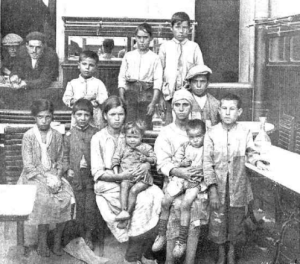
Mining children from the Riotinto area before things got really bad with the outbreak of war, via Wikimedia Commons
The relationship between the RTC and Francisco Franco took a highly ironic turn after 1939. Having successfully used Franco to crush the labour unions, the British company soon found themselves targeted by the very dictatorship they helped sustain. Once the civil war ended and World War II broke out just months between each other, Franco’s regime adopted an aggressive, hyper-nationalistic stance. The Falange began publicly denouncing the British RTC as a foreign coloniser, and Franco himself bitterly referred to the Riotinto mines as an economic Gibraltar of Spain and wanted the mines nationalised. While he stopped short of outright seizing them due to diplomatic pressure from Britain, his regime used economic policy to systematically choke the RTC. They forced the company to sell copper and pyrite to the Spanish state at artificially low, mandated prices and heavily restricted their ability to export minerals to their traditional allied markets. By 1941, blocked by the realities of WWII and choked by Franco’s interventionist policies, the RTC’s turnover fell by 53%. The company responded by slashing spending, freezing dividends, and minimising investments in the Huelva mines, letting the local infrastructure deteriorate.
.
Alexander Hall remained on the ground as General Manager in Spain during the incredibly volatile years leading up to and during World War II. As Franco’s regime shifted into a hyper-nationalistic, anti-British stance, Hall had to act as a frontline corporate diplomat. He was responsible for handling Franco’s intensive state interventions, which included price controls and mandatory resource diversion to Nazi Germany. Following the conclusion of World War II, Hall’s status within the corporate structure remained untarnished. Alexander Hall was never held legally, financially, or socially accountable for his role in the White Terror. Within the records of the global mining giant, his actions were treated as a masterclass in crisis management and the preservation of British capital under extreme political duress.
.
By the early 1950s, operating in Spain had become entirely unprofitable and politically exhausting for the British board. In 1954, after eighty years of presence in Huelva, the Rio Tinto Company officially sold its majority control of the Spanish operations to a consortium of Spanish banks and industrialists, creating the Compañía Española de Minas de Río Tinto. Armed with the cash from the sale, the RTC completely left Spain behind. They took the name they had stolen from the Andalusian river and used it to reinvent themselves into the modern global mining titan known today, Rio Tinto Group, shifting their focus to massive operations in Australia, Africa, and North America.
.
For the families of Riotinto and Nerva, the post-1939 era was a bleak landscape of poverty and institutionalised silence. The proud, radical cultural centres, newspapers, and labour organisations that the miners had spent half a century building were completely gone, replaced by forced membership in state-controlled fascist syndicates. Generations of families grew up with the knowledge that their fathers and grandfathers lay in un-demarcated mass graves, a truth they were forced to hide out of fear of state reprisal until Franco’s death in 1975.
.
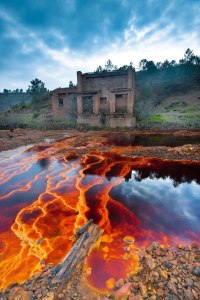
The town of Minas de Riotinto is now buried under sludge, via Huelva Informacion
Following the civil war, conditions for the miners and their families were deeply oppressive, defined by what historians call the Autarky period, an era of self-sufficiency, rationing, and intense state control. The mines were placed under direct military supervision. The right to strike was permanently banned, and the independent socialist and anarchist unions were replaced by the Sindicato Vertical, a mandatory state-run union that served the regime rather than the workers.In 1954, the RTC officially pulled out, selling its assets to a consortium of Spanish capitalists, the technical infrastructure deteriorated further, and operations became increasingly outdated. Wages were legally frozen while the cost of basic food items skyrocketed, malnutrition and overcrowding in the old workers’ quarters were rampant, and respiratory diseases plagued the miners due to a total lack of occupational safety and proper ventilation. Despite the danger of execution or torture by the Guardia Civil, the crushing conditions eventually broke the silence. Inspired by coal miners in Asturias, Riotinto miners participated in massive, illegal wildcat strikes in 1962, forcing the dictatorship to grant rare wage increases and proving that the spirit of labour resistance had survived the White Terror.
.
The death of Franco in 1975 brought hard-fought democratic freedoms and union rights back to the basin, but it concurrently ushered in a period of severe economic devastation. Global markets changed rapidly in the late 1970s and 1980s. International copper prices crashed, and the high-grade mineral veins in Huelva were increasingly depleted. The state-backed companies tried to restructure, but the operations were haemorrhaging money. By the 1980s, thousands of miners were laid off. Protests, blockades, and desperate marches became common as miners fought not just for better wages, but to save their towns from total extinction. One by one, the historical open pits and underground shafts closed. In 2001, commercial mining operations in Riotinto ceased entirely. A proud, generational industrial hub was suddenly hit by massive unemployment, forcing thousands of young people to abandon the basin for coastal cities, leaving behind an ageing population and a landscape of abandoned rust and toxic mine tailings.
.
Despite modern regulations, the region is still plagued by a toxic environmental legacy. Massive tailings dams (like the Gossan and Cobre facilities) hold over 200 million tonnes of industrial mining sludge. Local environmental groups constantly battle operators over air pollution and the safety of these mega-dams. While the modern miners operate heavy excavators and high-tech processing plants, the physical architecture of the past, from the Victorian executive homes of Bella Vista to the bullet-pocked cemetery walls, stands as a quiet monument to the generations of families who lived, struggled, and died under corporate and dictatorial rule.
.
Neither the Rio Tinto Company (RTC) nor any of its senior corporate executives ever expressed a single word of official regret, remorse, or apology for their direct collaboration with the Franco regime. Instead, the company maintained an attitude of cold, unrepentant commercial pragmatism that prioritised shareholder profits over human lives. This institutional silence can be understood through the company’s historical actions. Rather than expressing regret, the global leadership explicitly defended the violence. As late as May 1937, long after the scope of the White Terror in Huelva was fully understood in London, Chairman Sir Auckland Geddes openly praised the ‘peace’ that Franco’s execution squads had brought to the mines. To the board, the summary execution of unionised miners was not a tragedy; it was a highly effective solution to fifty years of labour unrest. Naturally, he got to die as as an old man warm in his bed, filthy rich, and made a literal baron by the British government. His descendants remain firmly entrenched in the British upper class and hereditary aristocracy, holding onto generational wealth, title, and political influence.
.
Human rights organisations and corporate watchdogs point out that Rio Tinto’s complete lack of remorse in Spain matches a broader, decades-long pattern of global behaviour. The company has consistently faced international allegations of environmental devastation and human rights abuses where they prioritised extraction over local populations, most notably at the Panguna mine in Papua New Guinea and the Grasberg mine in Indonesia. In recent years, the modern Rio Tinto Group has only issued public apologies when forced to by severe contemporary backlash, such as the global outcry following their 2020 destruction of the 46,000-year-old Indigenous sacred site at Juukan Gorge in Australia.
.
Mining has caused severe and long-term environmental damage, primarily through acid mine drainage and heavy metal contamination in the Minas de Riotinto and surrounding areas. Mining dates back to the Bronze Age and Roman periods, leaving a deep legacy of pollution and Large sludge and tailing dams pose ongoing structural and environmental risks to the region.
Related
Got a comment, question or suggestion? Know who took a photo? Have questions about a particular date or event? Cancel reply