As Lieutenant Colonel Juan Yagüe prepared his advance towards Badajoz, detachments of the Army of Africa moved through the surrounding countryside to secure roads, river crossings, and neighbouring villages against any Republican counterattack. Captain Gabriel Fuentes Ferrez led one of these detachments, occupying Valverde de Mérida together with Esparragalejo and La Garrovilla, completing the Nationalist consolidation east of Mérida.
The village of Esparragalejo, northwest of Mérida, with its population of approximately 1,200, came under Nationalist control on 12 August 1936, one day after the fall of Mérida. Rather than continuing immediately towards Badajoz, the Army of Africa detached forces to secure the surrounding countryside and protect its communications. A force of Moroccan Regulares under Captain Gabriel Fuentes Ferrez occupied Esparragalejo, together with nearby La Garrovilla and Valverde de Mérida, eliminating the remaining Republican authority in the area and securing the roads leading west towards Badajoz. There is no evidence of organised military resistance when the Nationalist supporters took the chance to overthrow the Republican town.
The delay between the occupation and the executions distinguishes Esparragalejo from neighbouring towns, where repression began almost immediately after Nationalist forces arrived. In Esparragalejo, control was secured first, followed by the systematic arrest and execution of selected Republican supporters once the new authorities had consolidated their position. The number of documented victims was smaller than in neighbouring municipalities, the village experienced the same pattern seen across western Extremadura: the removal of Republican institutions, the persecution of political opponents, and the burial of victims in unmarked graves that remained hidden for much of the twentieth century.
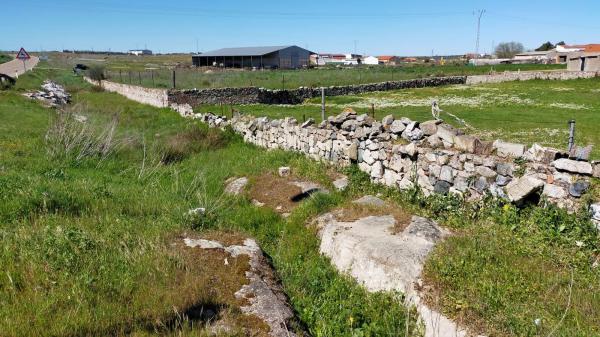
The remains of Pablo Díaz Concepción, originally from Esparragalejo but a resident of Montijo after marrying local Anselma Rodas Piñero, are believed to be in this mass grave just one of many in an unmarked mass grave in the town. According to his daughter, Díaz remained in Montijo after the coup because he was convinced that nothing bad could happen to him, as he believed there was no reason, but days later, he wes taken away by right-wing locals, who her mother refused to name. Díaz was taken to Esparragalejo, where he was held temporarily in hayloft, before being executed. The location of the grave was discovered thanks to the testimony Díaz’s father-in-law, who told his granddaughter everything he knew. According to his testimony, when he learned of his son-in-law’s arrest, he tried to intervene on his behalf by asking two businessmen he worked for to help. After his death, people from the town went to Díaz’s brother in Esparragalejo, and told him that he had been killed and that his body was exposed. His brother found the site and, using a shovel, buried him next to a rock so that he wouldn’t be trampled and near the road. In 2019, exhumation works began, but was interrupted by covid and remains unfinished.
The village of Valverde de Mérida fell into Nationalist hands on 12 August 1936. By the time Nationalist troops arrived, the fall of the provincial capital had made organised resistance untenable, and the village was occupied without significant fighting. The Republican authorities disappeared from public view as the new military administration assumed control and the surrounding district was brought under Nationalist authority. Repression occurred against local Republicans in Valverde de Mérida, where arrests, executions, imprisonment, and other forms of political persecution followed the Nationalist occupation over the ensuing weeks and months. The precise chronology of the first killings remains unclear because no detailed municipal study has yet been published. There is no doubt that the village became part of the Nationalist system of repression established after the fall of Mérida, the surviving evidence is currently insufficient to identify the first victims or describe the initial arrests with confidence. Until further municipal records or local investigations emerge, little more can be said with certainty about the events immediately following the occupation.
The village of La Garrovilla also fell into Nationalist hands on 12 August. As Lieutenant Colonel Juan Yagüe’s Army of Africa prepared to advance on Badajoz, detachments were sent to occupy the surrounding villages and secure the roads and river crossings behind the main column. Captain Gabriel Fuentes Ferrez led a force of Moroccan Regulares into La Garrovilla, ending Republican control without a significant battle. With Mérida already lost, there was little prospect of organised resistance, and the Republican authorities either fled or went into hiding. The village had remained calm during the first weeks of the Civil War. The Republican authorities arrested 32 local right-wing residents, holding them in the parish church as a precaution against a possible uprising. Despite the political tensions and pressure from outside the village, none of the prisoners were executed.
The Nationalist occupation brought a very different outcome. Once military control had been established, Falangists and the new authorities began arresting people associated with the Republic. Local investigations have identified only 21 of the residents who were killed during the Francoist repression. The first executions occurred during August and September 1936. The victims included agricultural labourers, trade union members, socialist supporters, and people linked to the Republican municipal administration.
The town of Torremayor was only 6km west of La Garrovilla. It appears as another town without any Nationalist killings, but that was no matter not the Army of Africa or Nationalist forces. Little documented evidence survives of Torremayor’s capture, but an eyewitness letter was written by the local schoolteacher Luis de Rivas Molina, a member of the Republican committee. On 31 August 1936, while in hiding, he wrote to his brother-in-law in Seville describing the town before the Nationalist occupation: ‘When people learn of the sad odyssey of the villages of this province, they will know that this has been the only village which, despite insinuations, orders, coercion and threats, behaved with the highest civic spirit. Here there was not a single detention, robbery or even a threat, and for that reason the village remained free, in complete tranquility and peace.’ The later disappearance of Luis de Rivas Molina himself became the subject of an investigation by the military Auditor of the 2nd Division because one of his relatives was a prominent Falangist in Seville. The surviving case file preserves committee records and correspondence that have become important sources for reconstructing the town’s final weeks under the Republic.
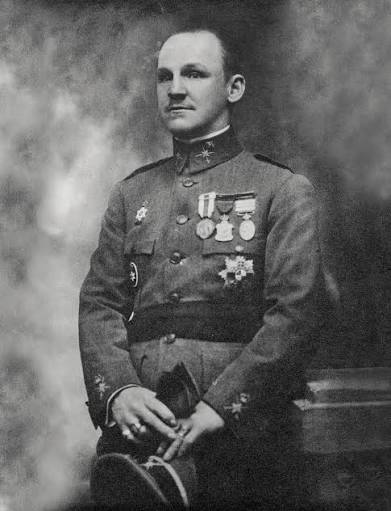
On the morning of 12 August 1936, General Manuel Goded Llopis, one of the most senior generals involved in the military uprising in eastern Spain, was executed by firing squad at Montjuïc Castle in Barcelona. Alongside him died General Álvaro Fernández Burriel, another senior officer who had participated in the failed rebellion. Their executions marked one of the earliest occasions on which the Republican government carried out death sentences against captured rebel generals, demonstrating that the Civil War had entered a new and uncompromising phase.
For the Republic, Goded was not simply another captured officer. General Emilio Mola had entrusted him with directing the uprising in Catalonia after he had overseen the successful rebellion on Mallorca on 19 July. Flying from Palma aboard a seaplane, Goded arrived expecting to assume command of a military revolt that would quickly seize Barcelona. Instead, he found the city largely in Republican hands. Loyal Assault Guards, the Guardia Civil under General José Aranguren, and thousands of newly armed members of the CNT and UGT had already defeated much of the military revolt. By the afternoon, the uprising had collapsed, and Goded was captured inside the Captaincy General building.
Before being imprisoned, Goded was persuaded by the Catalan government to broadcast a radio message ordering the remaining rebel troops in Barcelona to surrender. His words were heard across the city and throughout Catalonia, helping convince isolated Nationalist units that further resistance was futile. The broadcast became one of the Republic’s earliest and most significant propaganda victories of the war.
Following his capture on 20 July, Goded was imprisoned aboard the Uruguay, a merchant ship anchored in Barcelona harbour that had been converted into a floating prison by the Republican authorities. As Barcelona’s prisons rapidly filled with captured rebel officers, suspected conspirators, and political prisoners after the defeat of the uprising, several ships in the harbour were requisitioned for the same purpose. Conditions aboard the prison ships were often overcrowded and uncertain, but they provided secure detention facilities while the authorities worked to restore order after days of street fighting.
Goded was brought before a Republican military court on 11 August. Charged with military rebellion against the legally constituted government, he defended his actions by arguing that he had acted in what he believed were Spain’s national interests. The court rejected his defence, found both Goded and Fernández Burriel guilty, and sentenced them to death.
Early on the morning of 12 August, the two generals were taken from the Uruguay to Montjuïc Castle. There, in the castle’s moat, they were executed by firing squad. Contemporary accounts state that Goded refused a blindfold before the execution, and several reported that his final words were “¡Viva España!”, although the exact wording varies between sources.
Goded’s execution carried significance far beyond Barcelona. It demonstrated that the Republican authorities were prepared to impose the death penalty, following a formal military trial, on senior officers who had led the military rebellion. It also removed one of the most experienced generals involved in the conspiracy. Within little more than three weeks of the uprising, the Nationalists had lost both General José Sanjurjo, who had died in an aircraft crash on 20 July, and Goded, leaving Francisco Franco Bahamonde and Emilio Mola as the rebellion’s most prominent surviving commanders.
The execution marked the final act in the failed military uprising in Barcelona. Less than four weeks earlier, Goded had arrived believing Catalonia would join the rebellion. Instead, his defeat preserved the Republic’s largest industrial city, its principal Mediterranean port, and one of its most important political and military centres. Barcelona remained the heart of Republican resistance in northeastern Spain for the remainder of 1936, providing manpower, industry, and a vital base from which the Republic continued the war.

