During the first week of August 1936, Lieutenant Colonel Juan Yagüe drove the Army of Africa north from Seville with remarkable speed. After crossing into Extremadura, his columns captured Llerena, Zafra, and Los Santos de Maimona before advancing towards Mérida. Colonel Carlos Asensio Cabanillas, Major Antonio Castejón Espinosa, and other experienced officers led separate columns of Spanish Foreign Legionnaires and Moroccan Regulares, supported by artillery, armoured cars, and aircraft. Years of colonial warfare in Morocco had forged these troops into the best-trained formation in Spain.
Yagüe commanded approximately 2,200–2,500 men during the advance, although the strength of individual columns fluctuated as detachments secured towns and protected supply lines. Their objective extended beyond the capture of individual settlements. General Emilio Mola and General Francisco Franco needed to unite the Nationalist territories in southern and northern Spain, secure communications with Portugal, and open the western route towards Madrid. Every kilometre gained through Extremadura brought those goals closer.
Republican forces struggled to slow the advance. Local militia, Assault Guards, Carabineros, railway workers, and volunteers assembled defensive positions wherever they could, but shortages of rifles, machine guns, ammunition, transport, and experienced officers prevented them from mounting a coordinated defence. Each retreat forced more exhausted fighters towards the next town along the Nationalists’ line of advance. By 9 August, Mérida had become the Republic’s last major defensive position east of Badajoz.
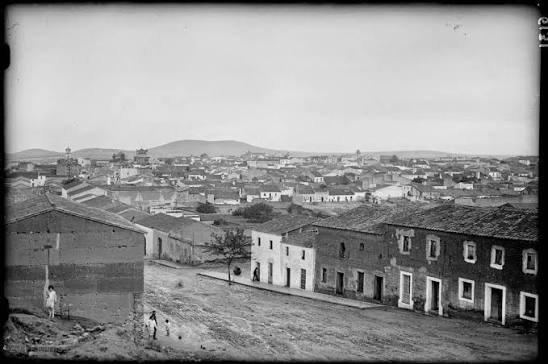
Mérida occupied one of the most important strategic positions in western Spain. The city stood on the Guadiana River at the junction of the Madrid–Badajoz railway and the main highway linking Seville with Cáceres and Salamanca. The Roman bridge, built almost two thousand years earlier as part of Augusta Emerita, remained the principal crossing over the Guadiana. Any army moving north or west had little choice but to seize it. If Republicans held Mérida, they could delay the Army of Africa, protect the approaches to Badajoz, and disrupt Nationalist communications across Extremadura. If they lost it, Yagüe could concentrate his forces against Badajoz while maintaining an uninterrupted supply route back to Seville.
Local authorities strengthened roadblocks, prepared defensive positions around the bridges, and gathered every available defender. Assault Guards, Carabineros, armed workers, socialist and anarchist militia, railway personnel, and retreating volunteers from towns already overrun joined the defence. Historians disagree on their exact strength, but most estimates place the Republican garrison between 1,000 and 1,500 men. Many possessed little military training, and few units had fought together before the Nationalists reached the city.
At dawn on 10 August 1936, Yagüe ordered his columns to attack Mérida before the Republican defenders could strengthen their positions or receive reinforcements from Badajoz. Every day the Army of Africa remained on the move increased the pressure on the Republic, while every delay gave Republican commanders an opportunity to organise a stronger defensive line farther west.
Colonel Carlos Asensio Cabanillas led one of the principal assault columns towards the eastern approaches to the city, while Major Antonio Castejón Espinosa directed supporting attacks against the Republican defences. Legionnaires and Moroccan Regulares advanced behind artillery fire, using their experience from the Rif War to move rapidly between cover and exploit weak points in the Republican line. They aimed to seize the crossings over the Guadiana before the defenders could destroy them or organise a prolonged defence.
Republican commanders concentrated their limited forces around the Roman bridge, the railway bridge, and the roads entering the city from the east. Assault Guards, Carabineros, militia volunteers, and armed civilians opened fire as the Nationalists approached, forcing the attackers into several sharp engagements. Machine-gun positions overlooking the bridge approaches slowed the first advance, while rifle fire from buildings near the river pinned down elements of the assault force. Although the defenders fought with determination, they lacked heavy weapons, reliable communications, and a unified command structure. Many militia units had formed only days earlier, and few had experience fighting disciplined regular troops.
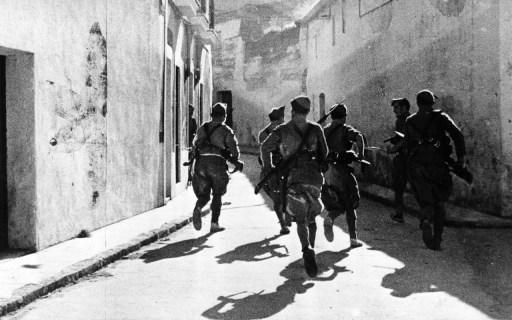
Yagüe’s officers brought forward additional Legion companies, concentrated their artillery against Republican strongpoints, and continued probing for crossings. Once the Nationalists secured positions on the eastern bank of the Guadiana, they increased the pressure across the river and gradually forced the defenders back into the city. Major Heli Rolando de Tella y Cantos played an important role during this stage of the battle, directing troops that helped suppress Republican counterattacks and secure the Nationalists’ advance into the urban centre. Fighting continued through the streets as Republican defenders attempted to delay the advance long enough for comrades to withdraw towards Badajoz. Several groups fought independently after communications broke down, while others abandoned isolated positions rather than face encirclement. By the afternoon, organised resistance had collapsed. Legionnaires and Regulares occupied the principal government buildings, secured the bridges, and raised the Nationalist flag over the city.
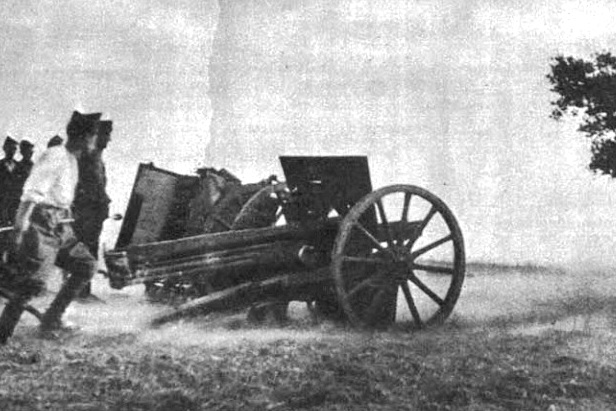
The battle itself lasted only a few hours, yet its outcome reflected more than local military fortunes. Republican defenders fought stubbornly, but they could not compensate for shortages of ammunition, trained officers, artillery, and transport. Yagüe’s veterans combined disciplined infantry tactics with coordinated artillery support and maintained the relentless pace that had characterised the Army of Africa’s advance since leaving Seville. Modern historians generally agree that casualties during the fighting numbered in the dozens rather than the hundreds, although no contemporary source provides a complete accounting for either side. The swift collapse of Mérida owed less to a lack of Republican resolve than to the overwhelming tactical superiority of the Army of Africa.
Within hours of securing the city, Nationalist officers began eliminating anyone they believed might oppose their advance. Legionnaires and Moroccan Regulares arrested Republican officials, trade union leaders, militia members, municipal councillors, railway workers, teachers, and civilians denounced by local supporters of the uprising. Military authorities sought not only to secure Mérida, but also to destroy the Republican political and social organisations that had governed the city since the outbreak of the war.
Local Falangists, conservative landowners, and other civilian supporters of the rebellion quickly identified political opponents for the occupation authorities. In many cases, longstanding personal rivalries, labour disputes, and political conflicts influenced who appeared on arrest lists. Prisoners filled the city’s jails and improvised detention centres as military investigators questioned them about Republican organisations, militia activity, and local political leadership. Soldiers removed groups of prisoners from detention, drove them to the outskirts of the city, and executed them without judicial process. Others disappeared after interrogation, leaving families to search unsuccessfully for news of their relatives. The repression that followed the battle reflected the methods already employed during the Army of Africa’s advance through Andalusia and southern Extremadura. Yagüe’s columns moved quickly, but they left behind military authorities and sympathetic civilians who consolidated Nationalist control through systematic arrests and executions.
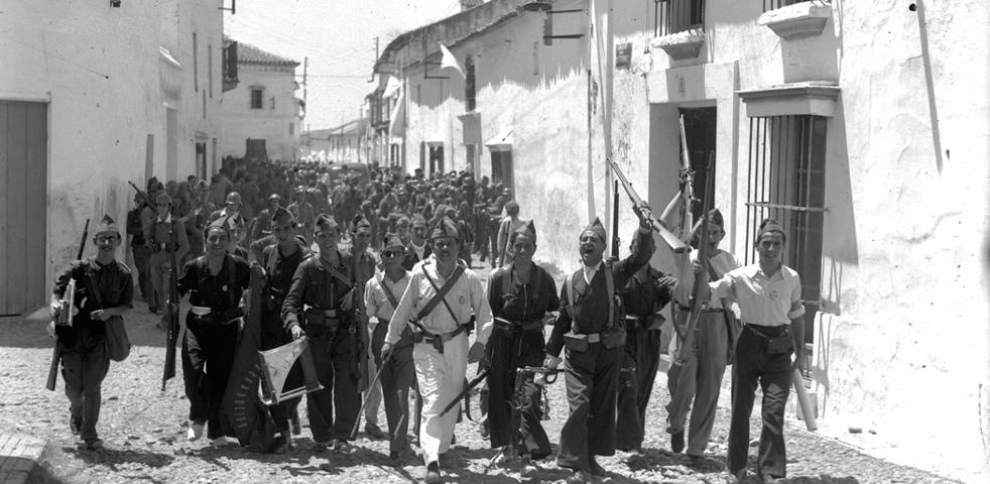
Determining the exact number of victims remains difficult. Francoist authorities rarely kept complete records of extrajudicial executions, while many families remained silent for decades through fear of reprisals. Modern research nevertheless indicates that the occupation of Mérida claimed well over one hundred civilian victims during the opening weeks of Nationalist control. Democratic Memory investigations have identified many by name, although historians continue to revise the total as archival research and local documentation uncover additional cases. Francisco Espinosa Maestre argues that the violence formed part of a deliberate strategy to eradicate Republican political leadership across Extremadura rather than a spontaneous response to military resistance.
Among those killed was the Republican activist remembered as Leiva, whose execution became one of the best-known individual cases associated with the city’s fall. Although surviving records preserve only fragments of her life, local memory organisations have identified her as one of the women targeted during the first wave of repression. Nationalist authorities arrested and executed her shortly after occupying Mérida because of her association with the Republic. Her death illustrates that the repression extended beyond armed combatants. Women who organised politically, belonged to trade unions, worked in secular organisations, or openly supported the Republic faced imprisonment, humiliation, sexual violence, or execution alongside their male counterparts.
- The El Valle Mass Grave
For decades, families from Arroyo de San Serván searched for relatives who disappeared after the Nationalists occupied the area in August 1936. Among them was Aniceto Asensio, who hoped to recover the remains of his uncle, Juan Barrena Álvarez. In 2003, relatives approached the Asociación para la Recuperación de la Memoria Histórica de Extremadura (ARMHEX), while local resident Andrés Galán identified a burial site on the privately owned El Valle estate, approximately three kilometres west of Mérida. Galán died before the excavation took place, but his testimony proved crucial in locating the grave.
The investigation encountered an unexpected obstacle when the landowner initially refused access to the estate. Unable to carry out a ground survey, investigators relied on digital infrared aerial photography to identify the most likely location of the grave while negotiations continued to find the 11 missing people. After permission was granted, archaeologists excavated the site in August 2012, recovering the remains of three men aged approximately 16, 18, and 36. Forensic anthropologists from the Autonomous University of Madrid identified gunshot wounds on at least two of the victims and found evidence that the bodies had been burned after they were buried, with carbonisation visible on the hands, feet, and teeth. Despite the fire, the skeletal remains were well preserved.
The excavation reunited one family with the remains of Juan Barrena Álvarez and confirmed the accuracy of the testimony provided years earlier by Andrés Galán. ARMHEX later published the excavation, historical research, oral testimonies, and forensic analysis in a dedicated volume, making El Valle one of the best-documented Civil War mass grave investigations in the Mérida district.
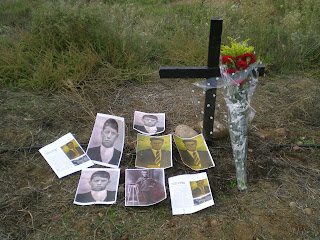
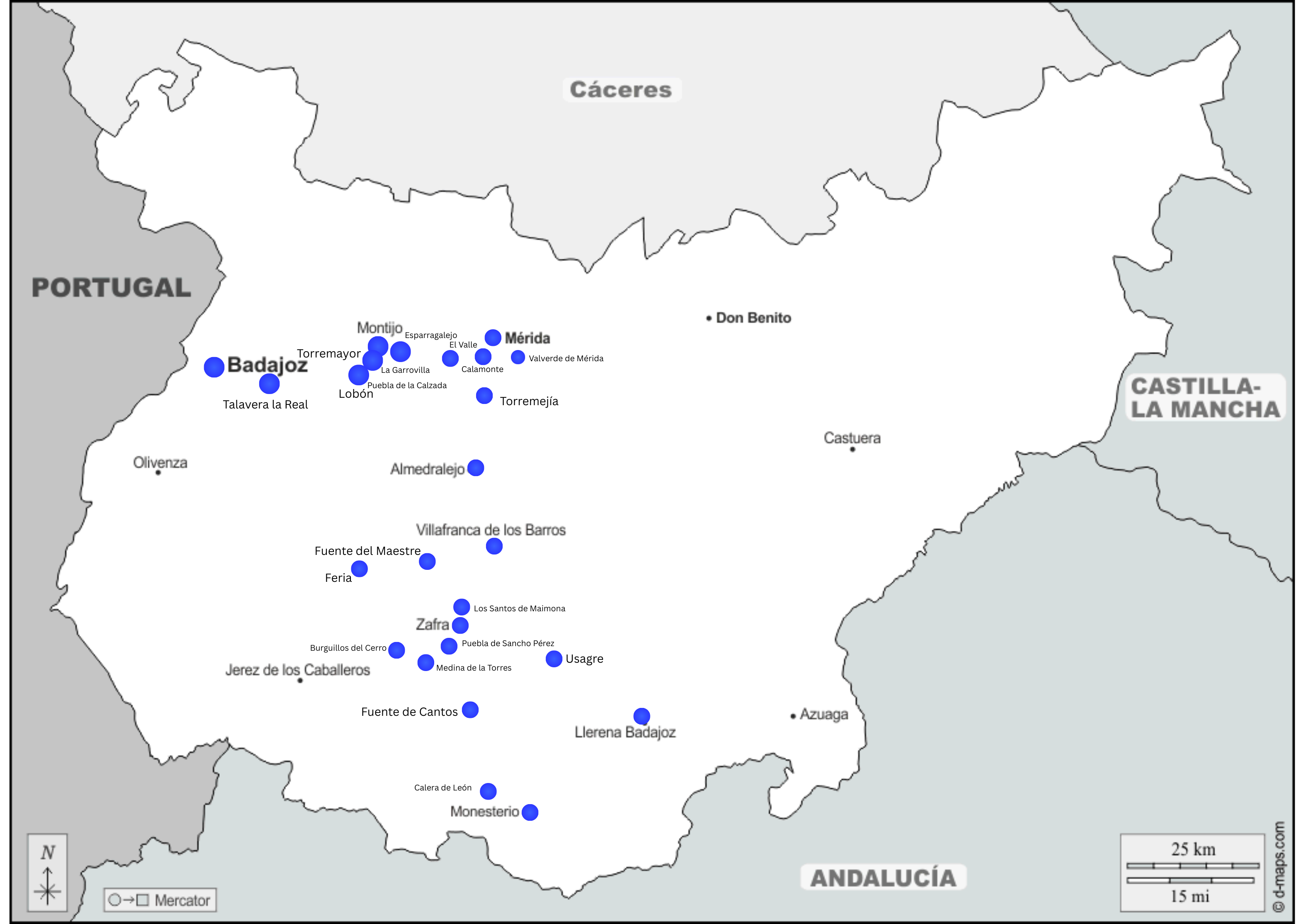
The nearby town of Calamonte is one of the towns that carried out exhumations in 1979, where their first democratically elected mayor, Eugenio Álvarez Gómez, ensured that remains from many individual mass graves around the area were gathered through family memory and reinterred in the local cemetery, a dignified burial after decades of being buried by roadsides. A granite memorial was also erected with the names of 30 identified names from around the small town which lies 7km over the river from Merida. Most Republican refugees would have fled either west to Badajoz, or east to Don Benito and Villanueva de la Serena.
The village of Torremejía fell into Nationalist hands on 10 August 1936 as Major Antonio Castejón Espinosa’s column advanced north from Almendralejo towards Mérida. The occupation met little organised resistance. By this stage of the campaign, Republican forces had largely withdrawn towards Mérida, leaving only scattered defenders along the route. Within hours, Torremejía had been secured, opening the road for the assault on Mérida.
The occupation marked the beginning of a campaign of repression that continued for several years. Local research agrees that no right-wing residents were killed in Torremejía before the Nationalist occupation. In fact, the president of the local Defence Committee released imprisoned right-wing residents on 7 August, only three days before Castejón’s arrival. The absence of Republican reprisals did not lessen the violence that followed the Nationalist takeover.
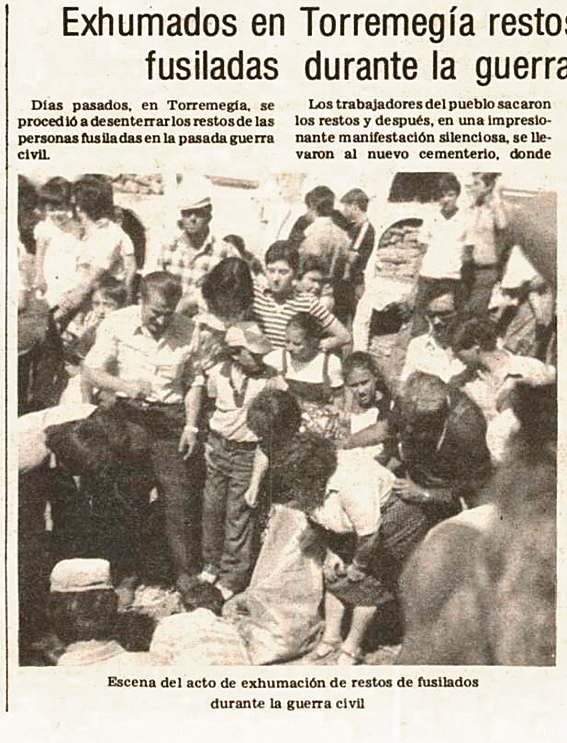
The most detailed municipal study has identified 18 documented victims of Francoist repression from Torremejía – 15 people were executed in the immediate capture, but historian Francisco Espinosa Maestre estimates that the true death toll may have been around 40, reflecting the uncertainty that still surrounds the repression in the village. When relatives erected a memorial after the restoration of democracy, they inscribed 33 names, illustrating the gap between documented executions and local memory. The recovery of the victims began in June 1979, when the newly elected municipal council approved the construction of a communal mausoleum at the request of the victims’ families. On 17 August 1979, the remains of those executed were exhumed and reburied in the new monument, making Torremejía one of the earliest communities in Extremadura to recover victims of Francoist repression. The old cemetery held a grave containing the remains of six Republican soldiers from outside the village who died during the fighting for Mérida on 11 August 1936. Because no right-wing residents were killed in Torremejía, these men were not local victims of Republican violence. Their remains were exhumed during the Franco dictatorship and transferred to the Valle de Cuelgamuros.