On 20 July 1936, the military uprising failed in two of the most important cities in Spain: Madrid and Barcelona. The survival of the Second Spanish Republic in these urban centres fundamentally altered the course of the conflict. Had the rebels secured both capitals quickly, the coup might have succeeded within days. Instead, Spain descended further into prolonged civil war.
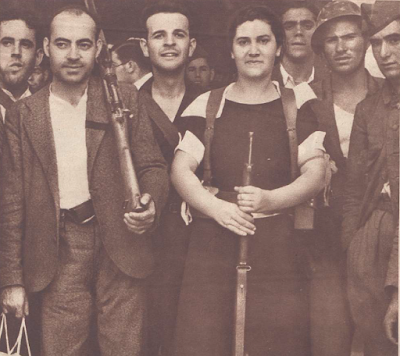
In Madrid, fighting centred on the Cuartel de la Montaña, a large military barracks overlooking the western part of the city. Rebel officers under General Joaquín Fanjul had fortified the barracks after the uprising in the capital failed to spread successfully through the rest of the city. Outside, thousands of armed civilians, Assault Guards, loyal soldiers, and members of workers’ organisations gathered around the complex demanding surrender.
The situation was tense and confused throughout the morning. Some defenders inside the barracks reportedly attempted to signal surrender by displaying white cloths from windows, while other rebel officers continued firing. Conflicting signals, panic, and anger among the attacking forces helped turn the assault into chaos. Eventually, artillery and concentrated gunfire breached the rebel position. Once the barracks fell, many defenders were killed, including some after surrendering. The violence shocked observers and demonstrated how quickly political conflict in Spain was becoming brutal and uncompromising.
The fall of the Montaña Barracks had enormous symbolic importance for the Republic. It showed that the uprising could be defeated in major cities if workers, loyal security forces, and Republican supporters acted together. At the same time, it also revealed the weakening authority of the central state. Armed militias were increasingly acting independently, and revolutionary violence was beginning to spread beyond organised military combat. Read all about Madrid’s uprising in depth HERE
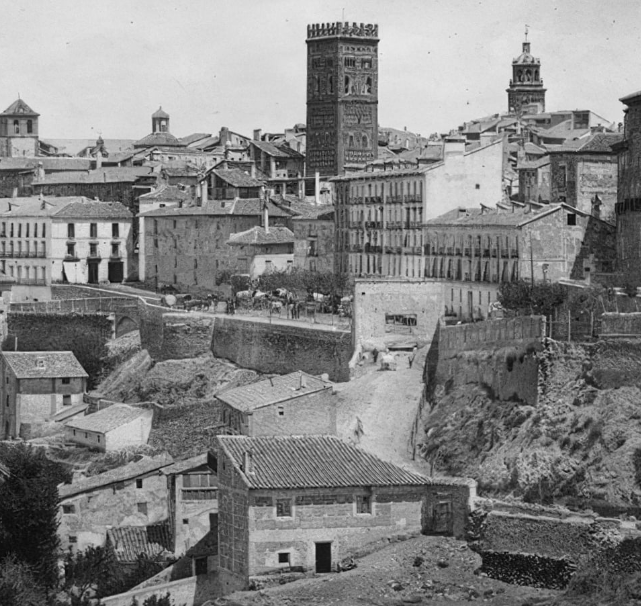
While fierce fighting continued in many cities, the military uprising succeeded comparatively quickly in Teruel. On 20 July 1936, the city’s military garrison, supported by the Guardia Civil and local right-wing supporters, completed its seizure of the provincial capital after only limited resistance from Republican organisations and workers’ groups. Key public buildings, communications and administrative offices passed into Nationalist hands, and the Republican authorities were rapidly arrested, dispersed or forced into hiding, and Teruel witnessed no sustained street fighting. The relatively swift collapse of organised resistance allowed the Nationalists to consolidate their position and begin extending control across much of the province. Although several eastern districts bordering Catalonia and Valencia remained under Republican authority, Teruel city itself would remain in Nationalist hands for more than a year, becoming an important administrative and military centre on the Aragón front.
In Barcelona, the rebellion was also collapsing. After two days of fierce street fighting, rebel forces were defeated by a coalition of workers’ militias, Assault Guards, loyal Guardia Civil, and police units. Barricades filled major streets, churches and public buildings were occupied, and armed civilians moved openly through the city. The anarchist Confederación Nacional del Trabajo and allied groups emerged from the fighting stronger than any other political force in Catalonia.
One of the most important rebel commanders in Barcelona, General Manuel Goded, had arrived from Mallorca believing the city would quickly fall to the military uprising. Instead, he found rebel troops isolated and increasingly surrounded. By 20 July, Goded had been captured by Republican authorities. Under pressure, he later made a radio broadcast urging remaining rebel soldiers in Barcelona to surrender. His capture was one of the greatest early defeats suffered by the conspirators.
The consequences of the Republican victory in Barcelona reached far beyond military success. State authority in Catalonia was now deeply weakened. Workers’ militias, revolutionary committees, and trade unions had not merely defended the Republic; many believed they had saved it themselves. Arms seized from barracks were distributed widely among workers’ organisations, and revolutionary enthusiasm spread rapidly across the city. Factories, transport systems, and neighbourhood patrols increasingly fell under militia or committee control.
Political power in Catalonia was changing almost as rapidly as the military situation. On 20 July, Catalan president Lluís Companys met leaders of the CNT and other anti-fascist organisations whose members had played a central role in defeating the uprising. Companys recognised the reality that armed workers now exercised enormous influence in the streets of Barcelona. Discussions between the Generalitat and revolutionary organisations soon led to the creation of the Central Committee of Anti-Fascist Militias, an organisation that would coordinate military operations, militia recruitment, and public order. Although the Generalitat continued to exist, real power in many areas increasingly depended upon cooperation between state institutions and revolutionary groups. Victory in Barcelona immediately raised a new question: what should be done next? While fighting still continued in some locations, many workers, trade unionists, and political activists believed the struggle could not end with the defence of Catalonia alone. Attention quickly turned toward Aragón, where Zaragoza remained firmly under rebel control. Across Barcelona and other Catalan towns, volunteers began enrolling in newly formed militia columns. Weapons captured from military barracks were distributed, transport was assembled, and plans were made for expeditions into Aragón. Within days, thousands of volunteers would leave Catalonia to carry the war westward. Read all about Barcelona’s uprising in depth HERE
Elsewhere in Spain, the war continued developing unevenly. The rebels secured control over Mallorca after heavy resistance, particularly around military installations and the air base. The Balearic Islands became strategically important because of their position in the western Mediterranean, although Menorca remained loyal to the Republic.
In Galicia, the rebels completed their takeover of Ferrol, one of Spain’s most important naval centres. The city contained major shipyards, naval workshops, arsenals, and warships under construction, making it a valuable military asset. The uprising there had exposed deep divisions between senior naval officers, many of whom supported the rebellion, and sailors and civilian workers who generally remained loyal to the Republic. Despite resistance, rebel forces secured the naval base and key installations. The loss of Ferrol deprived the Republic of a major naval facility and strengthened rebel control over much of Galicia, while arrests and repression against Republican supporters followed in the city.
By the evening of 20 July, the military coup had clearly failed to achieve its central objective: the rapid overthrow of the Republic. the Republic had also failed to crush the rebellion completely. Spain was now divided geographically, politically, socially, and militarily. In many Republican-held cities, revolutionary movements were accelerating. In rebel-held territories, military authority and repression intensified rapidly.
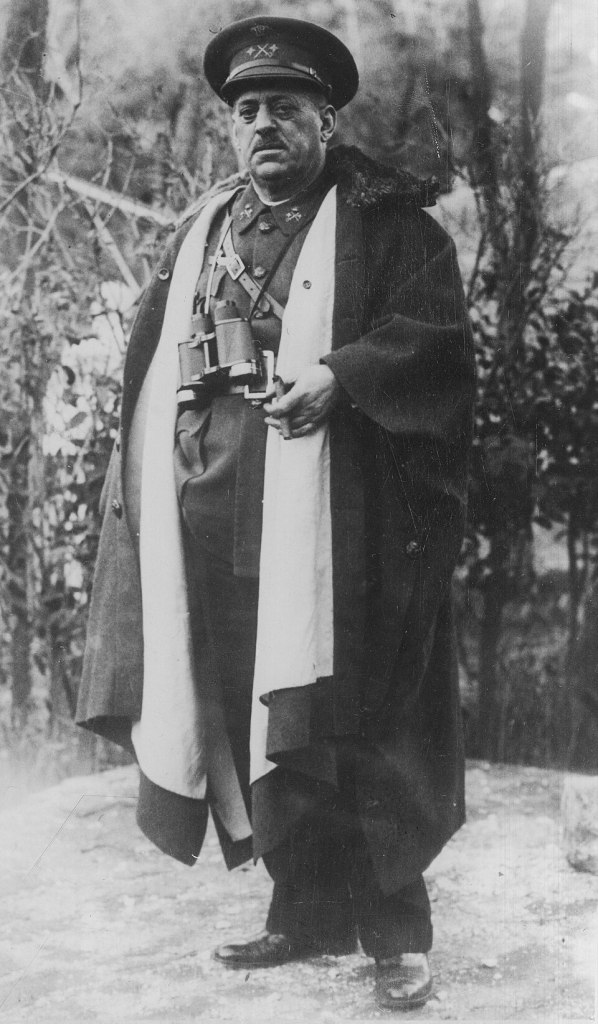
Among the conspirators and within conservative political circles, it was widely expected that General José Sanjurjo would become the leader of the rebellion rather than Francisco Franco Bahamonde. Sanjurjo was the senior conspirator, the most prestigious military figure involved in the plot, and the man whom many of the rebel generals expected to assume supreme command once he returned from exile in Portugal. His sudden death in an aircraft accident on 20 July transformed the leadership of the uprising and, in many respects, altered the course of the Spanish Civil War.
Born in Pamplona on 28 March 1872 into a military family, Sanjurjo spent almost his entire adult life in the army. He fought in Cuba during Spain’s final colonial wars before serving in Morocco, where he gained a reputation for personal bravery and aggressive leadership during the Rif Wars. His success in North Africa earned him numerous decorations and promotion through the officer corps. By the 1920s he was among Spain’s best-known generals. Following the disastrous defeat at Annual in 1921, Sanjurjo played a prominent role in restoring Spanish military fortunes in Morocco. He commanded forces during the successful Alhucemas Landing, one of the first large-scale modern amphibious assaults supported by aircraft and tanks. The victory effectively broke organised Rif resistance and elevated Sanjurjo into a national hero.
His prestige continued to rise under the dictatorship of Miguel Primo de Rivera. He became Director-General of the Guardia Civil, the country’s largest national police force, before later commanding the Carabineros. Within conservative and monarchist circles he was widely regarded as one of Spain’s foremost soldiers. But the proclamation of the Proclamation of the Second Spanish Republic dramatically changed Sanjurjo’s relationship with the state he served. Although he initially accepted the Republic, he rapidly became disillusioned by military reforms introduced by Manuel Azaña Díaz. These reforms reduced the size of the officer corps, abolished traditional privileges, and sought to bring the military firmly under civilian control.
On 10 August 1932 he led an attempted coup against the Republic, remembered simply as the Sanjurjada. The revolt quickly collapsed. Sanjurjo was arrested, sentenced to death, and then had his sentence commuted to life imprisonment. Within months the government reduced the punishment further, and after the electoral victory of the political right in 1933 he received an amnesty. Rather than remain in Spain, he settled in exile in Estoril, Portugal, where he maintained close contact with monarchist supporters and disaffected officers.
Although the day-to-day organisation of the 1936 conspiracy increasingly fell to General Emilio Mola Vidal, Sanjurjo remained its symbolic leader. Mola coordinated the military planning from Pamplona, drafting detailed operational instructions, assigning commanders, and establishing secret contacts throughout Spain. Franco, meanwhile, controlled the powerful Army of Africa from the Canary Islands once the uprising began. Sanjurjo’s role was different; to monarchists, Carlists and many conservative officers, he represented continuity with the pre-Republican army. Unlike Franco, whose political position in early 1936 remained deliberately cautious, Sanjurjo had openly opposed the Republic for years. He had already sacrificed his career through the failed coup of 1932 and had become something of a martyr among anti-Republican circles. The conspirators expected that once the military rising was underway he would fly from Portugal into Nationalist-held territory. There he would formally assume supreme command of the insurgent forces, allowing Mola and Franco to continue directing military operations beneath him.
This arrangement suited many factions within the conspiracy. Monarchists trusted Sanjurjo. The Carlists admired his traditional conservatism. Even officers who preferred a military dictatorship over a restored monarchy generally respected his seniority. His appointment avoided an immediate rivalry between ambitious generals. Political questions, including whether Spain would become a monarchy again, remain a military dictatorship, or adopt another form of government, were largely postponed until victory.
By 19 July the rebellion had succeeded in parts of Spain but failed in many major cities, making Sanjurjo’s return increasingly urgent. On the morning of 20 July 1936 he prepared to leave Estoril aboard a small de Havilland DH.80A Puss Moth piloted by Juan Antonio Ansaldo. Before departure, Ansaldo reportedly warned that Sanjurjo had brought far too much luggage. The general insisted on carrying several large suitcases, including ceremonial uniforms, decorations, personal belongings and clothing appropriate for what he expected would be his triumphant arrival in Spain as the new head of the uprising. According to Ansaldo’s later recollections, he urged Sanjurjo to reduce the load because the aircraft was already operating close to its safe limits. Sanjurjo refused. According to Ansaldo’s later account, Sanjurjo insisted he needed the uniforms because he expected to arrive in Spain as head of the new regime. The precise wording varies between memoirs, but the exchange became one of the most famous anecdotes of the Civil War.
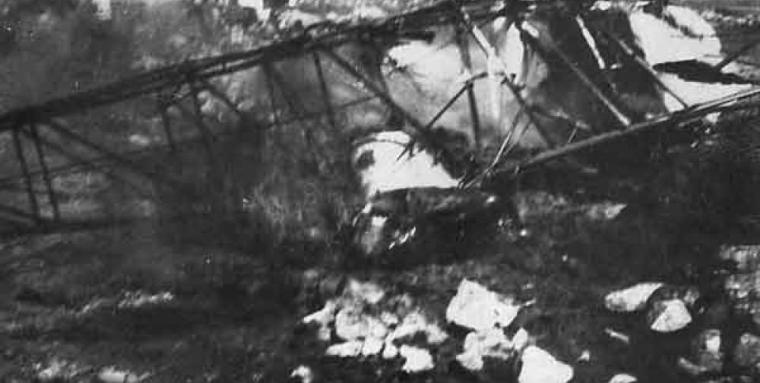
Shortly after take-off from the small airfield at Estoril, the overloaded Dragon Rapide struggled to gain height. Within moments it stalled, crashed, and burst into flames. Sanjurjo died almost instantly from severe burns. Ansaldo escaped the wreckage with injuries. Although excessive baggage has often been presented as the sole cause, modern historians generally regard the accident as the result of several contributing factors: the aircraft’s limited performance, high operating weight, the short take-off area, and the loading of the aircraft. Whatever the precise technical explanation, the crash removed the rebellion’s intended leader only three days after the uprising had begun.
Sanjurjo’s death created an immediate leadership vacuum. The original conspiracy had never depended upon a single commander directing operations across Spain. Mola continued organising the northern fronts while Franco consolidated control over the Army of Africa. The absence of Sanjurjo eliminated the one senior figure broadly acceptable to every major faction supporting the rebellion. Without him, influence gradually shifted toward the generals commanding armies in the field.
Mola remained the principal strategist during the first months of the war, but Franco possessed Spain’s strongest professional force in the Army of Africa and the only conspirator whose authority combined seniority, prestige, and broad acceptance across the principal factions supporting the uprising. Successful airlifts across the Strait of Gibraltar, advances through western Spain, and increasing German and Italian support enhanced his position further. By September 1936 the senior Nationalist generals met near Salamanca to decide on unified leadership. With Sanjurjo gone, no figure possessed comparable seniority or universal prestige. Franco was appointed Generalísimo and Head of State on 1 October 1936, concentrating military and political authority in his own hands. Had Sanjurjo survived, such an outcome would have been far less certain.
It is impossible to know what kind of leader Sanjurjo would have become. Some historians argue he might have presided over a collective military government before restoring the monarchy. Others believe he would still have established a military dictatorship, albeit perhaps one less centralised than Franco’s eventual regime. What is clear is that his death removed the only conspirator whose authority rested upon long-established prestige rather than military success during the Civil War itself.
Sanjurjo’s death is often regarded as one of the most consequential accidents in modern Spanish history. A single aircraft crash removed the man who had expected to command the uprising and opened the path for Franco’s rise to absolute leadership.