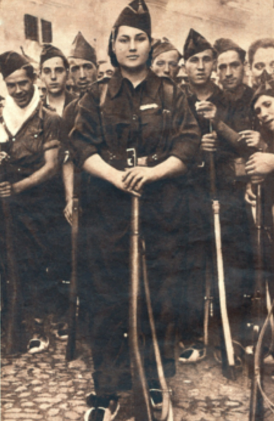
Among the hundreds of women who volunteered to defend the Spanish Republic during the opening weeks of the Civil War, few were celebrated as quickly, and forgotten as completely, as Francisca Solano. When she disappeared during the fighting around El Espinar on 26 July 1936, Republican newspapers transformed her into one of the earliest heroines of the war. Within days, her photograph appeared in the national press. Journalists praised her courage, writers celebrated her sacrifice, and poets immortalised her as La Heroína del Espinar. Yet despite this brief prominence, much of her life has since faded into obscurity. No grave has been identified, no definitive account of her final hours survives, and even the circumstances of her death remain partly shrouded in uncertainty.
According to contemporary accounts and records preserved by the Fundación Pablo Iglesias, Solano was originally from the province of Toledo before settling in Madrid. By the outbreak of the Civil War, she had trained and worked as a nurse at the Hospital de la Fuenfría, while also managing a small boarding house in the capital. She wasalready accustomed to caring for the sick and wounded long before Spain descended into civil war. Her political commitments were equally well established. Solano belonged to the Unión General de Trabajadores (UGT) and was an active member of the Agrupación Socialista Madrileña, attached to the Círculo Socialista del Oeste. Like many politically active workers in Madrid during the Second Republic, she lived in a city where socialist, communist and anarchist organisations had become deeply rooted within working-class neighbourhoods. Political meetings, trade union activity and discussions about social reform formed part of everyday life for thousands of ordinary Madrileños, and Solano was among those who chose to become actively involved rather than remain on the margins.
Eduardo de Ontañón’s Estampa profile portrays a woman remembered for her courage and her character. Friends and comrades described her as calm, thoughtful and deeply committed to the ideals of social justice. When the military uprising spread across Spain in July 1936, Francisca Solano already possessed skills that made her invaluable to the Republican war effort. As a trained nurse, she could have expected to serve behind the lines caring for the wounded. Thousands of women did exactly that, providing essential medical assistance as hospitals struggled to cope with the first casualties of the conflict. But according to Ontañón’s account in Estampa, however, Solano had no intention of remaining in the rear. Her uncle encouraged her to use her nursing experience rather than expose herself to the dangers of the front. bit Solano’s response became the defining quotation associated with her life – ‘No. I will not be a nurse. I want to fight the fascists.’
Following her decision, Solano reported to the headquarters of the Círculo Socialista del Oeste, where volunteers were being equipped for the defence of the capital. Like many of the hastily assembled militia columns of July 1936, the process was informal. She received a rifle, a militia uniform and the most basic military instruction before leaving Madrid for the Sierra de Guadarrama, where Republican volunteers were attempting to halt the Nationalist advance through the mountain passes. Solano many many like her consciously rejected the role that even many supporters of the Republic considered more appropriate for women. Nursing was a dangerous and indispensable service, yet Solano chose instead to become a combatant. In doing so, she joined the first generation of milicianas who believed that defending the Republic required them to fight alongside men as equals. Within days, she would find herself in the mountains north-west of Madrid, where the improvised militia columns faced the first major battles of the Civil War.
By the final week of July 1936, the war north-west of Madrid had become a desperate struggle for control of the Sierra de Guadarrama. The mountain passes linking Segovia with the capital offered one of the most direct routes to Madrid, and both sides recognised their strategic importance. Republican militia columns, many of them composed of hastily armed workers and political volunteers, occupied positions around Alto del León, Guadarrama, Peguerinos and El Espinar, attempting to prevent Nationalist forces from breaking through into the capital.
Francisca Solano was among these volunteers, and like thousands of others who had left Madrid only days earlier, she had received little military training before being sent into combat. The militia columns were enthusiastic but inexperienced, often lacking adequate weapons, communications and coordination. Uniforms were uncommon, officers were frequently elected rather than professionally appointed, and many volunteers learned the realities of warfare under fire.
The fighting around El Espinar was very confused. Republican forces launched a series of attacks and counter-attacks as they attempted to secure the town and the surrounding roads. Control of individual positions changed rapidly, while the pine forests and rugged terrain made it difficult for commanders to maintain contact with their scattered units. In this environment, small groups of militia volunteers could easily become isolated during an advance or retreat. Solano’s unit became involved in one such action near El Espinar. During the fighting, one of her comrades was seriously wounded and left behind as the Republican forces withdrew under increasing Nationalist pressure. Rather than retreat with the rest of her unit, Solano chose to remain behind and attempt to reach him.
What happened next has never been established with certainty. A record claimed that she headed towards the building where the wounded man had been taken, a structure reportedly being used by Nationalist forces as a field hospital. From that moment, Francisca Solano disappeared from the sight of her comrades. She never rejoined her unit, and no verified contemporary account describes exactly what occurred after she entered, or attempted to enter, the building. Her final hours have remained one of the many unresolved episodes of the opening weeks of the Spanish Civil War.
Almost immediately, other versions of her fate began to circulate among the surviving militiamen. One widely repeated account held that Solano had been captured while attempting to rescue the wounded soldier, before being executed shortly afterwards. This explanation became the version most commonly repeated in Republican newspapers and is generally accepted by modern historians as the most likely outcome. Another story claimed that she had shot a Nationalist officer after entering the building and fought until she was finally overwhelmed. This account appeared in later recollections of surviving comrades, but it remains impossible to establish whether it reflected an actual event or a story that developed in the days following her disappearance. Other rumours suggested that she had been killed immediately during the fighting or while resisting capture.
The uncertainty surrounding her death has become part of her story, reflecting the chaotic nature of the Civil War’s opening weeks, when hurried retreats, fragmented units and the absence of reliable records left many families and comrades with rumours instead of certainty. For Francisca Solano, the exact manner of her death may never be known, but the determination that led her to remain behind for a wounded companion has endured as the defining act of her short military service.
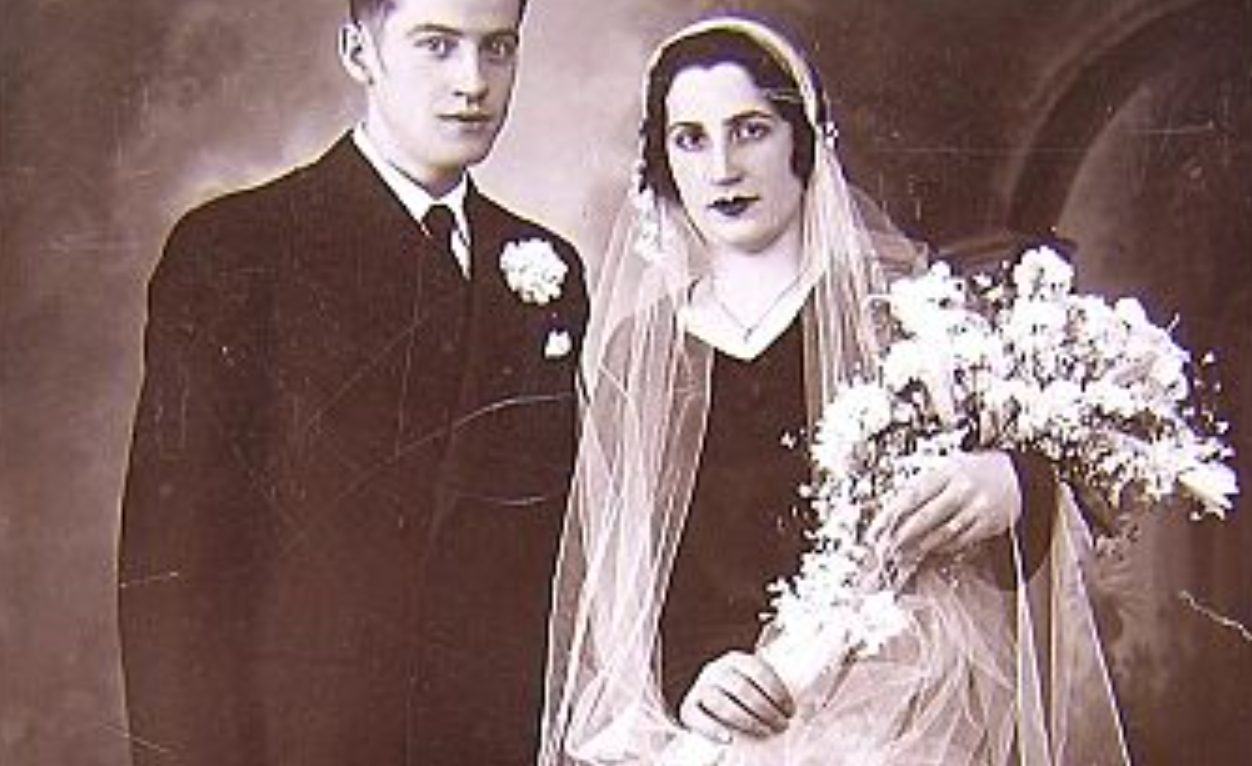
Solano was far from alone. In 2020, a wedding ring was uncovered by the Historic Memory Recovery Association (ARMH) while working on a mass grave in El Espinar, and found it belonged to Eugenio Juan Insua, who was killed on 25 July 1936, age 29, during an ambush and killed alongside 16 other Republican supporters. Insua had been married to Irene Serrano for five years, and was a Madrid trade unionist who, joined the militias to defend the Republic. But Francisca Solano has not yet been identified among the 17 in the mass grave dug on 26 or 27 July 1936, nor is her name among the 33 found in another mass grave also near the El Espinar cemetary.
 CAROLINE ANGUS
You must be logged in to post a comment.