By late November 1936, the Spanish Civil War had settled into a bitter struggle for Madrid.
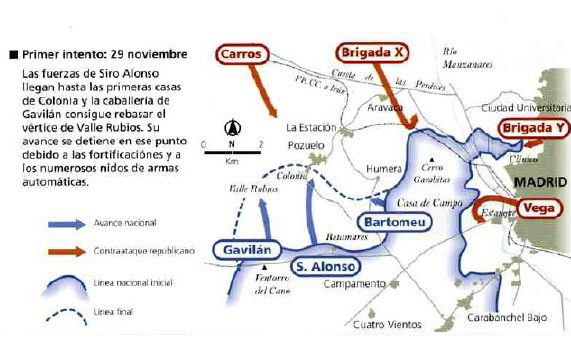
After weeks of fierce urban fighting failed to deliver the Spanish capital to General Francisco Franco’s Nationalist forces, and aerial bombardments failed to break the city’s morale, Nationalist commanders shifted their strategy. Instead of continuing costly frontal assaults into Madrid’s streets, they planned to encircle the city from the northwest. By cutting the strategic Corunna Road and sealing off the approaches from the Sierra de Guadarrama mountains, the Nationalists aimed to isolate Madrid and sever its vital water and electricity supplies.
Commanded overall by General José Varela and led in the field by Colonel Francisco García-Escámez, the Nationalists sought to seize a defensive arc encompassing Húmera, Pozuelo de Alarcón, Pozuelo Station, and Aravaca, push to the Cerro del Águila, and sever the Corunna Road (Carretera de La Coruña) at the Cuesta de las Perdices. Achieving these goals would cut Madrid’s communications with Republican forces in the Sierra de Guadarrama mountains and deprive the capital of vital water and electricity supplies.
The Nationalists had approximately 7,000 troops, primarily Spanish Legionnaires and Moroccan Regulares, with an initial spearhead of roughly 3,000, supported by 44 artillery pieces, 30 Panzer I light tanks, and German Condor Legion Junkers Ju 52 bombers. Defending the sector was the 3rd Mixed Brigade under Major José María Galán. Having held the front for less than a month, the Republicans lacked deep trench networks and relied heavily on fortified houses, garden walls, and summer villas in Pozuelo de Alarcón and Húmera to hold the line until reinforcements could arrive. Initially 3,200 men with only two artillery pieces (one field gun and one anti-tank gun) was later reinforced to roughly 5,200 troops and Soviet T-26 tanks.
The battle transformed quiet commuter towns and summer resorts northwest of Madrid into a devastated war zone, inflicting severe hardship on local residents. Pozuelo de Alarcón, Húmera, and Aravaca were famed for their leafy neighbourhoods of summer villas favoured by Madrid families, which were reduced to rubble by heavy artillery shelling, aerial bombing, and street fighting as soldiers turned private homes into concrete bunkers. Thousands of terrified civilians fled the shelling in Pozuelo, Húmera, and nearby Boadilla del Monte, streaming into central Madrid. Meanwhile, for civilians living in outlying towns like Boadilla del Monte and Villanueva de la Cañada, which remained under Nationalist control, the arrival of Franco’s Army of Africa brought immediate martial law, political purges, and fear of reprisals against anyone suspected of Republican sympathies.
Because the area was filled with resort areas for wealthy and middle-class Madrileños, many of the villas were empty or only partially occupied by caretakers and evacuees by late November, which is why both sides could immediately turn hundreds of houses into fortified bunkers. Pozuelo de Alarcón the largest civilian in the sector, with 4,000 inhabitants, made up of an old agricultural village core, the railway station, and summer villas. Its population dropped by more than half due to destruction and displacement. Nearby Aravaca, (part of Madrid since 1950) had 2,000 locals stuck right along the Corunna Road.
Húmera was part of Pozuelo with only a few hundred inhabitants, a small rural hamlet and summer-home cluster belonging to Pozuelo de Alarcón, sitting just north of the Casa de Campo. Boadilla del Monte had around 700 living in the tiny agricultural village centred around the 18th-century Palace of the Infante Don Luis, located several kilometres southwest of Pozuelo. Villanueva de la Cañada, a town of only 500, was a small farming hamlet further west that was completely devastated over the course of the war.
At dawn on 29 November, Nationalist artillery shattered the morning quiet with a heavy bombardment of the Pozuelo sector, accompanied by Ju 52 bombers striking Republican positions from the air. Under the field command of Colonel Francisco García-Escámez, three mobile Nationalist columns surged forward with the goal of seizing Pozuelo de Alarcón, Húmera, and Aravaca before cutting the vital Corunna Road at the Cuesta de las Perdices. In the center, Colonel Siro Alonso’s column drove northeast from the Boadilla del Monte road straight toward Pozuelo, shielded on its left flank by Colonel Gavilán’s column.
Simultaneously, Colonel Bartoméu’s troops pushed north out of the Casa de Campo park toward the village of Húmera. Caught off guard by the sudden firepower, elements of the defending Republican 3rd Mixed Brigade fell back in disarray. Siro Alonso’s column advanced roughly 3-5km, falling just short of its 7km objective, and reached the outskirts of Pozuelo de Alarcón and Húmera. Yet as the Nationalists closed in, retreating Republican soldiers turned the towns’ garden walls and summer villas into improvised fortresses. Fierce machine-gun fire from fortified houses halted the Nationalist columns right at the edge of both towns as night fell.
Major infantry assaults rarely happened in the pitch dark because advancing across unfamiliar suburban gardens and walls in the dark led to chaos and friendly fire. However, the night was arguably the busiest, coldest, and most nerve-wracking part of the 24-hour cycle. Because Pozuelo de Alarcón and Húmera were fought house-to-house, opposing soldiers were often separated by just a garden wall, a street, or a neighbouring villa. Troops rotated on watch, typically two hours on sentry duty, four hours off, staring into the dark for shadows or listening for the crunch of boots on gravel. Both sides also fired magnesium flares to briefly light up no man’s land and make sure the enemy was not creeping forward. Because the 3rd Mixed Brigade had not built deep trenches before 29 November, night was when they frantically built their defences. While half the men slept or stood watch, the other half knocked loopholes into brick villa walls, piled up furniture, mattresses, and sandbags against windows, and dug shallow connecting trenches across backyards under cover of darkness. On the Nationalist side, sappers used the dark to clear rubble from roads so their Panzer I tanks and supply trucks could move forward at dawn.
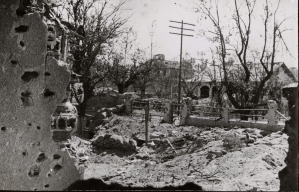
General Miaja sent the 2,000 reinforcements, including the Garibaldi Battalion, on 30 November, moving them in under cover of darkness kept Nationalist spotter planes from seeing where the new troops were being placed to bolster Galán’s battered 3rd Mixed Brigade. Determined to break through the improvised urban defences, Nationalist columns renewed their assault on Pozuelo de Alarcón and Húmera on the morning of 30 November. Throughout the day, Legionnaires and Regulares launched repeated probes against the barricaded streets, only to be met with stubborn close-quarters resistance. While the Nationalists struggled to advance, Republican Madrid Defence commander General José Miaja raced to prevent a collapse on his northern flank. With new troops manning the villas and trenches, the Republicans held every inch of the line.
During the day, any truck or mule cart moving down the roads near Pozuelo de Alarcón was an instant target for artillery or Ju 52 bombers. At night, supply columns crept forward with headlights blacked out to bring up crates of ammunition, hand grenades, and cold rations, usually bread, canned sardines or beans, and cold coffee. Stretcher-bearers worked heavily at night, carrying wounded soldiers out of the shattered villas back to field dressing stations in Madrid or behind Nationalist lines without getting sniped.
Recognising that Pozuelo de Alarcón remained in danger of being overwhelmed, Republican commanders launched a bold diversionary offensive on 1 December against Nationalist positions inside the neighbouring Casa de Campo park. Because thousands of Republican troops were already stationed inside the eastern half of the park and along the riverbanks just metres away from Nationalist lines, Republican command did not have to transport anyone to launch the 1 December diversion, they simply ordered their existing Casa de Campo sector forces to surge forward against the Nationalist flank.
Republican troops struck directly at the flank and rear of the enemy’s staging areas. The gamble paid off, as, forced to divert attention and reserves to stabilise their lines inside the park, the primary columns of Siro Alonso and Gavilán held their positions outside Pozuelo while Nationalist commanders shifted reserves and local units (including elements of Bartoméu’s right-flank group and garrison troops in the park) to contain the Republican attack, pausing their forward assaults. This allowed the exhausted Republican defenders at Pozuelo de Alarcón a crucial day to reorganise.
Small, quiet squads of three to six men from both sides, especially Moroccan Regulares, who were renowned for night scouting, could crawl through gardens and ditches to map out where the enemy had placed machine guns or to capture a stray sentry for interrogation during the nights in the park. Late November and early December around Madrid is literally freezing. Neither side could light campfires because the smoke and glow would immediately draw artillery shells. Soldiers tried to catch 1- or 2-hour naps huddled or wrapped in wool blankets and greatcoats on concrete floors, knowing they had to be awake and in position at least an hour before dawn, the classic time for an enemy attack.
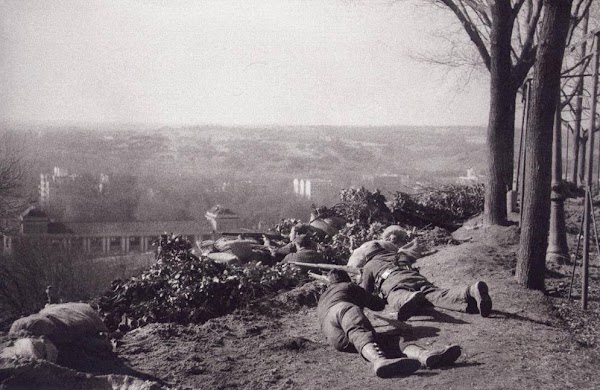
Republican high command rushed a detachment of Soviet-supplied T-26 tanks from Madrid’s mobile reserve into the Pozuelo sector. Unlike the Nationalists’ German Panzer I tanks, which only carried twin machine guns, the T-26 mounted a 45mm high-velocity cannon capable of punching through Panzer I armour and blasting apart Nationalist machine-gun nests in buildings. Holding the suburban villas on 30 November and launching the Casa de Campo diversion on 1 December bought Republican commanders two crucial days to recover from the initial shock, position their newly arrived T-26 tanks along flat approaches south of Pozuelo de Alarcón, and coordinate infantry-armour teamwork rather than fighting in scattered, reactive pockets.
With the Nationalist momentum broken, Republican forces seized the initiative on 2 December and launched a coordinated counter-offensive south of Pozuelo. Backed by armoured firepower, Republican infantry surged forward, recapturing lost ground south of Pozuelo de Alarcón and driving Nationalist units away from the immediate outskirts of both Pozuelo de Alarcón and Húmera. The Nationalists had expended much of their initial artillery ammunition and momentum during the first 48 hours without securing shelter inside the towns, leaving their troops exposed in open terrain when the T-26s rolled out on 2 December.
By the fifth day of the battle, the Nationalists were no longer trying to achieve their original grand objective of cutting the Corunna Road. Instead, they were attempting a push against Húmera to salvage some tactical ground before calling off the offensive. By 3 December, the element of surprise was completely gone, and the Republicans had fortified the villas and brought in 2,000 reinforcements plus T-26 tanks. However, the fortified Republican lines held firm, throwing back the assault without yielding any ground. Spanish military accounts note that on 3 December, the Nationalists pressed on Húmera, obtaining no success, and having exhausted the possibilities of exploiting any success. Shortly after, on 7 December, General Franco officially concluded that the Pozuelo–Húmera front had hardened too much for a 7,000-man force to crack.
Casualty figures for the five-day engagement were never formally tallied, though historians note heavy attrition on both sides. The defending Republican 3rd Mixed Brigade was described in military reports as decimated, having absorbed the brunt of the initial 44-gun artillery barrage and days of house-to-house combat. Formed the previous month in Alcázar de San Juan from the Carabineros corps, the brigade consisted of four infantry battalions, the 9th, 10th, 11th, and 12th, along with a few attached militia companies. When the brigade first deployed to the Pozuelo sector on 7 November 1936, it numbered roughly 2,500 troops. Although it briefly received an International Brigade battalion as reinforcement in mid-November, three weeks of continuous defensive fighting and counter-attacks around Retamares, Campamento, and University City prior to 29 November kept its numbers well below full strength.
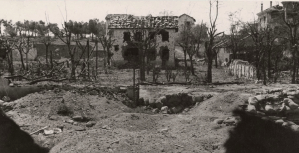
The 3rd Brigade’s commander, Major José María Galán, was lightly wounded and replaced by Captain Emeterio Jarillo, and the entire brigade had to be withdrawn from the front lines to rebuild afterward. On the Nationalist side, losses remain unrecorded, though Moroccan Regulares and Spanish Legionnaires suffered heavy casualties assaulting fortified villas in Pozuelo and Húmera without achieving their strategic goals.
Before the front reached Pozuelo and Boadilla, local Republican militias and armed groups from Madrid had carried out anti-clerical and political repression, including executing 23 Oblate priests in Pozuelo in July 1936 and using the wooded estates around Boadilla del Monte for executions of political prisoners between August and November. But because the Republicans held Pozuelo and Húmera after this five-day battle, Nationalist troops never occupied those towns during the first battle and could not carry over retaliatory repression. As local historians of Pozuelo note, because the sector had become an active frontline in early November, most of the civilian population had already fled into central Madrid or north into the mountains before 29 November. By late November, Pozuelo and Húmera were largely deserted ghost towns occupied by soldiers. Though Nationalist columns pushed past Boadilla del Monte on 29 November, Boadilla itself remained in a contested no-man’s-land after the first offensive.
- Madrid City
By the final days of November 1936, the Battle of Madrid had entered a new and suffocating phase. Having failed to storm the capital directly, and having failed to break its morale with five days of massive German Condor Legion air raids ending on 23 November, General Francisco Franco’s Nationalist forces shifted their approach. While preparing an armoured flanking strike to the northwest along the Corunna Road, Nationalist gunners dug into the western heights of the Casa de Campo park maintained a relentless, daily artillery bombardment designed to bleed the city’s nerves and infrastructure.
The human toll of this daily attrition is recorded in Madrid’s municipal police logs for 28 and 29 November, even though both events were technically the result of artillery shelling and delayed building collapses rather than fresh air raids. On 28 November, enemy shellfire claimed seven lives and left one person wounded across the capital. Six of those fatalities were unidentified victims pulled from the ruins of Calle del Marqués de Santa Ana, number 11, in the central Malasaña district. Twelve days earlier, on 16 November, a heavy bomb had struck the building, collapsing the basement of the Belato printing works where roughly 150 civilians were sheltering and killing 57 people. For nearly two weeks, rescue crews had dug by hand through the crushed masonry, recovering the final unidentified bodies on the eve of the Pozuelo offensive.
The following day, 29 November, shells continued to rain down on Madrid’s southern and central working-class districts. Municipal police reports logged two more deaths and six injuries from enemy artillery, recording strikes along Paseo de las Delicias near the Atocha rail hub and Calle Martín Soler. For ordinary Madrileños, life had moved underground, with tens of thousands slept permanently on the platforms of the Madrid Metro, ration cards governed every loaf of bread, and ambulances shuttled shrapnel victims to overwhelmed clinics while evacuation trains carried the wounded east toward Valencia.
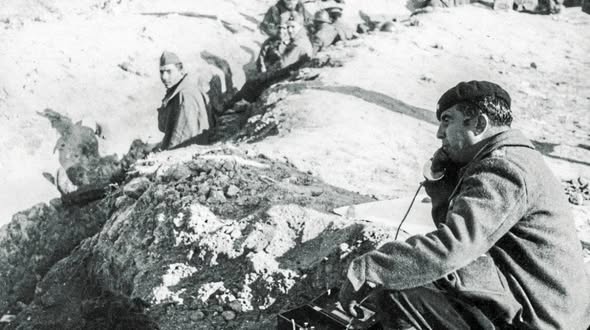
Along the frontline itself, November ended in a frozen deadlock. Inside the ruined buildings of University City and across the shattered streets of Carabanchel to the south, Republican militias, newly reorganised Mixed Brigades, and the exhausted survivors of the XI and XII International Brigades held trenches often just metres away from Franco’s Moroccan Regulares and Spanish Legionnaires.
Historians estimate the scale of November’s losses across three overlapping categories. Across the broader Madrid campaign (November 1936 through early 1937), total military casualties reached roughly 25,000 to 35,000 killed and 40,000 to 50,000 wounded or captured across both armies, with the heaviest concentrated fighting occurring during the initial November 1936 assault. Individual units suffered staggering loss rates. Nationalist columns frequently lost 400+ men in single 48-hour pushes (such as during the capture of Carabanchel and Cerro de los Ángeles on 6 November), while defending Republican brigades, like the 3rd Mixed Brigade at Pozuelo, and the newly arrived XI and XII International Brigades suffered 30% to 50% casualties in University City and the Casa de Campo during November alone.
Between the start of intense bombardments in early November and the end of the month, more than 500 to 1,000+ civilians were killed and thousands wounded inside Madrid. On the worst single bombing days of 16–19 November, records logged 150 to over 300 civilian deaths in a single 24-hour period.
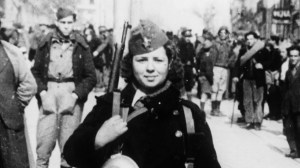
Some female fighters and specialised women’s units were still holding frontline positions at the end of November 1936, though the systematic removal of women from combat trenches had already begun. When Franco’s army reached the gates of Madrid in early November, women fought directly on the barricades. Most notably, the Unión de Muchachas, a Communist-organised women-only battalion of roughly 2,000 young women aged 14 to 25, deployed to the frontline on 8 November 1936, holding critical positions at the Segovia Bridge and near Getafe / Carabanchel, where they formed the bulk of the defenders and were among the last to pull back. Similarly, the Women’s Battalion of the Fifth Regiment (Batallón Femenino del Quinto Regimiento) operated on the Madrid front during November, alongside individual female leaders like 22-year-old column commander Aurora Arnáiz and 17-year-old political commissar Julia Manzanal.
By the end of November, the Republican government under Prime Minister Francisco Largo Caballero, backed by Soviet military advisors and the Communist Party, was actively reorganising the chaotic militias into the disciplined Ejército Popular. As part of this militarisation, authorities issued decrees ordering women off the front lines and reassigning them to auxiliary, medical, communications, and factory roles. While isolated milicianas remained in trenches around Madrid into December 1936 and early 1937, November 1936 marked the final major chapter of organised women’s combat battalions fighting on the Madrid frontline.
When Republican militiamen broke into Calle de Luisa Fernanda, number 6, on 23 November 1936, they were raiding a modest residential house sitting directly on the western lip of the Battle of Madrid. Located in the Argüelles–Príncipe Pío neighbourhood, the street lay barely 200 metres from the Cuartel de la Montaña barracks and less than half a kilometre east of the Parque del Oeste, the exact ridge from which Republican troops were firing down into the Casa de Campo toward Pozuelo and the Corunna Road.
Unlike Madrid’s large, centuries-old convents and monasteries, which were immediately stormed, burned, or requisitioned in July 1936, the community led by María Guadalupe Serneguet Gállego had been able to survive four months into the war largely because of its obscurity and informality. It was a small, newly rented residential house operating without formal legal registration as a religious order yet (initially called the Esclavas del Espíritu Santo y de la Caridad, later refounded as the Esclavas de la Virgen Dolorosa). Once the war began in July 1936, the sisters abandoned their religious habits for ordinary secular clothing. To neighbours and local patrol committees, the flat appeared to be a private charity household caring for pregnant young women, abandoned unwed mothers, and women with mental or physical disabilities.
Anticipating danger at the outbreak of the war, Madre Desamparados had already advised the residents who had families or safe alternatives to disperse. Those who stayed behind at Calle de Luisa Fernanda, 6, were the young novices who refused to leave her and the destitute women who simply had nowhere else to go. On 23 November, the Argüelles district was an active frontline combat zone. Neighbourhood blocks overlooking the Manzanares River were being evacuated, searched house-by-house for fifth-columnist snipers or signalling spies, and cleared for military billets. During one of these wartime sweeps, militiamen entered Calle de Luisa Fernanda, 6, and discovered that the welfare flat was a religious community led by a former Adoratriz nun, complete with hidden religious objects and young women living under religious vows. All eight women remaining in the house were arrested on 23 November and taken to nearby detention facilities inside the neighbouring Cuartel de la Montaña, just a two-minute walk away. Six days later, on 29 November 1936, all eight were executed. Their bodies were never recovered or identified in post-war exhumations, likely because of the immense numbers of deatsh in the area at the time.
Founder María Guadalupe Serneguet Gállego, 49, and three young novices/sisters, María Díaz López, 24, María Pilar Pérez Álvarez, 26, and Carmen González San José, 23. The militiamen also detained and executed the four women living in the shelter alongside them – Carmen Varela Alcón, 20, an orphan from Castellón, María Teresa Navagués González, 18, Mercedes Ansorena,36, and a disabled or destitute resident known in surviving records only as Victoria. After the war ended in 1939, the congregation’s co-founder, Father Manuel Herranz, together with former Adoratriz nun Madre Esperanza Cornago, reconstituted the community in Madrid to continue housing unwed mothers and abandoned women, a mission the congregation still carries on today.
Looking at it purely on a human level, arresting and executing four nuns, alongside four destitute, disabled, or orphaned women they were caring for, in the middle of a massive siege feels profoundly senseless and cruel. In the chaotic paranoia of November 1936 Madrid, with artillery shells hitting the city daily, fifth-column rumours swirling, and militias operating with virtually no oversight, revolutionary committees often treated any religious gathering near the frontline as an automatic political threat, regardless of how harmless or charitable the people inside actually were. Rather than a calculated military necessity, it was a grim product of fear, unchecked ideological hostility, and the breakdown of the rule of law inside the besieged capital. The world is littered with horror stories of what happened to girls and women in these types of homes, especially at the hands of nuns, but this is beyond the pale.
- Cadiz Province, Andalucía
At the end of November 1936, the naval war around Spain was undergoing a major shift.
While the Spanish Republican Navy actually started the war with most of the fleet (a battleship, three light cruisers, and 14 destroyers), its early command structure was crippled because sailors had mutinied against pro-Nationalist officers, leaving ships without experienced senior commanders. By 29 November 1936, the maritime balance had tilted sharply in favor of General Franco’s Nationalists, who were actively tightening a naval blockade around Republican ports while receiving massive foreign shipments of their own.
Two months earlier, at the Battle of Cape Spartel (29 September 1936), the newly completed Nationalist heavy cruiser Canarias and light cruiser Almirante Cervera had smashed the Republican blockade of the Strait of Gibraltar, sinking one Republican destroyer and damaging another. By late November 1936, Canarias and Almirante Cervera were operating freely between the Atlantic, the Strait of Gibraltar, and the Balearic Islands (Mallorca), stopping and seizing merchant vessels bound for Republican ports on both the northern Cantabrian coast and the eastern Mediterranean coast. Meanwhile, the Republican fleet, based primarily at Cartagena, remained largely defensive, venturing out mainly for short escort runs to bring Soviet cargo ships safely into harbour.
Just one week before 29 November, an unidentified submarine, widely identified by historians as the Italian submarine Evangelista Torricelli operating covertly for Franco, torpedoed the Republican light cruiser Miguel de Cervantes right outside Cartagena harbour, blowing a massive hole in her bow and putting one of the Republic’s premier warships out of action for over a year. On 20 November 1936, Nazi Germany secretly dispatched two submarines (U-33 and U-34) from Wilhelmshaven with all national markings painted over under a covert mission codenamed Operation Ursula. By 29 November 1936, these German U-boats were entering Spanish waters around the Strait of Gibraltar and Cartagena to hunt Republican warships and Soviet supply freighters (within two weeks, U-34 would torpedo and sink the Republican submarine C-3 off Málaga).
While Republican ports faced blockade, submarines, and air raids, Nationalist-held Cádiz in the southwest operated as a wide-open funnel for German and Italian war material. Following the official formation of the Condor Legion in mid-November 1936, a steady stream of German freighters sailed from Stettin and Hamburg directly into Cádiz. By 29 November 1936, thousands of German airmen, tank crews, anti-aircraft gunners, Panzer I tanks, 88mm flak guns, and Heinkel/Junkers aircraft had landed at Cádiz and were being railed north to reinforce Franco’s offensives around Madrid.
Off the Spanish coasts in late November 1936, British Royal Navy and French warships were also patrolling international waters under the Non-Intervention Agreement, officially to monitor arms embargoes and protect neutral merchant shipping, though in practice their presence often deterred the Republican Navy from aggressively boarding foreign ships carrying supplies to Franco.
On 29 November 1936, seven men, many of them neighbours, tradesmen, and fathers, were executed near Cádiz’s former Plaza de Toros and buried in the San José Cemetery after being removed from prison two days earlier under the false pretext of a transfer. In the municipal burial registers of Cádiz’s San José Cemetery for 29 November 1936, seven entries share the same bureaucratic formula: interment in a grave sin causa de fallecimiento (without a stated cause of death).According to reconstructed prison ledgers and local historical memory research, six of the men were logged out on 27 November as being transferred to the prison of El Puerto de Santa María, while the seventh was recorded on paper as having been set free. They were taken to the grounds around Cádiz’s former bullring (Antigua Plaza de Toros, today Plaza de Asdrúbal) and shot, almost certainly in the standard dawn firing-squad routine, before being buried together on 29 November
Together, the seven victims represent a cross-section of everyday working- and middle-class life in 1930s Cádiz, including two neighbours who lived almost side by side on the same street in the city’s historic La Viña district –
- Diego Morales González , 21, a young worker at the Campo del Sur ice factory who lived at Calle San Félix, 4. Arrested at home on 31 July 1936 by order of the Public Order Delegate on accusations of being a dangerous Communist and pressuring fellow workers during strikes, he spent months shuttling between the Provincial Prison and the Torpedo Factory detention site.
- José Hernández Herrera, 48, a married bricklayer and father of three daughters who lived right next door at Calle San Félix, 5. Arrested on 9 September 1936, he was held on the prison ship Miraflores and in San Fernando before being returned to the Provincial Prison.
- José Muñoz Arniz, 32, a bricklayer and member of the Spanish Socialist Workers’ Party. First detained on 30 August 1936, he had briefly been released on 24 September, only to be re-arrested on 22 October.
- Francisco Sánchez López, 33, a waiter living on Calle San Dimas, married to Rosario Selis Castro and father of three children (Anselmo, Flora, and Dolores). Imprisoned since 3 September at the Civil Governor’s disposal.
- Manuel Rodríguez Pérez, a baker living on Calle Paz. Detained on 17 September, his prison ledger claims he was taken out on 27 November to be released.
- Antonio Carrillo Santos, a local businessman residing at Plaza de Méndez Núñez, 1, whose brother Aníbal was a merchant marine pilot. Arrested early in the coup on 27 July 1936, Carrillo Santos endured four months of imprisonment aboard the coal hulk Miraflores and in San Fernando.
- Gabriel Mena Mendiros, imprisoned in the Cádiz Provincial Prison on 14 October 1936, he spent six weeks in custody.
In the years that followed, even the dates of their deaths were obscured in official civil registries, some death certificates were not formally entered until 1939, listing euphemisms such as ‘cardiac collapse’ or ‘nervous grippe’ alongside the location Alrededores Plaza de Toros. Today, all seven names are preserved on the memorial monument at Cádiz’s Plaza de Asdrúbal and in the San José Cemetery exhumation and memory archives. Alongside the moats of the Puertas de Tierra (where at least 145 people were shot), the Castillo de Santa Catalina, the Playa de la Victoria, and the walls of the San José Cemetery, the old Plaza de Toros was one of the primary execution sites used by Nationalist authorities in Cádiz city where executions totalled roughly 600–700+ people in the capital alone, and over 3,000 across the wider province.
- Sorihuela del Guadalimar, Jaén, Andalucía
Local Republican militiamen detained Petra, Marta, and Anatalia (Natalia) Montoro Romero in the quiet olive-growing town of Sorihuela del Guadalimar on 28 November 1936, three women in their sixties. The Montoro Romero sisters belonged to one of Sorihuela del Guadalimar’s wealthiest conservative landowning families, the exact social class (caciques and terratenientes) that landless rural labourers and leftist unions blamed for decades of poverty and political exclusion in Jaén (because, well, it was true).
Eleven years earlier, on 23 August 1925, Petra Montoro Romero had made national headlines when the military governor of Jaén appointed her mayor of Sorihuela del Guadalimar, making her the first female mayor in Andalusia and the third in Spain, serving until 3 March 1927). While General Miguel Primo de Rivera’s dictatorship was deeply conservative and traditionalist regarding women’s domestic roles, the regime occasionally appointed unmarried or widowed upper-class Catholic women to municipal posts as a show of administrative regeneration and loyalty to the Crown and Church. By November 1936, Petra was 63, Marta was 66, and Anatalia was 69. Local revolutionary committees treated prominent right-wing families and former Primo de Rivera officials as automatic class enemies and symbols of the old order.
On 28 November, armed militiamen took the three sisters from their homes and locked them overnight in Sorihuela del Guadalimar’s public school, which had been requisitioned as a makeshift local prison. The following day, 29 November 1936 (or late at night on 29 November – early morning 30 November), they were driven out to the bridge over the Guadalimar River, shot and thrown into the river.
Later traditionalist websites and partisan chronologies added graphic details to the event, claiming that young militiamen sexually assaulted the three elderly women, severed their ears, and paraded through town shouting bullfighting slogans. Those embellishments stem from uncorroborated post-war witness statements collected during the Francoist Causa General inquiry and later recycled in neo-Francoist martyrology compilations. During the 1940s, Francoist propaganda systematically amplified stories of sexual violence and ritual mutilation against conservative Catholic women to portray Republican militias as uniquely barbaric, despite a complete lack of oral history or testimony related to any kind of these things happening in Republican regions (rapists are everywhere, but as a war weapon, only the Nationalists encouraged that).
Peer-reviewed Spanish historical studies on Spain’s first female mayors, such as research by historians María Concepción Marcos del Olmo and Guillermo Fatás, confirm the arrest at the school and the execution at the Guadalimar River bridge, while omitting the unsubstantiated mutilation and bullfighting tales. Because their bodies were thrown directly into the flowing waters of the Guadalimar River in late November, during autumn rains when river levels ros, no formal burial grave was dug at the execution site. Victims disposed of in rivers across Jaén and Andalusia frequently vanished downstream without recovery, leaving only post-war civil death registrations filed by surviving relatives after 1939. But their bodies were recovered downstream several days later and were given a burial in the local cemetery, which is why post-war witness statements described gunshot and stab wounds.
The Causa General questionnaires explicitly asked municipal officials and grieving families to list ‘tortures and mutilations’ to build an official propaganda volume, as noted in La Dominación Roja en España, published in 1943. In small towns like Sorihuela, post-war witnesses, often eager to prove their own anti-Republican loyalty or deepen the guilt of accused local militiamen, repeated tavern rumours that the perpetrators had cut off the victims’ ears and mocked them with bullfighting chants.
Graphic details read like oral folklore rather than a consistent forensic report because modern partisan retellings cannot agree on what was mutilated. One version claims they cut off their ears and shouted ¡Como los buenos toreros, las orejas y el rabo! (literally, Like the best bullfighters, the ears and the tail!). Another version circulating in Jaén local Facebook groups claims militiamen cut off their breasts. Meanwhile, early-2000s Causa General summaries mention only gunshot and knife wounds (seen in other locations, general defensive wounds), without mentioning ears, breasts, or bullfighter slogans at all.
Historians who study wartime rumours and Francoist post-war trials have found very specific psychological, political, and legal reasons why certain killings attracted lurid, invented details while others did not. Petra Montoro had been the mayor of the town. Because she had held public authority under the Primo de Rivera dictatorship and belonged to one of Sorihuela’s wealthiest landowning families, her murder was viewed by post-war conservative townspeople as an attack on the entire traditional social order, religion, and hierarchy. When a prominent figure was killed, local rumour-mills often attached ritual humiliation stories like bullfighting slogans or mutilations to emphasise how completely the revolution had inverted the social order, turning respected matrons into’ trophies’ for young working-class men.
In 1930s rural Spain, strict Catholic codes of honour viewed elderly upper-class women, the señoras mayores, as untouchable figures of domestic modesty and piety. Adding claims of sexual assault and bodily mutilation against women in their late sixties was the ultimate way for post-war storytellers to portray the perpetrators not merely as political enemies, but as moral monsters who had violated every sacred taboo of Spanish society. After Franco won the war in 1939, ordinary political killings were sometimes treated as standard wartime crimes, whereas killings involving cruelty, torture, or mutilation carried automatic death sentences for any accused local militiamen sitting in Jaén prisons. In cases where the alleged local perpetrators were still alive and facing court-martial in 1939–1940, grieving relatives and local Francoist authorities had a direct legal motive to emphasise, or embellish, physical cruelty in their witness statements to ensure the maximum penalty.
There is also a very grim, practical detail: the three women’s bodies remained in the Guadalimar River for several days before being recovered. In small rural towns in 1936, villagers seeing bloated, damaged, or animal-scavenged corpses pulled from a river after several days frequently interpreted post-mortem river damage or knife wounds as deliberate, sadistic mutilations, and those visceral eyewitness impressions quickly mutated into embellished town folklore over the decades. All of us who have pulled a corpse from a river know the grim reality, but others seemingly take this fate to use as ammunition. Post-war courts rewarded proof of sadism, local rumour turned an awful political execution into an exaggerated atrocity legend.
Academic studies of Petra Montoro Romero (such as those from Madrid’s Complutense University and Centro de Estudios Borjanos) and summaries of the Sorihuela Causa General file (such as La Gaceta) refer to the killers strictly in collective terms as local Popular Front militiamen linked to the same wave of arrests in Sorihuela del Guadalimar that saw several male right-wing townspeople (including former Agrarian Party mayor Domingo Labrador Romero) killed around the parish church prison that same night. No individual militiaman’s name has entered published historical biographies of the Montoro Romero sisters.
In a small town of roughly 1,500 residents where everyone knew one another, surviving relatives of the Montoro Romero sisters almost certainly named members of the local 1936 municipal committee and militia in those 1939–1940 depositions. Those individual court-martial dossiers are stored in the Archivo del Tribunal Militar Territorial Segundo (Seville) or the Archivo Histórico Nacional (PARES) in Madrid, and their individual defendant names have not been digitised or published in secondary studies.
- Valencia City
Two Catholic priests were executed without trial at the Paterna riding arena outside Valencia. One was Eleuterio Catalá Tomás, 41, assistant priest of Manises. Catalá had taken refuge at his mother’s apartment in central Valencia (Calle Zapateros, 3–4º), where he was arrested on 23 November and held in the detention facility established in the former Seminary. In her post-war Causa General deposition, his mother, Isabel Tomás Catalá, attributed his arrest to a denunciation by the building’s doorkeeper, Mercedes Macario, whom she described as a leftist militant who had been monitoring his movements (though he was more likely just a man who still had a functioning wartime job). Following his execution on 29 November 1936, his body was initially buried in the Valencia General Cemetery. After the war ended his remains were officially exhumed and transferred to the Society of Jesus (Jesuit) pantheon in Valencia.
The other was Alfredo Simón Colomina, 59, a Jesuit priest and former rector of the Colegio San José who had been re-arrested two days earlier. After the Nationalists took Valencia in March 1939, authorities immediately opened the graves around the Picadero de Paterna and the local Paterna Municipal Cemetery. Unlike Republican victims executed at Paterna later in the war whose graves remained closed for decades, victims of 1936 Republican repression were systematically disinterred by the Francoist Causa General and diocesan commissions in 1939–1940 and removed to nearby cemeteries with proper burials or returned to their hometowns.
Ten civilians belonging to, or employed by, the prominent Feliu Ferrando merchant family were executed by Republican militiamen after authorities discovered they had sheltered the Jesuit priest Alfredo Simón Colomina. The victims were brothers Eduardo Feliu Ferrando (along with his wife and son, who go unnamed – that kind of omission is very typical of 1930s and 1940s Spanish legal and newspaper notices, which often treated a married woman and minor child as legal property of the male head of household rather than listing them individually, denying them dignity), Luis Feliu Ferrando, and Enrique Feliu Ferrando; their sister Concepción Feliu Ferrando and her husband Luis García Báguena; and three of their employees, Miguela Ballester, Luis Coloma, and Juan Faust. Because the Feliu Ferrando family were prominent Valencia business owners (proprietors of the well-known department store Los Sótanos on Calle San Vicente / Plaza de la Reina), surviving relatives had both the legal backing of the Causa General and private family plots/niches at the Cementerio General de Valencia to claim and rebury identified remains once the graves were opened in 1939.

