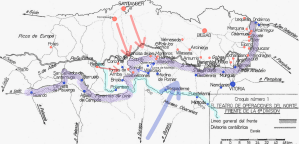
- Santander (Cantabria) – Basque Country – Burgos Front
The fighting between 27 and 30 November 1936 in northern Burgos (Las Merindades) was the opening phase of a coordinated Republican winter offensive across Spain’s Northern Front, happening directly over and through the fields that were seeing the horrific repression already torturing the inhabitants of the area. To relieve pressure on Madrid and break the stalemate in the north, the Republican High Command ordered a synchronised two-pronged offensive from the northern enclave – the Basque Offensive out of Villarreal would see Basque forces (Euzko Gudarostea) attack southward from Bizkaia toward Vitoria-Gasteiz, while the Santander–Burgos Offensive saw the Santander forces would push southeast out of the Cantabrian mountains into northern Burgos.
They planned to cut the vital Santander–Burgos highway near the Bricia and La Lora plateaus, and capture key mountain passes and road junctions, including Villarcayo and Trespaderne. The idea was that they could eventually converge the Basque Columns at Miranda de Ebro, the critical railway and road hub linking Nationalist-held Castile with Navarre and the French border. They also considered trying to take the mega-stronghold of Burgos, but quickly abandoned that third plan.
In November 1936, the Republican Northern Army was still transitioning from loose political/union militias (anarchist CNT, socialist UGT, communist) into militarised brigades (formally designated the II Cuerpo de Ejército – Santander Army Corps). The overarching Northern Front offensive was planned by Major Francisco Ciutat (Chief of Staff of the Army of the North) under General Manuel Llano de la Encomienda. Operational command in Santander fell to Lieutenant Colonel José García Vayas with Lt. Col. Luis López Piñeiro as Chief of Staff. The main 29-battalion concentration of the Northern offensive was committed to the Basque sector at Villarreal. In northern Burgos, fighting involved several thousand troops on each side spread thinly across a jagged, 60km mountain front of isolated villages and high plateaus.
For the offensive, forces were divided into two main operational columns, the first headed by Major José Gállego Aragüés, who was tasked with advancing from the Los Tornos pass through Villasante, Medina de Pomar, and Trespaderne toward Miranda de Ebro. teh second column under Major César Puig García was tasked with descending from the El Escudo pass and advancing toward Miranda de Ebro to establish a bridgehead across the Ebro River. Local militia battalions under Gregorio Villarías López and Fernández Navamuel would hold the rugged moorlands around Espinosa de Bricia and Arija.
Brigadier General Antonio Sagardía Ramos had been dispatched by the Nationalists to the Burgos–Santander border in October 1936, along with the Columna Sagardía (later expanded into the 62nd Division). Sagardía commanded a seasoned, cohesive force composed of regular Spanish Army infantry and artillery detachments, Guardia Civil units, and dedicated Falangist and Carlist Requeté volunteer units from Navarre and Gipuzkoa, and while they only had similar numbers to the Republicans, they were trained, better prepared, and had vastly better equipment.
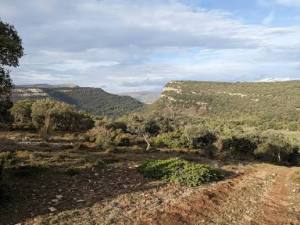
The geography of the Páramo de Bricia, a high, windswept limestone plateau sitting at roughly 950–1,000 metres above sea level, dictated the fighting. Whoever held the high villages controlled the approaches to the Puerto de Carrales mountain pass and the Santander–Burgos road. Preliminary clashes began earlier in the week when Republican troops launched bloody, close-quarters assaults on Cilleruelo de Bricia (22–24 November) and Quisicedo (24 November) to seize the Bricia salient, while Nationalist troops pushed back in the Villarcayo sector on 26 November in preparation.
On 27 November, Republican forces mounted heavy pressure against Nationalist positions around Espinosa de Bricia (which sits in a vulnerable depression below the plateau rim) and Barrio de Bricia (situated on higher, easily defensible ground). General Sagardía’s troops launched a sharp counteraction, seizing the strategic point of Carboneras. This secured Nationalist control over that stretch of the Santander–Burgos highway and blunted the Republican push out of the plateau.
While the main assault on the Bricia plateau stalled Republican units operating slightly further west, around Arija and the Montejo de Bricia enclave, advanced on 28-29 November. They successfully linked their forward positions with the secondary road running from Polientes (Valderredible) toward Burgos, threatening the Nationalist flank. Though 29 November had been designated as the official launch date for the grand coordinated push toward Villarcayo, Trespaderne, and Miranda de Ebro, the Santander columns failed to achieve a breakthrough by month’s end. Harsh winter weather, rugged terrain, ammunition shortages, and strong Nationalist fortifications along the plateau rim kept the offensive bogged down in localised positional warfare. Major fighting in the Villarcayo sector spilled over into early December, culminating in the Battle of Villasante on 2 December.
Contemporary press dispatches from both sides routinely claimed heavy enemy losses during the late-November Bricia clashes, and local histories describe the autumn/winter 1936–37 fighting on the Bricia plateau as among the bloodiest positional warfare in northern Burgos, leaving villages like Espinosa and Cilleruelo de Bricia largely in ruins. Tactically, the late-November operations were a draw that favored the Nationalists. Republican forces gained minor local ground near Arija/Montejo, but Sagardía’s defence of Barrio de Bricia and capture of Carboneras prevented the Republicans from severing the Santander–Burgos road or advancing on Miranda de Ebro. The front line froze into a bitter winter stalemate until renewed clashes erupted in mid-December.
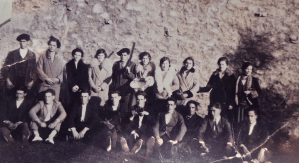
Espinosa de Bricia had approximately 80 residents (now only 16), and Cilleruelo de Bricia had about 60 residents (today only 5). The whole municipality of Alfoz de Bricia had roughly 1,000 inhabitants across all the villages, and almost all of them would be killed in the Offensive between 1936 and 1937. Residents were subsistence farmers tied to their livestock and land. No one expected a quiet, remote moorland with little political conflict to become a major battlefield, so families remained in their stone houses as troops arrived, likely feeling protected. Because civilians stayed, they were caught directly in the crossfire. During the late-November assaults on Cilleruelo de Bricia, Republican attackers stormed the village while civilians were still inside; local testimonies record that several villagers were killed alongside Nationalist defenders, and numerous homes were burned. As the front solidified directly across the Bricia plateau from late 1936 through the summer of 1937, constant artillery shelling, aerial bombing, and house-to-house raids made civilian life impossible.
Surviving residents in Nationalist-held Cilleruelo and Barrio de Bricia were evacuated southward deeper into Nationalist-controlled Burgos, leaving Cilleruelo a ghost town of ruins in just a few months. Residents on the Republican side around Espinosa de Bricia sheltered in nearby natural caves such as the Cuevona or Cueva de la Bruja, or evacuated northward toward Santander until Nationalist forces finally overran the enclave.
Other villages along the northern Burgos front experienced vastly different fates depending on their size and whether they sat directly on the ridge line, ranging from intense industrial mobilisation to total physical destruction and forced evacuation. Barrio de Bricia (80 residents) is positioned on higher, easily defensible ground overlooking Espinosa, and became a fortified Nationalist stronghold. Residents did not immediately flee; they lived a nocturnal existence, hiding inside stone houses by day and tending livestock or performing chores strictly at night to avoid Republican sniper fire from the nearby Castro hill. In Carboneras (50 residents) was occupied by Nationalist forces on 27 November to secure the Santander–Burgos highway, and the tiny settlement sat directly on the contested road corridor and was heavily militarised. At Montejo de Bricia (60 residents), a Cantabrian enclave adjacent to Arija, Montejo was held by Republican militias who pushed outward on 28–29 November to link up with the Polientes–Burgos road. Like Espinosa, its civilians were trapped between trench lines and suffered severe displacement as shelling intensified.
Arija (2,000 residents) was a bustling industrial town centred around the Cristalería Española glassworks. Because it lay just behind the Republican front lines (roughly 10–15km northwest of the Bricia fighting), it was not evacuated in November 1936, and served as a vital Republican logistics hub and staging base for the 28–29 November advances. However, the town was torn apart by internal political violence, when 20 right-wing residents died in early Republican repression, followed by 28 left-wing residents and glassworks committee members executed after Nationalist forces captured the town in August 1937.
Just north of the Bricia plateau, villages guarding the Puerto de Carrales mountain pass and the Valdebezana valley bore the brunt of the winter stalemate. At Virtus and Castrillo de Bezana (150–200 residents each), locals initially dug air-raid shelters into sandstone embankments or hid for days and nights inside natural caverns like the Cueva de la Cencerrada before both villages were evacuated by military authorities. Nearby at Torres de Arriba (obviously near Torres de Abajo), the hamlet was completely levelled by aerial and artillery bombardment during the frontline fighting.
While the Bricia fighting raged in late November, the eastern wing of the Santander offensive targeted the road junctions around Villarcayo and Espinosa de los Monteros. At Quisicedo (Merindad de Sotoscueva, 150 residents), first attacked in a pre-offensive clash on 24 November, sat directly in the path of the eastern push. Alongside combat deaths, its small civilian population suffered severe Nationalist political purges in late November. Over at Villasante and Loma de Montija (200 residents each and already suffering severe Nationalist repression on an almost daily basis), the planned late-November breakthrough toward Trespaderne stalled, but Republican columns launched their delayed main assault here on 2 December 1936 (the Battle of Villasante, which will be covered separately). Fighting raged across the heights of Noceco and Peña de Losa, leaving heavy military casualties, including the death of Republican battalion commander Félix Placer.
Hundreds of soldiers and civilians were killed, wounded, or captured in those late-November clashes, even though the frontline barely moved on a map. The fighting was not long-range skirmishing; it involved direct infantry charges against fortified stone farmhouses, trenches, and bare limestone ridges with little natural cover. In comparable mountain assaults in northern Burgos during that week (such as the preliminary attack on Cilleruelo de Bricia on 22–24 November and the immediate spill over at Villasante), individual battalions regularly suffered dozens of dead and wounded per engagement. Across the 60km front between Arija, Bricia, and Villarcayo, total military casualties easily reached into the hundreds over those four days.
Because villages like Cilleruelo de Bricia and Espinosa de Bricia had populations of under 100 people, even a small number of deaths wiped out a massive percentage of a community. Local testimonies confirm that several residents were killed inside their homes during the late-November storming of the village, alongside dozens of Nationalist defenders. Across the plateau, surviving villagers suffered immediate displacement, exposure to freezing November mountain weather, and the destruction of their homes and livestock. Whenever Republican forces pushed forward or threatened a sector in northern Burgos, Nationalist militias and Falangist squads behind the lines frequently carried out retaliatory abductions and executions (sacas or paseos) of suspected leftists or Republican sympathisers in nearby towns like Medina de Pomar, Valdebezana, and Sotoscueva. In late November 1936 alone, dozens of civilians across Las Merindades were executed behind the lines alongside the soldiers dying on the ridges.
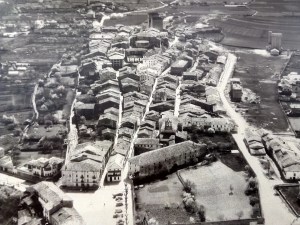
- Valladolid, Old Castile (Castilla y Leon)
Valladolid’s defining distinction is its role as the ideological heartland of Spanish fascism, where repression was carried out by the military AND driven with unmatched ferocity by local Falangist paramilitary squads in the birthplace of the Falange. Valladolid was the historical stronghold of Onésimo Redondo and the JONS (which merged with José Antonio Primo de Rivera’s Falange). When the coup succeeded on 18–19 July 1936, Valladolid had the largest, most aggressive civilian Falangist militia in Old Castile. Valladolid experienced unbridled paramilitary street terror led by notorious Falangist death squads, most infamously the Patrulla del Amanecer (Dawn Patrol) commanded by Vicente Muñoz Navarro. Armed civilians in blue shirts roamed the city and surrounding villages with total impunity, dragging victims out of homes and prisons without even the pretense of military orders.
Valladolid city was a major industrial and railway hub housing the massive workshops of the Compañía de los Caminos de Hierro del Norte (Northern Railway Company), home to one of Spain’s strongest socialist (UGT) and anarchist (CNT) workforces. Because railway workers went on general strike and actively fought the coup in the streets of Valladolid on 18–19 July, with snipers firing from the Casa del Pueblo and railway workshops, the repression had a fierce, anti-industrial class-warfare character. Hundreds of railway mechanics, engineers, and unionists were systematically hunted down and shot, crippling Spain’s northern rail network workforce.
Situated squarely on the main rail and road artery linking northern Spain to the Sierra de Guadarrama and Madrid, Valladolid acted both as an exporter of paramilitary violence (sending Falangist columns to purge neighbouring provinces) and as a penal processing hub for prisoners captured at the Madrid front. Valladolid’s prisons, including the Provincial Prison, the Cocheras de Tranvías (tramway depots), and the San Isidro barracks, overflowed with both local leftists and prisoners shipped north from the front lines, feeding daily firing squads at the Campo de San Isidro and dumping bodies into the vast common graves of El Carmen Cemetery (where more than 1,000 victims were buried, making it one of the largest single burial sites in Castile).
Dubbed La Capital del Movimiento by Nationalist propagandists, Valladolid turned public life into an intense theatre of fascist mobilisation, complete with mass rallies, public burnings of ‘subversive’ books from university and union libraries, and sweeping administrative purges of university professors, judges, and municipal workers. In 1936, Valladolid province had a population of roughly 315,000–320,000 inhabitants (with approximately 100,000 living in Valladolid city), and historians estimate that around 2,500 to 3,000 people were executed in the province during the repression, alongside more than 7,000 individuals subjected to imprisonment, purges, or other reprisals.
Research by the Association for the Recovery of Historical Memory (ARMH Valladolid) and regional historians such as Enrique Berzal de la Rosa have documented 2,334 named victims killed across the province, with academic estimates placing the true total close to 3,000 executions, tying Valladolid with León for the highest death toll in the area. Beyond those killed, more than 7,000 people in the province suffered long-term imprisonment, forced labour, property confiscation, or permanent dismissal from public and railway jobs.
Yet there were many leftists in Valladolid, far more than in almost any other Castilian province. While the rural countryside of Valladolid was socially conservative and Catholic, Valladolid city was a major industrial and transport enclave with a large, deeply organised left-wing working class. Valladolid was the northern headquarters and main workshop hub for the Compañía de los Caminos de Hierro del Norte (Northern Railway Company), alongside metallurgical plants, flour mills, and textile factories. Thousands of railway mechanics, foundry workers, and construction labourers belonged to the UGT and CNT. In the February 1936 general election, although the right-wing CEDA coalition won a majority of seats across the province as a whole (driven by the conservative rural villages), the Popular Front won outright inside Valladolid city itself, and Valladolid had elected a socialist mayor, Antonio García Quintana, who was later hunted down and executed at the Campo de San Isidro.
Outside the capital, landless rural day labourers in major agricultural market towns, such as Medina del Campo, Tordesillas, Peñafiel, and Nava del Rey, had formed active branches of the socialist landworkers’ federation (FNTT), leading to intense purges across dozens of villages after July 1936. Valladolid’s high death toll wasn’t an accident, it was the result of a massive, militant urban working class colliding directly with Spain’s largest, most aggressive civilian Falangist movement inside the city.
By November 1936, the mechanics of Valladolid’s terror had transitioned through two phases.
During the summer peak, the overwhelming majority of Valladolid’s 2,500–3,000 executions occurred during August and September 1936, when Falangist death squads like the Dawn Patrol emptied prisons nightly without paperwork. By November, the initial pool of local union leaders, railway militants, and Popular Front officials had already been largely wiped out or imprisoned, causing the daily body count to drop. In late October and November 1936, Franco’s central military authorities moved to rein in uncontrolled Falangist paseos across Old Castile, replacing street-level vigilantism with rapid military tribunals. Prisoners were now tried in batches on charges of imaginary military rebellion and executed by official firing squads at the Campo de San Isidro (and buried at El Carmen Cemetery). Even with the institutional shift, saca) did not vanish, particularly in rural districts like Medina del Campo and Montes Torozos, and Valladolid’s firing squads also began executing Republican soldiers and political organisers captured on the Madrid front and shipped north to Valladolid’s prisons for trial. But it did not matter what name was placed on an execution, whether at illegal court hearing, or an unmonitored group of village bullies, the result was the same; people who had not committed any offense were being killed by people with no authority.
The 27 November 1936 purge of Valladolid’s Cuerpo de Bomberos, municipal fire brigade was part of a removal of the city council’s workforce, triggered specifically by the firefighters’ alleged refusal to extinguish a fire at the Church of San Esteban on the day of the July coup.
When the military uprising broke out in Valladolid on 18 July 1936, the doors of the Church of San Esteban were set on fire amid the street clashes. Nationalist authorities later accused members of the municipal fire brigade of deliberately refusing to deploy to extinguish the blaze. As part of a department-by-department purge of Valladolid’s 952 municipal employees (which sanctioned 238 city workers, imprisoned 55, and saw 21 killed), the city’s purge commission targeted the fire brigade on 27 November 1936. Alongside routine accusations of leftist or union affiliation, the commission singled out the brigade’s refusal to put out the San Esteban fire, classifying it formally as an act of active resistance against the military coup.
On 2 December 1936, Valladolid’s municipal purge commission moved to remove council’s Building Maintenance Section, proposing the permanent dismissal of eight workers because they had belonged to the socialist-aligned Asociación de Obreros Municipales, Municipal Workers’ Association, which was affiliated with Valladolid’s Casa del Pueblo. The 2 December ruling targeted employees purely for pre-war union membership, part of a methodical, department-by-department removal across Valladolid’s city hall that continued into early 1937 (subsequently hitting the municipal police in January 1937, market workers in March 1937, and school caretakers in August 1937). Before formal departmental purge commissions were organised in late November, dozens of Valladolid’s 952 municipal employees had already been removed through direct violence, imprisonment, or summary decrees, including 21 city employees who were executed or died in prison (many in late July and August 1936) and 55 who were imprisoned.
- Almoharín / Miajadas, Cáceres, Extremadura
Cáceres stands in sharp contrast to Badajoz; while Badajoz experienced a rapid, apocalyptic military slaughter during General Yagüe’s August 1936 march, Cáceres fell almost immediately in July without a major urban battle, turning instead into a quieter, deeply intimate rear-guard purge defined by abandoned mine shafts and landlord-led blacklists.
Across the war and post-war period, historians document roughly 1,700 to 2,000 victims executed in Cáceres province, a fraction of Badajoz’s 11,200–12,000 toll, yet devastating for a province where there was no Republican rear-guard violence to avenge. Cáceres’s rural geography, dotted with abandoned tungsten, tin, and phosphate mines along the Portuguese border, became the signature dumping ground for Falangist execution squads. Prisoners were routinely driven out at night and shot at the edge of deep vertical shafts, most notoriously at Mina Terría in Valencia de Alcántara (where 49 bodies were later recovered from 25 metres underground) and Mina La Paloma in Zarza la Mayor (where 20 victims were thrown down a 33-metre shaft). Using mines allowed perpetrators to hide dozens of bodies permanently without digging trenches.
Between late August and late September 1936, Cáceres city served as General Franco’s personal headquarters (at the Palacio de los Golfines de Arriba) before he relocated to Salamanca. Inside the capital, nearly 700 prisoners were executed or died in custody, shot at the old pistol firing range, the bullring, or the walls of the Nuestra Señora de la Montaña Cemetery (where roughly 300 victims were buried in the unbaptised section known as El Limbo).
While many Nationalist rear-guard provinces saw their violence taper off permanently after autumn 1936, Cáceres experienced two massive peaks. July–November 1936 saw the initial wave of extrajudicial paseos, mine-shaft killings, and rural sacas (continuing steadily through late November 1936 in towns like Almoharín and Valencia de Alcántara). The terror began to ease, only to be reignited a year later, military governor Ricardo de Rada fabricated a communist plot to seize the city, triggering over 400 arrests and the mass execution of nearly 200 people over Christmas 1937, including Cáceres’ former socialist mayor, Antonio Canales. Cáceres was the quiet, rural mirror image, occurring behind closed doors, down deep borderland mine shafts, and along quiet country roads like the 27 November execution of at least ten neighbours from Almoharín, where local elites settled class scores with zero scrutiny.
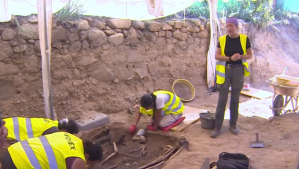
According to a witness, nine women and five men, whose identities are unrecorded, were transported by truck to the boundary between Almoharín and Miajadas. The vehicle stopped near the bridge over the Búrdalo River, close to the Hermitage of San Bartolomé, popularly known as El Santo, though at least two men managed to jump from the truck and flee. The others were taken out of the truck and executed by firing squad in a ditch. Several bodies were left lying on the road, discovered the next day by a bus driver heading between Miajadas to Almoharín. Finding the road covered with bodies, the driver turned the bus around and returned to Miajadas, where he notified the Civil Guard so that they could remove the remains and allow him to continue his journey. After notifying the Miajadas Guardia Civil, the bodies were buried on site and forgotten, with the spot along the ditch not recounted by anyone, leaving families with no information but the general 15km barren strip of road between the villages, where cactus grow along the roadsides around the old San Bartolomé church.
While information about the gravesite and murders comes from one primary source of a victim’s relatives, others who lost a family member that night give the same general area on the road, away from the odd nearby house. But there were a number of people dumped along this stretch of road in multiple events, and the victims even of 27 November may have been buried separately, given that some were left laying out.
In 2009, excavations by Miajadas Historical Memory Association and PREMHEX were attempted along both sides of the road ditches but no one was found. In 2018, José Javier Carreño, alogn with PREMHEX and fmaily members tried again without success. In August 2026, one of the mass graves in the area was discovered, and five bodies were exhumed under the watch of family members, locals and leftist officials of the area, but as of yet, there is no sign of which saca these victims came from, and the work continues. The Historical and Democratic Memory Service of the Provincial Council of Cáceres has €100,000 to investigate and locate mass graves in the municipalities of Villamesías and Almoharín, which was granted by the State Secretariat for Democratic Memory.
- Olivenza, Badajoz, Extremadura
On 27 November 1936, five residents of Olivenza and its surrounding agricultural hamlets were executed by Nationalist authorities, one more deadly entry in a month of sustained political repression that swept across the borderlands of western Extremadura. Olivenza had been firmly under Nationalist control since August 1936, when Colonel Juan Yagüe’s Army of Africa swept northward through Badajoz, leaving thousands of dead in its wake.
Situated along the Guadiana River directly opposite Portugal, Olivenza was a quiet municipality of whitewashed streets and scattered rural pedanías, small farming settlements like San Benito de Olivenza where landless day labourers had strongly backed the Republic’s agrarian reforms. In Olivenza and its surrounding villages, repression reached deep into tiny communities. Historical memory investigations have documented more than 155 victims of Francoist repression in the municipality, though researchers note that many killings went unrecorded in official civil registries. In the small hamlet of San Benito de Olivenza alone, over two dozen residents were killed, including local workers and even a traveling pair of comedic performers who had staged shows at the town’s socialist Casa del Pueblo.
By 27 November 1936, the executions of five more residents from Olivenza and its outlying settlements underscored how relentless that purge had become. Multiple attempts have been made to find these fiver victims, with multiple executions of trenches being undertaken at Olivenza cemetery, yet coffins, boxes and loose bones have been found, none are related to the five murdered victims, and the search remains ongoing. Their names remain private, alongside the 155 victims of the town, though a monolith to the victims of repression is in place at the cemetary.
- Munébrega, Zaragoza, Aragon
On 27 November 1936, four residents of the small Aragonese village of Munébrega were taken by Nationalist forces to the neighbouring spa town of Alhama de Aragón. There, just outside the town along the road leading south toward the Monasterio de Piedra, they were shot and buried in an unmarked roadside trench across from the former civil cemetery. By late November 1936, Alhama de Aragón was still far removed from the active trenches of the Spanish Civil War. Nationalist forces had secured control of the Calatayud district in western Zaragoza almost immediately after the July military coup. Yet in towns well behind the front lines, a quieter, systematic campaign of political violence was still unfolding.
Throughout the autumn of 1936, local Falangist squads, Guardia Civil, and military authorities carried paseos targeting union members, municipal officials, and suspected supporters of the Popular Front. Victims were taken from their homes or local holding cells under cover of darkness and driven along rural roads connecting neighbouring municipalities. For the four villagers from Munébrega, a quiet agricultural community roughly 15km away, that final journey ended on the road between Alhama de Aragón and the Monasterio de Piedra. Choosing a spot beside the old civil cemetery was deliberate; burying executed prisoners in roadside ditches just outside town limits served both to conceal the bodies from official municipal registries and to instil fear among travellers and local farmers.
Decades later, regional historical memory researchers documented the site as one of several unmarked mass graves surrounding Alhama de Aragón, though subsequent widening of the road toward the Monasterio de Piedra paved over the exact location of the trench. Today, the 27 November killings stand as a stark reminder that in 1936, the deadliest front in rural Aragón was the quiet country roads linking one village to the next. The four men were Manuel Revuelto Bueno, Julián Gil Peiró, Casimiro Hernández Montesinos, and Luís Ramón Gregorio, who all remain missing.

