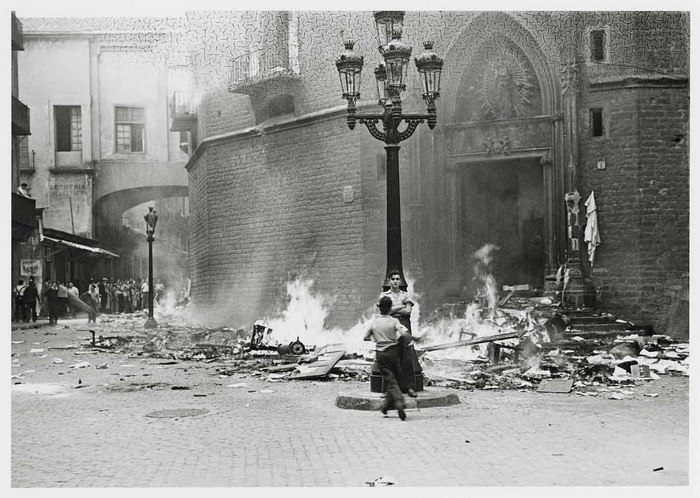
For centuries, the Catholic Church in Spain had been far more than a religious institution. The Church was deeply woven into the political, economic and social fabric of Spain, exercising influence that reached from the royal court to the smallest rural village. By 1936, many revolutionaries did not see churches simply as places of worship. They saw them as visible symbols of an old order that they believed had preserved inequality, defended privilege and resisted social change for generations.
Religion shaped almost every stage of life. Baptisms, marriages and funerals were administered through the Church. Parish records served as important civil documents before the establishment of modern civil registries. Religious festivals marked the calendar in towns and villages across the country, while Catholic teaching defined expectations surrounding family life, morality and public behaviour. Attendance at Mass was often viewed as a sign of respectability, and in many communities those who openly rejected religion risked social isolation or suspicion. A man could be a gambler who slept with every prostitute in town, but as long as he had a wife and a handful of children well-dressed on Sunday morning, he could still be a pillar of the community.
The Church also possessed considerable economic power. Despite the confiscation and sale of much ecclesiastical property during the nineteenth century, it remained one of Spain’s wealthiest institutions. It owned churches, monasteries, convents, seminaries, schools, hospitals, and agricultural estates throughout the country. Religious orders controlled extensive property portfolios, while donations, rents and investments continued to provide substantial income. Though the exact scale varied between regions, the Church remained a significant landowner, particularly through religious communities and diocesan holdings.
Its influence over education was equally profound. Thousands of children attended schools run by religious orders, where Catholic doctrine formed the basis of daily instruction. Teachers employed by these schools did far more than teach reading and writing. They helped shape political and moral values, presenting obedience, hierarchy, and religious authority as the foundations of a stable society. While many clergy believed they were providing moral guidance and valuable education, critics argued that Church-controlled schooling discouraged independent thought, scientific understanding, prevented gender equality, and reinforced existing class structures.
The Church’s political influence extended well beyond the classroom. Bishops regularly issued pastoral letters commenting on elections, legislation, and public affairs. Senior clergy maintained close relationships with conservative politicians, members of the aristocracy and military leaders. Although individual priests differed in their political opinions, the institutional Church consistently opposed many of the reforms demanded by republicans, socialists and anarchists. Divorce, secular education, civil marriage, land redistribution, women’s rights, and organised labour all encountered resistance from much of the Church hierarchy, which regarded these measures as attacks upon Christian civilisation and the natural social order.
For millions of Spain’s rural poor, particularly in regions such as Andalucía and Extremadura, this relationship between Church, landowners, and local authorities was impossible to ignore. Agricultural labourers endured seasonal unemployment, low wages, and chronic poverty while large estates remained concentrated in relatively few hands. Priests frequently occupied positions of considerable local authority alongside estate owners, mayors, judges, and Guardia Civil officers. Whether this reflected genuine political collaboration or simply the realities of rural society, many workers came to see these institutions as protecting the same unequal system. When labour disputes arose, Church leaders more often condemned class conflict than the conditions that had produced it.
Throughout the nineteenth century, Spain experienced repeated cycles of revolution, fighting, and political upheaval. Liberal figures attempted to reduce the Church’s economic power through the confiscation and sale of ecclesiastical property, while conservative governments restored many of its privileges. These struggles were never solely about religion. They reflected competing visions of what Spain should become: one centred upon monarchy, Catholicism and traditional authority; the other seeking constitutional government, secular institutions and greater social equality. As Spain slowly industrialised, particularly in Catalonia, the Basque Country and Madrid, a growing industrial working class developed its own political identity. Factory workers, railway employees, dock labourers, printers and miners increasingly organised themselves into trade unions and political organisations that challenged both employers and the institutions they believed defended existing inequalities. The Confederación Nacional del Trabajo argued that the Church encouraged obedience while discouraging workers from questioning the economic system that kept millions in poverty. The Unión General de Trabajadores and the Spanish Socialist Workers’ Party were often less hostile towards religion itself, but many of their members nevertheless viewed the institutional Church as an ally of conservative politics and employer interests.
One of the earliest major outbreaks of violence against the Church occurred in Madrid during July 1834, when crowds attacked monasteries during a cholera epidemic. Around 80 monks were killed, beaten or stabbed to death before monasteries were looted. The following year, anti-clerical riots spread through Catalonia and other parts of eastern Spain. Monasteries in Barcelona, Reus, Tarragona and several other cities were attacked, stripped and set on fire. Numerous religious communities were forced to flee, while many historic buildings were destroyed. For the next seventy years, anti-clerical violence reappeared whenever political tensions erupted. Churches were attacked during local uprisings and periods of revolutionary unrest, but no outbreak matched the scale of the events that unfolded in Barcelona during the summer of 1909.
By the early twentieth century, as the last generations who remembered the Spanish Inquisition were finally gone, anarchist and socialist unions had attracted hundreds of thousands of members who sought fundamental changes to Spanish society. Their demands included eight-hour working days, higher wages, land reform, secular education, and democratic freedoms. To many within these movements, the Church was an active defender of employers, landlords, and traditional authority. Sermons condemning socialism, pastoral letters warning against anarchism, and public support from senior clergy for conservative governments reinforced this belief. For many Spaniards, particularly among the urban working class and rural poor, anti-clericalism was a political and social movement directed against an institution they believed had accumulated immense wealth, defended privilege and opposed almost every attempt to reform Spanish society. Tragic Week marked a turning point. Between 26 July and 2 August 1909, opposition to military conscription developed into a widespread urban insurrection. During the fighting, approximately 80 churches, convents, monasteries and religious schools were burned or badly damaged across Barcelona. Many religious buildings were first looted and stripped before being set alight, while libraries, archives, religious images and furnishings were destroyed. Official figures recorded 78 deaths during the week’s violence, although later historians have suggested the true number may have exceeded 150 when all civilian and military casualties are considered. Most of those killed died during clashes between demonstrators and government forces rather than inside the religious buildings themselves.
During the reign of Alfonso XIII and the dictatorship of Miguel Primo de Rivera, the monarchy closely identified itself with Catholicism, while the dictatorship enjoyed broad institutional support from much of the Church hierarchy. Although there were clergy who sympathised with social reform and priests who worked tirelessly among the poor, these voices never shaped the public image of the Church. The institution became closely associated with monarchy, military authority, and conservative politics.
With the proclamation of the Second Republic in April 1931, Spain experienced its largest wave of anti-clerical violence since 1909. Between 10 and 13 May 1931, churches, convents, monasteries and religious schools were attacked across much of the country. Madrid saw the first major fires, but the violence quickly spread to Málaga, Seville, Cádiz, Alicante, Valencia, Murcia and several other smaller locations. Modern estimates indicate that more than 100 religious buildings were damaged or destroyed during the four days of unrest, and Madrid’s Jesuit Casa Profesa’s library, lost 80,000 volumes as it burned, including incunables and first editions of Spanish Golden Age authors. The pattern of destruction was strikingly similar from city to city. Crowds entered churches and convents, removed sacred objects, dragged furniture into the streets and set buildings on fire. Libraries and archives were often burned alongside altars, confessionals and religious images. Some buildings were completely destroyed, while others were gutted before the fires were extinguished. Despite the scale of the property damage, relatively few people were killed directly during the May riots. Contemporary accounts record several deaths across the disturbances, including civilians shot during clashes with security forces and individuals caught in confrontations surrounding the attacks, but the violence was directed overwhelmingly against property rather than against clergy themselves. Priests, monks, and nuns, they were all allowed to leave before the destruction took place.
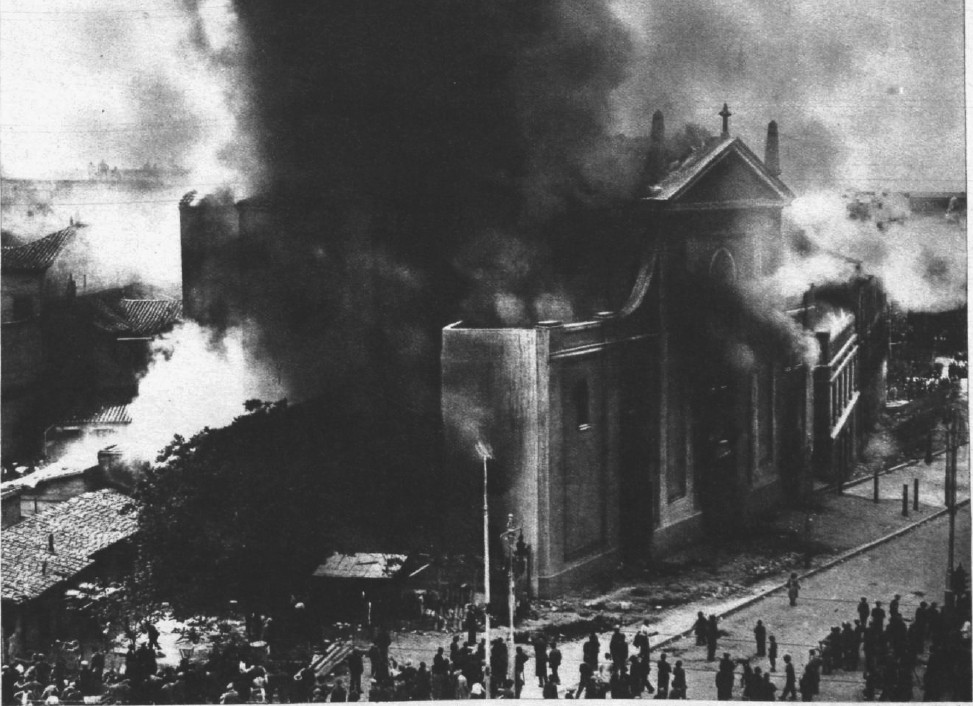
Anti-clerical violence continued intermittently during the following years but the Asturian miners’ strike of 1934 brought anti-clerical violence to a level not seen since 1909. Beginning on 5 October 1934, approximately 30,000 armed miners and other revolutionaries overran much of Asturias, occupying Oviedo and numerous mining towns within days. During the two-week uprising, at least 58 churches, convents and other religious buildings across Asturias were burned or destroyed, including churches in Oviedo, Mieres, Sama, La Felguera and Turón. The Cathedral of San Salvador (now Cathedral of Oviedo) suffered some of the most famous damage when the eighth-century Cámara Santa was blown apart during the fighting, destroying irreplaceable medieval treasures and relics. Across Asturias, 37 priests and religious brothers were killed, most after being arrested and summarily executed by revolutionary groups. Among the best known were the eight Martyrs of Turón and the Passionist priest Inocencio of the Immaculate, who were executed near Turón after refusing to renounce their faith. The destruction was accompanied by widespread looting of churches, the burning of altars, religious images, archives and libraries, including the one in the University of Oviedo, while many surviving church buildings were occupied by revolutionary committees or used for military purposes.
The months before the Spanish Civil War were marked by increasing political violence, and the Catholic Church did not escape it. Throughout the first half of 1936, churches, convents and other religious buildings were attacked in towns and cities across Spain. Most incidents were local rather than coordinated, but together they reflected a political climate that was becoming steadily more confrontational.
Following the Popular Front’s electoral victory in February 1936, anti-clerical demonstrations became more frequent. Churches were damaged or set on fire in a number of provinces, including Madrid, Alicante, Murcia, Valencia, Málaga, Seville and Granada. In many cases, crowds broke into church buildings, smashed religious images, removed furniture and attempted to set the interiors alight. Some fires were quickly extinguished, while others caused extensive damage. Most involved individual churches or small numbers of religious buildings rather than entire cities engulfed in anti-clerical violence. But they reinforced fears among Catholics that public order was collapsing, while many revolutionaries regarded the attacks as further challenges to an institution they believed remained politically aligned with conservative Spain.
Violence against members of the clergy also continued. Priests were assaulted in several provinces, religious processions were disrupted, and churches were vandalised during periods of political unrest. Although the number of clergy killed before the military uprising remained small compared with the months that followed, the attacks contributed to an atmosphere in which many believed confrontation between the Church and the revolutionary left had become increasingly inevitable.
During the first half of 1936, anti-clerical violence remained intermittent rather than continuous. Churches, convents and religious schools were attacked in numerous towns and cities across Spain, particularly in politically polarised urban centres, but there was no nationwide wave of destruction comparable to the outbreaks of May 1931 or the revolution that followed the military coup in July. Most incidents involved vandalism, looting or attempted arson, although some churches were completely burned. Violence against clergy occurred but remained relatively limited, with attacks directed more often against Church property than against priests themselves. The pattern was one of repeated local outbreaks rather than a coordinated national campaign, yet each incident further deepened the hostility between the institutional Church and Spain’s revolutionary left.
The attacks on churches formed only one part of a much wider pattern of political violence that gripped Spain during the months before the Civil War. Across the country, clashes erupted between rival political organisations, trade unionists, landowners, Falangists, socialists, anarchists, members of the security forces and ordinary civilians caught in the middle. Political assassinations, street shootings, bomb attacks, strikes that turned violent, attacks on newspaper offices, party headquarters and union premises became increasingly common. Priests were assaulted because they were associated with the institutional Church, just as socialist organisers, Falangists, Civil Guards, landowners, labour activists and local politicians could find themselves targeted because of their perceived political loyalties or social position. Although most Spaniards never experienced violence directly, the steady succession of local outbreaks created a growing sense that no profession, class or political affiliation guaranteed safety. By the summer of 1936, many communities had become accustomed to hearing of shootings, arson attacks or political confrontations occurring somewhere else in Spain, even if their own town remained temporarily untouched.