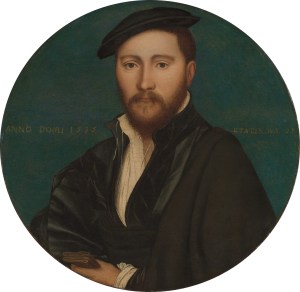
OTD with Thomas Cromwell, 7 April 1540: Cromwell and Secretary Sadler

Ralph Sadler by Hans Holbein. Metropolitan Museum of Art, 49.7.28

On 7 April, 1540, Cromwell wrote to Ralph Sadler, newly the co-secretary to the King. How odd Cromwell must have felt to write to the Master Secretary after six official years in the role himself. The letter concerns sending Richard Pate to replace Thomas Wyatt and Thomas Legh with the Emperor, so that Wyatt could accompany the Prince of Salerno, Ferdinando Sanseverino, to England for a visit. The letter shows the teething problems of the role changing hands; whereas Cromwell and Henry could have discussed matters, now the King would tell Sadler, who would talk to Cromwell, who then had to explain his suggestion, and then Sadler reported back to Henry. At the time, Cromwell was at home at Austin Friars while Sadler was at court with the king. This was a long-standing arrangement that allowed Cromwell a bit of space from court when needed.  

Sadler and Thomas Wriothesley were the first men to share the role, a situation that would not last. Promoted into the role because of his favour and loyalty, Ralph Sadler was more than capable of the role, trusted by the king, and would give another 40 years of fine loyal service to the crown. Sadler’s partner in the role, Wriothesley, would soon become a traitor to his master in an attempt to gain his own favour before bullying Sadler out of the role. Wriothesley died alone in 1550 after eventually being spurned by the court.

This is one of the final letters sent out under the name Thaosm Cromwell, as Cromwell was then given an earldom and started signing letters as Thomas Essex.

THOMAS LORD CROMWELL TO SECRETARY RALPH SADLER, 7 April 1540 (Roy. 7 C. xvi, f. 149)

To my assured loving friend, Mr. Sadler, Esquire, one of the King’s Majesty’s two principal secretaries.

Master Secretary, after my right hearty commendations, by your letters addressed unto me by this bearer, I do perceive the King’s Majesty’s pleasure touching answer to Mr. Wyatt’s letters, which I received as I rode hither, and be now remitted unto me, I require you to signify to his Majesty that I shall, according to my most bounden duty, cause Mr. Pate to put himself in order, and give advertisement to Mr. Wyatt accordingly. Immediately upon the receipt of your answer to the letters which dispatch to Mr. Wyatt, I shall stay till that time upon the purpose following.

First, where his Majesty thinks that Mr. Pate might arrive in such season as Mr. Wyatt might well accompany the Prince of Salerno hither, surely I think the same, but whether Mr. Wyatt should have his opportunity to depart so soon after Mr. Pate’s coming as he might well accompany the said Prince or no, I doubt much, the time of the taking of his leave, and the receipt of such letters and matter as he should bring with him not being in his arbiter or appointment. And yet as I think it were not mete that he made too much haste even at his departure, lest thereby he should lose some knowledge worthy to be related after to the King’s Majesty. Again, under his Majesty’s correction, I think it more mete that Mr. Wyatt should animate the said prince of himself to come hither as though he had given no significance of it, then that he should accompany him, being there his highness’ ambassador.

The world which knows that an ambassador dares not conduct such a man without his Master’s knowledge may think otherwise of it then there is cause, seeing it shall be no doubt of it opened that neither he has desired license to come, nor yet shall be recommended by the Emperor. In my poor opinion, it should be well done that some warnings were sent to Calais for his entertainment if he come, and some order for the like at Dover etc. for his money after he shall be here arrived, without making any further suits unto him in this behalf. Wherein, nevertheless I refer me wholly to his Majesty’s pleasure as my bounden duty requires and shall upon your answer make the dispatch accordingly.

Touching Legh, I think the opinion good for his coming home with Mr. Wyatt, which I trust shall be composed in such ways as he shall not stick at it, and then his Majesty may object to him his contemptuous absence at his pleasure. And if his gracious pleasure be that I shall send the minute after it shall be devised, I shall accomplish his pleasure therein as shall appertain. Since the beginning of this letter, I am informed that Mr. Pate is there. I pray you send for him and help him to take his leave that he may repair hither with diligence, and in the mean season, his letters of credence shall be prepared. But as for instructions, I think he shall better take them at Mr. Wyatt’s hand as to learn the state of things, then we can advise him here, unless it shall please the King’s Majesty to commit any other secret matter unto him then I know of. Thus, most heartily fare you well. From London this Wednesday night

 Your assured friend

THOMAS CRUMWELL

Note added by attendant – My Lord Privy Seal to Mr Sadler.

Cromwell’s ledgers are printed in full in The Letters and Remembrances of Thomas Cromwell

Wolf Hall 2: The Mirror and the Light – What Happened to Ralph Sadler?

Cromwell and Sadler in The Mirror and the Light. Photo: BBC/Playground Entertainment

From The Private Life of Thomas Cromwell

Thomas and Elizabeth Cromwell may not have had their own children in the early period of their marriage (just as Cromwell’s sisters did not), but they did take on a ward, young Ralph Sadler. Cromwell met Henry Sadler from Hackney, who worked with Morgan Williams for Thomas Grey, 2nd Marquess of Dorset. In 1517, Sadler’s wife Margaret died, leaving him with three young boys, Ralph, John, and infant Nicholas. Ralph, aged between seven to ten years old, went into Cromwell’s household and simply never left, becoming a son to Cromwell in all but name. Cromwell and Henry Sadler remained friends throughout their lives, the pair dying
just months apart, with Cromwell happy to aid the entire Sadler family. Ralph Sadler was Cromwell ward until 1527, when he started work as a clerk, first appearing in the paperwork on a murder case Cromwell was overseeing, the death of  Isabella Watson and her unborn baby.

Following the downfall of his patron and surrogate father, in 1540, Sadler managed to maintain his position at court, proving himself indispensable through his administrative expertise and diplomatic abilities. As co-Master Secretary to the king (with Thomas Wriothesley) since April 1540, Sadler came to grief alongside Sir Thomas Wyatt in early 1541, when the pair were arrested  on the king’s orders on very undefined terms. The king was still in a period of mourning Cromwell and yet suspicious of Cromwellians at court. The exact ‘crimes’ that Sadler and Wyatt committed go largely unrecorded. Sadler was given the chance to speak with Henry, and he managed to smooth-talk his way out of prison and remained in the privy chamber and Privy Council (Wyatt was sent to trial for speaking undefined slander and found innocent months later when Henry calmed down).

But Thomas Wriothesley, the great traitor, constantly bullied Ralph in his shared role as secretary. Sadler stayed out of Wriothesley’s way, and was one of the men tasked with overseeing the interrogation and execution of Queen Katheryn Howard in late 1541 and early 1542, alongside Thomas Cranmer. Sadler was removed as co-secretary in 1543 and given a figurehead role in the king’s wardrobe so he could remain close to the king, but his official position was to be a diplomat and advisor. Sadler did his best to make moves against Stephen Gardiner and the Duke of Norfolk throughout the rest of Henry’s reign in revenge for their behaviour against Cromwell. Both men continued to stir up trouble throughout the 1540s, and both men were committed to the Tower for all of King Edward’s reign.

Sadler came to grief in 1545, when his wife Lady Ellen’s first husband Matthew Barre reappeared, not dead after all, but the king had parliament ratify Sadler’s marriage and legitimise his children Thomas, Edward, Henry, Anne, Mary, Jane, and Dorothy through the Legitimation of Sir Ralph Sadler’s Children Act 1545 (37 Hen. 8. c. 30). The couple remained married for another 25 years until Ellen’s death.

After Cromwell’s execution, Sadler continued in the service of Henry VIII, who valued his experience in Scottish diplomacy. In the 1540s, he was sent as an ambassador to Scotland, where he worked to secure the Treaty of Greenwich (1543), which sought to unite England and Scotland through the marriage of Henry’s son, Edward VI, to Mary, Queen of Scots. The treaty ultimately failed due to Scottish resistance, leading to a period of military conflict known as the Rough Wooing. Sadler played a role in advising English commanders during this war, reflecting his continued importance in Henry’s foreign policy.

Henry VIII’s death in 1547 did not diminish Sadler’s influence. Under the rule of the young Edward VI, he remained active in government, supporting the Lord Protector, Edward Seymour, Duke of Somerset. He was involved in England’s ongoing military campaigns in Scotland, notably at the Battle of Pinkie Cleugh (1547). Sadler also took on key administrative roles, such as serving as Treasurer of the Army.

Following Somerset’s fall in 1549, Sadler’s career became more precarious. He briefly aligned with John Dudley, Duke of Northumberland, who took control of the government. However, when Mary I became queen in 1553, Sadler withdrew from public affairs due to his Protestant sympathies. Unlike many others associated with Edward VI’s Protestant government, he avoided execution, though he spent much of Mary’s reign in relative obscurity.

Sadler’s fortunes revived with Elizabeth I’s accession in 1558. As a Protestant, he was well-suited to serve the new queen. His deep knowledge of Scottish affairs made him invaluable during the tense negotiations between England and Scotland in the 1560s. He was again appointed as an ambassador to Scotland in 1559–1560, playing a role in securing the Treaty of Edinburgh (1560), which ended French influence in Scotland and helped establish Protestant control under James Stewart, Earl of Moray.

In the later years of Elizabeth’s reign, Sadler was tasked with overseeing the imprisonment of Mary, Queen of Scots. Though he had previously advocated diplomacy with Scotland, he recognised Mary as a potential threat to Elizabeth. In 1584, he was given the difficult role of Mary’s jailer at Tutbury Castle, though he treated her with kindness.

Sadler remained an esteemed elder statesman until his death in 1587, and he died as the richest commoner in England. His long career was marked by adaptability and discretion, allowing him to serve Tudor monarchs across a volatile period of English history. Unlike many of his contemporaries, he managed to navigate the shifting tides of court politics without suffering disgrace or execution.

The Life and Letters of Ralph Sadler will be published in 2026