Barcelona, the capital of Catalonia, had been a traditional stronghold of Spanish republicanism since the 19th century. General Emilio Mola, the leader of the coup plot, had foreseen several weak points in the military uprising, and one of them was Barcelona, given that the city was an important centre of the labour movement and therefore the chances of the conspiring military officers were much lower there than elsewhere. The commander of the 4th Organic Division, General Llano de la Encomienda, was loyal to the Republic; in fact, he had even warned his officers that, although he personally supported the Republican Union party, if circumstances forced him to choose between two extremist movements, he would not hesitate to support communism rather than fascism. But this opinion was not shared by all the officers of the Barcelona garrison, within the officer corps of the Barcelona garrison, the true mastermind of the conspiracy was Captain Luis López Varela. Another of the most prominent conspirators was Captain Ramón Mola, brother of General Mola, who in turn acted as a close collaborator of the Director.
In Barcelona, the officers sympathetic to the uprising had managed to assemble a significant force, gaining the support of a large number of officers, as well as right-wing, traditionalist, and Falangist volunteers. They commanded a force totalling 3,000 men. Their plan was for the units stationed in the various barracks on the outskirts of the city to converge on Plaça de Catalunya, while simultaneously seizing control of the main political and administrative centres (Generalitat, Parliament of Catalonia, City Hall, Public Order Police Station) and also the telecommunications centres (Telefónica, Post Office, and radio stations). They assumed that, after this, it would be easy to dominate the rest of the city. The conspiring military officers counted on the prestige of Goded, a staunch right winger and enemy of the left, to align the Barcelona troops and secure the rebels’ possession of this important city.
But the conspirators had a major problem. They lacked the support of the security forces, as the Guardia Civil, which had 2,000–3,000 officers and whose officers were mostly loyal to the Republican government. The situation was much worse in the Assault and Security Corps, which had 2,800–3,200 officers and whose commanders were clearly Republican. Finally, the Generalitat had the Mossos d’Esquadra, which had a force of 300 officers. The conspirators also lacked the support of the Military Air Force.
A few days before the planned start of the military uprising, the police arrested several officers of the Barcelona garrison who were involved in the conspiracy and seized several incriminating documents, including the declaration of war that was scheduled to be published. By then, the security forces had been very active in the Catalan capital, carrying out numerous police raids and checkpoints in the streets. The authorities of the Generalitat prepared a plan to respond to a possible uprising by the military garrison.
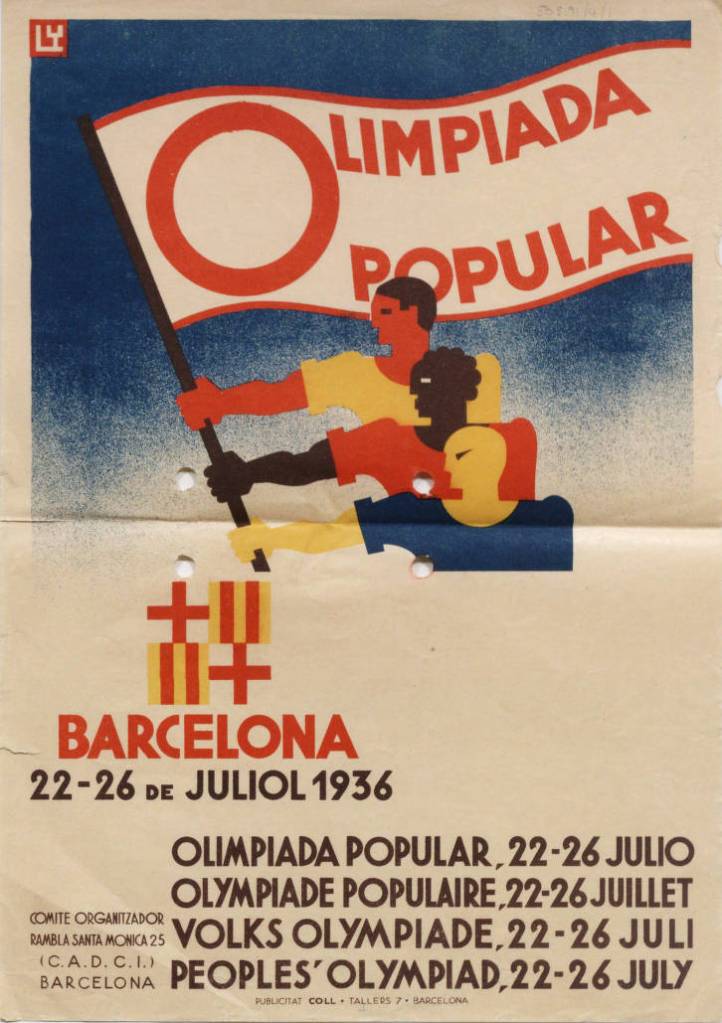
Parallel to all these events, numerous foreign athletes began arriving in the city to participate in the planned People’s Olympiad. The outbreak of fighting would catch thousands of foreign visitors completely by surprise. Around 6,000 athletes, coaches, journalists and delegates from two dozen countries and Spanish provinces had arrived in Barcelona for the People’s Olympiad, an anti-fascist sporting event intended as an alternative to the Berlin Olympics being held under Adolf Hitler’s regime. Participants had travelled from more than twenty countries, including France, Britain, Belgium, Czechoslovakia, the Netherlands, Scandinavia and the United States. Many German and Italian competitors were political exiles who could not safely represent their own countries. Instead of attending opening ceremonies on the morning of 19 July, many awoke to the sound of factory sirens, rifle fire and church bells. Athletes staying in schools, hotels and sports facilities found streets blocked by barricades and armed civilians. Some foreign visitors volunteered as stretcher-bearers and nurses, while others helped transport supplies and wounded civilians. A number of athletes later enlisted in Republican militia units, making the People’s Olympiad one of the first international communities to become directly involved in the Spanish Civil War. The games themselves never took place, becoming an early casualty of the conflict.
On the afternoon of July 17, the military garrison of Melilla unexpectedly revolted. Following Melilla, the other strongholds of the protectorate of Morocco revolted, and then, the next day, the garrison of the Canary Islands rose up, under the command of General Francisco Franco. At two o’clock in the afternoon of July 18, part of the garrison of Seville revolted against the Government. News reached Barcelona throughout Saturday 18 July. The conspirators continued their preparations, while the Republican and Generalitat authorities braced for a possible insurrection. That afternoon, the Generalitat leaders, led by Companys, rejected the request from the CNT and UGT unions to distribute weapons to the people, partly out of fear of an outbreak of violence and partly to prevent these organisations, which did not adhere to the dictates of Catalan nationalism, from gaining the upper hand. The Catalan authorities did mobilise the Estat Català ‘Escamots’ and the ERC youth wing, the JEREC, distributing 200 rifles.
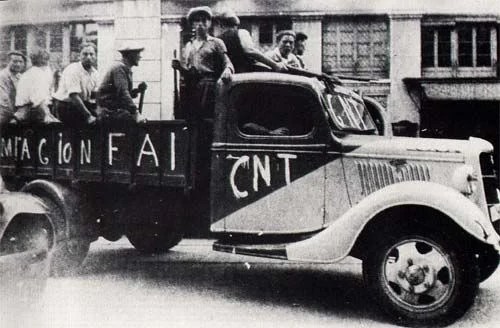
The CNT’s impatience grew as its members learned throughout the day of the coup attempts in Morocco, Navarre, and especially the surprise military uprising in Seville, and having received no weapons from the Generalitat of Catalonia, they began stockpiling their secret arsenals. The UGT socialists, for their part, seized the dynamite stored in the port and, by nightfall on July 18, were preparing homemade bombs with it. During the early hours of the 19th, the unions continued their preparatory activities, expecting a clash with the rebel military as inevitable. Meanwhile, the CNT stormed several arms depots in the city, including the old prison ship Uruguay, anchored in the port; well-equipped, it called a general strike for the following morning and prepared for battle.
But even with this escalating situation, Llano de la Encomienda informed Companys that all was calm in the garrisons. The conspirators waited throughout the 18th for General Goded to arrive by plane from Mallorca. The information circulating from Morocco and Seville throughout the rest of the peninsula meant that the conspirators in Barcelona would not be able to count on the element of surprise. But despite what General Llano had told him, Companys was unable to sleep that night of July 18-19, so he went for a walk along the Ramblas, accompanied by his collaborators. In the middle of the hot night, Companys learned of the beginning of the uprising. Unlike many political leaders elsewhere in Spain, Companys remained in Barcelona throughout the crisis. During the night he moved between government offices, received reports from police commanders and military officers, and attempted to maintain contact with Madrid while events unfolded around him. Although the Generalitat lacked the military strength to defeat the uprising alone, Companys’ refusal to abandon the city gave Republican supporters a visible political leader during the most uncertain hours of the revolt.
The troops in the barracks were woken very early and, after breakfast, received a generous ration of cognac. Some were told they had to go and crush an anarchist uprising, while others were told they were going to parade through the city in honour of the People’s Olympiad, which was scheduled to begin that morning, Saturday, July 19. To confuse the loyalist forces, the soldiers received orders from their officers to raise their fists.
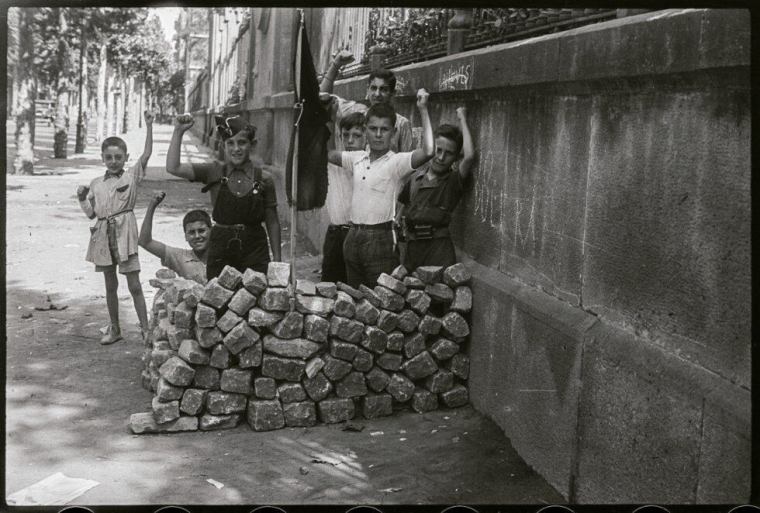
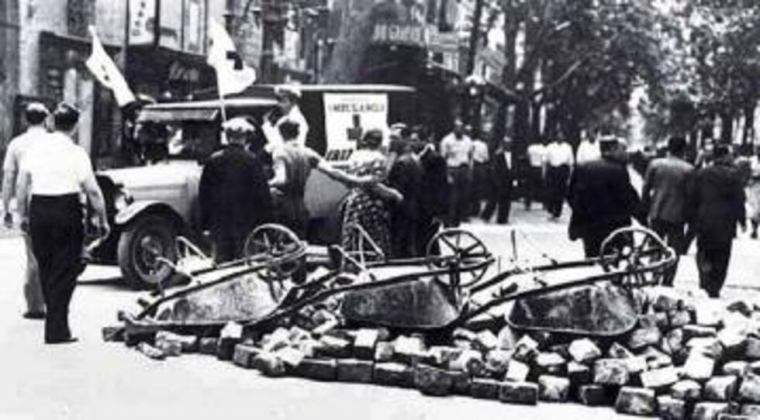
Meanwhile, during the days before the coup, workers, men and women, had quietly gathered their resources. Vehicles were requisitioned, workshops prepared improvised armoured trucks, dockworkers seized rifles, dynamite was converted into homemade grenades. By the evening of 18 July, many workers no longer slept at home. They remained in union buildings waiting for the expected signal. When factory sirens began sounding before dawn on 19 July, the defence committees moved immediately. Their preparations did not guarantee victory. Most participants still lacked proper weapons. But without those months of planning, the military uprising in Barcelona might have succeeded. Tramcars were pushed across intersections, buses overturned, paving stones ripped from streets and construction materials dragged into roadways. Residents emptied workshops, warehouses and building sites to create obstacles capable of slowing cavalry and artillery. Many of the barricades were erected within minutes of the factory sirens sounding. By sunrise, large sections of Barcelona had effectively become a maze of defensive positions controlled by workers and local residents rather than by the so-called authorities.
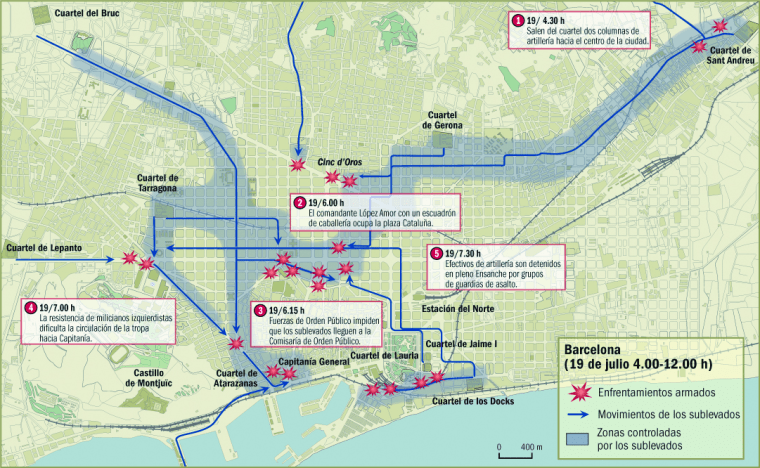
As planned by the conspirators, starting at 4:00am, the conspiring officers began mobilising and removing military units from their barracks. The rebel officers of the 13th Badajoz Infantry Regiment deposed the regimental and mobilised the troops, organising several columns that departed from the Pedrables barracks, and marched toward Plaça de Catalunya. The companies of the Badajoz regiment traversed several streets where they encountered small pockets of resistance, which they neutralised without much difficulty. When the Pedrables group reached Plaça Catalunya, the garrison of Assault Guards defending it defected to the rebels. The rebels then proceeded to occupy the Telefónica building, taking control of the first floor, but from that moment on they were subjected to intense gunfire from the surrounding area, which quickly decimated the rebel column. The fire from the Republican defenders intensified, forcing the rebels to retreat and take refuge in the Hotel Colón, the Military Casino, and the Maison Dorée. They left behind numerous dead and wounded, and their Commander López Amor, who was taken prisoner.
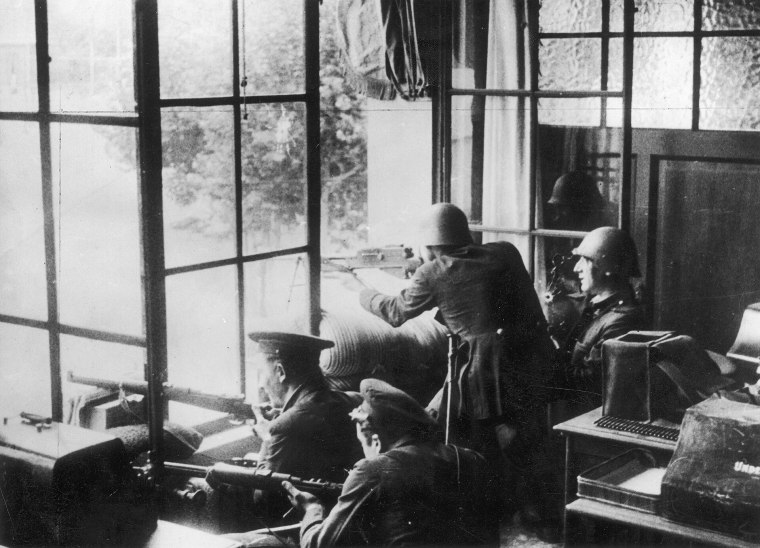
Shortly after the first rebels set out, they were joined by the Montesa Cavalry Regiment, under the command of Colonel Pedro Escalera, and the Santiago Cavalry Regiment, commanded by Colonel Lacasa. The Montesa Regiment’s forces were organised into three groups tasked with occupying the Plaza de España, the Plaza de la Universidad, and San Pablo Street. One of the squadrons managed to occupy the Plaza de España with the support of a battery from the Mountain Artillery Regiment, which linked up with the Montesa Regiment’s forces without encountering any resistance. The Plaza de la Universidad was also occupied without major difficulties and remained under rebel control until the afternoon. But one of the groups, the squadron heading for San Pablo Street, was virtually annihilated when it encountered resistance from the Assault Guards, and its remnants took refuge in several nearby buildings.
From the Docks Barracks, a column commanded by Captain López Varela and composed of troops from the 1st Mountain Artillery Regiment set out to occupy the Ministry of the Interior, the França Station, and the port. According to the conspirators plans, this column was to be protected by reinforcements from the Alcántara Infantry Regiment, but these reinforcements never arrived. When López Varela’s column began its advance, it could not advance more than 500 meters before encountering fierce resistance from Assault Guards and CNT – FAI militants, who had fortified themselves between the port docks and the railway cars. Casualties were very high, and the rebels eventually retreated to several strong positions. One of the Assault Guard officers, Captain Francisco Arrando, was among the defenders who had fallen during the skirmish. The workers militia convinced the soldiers of a regimental battery to abandon their officers, telling them that they had been deceived about their true motives. After this, the militiamen received support from some artillery pieces.
General Fernández Burriel, who had been present during the uprising of the Montesa Regiment arrived at the headquarters of the 4th Organic Division, had the mission of occupying the Radio Barcelona station and also supporting the column of the mountain artillery regiment that had already set out to try to link up with other units in the city centre. One column advanced to Lauria Street, where it was decimated by the resistance it encountered and had to take refuge in the nearby Ritz Hotel, the other column advanced along Icaria Avenue until it too was decimated and had to retreat to defensive positions.
In the Balearic Islands, at 7:30am, General Goded declared a state of war and incited the military garrison to revolt. He quickly and easily gained control of the islands of Mallorca and Ibiza, hardly firing a shot. As agreed by the conspirators, Goded was to leave Mallorca as soon as he heard a patriotic address from Barcelona, which would signal that the uprising had begun in the Catalan capital. Several hours passed until finally, at 8:45am, the rebels in Barcelona issued the proclamation, and he immediately prepared to depart. Goded left the port of Palma de Mallorca around 10:30am aboard a seaplane, accompanied by a seaplane escort. At approximately 12:30pm, General Goded arrived in the port of Barcelona. Goded quickly made his way to the Captaincy General building and took command of the 4th Organic Division.
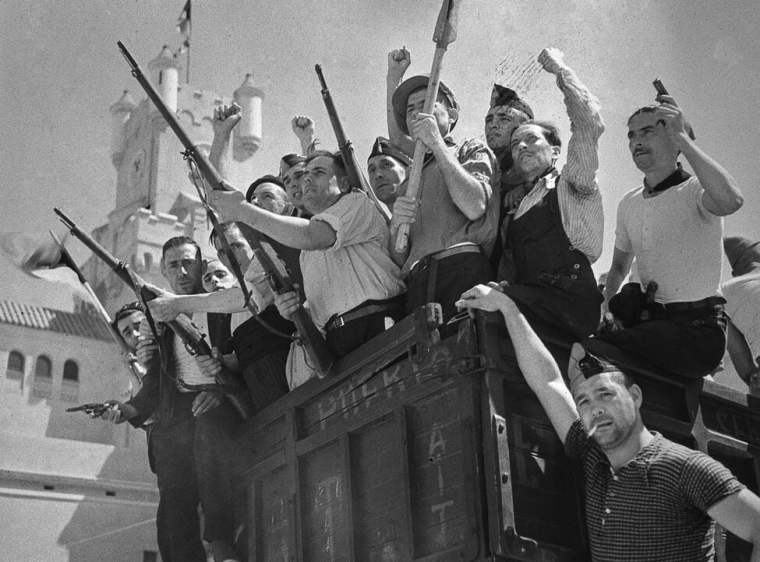
The rebel troops had to engage in fierce street fighting from the outset, and after several hours of combat they were able to capture some strategic points in the city of Montjuïc Castle, part of the Telefónica building and Plaça Catalunya, the Ritz Hotel, Plaça d’Espanya, the Colón Hotel, and the Drassanes Barracks only after suffering heavy losses. The workers had erected barricades at numerous points throughout the city to block the rebel advance, and the security forces joined them in the resistance. Some assault guards even shared their weapons with the anarchist defenders. Despite the rebel plans, the rebel columns failed to converge in the city centre due to the resistance they encountered; meanwhile, the Security Forces and the workers’ militias mounted a strong opposition to the uprising.
The buildings captured by the rebels were merely a series of isolated points, blocked by barricades and too far apart to provide mutual support. Some aircraft from El Prat carried out attacks and bombing raids against the rebel columns advancing through Barcelona, sowing chaos and demoralization among the rebels. At approximately two o’clock, columns of Guardia Civil entered the centre of Barcelona under the command of Colonel Antonio Escobar. Their appearance transformed the atmosphere of the battle. Workers who had spent years fighting the Guardia Civil watched nervously as mounted guards advanced through the streets. The tension disappeared when the Guards openly declared their support for the Republic. Crowds cheered. Barricades opened. Workers and Guardia Civil began fighting side by side. The combined force immediately attacked rebel positions around Plaça de Catalunya, the Hotel Colom, the university district and other remaining strongpoints. The effect was devastating. Soldiers who had successfully resisted poorly armed civilians now faced trained security forces advancing in coordinated formations. For many participants, the local victory at Plaça de Catalunya became proof that organised workers could defeat regular soldiers in open urban combat. The symbolic importance of the square endured long after the shooting stopped.
Now the militias and security forces were concentrating around the Captaincy General, where Goded was still resisting. In the afternoon the building was stormed and the main rebel officers taken prisoner. Goded, who was saved from popular anger thanks to a famous communist from Barcelona, Caridad del Río, was taken prisoner. The rebel officers were transferred to the Ministry of the Interior, while Goded was taken to the Generalitat, in the presence of Companys. There he broadcast an appeal in which he asked the rebels who were still resisting to lay down their arms, saying, ‘luck has turned against me, and I have been taken prisoner; if you wish to prevent further bloodshed, you are released from the commitment you had with me.’ The general’s voice was heard throughout Spain and gave encouragement to the supporters of the Republic in the rest of the country.
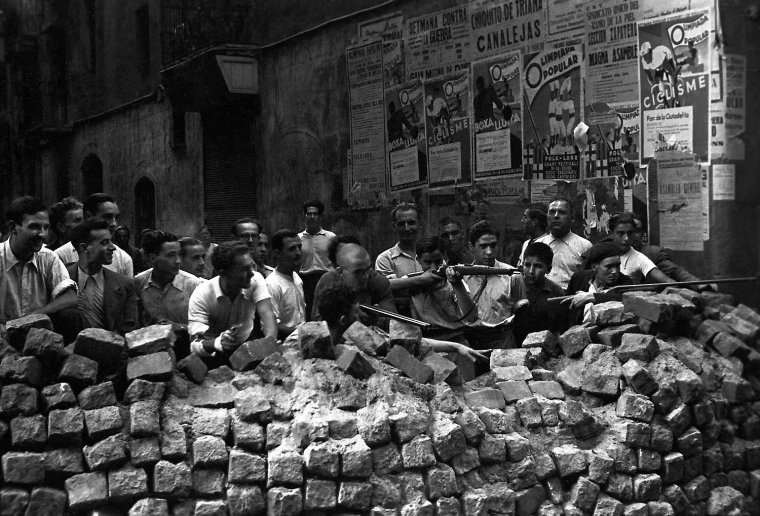
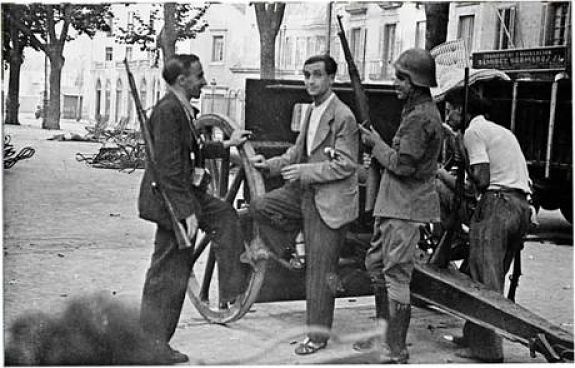
By nightfall on July 19, only the Drassanes barracks, near the port, and the San Andrés barracks, a few kilometres from the city centre, remained for the rebels. A group of officers and soldiers from the 9th Cavalry Regiment Santiago were also still resisting, having taken refuge in the Monastery of the Discalced Carmelites on the Diagonal Avenue. During the night of 19–20 July, however, the situation at San Andrés collapsed. The defenders abandoned Barcelona’s largest military arsenal, leaving behind one of the greatest prizes of the battle. When anarchist and workers’ militia units entered the barracks they discovered between 30,000 and 50,000 rifles, together with ammunition and military supplies. Until that moment many defenders had fought with pistols, hunting guns and homemade explosives. The seizure of the arsenal transformed the balance of power in the city. Trucks loaded with weapons immediately began distributing rifles to union headquarters, neighbourhood defence committees and militia formations throughout Barcelona. For thousands of workers, the captured rifles represented more than military equipment; they were proof that the uprising had been defeated and that the future of the city would now be decided by those who had defended it. Within hours, armed militia columns were already discussing carrying the fight beyond Catalonia against rebel forces elsewhere in Spain. Throughout the night workers’ militias consolidated their positions and prepared for a final assault. Captured weapons were distributed. Volunteers arrived from across Barcelona. Among those organising the attack were Buenaventura Durruti, Francisco Ascaso, Joan Garcia Oliver, Ricardo Sanz and Aurelio Fernández. The Drassanes assault began on 20 July.
The Carmelite Convent quickly surrendered the Guardia Civil arrested the occupants, but the battle intensified at the Drassanes barracks and the Military Government headquarters. At the Teatre Principal, Durruti, Ascaso, Garcia Oliver, Ortiz and other anarchist leaders met to discuss a plan to attach mattresses to a vehicle, which had been outfitted the previous day, and drive it towards the sites to clear the way for men following behind. Ricardo Sanz and Aurelio Fernández got into the truck and set off down La Rambla, where they came under fire from the Drassanes barracks and the Military Government headquarters. Durruti, Ascaso and Garcia Oliver followed it to the barracks and took shelter behind a wall, where they were exposed to a sentry box looking out at Carrer de Santa Madrona. Durruti gave the order to attack, shouting Adelante hombres de la CNT! (Forward men of the CNT!). Ascaso quickly advanced but he was shot in the head before he made it. Many others died during the attack, including an Assault Guard captain, four Guardia Civil and numerous citizens.
Not long after Ascaso’s death around 1:00pm, the soldiers inside the Drassanes barracks and the Military Government headquarters surrendered. With the last holdouts vanquished, the workers’ militias declared victory over the military coup. Durruti observed that the Spanish Revolution had only just started, and that it would not be over until every last rebel soldier in the country was defeated. (Random clashes continued to take place in the Catalan capital in the days after the defeat of the coup, but on 24 July, with the bulk of the fighting over, the CNT ordered its members to return to work.)
Around midday, the Drassanes Barracks also surrendered after a prolonged resistance against the workers ‘militias and security forces. During these final battles, the renowned anarchist leader Francisco Ascaso was killed while taking part in the final assault on the Drassanes. Ascaso’s death was a severe blow to the morale of the anarchist movement, which had been ecstatic about its victory. The rebels who had taken refuge in the Carmelite Convent finally decided to surrender, but only to the Guardia Civil. Numerous armed militiamen had gathered around the convent; the rebels grew impatient with this concentration and even fired on the crowd. When the rebels were about to surrender to the Guardia Civil forces under the command of Colonel Escobar, an enraged mob stormed the place, causing a massacre among those surrendering and the friars of the convent. In addition to these deaths, some officers detained in the Military Quarters committed suicide on the night of the 19th, as was the case with Captain Ramón Mola, the brother of General Mola.
The victory came at a heavy price. Modern estimates suggest between 450 and 600 people were killed during the fighting, while between 2,000 and 4,000 were wounded. Approximately 200 of the dead were workers who had fought against the uprising. Among those killed were the anarchist leader Francisco Ascaso, the Assault Guard officer Francisco Arrando, numerous soldiers from both sides, and civilians caught in the crossfire as the battle spread through the streets of the city.
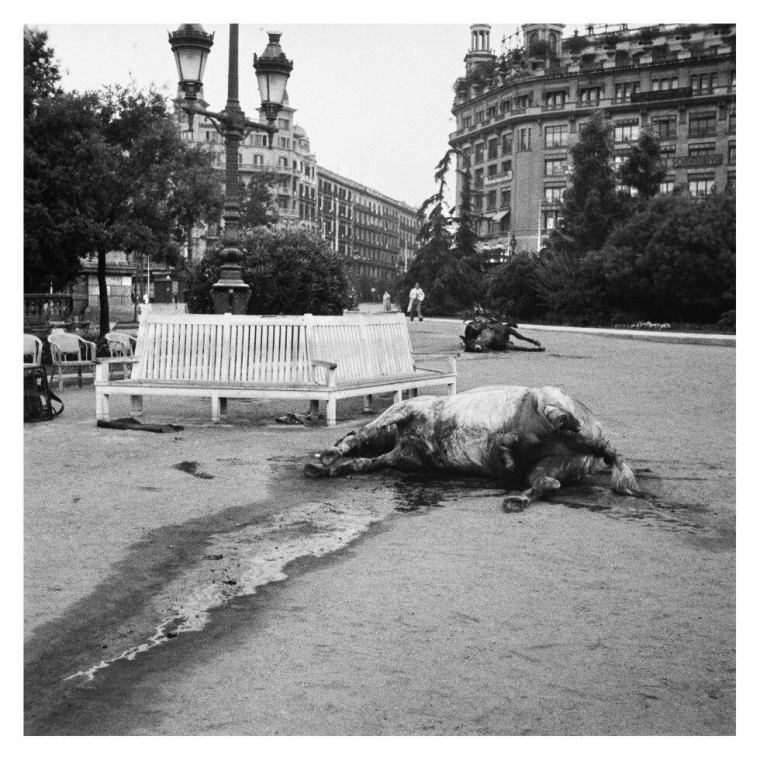
By the evening of 20 July, Barcelona was a city transformed. Barricades still blocked major streets, dead horses remained where artillery columns had been destroyed, and many buildings bore the scars of machine-gun fire. Families searched hospitals for missing relatives while armed patrols guarded neighbourhoods that had been battlefields only hours earlier. The military uprising had been defeated, but nobody yet knew that the struggle unfolding across Spain would continue for almost three years.

Following the failed uprising in Barcelona, the city was practically in the hands of the workers’ militias, who had obtained weapons from military arsenals and possessed a force of armed men far superior to the security forces available to both the Central Government and the Generalitat. Hugh Thomas estimates that at the end of the military rebellion in Barcelona, the security forces had 5,000 armed men, while the CNT – FAI had approximately 30,000. Thus, although the anarchists and loyalist forces had jointly defeated the rebels, the reality was that the workers’ movement had seized control of the city and supplanted the authority and powers of the state.
The officers and principal leaders of the rebellion who had been arrested were initially taken to Montjuïc Castle, where they remained until July 26, when they were transferred to the prison ship Uruguay, in the city’s port. On August 11, Generals Goded and Fernández Burriel were tried for leading the military rebellion, sentenced to death, and executed by firing squad the following day in the moat of Montjuïc Castle, followed by all the major rebel leaders a few days later.