


Note: many readers know north-northwest Spain as map three, showing the autonomous communities of Castilla y León, Galicia, Asturias, Cantabria, the Basque Country (Euskadi/País Vasco), La Rioja, and Navarre, which were re-established in 1983 (it took a while to wash the Franco off everything). Map two shows each region within the communities, and map one shows the discrepancies owing to 1936’s provinces of Castilla la Vieja (Old Castile), León, Galicia, Asturias, Santander (now Cantabria), the Basque Country, Logroño (now La Rioja), and Navarre.
- Pamplona and Navarre
For Republicans across Spain, Pamplona in Navarre was one of the most dangerous cities in the country long before the first shots of the Civil War were fired. Pamplona was the centre of a rebellion that had been openly preparing for months. The dominant figure in Pamplona was General Emilio Mola (Nationalist rebel and principal planner of the military uprising). Officially, Mola had been posted to Navarre by the Republican government in 1935 in an attempt to remove him from the political centre of Madrid. Instead, he transformed Pamplona into the headquarters of the rebellion. From his office in the city, he coordinated contacts with military officers, monarchists, Carlists and right-wing organisations across Spain. The secret directives that helped organise the uprising were drafted and distributed from Navarra.
Navarre did not possess a large industrial working class. Socialist and Republican organisations certainly existed, particularly in parts of the Ribera region south of Pamplona, but the political balance of the province was very different from that of most major Republican strongholds. The conservative Catholic right enjoyed deep roots throughout Navarre, and no organisation was more important than the Carlists. They possessed their own militia, the Requetés, whose members had spent months preparing for armed conflict. By July 1936, thousands of these volunteers had been organised, trained and equipped. While Republican supporters elsewhere were pleading for rifles from hesitant governors, many Carlists in Navarre already possessed weapons and clear instructions.
For the small Republican and Socialist organisations in Pamplona, the atmosphere was increasingly threatening. Labour activists had watched the growth of Carlist militias with alarm during the previous months. The Republican authorities possessed few reliable tools with which to confront the rebellion. The province’s military command was already in Mola’s hands. Much of the Guardia Civil sympathised with the rebellion. Large sections of local society openly supported the anti-Republican cause. Decisions made there influenced events across Navarra, Aragón, Old Castile and beyond. By midnight on 18 July, the city technically remained under the authority of the Republic. The formal proclamation of martial law would come the following day. Mola controlled the military command, the Requetés stood ready for mobilisation, and Republican opponents were under growing surveillance, and many already feared arrest, and the area who soon become known for mass killings.
- Valladolid
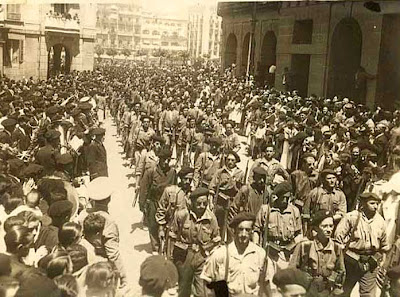
Valladolid was one of the most alarming developments of 18 July because it demonstrated how quickly an entire military region could be lost from within. There was no mass uprising in the streets, no dramatic struggle between armed workers and soldiers, and no prolonged battle for public buildings. The fate of the city was decided largely inside military headquarters, far from the view of most residents. Valladolid had a substantial Socialist tradition, strong UGT organisations and active Republican parties. The 9:00am command for Guardia Civil men to be moved to Madrid left places like Valladolid just sitting ducks for military overthrow.
The city was headquarters of the VII Organic Division, one of Spain’s major military districts. Its commander was General Nicolás Molero Lobo (Republican military commander), an officer regarded as loyal to the government. If the rebels could remove Molero, they would gain control of Valladolid and a large military region stretching across much of Old Castile. At approximately 10:00pm, General Andrés Saliquet (Nationalist rebel) and General Miguel Ponte (Nationalist rebel) confronted Molero at military headquarters. The meeting was intended to force him to support the uprising, and Molero refused. A violent confrontation broke out inside the headquarters building. Gunfire was exchanged, with two of Molero’s aides killed, along with a civilian employee. Molero himself was wounded and neutralised, and Saliquet assumed command of the division. This was a decisive moment because it handed the rebels control of the region’s military apparatus.
Most ordinary citizens learned of these events gradually. Valladolid contained a significant population loyal to the Republic. Socialist organisations were influential, trade unions were active, and many workers opposed the military uprising, but the struggle was decided before large sections of the population even understood that it had begun. Control of the VII Organic Division provided the Nationalists with a secure base in the heart of Old Castile. It linked areas already moving toward the rebellion, including parts of Navarre and northern Spain, and helped create the territorial continuity that the insurgents desperately needed during the first days of the conflict.
In nearby Salamanca, a conservative provincial capital, strongly influenced by the Church, the university and traditional elites, created an environment in which the rebels faced less opposition than in many other parts of Spain. The city’s labour movement existed but lacked the scale seen in industrial centres. Socialist organisations, trade unions and Republican parties maintained a presence, yet they could not match the influence enjoyed by conservative institutions. As a result, Republican supporters entered the crisis at a disadvantage. In the months ahead, the city would serve as one of the principal centres of Nationalist administration and eventually host General Francisco Franco and his headquarters.
On 18 July 1936, the provinces of Ávila and Segovia remained outwardly calm as news of the military uprising spread across Spain. Local authorities and military commanders closely monitored developments elsewhere, particularly in nearby Valladolid and Madrid, but no major fighting occurred. Both provinces contained garrisons sympathetic to the conspiracy, and as the situation became clearer on 19 July, the local military authorities declared for the rebellion with little organised resistance. By the end of July, Ávila and Segovia formed part of the secure Nationalist-controlled zone stretching across much of Old Castile.
- Burgos
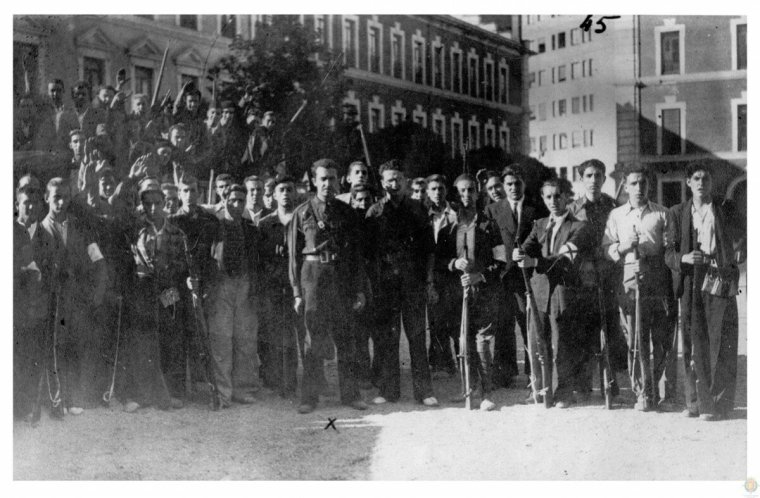
For Republicans, Burgos revealed how quickly an apparently stable city could slip from their grasp. There were no dramatic street battles and no mass uprising of civilians. Instead, the city became another example of how the military rebellion succeeded when it controlled the command structure before the wider population could react, and the Guardia Civil be drafted away from the area only made things worse.
Burgos occupied an important position in northern Spain. It was a provincial capital with a substantial military presence and strong conservative traditions. While Republican parties and labour organisations existed, they were generally weaker than those found in industrial centres such as Bilbao, Barcelona or Gijón. This political balance gave the rebels an advantage from the beginning. Reports from Pamplona and Valladolid suggested that important military commanders were already siding with the rebellion. These developments were especially troubling because Burgos lay between regions that were rapidly becoming Nationalist strongholds.
Senior officers sympathetic to the rebellion gradually consolidated their position. Unlike Barcelona, where workers would soon confront troops in the streets, Burgos never developed a comparable popular resistance. The military retained the initiative and encountered little organised opposition during the crucial first stages of the uprising. What the locals experienced was a city drifting steadily away from the Republic while its supporters struggled to find an effective means of resistance.
In nearby Logroño (now La Rioja), as news arrived from Burgos and Pamplona, many Republicans feared that the city would soon be drawn into the orbit of Mola’s rebellion. The local labour movement was active but comparatively small and its strategic location would soon help the Nationalists create continuity between their northern strongholds.
- San Sebastián, Bilbao, and Vittoria of the Basque Country (Guipúzcoa/Gipuzkoa)
For Republicans in San Sebastián in Guipúzcoa/Gipuzkoa, 18 July was a day of growing concern as reports arrived from nearby Navarre. While much of Spain was struggling to understand the scale of the military uprising, the people of Guipúzcoa had a unique problem, as one of the principal organisers of the rebellion, General Emilio Mola, was only a short distance away in Pamplona.
San Sebastián occupied a complicated political position. Like much of the Basque Country, San Sebastián contained Republicans, Socialists, trade unionists and Basque nationalists whose political views often differed sharply, but who increasingly viewed the military rebellion as a threat. The Basque Nationalist Party had not fully aligned itself with the Republic in the way it later would, but neither was it prepared to embrace a military rebellion that threatened Basque autonomy. Throughout the day, reports arrived that Navarre was mobilising. Carlist militias were gathering. Military officers loyal to Mola were consolidating control. The contrast between the two provinces became increasingly stark. On one side of the provincial border stood a region moving toward rebellion; on the other stood a city whose political organisations were attempting to defend constitutional government.
Nearby Irún reflected much of Republican Guipúzcoa. Republicans, Socialists, trade unionists and Basque nationalists all possessed influence in the town, and there was little support for the uprising compared with nearby Navarre. As events unfolded elsewhere in Spain, local leaders began organising defensive measures and monitoring roads and rail links leading toward the Navarrese frontier.
For Republicans, Socialists and Basque nationalists, Bilbao in the Vizcaya/Bizkaia province of the Basque Country, entered 18 July with a sense of apprehension. The city had spent months watching Spain drift towards crisis. Political violence had increased, strikes and demonstrations were common, and rumours of military rebellion circulated constantly. When news arrived that army units in Spanish Morocco had risen against the Republic, few people were truly surprised. Bilbao was a city where the Republic possessed powerful allies. The city was one of Spain’s great industrial centres, dominated by shipyards, steelworks, mines and heavy industry. Its workers were organised through the UGT, the CNT and Socialist organisations. At the same time, Bilbao was also the political heart of Basque nationalism. This produced a unique political landscape that differed sharply from much of the rest of Spain.
The most important political force in the region was the Basque Nationalist Party (PNV). To outsiders, the party’s position often seemed contradictory. The PNV was Catholic and socially conservative, characteristics that might have drawn it towards the military uprising. Yet it was also committed to Basque self-government, and many of its members viewed the Republic as the best hope of securing autonomy. By July 1936, this question remained unresolved, and many Basque nationalists were still deciding how they would respond to the crisis. The loyalty of Bilbao could not be taken for granted. The city’s future depended not only on the actions of workers and trade unions but also on the decisions of Basque political leaders and military commanders. One of the reasons Bilbao differed from many other cities was the attitude of local security forces and military commanders who had not declared for the uprising. Bilbao’s population understood that events elsewhere in Spain might soon reach the Basque Country. The difference was that the city still possessed options. The military had not seized power. The Republican authorities remained in office. Political organisations retained freedom of movement.
Vitoria-Gasteiz in the Basque Álava/Araba province remained relatively calm as news of the military uprising spread across Spain. Unlike neighbouring Guipúzcoa and Vizcaya, where support for the Republic remained strong, conservative and Catholic political forces held significant influence in Álava. The local military authorities moved cautiously while awaiting developments elsewhere, but on 19 July the province declared for the rebellion with comparatively little resistance. By the end of July, Álava had become the only Basque province firmly under Nationalist control, creating a sharp political divide within the Basque Country between Nationalist-held Vitoria and Republican-held Bilbao and San Sebastián.
- Oviedo, Gijón, and Asturias
For Republicans, Socialists and trade unionists across Spain, Asturias was supposed to be one of the safest regions in the country on 18 July 1936. The province had a long history of working-class militancy, strong Socialist and trade union organisations, and thousands of miners who had already fought government forces during the Asturian Uprising of 1934. If civil war came, many believed Asturias would be one of the Republic’s strongest bastions.
Asturias spent much of the day believing it had escaped the worst of the uprising. The central figure in this illusion was Colonel Antonio Aranda Mata (Nationalist rebel and military commander in Oviedo). Aranda was widely regarded as politically conservative, but he had carefully cultivated relationships with Republican and Socialist leaders. In the tense hours following the outbreak of the rebellion in Morocco, many local politicians believed that whatever his private views, he would remain loyal to the legal government.
Throughout the day, local Republican authorities met with labour leaders to discuss the crisis. Among the most influential figures were Ramón González Peña (Socialist leader and veteran of the 1934 uprising) and other representatives of the workers’ movement. Their primary concern was determining whether the military command in Asturias could be trusted, and Aranda assured them that it could, presenting himself as a loyal defender of the Republic.
One of the government’s greatest concerns was the defence of Madrid. As reports of military unrest spread, there were fears that the capital might soon come under attack. Asturias possessed thousands of experienced miners who were politically committed, accustomed to hardship and, in some cases, already familiar with armed conflict. Aranda encouraged the idea that these men should be sent south. If Asturias was secure and its military commander loyal, then sending volunteers to Madrid seemed a logical contribution to the defence of the Republic.
As a result, preparations began to dispatch large numbers of miners toward the capital. The numbers involved vary in different accounts, but several thousand men ultimately left Asturias during these critical days. Many carried dynamite from the mining districts, a weapon that would become one of the symbols of Republican resistance during the early stages of the war. They departed believing they were helping save the Republic.
Aranda’s assurances prevented the rapid arming and mobilisation that occurred in some other Republican strongholds. Labour organisations remained active and alert, but they believed they were working alongside the military rather than preparing to confront it. The trust that existed between Republican leaders and Aranda reduced the sense of urgency that might otherwise have produced more decisive action. By nightfall, most supporters of the Republic still believed their province remained secure. The military command had not declared for the rebellion. Government institutions continued to function. Workers were organising to defend Madrid rather than preparing to defend Oviedo.
Aranda had defeated the Republic by convincing its supporters that force was unnecessary. His deception bought valuable time for the rebels and prevented the immediate confrontation that might have exposed his true intentions. When he finally declared for the uprising in the days that followed, many Republicans were stunned by the betrayal. Oviedo would fall to the rebels, but the rest of Asturias would not.
If Oviedo represented uncertainty and deception on 18 July, Gijón represented determination. The city was one of the strongest working-class centres in Spain. Its docks, industries and connections to the Asturian mining districts produced a politically active population with deep Socialist, Communist and trade union traditions. News of the uprising in Morocco spread rapidly through the city, and many workers immediately assumed that armed resistance would soon be necessary. Unlike many communities elsewhere in Spain, Gijón’s population had recent experience of violent political conflict. The memory of the Asturian Uprising of 1934 remained vivid. Thousands of workers had participated in that struggle, and many still carried the lessons of those events into 1936. The contrast with Oviedo would later become significant. While Aranda’s deception temporarily convinced many Republicans that the province was secure, Gijón’s workers remained highly alert to the possibility of betrayal. By midnight, the city remained loyal to the Republic. The region of Asturias remained in Republican hands, as did the city of Gijón, but Oviedo was collapsed under the weight of the Nationalist deception and was captured on 31 July.
- Santander (Cantabria)
While reports of military uprisings spread across Spain, Santander spent much of 18 July in a state of uncertainty rather than open conflict. The city remained under Republican control, and unlike many provincial capitals, the rebels failed to seize the initiative during the crucial opening hours of the rebellion. Santander was a port city with strong labour organisations and a substantial working-class population. Socialist organisations, trade unions and Republican parties possessed considerable influence. As evening fell, Santander remained firmly Republican. The city would later become one of the principal centres of Republican resistance in northern Spain. Its survival on the first day of the uprising helped ensure that the Cantabrian coast did not immediately pass into Nationalist hands.
- Galicia
The situation in Galicia was complicated by geography and politics. The region contained the provinces of A Coruña, Pontevedra, Lugo and Ourense, including the major cities of Santiago de Compostela, A Coruña, and Vigo, as well as important naval facilities at Ferrol and major ports along the Atlantic coast. Control of Galicia would be strategically valuable for either side. It offered ports, shipbuilding facilities, agricultural production and access to northern Spain.
The region had supported the Popular Front in the February elections, and on 28 June, Galicians had overwhelmingly approved a Statute of Autonomy in a referendum. Republican supporters entered July believing that Galicia remained firmly within the constitutional framework of the Republic. Yet conservative Catholic influence remained strong in rural districts, while significant sections of the military harboured deep hostility toward the government.
The centre of Republican authority in the region was General Enrique Salcedo Molinuevo (Republican commander of the VIII Organic Division), whose headquarters were located in A Coruña. Unlike Mola in Pamplona or Cabanellas in Zaragoza, Salcedo was not part of the rebellion. Throughout 18 July he remained loyal to the Republic and attempted to assess the rapidly changing situation. In A Coruña, workers gathered in union offices and political headquarters to discuss events. The city possessed a substantial labour movement, including strong Socialist and Republican organisations. Similar meetings took place in Vigo, Ferrol and other Galician cities. Across the region, people attempted to determine which military commanders could be trusted and whether local garrisons intended to follow the example of Seville. The uprising was spreading across Spain, but communications remained imperfect. Reports were often contradictory. One rumour suggested that the government had the situation under control; another claimed that whole regions had already fallen. This uncertainty encouraged caution among both Republicans and rebels.
By midnight on 18 July, Galicia remained under Republican authority. This fact was genuine, but it was also misleading. The institutions of the Republic still existed, yet many of the forces capable of destroying those institutions remained intact. The danger had not passed; it had merely been postponed. All the major centres were under Nationalist control by 20-24 July, and the entire autonomous community by 31 July.
- Logroño
For Logroño and the wider region of La Rioja, the military uprising succeeded quickly. General Mola’s forces entered Logroño on 19 July 1936, and within days the province was firmly under Nationalist control. There was no major front line in La Rioja and very few armed confrontations took place. Republican organisations, trade unions and left-wing parties were rapidly suppressed before they could organise effective resistance.
The absence of large-scale fighting did not mean the absence of violence. Logroño Province became one of the regions most heavily affected by early Nationalist repression. Researchers estimate that around 2,000 people were killed in the province during the first months of the war, despite a total population of little more than 200,000. Arrests were carried out by military authorities, Falangists and Carlists, targeting trade unionists, socialist activists, republicans, municipal officials and others suspected of opposing the uprising. From September 1936 onwards, hundreds of those executed were taken to the ravine known as La Barranca near Lardero, where more than 400 people were buried in mass graves. For many families in La Rioja, the war was experienced not through battlefield combat but through the arrests, disappearances and executions that followed the Nationalist victory.
While centres in each province either fell prey to the Nationalist rebels or remained free, it did not mean an entire province came under the control of the victors. Urban and rural loyalties could be, and often were very different. In the early days and weeks of the war, individual areas and villages would have remained starkly opposed to one another, and arrests and killings would be constant.

