
A name synonymous with anarchism and feminism during the Spanish Civil War is Federica Montseny. With a powerful voice and even more powerful convictions, the anarchist cause owes a great deal to Montseny.
Federica Montseny Mañé was born February 12, 1905 in Madrid, the only surviving child of strong anarchist parents. Her mother, teacher Teresa Mañé Miravet (aka Soledad Gustavo) was an anarchist activist, and her father was Juan Montseny Carret (alias Federico Urales) a tunneling worker turned propagandist and anti-authoritarian writer, who had spent time exiled for his beliefs (hence the need for aliases). Together they were editors of La Revista magazine for anarchists from 1898 until 1905 before moving home to Barcelona in 1912 to write libertarian propaganda.
Montseny’s parents were enthusiastic in education, which stayed with their daughter her whole life. As well as the usual basic subjects, Montseny was also educated in arts, politics, dance, philosophy, languages, history and classics. She grew up in a rural environment, and became strong in self-reliance, independence and freedoms not many girls were able to enjoy. She became a writer at an early age, and found her youth of being concerned with herself changed to wanting to share her independence and free thinking with the population. In a country where social, political and feminist freedoms were largely non-existent, anarchism was a way for Montseny to express her views. As with many feminists throughout time, she believed that equal rights cannot exist until women’s rights are addressed. Montseny could see from an early age that women were oppressed in Spain for a variety of social and economic reasons, and social revolution was in dire need.
Montseny published her first novel, Horas trágicas (Tragic Hours) in 1920, at the age of only 15, and another 50 would follow. She was living in a time of huge social upheaval, peppered with violence as workers rose up to the government and landowners alike. She fought to insist women gain the right to choose who to marry, if at all, if and when to have a family, and a woman’s right to choose the father of her children. She also fought for women to be educated in women’s health and pregnancy, which most women were denied. As women were given all responsibility for pregnancy and raising of a baby, Montseny believed that a woman should be given education in order to fill that role as best as possible.
 Another view Montseny advocated was free love, rather than the usual view of marriage, which oppressed women in Spain during the era. She entered into a relationship with Josep Esgleas Jaume (aka Germinal Esgleas) and while they would never marry, they remained together for life, with a daughter born prior to the Spanish Civil War, a son during, and a daughter after the war.
The Second Spanish Republic came to Spain in 1931, which paved the way for revolution, and many organisations, such as anarchism, were given more power and confidence that true social changes could be made. The Socialist Republic pushed for changes, with Montseny there to help arrange regional and nationwide meetings to collectivise the people and their needs and ideas. She travelled across Spain, discussing workers’ rights, women’s rights, how people could stand up to their government, and the need for all to come together for social revolution.
 The trouble was that women were still not given any rights during this time. Women were not supposed to travel on their own, or be doing anything that was not controlled by a man. Attending rallies alongside men and spending time with men without a husband or father meant she was not always given the time she deserved – the same as the men advocating for rights. When the government turned conservative in 1933, changes stumbled, and with fascism creeping into Europe, people like Montseny could see the trouble awaiting them.
Montseny supported the Popular Front government went they won the 1936 election, though as an anarchist, this was not an easy decision. Anarchism was not part of the collective group of left-wing parties in the Popular Front at the time. When war broke out in July 1936, it was clear that a violent strike against the rebels was needed for both survival and to protect the left-wing government from fascists.
In November 1936, Montseny was chosen by Prime Minister Largo Caballero to be Minister of Health and Public Assistance, and she joined the Popular Front, despite anarchism still not supporting the government. She was the fourth female government minister in western Europe, (after one in Denmark and two in Finland). While in times of peace this would have been an excellent role for her, during war it was a struggle. Hospitals, doctors and nurses were overrun with wounded and dying from the front lines, and people were refugees in their own war-torn country, moving constantly to try to stay alive. Food and medical supplies were far too sparse to help, and the number of orphans quickly skyrocketed. Health problems broke out as people did not have access to clean water and sanitation. The front lines needed all supplies available, fighting in ‘peaceful’ areas was constant, and the Popular Front began to collapse as the factions brought together fell apart. The anarchists/powerful CNT were reluctant supporters, and the Communists could not agree with either group. All the programmes that the Minister of Health could oversee were in complete disarray.
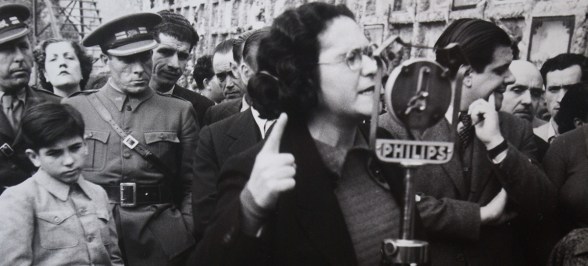 Despite the situation, Montseny pressed on, and kept up with her support for women’s social revolution. She joined the Mujeres Libres, which arranged schooling for children as their mothers fought in the war effort, were trained with useful skills and educated on multiple subjects. She fought to ensure women who wanted out of prostitution (let’s face it – all of them) could be helped, educated and trained for new roles in society, in a time where women were needed everywhere. New mothers were cared for and pregnant women were also educated in women’s health. She went to anarchist Juan Garcia Oliver, Minister for Justice, to make sure children of unwed mothers were made legitimate, as neither the women or their children deserved to be treated with such disrespect by society. Under her charge, abortion was made legal (Franco destroyed this law immediately after the war).
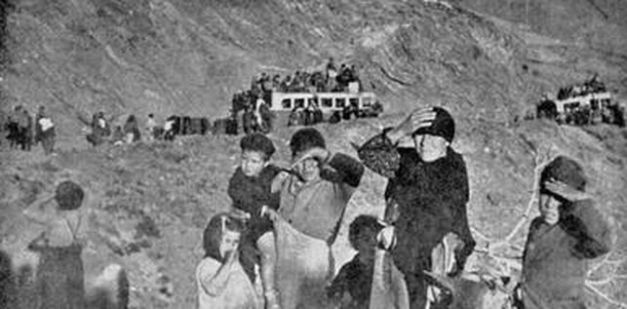
But with factions on the left collapsing as the war pressed on, Communist pressure forced Montseny from her post in May 1937. She returned to anarchism, even though many hated her for ever leaving, and continued to help in the war effort to kill fascism. As the war went on, she was forced to accept food packages from friends in the Netherlands. When Barcelona was bombed in 1938, she feared either that or raids by Franco supporters would see her and her family killed. When the Nationalists finally broke Barcelona in January 1939, she, her partner, their daughter, their newborn son and both of her parents fled north through the snow, walking to France. Montseny’s mother died on route, which forced Montseny to leave her body, and the country, behind. Many refugees were now in France, and kept in internment camps, where death swept through those displaced. They lived near Paris, trying to help Spanish refugees, but then the Nazis invaded, forcing them to hide in Toulouse.
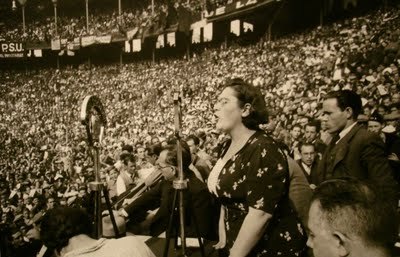 Franco was after Montseny specifically now, wanting to execute all those who opposed him and the Nationalists during the war. In 1942, the same time Montseny’s father died in an internment camp, Franco asked the French government to help catch Montseny for extradition. But Montseny was pregnant and the French government refused to send a pregnant woman home to be killed. Spanish refugees were trapped in France, the French pinning them in, and allied countries were of no help.
Montseny and her family were forced to stay in Toulouse, where on top of her 51 novels, Montseny finished 22 nonfiction works, and wrote regularly for two French magazines, despite only learning the language after her exile. She did not return to Barcelona in 1977, two years after Franco was dead.
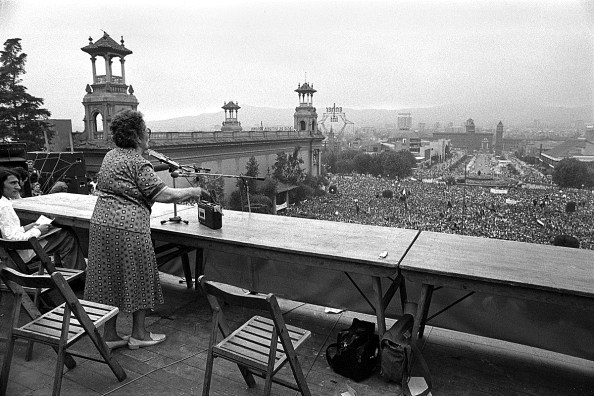 Montseny addresses the first CNT meeting in Barcelona since the war, in 1977
Montseny did not stay in Spain; she continued with her life in Toulouse, publishing her final book, Mis primeros cuarenta años (My First Forty Years) in 1987, and died aged 88 in 1994. She lamented that she was unable to instill her ideals about gender into her children, in particular her son, as the change in generational shifts came too late.
~~
This is not a detailed analysis, just a highlight of the Montseny’s life. Things get lost in translation – Feel free to suggest an addition/clarification/correction below. The more the world remembers, the better. All photos are linked to source for credit




 CAROLINE ANGUS
