MY HEARTY COMMENDATIONS: THE TRANSCRIBED LETTERS AND REMEMBRANCES OF THOMAS CROMWELL NEW EDITION 2025

This Week in Spanish Civil War History Extra: 80 Years Since the Guernica Bombing

26 April 1937 – Guernika-Luma, a Basque town of 7,000 people, entered the history books when it was attacked by the German Condor Legion (aided by the Fascist Italian Aviazione Legionaria) fighting on behalf of Franco’s Nationalist forces. The small town of Guernica, in the Biscay region of the Basque Country was a communication hub for the Basque fighters, who had sided with the Republican forces since the outbreak of the Spanish Civil War. Guernica, the spiritual home to the Basque people, became a target for a sustained and pre-panned terrorist bombing, where civilians, not military targets, would be bombed, to inflict devastation and murder. Operation Rügen would go down in history as a horrific slaughter of innocents which would shock the world, and single itself out as a vile test run for what Germany would inflict throughout Europe only a few years later.

Guernica is a town just inland from the Bay of Biscay, and just 30 kilometres from the Basque capital of Bilbao. The area had been under intense stress from the War of the North, carried out by the Nationalists in the months leading up to the bombing, hot on the heels of years of struggle for the Basque people. Guernica is the home of the Gernikako Arbola (Tree of Gernika), the symbol of freedom to the Biscayan and Basque people. Guernica was also home to a manufacturing plant which produced firearms to the police and military, which became a vital resource during the Spanish Civil War, when the Basque Army supported the Republicans’ cause over Franco’s Nationalist rebels.

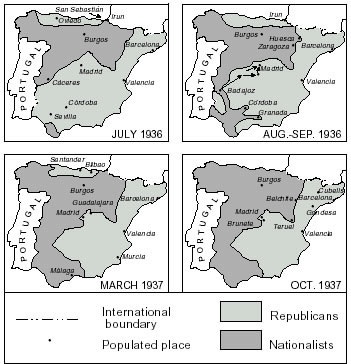
By April 1937, the Basque Country was under constant bombardment by the Nationalist advance, coming at them on all fronts. The small Basque Army, set up by the independent Basque Government, sought to protect the Biscaya and Guipuzcoa regions. With the Basque capital of Bilbao only 30 kilometres west, Guernica was vital in protecting the capital, and also a point where Republicans could retreat to if needed. Throughout the war, Guernica had no seen direct front-line fighting, though 23 Basque battalions were now nearby to the east. The area had no airforce protection, no air base and only room to house two battalions if needed.

The attack on the Basque Country has been planned a month earlier by Franco, in conjunction with murderous General Mola, who lead the northern army, along with the German Condor Legion. The town of Durango suffered civilian bombing on March 31, part of a test run of killing innocents, and troops starting pouring into the region. Many people sought refuse in the town of Guernica, away from the fighting. But eventually, there was nowhere else to flee as the Republian and Basque fighters were slowly beaten back by the Nationalist forces. General Mola planned a devastating attack on Guernica, all done with Franco’s blessing. They planed for 21 German and three Italian bombers, carrying 22 tonnes of bombs, to be dropped on innocent people.

Monday was market day in the town of Guernica. While market days had been largely banned or discouraged in the region for safety, people still needed supplies. Monday 26 April was a typical Monday market day which could see up to 10,000 people in the town from surrounding areas, all in the main plaza. Coupled with around 1,000 refugees from the area, the town was full, the roads more congested than usual.

At 4.30pm, the first wave of bombers came from the north from over the Bay of Biscay, along the Urdaibai estuary which connects Guernica to the sea. The initial plan was to cut off bridges to block movements in the area with two 50 kg bombs, while the Italian bombers dropped another 36 50kg bombs on people. The first wave took only a minute, destroying bridges and the San Juan church and Republican Left headquarters, as the people of the town looked to take cover in panic. For the next 90 minutes, another four waves of attack would fly over the town, this time dropping bombs at random, killing innocent people, all cowering for cover in a town overfilled with people trying to buy and sell food. Guernica had no strategic assets to be captured, nor had seen any major wartime fighting, and was totally obliterated without warning or reasoning.

The people of Guernica were given 30 minutes of silence at around 6pm, thinking the bombing was complete. But by 6.30pm, the bombers were back in formation again, spread out over 150 metres, to drop the remainder of their arsenal. Then in came German biplanes, to bomb streets leading out of the town and machine-gun down people fleeing the carnage over a brutal 15 minute period. This cruel attack on civilians would have a larger impact than Franco could have anticipated.

This short space of time saw 75 percent of the town reduced to rubble. While the raid was considered a failure, as it was supposed to have been a military, not civilian attack, to bomb the area and cut off the Republican fighters from communications and reinforcements in Bilbao. As a result for the killings, within days, the Nationalists were able to swarm the area, not that they was much left to ‘conquer’. The firearm manufacturing plant was saved, as planned, along with the Gernikako Arbola (Tree of Gernika) and its government building. The town had become a testing ground for what would go on to be labelled carpet bombing, or blitz bombing, a popular tactic by German planes.

News quickly spread about the horrific acts at Guernica. First spreading through Europe and then the rest of the world, the Nationalists were branded as murders and barbarians (which should have been obvious already) as the blatant killing of innocents became apparent. Franco quickly had to have the propaganda dialled up, and denied the Nationalists’ own involvement, and claimed the Republicans destroyed the own town and killed their own people while in retreat from ground troops. Germany claimed no knowledge of the attack, claiming to have bombed a strategic bridge, the rest nothing to do with them. No such luck; journalists in the area were quick to file stories on the truth of Guernica.

But in the aftermath, the death toll was hard to quantify. The Basque government were unable to do much in way of assistance as Nationalists forced swarmed the area, and they made no attempt to calculate the dead and injured. Many left to die in the rubble were never accounted for, likewise the number of people who fled the region, never to return.

For decades the number of killed sat at 1,654, another 889 injured. A British journalist for The Times was in the area, and also came up with similar numbers. These incorrect figures became commonly adopted as accurate, though with the Nationalists not helping the wounded when then they invaded, and without proper funerals and records, there was no official death and injury toll. Even in the 1970’s the Nationalists were still denying everything and claimed only a dozen people were killed. Without further details coming to light over the years, historians now recognise the number of dead about approximately 300. A comprehensive study in the region in the 1980’s suggested 153, based on what records survived, with another 592 people who either died or recovered in Bilbao’s nearby hospital. While in context with many atrocities which occurred in Europe over intervening years make the numbers appear ‘small’, the casualty rate per bomb was much higher than many carpet bombings to come in the future, setting Guernica apart for yet another reason.

British journalist George Steer reported the story to the world, Guernica on the front pages in England for over a week as the horrors emerged. Cartoons emerged of the Basque ‘holy city’ being crushed by Hitler and his bloody swords in the US. The fact Guernica had no military targets quickly turned on the panic in many around the world, as people realised nothing was safe anymore. Guernica became a symbol of international horror and innocent suffering as deviant fascists sought to kill and destroy all in their way.

On the 60th anniversary of the bombing, Germany formally apologised for their role in the massacre, and in 2003, Guernica was commemorated alongside Dresden at the own commemorations, for suffering such a similar attack, but far less honoured and remembered. On Guernica’s 70th anniversary, officials in Hiroshima spoke of Guernica’s legacy in line with their own experiences. It has been suggested that Guernica be the world capital for peace.

For all the historical significance, the destruction and most importantly, the death toll, Guernica is probably best known internationally due to the Picasso painting of the same name. Picasso, living in exile in Paris, had been commissioned for war painting three months prior, and when he hard of Guernica, all of Picasso’s ideas were scraped for the depiction of those suffering. To Picasso, to bomb women and children was  to victimize humanity. The painting was complete by June 3. In black and white, the painting shows innocents dying, along with the Spanish symbols of the horse and bull, as Spain is ruined, along with tiny symbols of hope trying to shine through while destruction comes from all angles. When German soldiers came into Picasso’s Paris apartment years later during WWII, and was asked if he did the work, he told the Nazi’s – ‘no, you did’. Guernica traveled the world but was not able to return to Spain until 1981 when freedom was achieved for the Spanish people. It now sits in the Reina Sofia gallery in Madrid (if you haven’t been, you should).

After the bombing of Guernica, the town was in flames, seen 10 miles (16 kilometres) away, according to George Steer, as buildings continued to crumble and crush the injured and trapped. Yet, pilots who belonged to the Condor Legion, whom Franco let practice on his own people, received a mausoleum in La Almudena in Madrid. Many vicious men from the war were revered in Spain, these plaques and statues and memorials removed over the years. To mark the 80th anniversary of Guernica, the mausoleum in La Almudena for fallen Condor Legion pilots was quietly removed, to be replaced with simple names. No more “Here rest the German pilots who fell in the struggle for a free Spain. German aviators who died for God and for Spain”. The plaque had been removed in the past but had been quietly replaced by those who still love Franco and all that happened in his name.  It has taken 80 years for this last sign of pro-German acts to be removed. The wounds on Guernica will never fully heal.

~~

This is not a detailed analysis, just a highlight (lowlight?) of the events. Things get lost in translation – Feel free to suggest an addition/clarification/correction below. The more the world remembers, the better. All photos and captions are auto-linked to source for credit, and to provide further information.

This Week in Spanish Civil War History Extra: 80 Years Since the Bombing of Durango

The Nationalists had tried everything to get into Madrid. Both the city and surroundings areas in all directions had already been bombarded by March 1937, eight months since the start of the SCW. Franco decided to turn his attention away from the broken yet defiant capital, and launched a new War on the North. General Emilio Mola y Vidal, who was named the leader of the north during the war while Franco commanded the south, decided to wipe out the Basque country. He already had launched offensives throughout the Basque region while basing himself in Burgos (160 kilometres south of the Basque city of Bilbao). Mola decided to deploy 50,000 troops and multiple German planes, but this time had a new plan – to launch ‘terror attacks’, where he would have his men attack civilians instead of military targets. This time, innocents were to be targeted, to inspire fear, to make the Republican held areas cower to the will of the Nationalists, or be hunted down and murdered.

The town of Durango was marked as the test target. Just 30 kilometres south of Bilbao, Durango was a small village, typical of the region and Spain as a whole. With 10,000 people, it was a rail stop between Bilbao and the front lines of the war. While it had no military operations, it was in Republican territory and ripe for attack. Mola wanted to burn the entire province of Vizcaya to the ground for being in Republican territory.

At 8.30am, inhabitants were at Mass at the Santa Maria basilica in the centre of town, and in the basilica arcade, where the local market was held. Five bombers, German Ju-52’s flown by the Condor Legion and Italian Savoia-Marchetti SM.8’s flown by the  Aviazione Legionaria, set out and used the basilica as the focal point. A direct hit was scored from the very beginning; the priest and 26 worshippers were bombed to pieces. The nearby cloister was also destroyed, killed all 14 nuns inside. The market was also hit directly, killing all those looking for food, others killed by falling buildings and horrific injuries from which they could not recover. A total of 281 bombs were dropped on Durango, almost 15,000kg of explosives. Just over 200 buildings were destroyed, though some have been rebuilt and their shrapnel wounds are still visible today.

The initial bombing sent the people first into panic, followed by a desperate attempt to rescue those under rubble once the bombers disappeared again. Word spread outside the village; Bilbao received news of the bombings, and send ambulances, doctors and police to help the stricken people of Durango. The tiny village of Ellorrio, ten kilometres from Durango, with no military targets at all, and just a few thousand civilians, was also bombed, like a cruel parting shot at the region.

As help from Bilbao tried to get to Durango and people rushed around their village to save as many as they could, the worst was not over. By 5.30pm that same afternoon, the planes returned, this time accompanied by eight Heinkel He-51 fighter bombers, equipped with machine guns. Bombs were dropped to stop those from Bilbao getting to Durango, and the people of the town were machine-gunned down as they tried to help the injured and those trapped in rubble. By the end of the day 250 were dead, with another 100 to die of their injuries, and 200 homes reduced to rubble.

Killings and executions were common by now in Spain; Durango itself had previously carried out executions on Nationalist sympathisers for earlier bombings of Republicans in their small town. Between this ugliness and the front line deaths, Spain was growing used to fear. But now Mola had ushered in a whole new era. Durango became the first place in Europe to be targeted to kill civilians and not military targets. A whole new world of death was born that day in Durango.

Nationalists denied their role entirely. Mola, and Franco henchman General Gonzalo Queipo de Llano said that the Republicans attacked and killed the priest, nuns and the churches of the village, as had happened in other places. They claimed their planes were looking for military targets and it was Cocialists and Communists who came out and used the opportunity to murder innocents.

By April 28, Nationalists soldier had entered Durango and taken over the area. By then, Mola and his killers had stepped up their missions and bombed Guernica (which needs a long post on its own on its commemoration date).

Where the bombs hit in the centre of the Durango old town is now a site for historical memory, and commemorated every 31 March.

~~

This is not a detailed analysis, just a highlight (lowlight?) of events. Things get lost in translation – Feel free to suggest an addition/clarification/correction below. The more the world remembers, the better. All photos are screencaps of the video and linked to source for credit.

Women in the Spanish Civil War: Part 2 – Federica Montseny Mañé

A name synonymous with anarchism and feminism during the Spanish Civil War is Federica Montseny. With a powerful voice and even more powerful convictions, the anarchist cause owes a great deal to Montseny.

Federica Montseny Mañé was born February 12, 1905 in Madrid, the only surviving child of strong anarchist parents. Her mother, teacher Teresa Mañé Miravet (aka Soledad Gustavo) was an anarchist activist, and her father was Juan Montseny Carret (alias Federico Urales) a tunneling worker turned propagandist and anti-authoritarian writer, who had spent time exiled for his beliefs (hence the need for aliases). Together they were editors of La Revista magazine for anarchists from 1898 until 1905 before moving home to Barcelona in 1912 to write libertarian propaganda.

Montseny’s parents were enthusiastic in education, which stayed with their daughter her whole life. As well as the usual basic subjects, Montseny was also educated in arts, politics, dance, philosophy, languages, history and classics. She grew up in a rural environment, and became strong in self-reliance, independence and freedoms not many girls were able to enjoy. She became a writer at an early age, and found her youth of being concerned with herself changed to wanting to share her independence and free thinking with the population. In a country where social, political and feminist freedoms were largely non-existent, anarchism was a way for Montseny to express her views. As with many feminists throughout time, she believed that equal rights cannot exist until women’s rights are addressed. Montseny could see from an early age that women were oppressed in Spain for a variety of social and economic reasons, and social revolution was in dire need.

Montseny published her first novel, Horas trágicas (Tragic Hours) in 1920, at the age of only 15, and another 50 would follow. She was living in a time of huge social upheaval, peppered with violence as workers rose up to the government and landowners alike. She fought to insist women gain the right to choose who to marry, if at all, if and when to have a family, and a woman’s right to choose the father of her children. She also fought for women to be educated in women’s health and pregnancy, which most women were denied. As women were given all responsibility for pregnancy and raising of a baby, Montseny believed that a woman should be given education in order to fill that role as best as possible.

Another view Montseny advocated was free love, rather than the usual view of marriage, which oppressed women in Spain during the era. She entered into a relationship with Josep Esgleas Jaume (aka Germinal Esgleas) and while they would never marry, they remained together for life, with a daughter born prior to the Spanish Civil War, a son during, and a daughter after the war.

The Second Spanish Republic came to Spain in 1931, which paved the way for revolution, and many organisations, such as anarchism, were given more power and confidence that true social changes could be made. The Socialist Republic pushed for changes, with Montseny there to help arrange regional and nationwide meetings to collectivise the people and their needs and ideas. She travelled across Spain, discussing  workers’ rights, women’s rights, how people could stand up to their government, and the need for all to come together for social revolution.

The trouble was that women were still not given any rights during this time. Women were not supposed to travel on their own, or be doing anything that was not controlled by a man. Attending rallies alongside men and spending time with men without a husband or father meant she was not always given the time she deserved – the same as the men advocating for rights. When the government turned conservative in 1933, changes stumbled, and with fascism creeping into Europe, people like Montseny could see the trouble awaiting them.

Montseny supported the Popular Front government went they won the 1936 election, though as an anarchist, this was not an easy decision. Anarchism was not part of the collective group of left-wing parties in the Popular Front at the time. When war broke out in July 1936, it was clear that a violent strike against the rebels was needed for both survival and to protect the left-wing government from fascists.

In November 1936, Montseny was chosen by Prime Minister Largo Caballero to be Minister of Health and Public Assistance, and she joined the Popular Front, despite anarchism still not supporting the government. She was the fourth female government minister in western Europe, (after one in Denmark and two in Finland). While in times of peace this would have been an excellent role for her, during war it was a struggle. Hospitals, doctors and nurses were overrun with wounded and dying from the front lines, and people were refugees in their own war-torn country, moving constantly to try to stay alive. Food and medical supplies were far too sparse to help, and the number of orphans quickly skyrocketed. Health problems broke out as people did not have access to clean water and sanitation. The front lines needed all supplies available, fighting in ‘peaceful’ areas was constant, and the Popular Front began to collapse as the factions brought together fell apart. The anarchists/powerful CNT were reluctant supporters, and the Communists could not agree with either group. All the programmes that the Minister of Health could oversee were in complete disarray.

Despite the situation, Montseny pressed on, and kept up with her support for women’s social revolution. She joined the Mujeres Libres, which arranged schooling for children as their mothers fought in the war effort, were trained with useful skills and educated on multiple subjects. She fought to ensure women who wanted out of prostitution (let’s face it – all of them) could be helped, educated and trained for new roles in society, in a time where women were needed everywhere. New mothers were cared for and pregnant women were also educated in women’s health. She went to anarchist Juan Garcia Oliver, Minister for Justice, to make sure children of unwed mothers were made legitimate, as neither the women or their children deserved to be treated with such disrespect by society. Under her charge, abortion was made legal (Franco destroyed this law immediately after the war).

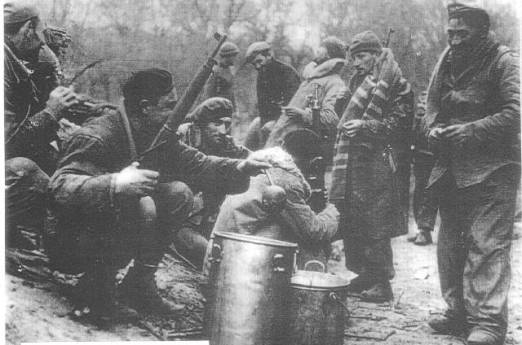
But with factions on the left collapsing as the war pressed on, Communist pressure  forced Montseny from her post in May 1937. She returned to anarchism, even though many hated her for ever leaving, and continued to help in the war effort to kill fascism. As the war went on, she was forced to accept food packages from friends in the Netherlands. When Barcelona was bombed in 1938, she feared either that or raids by Franco supporters would see her and her family killed. When the Nationalists finally broke Barcelona in January 1939, she, her partner, their daughter, their newborn son and both of her parents fled north through the snow, walking to France. Montseny’s mother died on route, which forced Montseny to leave her body, and the country, behind. Many refugees were now in France, and kept in internment camps, where death swept through those displaced. They lived near Paris, trying to help Spanish refugees, but then the Nazis invaded, forcing them to hide in Toulouse.

Franco was after Montseny specifically now, wanting to execute all those who opposed him and the Nationalists during the war. In 1942, the same time Montseny’s father died in an internment camp, Franco asked the French government to help catch Montseny for extradition. But Montseny was pregnant and the French government refused to send a pregnant woman home to be killed. Spanish refugees were trapped in France, the French pinning them in, and allied countries were of no help.

Montseny and her family were forced to stay in Toulouse, where on top of her 51 novels, Montseny finished 22 nonfiction works, and wrote regularly for two French magazines, despite only learning the language after her exile. She did not return to Barcelona in 1977, two years after Franco was dead.

Montseny addresses the first CNT meeting in Barcelona since the war, in 1977

Montseny did not stay in Spain; she continued with her life in Toulouse, publishing her final book, Mis primeros cuarenta años (My First Forty Years) in 1987, and died aged 88 in 1994. She lamented that she was unable to instill her ideals about gender into her children, in particular her son, as the change in generational shifts came too late.

~~

This is not a detailed analysis, just a highlight of the Montseny’s life. Things get lost in translation – Feel free to suggest an addition/clarification/correction below. The more the world remembers, the better. All photos are linked to source for credit

This Week in Spanish Civil War History Extra: 80 Years since the Málaga-Almería Massacre

‘The Moors are coming’

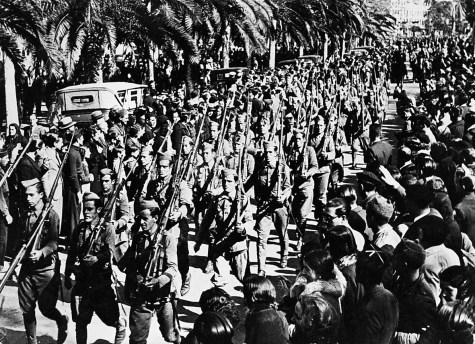
By January 1937, the Spanish Civil War already six months old, and the southern region of Andalucía had already been through its fair share of horrors. With much of the area sided with the Republicans, the Nationalists, led by fascist Franco (and his German and Italian allies) were hot on ripping through Andalucía and ruling the area, and were having great success. In January, General Queipo de Lllano, who had already enjoyed mass executions through Andalucía, was named head of the Army of the South, a division of 15,000 troops, made up of Spanish soldiers and Moorish fighters from Morocco, based in Seville. They were aided by Italian men brought in from Cadiz, 10,000 ‘Blackshirts’, and were ordered to take Málaga on the southern coast, picking up Granada, Marbella and Ronda on the way, along with the surrounding rural areas.

bandicam-2017-02-08-14-17-38-504

The city of Málaga, population 250,000, plus another 90,000 who had fled there from the countryside, saw no immediate reason to worry, and their 12,000 Republican militia (only 8,000 armed) did not take up any training, dug in no trenches, set up no road blocks and manned no hilltop lookouts. They simply did not have the manpower or supplies to defend themselves. The Nationalists were battle-hardened men who had no problem killing brutally, particularly the Moorish soldiers, who had committed horrid crimes elsewhere in Spain.

The attack began on February 3, 1937 when Ronda was defeated by Nationalist troops, leading them right to Málaga, coming from the west. The Italian troops, who had entered the region from the northern hills, arrived on February 6. At that point, all the people of the city could either fight or flee. Through the day on February 7, the Republican fighters were torn apart by the onslaught of the Nationalists, and executions began. It mattered little whether you were a militiaman or not, you were executed. Women were raped brutally, and then shot if the rape didn’t kill them. Children were killed in the crossfire or just killed as collateral damage. February 8 marked the official fall of Málaga, completely swamped with Nationalist soldiers and bombed from the air by German and Italian planes. Boats offshore also bombarded the city. Around 4,000 people were killed in the initial executions alone, though exact numbers are not possible.

The people of Málaga had only one way to go; east along the coast towards the haven of Almería, an area relatively safe at this point in the war. But Almería was 220km (135 miles) along the N-340. It is unknown precisely how many people tried to flee, either on foot, donkey or by truck (until petrol ran out anyway), though an estimate by Contemporary History professors Encarnación Barranquero and Lucia Prieto is 100,000 now-refugees.

By dawn on February 8, the city was Nationalist territory, and many of the people who fled were around 30 kilometres east in Torre del Mar, walking the sparse road. Trucks that ambled past were loaded with children, parents eager to get them to safety any way possible, begging the trucks to take children from their arms as they walked. They had to walk with everything they owned, clothes, bedding, sewing machines, tools, water, anything they had, strapped and carried by their bodies or donkeys. But the walk was not their only problem. General Queipo de Llano was not content with taking the city and executing those who didn’t flee. The refugees would be chased.

As people trekked the winding, hilly, unsealed road, the troops were making their way behind them, swift and trained for marching. Then bombing from the air along the road began. People had nowhere to hide – caves, ditches, rocks, anything had to be used for defense as the Nationalists looked to wipe out the lot. The 16-kilometre stretch between Nerja (55 kilometres east of Málaga) and La Herradura suffered a terrible fate as the first wave of civilians were attacked, bodies littering the road as they were defenseless from the air. Parents were forced to dig with their hands and bury their children. People pressed themselves against cliff-faces in the hope of safety and died on the spot. Gutters filled with bodies as they fell from the roadside. Whole extended families were found lying together, all dead, and some with children left alive, picked up by other people strong enough to carry an extra person. The bridge over the Guadalfeo River, 90 kilometres from Málaga, was bombed, sending innocent refugees into the water and drowned at nightfall.

By the time the refugees arrived in Motril, 95 kilometres from Málaga, the International Brigades were there to help defend them against the Nationalists, but many refugees were now injured, starving and exhausted, and still had a long way to go, with family members left dead on the roadside. None would return until the end of the war, some remained in exile for life. Reports state that skeletons of the people killed on that dusty stretch were still to be found on the roadside until the mid-1960’s. No one wanted to go home along the N-340, and the whole incident was silenced.

One man became well-known in the mess, a Canadian named Norman Bethune. A doctor and ambulance driver, he was in Spain to fight fascism as an international volunteer. His ambulance raced back and forth along this road, trying to save all he could. To read about Bethune, try ‘The Ambulance Man and the Spanish Civil War’ by Paul Read. It’s a shame the locals who suffered this event were not so well-known, their stories limited to tales told between generations until recently.

Professors at the University of Málaga estimate over 5,000 people died on the road, based on oral histories collected, plus burial records in Salamanca, and Málaga archives. Bodies were not properly buried or treated, so the exact figure can never be established. Those killed and buried along the roadside are still left there today. Ten years ago, the Diputación de Málaga opened its archives for professors to complete historical memory works on the massacre in the area, to accompany the stories of 400 people who came forward with their personal accounts of the event.

The Malaga-Almeria massacre is commemorated at Torre del Mar, considered a halfway point along the road where the massacre took place, on February 7, the date people began to flee their homes in Málaga. This attack was almost a practice, a prelude to many atrocities that would go on to occur in WWII. The damage done to the people of Málaga, the towns that were in the firing line towards Almeria, and the whole rural region itself is unimaginable, and how it shaped and changed the lives and lifestyle of following generation in the area has been largely ignored until recent times.

If you are interested and can read Spanish, the book by professors Encarnación Barranquero and Lucia Prieto from the University of Malaga is Poblacion y Guerra Civil en Málaga: Caido Exodo y Refugio, an excellent book, well researched, with powerful personal recollections.

A first person account written is 1937 is Norman Bethune’s The crime on the road Malaga-Almeria : narrative with graphic documents revealing fascist cruelty (if you can get a copy – I can’t!)

~~

This is not a detailed analysis, just a highlight (lowlight?) of the week’s events. Things get lost in translation – Feel free to suggest an addition/clarification/correction below. The more the world remembers, the better. All photos are auto-linked to source for credit.

Women of the Spanish Civil War: Part 1 – Lucía Sánchez Saornil

cntLucía Sánchez Saornil was born in Madrid on 13 December 1895, and raised in poverty by her father. Sánchez got accepted into the Royal Academy of Fine Arts of San Fernando (Madrid) with her passion for poetry, and by 1919 she had already been published in multiple journals, where she used a pen name. As a man, she was able to write of lesbian themes; at that time, all gay relationships (and anything related) was subject to censorship and prison time, all still illegal in Spain. This lead to Sánchez having to keep her private life very private for her safety. However, she wrote alongside many modern new authors, dedicated to promoting new literary styles, but only as a man.

1933Sánchez worked for the as a phone operator at Telefónica, and in 1931, participated in the union strike arranged by the CNT (anarchist workers union), and ignited her passion for activism. In 1933, Sánchez gained a role with the CNT in Madrid, as their Writing Secretary, and edited their own journal, right until the start of the Spanish Civil War in 1936. Her writing quickly established her as a feminist and addressed the urgent need for better equality in Spain. At that time, gender roles were extremely strict and went unquestioned. Sánchez wrote of how motherhood should not have to define a woman and that women deserved far better treatment. The anarchist movement praised equal rights, but it seemed as all talk and no action, with men who claimed to be anarchists still sexist in the home. Women still were forced into marriage and single women required a chaperone in public. Women still received half the income of men. The working class women were not receiving any benefits promised by the Second Spanish Republic.

In 1935, Sánchez decided to form the Mujeres Libres (Free Women), along with Mercedes Comaposada, a socialist lawyer in Madrid. They argued that social revolution and women’s revolution were the same thing; that women’s issues were everyone’s issues. They started their magazine, and were soon joined by Amparo Poch y Gascon, a doctor who believed in sexual freedom and the abolishment of double standards for women. The women felt that their contribution to the CNT was not being treated equally, and that sexism was rampant. At same time, Soledad Estorach in Barcelona started the Grupo Cultural Feminino, a group committed to equality in unions. In 1936, the groups came together and formed the Agrupacion Mujeres Libres, a group which would grow to 30,000 members.

The anarchists believed that women’s equality would be naturally created after the social revolution, when the working classes received better rights. However, the Mujeres Libres believed women’s rights could begin right away, and they created networks of support and reported on sexist issues within their unions. By the start of the Spanish Civil War in 1936, coinciding with the Spanish revolution, Mujeres Libres were already formed and prepared, so that women could participate in war fully, both in the revolution and as militia in battle. Sánchez and her team spread propaganda, radio news, and travelled to rural women to give them support.

In order for women to be free as the Spanish Civil War and revolution progressed, the Mujeres Libres organised schools, women’s only social occasions and a women-only newspaper, so women could feel safe and confident as their political consciousness was educated. Many working class women could not read or write, so Mujeres Libres set up classes for these women to attend, and women were trained as nurses for the ever-increasing wounded from the front. At the same time, they were taught about sexual health and post-natal care, to pass on to as many women as possible. Much had been denied to working class women in the past, and they finally started to receive basic help.

Mujeres Libres did not become part of the CNT or FAI, as they wished to be an independent anarchist group. As men left to fight at the front (along with many women, who are largely forgotten by history), the Mujeres Libres had women work-ready to fill men’s roles. While still stuck in female roles like cooking for the militia and nursing the wounded, women were also being training in shooting by Mujeres Libres. Also formed was daycare for children as women empowered themselves, and the children were educated in the causes their mothers fought to achieve. Mothers, in turn, received information on child care and development, for the better of the whole family. They also published their first Mujeres Libres magazine as the war broke out, being printed until the front reached Barcelona.

Mujures Libres had much opposition, as feminism does today, believing women cannot be a good mother and a good working woman. Their roles would always be limited to parenting. Many believed that anarchism could not work if women soughtto undermine men, even though one of their aim goals was an egalitarian society with freedom for all. As Mujeres Libres flourished, so did the man tears, who got scared and voiced opposition. To this day, no one has figured out why men are so scared of women.

The revolution broke down ten months after the outbreak of war, and the ability of the Mujeres Libres faltered. The inability to work together got the better of the left-wing factions, and the strength of the Nationalists slowly ate away at freedoms gained for the working class. Fighting and killing became the only activity in all parts of Spain.

Sánchez fled to Valencia and worked as a journal editor for Threshold, and met the love of her life, America Barroso. Sánchez became a member of the SIA (international antifascist union) and worked as their General Secretary, who supplied anarchist aid to the wounded and fleeing during the war. Sánchez and Barroso were forced to flee to France in 1939 as anarchists, but were forced out of there by Nazis in 1941. Sánchez did not have the luxury of anonymity and had to live quietly in Valencia, living with her ‘wife’s’ family, as all same-sex relationships were illegal, and fascism and Catholicism were raining down. Sánchez worked as an editor and Barroso worked at the Argentine consulate, until Sánchez died of cancer in 1960, aged 75.

Sánchez was buried quietly in Valencia with a headstone which reads –

¿Pero es verdad que la esperanza ha muerto? But is it true that hope has died?

~~

This is not a detailed analysis, just a highlight of the Sánchez’s life. Things get lost in translation – Feel free to suggest an addition/clarification/correction below. The more the world remembers, the better. All photos are linked to source for credit