Welcome to the author Q+A! I tried to combine question where possible to fit everything into one post.
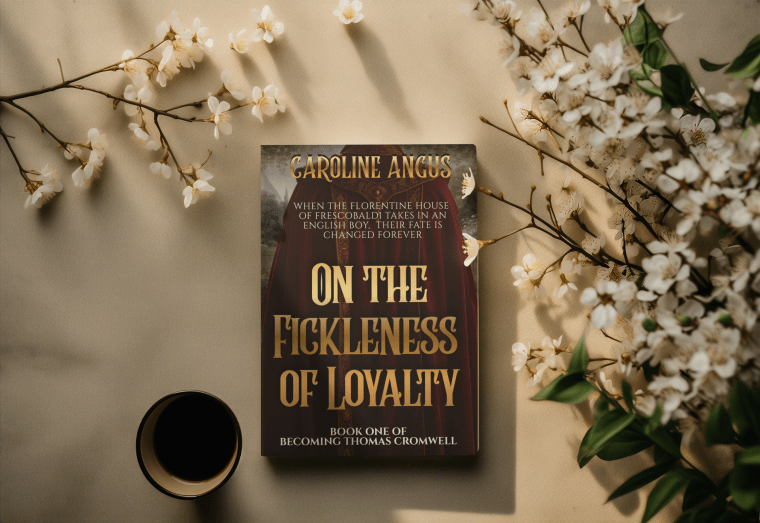
On the Fickleness of Loyalty is out now here, or your chosen Amazon site. It might take a few days to load on other stores’ sites (can’t control that, sorry!)
Why do you like Thomas Cromwell so much? How long have you been researching Cromwell? Why Cromwell?
The question I get asked most often! Why Thomas Cromwell is easy for me. For the vast number of men at the Tudor court, they are duke/baron/whatever of somewhere, the son of duke/baron/whatever of somewhere, on and on and on. For the women, the are the lady of somewhere, daughter of him and her of somewhere, on and on and on. Then there is Thomas Cromwell, a guy from nowhere, with no family pedigree, no history anyone can trace, who, on a mixture of charm, quality public speaking, and the ability to remain invisible when it suited, managed to make his way through life to the very top of society. The story writes itself. I love a cheeky opportunist. It gives so much more range, because Cromwell was not confined by court rules or social customs like other people. He had to go to great lengths to rise high as a nobleman at court, earn every penny personally, and put up with the grief he would get from those born with a silver spoon. For the first 45 years of his life, he disappeared from England as a teenager, only to turn up years later in Florence, and then in Antwerp and Middelburg a decade later, marries for a modest inheritance and family connections to let him work as a lawyer, and be accepted into Gary’s Inn without any actual legitimate education. By the time King Henry noticed Cromwell, he was a multi-millionaire (by today’s standards), and all entirely on his own work. Attempting to help his master Cardinal Wolsey saw Cromwell placed into court life and ends up recreating government as we know it today and breaking down the Catholic Church’s hold over England. The scope of storyline in fiction is immense in a way others at court don’t have. When I wrote my first three novels on Cromwell, I felt like the narrative could have gone on forever, and now, doing his early life, I can spread out so much wider again, add new characters, and create a whole new world. I don’t want to write about a man who was born on third base. I don’t want to write about a pretty girl with rich parents and the ability to read. I want bigger than that, and the nobility rarely provides it. (I am happy to read about what others make of them of course)
Why put Cromwell in Florence instead of England with Wolsey?
Because Florence is amazing! The history of Florence is incredible, and it is the only location, other than Garigliano, that Cromwell can be placed before 1510. It created such a massive world for me to build, because the majority of historical novels in Florence feature the Medici, but Cromwell lived there in a period where the Medici were ousted. No one says they are dying to write about the reign of Piero Soderini, do they? The way Florence was run under Soderini’s rule was totally different the structure to the century prior under Medici rule, or the century after, also under Medici and papal rule. There was this small pocket of time where anything can be created, and it was the exact time that Cromwell lived in Florence. Cromwell can walk down the street and help Botticelli with his bag, have dinner with Michelangelo, catch up with da Vinci at a goodbye party, buy remedies from Caterina Sforza, throw stones at the statute of David (which was apparently a popular activity), and most importantly, drink at a bar with Machiavelli, who, I discovered, was nothing like his works would suggest.
What sources or records were most important in shaping your version of Cromwell’s early life? Are the Frescobaldi family real?
Matteo Bandello’s story of the Frescobaldi family is the only written record of Cromwell under the age of 25, and that was limited to a few lines. It was enough for me to recreate the Battle of Garigliano at the start of book one, before moving to create a world about a young unemployed Englishman hungry enough to take on anything. The Frescobaldi family mattered a great deal to Thomas Cromwell, as seen by later actions back in England and his close relationships with the allies who lives in London. Again, the story of a starving teen soldier stumbling into the path of a Florentine family who takes pity on him practically writes itself.
There is a book, underrated in my opinion, The Winter King by Thomas Penn, which has some of the most well researched information on the smuggling operation the Frescobaldi family created with King Henry VII. These were shrewd people who managed to get their name into the most powerful circles of Europe; Henry VII, James IV, Duchess Margaret of Savoy, Maximilian, King of the Romans, Pope Julius II, Philip of Burgundy and Juana of Castile. The scale of historical figures I can use is limitless.
When the comes to the Frescobaldi family, which is still prestigious today, the people I have created are not based on the real life people of 1503-1513. There are similar names, yes, and the Frescobaldi palaces are a location, but the people are 100% fictional. The information about these particular generations of the family are limited to their business dealings in ledgers around Europe; their personal lives are not a subject for scrutiny. I completely made up the characters. However, what is happening in Florence and Europe at the time is completely accurate, with people at different levels of power having to deal with the realities that life sent them. I have worked as closely as possible with primary sources to ensure that when they are in the city, they are dealing with what was happening at that time, when they travel, they must skirt around war and disease accurate to the period. Historical events and weather anomalies change their lives the way it would have 500 years ago.
Is this another Medici drama based in Florence? Is this like a mystery novel, or more a historical take on Florence? How much Machiavelli is in this book?
In 1494, Piero de’Medici, ruler of Florence for only two years, lost control and the Medici family were exiled. Girolamo Savonarola came in as a religious fanatic and completely upended the city and its way of life before he was eventually killed less than five years later. Piero Soderini, a politician and statesman, stepped in and was eventually voted in for life to rule over the Republic of Florence, which was controlled by councils that regularly rotated men in and out of power, until the Medici storm the republic and recapture the city in 1513. For the bulk of the series, the Medici are a threat in the distance, giving other families and alliances to breathe. In the first book, Cromwell is constantly reminded of his dealings with Piero de’Medici at Garigliano, which he hates.
As for Machiavelli, he does pop up from time to time. In this time period, he is not the great author that his name inspires, he is a chancellor and diplomat with varying degrees of skill, poor decision-making skills, and exceptionally loose morals. It is a mystery novel I guess, in that there is an element of mystery, however most of the mystery is how long the characters will take to admit the inevitable truth they already know.
Do you see Cromwell as someone shaped more by ambition or by circumstance? Do you think Cromwell knew how high he would rise in life? Do you think Cromwell ever wanted to stay in Europe?
There must have been a fairly large portion of Cromwell that ran on ambition, to reach the heights he did. But the bulk of his life is only seen through his ten years at the royal court for Henry VIII. He could have tried breaking into court much earlier, but chose not to, despite ample opportunity to do so. He was able to sit in parliament in 1523 on behalf of Sir Thomas Grey, and gave a speech to the king, telling him not to go to war because of the provisioning costs, and yet that was not at all what he was meant to do in parliament. Grey wanted petitions for the north to be read (I can assume they were, though records from 1523 have been destroyed). Did Cromwell burn with an ambition to create modern government? Did he burn with desire to create the Church of England? I don’t think so, but when the opportunity came, he took it. It tends to be a theme throughout his years prior to court life too, he found himself somewhere, with certain people, and chose to make the best of it. As a result, he ended up with a wide network of friends in different places, not in high places, but in places where he was respected. As for staying in Europe, it is hard to tell. From what I can gather, his father died around the time Cromwell retuned to England. Obligation kept him home for the rest of the 1510s, except for few times to Italy.
How do you decide when to stay strictly accurate to history, and when to let the story take over?
Generally, I will change history if I have to for the story, but it might mean I move a historical event up by two months or something and the story doesn’t get affected in any way. There aren’t huge changes to history as we know it. Because many of the characters are fictional, I can bend them around history. One example in book one is the death of Isabella of Castile in late 1504, and then the shipwreck of Philip of Burgundy and Juana of Castile in early 1506. It would have been great if I could have moved one of those events to have them close together, but instead I moved around the lives of fictional characters and made it fit. I don’t like changing history if I can avoid it. One thing to consider though is that different people from different places and cultures see different events in a different light. How an event is perceived in one place may not be the way you perceive in yours as the reader.
Are there parts of Cromwell’s life that are harder to write than others? Is it hard to write when there are so few historical facts to use?
I hate writing romance! No shade to romance authors, I just hate doing it myself. I’m amazed I ever managed it. Cromwell’s personal life is a blank, throughout his life. Yes, he had a wife at one stage, but I don’t place much stock in that. Marriage was a system where even the poorest man could have a maid. He made a choice based on what appears to be a smart financial decision to marry someone related to his brother-in-law, who could offer him legal work. That gave me plenty of scope when writing my 1529-1540 series, because there are zero romantic entanglements to have to deal with, and it was great. Now, in this series, because so many people are fictional, or I have been able to research their personal lives, I can be entirely fluid with sexuality as much as I please outside the traditional notions of arranged marriages and tepid relationships between strangers. The men and women of Florence were up to A LOT. Though, no, I don’t write sex books, don’t worry.
Another thing is the clothing of the period. I don’t want to get bogged down in dresses or caps, or hairstyles, I describe things in a basic way and move on. Please google if you want an in-depth idea! There are some exceptions; I do describe fabrics, as that is relevant to Frescobaldi trade, and the cover image, of Cromwell wearing a red brocade cloak with gold embroidery is very relevant. He wears this cloak (that obviously is not his) and it starts a chain of events that spiral out of control over a year. Fabrics are relevant to how a person felt in society, but this isn’t a great book if you want fancy gowns.
I was amazed by how much historical research I could use in this book. I was unsure when I started if I could fill a book covering 1503-1513, and before I realised it, I had written four books’ worth. I started writing this series in early 2023, but it was interrupted by several non-fiction contracts I needed to finish, and real life got really hard in 2024 and 2025. It has been very nice to finally finish this project.
It says book one of Becoming Thomas Cromwell, what more could there be? Is this book part of a series? Does this book match up with your other Cromwell series?
This book covers 1503 at Garigliano, though to early 1506 when Cromwell… well, you have to read it. In this book, Cromwells works at Palazzo Frescobaldi and is a secretary helping with the smuggling arrangement for King Henry in England and dealing with a lot of metaphorical ghosts of things that have happened. Book two, currently scheduled for a Christmas 2026 release, covers 1506-1508, book three in mid-2027 will cover 1509-1511, and Christmas 2027 will have book four covering 1512-1513. Could it go beyond that? It’s entirely possible. The Becoming Thomas Cromwell series is in the same universe as the Queenmaker series, and you will recognise certain characters that are in both.
Why do you only write about men?
Seriously? Who do you think is running all these men?
One thing that falls in Cromwell’s favour is that he helped people when they were down. He helped women when they had been wronged. He pulled wayward husbands into line. He gave out money and did not get it back. Cromwell didn’t look down on people, and when I write fiction like this, where young Cromwell is beguiled by the powerful women he encounters, he gives him their dues, he sees their importance. I will always write that way, and I don’t have to bend history to do it. Had there been a plucky opportunistic who was female at court, maybe I would have written her. Instead, I took historical figures and made fictional women around them. I wish we had more primary sources on women, written by women, about women, for women. But we don’t.
I know many people like to portray Anne Boleyn as a kind of hero, but I don’t see her that way. She did some nice things for some people, and she did some horrible things too. People generally get annoyed at Cromwell works because he was the man who killed Anne Boleyn, and no, there is nothing that can redeem such an act. I literally wrote Planning the Murder of Anne Boleyn, and I didn’t do it to absolve Cromwell of his part in it, but it does show the underbelly that propelled Anne to her death, entirely because of her husband. So please, send me rude messages about Cromwell if you like, but I have a tight schedule, so don’t expect a reply.


You must be logged in to post a comment.