NEW – BECOMING THOMAS CROMWELL: ON THE FICKLENESS OF LOYALTY

AVAILABLE 4 MAY 2026
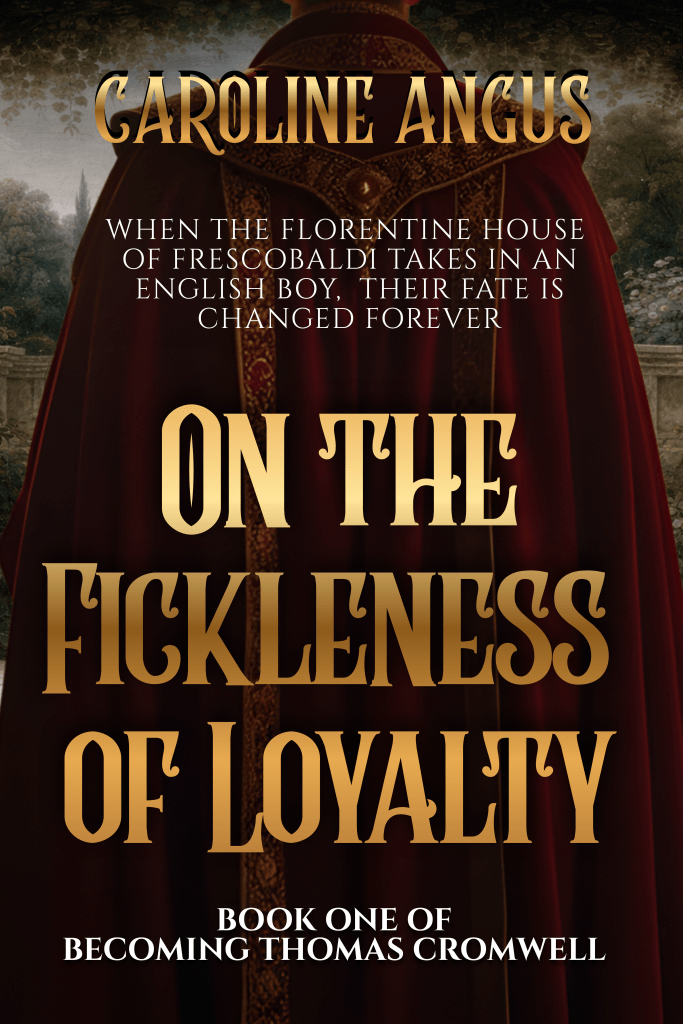
Before Thomas Cromwell could rule Henry VIII’s England, he first had to survive Machiavelli’s Florence.

Thomas Cromwell is eighteen when he arrives in Florence, carrying little but the memory of war and the instinct to survive.

Taken into the household of the powerful Frescobaldi, he finds himself in a city balanced between republic and ruin, where Piero Soderini governs in the uneasy absence of the Medici, and where influence is measured not in titles alone, but in gold, information, and silence.

Under the watch of Francesco Frescobaldi, and in the orbit of Niccolò Machiavelli, he begins to understand that power is rarely declared, but quietly constructed through alliances, through deception, and through trade. For Florence’s wealth does not rest in its streets, but in its reach. From Rome to the Low Countries, from the Papal monopoly of alum to the court of King Henry VII of England, commerce binds the city to forces far beyond its walls. And where such wealth moves unseen, so too does danger.

Yet not all risks are counted in coin. As Cromwell is drawn deeper into the lives of those around him, loyalty begins to blur, and the cost of belonging reveals itself in ways he cannot easily control.

As the Italian Wars redraw the balance of Europe, Cromwell is pulled ever further into a network of ambition and secrecy, where survival demands more than obedience, and where every choice leaves its mark.

In Florence, nothing is ever simply bought or sold. And every debt must be paid in full.

PRE-ORDER IN HARDBACK AND KINDLE NOW 

THE COMPLETE TRANSCRIBED LETTERS AND REMEMBRANCES OF THOMAS CROMWELL NOW UPDATED 2025

THE TRANSCRIBED LETTERS AND REMEMBRANCES OF THOMAS CROMWELL

Four hundred years passed between Thomas Cromwell’s death in 1540 and the recognition that this faithful servant was more than another agent of Henry VIII. Born a common man with no recorded education, Cromwell became a wealthy lawyer, politician, minister, and peer of the realm, and created the modern style of government in England. An extraordinary man of wisdom, charm, strategic cunning, and boasting an incredible memory, Cromwell redefined bureaucracy, broke a nation from Rome, reformed parliament, created royal supremacy and developed the revolutionary administrative procedures still in place today.

But after his execution, Thomas Cromwell became an intellectual genius lost to history, only now again known for his brilliance, finally appearing out from the shadows of the king he served. Cromwell laid the foundations for the success of Britain throughout the centuries, emerging from archives through the past seventy years of fine academic research, and now historical fiction brings the great man into public view once again.

Many know of Thomas Cromwell’s life through the words of others, their letters, tales, and opinions passed down through the years, with much of Cromwell’s vast correspondence lost to time and destruction. For the first time, Cromwell’s surviving letters are together in a single volume, alongside his personal remembrance lists, transcribed from original primary sources. Here are Thomas Cromwell’s letters on an array of subjects, without opinions from others, without the legal definitions of his legislation, the chance to read Cromwell’s own words.

AVAILABLE WORLDWIDE IN HARDBACK, PAPERBACK AND ON KINDLE 

 AVAILABLE HERE 

PLANNING THE MURDER OF ANNE BOLEYN

Almost 500 years have passed since the death of Anne Boleyn, and yet, there has never been a suggestion she was guilty of the crimes that saw her executed. Attempts to muddy Anne’s reputation throughout history have not lessened her popularity, nor convinced anyone she was an adulterer. But many myths surrounding Anne’s conviction for sleeping with George Boleyn, Henry Norris, Francis Weston, William Brereton, and Mark Smeaton, have cropped up as a result of centuries of lies, slander, and misinformation from detractors.

One month after Anne was executed, the Convocation of Canterbury ratified the paperwork detailing her arrest, conviction, execution, and the annulment of the marriage between King Henry VIII and his second wife. As parliament had already ruled Anne’s only child, Princess Elizabeth, was no longer heir to the throne, all the paperwork surrounding the trial was destroyed. No trace of her charges, witness statements, evidence, or even Archbishop Thomas Cranmer’s reasoning for annulling the royal marriage survived the mass destruction. Everyone was supposed to forget Anne Boleyn and accept Queen Jane.

But why did Anne Boleyn ever need to die? King Henry had started little more than an infatuation with Jane Seymour in December 1535, and yet many saw the opportunity to pounce, not to reduce Anne’s influence but to increase Princess Mary’s standing. As Vicegerent Thomas Cromwell and Ambassador Eustace Chapuys whispered of alliances in secret meetings, the Catholic nobility and the White Roses began to hatch their plan to restore the king’s daughter Princess Mary to her rightful place at court. Just as Katharine of Aragon died, Anne Boleyn felt secure as England’s queen, only to find that her adversary’s death would soon bring on her own.

Who ultimately planned Anne Boleyn’s death? Why did political and religious enemies of Thomas Cromwell go to him in the months leading to Anne’s death, expecting his co-operation to restore Princess Mary? Did Jane Seymour have any significance, why did King Henry and Thomas Cromwell get into a public shouting match at a dinner party, and just how easy was it to convince Henry to remove his wife for good?

The answers lie not in what evidence remains of court life in early 1536, but in the gaps left behind. None of the characters that played a role in Anne Boleyn’s death were strangers; all had connections, alliances, and opportunities, and when their pasts and futures are laid together, we can see how a haphazard plan to end a queen’s life had almost nothing to do with her at all.

Henry VIII’s Children

HENRY VIII’S CHILDREN: THE LEGITIMATE AND ILLEGITIMATE SONS AND DAUGHTERS OF THE TUDOR KING

Of the five Tudor monarchs, only one was ever born to rule. While much of King Henry VIII’s reign is centred on his reckless marriage choices, it was the foundations laid by Henry and Queen Katherine of Aragon that shaped the future of the crown. Among the suffering of five lost heirs, the royal couple placed all their hopes in the surviving Princess Mary. Her early life weaves a tale of promise, diplomacy, and pageantry never again seen in King Henry’s life, but a deep-rooted desire for a son, a legacy of his own scattered childhood, pushed Henry VIII to smother Mary’s chance to rule. An affair soon produced an unlikely heir in Henry Fitzroy, and while one child was pure royalty, the other illegitimate, the comparison of their childhoods would show a race to throne closer than many wished to admit.

King Henry’s cruelty saw his heirs’ fates pivot as wives came and went, and the birth Princess Elizabeth, saw long-term plans upended for short-term desires. With the death of one heir hidden from view, the birth of Prince Edward finally gave the realm an heir born to rule, but King Henry’s personal desires and paranoia left his heirs facing constant uncertainty for another decade until his death. Behind the narrative of Henry VIII’s wives, wars, reformation and ruthlessness, there were children, living lives of education among people who cared for them, surrounded by items in generous locations which symbolised their place in their father’s heart. They faced excitement, struggles, and isolation which would shape their own reigns. From the heights of a surviving princess destined and decreed to influence Europe, to illegitimate children scattered to the winds of fortune, the childhoods of Henry VIII’s heirs is one of ambition, destiny, heartache, and triumph.

ORDER HARDBACK AND EBOOK FROM PEN & SWORD 

ORDER AT AMAZON US

ORDER AT AMAZON UK

ORDER AT WATERSTONES

THE PRIVATE LIFE OF THOMAS CROMWELL

Thomas Cromwell was King Henry VIII’s most faithful servant, the only man the king ever openly regretted executing. But Thomas Cromwell came to royal prominence late in life and had 45 years of family, friends and experiences behind him before catching Henry’s eye.

Born a common boy at a time of significant change in England in 1485, Cromwell grew up in a happy, close-knit family, before heading to Europe for dramatic adventures. Returning to England a decade later, Cromwell emerged with the skills of a lawyer and merchant, with the European language skills and connections to match. Marriage, children, friends, family and manor homes all furnished Cromwell’s life, a man happy and settled in London. But more beckoned for the Italian-Englishman, when a special friendship with Cardinal Thomas Wolsey grew, along with the attention of the king.

Tragic personal loss affected Cromwell, hidden behind the more-recorded professional accolades. But friendships remained throughout time, changes in allegiance and even religion. Men who had met the young Cromwell stuck close to him through the years, and Cromwell never forgot a single loyal friend. Cromwell’s desire to support his son saw Gregory become brother-in-law to the king himself, only for more tragedy to harm the ever-growing Cromwell family.

Far from the seemingly dour, black-clad, serious man, Cromwell lavished those around him with gifts, parties, extravagant games, entertainments, animals and outfits. But the glamour and beauty of Cromwell’s life would come to a sudden end, leaving a trail of devastated men and women, and an extraordinary manor home, Austin Friars, scattered to the wind.

Using a wide variety of primary material, this exciting biography weaves a new narrative on the indefatigable Thomas Cromwell, illustrating him more vividly than we’ve known him before.

AVAILABLE WORLDWIDE IN HARDBACK AND EBOOK FROM PEN & SWORD BOOKS 

ALSO AVAILABLE FROM

AMAZON US

AMAZON UK

THE NATIONAL ARCHIVES UK

BARNES AND NOBLE  

WATERSTONES

GOOGLE BOOKS