MY HEARTY COMMENDATIONS: THE TRANSCRIBED LETTERS AND REMEMBRANCES OF THOMAS CROMWELL NEW EDITION 2025

Part 1: Vengeance in the Valencian Water Q+A (plus a FREE book)

Valencia, Spain: October 1957 – After a long hot summer, Guardia Civil officers José Morales Ruiz and Fermín Belasco Ibarra have had enough of their lives. Sick of dealing with lowlifes and those left powerless under Franco’s ruthless dictatorship, the friends devise a  complex system of stealing babies, to be sent away to paying families. But as the October rains fall, the dry Valencian streets fill with muddy water, and only greed and self-preservation will survive…

It’s 2010, and Luna Montgomery is busier than ever. With the mystery of her murdered grandfather solved, she reluctantly prepares to be the bride in Spain’s ‘wedding of the year’. But four more bodies lie hidden at Escondrijo, Luna’s farm in the Valencian mountains. Her fiancé, bullfighter Cayetano Beltrán Morales, is not eager to have his name brought up in a post-civil war burial excavation. When Cayetano’s grandfather José, an evil Franco supporter, starts to push his ideals on Luna, her decision to join the Beltrán family comes under scrutiny.

The Tour de France is fast approaching, and Luna’s position as a bike mechanic on Valencia’s new cycling team begins to come under pressure. When an ‘accident’ occurs at Escondrijo, lives hang in the balance as more of Spain’s ghosts come to life and tell the story of a flood in 1957…

It’s that time again. With time ticking away until Vengeance in the Valencian Water is released on January 24, it’s time I got onto answering some of your questions! I have merged some questions together, to answer as many as possible, but will post in a few parts. Let’s jump right in.

book covers

1 ) What is Vengeance in the Valencian Water all about?

VITVW is the second in the Luna Montgomery ‘Secrets of Spain’ series, which continues right where Blood in the Valencian Soil left off. VITVW follows the same vein – two different time periods, with their own themes that are bound together by similar circumstances. VITVW is centred in Valencia 1957, with a Guardia Civil officer, José Morales and his battle against the struggles of Franco Spain. Common in this time period was the horrendous baby-stealing practices in hospitals, where the church would steal babies from mothers at birth and sell them, with the law on their side. José gets caught up in this vicious circle, only to find his real adversary is the Valencia flood of October 14 the same year. The story runs alongside the 2010 storyline of Cayetano Beltrán, José’s grandson, and his life with Luna Montgomery, which is under pressure. With the financial crisis weighing down Cayetano’s career as a bullfighter and the impending bankruptcy of his grandfather’s huge business, life is increasingly difficult. Luna is still struggling after the recession claimed her job in the first novel, and just as she finds some stability, her late husband’s alleged drug cheating as a professional cyclist rears its head. The long-awaited trial of a Spanish doctor caught doping Tour de France riders leaves Luna to face a legacy she never wanted to be part of. Luna continues pushing to dig up unidentified Spanish civil war bodies, the common clash in Luna and Cayetano’s relationship in BITVS. All the themes in both 1957 and 2010 interlink as ‘coincidence versus fate’ is again explored.

DSCF5338

Pretending to be researching in Segovia

2 ) How long did it take to write Vengeance in the Valencian Water?

I started writing in February ’13, with the intention of having the bulk of the storyline completed before my research trip in May. That failed dismally but while in Spain, I learned so many things. Once back from Spain I was busy with Violent Daylight‘s August release and the story went on hold. I didn’t get back to VITVW until October and finished at the end of November. The book dragged out longer than ever planned, and many ‘real-life’ things got in the way. I had the background for the book, with the research on the Valencian flood, the baby black market and the drugs in cycling done a year in advance, so when it came time to flesh out the book, there was no delay. Going to Spain to learn more about bullfighting and the reality of the recession in Spain really helped with the final touches. Because this book had swirled in my mind for so long, the writing was the final piece of the puzzle, rather than just writing and seeing where the book led, as I have done in the past.
BXR-AKQIAAEkSOK

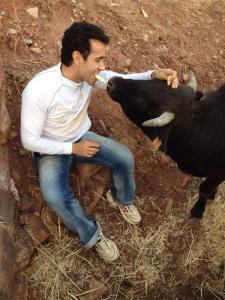
wonderful photo by @v_puerto

3 ) How can you justify being a fan of bullfighting? Bullfighting is grotesque, so why do you condone animal cruelty? 

I have heard it all. I have three things that attract internet trolls – bullfighting, supporting cycling (in NZ) and being a feminist. Bullfighting tends to bring out the animal in people themselves. I have been told I am vile, I am cruel, I don’t deserve to be a parent, I am disgusting, my family deserves to be hurt… the list goes on. Are all these people interesting in the way their meat was raised and processed? Bulls raised on ganaderías and sent to bull fights are treated like kings. Quality healthcare, exercise regimes, carefully controlled diets… none of those things are taken into consideration for the chicken or pork in your fridge. Yes, bulls are taunted and exhausted in the ring, surrounded by the real beast of bullfighting – the crowd – who hungers for the animal to die. Is that degrading? Yes – that is without question. Do I feel sorry for the bulls while they stand disoriented and weakened as they get stabbed to death? Absolutely! The combination of watching the animal die, combined with sitting beside people who love to watch the event is not a nice feeling at all. Am I trying to promote bullfighting? I’m not sure if that is even possible – people can make up their minds about the corrida long before they get there. Many argue on the side of tradition, and I can identify with that. Bullfighting is more than killing an animal. The toreros are fascinating men and their dance with death is something I could write about forever. They are brave, proud and skilled. They have a talent that is frowned upon in the modern age, and stand in the ring to cheat death of its right to claim them, and are both reviled and revered every time they do so. (Numbers of men wanting to be toreros is up, not down as expected). I have great respect for these men, but I have no desire to promote cruelty to animals. I don’t plan on opening minds to both sides of the argument – many minds cannot be opened. The bull is the orchestra, the torero is the conductor. The crowd chants for a kill. I don’t write to glamourise the event – in fact, if you read, you’ll find the books regularly grapple with the subject, and show there is more to a torero than his sword.

4 ) Do you need to read Blood in the Valencian Soil before you read Vengeance in the Valencian Water?

A tricky one. Yes and no. Book one tells the story of a lonely bullfighter and a grieving bike mechanic teaming up to unearth a civil war grave, running parallel to the 1939 storyline of their grandparents trying to flee Valencia at the end of the civil war. The story tells of how Luna and Cayetano meet and how unorthodox they are as a team. However, book two tells the story of them battling through the trials of 2010 Spain, alongside unearthing an all-new grave. The story does stand alone, and the book should give you enough of background that you don’t feel like you’ve been denied any detail. But they are designed to run together, with VITVW starting off just a month after BITVS ended.

5 ) Why have alternate storylines? Isn’t that complicated?

I’ve never had anyone tell me that alternate storylines is complicated. I personally feel that VITVW is even easier to follow than BITVS with the different time periods. The series tells the story of Spanish families throughout the civil war and Franco time period. BITVS is a snapshot of life in 1939, VITVW tells of 1957 Valencian life, and the third book (out 2015) tells the story of 1976 Spain, as the country comes to terms with Franco’s recent death. These times are pitted alongside modern Spain and the very real struggles that the nation is facing. Given the laws that the current Spanish government passes, there is no need to imagine fantastical fiction; reality continues to inspire in depressing ways.

Portal de la Valldigna ’57/’13 – Different and yet the same (photo courtesy of Juan Antonio Soler Aces)

I will be back with part two of the book Q+A in a few days, so if your question hasn’t been answered, have no fear! In the meantime –

For 48 hours only – Blood in the Valencian Soil is free on Kindle/Kindle App. Catch up for free before Vengeance in the Valencian Water is released!

(promotion runs from midnight January 9 until midnight January 11 PST)
From Newton, Auckland to the Sangro River, Italy

100 years ago today, on a warm New Zealand Christmas Eve, Trevor James Cunningham was born to his parents Elizabeth and Herbert of 2 Suffolk Street, Newton, Auckland. Several years later, his little sister Lorraine was born, my grandmother. Lorraine lost her beloved brother just before Christmas in 1943, on the battlefields in Italy. They say a person lives as long as the last person who remembers them, so here is the short story of Trevor Cunningham, as written by my late father.

Early history

Trevor James Cunningham – born 24 December 1913 to Herbert Gardiner Cunningham and Elizabeth Wallace Cunningham – registered for war service on 13 November 1940 in Auckland. His medical check showed he was in good general health and described as 5ft 7in tall, weighing 9st 6lb (60kg) with fair hair, grey eyes and a sallow complexion. He also required dental treatment. He was 27 years  and 324 days old.

He was the time employed as a truck driver for Shell Oil, single, and declared himself as ‘unable to ride or provide a horse’. At medical check taken on that day, Trevor stated that previous injures had been concussion in 1938 and a broken jaw in 1940. There is no record of how these injuries had occurred.

It was eight months later on 5 July 1941 when Trevor was called to report for training at the Trentham military base. Upon on his enlistment he was allocated his army number of 47638. One of this first tasks was to make a will and he named his mother as his executor, and left a copy with the base records station.

Trevor was assigned to be an Acting Lance Corporal in an Engineering and Ordinance Training Depot. The army often took into account any previous experience a soldier may have had, and Trevor’s occupation as a truck driver was taken advantage of. During his period of service in New Zealand, Trevor was alternated between being a Private, Acting Corporal, and a Driver Mechanic. As a Driver Mechanic he was entitled to one shilling a day extra pay.

In December 1941, he was sent and qualified from the School of Instruction in Trentham. He was then placed in the training role and this continued at Trentham, also having a short period in the hospital from the 18th April until May 1st 1942. There is no record for the reason of his hospitalisation.

During the period from July 1943 until he left for overseas there is no record of him having had any leave or returning home to Auckland.

photo

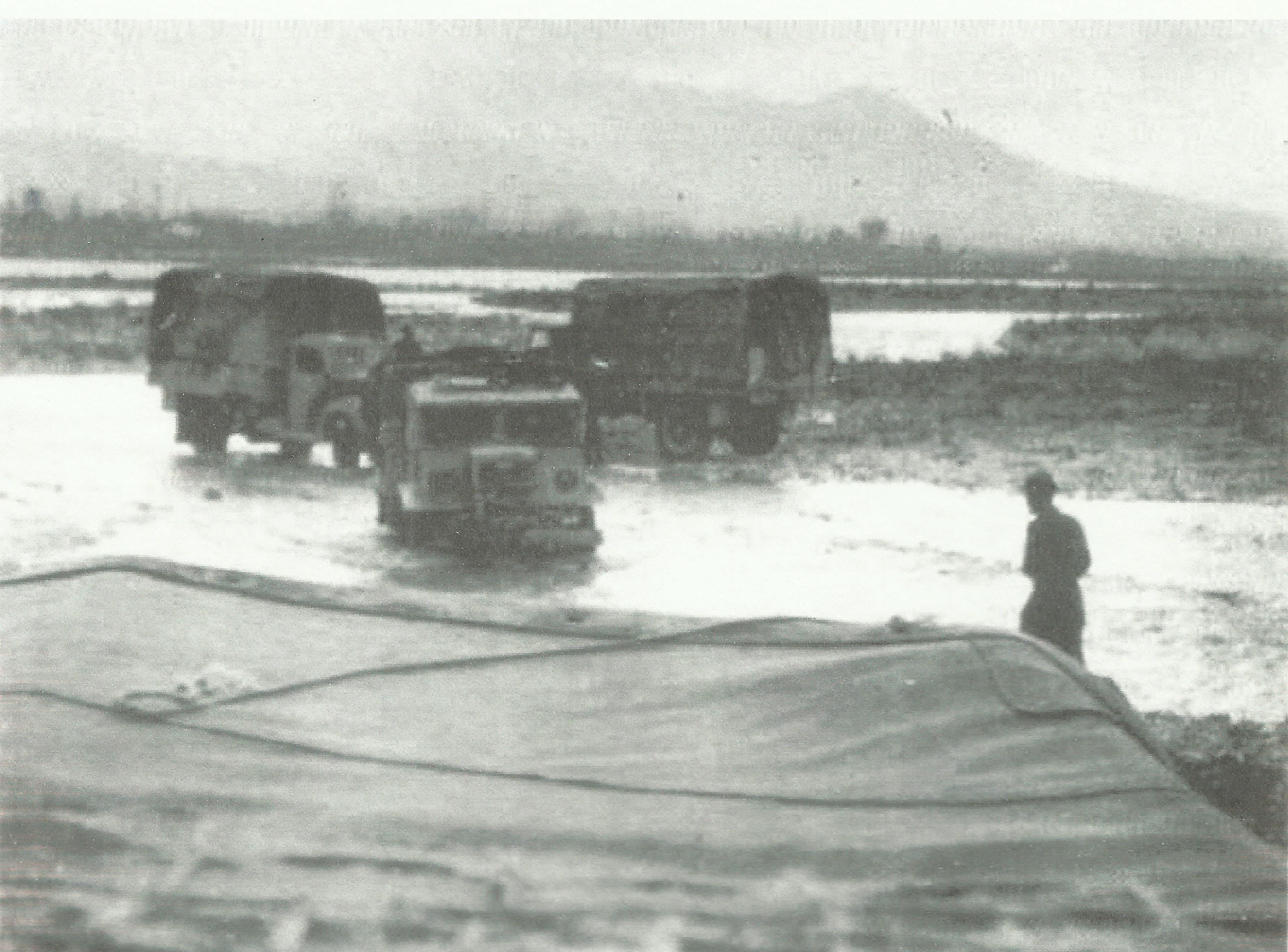
Crossing the Sangro river

Overseas Posting

When his overseas posting came through he left New Zealand bound for North Africa by way of the Panama Canal. The New Zealand army contributed to the second New Zealand Expeditionary Force. In total around 140,000 NZ personnel served overseas for the allied war effort.

The 2NZEF fought in North Africa and then was became part of the Allied campaign to invaded the Italian mainland, Trevor leaving North Africa on the 20th October 1943. The campaign invasion had begun on the 3rd September 1943 and coincided with the armistice made with the Italians who then re-entered the war on the allied side.

The invasion objectives were to draw German troops from the Russian front and more particularly from France, where an offensive was planned for the following year, and progress through southern Italy was rapid despite stiff resistance, but by the end of October, the allies were a facing the German winter defensive position known as the Gustav line, which stretched from the river Garigliano in the west to Sangro river in the east.

By 4th November the allied force that had fought its way up the Adriatic coast was preparing to attack the Sangro river position. A bridgehead had been established by the 24th November, and after heavy fighting the whole ridge overlooking the river was in allied hands by nightfall on the 30th November.

telegrama dreaded telegram

Wounded in Action 

During the fighting in the battle for the Sangro river valley. Trevor was reported as wounded in action on the 25th November 1943. As a battle casualty he was admitted to an army medical base. The following day on 26th he was reported as ‘died of wounds’.

As was custom at this stage of the war, there was no records kept of details of soldiers wounds, or of any medical treatment they received or a cause of death. When a soldier was admitted to the medical station an assessment was done and only those who had a reasonable chance of survival were targeted, and others were made comfortable for further assessment. Most of these would pass away within 24 hours. Records were only maintained if the soldier was to be transferred to another medical facility. In these cases treatment already given was recorded and was forwarded along with the patient. No records of who or why Trevor were ever uncovered, but he was recorded as injured on November 25, indicating a slow painful demise.

letterlittle comfort

Final Resting Place

Trevor was taken to the Sangro River War Cemetery where he was buried along with soldiers from the New Zealand Australian armies. His grave with his Name, Rank and Service Number.The grave is marked with the code XV1. E. 20.

He was decorated with the following medals – 1939-45 Star, Africa Star, 8th Army Clasp, Italy Star, 1939-45 War Medal and NZ War Service Medal, all given to his mother on 14 March 1950. the New Zealand Government also paid a War Service gratuity and 200 pounds to Elizabeth Cunningham on 27 May 1946. His gloves and a strand of his hair also arrived home to his mother.

card

Trevor send this card home to his mother and stepfather, which would have arrived after his death

My father Scott never made it to the Sangro river on his first and only trip to Europe in 2006, but longed to return. Now in his place, I am planning to be the only relative in my little family that has made the journey to find the grave of Trevor Cunnginham. Happy 100th birthday uncle Trevor.

SPAIN BOOK REVIEW: ‘City of Sorrows’ by Susan Nadathur

CITY OF SORROWS is an emotionally intense story about how relationships can get complicated, and how life is not always the way we want it to be . . . Under normal circumstances, they never would have met. Andres is a wealthy Spaniard, Diego a poor Gypsy, Rajiv an Indian immigrant. On a dark road outside the city of Seville, the lives of these three men come crashing together. One man’s anger leads to an unthinkable act, triggering another man’s obsession and forcing the third to negotiate his way through the underside of life. The choices they make ripple outward, throwing not only their lives, but an entire city, into turmoil and change. A devastating loss. A dangerous obsession. CITY OF SORROWS is an epic story of love, death, romance and rage. About what controls us . . . and the choices we must make to be free.

~~

As a fan of the city of Seville, I jumped at the chance to read some Spain-based fiction. This book brings together three very different men on a path that could either save or destroy them.

The main protagonist is Diego, a young Gypsy living on the edge of poverty in Seville. We meet Diego young and married, with a seventeen-year-old wife who is already six months pregnant. The naivety and youth is a mix for a fun new relationship but their tale is not a happy one. When disaster befalls the young couple, the entire city of Seville burns with rage as racism between Spaniards and Gypsies literally ignites. Diego’s life falls to awful lows filled with crime and revenge, which could end him.

Diego crosses paths with Andres, a rich young Spaniard, and not a character many could indulge or come to like. Andres’ hatred of Gypsies, born out of a cliché and unfair stereotype in his own head, leads him to make a simple yet cruel decision that costs someone their life. Andres is mean, tortured, racist and lazy, and while he tried is best to redeem himself through the guise of caring for his young sister Adela, it can be hard to not wish Andres would step in front of a bus.

A third man, Rajiv, a young Indian fresh in the city of Seville, is a wholly likable character. I live in an Indian community, all those who have emigrated for a new life, and the story of this man mimics one of so many real people in the world. He is kind, intelligent and good in the face of all that troubles him – mostly Andres, who he is forced to work with and help. Rajiv is on a different path in life to the other two men in the book, yet their stories weave together in the heartache that swirls through Seville.

Susan Nadathur has done a wonderful job at creating characters that both endear and infuriate, and it shows the divide between Spaniards and Gypsies in Spain. It shows how three different men from three different walks of life and effect, hurt and save one another, as well as explaining the inside details of Gypsy life. As chapters flip between the point of view of each man, one cannot help but want to turn the pages to see where their favourite character ends up next.

Learn more about Susan Nadathur here

SPAIN BOOK REVIEW: The Killing of el Niño Jesús: ‘A Max Cámara Short Story’ by Jason Webster

Max_Christmas

‘It was, thought Cámara, a uniquely Valencian affair, being both tacky and tragic at the same time. But most of all, it was surreal; nothing quite like it could happen anywhere else in Spain’

This Christmas, we are treated to Max Cámara short story from Webster, who has previously penned three full-length Cámara novels, with a fourth due in mid 2014. We find our favourite Spanish detective, hungover on Christmas morning, and with his partner and friend Torres, off to solve a murder in one of Valencia’s mind-bloggling disco-brothels.

Immersed in a mostly naked set of ‘dancers’, done up as nativity scene members, and one hungry goat, Cámara and Torres need to find who killed one of the dance orgy troupe. In true style, Cámara does his best not to raise an eyebrow as the amusing and quirky dwarf Jesus, Joseph, Mary, Father Christmas, the Camel-man and three naked angels recall a night in the brothel that is stuck in 1985 for all eternity.

For an added treat of readers, Cámara’s grandfather Hilaro makes an appearance with his ever present Spanish proverbs and no-nonsense attitudes. If you’re tired of sickly-sweet Christmas stories and events this year, read this and laugh at a far more fun reality, Spanish style.

As an added bonus, you also get the first chapter of the first in Max Cámara series, Or The Bull Kills You, which is a truly excellent read and fantastic introduction to the Cámara series.

If you have never witnessed the brothels just outside Valencia, or an all-night disco party, perhaps you haven’t really lived. I don’t want to spend Christmas with a goat high on cocaine, but it’s the best Christmas story I’ve read in a while.

Buy The Killing of el Niño Jesús here

Visit Webster’s website – jasonwebster.net

Read my reviews for both  the last two Cámara novels – A Death in Valencia and The Anarchist Detective

You can also pre-order your copy of The Spy with 29 Names: The story of the Second World War’s most audacious double agent now

SPAIN BOOK REVIEW: ‘Franco’s Crypt: Spanish Culture and Memory Since 1936’ by Jeremy Treglown

bandicam 2013-12-05 16-29-18-214

source

An open-minded and clear-eyed reexamination of the cultural artifacts of Franco’s Spain –True, false, or both

Spain’s 1939–75 dictator, Francisco Franco, was a pioneer of water conservation and sustainable energy. Pedro Almodóvar is only the most recent in a line of great antiestablishment film directors who have worked continuously in Spain since the 1930s. As early as 1943, former Republicans and Nationalists were collaborating in Spain to promote the visual arts, irrespective of the artists’ political views.

Censorship can benefit literature. Memory is not the same thing as history.

Inside Spain as well as outside, many believe—wrongly—that under Franco’s dictatorship, nothing truthful or imaginatively worthwhile could be said or written or shown. In his groundbreaking new book, Franco’s Crypt: Spanish Culture and Memory Since 1936, Jeremy Treglown argues that oversimplifications like these of a complicated, ambiguous actuality have contributed to a separate falsehood: that there was and continues to be a national pact to forget the evils for which Franco’s side (and, according to this version, his side alone) was responsible.

The myth that truthfulness was impossible inside Franco’s Spain may explain why foreign narratives (For Whom the Bell Tolls, Homage to Catalonia) have seemed more credible than Spanish ones. Yet La Guerra de España was, as its Spanish name asserts, Spain’s own war, and in recent years the country has begun to make a more public attempt to “reclaim” its modern history. How it is doing so, and the role played in the process by notions of historical memory, are among the subjects of this wide-ranging and challenging book.

Franco’s Crypt reveals that despite state censorship, events of the time were vividly recorded. Treglown looks at what’s actually there—monuments, paintings, public works, novels, movies, video games—and considers, in a captivating narrative, the totality of what it shows. The result is a much-needed reexamination of a history we only thought we knew.

~~~

‘Franco’s Crypt: Spanish Culture and Memory Since 1936’

When opening this book, a reader could easily expect to sit down an examine Franco’s effect on Spanish art during his dictatorship. Instead, this book extends far further, into many aspects of the Franco period, so much so that art ends up being only a fraction of the story.

The first part of Franco’s crypt gives a clear introduction to the Franco period. The book titles refers to Valle de los Caídos, where Franco is buried outside Madrid, and his behemoth is discussed, along with other monuments to the time period. The book talks about Spain’s left and how the crypt is a symbol for all things horrid, while also managing to be a figure for the Spanish right, their religion and their vast power under Franco. The opening of the book delves into the subject of bodies buried in unmarked mass graves throughout Spain, and goes through the reality of digging up such a grave. The section is laced with a feeling of resignation; that after  all this time, whose bodies are they and the reasoning behind digging is uncertain. It is a subject that deserves far more opinions and time placed upon it. 

The author gives a feeling that ‘memory’ is not such a simple beast; rather that the name encompasses many things. This could be certainly true, as memories and history are merely a recollection of the winners in a heated battle. With Spain being divided, by being its own enemy, all ideas, social and cultural norms, politics and attitudes are up for debate.

One chapter is dedicated to dam building in Spain under Franco. The voice of the book pulls back and forward between talking of the need to progress and the results of such ambitious, and sometimes failed, projects as well as the reality of what it did to the poorer people, who saw no benefit of the projects. This back-and-forward feeling in opinions distinguishes itself throughout the book.

What this book does do is lay out all the various elements of life under Franco, and how it is perceived in modern times. There can be no one element which accurately portrays Francoism and its effects, rather embracing that all walks of life, levels of wealth and social standing, and everyday opinion shape what is called ‘history.’ Treglown takes a (well-needed) swipe at the Spanish Biographic Dictionary, done by the Royal Academy of History in 2011. The glaring pieces of detail left out, and the additions and exclusions in this so-called encyclopaedia of Spain’s history is the perfect analogy for how Spain is viewed today.

This book does tell much of arts during Franco’s reign. To say Franco suppressed the arts could be an unfair comment. The book talks of great artists such as Joan Miró, Antoni Tàpies and Antonio Saura. It talks of Spanish art making its way around the world, to be seen by overseas audiences more so than ever before. Writer Camilo José Cela won the Nobel Prize for literature. Filmmakers Pedro Almodóvar and Luis Buñuel were able to produce their films in Spain (though Buñuel, fresh from exile, had his work again banned). The book makes little mention of artists whose arts were not selected for greatness, and why, and a recurring theme throughout the book is that women barely managed to scrape their way into the history books. While Spain had its own share of female painters and writers, it seems fair to say women were not able to make much headway in the art houses of Spain. Treglown touches on the fact a feudal system still persisted among artists; not many artists were working class, no doubt out of the need to earn a living as best they could. While notable exceptions to this class divide are celebrated, all it does is highlight the inequality of the age.

Franco’s Crypt, page 102 – ‘Besides, while in the nineteenth century all the talent painters had to emigrate, in the Franco period they were once again living on the Peninsula. Did the unexpected development occur because of or despite the regime?’

Treglown answers that the regime did neither or both. Franco allowed Spanish artists to speak and their word spread worldwide, thus creating an image of Spain. Whether Franco liked it or not, we will never truly know. The book does not dwell much on drama or performance art, or on poetry, which is a shame.

One area of considerable divided option is the author’s chapters on the transition to democracy in the 1970’s. Opinion (or propaganda) tends to say that the left were hushed up during this period, and that the voices of the people went unheard during this period. Treglown gives examples of media accounts, historical studies and publications and documentaries which spoke out in this period against Franco, and of past crimes. He attempts to show that opinions of leftist Spain did have a voice. However,  the so-called ‘pact of forgetting’ does remain in place, and those guilty were never tried for crimes, so to what effect these limited voices had is questionable. A roll-call of those in power after the transition says a lot of the effect of leftist ideas for change.

The reality of the era is that Franco modernised his country. After war in the 30’s, the violence of the 40’s and the struggling 50’s, Spain did begin to prosper in the 60’s, by becoming a US ally, with all important tourism and through economic growth. Little mention of the early 70’s, with inflation, high increases in the cost of living, and Spaniards returning home in search of work, isn’t touched upon. The book tries to sit on the fence in the opinions of Franco and his regime, in an effort to tell truths otherwise hidden. However, it shows without doubt that Spain lacked any decent authority figures for a long period. Some argue the Catholic right-wingers lost much of their hold on Spain towards the end of Franco’s reign, but a quick look who has influenced Spain since Franco, and at the laws being created in Spain in 2013 by the PP government, suggests an evil seed has been allowed to flourish. Liberalism have have got hold for some time, but the future remains murky for Spain.

Treglown should be praised for putting together a book so laden with information. This is no summer-sun read, but if you want to learn about Spain, understand the country you have moved to, or wish to make sense of a divided nation, be aware that this book is written with a biased prose. I can’t be certain it shows that Franco wasn’t the oppressor he was made out to be, but it shows that despite the regime, creativity and the human spirit continued to fight. I am a unashamed leftie and won’t praise anything Franco achieved, and this book didn’t sit well with me for the entire length.

Buy Franco’s Crypt here