Life has a habit of throwing obstacles in your path for a good reason: They arise to challenge the undaunted, or deter the uncommitted. Either way, when you stumble into a town that the guide books have overlooked, you must choose between quickly moving on, or staying to see what the obstacles conceal.
When one man and his faithful hound turn their backs on the Mediterranean Sea and set out on a journey into the interior of the Deep South, they go in search of a town that still cooks it’s food rather than shops for it. Tired of the disposable nature of modern living and its embrace of microwaved food, this search for authentic recipes unveils not just a series of gastronomic secrets, but the rich history, culture, politics and diet of a charismatic country as it struggles out of the shadow of its past and into the searing light of its future.
Inside the Tortilla: A Journey in Search of Authenticity
I am generally suspicious of anyone using the word ‘authentic’ when it comes to Spain. There will be half a million Brits living in Spain right now, penning out their ‘new life in Spain’ book, thinking they are special. There will be legal hoops to jump through, a charming neighbour named Juan, lazy builders, translation mishaps… blah, blah, blah. I gave up reading such books a while back, after reading a memoir so bad I tossed it out a window. But when Paul Read told the story of searching for authentic tortilla in Andalucia, there was finally a ‘living in Spain’ book with reading.
Many pronounce to have found ‘the real Spain’ (as if there can be a one-size-fits-all Spain). If they do find such a beast, they pen the tale all wrong. Not so with Read – Inside the Tortilla reads like you’re in the moment, hearing the words from the author himself, who spares the clichés. Read’s words rang true about the Mediterranean coast being a mess, and the food being disappointing. Tourism is the ultimate double edged sword – it’s a huge industry, making money and providing employment, but it also poisons all it touches. Read goes where many an expat doesn’t bother – away from the packaged coast of Spain.
Enter the town nicknamed ‘La Clave’ in the hills outside Granada, and a more natural way of life. We find Read finding his way, making a new life far removed from the path many expats take. We meet Andrés, who gives rise to the nickname ‘Gazpacho Monk’ as the author is known. The book dives into everyday meetings with those in the town, the fiestas that dominate Spanish life, the annoyances of having a car towed, and throwing what is akin to a Brontosaurus hide at a dog living on a roof.
Through the story lies recipes, the classics that the Spanish enjoy eating, recipes that exist solely because of Spain’s once simple way of life. The book also tells of the town’s history, of the first Spanish Republic, and its ‘Revolution of Bread and Cheese’, and of Spain’s more recent battles, with the 2007 historical memory laws and the threat of opening old wounds. Strategies to cope with the Spanish heat are included, along tips for eating almejas (clams) – a picture of King Alfonso is required, or a suitable substitute such as Real Madrid memorabilia or a toilet roll.
Anyone who knows Spain well will find themselves nodding in agreement at the Spanish way of life, like the old ladies gossiping at the bus stop, or the act of getting a recipe with your mortgage. Those who don’t know about living in Spain can get an introduction into what the country is really like when you step away of the microwaved version of the country found along the coast. This is no guide to moving to Spain; this book is a success story, told by someone who made a real effort to build a new life.
The quintessential novel of the Lost Generation, The Sun Also Rises is one of Ernest Hemingway’s masterpieces and a classic example of his spare but powerful writing style. A poignant look at the disillusionment and angst of the post-World War I generation, the novel introduces two of Hemingway’s most unforgettable characters: Jake Barnes and Lady Brett Ashley. The story follows the flamboyant Brett and the hapless Jake as they journey from the wild nightlife of 1920s Paris to the brutal bullfighting rings of Spain with a motley group of expatriates. It is an age of moral bankruptcy, spiritual dissolution, unrealized love, and vanishing illusions. First published in 1926, The Sun Also Rises helped to establish Hemingway as one of the greatest writers of the twentieth century.
The protagonist of The Sun Also Rises is Jake Barnes, an American journalist (surprise, surprise) who lives in Paris. Jake is in love with an Englishwoman named Lady Brett Ashley, who has been divorced twice and has an attitude that is hard to come to grips with. Brett embodies everything the 1920’s wanted to let shine in women – sexual freedom with many love affairs, a short haircut and a party lifestyle. Jack and Brett are the epitome of ‘the Lost Generation’, those found without a sense of life or purpose in the aftermath of the first world war.
The book comes in three parts – book one opens in Paris. Jake meets with his friend Robert, before picking up a prostitute. Jake’s seemingly miserable attitude is there from the very beginning, and only seems to increase when he bumps into Brett and one of her men in a nightclub. Brett confesses she loves Jake, but they know they can never be together. Jake suffered an injury in the war and is impotent. While it is never openly discussed, the injury makes itself known very early in the story, as is Brett’s desire for sex.
Fast forward to book two, and Jake’s friend Bill arrives New York, and Brett’s fiancée Mike from Scotland. Jake and Bill go fishing in Pamplona in northern Spain, but Robert decides to stay in Pamplona to wait for Brett and Mike, because he and Brett had a tryst weeks earlier and hates the fact she is with Mike. Jake and Bill have an enjoyable trip and come back to Pamplona to drink a lot, something that is a ‘theme supreme’ throughout the book. As the alcohol flows, the group slowly turns on Robert, who is bombarded with anti-semitic jokes. The group do everything Pamplona can offer – eat, drink, the running of the bulls, bullfighting and generally get on each other’s nerves. Brett has another affair, with a 19-year-old bullfighter named Romero, and eventually her lovers – Romero, Jake, Robert and Mike end up all professing love and generally punching each other as much as they feel like – which is a lot. Robert crushes young Romero in a fight, but he still manages to succeed in the fiesta bullfight.
Book Three starts with the aftermath of the disastrous trip to Pamplona. The group parts ways and Jake goes to San Sebastian, but as he prepares to leave for Paris, he gets a telegram. Brett has gone to Madrid with young Romero, and (as with all stupid love affairs) things have gone sour. Jake goes to her rescue in Madrid, but Brett decides to go home to Mike. The closing scene is Jake and Brett together, wondering how things could have been between them.
It would be easy to sympathise with the lost generation of the 20’s, after all they had endured. Sadly, with many of these characters, they are unlikable, but not unreadable. Hemingway gave Paris and Pamplona a distinct feel, Paris of general listlessness and Pamplona of fire and drama. The scenes in Paris can be tough – the cynic in me wanted to shake the sorry lot of characters – rather than lost, they came off as a bit lazy. Brett is a character I thought I could identify with – independent, dismissive of cultural norms, her own woman. Instead, when she got dumped in Madrid, I was pleased. She played with people, and while reasonably honest about her behaviour, she pitted men against one another, without thoughts of anyone but herself. Strong women can have a conscience, but Brett is sadly lacking in morality, no matter the time period she lived in. Some noble actions are timeless.
The book relies on plenty of ‘what-if’ scenarios, something all can identify with and the story moves at a good pace. Some have called it anti-semitic due to the number of times that Robert’s faith is mentioned (A lot. Too much? Perhaps). Masculinity and sexuality play their roles, consistent with the time period Hemingway wrote the book, when women were gaining some semblance of independence and free to explore sex almost as much as men (though in 2013, things still haven’t caught up completely). Some characters, such as masculine bullfighter Romero, struggle with the emergence of women’s sexuality and his perceived changes to their ‘femininity’. Love and sex are bantered back and forth with a male character who gives love but not sex, and a woman who is the reverse, something readers should appreciate.
The Sun Also Rises is an excellent novel. It deals with a yearning that strikes every person during their lifetime. While some characters are more difficult to connect with, their emotions, Jake’s in particular, are very real. Whether they are lost people in search of the meaning in life, or a bunch of lazy drunks, is up to the reader. Personally, to me they are a bit of both. Even great love doesn’t always work out, and in my opinion, Jake had a lucky escape from Brett’s clutches.
Next week – Noble prize winner The Old Man and the Sea
In 1937 Ernest Hemingway traveled to Spain to cover the civil war there for the North American Newspaper Alliance. Three years later he completed the greatest novel to emerge from “the good fight,” For Whom the Bell Tolls. The story of Robert Jordan, a young American in the International Brigades attached to an antifascist guerilla unit in the mountains of Spain, it tells of loyalty and courage, love and defeat, and the tragic death of an ideal. In his portrayal of Jordan’s love for the beautiful Maria and his superb account of El Sordo’s last stand, in his brilliant travesty of La Pasionaria and his unwillingness to believe in blind faith, Hemingway surpasses his achievement in The Sun Also Rises and A Farewell to Arms to create a work at once rare and beautiful, strong and brutal, compassionate, moving and wise. “If the function of a writer is to reveal reality,” Maxwell Perkins wrote to Hemingway after reading the manuscript, “no one ever so completely performed it.” Greater in power, broader in scope, and more intensely emotional than any of the author’s previous works, it stands as one of the best war novels of all time.
“There are many who do not know they are fascists but will find it out when the time comes.”
― Ernest Hemingway, For Whom the Bell Tolls
Many foreign writers went to Spain to cover the civil war in the 30’s, and fine selection of them told the situation in different ways, all coming together to tell a truthful account of war. Among these writers was Ernest Hemingway, who went on to write one of the greatest novels of all time, For Whom The Bell Tolls. There are only a tiny amount of tales written that capture the bitterness, the desperation, and the tragic outpouring of war. Hemingway succeeded in captivating readers and opening up the reality of Spain’s front lines, through real life situations and experiences that cannot be imagined.
The book tells the story of Robert Jordan, a journalist who travels to Spain as part of the volunteer International Brigade. Jordan, who is experienced with dynamite, is ordered to destroy a bridge outside the town of Segovia, just north-west of Madrid. Jordan and a group of Republican fighters, including Pablo and his wife Pilar, and a young woman named Maria, are all aware that their mission will almost certainly kill them. As the group go ahead with their operation, Jordan finds himself falling in love with Maria, who has suffered the worst atrocities of the Falange (fascist group following Franco’s rebel forces), which only complicates Jordan’s quarrel with death. When a fellow Republican group is caught by the rebels, Jordan’s team falls into disarray and betrayal as the reality of being against a far-stronger enemy begins to become clear. While the band all have honest intentions, fear and misery overcome the group. In a final stand, Jordan is forced to ambush the enemy, just as the world around the idealism of the Republican causes hits the darkness.
One thing readers need to come to grips with is Hemingway’s use of thou/thee, which is a translation of the Spanish tu, meaning you. Once readers have got the hang of using the old adage, it becomes enjoyable to read. The novel is written in the third person limited omniscient narrative, in my opinion the best of its kind for this book. By giving the protagonist an all-knowing all-seeing narrative, as well as thoughts of other characters, the whole picture become more realistic and heartfelt.
Many themes are considered in the book, the main being death. Each character needs to come to terms with the fact escape while under enemy attack is unlikely. Suicide is also on the minds of each character, as it is their only alternative to an evil death in enemy hands. True to form with the civil war, politics is explored, and the ideal that men and women are equal (touted by the Republicans, hated by the Fascists) is given a real chance through the character of Pilar, who threatens to be the star of the entire story.
Due to Hemingway’s real experiences in the field during the civil war, the opportunity to have scenes well described has been used superbly. Readers have no need to have a good knowledge of Spain or the civil war because Hemingway brings it to life for all. The author had been trying to use internal dialogue correctly for years, and this is the book that cracked it with aplomb. The book was also the birth of the famous line “Did you feel the earth move? (or in Hemingway’s case, Did thee feel the earth move?). With the use of fictional characters, those based on real life figures Hemingway met, and also famous figures of the war, the book comes to life with a richly uplifting and painful novel that is a must-read for everyone.
No need to be a Spain or civil war lover, because you haven’t read until you have finished For Whom The Bell Tolls. The book should be rated 15/10. Life and death, ideology versus reality, Robert Jordan is a character that comes along once in a generation. Even if you have read it before, read it again, because books change as people change. This novel just gets better and better.
“Bullfighting is the only art in which the artist is in danger of death and in which the degree of brilliance in the performance is left to the fighter’s honor.” – Ernest Hemingway, Death in the Afternoon
(try telling me no one likes bullfighting anymore while looking at this!)
Welcome to the first in the series of Hemingway Tuesdays, where we work through Hemingway’s catalogue for those new to the man and his work. Today is the heavy classic Death in the Afternoon
Synopsis –
Still considered one of the best books ever written about bullfighting, Death in the Afternoon is an impassioned look at the sport by one of its true aficionados. It reflects Hemingway’s conviction that bullfighting was more than mere sport and reveals a rich source of inspiration for his art. The unrivaled drama of bullfighting, with its rigorous combination of athleticism and artistry, and its requisite display of grace under pressure, ignited Hemingway’s imagination. Here he describes and explains the technical aspects of this dangerous ritual and “the emotional and spiritual intensity and pure classic beauty that can be produced by a man, an animal, and a piece of scarlet serge draped on a stick”. Seen through his eyes, bullfighting becomes a richly choreographed ballet, with performers who range from awkward amateurs to masters of great elegance and cunning. A fascinating look at the history and grandeur of bullfighting, Death in the Afternoon is also a deeper contemplation of the nature of cowardice and bravery, sport and tragedy, and is enlivened throughout by Hemingway’s sharp commentary on life and literature.
If ever there was an author to take on bullfighting, it is Hemingway and his incredibly masculine style of writing. Beware, if you are new to Hemingway, this may not be the best book to start with; his style can take a little getting used to. If you have read The Sun Also Rises, you would already would know the man is possibly the greatest English writer on the subject of bullfighting. This book delves so deeply into the world of the corrida, that readers are only saved from the technical aspects of the art by the strong writing style. The fact that the book is 80 years old makes no difference; prepare to step to the barrier and see the art through the eyes of an expert.
It should be no surprise that Hemingway chose to write this work, as it serves to provide the backdrop to life’s most important element – life versus death. It also shows off Spain and its way of life, as it was 1931 (and also now to some degree). While many books on Spain tend to talk of the people, the light, the food, the mysticism of the Iberian Peninsula, Hemingway does not do this; Spain isn’t held up as an idol. The author got the feeling that all of Spain could be seen in the bullring, the zest for life against the inevitable glory and defeat of death.
Many people call bullfighting a sport, but Hemingway correctly is firm in calling it an art, a decadent art. Hemingway goes as far to compare the greats of the time, like Belmonte and Joselito with other great Spanish artists such as Velasquez (though, these men all died differently. Velaquez died of illness, Belmonte committed suicide and Joselito died in the ring, so not all the comparisons worked out). Hemingway talks of the pose of the matador, the build of the bull, as if it were a work of art to be admired and studied. The book spares no details for readers, and doesn’t stop with giving readers simple answers and explanations, but digs into both the art and also the mind of those who produce the spectacles.
Hemingway is a true aficionado of bullfighting in every sense of the word. He certainly did his time at the barrier, understanding the feeling of the matador and the crowd. He laments that aficionados not want to see a great matador killed, but an average matador receives no such admiration. The way the bull is killed is under scrutiny from Hemingway as well. A matador can only be praised if he has killed the bull ‘honestly’ no easy or trick swipes with the sword can be taken. The matador must be so close, that when he trusts his sword into the bull, the final chance to be gored is there.
Bullfighting means death, and Hemingway tried to convey how Spaniards understand death better than other countries. A bull with always die in the ring. Even if the fight is a disaster, the animal will still be slaughtered. A matador will eventually die; surely his days are numbered, and he and the spectators alike are aware of this. Hemingway muses that it is better to die in the ring than to die old and forgotten, away from the spectacle and understanding of death and glory (something Belmonte said before he shot himself). Hemingway speaks of pride, which he said was often considered a sin, but it is pride that give a matador enjoyment in what he does in the ring. He waxes around how a matador feels Godlike in the ring, as they are dancing with death, attempting to argue its inevitably.
Anyone who has ever read Hemingway knows his style. It can be wistful and long-winded, or short and sharp, sometimes both on the same page. In this particular book, his hard style is not as energetic as other novels. If Hemingway’s writing is known for anything, it is three things – women, booze and sadness. He can ramble, he can jump around all over the place (as great minds tend to do). This book will not disappoint anyone, and you will feel like you’ve delved in the mind of Spain when you’ve finished this long but engaging book. Personally, action and conversation make a good book, and this book veers off course compared his other work, but anyone who wants to build knowledge of Hemingway must read this book. I must admit that my interest was held throughout Death in the Afternoonbecause of my passion for the subject matter, something that does not apply to everyone.
On October 14, 1957, a little known disaster occurred in the Spanish city of Valencia. When I first moved to Valencia in 2005, I heard the story of the Turia (the Valencia river) flooding the city in the 50’s. Now, the city has the beauty of a park in place of the dry riverbed. Years after I first moved to Spain, I decided to research the event in more depth (excuse the pun), and it is the backdrop for my second Secrets of Spain novel, Vengeance in the Valencian Water (out Jan. 2014).
Many people are finding this old post and linking it to stories about climate change after the 2024 Valencia flood. What happened to south Valencia on 29 October 2024 is totally different to what happened in Valencia’s previous 80 floods. Climate change is absolutely a factor in Valencia’s floods, the rainfall was heavier than ever, in a shorter space of time than ever before, and flooded an area not given any consideration around safety of climate effects. Valencia is a flood plain, and that doesn’t mean climate change isn’t real.
In my first book of the series, Blood in Valencian Soil, Cayetano, a bullfighter from Madrid and Luna, a bike mechanic from Valencia, team up to find the burial-place of a murdered Republican soldier and his involvement with an International Brigade nurse, who disappeared from Cuenca in 1939. The second book of the series, while on the search for more civil war mass graves, Cayetano’s Falange member grandfather, José, is forced to tell his story of survival during the Valencian flood which changed his life forever.
The Turia wasn’t always a flowing torrent of water. While there has been recorded flood records since the 1300’s, the riverbed spent most of its time dry, where people would walk to the tiny stream, to wash their clothes. Shack houses sprung up in the riverbed. Sales of animals were held down in the riverbed. It was not a year round flowing river. Serious floods had happened every century the modern city was based against the Turia, the most recent in only 1949 when several dozen people drowned. Even so, they were unprepared for October 1957.
Before you read on, here is the link to a documentary made in 2007 by Valencia University, with radio reports, video footage and eyewitness accounts of the flood. It’s all in Spanish, but if you don’t speak the language, you could just mute the sound and watch the video if you want, you will get the idea. Floods pretty much speak for themselves.
Each October, rain comes to the Valencia region, not so much in the city area, but in the surrounding plains and mountainous area that separates the city from inland Spain (If you’re new to this area, Valencia is both a city and a province of Spain. Just a heads-up). The rainfall surges during this change in autumn, onto land that is very dry after a long year without much rain. On Saturday 12 October, 1957, the heavens opened up over Valencia city, in conjunction to the torrential rains in surrounding villages in the Turia (plains around the city) region. On the morning of Sunday 13 October, Las Provincias newspaper noted that the outlying towns of Lliria, Segorbe, Chelva, Requena and Buñol had received rainfall of 500 millimetres in only two days. The Barranco del Carraixet and Palancia rivers north of the city, and the Magre river to the south, along with the Turia river through than ran Valencia city had all risen, but said there was no reason to worry. The rain began to die down in the city, and by late evening, had stopped completely. What the people of Valencia didn’t know was the immense torrent that was gushing its way down the Turia river towards them.
At around 9.30pm, an emergency call came through from the towns of Pedralba and Vilamarxant, 40 kilometres from Valencia, announcing that both towns had been flooded by a deluge of water as the river swelled beyond breaking point. At 11pm, an alarm sounded in the city, notifying all Guardia Civil and Police to be on alert, as the flood was heading directly towards the populated city.
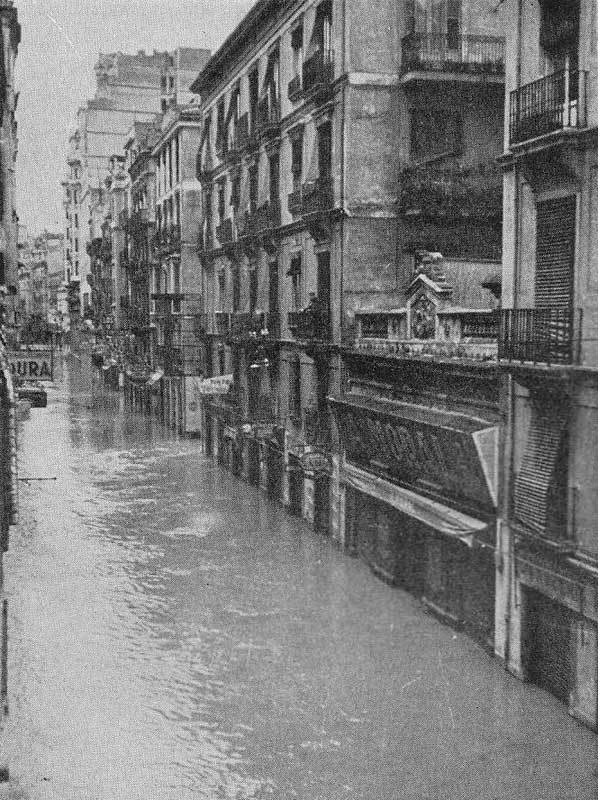
Just after midnight, with the absence of rain, the river continued to swell, and logs and debris began floating through the city, blocking the bridges that connected the two sides of Valencia. Alarms sounded to alert people, and messengers knocked on doors in the El Carmen and Campanar areas, both the closest barrios on each side of the river’s edge. Radio messages went out with a flurry as police rushed to warn people of impending water. Soon after, the first waves began crashing over the edge of the riverbed, instantly flooding the flat streets on both sides, just as the torrential rains returned. In one hour, the water height pouring against the central city was between one to two metres and rising, cutting people off from any escape in the dark. More than 1000 cubic metes of water per second flowed into the streets, reaching over two metres in some areas. The Manises Dam at the edge of the city rose to seven metres above normal height as the river tripled its width and swallowed up much of the city and surrounding area. All water, power and phone connections were swamped and collapsed under the water. Reports say manhole covers exploded into the air followed by a violent shot of muddy water as the water took the city one street at a time.
(If you don’t speak Spanish – blue: river, green: populated flooded farming areas, purple: city/town flooded, grey: not flooded populated areas. Notice the tiny safe area in the centre of the disaster zone?)
In the centre of the old town lies the Plaza de la Virgen and Plaza de la Reina, where today stands the Valencia cathedral, the Basilica and the archbishops palace just behind them. Along with Calle Micalet, this tiny pocket was once home to a mosque and before that a Roman city. This area is built on the slightest, and almost impossible to see, ridge in the land, resulting in these treasures not getting any water and instead were surrounded. (Coincidentally, in my novel, the main character lives one street over from Calle Micalet in this magical pocket of space, but don’t be fooled into thinking they are all going to be safe – you know I don’t write happy endings!)
At 4am, the flood reached its peak of approximately 2,700 cubic metres of water per second, but then quickly tapered off. As the sun rose on Monday October 14, the water continued to decrease and the Manises dam was no longer inundated. From the peak of around eight metres above average to only two metres at the dam, Valencians thought the worst was over. A single telephone line to Castellon in the north remained, so emergency services could get word to Madrid, calling for help. All roads and rail lines leading out of the city towards Madrid, Barcelona and Albacete were blocked, damaged or completely swept away. Many of the bridges that crossed the Turia were damaged or destroyed, along with the beautiful stonework that lined the river one day earlier.
As people ventured out into the water and mud-filled streets, the government received a message around midday that things were about to get worse. The towns of Pedralba to Vilamarxant had again been inundated with a second flood, washing away all landmarks. The water took two more hours to reach Valencia city, with 3,500 cubic meters of water per second hitting around 2pm, accompanied by the worst downpour of rain yet seen; around 100 millimetres in just half an hour, enough that people couldn’t even see in front of them. By 3.30pm, the flood reached its peak of around 6,000 cubic metres of water per second, enough to start washing away buildings that had been weakened in the first flood. The river had expanded to cover 2,200 hectares. While Valencia city gave many the luxury of multi-story buildings to find shelter above the water line, which rose between 2-5 metres above street level in places, the more outlying areas by the beach and port, including the towns of Nazaret, El Cabanyal and Malvarrosa at the mouth of the river, were on flat land and single level buildings, resulting in a complete catastrophe and loss of life as the water poured into the sea. Only five bridges, the longest-standing stone ones remained in place, though some were damaged and impassable. The worst had finally passed, and the riverbed emptied out into silence again. The final death toll was recorded as 81, though the actual figure remains unknown.
In the coming days, the army came in by truck and helicopter, bringing up to 500,000 kilos of bread to feed stricken residents. Many needed to be airlifted from rooftops and isolated pockets of dry land as the water receded. Much of the city, port and beach areas were filled with a heavy mud and debris, resulting in a ‘on hands on deck’ response from army and locals alike to clean up. On October 24, dictator Francisco Franco arrived (when much was cleaned already, of course) to survey the damage and have his loyal (oppressed, whatever) subjects cheer for him for coming to the disaster zone. As people lived on bread brought north from Gandia and milk given out by the ladle-load, the long process of rebuilding began. The mud was not completely cleaned away until the end of November.
In June 1958, the outlying port and beach areas suffered a second minor flood, as their drains were still clogged with mud, and the following month ‘Plan Sur’ began, a project to divert the river. The plan had initially been designed over a decade earlier but sidelined due to excessiveness (which is ironic considering the ‘excessiveness’ of everything the Valencian government spends money on). A plan to build an enormous green space in the city was put up against building a huge highway to get people from Madrid to the beach a fraction faster. In 1965 construction began to divert the river south of the city, resulting in water flowing around the city for the first time in 1972. At the same time, land cleared by the flood on the other side of the river from the old town was used to create many new buildings, mostly apartments, giving Valencia a construction boom (that’s a whole other tale). The flood had accidentally given Valencia a whole new chapter in its story, already thousands of years old. (I have never seen any water in the river diversion, other than the tiny part where the sea flows into the river mouth. If you have a photo of the Plan Sur river diversion (any year) with water in it, I would love to see it).
Here is a short clip (in Spanish) made as they designed Plan Sur in the 60’s, with some aerial shots of Valencia if you’re so inclined
In 1976, on his first visit to Valencia as head of State, King Juan Carlos I gifted the dry riverbed to the city, and the highway plan was shelved forever; the 7 kilometre park won its place in Valencia’s history. Construction on the final part of the Turia riverbed park continues today, with most of the park now complete. The ‘top’ of the park has Valencia’s zoo, the Bioparc, and footpaths and bike lanes weave though gardens, streams, sports fields, playgrounds to the other end, home to Valencia’s massive Arts and Sciences complex. The final part, where the old riverbed meets the sea is still to be completed.
While Valencia is an amazing city, the park is the jewel in the crown.
This is a tourism video was taken a few years ago, but shows Valencia from the air, over the park and areas rebuilt after the flood, plus many of the great sights you can read about in my books.




 CAROLINE ANGUS