This Week in Spanish Civil War History – November 1937: The Halfway Point

In a war which lasted almost three full years, November 1937 is the approximate halfway point in the destruction of Spain. Spain was already a deeply divided nation, struggling with multiple inside forces and serious social and economic issues, and while civil war is tragic, Spain had come to a point where it was inevitable. The working class was deeply oppressed and dire need for salvation, which could come from nowhere but within. Franco’s initial coup in July 1936 was thwarted only by the men and women who rose up in haste, without training or preparation, in a  desperate attempt to free themselves and save their country from fascism.

(Before we continue, this is a quick round-up of posts I have done throughout the war, not a detailed breakdown. Ease up on the posts saying I wasn’t specific enough. You have been warned. All links open a new tab so you don’t lose the timeline of the events).

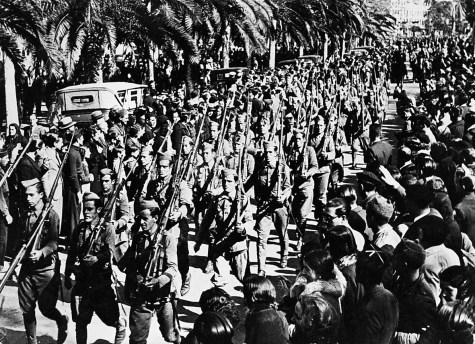
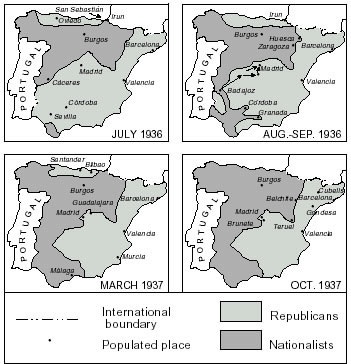
The opening weeks of the war saw Spaniards forced to take sides, to align themselves with the military taking control of their cities and towns, often with the Guardia Civil on their side, or instead arm themselves as best they could and align themselves with the Spanish government, the Republican side, to try to hold off the rebels. Within weeks the battle lines were strong; much of southern Spain was conquered by a marching army of rebels, with massive bloodshed in cities and countryside alike. Madrid, Valencia and Barcelona were firmly Republican and fighting within themselves, while in the north, the Basques, Cantabrians, Asturians and Galicians fought to maintain their autonomy over the rebels. Slaughter occurred in Santander and Asturias as rebels initially overpowered these centres, only to be beaten back again. Much north of Madrid beneath these independent areas backed Franco and the killing continued. Click here to read Weeks 1 and 2:  July 1936

August saw thousands slaughtered in the summer heat. The battle of Badajoz saw up to 4000 killed in days. Cordoba suffered massive fighting and killing as troops stormed the southern city. The famous poet Federico García Lorca was taken and murdered outside Granada. While Madrid continued to defend itself, the nearby town of Talavera de la Reina suffered mass slaughter. Click here to read all of August 1936

September saw the huge attack on the Alcazar of Toledo, as well as the formation of the International Brigades, all foreign volunteers who decided to flood into Spain in an effort to stop fascism taking hold. Major nations such as England, France and the US decided to say out while Hitler and Mussolini decided to back their fascist mate Franco.

Through October and November the killings continued, the Spanish government collapsed, and the Catalonia and Aragon regions in the northeast began life as anarchist regions, creating their social revolution where control was handed back to the people. The siege of Madrid began as Franco fought to take the capital and end the war, and the Russians provided tanks and equipment to aid the socialist/anarchist/worker unions/communist Republicans. In the north, and Asturias took heavy losses as they were bombed from the air by German planes. After leaving Barcelona, Buenaventura Durruti was killed in Madrid, a huge set-back for the social revolution in the northwest. Also in Madrid,  Falange leader José Antonio Primo de Rivera is executed.

By the time the year ended, Madrid had been heavily bombed but not taken by the rebels, and the International Brigades had set up and integrated (as well as they could) into the Republican troops. The Republicans were not taking much ground but continuing to hold main centres in the east, along with Madrid. Click here to read all about December 1936

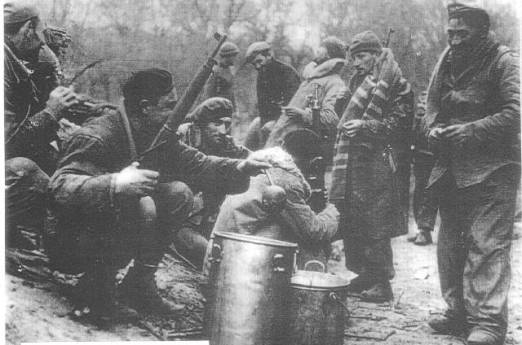
January and February held battles fought in heavy fog and rain, including much fighting outside Madrid, and Jarama, just northwest of the capital. Militias in Catalonia and Aragon held fast to their social revolution, while the Basques suffered heavy losses again as they held off the rebels. In Málaga in the south, the city was invaded when they could not defend themselves, sending thousands to flee along to the coast to relatively safe Almeria. Thousands were slaughtered as they walked the perilous road, where refugees were exposed, then bombed and shot as they fled. Click here to read about the Málaga/Almería massacre.

The bloody battles of Jarama and Guadalajara continued through March, and in April, 32,000 children started being shipped from the Basque country overseas in order to save their lives. The rebel army of the north is intensifying its efforts, with the now-infamous bombing of Durango and Guernica.

May saw the intense bombing of the new Republican capital city of Valencia, along with the fighting in the May Day fighting in Barcelona. June was an especially brutal month, with huge frontlines drawn up along the region of Aragon, battles in the Sierra de Guadarrama outside Madrid, Bilbao in the Basque Country was bombed and invaded, and in Barcelona, leader Andreu Nín was kidnapped and murdered in a Madrid prison.

Battles around Madrid, in Boadilla, Sierra de Guadarrama and Brunete saw huge fighting and casualties for both sides as the war reached its first anniversary. Legendary war photographer Gerda Taro was killed outside Brunete, and no nation except Russia comes to the Republicans’ aid as they are slaughtered by the fascists and their Moorish soldiers.

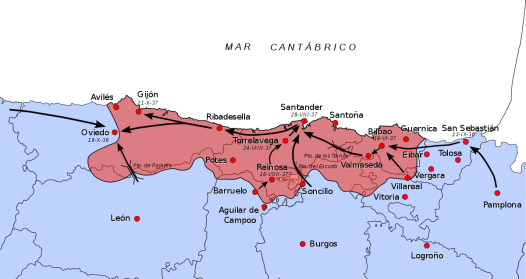
August 1937 focussed on the north. With the Basque region taken by the rebels, they turned east to take Santander in the Cantabria region. By September, the fascists again moved east again to take Gíjon in the Asturias region, with heavy mountainous battles taking place on cliffs that had kept Asturias safe from invaders for centuries. By October, Asturias was defeated by the northern army and could keep going west to claim Galicia, and Valencia is stripped of its title of capital of Spain in favour safer Barcelona. The Republican alliances of multiple militias fell apart, and many are fired from government and imprisoned, political alliances were ruined, and the dislike for the powerful communists pulled the left apart. The social revolution has suffered setbacks, including heavy battles and losses in the Aragon region, and there was breakdown of working class support in Barcelona.

By November 1937, the frontlines have moved little in some time, with the exception of the conquering of the northern regions. Madrid remains in Republican hands, along with the Valencia, Aragon, Catalonia and Almería region in the east. All regions have suffered serious losses, but little ground is gained in seriously bloody battles.The north is now under Franco’s control, along with all the south and the western Extremadura region. The strong left-wing cities of Madrid, Barcelona and Valencia are targets for the well-trained fascist brigades. The month of November saw little of major battles taking place, as both sides are exhausted from the fighting, and small breakouts of fighting yield little results for either side. The new target for the fascists is Teruel, a strong city in the Aragon region, which is about to see one of the war’s biggest fights go down in a particularly brutal winter.

~~

This is not a detailed analysis, just a highlight (lowlight?) of the week’s events. Things get lost in translation – Feel free to suggest an addition/clarification/correction below. The more the world remembers, the better. All photos and captions are auto-linked to source for credit, and to provide further information.

‘LA RIUÁ’ October 14, 1957: 60 Years Since The Flood That Changed Valencia Forever

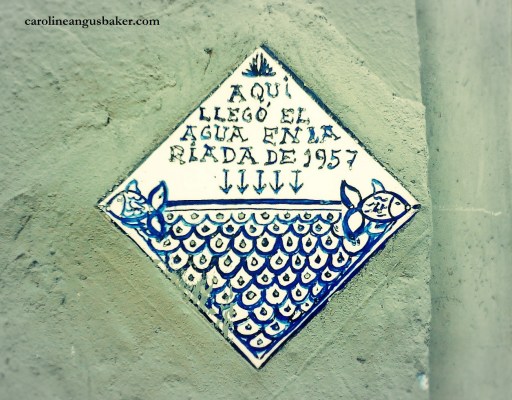
On October 14, 1957, a little known disaster occurred in the Spanish city of Valencia. When I first moved to Valencia in 2005, I heard the story of the Turia (the Valencia river) flooding the city in the 1950’s. Now, the city has the beauty of a park in place of the dry riverbed. Years after I first moved to Spain, I decided to research the event in more depth (excuse the pun), and it is the backdrop for my second Secrets of Spain novel, Vengeance in the Valencian Water (out Jan. 2014).

In my first book of the series, Blood in Valencian Soil, Cayetano, a bullfighter from Madrid and Luna, a bike mechanic from Valencia, team up to find the burial-place of a murdered Republican soldier and his involvement with an International Brigade nurse, who disappeared from Cuenca in 1939.  The second book of the series, while on the search for more civil war mass graves, Cayetano’s Falange member grandfather, José, is forced to tell his story of survival during the Valencian flood which changed his life forever.
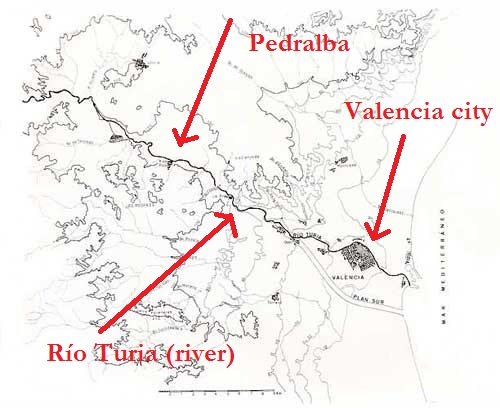
city mapThe Turia wasn’t always a flowing torrent of water. While there has been recorded flood records since the 1300’s, the riverbed spent most of its time dry, where people would walk to the tiny stream to wash their clothes. Shack houses sprung up in the riverbed. Sales of animals were held down in the riverbed. It was not a year round flowing river. Serious floods had happened every century that the modern city was based against the Turia, the most recent in only 1949 when several dozen people drowned. Even so, they were unprepared for October 1957.

Before you read on, here is the link to a documentary made in 2007 by Valencia University, with radio reports, video footage and eyewitness accounts of the flood. It’s all in Spanish, but if you don’t speak the language, you could just mute the sound and watch the video if you want, you will get the idea. Floods pretty much speak for themselves.

Each October, rain comes to the Valencia region, not so much in the city area, but in the surrounding plains and mountainous area that separates the city from inland Spain (If you’re new to this area, Valencia is both a city and a province of Spain. Just a heads-up). The rainfall surges during this change in autumn, onto land that is very dry after a long year without much rain. On Saturday 12 October, 1957, the heavens opened up over Valencia city, in conjunction to the torrential rains in surrounding villages in the Turia (plains around the city) region. On the morning of Sunday 13 October, Las Provincias newspaper noted that the outlying towns of Lliria, Segorbe, Chelva, Requena and Buñol had received rainfall of 500 millimetres in only two days. The Barranco del Carraixet and Palancia rivers north of the city, and the Magre river to the south, along with the Turia river through than ran Valencia city had all risen, but said there was no reason to worry. The rain began to die down in the city, and by late evening, had stopped completely. What the people of Valencia didn’t know was the immense torrent that was gushing its way down the Turia river towards them.

At around 9.30pm, an emergency call came through from the towns of Pedralba and Vilamarxant, 40 kilometres from Valencia, announcing that both towns had been flooded by a deluge of water as the river swelled beyond breaking point. At 11pm, an alarm sounded in the city, notifying all Guardia Civil and Police to be on alert, as the flood was heading directly towards the populated city.

Just after midnight, with the absence of rain, the river continued to swell, and logs and debris began floating through the city, blocking the bridges that connected the two sides of Valencia. Alarms sounded to alert people, and messengers knocked on doors in the El Carmen and Campanar areas, both the closest barrios on each side of the river’s edge. Radio messages went out with a flurry as police rushed to warn people of impending water. Soon after, the first waves began crashing over the edge of the riverbed, instantly flooding the flat streets on both sides, just as the torrential rains returned. In one hour, the water height pouring against the central city was between one to two metres and rising, cutting people off from any escape in the dark. More than 1000 cubic metes of water per second flowed into the streets, reaching over two metres in some areas. The Manises Dam at the edge of the city rose to seven metres above normal height as the river tripled its width and swallowed up much of the city and surrounding area. All water, power and phone connections were swamped and collapsed under the water. Reports say manhole covers exploded into the air followed by a violent shot of muddy water as the water took the city one street at a time.
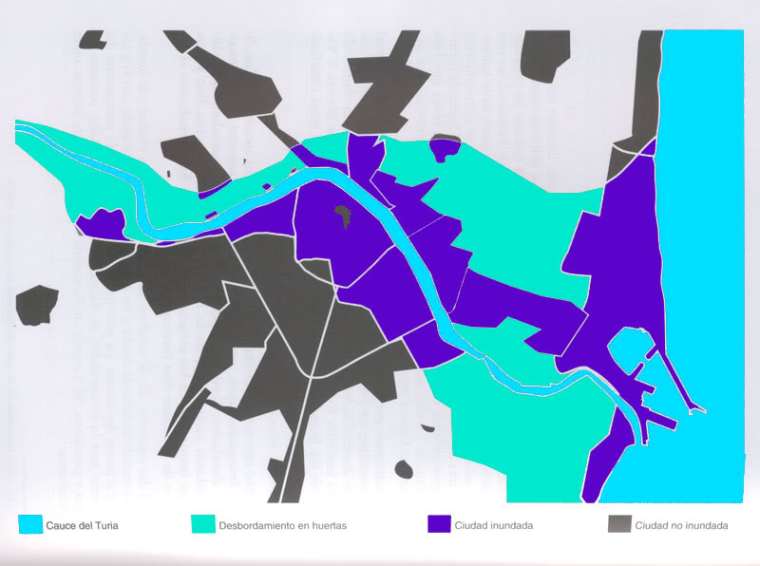
ciudadinundada-1(If you don’t speak Spanish – blue: river, green: populated flooded farming areas, purple: city/town flooded, grey: not flooded populated areas. Notice the tiny safe area in the centre of the disaster zone?)

In the centre of the old town lies the Plaza de la Virgen and Plaza de la Reina, where today stands the Valencia cathedral,  the Basilica and the archbishop’s palace just behind them. Along with Calle Micalet, this tiny pocket was once home to a mosque and before that a Roman city. This area is built on the slightest, and almost impossible to see, ridge in the land, resulting in these treasures not getting any water and instead were surrounded. (Coincidentally, in my novel, the main character lives one street over from Calle Micalet in this magical pocket of space, but don’t be fooled into thinking they are all going to be safe – you know I don’t write happy endings!)

At 4am, the flood reached its peak of approximately 2,700 cubic metres of water per second, but then quickly tapered off. As the sun rose on Monday October 14, the water continued to decrease and the Manises dam was no longer inundated. From the peak of around eight metres above average to only two metres at the dam, Valencians thought the worst was over. A single telephone line to Castellon in the north remained, so emergency services could get word to Madrid, calling for help. All roads and rail lines leading out of the city towards Madrid, Barcelona and Albacete were blocked, damaged or completely swept away. Many of the bridges that crossed the Turia were damaged or destroyed, along with the beautiful stonework that lined the river one day earlier.
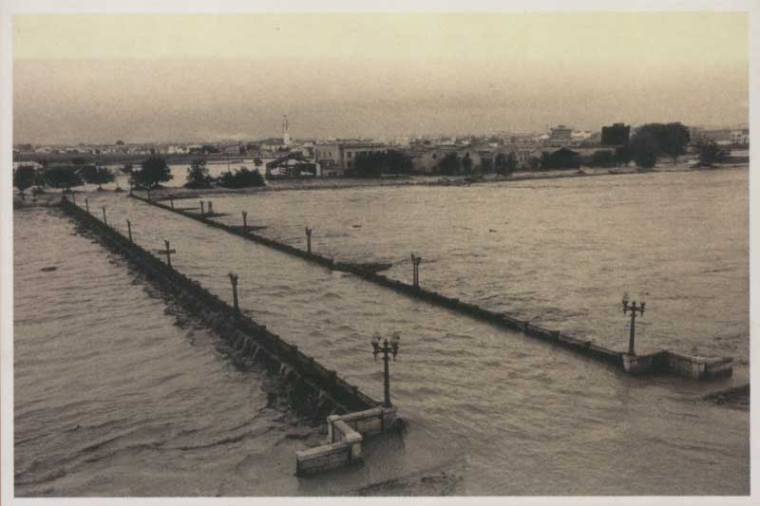
riada10As people ventured out into the water and mud-filled streets, the government received a message around midday that things were about to get worse. The towns of Pedralba to Vilamarxant had again been inundated with a second flood, washing away all landmarks. The water took two hours to reach Valencia city, with 3,500 cubic meters of water per second hitting around 2pm, accompanied by the worst downpour of rain yet seen; around 100 millimetres in just half an hour, enough that people couldn’t even see in front of them. By 3.30pm, the flood reached its peak of around 6,000 cubic metres of water per second, enough to start washing away buildings that had been weakened in the first flood. The river had expanded to cover 2,200 hectares. While Valencia city gave many the luxury of multi-story buildings to find shelter above the water line, which rose between two to five metres above street level in places, the more outlying areas by the beach and port, including the towns of Nazaret, El Cabanyal and Malvarrosa at the mouth of the river, were on flat land and single level buildings, resulting in a complete catastrophe and loss of life as the water poured into the sea. Only five bridges, the longest-standing stone ones, remained in place, though some were damaged and impassable. The worst had finally passed, and the riverbed emptied out into silence again. The final death toll was recorded as 81, though the actual figure remains unknown, but commonly thought around 400.
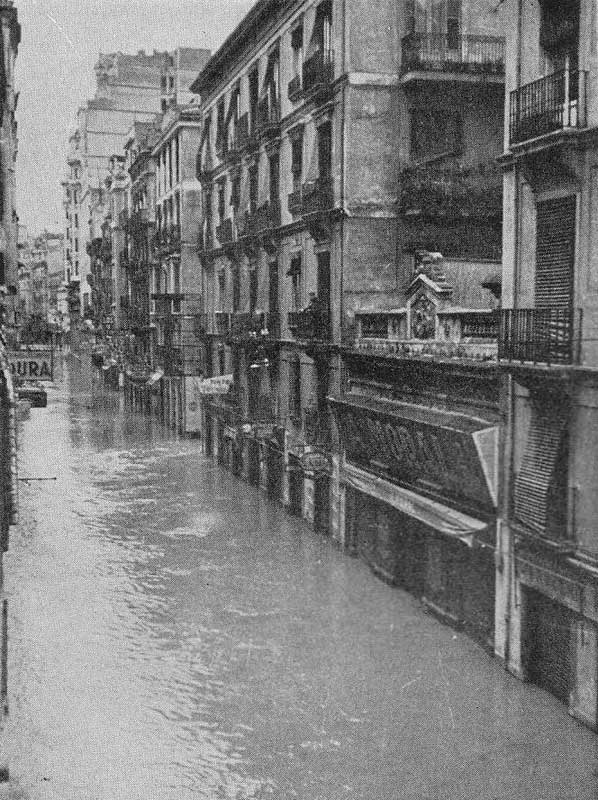
riada07In the coming days, the army came in by truck and helicopter, bringing up to 500,000 kilos of bread to feed stricken residents. Many needed to be airlifted from rooftops and isolated pockets of dry land as the water receded. Much of the city, port and beach areas were filled with a heavy mud and debris, resulting in a ‘on hands on deck’ response from army and locals alike to clean up. On October 24, dictator Francisco Franco arrived (when much was cleaned already, of course) to survey the damage and have his loyal (oppressed, whatever) subjects cheer for him for coming to the disaster zone. As people lived on bread brought north from Gandia and milk given out by the ladle-load, the long process of rebuilding began. The mud was not completely cleaned away until the end of November.

In June 1958, the outlying port and beach areas suffered a second minor flood, as their drains were still clogged with mud, and the following month ‘Plan Sur’ began, a project to divert the river. The plan had initially been designed over a decade earlier but sidelined due to excessiveness (which is ironic considering the ‘excessiveness’ of everything the Valencian government spends money on). A plan to build an enormous green space in the city was put up against building a huge highway to get people from Madrid to the beach a fraction faster. In 1965 construction began to divert the river south of the city, resulting in water flowing around the city for the first time in 1972. At the same time, land cleared by the flood on the other side of the river from the old town was used to create many new buildings, mostly apartments, giving Valencia a construction boom (that’s a whole other tale). The flood had accidentally given Valencia a whole new chapter in its story, already thousands of years old. (I have never seen any water in the river diversion, other than the tiny part where the sea flows into the river mouth. If you have a photo of the Plan Sur river diversion (any year) with water in it, I would love to see it).

Here is a short clip (in Spanish) made as they designed Plan Sur in the 60’s, with some aerial shots of Valencia if you’re so inclined.

In 1976, on his first visit to Valencia as head of State, King Juan Carlos I gifted the dry riverbed to the city, and the highway plan was shelved forever; the seven kilometre park won its place in Valencia’s history. Construction on the final part of the Turia riverbed park continues today, with most of the park now complete. The ‘top’ of the park has Valencia’s zoo, the Bioparc, and footpaths and bike lanes weave though gardens, streams, sports fields, playgrounds to the other end, home to Valencia’s massive Arts and Sciences complex. The final part, where the old riverbed meets the sea is all-but completed.

While Valencia is an amazing city, the park is the jewel in the crown.

This is a tourism video was taken a few years ago, but shows Valencia from the air, over the park and areas rebuilt after the flood, plus many of the great sights you can read about in my books.
riada1

All photos in 1957 are courtesy of Juan Antonio Soler Aces.

This Week in Spanish Civil War History – Week 65/66/67: 10 – 31 October 1937

October 10 

Franco’s Navarrese Brigade are still heading west into Asturias, and reach the small town of Cangas de Onís. The town, deep in the Picos de Europa, is only 65kms from the city of Gijón, which is preparing for invasion.

A mixture of Republican fighters and International Brigades are still keen to take ground in Aragon, and after minimal gains for heavy losses in the battle of Sabiñánigo, they again plan to attack along the Ebro river in the Zaragoza area. Fighting in the rural areas is sparse and it gains little for either side scattered through the region.

October 13

The Madrid Council, representing socialist parties and workers’ unions, confronts the Spanish government (currently in Valencia) over the influence of the PCE (Partido Comunista de España, Communist party of Spain) in the Republican government. They also protest the recent expulsion of Caballeristas, socialist parliamentary supporters of former prime minister Francisco Largo Caballero.

Caballero in Madrid

October 17

Th Consejo Soberano, the Sovereign Council of Asturias and Leon, decide to evacuate, due to the large number of Nationalist soldiers entering the region from fallen Cantabria. The Consejo Soberano is based in Gijón and officials and their families are taken out of the city for their safety. Asturian villages to the west of Gijón are abandoned, as the 1934 miners revolt is still a fresh horror for those living in the mountain areas.  Guerilla style groups form, to help protect rural areas from incoming Nationalists, but none have the numbers or resources to save anyone. These men will fight to the death and light houses on fire with dynamite if they flee.

Socialist Francisco Largo Caballero is arrested in Madrid while giving an anti-PCE speech at Pardina cinema. He is placed under house arrest in Madrid and held responsible for the Madrid Council’s anger.

The Condor Legion march through Gijon

October 21

The Nationalist Army of the North finally reaches Gijón. The fall of the city is as bad as expected; rape and murder goes uncontrolled for days as those still in the city are subjected to the Nationalists’ cruelty. Countless thousands are raped and murdered in the first few days of the invasion, and no official count of those tortured and killed is ever recorded. The soldiers plundering the city are so busy with killing, their jurisdiction is called ‘the machine gun’. Unlike many other Republican-held cities, Gijón cannot put up a fight; many have fled, many are already refugees from other cities, they is no international back-up and the atrocities committed are not well-documented or photographed. Wholesale slaughter brings Asturias’ largest city under control within days.

I do not post photos of women raped to death, or mass bodies lined up before firing squads. While the majority of these types of widespread depravity happened earlier in the war, Gijon managed to hold out longer than most main centres. Regardless of when it happened, I do not post such photos. You can search for yourself if you are into such perverse behaviour.

October 30

The Republican government has been safe in Valencia for a year. Valencia is far from the front line and is a base for many Republicans and Spain’s elite who do not side with Franco. Valencia does still suffer many air raids, and the government decides to leave Valencia and move north to Barcelona, despite the Catalonia region not being stable like Valencia.

Need to catch up? – SCW history : October 1936

~~

This is not a detailed analysis, just a highlight (lowlight?) of the week’s events. Things get lost in translation – Feel free to suggest an addition/clarification/correction below. The more the world remembers, the better. All photos and captions are auto-linked to source for credit, and to provide further information.

HISTORICAL BOOK REVIEW SERIES: ‘Richard, Duke of York’ by Matthew Lewis

Richard, 3rd Duke of York is frequently used to recall the colours of the rainbow with the mnemonic ‘Richard Of York Gave Battle In Vain’, wrongly believed to be the Grand Old Duke of York who had 10,000 men, or mistaken for his youngest son, Richard III. The son of a traitor, he inherited a dukedom aged four, became the wealthiest man in England at thirteen and later rebelled against his king, and if he is remembered, it is as a man who ignited the Wars of the Roses. Further eclipsed by two of his sons, who would become the mighty warrior Edward IV and the recently rediscovered Richard III, he is an ancestor of the Tudor monarchs and fifteenth great-grandfather to Queen Elizabeth II, yet the man himself is obscured from view. Matthew Lewis pushes aside the veils of myth and legend to challenge the image of Richard as a man whose insatiable ambition dragged a nation into civil war, revealing a complex family man with unparalleled power and responsibilities. The first person ever recorded to use the Plantagenet name, he pushed the political establishment to its limits, dared to fight back and was forced to do the unimaginable.

cover and blurb via amazon

~~

I was looking forward to this book for a number of reasons – firstly, because it’s Matthew Lewis, and also because Richard, Duke of York, really was kinda sorta the right person to be king if you dig through the family tree. This book didn’t disappoint at all.

Henry VI was in power, a man who was king as an infant, and England first had to go through a period ruled by the Lord Protector, the Duke of Gloucester, before Henry VI, a meek boy and then weak man, took over. Henry VI got himself a bride who was smart, strong and up to something with the Duke of Somerset. French lands in English hands were lost before Henry VI had a chance to rule them, and England was going to hell. (No offence, H6, it wasn’t really your fault).

Richard Plantagenet was a descendant of Edward III, like pretty much everyone in the War of the Roses. Through his mother, Richard was related to Edward II’s son Lionel Duke of Clarence, and through his father, Richard was related to Edward III’s son Edmund Duke of York. Edward III had five sons and three daughters who survived to adulthood (eight sons, five daughters in total, yikes!), and Richard Plantagenet was a descendant of surviving sons number two and four. As King Richard II, son of Edward The Black Prince, eldest son of Edward III, died without children, Lionel’s descendants were supposed to inherit (Richard’s mother’s family line, the Mortimers).

But the Lancaster branch took over. Edward III’s third son, John of Gaunt – the Lancaster line, usurped the throne from Richard II, led by Gaunt’s son Henry IV, leading to Henry V and Henry VI. But the Mortimer/York branches, now joined in marriage, thought they deserved the crown. And by right they did.

Richard Plantagenet sought to claim his right, resulting in the War of the Roses, killing off all the direct male descendants of Edward III, more or less. It was bloody, it was awful and needless and could be confusing if not for great books like this one. Richard had a solid claim to the throne, but Henry VI also had a claim, and was an anointed king. Richard Plantagenet is portrayed as a greedy, bloodthirsty man who tried to steal the throne, when it was essentially stolen from him by his own relatives years ago. Richard’s own father was beheaded for trying to assert the same right. Richard’s head too ended up on a spike, and his son Edmund was killed with him.

But two of Richards’ three remaining sons went on to be kings – Edward IV and Richard III (they killed their other brother, long story). Richard may have been killed in 1460, but his seven surviving children all continued to fight as Yorks against the Lancasters for the right to the throne, ending with Richard’s granddaughter Elizabeth, who married Lancastrian Henry VII and became queen, ending the wars for good.

A huge thanks to Matthew Lewis for this book, giving Richard Plantagenet a book of his own to show him as more than a usurper who got what he deserved. The Yorks had every right, just as Richard believed.

HISTORICAL BOOK REVIEW SERIES: ‘Owen Tudor’ by Terry Breverton

For generations, the ancestors of Welshmen Owen Tudor had fought Romans, Irish Picts, Vikings, Saxons, Mercians and Normans. His uncles had been executed in the Glyndwr Welsh War of Independence, his father pardoned, but his estates stripped from him. Owen’s now landless father took him to London to try and find employment, and Owen fought for Henry V in France. He entered the service of Henry’s queen, Catherine of Valois, and soon after the king’s death he secretly married her, the mother of the eight-month-old Henry VI. Owen and Catherine would have two boys together, hidden from the world and the boy-king Henry VI by the Bishops of London and Ely. Henry VI would go on to ennoble them as Edmund Earl of Richmond, and Jasper Earl of Pembroke, but upon Catherine’s death Owen was imprisoned. Escaping twice, Owen was thrown into the beginnings of the Wars of the Roses with his two sons. Edmund died in Wales, and Jasper became the only lord who fought throughout the civil wars until his nephew, Edmund’s son Henry Tudor, was established on the English throne as Henry VII. When Jasper led the Lancastrian forces at Mortimer’s Cross in 1461, the aging Owen led a wing of the defeated army, was captured and executed. Without the secret marriage for love, there would have been no Tudor dynasty.

cover and blurb via amazon

~~

I have to admit I had only read fiction about Owen Tudor until I picked up this book. The author has written a bountiful amount of Tudor works, so before reading the books on Jasper Tudor and Henry VII, I decided to start with Owen Tudor.

Tudor was, of course, a Welshman, from a family fraught after the Welsh Independence wars. Tudor, born Owain ap Maredudd ap Tudur, left for England for a new start. Tudor got a job, working for Queen Katherine de Valois, the bride Henry V took from France in return for peace. While Shakespeare wrote of Henry’s love for Katherine, all he did was basically purchase her, get her pregnant and then die. Katherine was left in England with a tiny baby who was king at nine months old, and all alone.

But all was not lost. Katherine had fallen in love with Owen Tudor, who had been working in her household on behalf of the king’s steward. Katherine and Tudor secretly married, and had up to six children – two sons who survived, Edmund and Jasper, plus Edward and Margaret ( who may or may not have entered the church and died young), and possibly two more, unknown, who did not survive (it’s a murky situation. For an author researching, a bit of  nightmare really). Sadly, Katherine passed away in 1437, aged only 35, leaving her kingly son in the Lord Protector’s hands and Tudor with the boys. Tudor was lucky not to be imprisoned or worse for secretly marrying a queen, as a law was in place that she could not marry without the king’s permission. There was no proof Katherine and Tudor ever legally married, and could have been nullified anyway. Tudor had all his possessions and lands seized but did keep his head and children.

Once Henry VI grew up a little, he treated his half-brothers well and kept Tudor on a good salary. Poor Tudor however was captured in Hereford during the Battle of Mortimer’s Cross in 1461 when his son Jasper’s army was defeated. Tudor was beheaded, his last words about Katherine. The bastard son he had fathered two years earlier had a headstone placed on his father’s grave years later.

Owen Tudor must be a hard man to write about, as he was not born royal and has a murky history, along with his family, given the lack of evidence about his life. What we do know is that Edmund died, leaving a pregnant Margaret Beaufort behind, who had Henry VII, and of course, had his bloodline through the royals ever since. I am definitely going to read the other books written by Terry Breverton.