MY HEARTY COMMENDATIONS: THE TRANSCRIBED LETTERS AND REMEMBRANCES OF THOMAS CROMWELL NEW EDITION 2025

SPAIN BOOK REVIEW OCTOBER: ‘Hell and Good Company’ by Richard Rhodes

This book skims the basics, which, in theory, should be good for newcomers. But with the omissions of this book, those new to the subject won’t get the full picture. Bonus point from me – New Zealand journalist Geoffrey Cox gets a mention, someone often missed. This book is suited to those looking for something specific, and in the style of the author. To enjoy, make sure that is you before you buy.

SPAIN BOOK REVIEW SEPTEMBER: ‘­­¡No Pasarán! Writings from the Spanish Civil War’ by Pete Aryton

Hope, resignation, despair, sadness, humour, confusion, ruthlessness, compassion, kindness, generosity and love inhabit Pete Ayrton’s anthology of writings from the Spanish Civil War: there is little sense of certainty and still less of triumphalism among the bewilderingly diverse Republican and Nationalist coalitions, all shades of which are represented here. Previous collections privileged the writings of the International Brigades over those of the Spanish, sometimes excluding them altogether. ¡No Pasarán! corrects the balance: by far the largest contingent of its thirty-five writers are Spanish, including Luis Buñuel, Manuel Rivas, Javier Cercas, Arturo Barea, Joan Sales and Chaves Nogales. The remainder offer contrasting perspectives of participants in the conflict from America (among them John Dos Passos, Muriel Rukeyser and Langston Hughes); Italy (Curzio Malaparte and Leonardo Sciascia); France (Jean-Paul Sartre, André Malraux and others); Germany (Gustav Regler); Russia (Victor Serge); Great Britain (including Arthur Koestler, George Orwell and Laurie Lee); Cuba, Argentina and Mexico.

Pete Ayrton brings together hauntingly vivid stories from a bitterly fought war. This is powerful writing that allows the reader to witness life behind and at the front lines of both sides.

cover art and blurb via Amazon – released 2016

~~

¡No Pasarán!: Writings from the Spanish Civil War, is a selection of texts, mostly from Spanish writers, all brought together by Pete Aryton. The story of the SCW is so often told by foreign journalists and writers, and through the eyes of the International Brigades. This time it is a far more Spanish view of the war.

The book makes a strong start with Luis Buñuel with My Last Breath, which forms part of his autobiography. The chapter tells of when Franco arrives in Spain, when Buñuel was in Madrid. While Buñuel longed for revolution, the initial siege between Spaniards in Madrid is shocking for the artist. The book goes a long way to describe all the groups on the Republican side (Anarchists, Socialist, Communist, etc,) trying to come together to fight a far more organised enemy. Importantly, what the anarchists wanted for Spain – their own utopia-like society is explained and discussed. Buñuel is one, if not the best, voice in the book and the one who explains the war the best, from the beginning, and from the ideas of multiple sides.

A great piece of writing is that of Dulce Chacón. Her chapter -The Missing Toe’, part of her novel The Sleeping Voice, is about a female prison, Prisión de Ventas in Madrid. The prison is run by guards and nuns and is vicious place to be.

One advantage of this book is the voice of José María Gironella, who fought for Franco and was Catholic. This way, the destruction of churches and burning of priests can be explained from the religious-minded and the destruction (in this particular case) by Communists. The Republican crimes aren’t glossed over in this book.

One excellent read is a part from Forbidden Territory by  Juan Goytisolo. In a rich part of Barcelona, Franco supporters hide in wait for safety. The writer’s family themselves are affected and killed. While Barcelona during the war is so often centred on the controlling Anarchist/Republican factions, an insight to the enemy side is confronting and sad.

A portion taken from The Wall, by Jean Paul Sartre, is short but essential. Pablo Obbieta is a Nationalist prisoner, threatened with death unless he tells info to his captors. But as Nationalists never keep prisoners and leave only bodies, nothing can end well.

The eternal voice of Arturo Barea is naturally included, ‘The War is a Lesson’ from The Clash. It focuses on the portion where Barea needs to leave Madrid for his safety, though never wants to leave the besieged Madrid, the centre of the battle for his country.

This collection by Pete Aryton is an essential read. It not only beings together Spanish voices, it can also be a literal reading list of other writers to look for, voices often forgotten in SCW reading lists. Other notable voices included are Lee, Orwell, Rivas, Cercas and Soler, while including lesser mentioned authors Rororeda, Atxaga, Fraile, Etchebáháre and many more, a total of 38 writers. Everybody needs this book.

This Week in Spanish Civil War History – Week 14 and 15: 17 – 31 October 1936

Week 14 and 15: 17 – 31 October 1936

Sorry for the delays, as the website was hacked and is only just back online now. Normal service is resumed.

Week 14

October 18

The Republican government creates the ‘Mixed Brigades’. This combines the army units which remained loyal during the initial rebellion, and militia groups of all forms fighting around Spain. This mix is titled the Popular Army, the name coming from the Popular Front party in government. While anarchist groups are not art of the government (yet), their militias are still able to be part of the Popular Army.
.
Week 15

October 24

The first shipment of gold arrives in the Soviet Union; the first shipment of over half the Spanish supply which will be sent to Moscow. It is worth around $35 per ounce, a total of around almost $600 million, though Spain only gets half its worth.

October 27

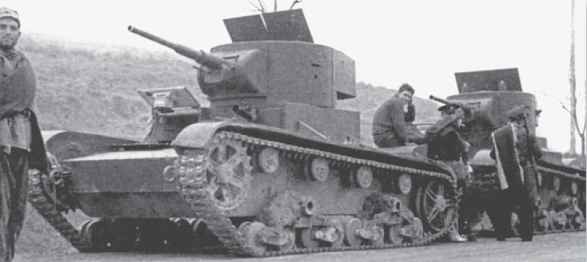
Russian tanks finally get to Madrid to defend the city. T-26 tanks, around 10 tonnes in weight each, are dispatched from Madrid main’s train station and head straight to the front. The Nationalists outside the city already have tanks, supplied by Italy and Germany. The Republicans have been using Molotov cocktails to hold back the Nationalists until now and are in desperate relief to save the city.

.

T-26 tank outside Seseña

October 27

The Nationalist unleash an air raid on Madrid. Six bombs are dropped in Plaza Colón, a major square in the city, heavily populated. A queue of women and children are waiting to get milk and a bomb lands directly on them. A total of 16 are killed, another 60 seriously injured. The air raid comes from a Junker Ju-52 with a German pilot. The bombing is labelled the first bombing in history that served no purpose. It was designed solely to bring terror to 900,000 Madrileños. Madrid has no way to stop planes flying overhead and bombing them as they are becoming surrounded by Nationalists, setting the stage for the coming mammoth siege of Madrid.

October 28

A squadron of Soviet Tupolev ANT-40 planes, named Katiuska bombers, drop bombs over the city of Seville, which has been in Nationalist hands since July. This Republican-supported bombing leads the Germans to send more planes and supplies, and set up the Condor Legion in Spain, to overcome the Soviet forces.

Aftermath of the air raid in prep for the Madrid siege

October 29

The town of Seseña is 30 kilometres (18 miles)  south of Madrid, near destroyed Toledo. The Nationalist army, who have marched and massacred their way north are now ready to take Madrid. The Republicans who hold Seseña attempt to hold their town. The new Mixed Brigades, led by Spanish and Russian colonels, lead their mixed-nation/loyalty troops with newly arrived tanks. However no one has any training, other than one Russian tank expert. The Nationalists have their highly trained Spanish and Moroccan troops and Italian tankettes on their side. The Republicans head south of Seseña to engage with the Nationalists about only gain around 1.5 kilometres (1 mile) before they are attacked.

The Republican were able to destroy 11 Italian tankettes and kill 600 soldiers, losing only eight men and three tanks in the fighting. However numbers were on the Nationalists’ side and they won the battle of Seseña when the Republicans were forced to retreat.

The showdown for the siege of Madrid is ready to begin.

~~

This is not a detailed analysis, just a highlight (lowlight?) of the week’s events. Feel free to suggest an addition/clarification/correction below. All photos are linked to source for credit

This Week in Spanish Civil War History – Week 13: 10 – 17 October 1936

October 12

University of Salamanca’s rector, writer Miguel de Unamuno, gives a speech at their Columbus Day celebration. The western city, in the Nationalist-held area, has many important right-wing audience members, including Franco’s wife. Unamuno speaks out harshly against General Millán Astray, who leads the Spanish Legionaires. While Unamuno had previously said he was a supporter of the Nationalist, he changes his mind and calls Astray inhuman, and an example of the terrible rebel uprising.

Unonumo said – It torments me to think that General Millán Astray could dictate the norms of the psychology of the masses. A cripple, who lacks the spiritual greatness of Cervantes, hopes to find relief by adding to the number of cripples around him.

Astray cried from the crowd – Death to intelligence! Long live death! to the praise of the Nationalist-loving crowd.

Unamuno finished his time on stage by replying – This is the temple of intelligence, and I am its high priest. You are profaning its sacred domain. You will win because you have enough brute force. But you will not convince. In order to convince it is necessary to persuade, and to persuade you will need something that you lack: reason and right in the struggle. I see it is useless to ask you to think of Spain. I have spoken.

Unamuno left the meeting with Franco’s wife Carmen polo, which secured his immediate safety. But he is soon removed from his job and put under house arrest. He will die, humiliated and ruined, two months later.

October 14

The first 500 international volunteers arrive in Albacete, the eastern town set up as the training base for all international volunteers.

October 15

The first ship from the Soviet Union, carrying Republican bought weapons arrives in the port of Cartagena. The weapons are sorely needed as the Nationalist army continues their bloody march towards Madrid.

~~

This is not a detailed analysis, just a highlight (lowlight?) of the week’s events. Feel free to suggest an addition/clarification/correction below. All photos are linked to source for credit

This Week in Spanish Civil War History – Week 12: 3 – 10 October 1936

Week 12: 3 – 10 October 1936

October 3

Franco sets up a new Civil Junta, or civil government, for the areas the rebels have captured, named the National Zone. This is done to try to legitimise the uprising. The Civil Junta is only a facade and has no power or control, as the country is covered in a state of war already. This new group gives Franco no extra power over the German and Italian forces, though their decisions are similar to Franco’s anyway.

October 6

The USSR decides it no longer wants to be part of the Non-Intervention Agreement. As Germany, Italy and Portugal are openly intervening whilst signed to the agreement, the Soviet Union decides it can intervene too, except instead for the Republicans. The Nationalists’ area is supplied with weapons and supplies over the Portuguese border, but as France will not break the agreement, the Republicans have no way of getting supplies.

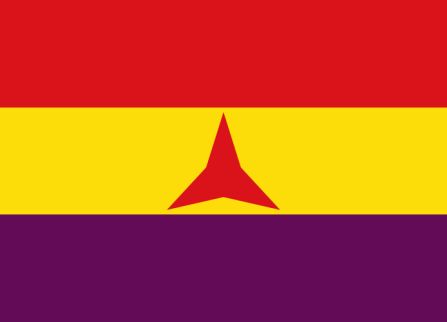
International Brigade flag

October 7

The International Brigade volunteers set up a base in Albacete, in the Valencia region. To men are selected to run the organisation – André Marty, a French Communist, and Palmiro Togliatti, an Italian Communist. Both men are well experienced in running left-leaning groups. Volunteers start arriving, some over the French border. Anarchists control the border and don’t want communist volunteers, but need the manpower. Others make their own way into the country, not contracted or obliged to fight in any way.

October 9

The Spanish Republican government officially forms the Popular Army. As most left-wing groups are militias of workers and/or peasants, these need to be grouped more effectively and have commanders who are sharing information. Also part of the civilian militia joins those army men who remained loyal, along with any Guardia Civil and assault guard men, who are already trained to fight.

The flag three pointed star of the Popular Front

~~

This is not a detailed analysis, just a highlight (lowlight?) of the week’s events. Feel free to suggest an addition/clarification/correction below. All photos are linked to source for credit