This Week in Spanish Civil War History – Week 28: 22 – 29 January 1937

Week 28: 22 – 29 January 1937

January 22

The Nationalists forces have been constantly battling to take Madrid since early November and still not able to get into the city. Franco decides its time to change tactics and attempt to cut off the city  by crossing the Jarama river, south-east of the city. This will cut off Madrid’s communications with Valencia to the east, which is the temporary Spanish capital. Franco groups together General Mola, General Varela and General Orgaz, and plans an attack 7 miles south of Madrid, with 25,000 troops and heavy artillery. The German Condors are also called in to help, while Italian troops plan an attack on Guadalajara at the same time. They plan to attack in early February.

Nationalist forces in the Jarama region

January 25

The newly formed Army of the South is still marching towards Malaga in the far south. The city is still in Republican hands, but their inland areas are slowing being eaten away by incoming troops left and right, while Italian troops march in to meet them in Malaga. The troops will take the remaining 10 miles left inland around the city in every direction as they face no resistance from unarmed Republicans.

January 27

The Basque Statute of Autonomy in the north is still holding, after being formed in October. The city of Bilbao is filled with civilians who have fled to the far north to find safety from Nationalist forces. But the Nationalists have been striking the city from the air repeatedly, to outcries from both sides. The Basques/Republicans are mostly civilians trying to stay safe, and there are prison-ships parked in the city where Nationalists are being held, now in danger by their own side. Over January, 224 are killed.

January 29

The workers’ militia are still controlling Barcelona, and most of the Catalonia region; most workers belong to the CNT/FAI. These militias have been working with the Catalonian government since the uprising in July, though the workers unions have control of the area. They have around two million members, plus the allies from the UGT union with one million members, and the Communists have just a few thousand. Regardless of numbers, everyone has equal representation.

Through some of the Catalonia region, and through much of the neighbouring Aragon region, militias have established an anarchist-led movement based on freedom and lack of government, working with the locals. While these sides in Barcelona are opposed to the Nationalist invaders, the Republican government in Valencia also sees these people as enemies, as the movement promotes freedom from government. As the situation continues to evolve, the CNT maintain control, with some representation from the Communists. The anarchists have opposition to all supervisory positions.

But trouble is starting to brew as so many factions working together is running into constant problems. The anarchists cannot work closely with the Socialists, Communists and Catalan nationalists (as in wanting independence from Spain, not the rebel Nationalists). Barcelona also has the communists splitting into different factions, some supporting Spain and the Soviet Union, the others supporting the Catalonian independence groups. Also now gaining traction are the Marxists, who formed the POUM (including famous writer George Orwell), who believe in war to gain social revolution, like the anarchists.  But the Marxists are also flaring up against Trotsyists. With all these groups working and living together, while trying to set up a new social order and hold back the Nationalist troops trying to conquer the area, things are getting heated and shaky in the northeast. They are more looking at each other rather than their common enemy.
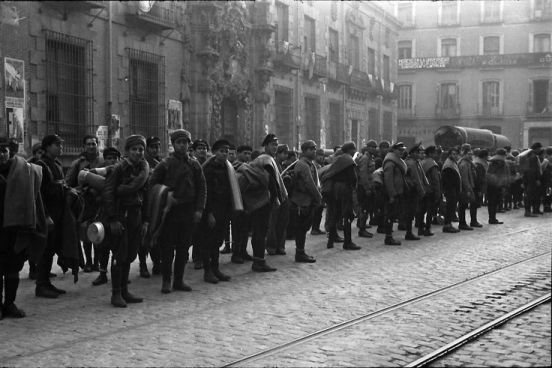
XV International Brigade volunteers arrive in Barcelona, January, 1937

~~

This is not a detailed analysis, just a highlight (lowlight?) of the week’s events. Things get lost in translation – Feel free to suggest an addition/clarification/correction below. The more the world remembers, the better. All photos are linked to source for credit.

This Week in Spanish Civil War History – Week 26: 8 – 15 January 1937

Anarchist supporters in Barcelona

January 8

The Popular Executive Committee of Valencia is dissolved. The Committee is one of eight main groups set up to look after regions (broken into almost smaller 600 collectives) which have been participating in the Spanish Revolution, an anarchist-driven change in way of life for workers of their regions. Aragon was the main driver of this movement, along with neighbouring Catalonia and Valencia regions. Workers unions were collectivised and land is redistributed between workers to create a new, more equal society. At its peak, between five to seven million people were involved in participating in this enormous and ambitious change. Now through three main phases of its operation, the end is coming to much of the programme, which is suffering for a myriad of reasons (this post could go on for months if I get too detailed). The Popular Executive Committee of Valencia, which set laws and rules in the region, is taken over by the Republican government, which can now take control of anarchist popular militias. The militias now have to join the Popular Army and fight officially for the Republicans and fight under the command of professional army officers (anarchist principles are against hierarchy). While the revolution is huge and successful many places, the collapsing of major collectives such as the Popular Executive Committee signals the beginning of the end for the anarchist revolution. (Click on the above or below photos captions to read more about the collectives and revolution)

Examples of anarchist money coupons issues in some collective areas. Other areas did away with money completely

January 9

The second battle for Corunna Road outside Madrid is coming to a close. In one day, the Nationalists take seven miles of the road between Las Rozas and Puerta de Hierro. The Republicans and International Brigades have all been killed, and a handful have managed to flee, leaving the Nationalists to control the critical supply road into Madrid.

The Garabaldi battalion, part of the XII International Brigade

January 10

The XII International Brigades (mostly Spanish volunteers, along with Italian, Franco-Belgian and Albanian volunteers) enter the region from Madrid to start the third Corunna Road battle. The next five days of fighting shall see them fight to recapture the northwest Madrid areas of Majadahonda, Villanueva, Pozuelo and Boadilla, all areas taken during the Corunna Road battles. The heavy fog has dropped on the region again making fighting cold, wet and difficult.

January 11

The Nationalist forces, which have only just finished the battles killing so many Republicans, have lost up to 15,000 men themselves (the same as the Republican side) and take cover in trenches in the under siege Madrid areas, as they are suffering from their casualties and lack of supplies.

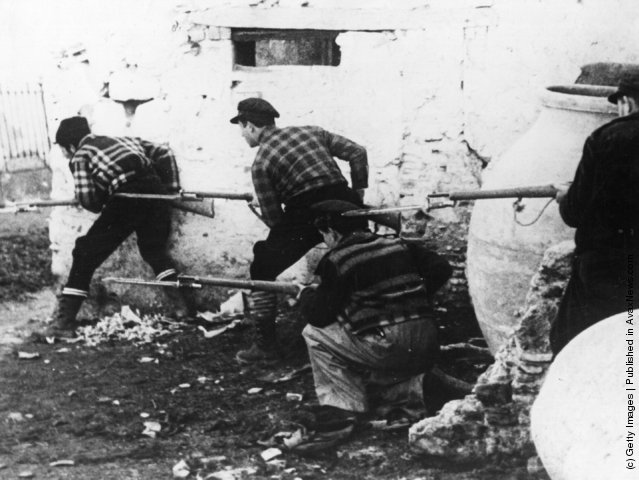
Republican forces lying in ambush in a village near Madrid

January 15

The third battle of Corunna Road ceases. The Nationalists have convincingly won the first and second waves of battle, and now both sides are exhausted. The XII International Brigades do not have the men or supplies to take back any of the northwest Madrid areas, and the Nationalists can’t get any further with their numbers. Both sides are now exhausted and give up in their plans. The Corunna Road route is still technically open and supplies still have a chance of getting through to Madrid, though now the city will have to rely more on the roads coming from Valencia and Aragon in the east/northeast.

~~

This is not a detailed analysis, just a highlight (lowlight?) of the week’s events. Things get lost in translation – Feel free to suggest an addition/clarification/correction below. The more the world remembers, the better. All photos are linked to source for credit.

This Week In Spanish Civil War History – Week 2: July 25 – 31 1936


Week 2: 25 – 31 July 1936

July 25

Hitler agrees to support Franco’s bid to take over Spain. Franco needs urgent supplies and Hitler needs a distraction from his plans to dominate Europe.

Reprisal killings are happening in the south, in and around Seville. Numbers of deaths are unknown; anyone suspected of supporting the Republicans is taken away to face a firing squad.

franco_hitler

Franco and Hitler

July 26

German and Italian planes land in Morocco, ready to help the Nationalist cause. With a naval blockade halting the transfer of soldiers from Morocco to the mainland, they can be flown instead.

July 27 

The Nationalists control Seville with reinforcements from Morocco on the German-donated airplanes. Seville is to be a main centre for the rebels to plan their sweep north to capture all of Andalusia in southern Spain.

Aircraft used by the Nationalists drop a bomb on a market in Malaga, killing mainly women and children.

Fighting between Republicans and Nationalists continues in the eastern cities of Valencia and Alicante, which haven’t been captured by either side yet. Both cities are Republican strongholds.

00001d7d_big

Republicans fighting in the streets

July 28

First bulk arrival of German and Italian planes into mainland Spain. Masses of troops arrive, ready to help local military forces, now vastly outnumbering the Republican people.

Savoia-Marchetti_SM.81

German donated aircraft used in Spain

July 29

Northern city of Gijon still fighting for control; military haven’t yet been able to claim the area.

July 30

Fighting still ongoing in Valencia as the large Republican population manage to contain the military in their barracks. Local people in support of the Nationalists are subdued by the worker’s Republican groups. Reports of old grudges between individuals being resolved with shooting, masked as executions due to the rebellion.

July 31

Great Britain bans the sale of weapons to the Republic. Most of Europe foolishly thinks that non-intervention is better than assistance.

400 Nationalist supporters killed by Republican supporters in Toledo as part of reprisal killings.

Reports from all locations of both Republicans and Nationalists being pulled from their homes and murdered, based on the perception of who they support. Reports of mass rape of women prior to being put before firing squads. Republicans are angry and trying to weed out ‘traitors’; Nationalists are killing the educated – doctors, lawyers, teachers, artists, government workers, anyone left-wing, and anyone suspected of voting Popular Front last February. Full-scale massacre has begun.

Republican prisoners about to be shot by Nationalist firing squad

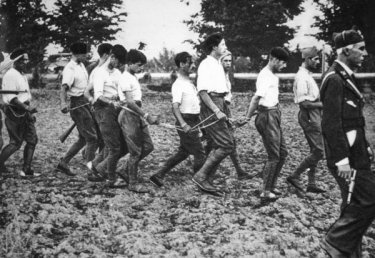
Men being marched to firing squads

~~

This is not a detailed analysis, just a highlight (lowlight?) of the week’s events. Feel free to suggestion an addition/clarification/correction below. All photos are linked to source for credit.
Valencia Photos of the Month: Horchaterías in Plaza de Santa Catalina


Plaza Santa Catalina in 1837, 1860, 1895 and 2013. Horchatería Santa Catalina is on the left, across the church entrance and El Siglo is on the right just before the church entrance. 

Plaza de Santa Catalina (named after the Santa Catalina church), off Plaza de la Reina, located in the heart of Valencia since forever, is home to two of Valencia’s long-standing and iconic stores, all-but across the tiny pedestrian street from one another and selling the same product – horchata.

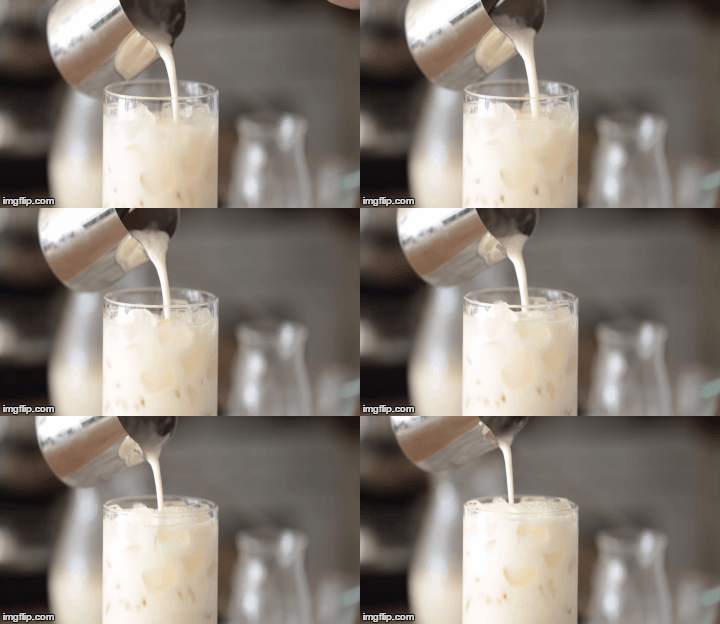
Horchata (orxata in Valencian) is the local beverage of the ages. The drink is made of tiger nuts, water and sugar; you can get substandard versions made from almonds or rice elsewhere, but Valencia is the home of the product. When the Muslims owned/ ran/ inhabited the city from the 8th-13th centuries, they perfected the drink, made from chufas (tiger nuts) in nearby Alboraia, outside the city area. It looks as if made from milk, but dairy-avoiders have no need to shy away from the drink. It is served ice-cold and has fartons (don’t poke fun of the name), long pastry delights dipped in for extra fun.

horchata gif

Right across from the entrance to the Santa Catalina church is Horchateria de Santa Catalina, which is decorated in the traditional tile design of the area. After several hundred years and multiple royal visits, they know what they are serving. Horchata, fartons, various pastries, churros and coffees are all available, and you can get your sugar on for just a few euros. It’s one of Valencia’s quiet icons, with a handy location to everywhere in the old town.


Across the tiny street is Horchatería El Siglo, who have been serving up horchata since 1836. The same products as across the street, though with a simpler setting, and some argue, better quality horchata. They also have a nice outdoor setting area. Again, for a few euros you can have all you want and chill with the locals. Or could, because as of 31 December 2014, thanks to a law changing rents in Spain, disaster has struck El Siglo. While the rent increases, put up to current market rates, have been coming for the last twenty years, they have now come into force. While many of the 9000 local family-owned stores in Valencia, the classic older stores of the city, managed to negotiate rents (going up thousands of euros a month!), some, like El Siglo have instead decided to close their doors and have the owners retire. Rents have been frozen, some for up to half a century, in Spain for the aid of businesses, and that helpful time has come to an end. After all this time, a law has closed El Siglo and we’ll be seeing some ugly generic Starbucks in there, even though they are everywhere like a plague. Thousands of stores around Spain will now disappear thanks to this law change. You will be seeing more franchises and generic stores over the beautiful lace stores, shoe stores, doll repairers (yes), antique shops, tailors, cafes, basket weavers, horchaterías et al, businesses handed down through generations. And that really sucks. The time for the rent freezes came to an end, and some argue it had to happen, however the face of Spain is being changed quickly, thanks to corporations who can afford the new rents.

 RIP El Siglo

Beautiful Drone Footage of Valencia, Spain

The Spanish powers-that-be hate drones. Why? Maybe because they are awesome. But here are some beautiful short drone videos over some of Valencia’s best landmarks. They are made by Aerial Valencia with a Phantom drone, giving people a chance to see Valencia’s well-known sights from a new perspective.

This video is done by Aerofilm HD, which drone around other Spanish locales, and this very special location 🙂

`

Aerial Valencia is on Twitter – @aerialvlc and on youtube – Aerial – VLC