This Week in Spanish Civil War History – Week 51/52: 3 – 17 July 1937

July 6

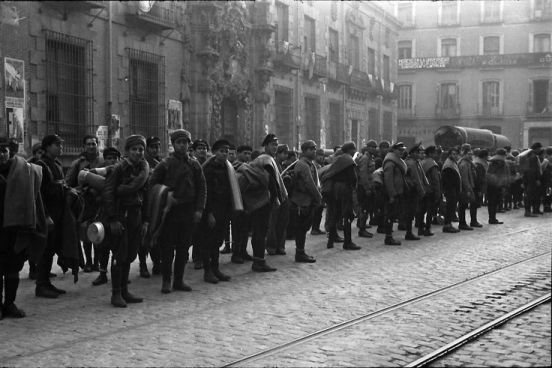
Under the cover of pre-dawn, the Republican men (between 70-85,000 total for the battle, 22,000 for the initial attack), commanded by General Miaja, sneak deep behind the Nationalist front lines, who lack troops on the ground. Rather than having men along the front lines, the Nationalists have men stationed at a series of towns north and east of Brunete (see map), their headquarters in Navalcarnero, 15kms south of Brunete. At dawn, the Republicans bombard all the towns around Brunete by air with 100 planes brought to the well-planned battle, and heavy artillery is used on the ground, catching the Nationalists off guard. General Líster and his newly reformed 11th division manage to advance 8kms through the front lines and circle around Brunete. By midday, the Republicans have the strategic town of Brunete. While the town does not have anything particular the Republicans want, it was proof they could dig into Nationalist territory and fight their enemy. This was to convince the Soviets to send more aid, and the French to open their borders to arms shipments.

The Nationalists, still commanded by General Varela, quickly pull together reinforcements around the area, and by midday as the Republicans claimed Brunete, the Nationalist 12th, 13th and 150th divisions are ready to fight back. The Nationalists have 45,000 troops in the immediate area to fight back. The Republicans quickly are met with resistance as they seek to storm south of Brunete, but are held in the town. The Republicans, flanked by the 34th and 46th divisions, attempt to break towards Quijorna, 6kms north-west of Brunete itself, but also cannot fight the sudden onslaught of Nationalists. The advance of the Republicans on the first day surprises even themselves, and the XVIII Army Corps, another 20,000 men (the 10th, 13th and 34th divisions) are not deployed, as they were not expected to be needed.

The east-located Republicans, who planned to fight from Carabanchel, the most southern suburb of Madrid, never break through the front lines, the Nationalists close into Madrid in full control of the area. The Republicans use heavy artillery bombing and still cannot break the Nationalists around Madrid.

July 7

An overnight stalemate outside the village of Villanueva de la Cañada ends at 7am when the 15th division, with the British XV International Brigades, take the town and Nationalists flee. The villages of Villanueva del Pardillo and Villafranca del Castillo, 9kms north of Villanueva de la Cañada, are still held by Nationalists. The 15th division need to head to Boadilla, 12km east of Villanueva de la Cañada, so the 10th division attacks the Nationalists on nearby Mosquito Ridge. The Republicans force the Nationalists back to Boadilla, which is only 18kms from southern Madrid.

Fires are starting to break out in the dry landscape outside Brunete due to firepower being used. Neither side make any advancements. The Republicans are keen to fight off each small resistance as they come, rather than moving around them and onto larger targets. This gives the Nationalists time to bring in fresh men.

Republican tanks seen by Gerda Taro outside Brunete

July 8

The Republican XVIII Army Corps of 20,000 men attack under darkness to cross the Guadarrama River and head east towards Boadilla and attack the Nationalists trying to hold the front lines outside Boadilla. Fighting continues after daybreak and the Republicans win, only to be repelled later in the day.

The Republicans in Madrid again attack the front lines at Carabanchel and fail. They will not attack here again as the circle around Madrid is a Nationalist priority and will not fail. The Nationalists also still hold the village of Quijorna west of Brunete. Franco sends 31 battalions, seven batteries of artillery and the entire Condor Legion (around 70 planes) from the Basque Country to help the Nationalists, finally giving the battered Basques a break.  The Republicans still have little more than their WWI artillery and guns with the troops.

International Brigades outside Boadilla

July 9

Two Republican brigades attack Quijorna, and take the village after suffering massive losses. Republican troops headed east towards Boadilla have suffered such great losses that they are now stranded, so close to the village itself. The Republican air support, while starting strong, are now outpaced by the German Condor Legion, who are taking control of the skies.

July 10

The Republican 60th division and XII International Brigades take Villanueva del Pardillo with tanks. Around 500 Nationalists are captured along with precious ammunition. Nearby Villafranca del Castillo is surrounded by Republicans by the 10th and 45th divisions.

Taken by Gerda Taro with Republican men outside Brunete

July 11

Colonel Jurado of the XVIII Army Corps plans a huge assault on Villafranca del Castillo, but falls ill and is replaced by co-leader Colonel Casado, who cancels the assault due to morale and fatigue. They are forced to engage by Republican leader General Miaja. The Nationalists are reinforced from a division arrived from Navarre and repel the assault. The Nationalists then try to take back Villanueva del Pardillo, but fail. Overhead these villages, huge air battles are being fought, up to 30 planes flying in formation against similar numbers in retaliation, with losses on both sides.

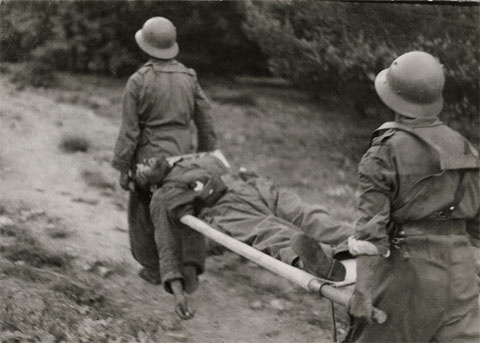
On the ground throughout the whole area, both sides are suffering horrific losses. American communist Oliver Law, commander of the Abraham Lincoln Brigade, is killed while fighting on Mosquito Hill, the ridge outside the town of Boadilla, among heavy Republican losses.

July 12

France decides to open its border with Spain (the point of the Brunete attack, to show Spain’s strength), and enormous amounts of weapons and equipment is shipped into Spain over several days, vital for the Republican cause to continue. France has violated the Non-Intervention clause, but this is retaliation for the Fascist Germans and Italians constant assistance the war on behalf of Nationalists.

July 14

The Republicans are suffering huge losses, not just from fighting. The extreme heat in the area plus lack of water has injured many men. Most Republican brigades, Spanish and International, have lost between 40 to 60 percent of their men in a week. The XIV International Brigades have lost 80 percent of the men. Total losses have not yet been tallied though between 15,000 and 20,000 Republicans are now dead, the Nationalists suffering similar.
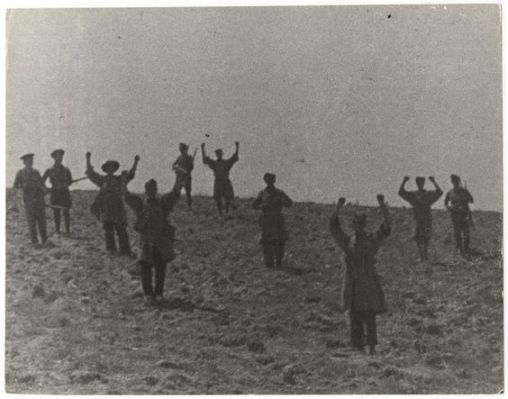
Republicans outside Boadilla

July 16

British volunteer Major George Nathan dies while commanding the XV International Brigades when a bomb detonates at his post near Boadilla. Attacks on all fronts are now minor and General Miaja of the Republican Army wants to end the offensive. The Republicans have Brunete and have cut off the Extremadura Road. The Basque country is relieved by diverted Nationalist troops and planes. The Republicans look strong in the eyes of the French and Soviets again, and their main objectives have been achieved. However the Nationalists surrounding Madrid have not yet been totally cut off from the Army of the South.

July 17

The Republicans are ill, battered, without serious supplies and suffering from their massive losses. They dig in all areas in the Brunete front and prepare for the Nationalist counterattack they know is coming. Some 38,000 Nationalists are coming.

The war is one year old today. Spain is fractured and blood had spilled in every city and village. No one is safe. No end is in sight. No saviour is coming.

Republicans dig in outside Brunete

~~

This is not a detailed analysis, just a highlight (lowlight?) of the week’s events. Things get lost in translation – Feel free to suggest an addition/clarification/correction below. The more the world remembers, the better. All photos and captions are auto-linked to source for credit, and to provide further information.
This Week in Spanish Civil War History – Week 47: 5 -12 June 1937

June 6

The Basque Army fighters, fighting alongside the Republicans, lose their last planes when they are shot down. The German Condor Legion planes destroy all their remaining planes, leaving the Republican men in the trenches around Bilbao exposed to Nationalist bombers.

Republicans outside Segovia

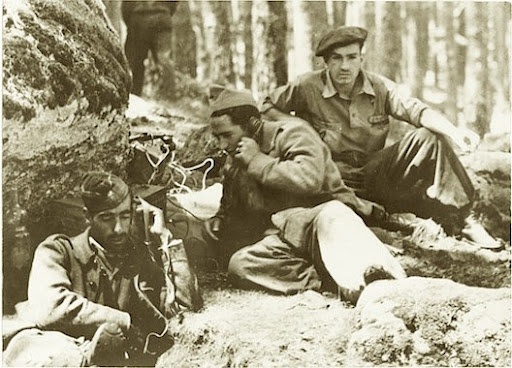
Republican Colonel Moriones, who is heading the Republican forces towards Segovia, orders a full retreat. The three divisions and the XIV International Brigade men have been soundly beaten over a week of fighting when they headed from the Sierra de Guadarrama mountains towards Segovia. A total of 3,000 Republicans have been killed, including 1,000 international volunteers.

Republicans outside Segovia seen by Gerda Taro

June 7

Manuel Hedilla, who has been leading northern areas of the fascist Falange party, is tried through a court-martial. The Falange have been merged with other Nationalist supporter groups, and Hedilla is in the way of Franco assuming total control over all right-wing factions. After being arrested in April for not following procedure set out by Franco (read: doing as told) Hedilla is sentenced to death. He is saved by Franco’s brother-in-law Ramón Serrano Suñer, who gets Hedilla a life sentence instead, which turns to only four years in prison. Having sidelined Hedilla allows Franco more control of Falange members and their attacks. Hedilla will remain a pain in Franco’s neck until his death in 1970.

June 11

Nationalist fighters in the Basque country breach the ‘Iron Ring’, the circle built outside the city of Bilbao. A series of fences and underground tunnels, the miles of iron tunnels serve to protect Bilbao and allow safe movements of Republican/Basque fighters. With not enough men or supplies to maintain the Iron Ring, the Nationalists finally break through to start an assault on the Basque capital. Basque President Aquirre is at the front, and sees German Condor Legion planes bombing the Iron Ring at Mt. Urcullu. The three miles of dried forest is bombed and set alight, overwhelming the Basque men inside the protective ring. The Nationalists get through on foot and are only 10 miles from Bilbao itself. The Basque government has no choice but to start a retreat to Santander.

The Republicans to attack the city of Huesca, in order to draw Nationalist troops away from Bilbao, take a hit when Hungarian General Béla Fankl, aka Zalka Mate, aka Paul Lukacs, is killed while inspecting Republican lines outside Huesca. An artillery shell hits his car and Lukacs is wounded in the head and dies hours later, his driver killed instantly. (Some accounts name his death as June 12, during fighting, but killed in the same manner)

June 12

The Republican attack on Huesca begins in the hope of stalling the Nationalist attack on Bilbao. The XII International Brigade, now without their General, join Spanish Republicans under their General and storm Huesca, 300 kilometres southeast of Bilbao, and just 70 kilometres north of Zaragoza. Huesca has been held by the Nationalists through the war and while they lack the men the Republicans have, they are well dug into the area. The Republicans have 50,000 men, mostly anarchists and POUM members from Barcelona, sent after the May Days a month earlier. Thousands of Republicans men are cut down with machine guns and artillery fire in what will become a week-long offensive.

~~

This is not a detailed analysis, just a highlight (lowlight?) of the week’s events. Things get lost in translation – Feel free to suggest an addition/clarification/correction below. The more the world remembers, the better. All photos and captions are auto-linked to source for credit, and to provide further information.


This Week in Spanish Civil War History Extra: 80 Years Since the Guernica Bombing

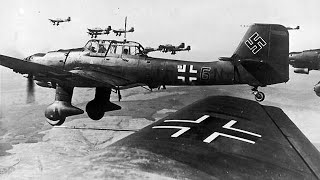
26 April 1937 – Guernika-Luma, a Basque town of 7,000 people, entered the history books when it was attacked by the German Condor Legion (aided by the Fascist Italian Aviazione Legionaria) fighting on behalf of Franco’s Nationalist forces. The small town of Guernica, in the Biscay region of the Basque Country was a communication hub for the Basque fighters, who had sided with the Republican forces since the outbreak of the Spanish Civil War. Guernica, the spiritual home to the Basque people, became a target for a sustained and pre-panned terrorist bombing, where civilians, not military targets, would be bombed, to inflict devastation and murder. Operation Rügen would go down in history as a horrific slaughter of innocents which would shock the world, and single itself out as a vile test run for what Germany would inflict throughout Europe only a few years later.

Guernica is a town just inland from the Bay of Biscay, and just 30 kilometres from the Basque capital of Bilbao. The area had been under intense stress from the War of the North, carried out by the Nationalists in the months leading up to the bombing, hot on the heels of years of struggle for the Basque people. Guernica is the home of the Gernikako Arbola (Tree of Gernika), the symbol of freedom to the Biscayan and Basque people. Guernica was also home to a manufacturing plant which produced firearms to the police and military, which became a vital resource during the Spanish Civil War, when the Basque Army supported the Republicans’ cause over Franco’s Nationalist rebels.

By April 1937, the Basque Country was under constant bombardment by the Nationalist advance, coming at them on all fronts. The small Basque Army, set up by the independent Basque Government, sought to protect the Biscaya and Guipuzcoa regions. With the Basque capital of Bilbao only 30 kilometres west, Guernica was vital in protecting the capital, and also a point where Republicans could retreat to if needed. Throughout the war, Guernica had no seen direct front-line fighting, though 23 Basque battalions were now nearby to the east. The area had no airforce protection, no air base and only room to house two battalions if needed.

The attack on the Basque Country has been planned a month earlier by Franco, in conjunction with murderous General Mola, who lead the northern army, along with the German Condor Legion. The town of Durango suffered civilian bombing on March 31, part of a test run of killing innocents, and troops starting pouring into the region. Many people sought refuse in the town of Guernica, away from the fighting. But eventually, there was nowhere else to flee as the Republian and Basque fighters were slowly beaten back by the Nationalist forces. General Mola planned a devastating attack on Guernica, all done with Franco’s blessing. They planed for 21 German and three Italian bombers, carrying 22 tonnes of bombs, to be dropped on innocent people.

Monday was market day in the town of Guernica. While market days had been largely banned or discouraged in the region for safety, people still needed supplies. Monday 26 April was a typical Monday market day which could see up to 10,000 people in the town from surrounding areas, all in the main plaza. Coupled with around 1,000 refugees from the area, the town was full, the roads more congested than usual.

At 4.30pm, the first wave of bombers came from the north from over the Bay of Biscay, along the Urdaibai estuary which connects Guernica to the sea. The initial plan was to cut off bridges to block movements in the area with two 50 kg bombs, while the Italian bombers dropped another 36 50kg bombs on people. The first wave took only a minute, destroying bridges and the San Juan church and Republican Left headquarters, as the people of the town looked to take cover in panic. For the next 90 minutes, another four waves of attack would fly over the town, this time dropping bombs at random, killing innocent people, all cowering for cover in a town overfilled with people trying to buy and sell food. Guernica had no strategic assets to be captured, nor had seen any major wartime fighting, and was totally obliterated without warning or reasoning.

The people of Guernica were given 30 minutes of silence at around 6pm, thinking the bombing was complete. But by 6.30pm, the bombers were back in formation again, spread out over 150 metres, to drop the remainder of their arsenal. Then in came German biplanes, to bomb streets leading out of the town and machine-gun down people fleeing the carnage over a brutal 15 minute period. This cruel attack on civilians would have a larger impact than Franco could have anticipated.

This short space of time saw 75 percent of the town reduced to rubble. While the raid was considered a failure, as it was supposed to have been a military, not civilian attack, to bomb the area and cut off the Republican fighters from communications and reinforcements in Bilbao. As a result for the killings, within days, the Nationalists were able to swarm the area, not that they was much left to ‘conquer’. The firearm manufacturing plant was saved, as planned, along with the Gernikako Arbola (Tree of Gernika) and its government building. The town had become a testing ground for what would go on to be labelled carpet bombing, or blitz bombing, a popular tactic by German planes.

News quickly spread about the horrific acts at Guernica. First spreading through Europe and then the rest of the world, the Nationalists were branded as murders and barbarians (which should have been obvious already) as the blatant killing of innocents became apparent. Franco quickly had to have the propaganda dialled up, and denied the Nationalists’ own involvement, and claimed the Republicans destroyed the own town and killed their own people while in retreat from ground troops. Germany claimed no knowledge of the attack, claiming to have bombed a strategic bridge, the rest nothing to do with them. No such luck; journalists in the area were quick to file stories on the truth of Guernica.

But in the aftermath, the death toll was hard to quantify. The Basque government were unable to do much in way of assistance as Nationalists forced swarmed the area, and they made no attempt to calculate the dead and injured. Many left to die in the rubble were never accounted for, likewise the number of people who fled the region, never to return.

For decades the number of killed sat at 1,654, another 889 injured. A British journalist for The Times was in the area, and also came up with similar numbers. These incorrect figures became commonly adopted as accurate, though with the Nationalists not helping the wounded when then they invaded, and without proper funerals and records, there was no official death and injury toll. Even in the 1970’s the Nationalists were still denying everything and claimed only a dozen people were killed. Without further details coming to light over the years, historians now recognise the number of dead about approximately 300. A comprehensive study in the region in the 1980’s suggested 153, based on what records survived, with another 592 people who either died or recovered in Bilbao’s nearby hospital. While in context with many atrocities which occurred in Europe over intervening years make the numbers appear ‘small’, the casualty rate per bomb was much higher than many carpet bombings to come in the future, setting Guernica apart for yet another reason.

British journalist George Steer reported the story to the world, Guernica on the front pages in England for over a week as the horrors emerged. Cartoons emerged of the Basque ‘holy city’ being crushed by Hitler and his bloody swords in the US. The fact Guernica had no military targets quickly turned on the panic in many around the world, as people realised nothing was safe anymore. Guernica became a symbol of international horror and innocent suffering as deviant fascists sought to kill and destroy all in their way.

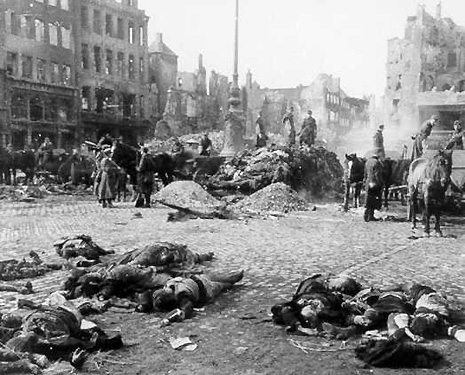
On the 60th anniversary of the bombing, Germany formally apologised for their role in the massacre, and in 2003, Guernica was commemorated alongside Dresden at the own commemorations, for suffering such a similar attack, but far less honoured and remembered. On Guernica’s 70th anniversary, officials in Hiroshima spoke of Guernica’s legacy in line with their own experiences. It has been suggested that Guernica be the world capital for peace.

For all the historical significance, the destruction and most importantly, the death toll, Guernica is probably best known internationally due to the Picasso painting of the same name. Picasso, living in exile in Paris, had been commissioned for war painting three months prior, and when he hard of Guernica, all of Picasso’s ideas were scraped for the depiction of those suffering. To Picasso, to bomb women and children was  to victimize humanity. The painting was complete by June 3. In black and white, the painting shows innocents dying, along with the Spanish symbols of the horse and bull, as Spain is ruined, along with tiny symbols of hope trying to shine through while destruction comes from all angles. When German soldiers came into Picasso’s Paris apartment years later during WWII, and was asked if he did the work, he told the Nazi’s – ‘no, you did’. Guernica traveled the world but was not able to return to Spain until 1981 when freedom was achieved for the Spanish people. It now sits in the Reina Sofia gallery in Madrid (if you haven’t been, you should).

After the bombing of Guernica, the town was in flames, seen 10 miles (16 kilometres) away, according to George Steer, as buildings continued to crumble and crush the injured and trapped. Yet, pilots who belonged to the Condor Legion, whom Franco let practice on his own people, received a mausoleum in La Almudena in Madrid. Many vicious men from the war were revered in Spain, these plaques and statues and memorials removed over the years. To mark the 80th anniversary of Guernica, the mausoleum in La Almudena for fallen Condor Legion pilots was quietly removed, to be replaced with simple names. No more “Here rest the German pilots who fell in the struggle for a free Spain. German aviators who died for God and for Spain”. The plaque had been removed in the past but had been quietly replaced by those who still love Franco and all that happened in his name.  It has taken 80 years for this last sign of pro-German acts to be removed. The wounds on Guernica will never fully heal.

~~

This is not a detailed analysis, just a highlight (lowlight?) of the events. Things get lost in translation – Feel free to suggest an addition/clarification/correction below. The more the world remembers, the better. All photos and captions are auto-linked to source for credit, and to provide further information.

This Week in Spanish Civil War History – Week 32 and 33: 19 February – 5 March 1937

February 20

Republican General Asensio Torrado resigns his post as head of the Central front. Torrado is one of the few ‘Africanista’ Republicans who did not side with the Nationalists at the outbreak of war. Immediately after the initial coup, he led teams of soldiers in the Somosierra area just north of Madrid as well as the Battle of Talavera de la Reina. By October he was sub-secretary for war and leader of the Central Army by November, one of the leaders during the defense of Madrid. He created mixed brigades of men, both trained and those men new to fighting, to create stronger brigades. He was rejected by both anarchist ans communists due to his military-style control of the militias, and was forced to resign after the Republicans failure in Málaga.

February 21

The Non-Intervention Committee set up by the League of Nations officially bans all foreigners volunteering to fight in Spain, useless as thousands have now entered the country, defying their countries, or claiming statelessness. The Non-Intervention Committee is letting large countries such as England, France and the U.S sit on their hands, while individuals worldwide (even as far away as New Zealand) see the need to help Spain. German and Italy defy the ban daily by supporting Franco, and the Soviet Union aides the Republicans.

Captain Merriman prior to his injuries

February 23

The battle of Jarama is ongoing, but with the stalemate at the front line, snipers are killing on both sides, with no progress being made. The new Abraham Lincoln battalion are ordered to take Pingarrón (Suicide Hill) again, and send 450 Americans (supported by an Irish column) off to their first major offensive, one known already as a disaster thanks to previous battles. The men have no artillery or planes for support, but storm the Nationalists over four days, and are violently killed. The battle hears the immortal words of Irish poet Charles Donnelly – ‘even the olives are bleeding’, just before he is killed by machine gun. The Americans lose 127 men and another 200 are wounded, Captain Robert Merriman included, and mutiny ensues. Other Republican units catch those who mutiny to be court-martial, but the Soviets prevent them from being tried or punished. Naturally blame needs to be passed, and XV International Brigade Commander Vladimir Copic is named, who in turn blames wounded Captain Merriman. This marks the end of the battle of Jarama, as both sides are now totally exhausted and nothing can break the stalemate. The front line shall remain here for the rest of the war, a little over two years away.

March 4

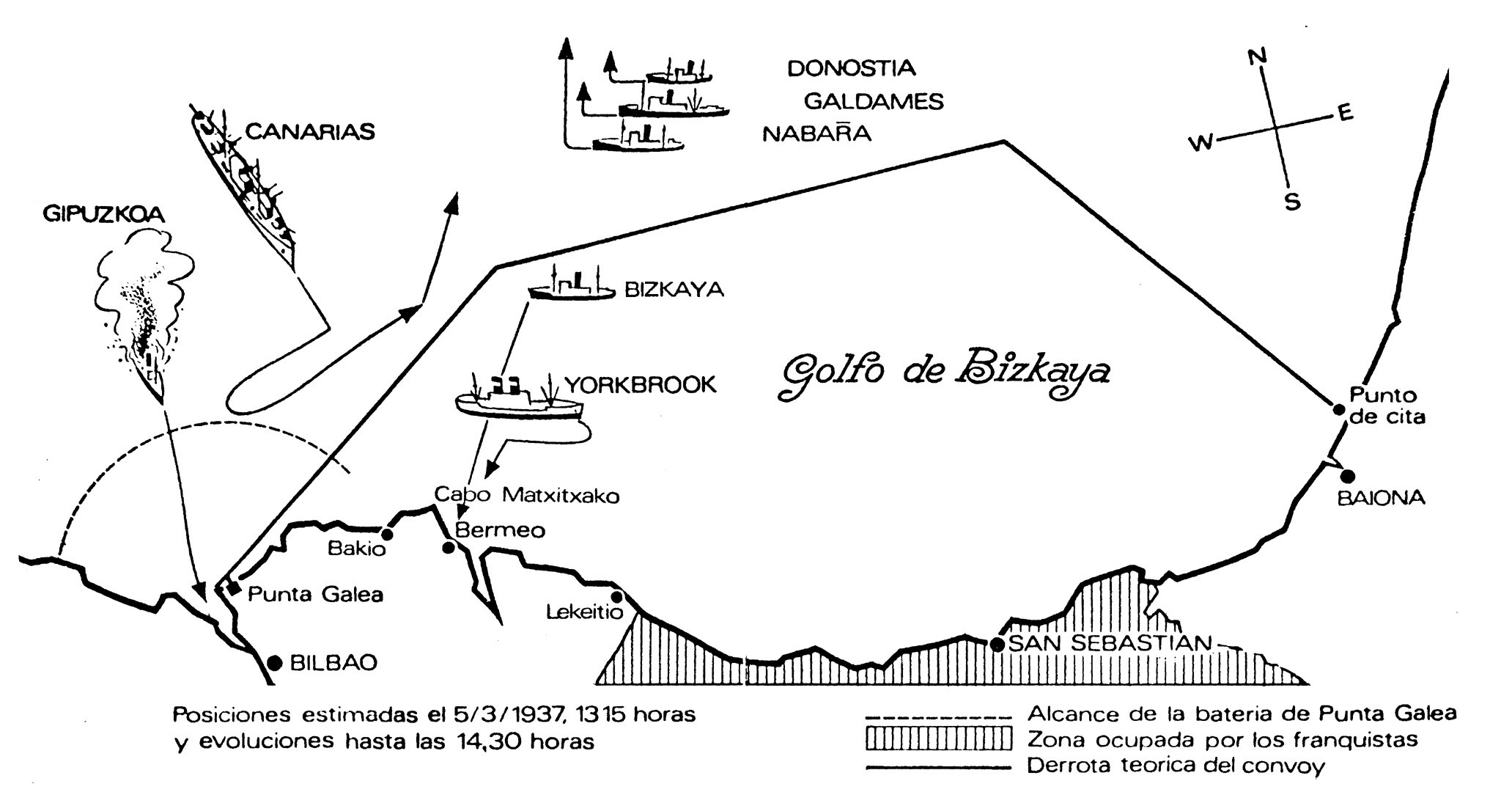
The Battle of Cape Machichaco begins. The Basque Auxiliary navy, supporting the Republican navy, send four trawlers from France to Spain – the Bizcaia, Gipuzkoa, Donostia and Nabarra. They accompany the Galdame, carrying  people, machinery, weapons, mail supplies and 500 tonnes of nickel coins, all owned by the Basque government. The Nationalists send the Canarias from port in Ferrol to stop the Galdame reaching the Basque ports.

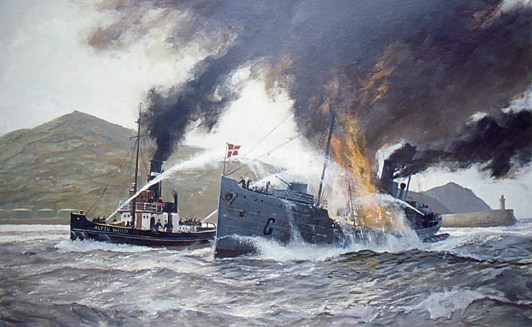
By the following morning, the Canarias was spotted by the Gipuzkoa only twenty miles from Bilbao. Shots were fired, hitting Gipuzkoa on the bridge. Returned fire kills a seaman on the Canarias, and wounds others, forcing them to retreat. The Nabarra and Donostia engage in battle with the Canarias for hours before they are forced to retreat. The Nabarra is hit at the boiler and 29 are killed, including their captain. Another twenty men are forced to abandon ship. All the men are picked up by the Nationalist Canarias and treated for their injuries.

The Galdame is also hit by the Canarias and is captured by the Nationalists, and four are killed in the carnage. Gipuzkoa manages to get to port in Portugalete and Bizcaia lands in Bermeo. Donostia lands in France. The twenty survivors of the Nabarra are sentenced to death by Franco, but the Canarias captains beg mercy, and the men are released in 1938. On board the Galdames, the passengers are let go, expect for politician Manuel Carrasco Formiguera from Catalonia, who is jailed before his execution a year later.

March 5

Trouble begins to mount as the PCE – Communist Part of Spain – holds its first council. They agree to favour democracy, against revolution and Trotskyism. The trouble is that this flies in the face of their allies, the Republican movement, the Spanish government and the powerful anarchist CNT. This decision will bring in-fighting among the Republicans in coming months, weakening the entire movement.

014guadalajaraAlso March 5

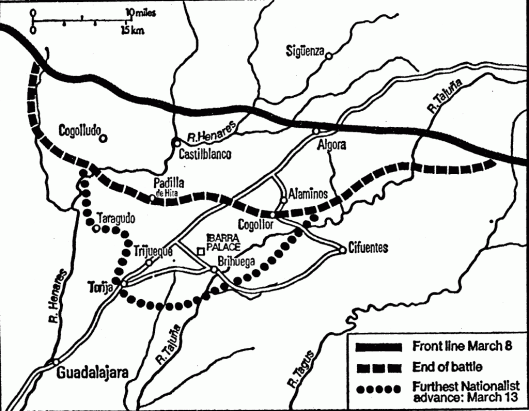
The Nationalists, fuelled with Spanish, Moorish and Italian soldiers, are preparing to attack Guadalajara, 60 kilometres north-east of Madrid. After all the failed attempts to take Madrid, and the collapse of battle at nearby Jarama, the Nationalists are keen to engage again. The Italians, fresh from taking Málaga, are ready to fight. The Nationalists have gathered 35,000 men, hundreds of artillery supplies over 100 tankettes, 32 armoured cars, 3,600 vehicles and 60 planes. Much of the tank, car and plane equipment comes from the Italians, as Mussolini strongly supports the offensive.

The Republicans are the 12th division of the Republican army with only 10,000 men, but only 5,900 rifles, 85 machine guns and 15 artillery pieces. They do have a few light tanks on their side. Guadalajara, until now has been peaceful, so no trenches, road blocks or defensive have been set up, but the Republicans know (assume), a Nationalist attack from the south is imminent. Meanwhile, the Nationalists are preparing to attack the 25 kilometre stretch of the Guadalajara-Alcalá de Henares road, south of Guadalajara, which will cut off the main road, and five other roads which stem from the area. The enormous offensive is planned for March 8.

~~

This is not a detailed analysis, just a highlight (lowlight?) of the week’s events. Things get lost in translation – Feel free to suggest an addition/clarification/correction below. The more the world remembers, the better. All photos and captions are auto-linked to source for credit, and to provide further information.

This Week in Spanish Civil War History – Week 28: 22 – 29 January 1937

Week 28: 22 – 29 January 1937

January 22

The Nationalists forces have been constantly battling to take Madrid since early November and still not able to get into the city. Franco decides its time to change tactics and attempt to cut off the city  by crossing the Jarama river, south-east of the city. This will cut off Madrid’s communications with Valencia to the east, which is the temporary Spanish capital. Franco groups together General Mola, General Varela and General Orgaz, and plans an attack 7 miles south of Madrid, with 25,000 troops and heavy artillery. The German Condors are also called in to help, while Italian troops plan an attack on Guadalajara at the same time. They plan to attack in early February.

Nationalist forces in the Jarama region

January 25

The newly formed Army of the South is still marching towards Malaga in the far south. The city is still in Republican hands, but their inland areas are slowing being eaten away by incoming troops left and right, while Italian troops march in to meet them in Malaga. The troops will take the remaining 10 miles left inland around the city in every direction as they face no resistance from unarmed Republicans.

January 27

The Basque Statute of Autonomy in the north is still holding, after being formed in October. The city of Bilbao is filled with civilians who have fled to the far north to find safety from Nationalist forces. But the Nationalists have been striking the city from the air repeatedly, to outcries from both sides. The Basques/Republicans are mostly civilians trying to stay safe, and there are prison-ships parked in the city where Nationalists are being held, now in danger by their own side. Over January, 224 are killed.

January 29

The workers’ militia are still controlling Barcelona, and most of the Catalonia region; most workers belong to the CNT/FAI. These militias have been working with the Catalonian government since the uprising in July, though the workers unions have control of the area. They have around two million members, plus the allies from the UGT union with one million members, and the Communists have just a few thousand. Regardless of numbers, everyone has equal representation.

Through some of the Catalonia region, and through much of the neighbouring Aragon region, militias have established an anarchist-led movement based on freedom and lack of government, working with the locals. While these sides in Barcelona are opposed to the Nationalist invaders, the Republican government in Valencia also sees these people as enemies, as the movement promotes freedom from government. As the situation continues to evolve, the CNT maintain control, with some representation from the Communists. The anarchists have opposition to all supervisory positions.

But trouble is starting to brew as so many factions working together is running into constant problems. The anarchists cannot work closely with the Socialists, Communists and Catalan nationalists (as in wanting independence from Spain, not the rebel Nationalists). Barcelona also has the communists splitting into different factions, some supporting Spain and the Soviet Union, the others supporting the Catalonian independence groups. Also now gaining traction are the Marxists, who formed the POUM (including famous writer George Orwell), who believe in war to gain social revolution, like the anarchists.  But the Marxists are also flaring up against Trotsyists. With all these groups working and living together, while trying to set up a new social order and hold back the Nationalist troops trying to conquer the area, things are getting heated and shaky in the northeast. They are more looking at each other rather than their common enemy.

XV International Brigade volunteers arrive in Barcelona, January, 1937

~~

This is not a detailed analysis, just a highlight (lowlight?) of the week’s events. Things get lost in translation – Feel free to suggest an addition/clarification/correction below. The more the world remembers, the better. All photos are linked to source for credit.