SPAIN BOOK REVIEW: ‘The Spy with 29 Names’ by Jason Webster


thespy

The Spy with 29 Names is a gripping account of the exploits of Juan Pujol, the most extraordinary double agent of the Second World War, who was awarded both an Iron Cross by Germany and an MBE by Britain.
 
After the Spanish Civil War, determined to fight the spread of totalitarianism, Pujol moved to Lisbon with his wife, persuading the German intelligence services to take him on. But in fact, he was determined all along to work for the British, whom he saw as the exemplar of democracy and freedom. Seeing the impact of the disinformation this Quixotic freelance agent was feeding to the Germans, MI5 brought him to London, where he created a bizarre fictional network of spies – 29 of them – that misled the entire German high command, including Hitler himself. Above all, in Operation Fortitude he diverted German Panzer divisions away from Normandy, playing a crucial role in safeguarding D-Day and ending the war, and securing his reputation as the greatest double agent in history.
Cover artwork and blurb from jasonwebster.net
~~~

The Spy with 29 Names is the story of a man who was almost lucky that the Second World War was raging. Had it not, his behaviour and attitude probably would have gotten him into trouble. A master of disguise, a man who had charming down to a fine art, a deceiver who could tell any lie. The spy known as ‘Garbo’ set up another, almost implausible, 28 spies from all walks of life and locales, and tricked the Germans into things no other spy managed during the war effort.

The book covers Juan Pujol Garcia’s early life from his birth in 1912 and the effects the Spanish Civil War had on his family in Barcelona. Pujol tried to fight for the Nationalists after his family got imprisoned by the Republicans, but he ended up with hate for the ideals of both sides of the conflict. Pujol harboured desires of being a WWII spy for the British but got rejected early on by the Embassy in Madrid, so he set out to work alone. Living in Lisbon, he started feeding downright false information to the Germans. The lies seemed to be trusted with impunity, so was Pujol’s ability to deceive.

British Intelligence crossed paths with Pujol first in 1941 when the code-breakers at Bletchley Park started finding messages to ‘Arabel’, a German agent who appeared to be in Britain. The messages started capturing their attention when they could see the information was blatantly false, but still seemed to be believed by the Germans. Kim Philby, the famous British spy, decided they needed to recruit ‘Arabel’ to help their own efforts and keep the British spy operations a secret. MI5 discovered the identity of ‘Arabel’ and Pujol went to Britain and worked with Tomás Harris to help with the effort and increase his false intelligence operation. While the information that Pujol spun to Germany was a pack of lies, he peppered it with a few genuine facts, only increasing his believability. The deeper Pujol went with Germany, the more elaborate he became, eventually having both male and female ‘spies’ on his side, reporting from the UK and abroad.

MI5 gave Pujol the code name ‘Garbo’ because he was a top-quality actor. Pujol went on to name his spy aliases with simple names, such as Rags the Indian poet, Mrs Gerbers the Widow, the Treasurer, the aptly named Con, and my personal favourite the Mistress, whom the Germans knew as Amy. Pujol’s ability to play the role of 29 different people would sound preposterous if it hadn’t been a real man who made such a massive contribution to the Allied endeavours. Pujol then become the main agent in ‘Operation Fortitude’, and his main objective was to tell the Germans that the proposed Allied invasion of Europe would happen anywhere other than Normandy.

As Pujol increased his involvement, even Hitler himself believed that Normandy would be not the D-Day location. For weeks leading up to the D-Day invasions, the Germans were diverting men and supplies away from Normandy. Pujol planned to tell the Germans a location and time of an invasion, only an hour before it happened. He then banked on them missing the transmission so his lying operation wouldn’t be blamed when the Allies stormed Normandy rather than up the coast, and ‘Garbo’ changed the war forever.

Two months after D-Day, the Germans awarded Pujol with the prestigious Iron Cross and a whopping payout for all his work. Even after the pivotal point in the war had damaged their operations, the Germans still believed all Pujol told them. Did anyone ever truly suspect Pujol? We will never know. Pujol moved to South America for his own safety after the war, and didn’t return until 1984 when he received his belated MBE and got the chance to visit the site of the D-Day landings. He passed away in 1988.

The story of Juan Pujol could have been lost to history while the stories of Kim Philby and other British spies were shared. Spain’s contribution to the Allied effort with one man’s charisma, lying and genius ideas is a story that needed to be told. Webster has woven a tale so astounding that it could be mistaken for a work of fiction and lets the light of day shine on the network of deception which saved countless lives. With meticulous planning and a clear, easy to read style, Webster has made an espionage tale that can appeal to those who enjoy war history and those who don’t. From the offices of the code-breakers to the complex conversations with the Germans and everyone in between, both the real-life and entirely fictional characters of the most fascinating spy are brought to life. Webster has written a book where everyone feels so authentic that a reader could be forgiven for falling for Pujol’s lies 70 years later.

Thanks to my father being a WWII buff, I grew up with a good knowledge of the war from the British point of view, but that level of knowledge isn’t required to enjoy this book. Webster also supplied a marvellous collection of photographs to feed the imagination of the reader. The book can sit proudly among all the fabulous works of fiction and non-fiction by this author. The Spy with 29 Names is an extraordinary account for all to enjoy as they recall how one of the most powerful weapons that saved the lives of our own relatives wasn’t a bomb – but a concoction of fiction.

Check out The Spy with 29 Names at jasonwebster.net and thespywith29names.com, and purchase on Amazon UK. Plus here is a video with the author about the locations where Pujol and Harris ran their operations.

Valencia Photos of the Month: The Valencian Gate Series – Puerta del Mar / Puerta del Real

Today, the Puerta del Mar (Gate to the Sea) sits in Plaza Porta de la Mar, in a roundabout connecting six roads, including where the glorious Calle Colón meets its end against the Turia. But this gate has a long history.

Puerta del Real (Royal Gate) was the entrance to the city from Puente del Real, one of the city’s historical bridges. The eastern part of the wall around the city was built in 1574, when worries about Turkish attacks began. In 1599, the open entrance to the city was moved to align perfectly with the bridge, when the wedding of King Felipe III was held in Valencia’s cathedral. This gate was the main entrance through to Valencia’s palaces for the wealthy, and stood in place until the bridge and gate needed repairs in 1801 (as in seen the photos below) when the gate was totally replaced in limestone and widened for convenience. The Real Academia de Bellas Artes de San Carlos held a design competition, which chose the new design seen in the photos. They built three arches, and in the centre engraved Reinando Carlos IV y Maria Luisa de Borbón. Año 1801 (Reigning Charles IV and Maria Luisa of Bourbon. Year 1801), along with the shield of the city on top. In keeping with the epic stupidity that saw the walls around the city pulled down in 1868, this gate was also destroyed.

Roll over the photos/drawings for their dates

In 1945, the replica of the Puerta del Real was built, but named Puerta del Mar. The replica’s new physical location (in then Plaza del Marqués de Estella) is the site of the original Puerta del Mar, rather than the Puerta del Real. During this time, Spain was in isolation after their civil war and then ugly neutrality of the Second World War, so the reconstruction of the 1801 design became a postwar icon. The new addition to the gate is the cross in the centre, a symbol to those killed during the Spanish Civil War. One one side they engraved – Este monvmento encuentra en mvralla antigva pverta mar de la fundación y es reprodvcción exacta pverta llamar a la real que era sitvuada frente de pvente sv nombre y fve construidas en 1801 y demolido en el 1868 (This monument is located on the foundations of the Puerta del Mar and is a reproduction of the Puerta del Real, built in 1801 and demolished in 1868). One the other side was engraved –  Francisco Franco Bahamonde Hispanium moderating valentinus senatus ad memoriam perpetuam deo qui vitam ed homeland devoverint hoc monumentum erexitanno (The Valenciano senate erected this monument to Francisco Franco Bahamonde, alderman (regidor in Spanish, I think, like a council) of Spain to perpetuate the memory of which he offered his life for God and Country.) This ode of Franco is currently covered over, but remains on the gate, in line with the historical memory laws of getting rid of all things Franco.

I don’t remember even taking these photos but they were tucked away in my archive. Three show the side where the Franco love is covered, the other shows the pretty Valencia shield garden side.

The original Puerta del Mar was a gate which pointed directly to the sea and was not on the riverbed itself like Puerta del Real. It led directly to the Convento de Santo Domingo, which is situated close to the new replica gate. During its time, the gate was connected to the convent, a citadel, a palace and weapons storage, and bore the shield of the city. The design and detail was similar to the Puerta del Real, and because the 20th century replica bears its name, the two gates can be easily confused. (In the first picture below, both gates can be seen, Puerta del Real at the bridge, and Puerta del Mar to the left)

The Puerta del Mar, a replica of the Puerta del Real, but put in the original place of a whole different gate, taking its name, but not actually having anything to do with the gate whose name it took. Yes, that wasn’t confusing at all.

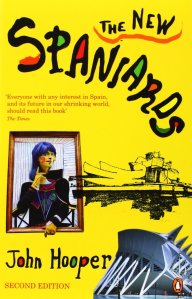
SPAIN BOOK REVIEW: ‘The New Spaniards’ by John Hooper

71treumJ37L._SL1355_

Modern-day Spain is a country changing at bewildering speed. In less than half a century, a predominantly rural society has been transformed into a mainly urban one. A dictatorship has become a democracy. A once-repressed society is being spoken of as a future ‘Sweden of the Mediterranean.’ John Hooper’s outstanding portrayal of the new Spanish society explores the causes behind these changes, from crime to education, gambling to changing sexual mores. This new, up-to-date edition is the essential guide to understanding twenty-first-century Spain: a land of paradox, progress, and social change.

~~~

The New Spaniards is a book which has sat on my to-read shelf for far too long. The second edition of this book got released in 2006, so by the time I pulled it from my shelf, I wondered if its information would be little irrelevant, given the changes to Spain in the past eight years. I could not have been more wrong.

So often mentioned in the same breath as Ghosts of Spain by Giles Tremlett, the book which pulled me from my slumber about Spanish history, The New Spaniards is a must read. The author brings together over 400 pages, creating a solid, credible and easy to read review of Franco and modern life. One chapter in, what immediately becomes clear is the efficient and clean writing style Hopper has; while other books on the subject can feel academic and stiff, the prose is fresh and makes the reader comfortable among a detailed and insightful presentation.

The book starts with a section of the Franco reign, from the years of hunger, the economic boom, the mass migration of Spaniards both abroad and within their own nation, and effects of the reforms made during the dictatorship. The 1970′s, once Franco had gone and democracy set in, is covered with excellent detail, without any confusion on what was undoubtably a dizzying time of change in so many ways. Then-young king Juan Carlos and Prime Minister Adolfo Suárez are well discussed, along with the placement of the young and the old to form a peaceful democracy. The changes made by the Socialist government in the 1980′s are well touched upon, their effect on the economy and the high unemployment rate (easy to identify with today), along with the stark changes in the 1990′s by successive governments.

Chapter 7 – Legacies, Memories and Phantoms – is an engrossing read, whether a reader understands Spain’s 20th century history or not. It explains how Francoism has not survived the passing of years, but a legacy has become ingrained in Spanish life. The pact of forgetting, which did not allow anyone to forgive or heal, is touched upon with honesty, as is Valle de los Caídos outside Madrid. Hooper’s accurate argument is that the omission of the civil war (and its mass graves) in school textbooks, because it is not old enough to be considered history, is an excuse wearing thin.

Part two sweeps in with a section on the churches’ role in Spain, along with the curious and absurd prudery of Franco and the changes to modern time, such with gay marriages. It makes an enlightening read for those less acquainted with subjects such as prostitution, abortion, contraception and gay rights in Spain. Another absorbing chapter is the death of machismo in Spain as women gain rights after being so deeply and cruelly oppressed under Franco. The fact Spanish women are still suffering sexism, like all nations, is also explained, with the all the relevant details to back up the claims. The role of family in Spanish life is given a thorough and honest portrayal, as are the changes in domestic violence and divorce laws which have changed the precious Spanish family for the better.

Part four sheds light on the autonomous regions of Spain, something not well understood by those not living in the country. The Basques, the Catalans and the Galicians are all opened up as Hooper shares their desire for self-governance, with all the information on the remarkably different laws and goals for their regions. (I wanted to wave the flag for the region of Valencia at this point, which has been trapped under their corrupt PP mayor for over 20 years). The book covers the how’s and why’s of the 17 autonomous regions of Spain, their individual paths to freedom, and what lies ahead for these proud places. I learned more about this process, despite having studied it in the past, a testament to the author’s respect for detail.

 This book covers so many subjects that it can dizzying when looking back over all that is covered – from Spanish gypsies, to the welfare system, to the ups and down of the education system, housing and the booms and busts suffered, to the legal system, the media, the arts, but Hooper guides readers through every subject with a smooth yet meticulous manner, opening up each of these fundamental subjects. For me, one of the final sections on changing traditions was especially fascinating. Bullfighting is covered in-depth with an unbiased yet accurate voice. I have read much about bullfighting, but it can be hard to find anything written that does not either lean heavily in favour or against the art form. Regardless of your opinions on the subject, any reader can gain from the information shared by the author.

While much as happened politically, socially and economically to Spain since this book was written, it still serves to provide a clean, realistic picture of Spain and why the nation sits in its current form. The book shows how the past has shaped the present, and can also show that what Spain is currently suffering is not unique. Each generation of Spaniard has seen suffering, but also moments of hope in the time since Franco died. If anyone wanted to learn from the past mistakes, the tips to succeed could well lie in the words of John Hooper.

This book got first published in 1986, rewritten in 1995 and revised in 2006, and could be easily overwhelming if it was not so well planned and laid out. I have yet to find a book that captures Spain’s identity as well as The New Spaniards. It should be handed out to each person who arrives in Spain and plans to make a life there.

My only gripe is that my paperback copy has a tiny font! While this has nothing to do with the quality of the author’s work, I had a headache the entire time. I can understand a publisher’s desire to make the text small, with so much to give to a reader, but it was difficult to read. Going to a Kindle version and sizing up the text is needed for everyone with delicate eyes.

Valencia Photos of the Month: Las Fallas

Everyone knows all about Las Fallas – started in the middle ages to celebrate the coming of spring. You don’t know? Here’s a one-minute recap.

Workshops would through the woodchips etc out on the street during March, along with anything else they didn’t want, and would burn it. Over time, these fires became more artistic, leading to statues representing people and events, which could be set on fire as spring emerged. Now, the city celebrates big style, starting at 8am with bands and fireworks to wake up the city, called La Despertà. Each day for the 19 days of the fiestas, the 2pm Mascletà lets off an insane amount of fireworks for all to enjoy (see below video for a demo). After 15 days of gunpowder, bands and parades, the statues are brought out, the La Plantà, when about 400 statues are placed around the city, cutting off the streets to everything except enjoying the fallas and festivities with paella, churros, chestnuts, beverages and pretty much anything you like. One the party nights of the 15,16,17 and 18, you can enjoy the Els Castells and La Nit del Foc, riverbed fireworks, the L’Ofrena de flors, the flower offering (17/18March) in Plaza de la Virgen,  plus streets parties and meals shared by neighbourhoods. On the 19th is the Cabalgata del Fuego, with parades, fireworks and snacks before the midnight Cremà, where all the statues are burned to dust, including the ones judged as the best of the competition (one is saved for display). The party goes all day and night for 19 days, and men can wear traditional Saragüells outfits, while women enjoy fallera dresses, and being voted in as a fallera girl, and participating in parades, fireworks displays etc is a big deal and excellent to enjoy during the fiesta. There, basic recap done.

But this isn’t a history lesson, this is the photo of the week. Here are a few examples of fallas statues over the past 100 years, next today’s offerings (plus videos at the bottom to enjoy and learn a bit more in a short time).

All about Las Fallas

La Cremà

La Mascletà

Historical photos by Juan Antonio Soler Aces, and current photos by Caroline Angus Baker and Graham Hunt at Valencia Property

Valencia Photos of the Month: Puerta de los Apóstoles and the Tribunal de las Aguas

Valencia’s cathedral, which began construction in 1262 on the site of a mosque, has three main entrances – the main palace entrance by the Micalet tower (Romanesque), the Almoina (Baroque), and the Puerta de los Apostoles (Gothic) entrance. Since there is so much to cover at the cathedral, today we just are focusing on the Gothic entrance, the Door of the Apostles.

The entrance leads onto Plaza de la Virgen, and was the original entrance to the mosque on the same site. It has around fifty reliefs of angels virgins and saints. It also has figures of the apostles, which gives the entrance its name, and a rose window with the star of David above the door for light into the cathedral. This area of Valencia is central to the fiestas and religious holidays of the city, and the door features in many photos of the city throughout its history due to its fantastic location. If you want a photo of any of the buildings in Plaza de la Virgen without the hordes of crowds, it’s best to start early. I have tried to find the best photos I have without the crowds, but it’s not easy.

Every Thursday at midday, the Tribunal de las Aguas de la Vega de Valencia, the Water Court or Water Tribunal, hold a session on the steps of the Apostles door. The court is held in Valencian and has no written records, but has been discussing irrigation matters of the areas (Quart, Benàger i Faitanar, Tormos, Mislata, Mestalla, Favara, Rascanya, Rovella and Chirivella) for almost 1000 years. Vicente Blasco Ibáñez wrote about the court in detail in his 18th century novel La Barraca, and I added a section on it in Blood in the Valencian Soil, when it featured in a major storyline set in the present day.

One more glorious photo – In Vengeance in the Valencian Water, in the storyline set in 1957, the main character José Morales Ruiz has to struggle to survive in the flood of the city, and pauses in Plaza de la Virgin. Here is an exact picture of what just how to plaza looked in 1957, with the Puerta de los Apóstoles in the background. Little bit of book trivia for you.

Años 50, plaza de la Virgen con la fuente, la puerta de los Apostóles y el Cimborrio de la Catedral.

Once again, all historical photos are courtesy of Juan Antonio Soler Aces.