This Week in Spanish Civil War History – Week 60: 3 – 10 September 1937: 80 years since the Battle of Belchite

The ailing Republican battle of Zaragoza is now centred on the bombing of the village of Belchite, which has been surrounded for two days. Around 3800 civilians are trapped in the town along with 7000 Nationalists fighting, determined not to lose the area. All are suffering with the heat of summer and water in the area has been cut off by the Republicans. With troops so spread out over the Zaragoza battle area of 100 kilometres between Belchite and Zuera, exact numbers are not known, but bloody combat continues right around the small town. Much of the Republican artillery for the battle, with T-26 tanks and aircraft support, moves in to cut off the southern end of the Nationalist troops from the northern reinforcements.

September 4

While the bombardment of tiny Belchite continues, Nationalists with the Army of the North continue their trek through the mountains from the Cantabria region into Asturias, and cross the strategic point of the Deva river, with Republicans holding the area quickly having to retreat.

September 5

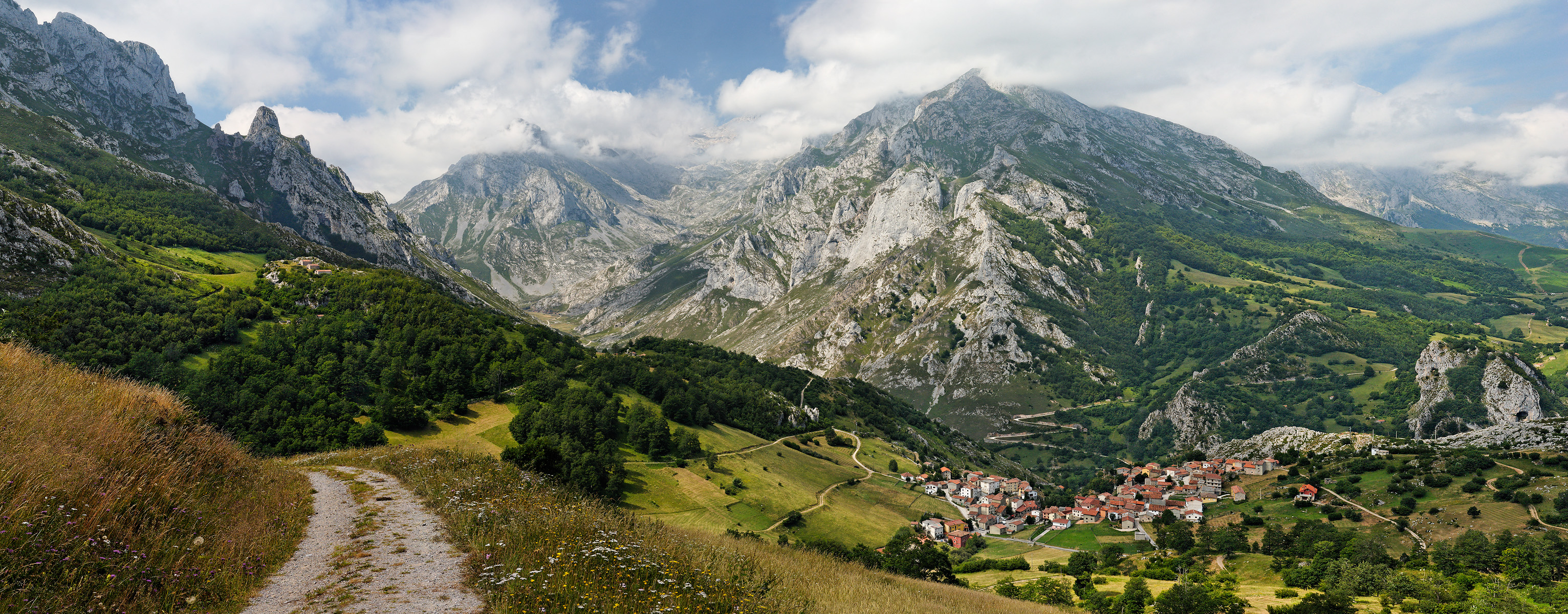
The advancing Nationalists capture the tiny town of Llanes, but the 33,000 troops now have to trek through the limestone cliffs of the Sierra de Cuera. These difficult regions are Asturias’ protection and the Nationalists will have to take the El Mazuco pass in order to advance any further.

El Mazuco mountains

September 6

While the bombardment of Belchite is still ongoing, the 33,000 Nationalists in the north begin the battle of El Mazuco. The Republicans, groups of Basque, Cantabrian and Asturian fighters, have only 5,000 men in the Sierra de Cuera region. El Mazuco is just five kilometres from the ocean, meaning destroyers can also be deployed to help the Nationalists, along with German Condor Legion aircraft. The Republicans, all men weakened from the lost battles of Bilbao and Santander, have no support and no way of gaining reinforcements. Only the steep cliffs will keep the Nationalists at bay.

Republican Libertad

September 7

The Nationalist cruiser Baleares battles the Republican light cruisers Méndez Núñez and Libertad off the coast of Cherchell on the Algerian coast. The Baleares comes across the Republican convoy in the dark, becoming the battle of Cherchell. Republican ships are escorting merchant ships through the dangerous area. The entire convoy flees the area while Libertad and Méndez Núñez try to hold off the larger Baleares. The two Republican ships are separated  during the day while Baleares tries to repair initial damage, but by afternoon, Baleares is hit twice by Libertad. Baleares backs away to be recused by a sister-ship in the sea, while both Nationalist and Italian planes attack the two Republican ships from the air. All ships involved are damaged and the leave the area, with only the Nationalist Baleares suffering serious damage. However, two of the cargo ships which had been travelling with the Republican convoy panicked during the nearby battle and changed course to get to Algeria. One ship runs aground, and one is captured the French and taken into the Cherchell port.

Carpet-bombing is used in the battle of El Mazuco, using both explosive and incendiary bombs throughout the day. The Republicans are trying to hold their post under Commander Higinio Carrocera, just three battalions and 24 machine-guns, and only the terrain holds back the strong Nationalist troops.

Still on September 7

The huge battle of Zaragoza is over. Republicans managed to eat 10 kilometres into the Nationalist areas, but only captured unpatrolled areas and win a few tiny villages. Exact losses on both sides are unknown (running into the thousands) but are worse for the Republicans who have also lost much of their artillery in the process. The battle of Belchite has also now come to an end, with the village completely destroyed. The Republicans and International Brigades take 2,411 prisoners and another 600 Nationalists have been wounded in the fight. After both bombing and hand-to-hand fighting, 3,000 people are dead. Those left behind manage to live in the rubble until a new town is built nearby in 1939, however the ruins will never be touched.

source

September 8

The battle through the El Mazuco mountains continues as thick fog fills in the whole area. The only fighting that can be done is hand-to-hand combat, causes massive casualties and wounds on both sides, and the Nationalists manage to capture a full two kilometres of ground.

September 9

The Republicans battalions defending El Mazuco have to retreat as the Nationalists shell their positions, but the Nationalists cannot take new ground as the men are cut down by machine gun fire from the Republicans in reply, meaning no one makes up any ground.

Area of Cabrales in the El Mazuco pass area

September 10

Still under the thick fog, the Nationalists take the hill at Biforco, below the El Mazuco Pass, but the mountain of Llabres is still in Republican hands, where they machine gun Nationalist troops and roll down barrels of explosives. The day is marked with the first delivery of hot food for the Republican men. If the Nationalists cannot take this pass, they will be forced to climb much steeper mountains to claim El Mazuco.

on the hills at El Mazuco

~~

This is not a detailed analysis, just a highlight (lowlight?) of the week’s events. Things get lost in translation – Feel free to suggest an addition/clarification/correction below. The more the world remembers, the better. All photos and captions are auto-linked to source for credit, and to provide further information.

FRAILTY OF HUMAN AFFAIRS: Author Q+A – Part 1

How much do you know about Tudor England? Maybe you are an expert; maybe you are new and know no more than Henry VIII and his desire to crop heads (roughly 72,000). Maybe you know Thomas Cromwell was the real genius behind Henry’s reign and changed laws in a way no country has ever known. Maybe you have heard his name a few times, maybe watched Wolf Hall, or get him mixed up with the genocidal Oliver Cromwell of the 1600’s.

Frailty of Human Affairs is set in the years 1529 – 1533, the early years of Cromwell’s rise to control England behind Henry VIII. He was already a wealthy merchant, trader, lawyer and money-lender. He had already served both the royal court for his master,Cardinal Wolsey, and in parliament. But it was 1530’s in which Thomas Cromwell basically picked up England and shook it, changing everything that everyone knew in a way that had never been done, and was never done again. If you are English or in a country invaded and dominated by the English (like here in the antipodes), you can thank Thomas Cromwell that you are not Catholic (unless you want to be, which is your choice now, you do you). Yes, Catholic vs. Protestant reform would have come to England with or without Cromwell’s help, but how it played out would have been very different.

Do you need to understand the difference between Catholic vs. Protestant to read this book?

I have kept it simple because unless you have done religious studies (like me), it can seen as daunting. It did to me at the start. Basically, Catholics pray in church to their priests, bishops archbishops and cardinals. All bow to the Pope in Rome. In Cromwell’s time, prayer had to be done in Latin. The Protestants (literally religious protestors, mostly in Germany) translated the bible from Latin to German and then English, and the translations came out with different rules on how to revere God. These bibles were banned in Cromwell’s time, as they questioned the Church’s real power. These English and German bibles allowed people to understand prayer easier, let them pray where and when they chose, and didn’t expect people to pray a premium in church for their souls to be saved. That’s the over-simplified version, but it’s all you need to start reading.

Why read your Cromwell over another version?

Thomas Cromwell sat in obscurity until around the 1950’s when he was brought back into public knowledge, as the villain behind King Henry VIII and the destruction of Catholic England. In the last decade, much has been written to reinvent Thomas Cromwell as a hero, a smart man who was caught under a despot king. I seek to write neither a hero nor a villain. In a world such as the Tudor court during the 1530’s, every man and woman would have needed to take sides – hero or villain – but I wanted to show that people can be both and neither. Neither Cromwell nor Frescobaldi are in any way perfect, and have intentions of their own as well as serving a king.

Who is Nicóla Frescobaldi in all this?

While Francesco Frescobaldi was the man who found a starving English teenager (Thomas Cromwell) on the streets of Florence, nothing is known about his immediate family. All characters focused around Frescobaldi are purely fictional, including Nicóla and Nicóletta.

Who is Machiavelli?

Niccoló Machiavelli was an Italian writer and diplomat in Florence until his death in 1527. He was at odds with the reigning Medici family, but wrote many books which have been him eternal. ‘The Prince” is his top book, basically the creation of modern political science. Seriously, grab a copy.

Much has been made of who ‘The Prince’ of Niccoló Machiavelli’s book really was. While dedicated to Lorenzo Di Piero De Medici, the book is said to be sometimes based on Cesare Borgia, the infamous son of Pope Alexander VI. The book,  published in handwritten form in 1513, was first published on a printing press in 1532, when Pope Clement VII agreed to its release. Thomas Cromwell and the Protestants were known as fans of the Machiavelli book, though Catholic kings such as Charles V, and French Queens such as Catherine de’ Medici, also endorsed the writing. Who inspired much of the book may in fact be a wide number of people, but Thomas Cromwell and his incredible mind lived in Florence from around 1503 until 1513. Very little is known around this period of his life. Is Cromwell the prince? Frescobaldi believes so.

What is the point of Cromwell’s changes to England?

Henry VIII needs rid of his first wife, who served England for twice as long as his other five wives combined.

Click here to read more on the “Great Matter”

In 1509, King Henry VIII was crowned alongside his new bride, Princess Katherine of Aragon. Katherine had married Henry’s brother, Prince Arthur, in 1501, only for him to die months later. After receiving dispensation from the Pope, the couple married and were crowned in a dual coronation, and would go on to have one daughter and lose another five children at birth.

After having affairs with several well-known mistresses, King Henry set his sights on Anne Boleyn, lady-in-waiting to Queen Katherine, sometime in 1525. By 1527, Henry set his chief advisor, Cardinal Thomas Wolsey, Lord Chancellor of England, to the task of procuring an annulment of his marriage to Katherine, on the grounds that a man could not marry his brother’s widow.

After several failed attempts to persuade Pope Clement VII to agree to an annulment, a decision was made – an ecclesiastic legatine court was to be set up in London. Two cardinals, Cardinal Wolsey and Cardinal Lorenzo Campeggio, a chief confidant of the Pope, would stand in as papal legates (the Pope’s representatives), and through a hearing, decide on whether Henry and Katherine’s marriage was ever lawful in the eyes of God.

The people of England loved Queen Katherine; she had ruled for twenty years, a kind, pious and beautiful Catholic queen all could respect. But Katherine was too old to give Henry what he needed – a son to inherit the English throne. Anne Boleyn was still in her twenties – pretty, sophisticated, intelligent, and young enough to give birth to a male heir.

After being in love with Anne Boleyn for four years, King Henry had become bitter towards his Queen, and also his sixteen-year-old daughter, Princess Mary, whom he considered too unnatural to inherit the throne, as she was female. Anne Boleyn was a mistress who would not share Henry’s bed, and a combination of frustration, longing, and arrogance built in the 38-year-old ruler. Cardinal Wolsey, at Henry’s side for twenty years, and credited with countless successes at home and abroad, and the wealthiest man in England, could not give the King what he wanted, an annulment from Katherine. With the witty Anne Boleyn and her family taking Wolsey’s place at Henry’s side, and the Protestant reformers beginning to eat into England’s Catholic soul, the King could be easily swayed in any direction.

Enter Thomas Cromwell – lawyer and advisor to Thomas Wolsey, a commoner with a smart mind and vivid history throughout Europe, educated in England and Italy, who had ideas on how to create an annulment, and destroy Pope Clement’s power in the process.

By 1529, no one, noble or common, knew what would happen in their realm, and with the anger of the Holy Roman Emperor also weighing upon the annulment issue – the King’s ‘Great Matter” – the threat of war was real, all to gain a male heir for the kingdom. King Henry needed a new queen, and Katherine would never give up her crown.

Why so many characters?

They, with the exception of the Frescobaldi children, Nicóla and Nicóletta, all the characters are real people who served or opposed Henry VIII. There are a lot and they all played a role. There were many more who I have chosen not to showcase, and more will be added in the next books.

England’s royal inner circle by 1529

King Henry VIII

All-powerful, well-educated and athletic ruler of England for twenty years. Aged only 38 years old, a religious, volatile, arrogant man. Father of one legitimate heir, Princess Mary, and a bastard son, Henry Fitzroy, Duke of Richmond and Somerset

Click here for more on Henry VIII

 Queen Katherine

Catholic Spanish princess married to Henry for twenty years – pious, respectable, intelligent, and mother to the only legitimate royal heir, Mary, Princess of Wales

Click here for more on Katherine

Anne Boleyn

High-educated former lady in-waiting to Queen Katherine, daughter to successful courtier Thomas Boleyn

Charles Brandon

Duke of Suffolk, and Henry’s best friend. Married to Henry’s sister Mary, Dowager Queen of France. Member of the Privy Council (advisors to the King on state matters) and the King’s Council (the King’s private advisors)

Thomas Howard

Duke of Norfolk, uncle to Anne Boleyn, close courtier to Henry. Member of the Privy Council and King’s Council

Thomas Boleyn

Lord Rochford and Lord Privy Seal (leader of the Privy Council) and member of the King’s Council. Father to Anne Boleyn, along with popular courtier George Boleyn and the beautiful Mary Boleyn, King Henry’s former mistress

Advisors and courtiers to King Henry

Cardinal Thomas Wolsey

Common-born man risen through the church to become advisor to King Henry, elevated to Cardinal by the Catholic Church, and Lord Chancellor of England, the nation’s most powerful ministerial role

Click here for more on Thomas Wolsey

Thomas Cromwell

Advisor and lawyer to Thomas Wolsey. Member of parliament, wealthy merchant and money-lender. Former soldier, Italian trader and banker and English-trained scholar

Click here for more on Cromwell

Sir Thomas More

Chancellor of the Duchy of Lancaster, respected humanist, author and Catholic theologian. Loyal advisor to King Henry and champion of Dutch writer Erasmus

Thomas Cranmer

Highly educated theologian, humanist and ordained priest, and supporter of Martin Luther. Diplomat to both Spanish court and Holy Roman Emperor on King Henry’s behalf

Archdeacon Stephen Gardiner

Trained in canon (religious) and civil law, and master secretary to Cardinal Wolsey. Well-travelled diplomat, Master of Trinity Hall and expert at Cambridge University

William Warham

Archbishop of Canterbury and leader of the Convocation of Canterbury (religious parliament). Bound to Pope Clement and the Catholic faith

Eustace Chapuys

Imperial Ambassador to England and champion of the cause of Queen Katherine on Charles V’s behalf

Powerful Italian figures in 1529

Pope Clement VII

Pope of Rome and leader of the Catholic faith since 1523. Member of the powerful Florentine Medici dynasty. Imprisoned during the sacking of Rome by Charles V’s soldiers in 1527

Cardinal Lorenzo Campeggio

Powerful and well-travelled cardinal, left in charge of Rome during the Pope’s absences, and Cardinal Legate of England. Representative of Pope Clement abroad

Charles V of Spain

King of Spain, Holy Roman Emperor, King of Italy, King of the Romans, Lord of the Netherlands and Duke of Burgundy, ruler of the German and Austrian states controlled by the Roman Empire. Nephew of Queen Katherine of England

The Medici dynasty

Multi-generational family in control of the Republic of Florence. One of the wealthiest families in Europe, creator of two Popes, including Clement. Ousted from Florence in 1527 during a siege, only to be reinstated with full control and wealth

Nicóla Frescobaldi

Effeminate bastard son to the late Francesco Frescobaldi, a wealthy Florentine merchant and banker. Reclusive favourite courtier of Pope Clement, highly educated man of business and theology

Nicóletta Frescobaldi

Only living daughter of Francesco Frescobaldi. Pre-contracted in marriage to Alessandro de’ Medici

Well known figures in Europe in 1529

Erasmus of Rotterdam

Dutch Renaissance humanist, Catholic priest, social critic, teacher, and theologian. Creator of the Latin New Testament bible based on Greek texts

William Tyndale

Creator of the English language bible, translated from Greek and Hebrew texts. Supporter of Protestant reform. In exile from England and against Henry’s annulment

Martin Luther

German theologian, excommunicated priest and creator of the Protestant Reformation and the German language bible

Niccoló Machiavelli

Recently deceased Florentine diplomat, politician, historian, philosopher, humanist, and writer. Creator of political science

King Francis I of France

Popular young King of France. Well-educated writer and patron to Leonardo da Vinci. Signed the peace treaty at the Field of Cloth of Gold with England

Alessandro de’ Medici

The last senior member of the original Medici generation, illegitimate son of Pope Clement, set to rule Florence. His ‘sister’, Catherine de’ Medici, is set to become a French princess

Stephen Vaughan

English merchant, royal agent and diplomat, and strong supporter of the Protestant Reformation

Popular English courtiers in 1529

Ralph Sadler

Ward and master secretary to Thomas Cromwell

Richard (Williams) Cromwell

Nephew and attendant to Thomas Cromwell

George Cavendish

Writer and faithful attendant to Thomas Wolsey

Edmund Bonner

Faithful friend and chaplain to Thomas Wolsey

Sir Thomas Audley

Barrister and Speaker in the House of Commons

Richard Rich

Popular lawyer and member of parliament

Thomas Wriothesley

Lawyer serving Thomas Cromwell and Stephen Gardiner, clerk of the royal court

Sir Henry Norris                        

Sir Francis Weston

Sir William Brereton                                 

Sir Francis Bryan

Members of the privy chamber of  King Henry

Mark Smeaton

Talented young English composer and musician

Sir Thomas Wyatt

Diplomat, politician, poet, loved friend of Anne Boleyn

Hans Holbein the Younger

Popular German artist, given royal favour for his extraordinary portrait talents

What else do I need to know?

Check out the author Q+A Part 2 on the book for more, or click here to read the first chapter free right now.

This Week in Spanish Civil War History – Week 58/59: 21 August – 3 September 1937

August 22

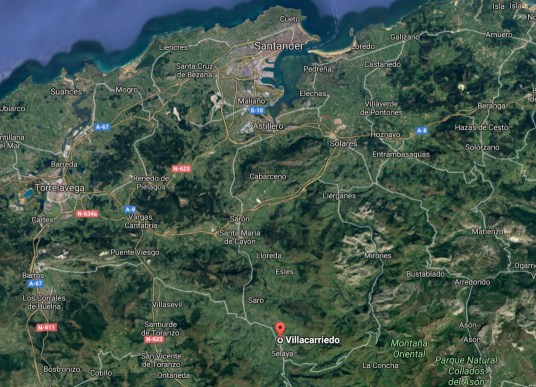
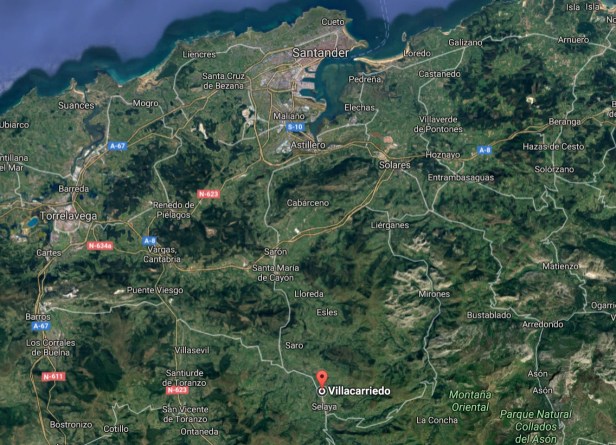
Nationalist forces take the areas of Selaya, Villacarriedo, Ontaneda and Las Fraguas in the Cantabrian region as they advance towards Santander.

August 23

Navarrese forces fighting for the Nationalists claim Mazcuerras Valley and take Mount Ibio, which all-but cuts off the main road and the rail line between Santander and Asturias. Italian forces take Puente Viesgo after facing little Republican resistance.

Fascist salutes for Nationalists in Cantabria

August 24

Republican General Gámir-Ulibarri orders the general evacuation towards Asturias. Basque fighters begin their withdrawal from the front as the Nationalists are overwhelming the Cantabrian region.

The Republicans begin a major ongoing campaign in Zaragoza, which is their main aim for recapture. Both Belchite and Quinto are heavily guarded town where fighting begins, though Belchite has around 7,000 Nationalists fortified in the the village.

Nationalists enter Santander

August 26

Santander falls to the Nationalists at last thanks to huge troops numbers and air strikes. Around 160,000 refugees are in the city, including Republican  soldiers. Many try to escape via boats, which are overcrowded and begin sinking in the Bay of Biscay. Republican General Gámir-Ulibarri flies out of the region to France, to re-enter and take up arms again. All major Republican leaders flee the area. Nationalist forces enter Santander at midday and take 17,000 prisoners, but many are executed right away.

Unknown to the Republicans, the Basque fighters have made a secret agreement with the Italian Nationalist soldiers two days earlier. They agree to surrender at Santoña near Santander (close to 30,000 troops and officials), give over their weapons and do no harm to Basque industry. The Basques head aboard two British ships waiting to take them to safety. This becomes known as the Treason of Santoña.

August 27

The Basque troops waiting to leave Santander are captured by Franco forces. They are given the choice of fighting for the Nationalists or being Italian prisoners in Santoña. 22,000 are imprisoned, with half released three months later as they start fighting for the Nationalists. Only 510 are executed. The final prisoner won’t be released until 1943.

Prisoners being held in the bull ring in Santander

August 29

The Republican Army of the East, along with the XI and XV International Brigades, a total of 80,000 men, 90 planes and 105 T26 tanks, have fighting for five days begin the offensive to capture Belchite. The centre and north units only take vacant land, though the southern units have more success and take Mediana, Quinto and Codo. The Republicans surround Belchite itself but the Nationalists are ready to hold out over the forces. The Republicans cut off the water supply to the Nationalists and the 3,800 people in Belchite. September 1

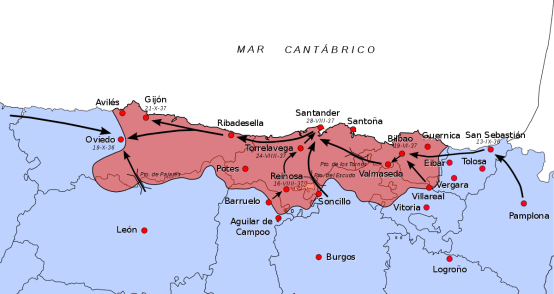
The Nationalists take Unquera in Cantabria, which borders Asturias, as the Nationalists fighting in the north begin the offensive of Asturias. They begin a slow offensive, which will see troops moving less than one kilometre per day in mountainous areas.

The Republican offensive to take the town of Belchite begins, with aerial bombing, artillery bombing and fighting on the ground. The town is surrounded but the Nationalist are desperate to keep their post.

~~

This is not a detailed analysis, just a highlight (lowlight?) of the week’s events. Things get lost in translation – Feel free to suggest an addition/clarification/correction below. The more the world remembers, the better. All photos and captions are auto-linked to source for credit, and to provide further information.

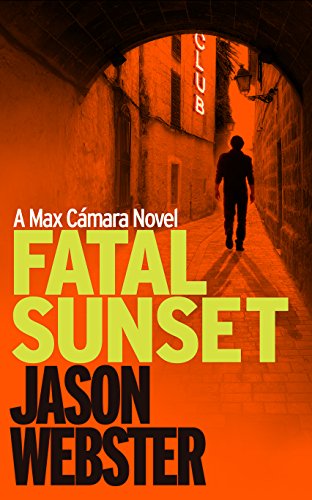
AUGUST SPAIN BOOK REVIEW: ‘Fatal Sunset’ by Jason Webster

In the hills above Valencia is a notorious nightclub called Sunset. When its larger-than-life owner, Jose Luis, dies suddenly, everyone assumes it was a heart attack. Perfectly understandable for a man of his age, size and lifestyle.

Meanwhile, all is not well for Max Cámara at HQ. His new boss, Rita Hernández, has it in for him and his idiosyncratic methods. He must abandon a complex investigation into home-grown extremism to check out what looks like a routine death at Sunset. But an anonymous phone call suggests otherwise…

Back in the city, Max’s journalist girlfriend, Alicia, is working on a lead that could turn out to be the story of her career. How her own investigation connects with Max’s at Sunset, and an unholy network of drug dealers, priests and shady officials protecting a dark government secret, will place both their lives in jeopardy and push everything to the very edge.

~~

(Before I begin – I make no apology for being MIA with Spain book reviews. I didn’t see anything I wanted to read for months. Admittedly, I didn’t look too hard. If I missed something worth reading, leave me a comment)

What can I say about Max Cámara. Fatal Sunset is the sixth book in the series (I’ve reviewed the others here) and the author has decided to really mix things up this time. Fatal Sunset is longer than the previous books, which is a nice bonus, taking in a far bigger plot than in the past. 

Cámara is a Valencian cop who was in Barcelona during the last book, another was based in Albacete. This time he is back in his home city, and out in the Sierra Calderona, the mountains outside Spain, aka my favourite place on Earth and the location of three of my own books, so I was thrilled to get into this novel.

The book starts off from the point of view of the victim, and gets weird fast. Page 2 has the guy reminiscing about his childhood, watching water run along the insides of his mother’s thighs as she washes her ‘down there’ (dude! wtf). But it’s okay, because he’s a victim and is dispatched.

Off to Max Cámara himself, back at the station in Valencia, and wow, he is a changed man. Cámara used to be a likeable, pragmatic rogue, breaking all the rules (in a city/country which was so riddled it didn’t matter). But that guy seems to have withered with age. The world is changing, and at least attempting to clean house, and the women now in charge of the station want everything done properly, not rude, not disrespectful, not wasteful or illegal. Only Cámara doesn’t agree. Cámara seems to go out of his way to be difficult right from the very beginning. He’s handled some high profiles cases in the past and now has developed one hell of an ego. Congrats to the author; it would have easy to just pump out another book with the same old character traits, but Webster hasn’t taken the easy route or written a flawless character.

Cámara likes to continuously point out that he comes from a long line of anarchists, like his wonderful grandfather, and how he likes the disorder and defiance that comes with being an anarchist. Only it doesn’t work for Cámara anymore. He is middle-aged; what he learned as a kid, and was influenced by family, isn’t so important, for now he has had plenty of time to develop his own ideals; he could be a grandfather himself. Cámara isn’t aspiring to be a good anarchist to make granddaddy proud, rather he is a breed of man, breed of cop, which is dying out, and he is rebelling against everything, like an angry kid.

Fatal Sunset bounces between characters for its point of view with every chapter, with enough characters to rival a Games of Thrones book. There is Alicia, Cámara’s girlfriend (girlfriend? She’s middle-aged too. Sidekick maybe), who is, as usual, digging up conspiracies and stories but seems to achieve little, which is a shame.  As Cámara and Alicia works to solve murders and unearth conspiracies, they never work together that well. We get to hear about how she makes breakfast half-naked, or the way her thighs wrinkle when she puts on pants, but Alicia is not a strong character anymore. She has also undergone a transformation, much like Cámara; failure to adapt has also left Alicia misplaced in the world.

However, there is Carlos, the ‘bad guy’, who is digging up stuff on Alicia, and Cámara by association. Carlos is a stiff, self-inflated guy, but the trouble is, he is better at what he does than Cámara and Alicia. The ‘bad guys’ are ruthlessly efficient, where as Cámara is an old-style detective in a new world and seems to succeed with luck as much as with experience.

But the whole theme of old v. new shines through in the short-burst chapters which flick between characters. There is no denying that policing (and the world) is changing around Cámara; the days of sitting around eating paella with his buddy Torres are done. The seedy elements of Valencia, and Spain in general, gives a feeling that the place is as stale as the endless cigarettes. Webster has done a fine job in setting the tone and the vibe of everyone and everything. It’s hard to be specific without giving away the big scandals Cámara and Alicia find (no spoilers here!) but there is a sense that if Cámara didn’t spend so much thinking about himself and how he liked to be different, he could have been more successful. Sometimes it is easier to bring something down by playing by your opponent’s rules rather than your own. Cámara never really figures that out, or at least, never gives it a try. Webster has made a character you want to see succeed, but also want to ring his sweaty neck. Kudos on that score.

There was one passage that stuck out for me, pg 193

Either side of the bag strap, her breasts hung low on her chest, nipples splayed to the sides. Below, her belly was taut and firm, yet the skin sagged in small crescents beneath the navel, where he first airs of her pubis crept up, heralds of the dark silhouetted triangle of her sex. Cámara watched in awe. But for her age, and the signs of motherhood, she appeared like an embodiment of Artemis, the Moon goddess herself out hunting during the hours of night.

And this is just a sliver of the long description of the character. Really, Cámara, really? The characters in the book are all barely described, yet here Cámara is, in the countryside perving on women who run their land nudist-colony style. She could look like a goddess if only she didn’t have qualities that make women real, like age and being a parent? Really, Cámara? The constant descriptions of women as objects makes me feel uncomfortable while I read. I used to like you, Cámara, but you are practically ageing yourself out of the system with the sexism and casual homophobia. Women’s bodies are decorative features to be described for entertainment, and there are people who use words like ‘poof’, as if they were shot out of a cannon in the 50’s and landed in the 21st century by accident. Cámara is circling around a world that needs to change, whether people like it or not. The criminals are evolving, still scum, but evolving. Cámara needs to as well. Both he and Alicia are essentially good people, but this time have not done a great job with their investigations or behaviour.

Congratulations to Jason Webster for his latest installment; six novels based on one central character is no easy feat for a writer, and Webster has successfully moved the character into a new stage in his life in Fatal Sunset, rather than just churning out a book which could have just coasted on the success of previous editions. Thank you, Jason; I have not had a book in my hands that had me turning the pages this fast in a while, or thrown it in frustration at times. This book is certainly not a boring read.

If we see Cámara and Alicia for book seven, I hope they get a holiday first! Cámara needs to chill and eat rice again, but ease up on the marijuana – really, at your age, Max? Just don’t ever leave Alicia behind; a crime character with a steady relationship is rare (no rolling through women like he’s at a drive-thru for Max), and one main reason that sets Webster’s series apart from the generic crime series that are available. I have no interest in reading any crime series other than Webster’s.

This Week in Spanish Civil War History – Week 57: 14 – 21 August 1937

August 14

The Nationalists are ready to begin their massive new siege to take the north of Spain. The Army of the North of both sides have been assembled throughout the top half of Spain. General Fidel Dávila has 90,000 troops, 25,000 of them through three Italian divisions. They also have a massive cache of weapons, plus the German Condor Legion aircraft, plus Spanish and Italian planes. Their troops are fresh and the Nationalists are ready after the end of the battle of Brunete at the end of July. The Republicans have 80,000 in the region under General Mariano Gámir Ulíbarri. However, their planes are useless, and morale is low. The Basque soldiers included in the numbers are tired and devastated from a loss of their autonomous region and their capital Bilbao, and are already considering surrendering to Italian troops in order to survive.
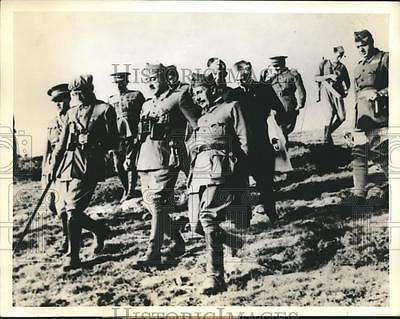
 The Nationalist 1st Navarrese Brigade attacks the frontlines between Valdecebollas in the Palencia region and Cuesta Labra in order to block Republican troops south of the Cantabrian mountains. This is in preparation to start capturing Republican territories in the mountain region over the coming week and capture the entire Cantabrian region and Santander city on the coast.

August 15

The Nationalist troops advance through Barruelo up to Peña Rubia, Salcedillo, Matalejos and Reinosilla, all mountainous villages, without resistance, with the exception of the Republicans fighting back at nearby Portillo de Suano.

also August 15

The Servicio de Inteligencia Militar (SIM) is created. Having SIM means that secret police activities are now in the control of the government again, rather than Communist and Soviet hands. Political meetings have now been banned in Barcelona, and the constant fighting is undermining the left-wing groups. Barcelona is the central hub for Republicans mixing, with anarchism, socialism, regionalism, and communism coming together to produce infighting. The Republican war effort is hindered by these internal arguments. Peace has not truly been restored in Barcelona since the outbreak of fighting in May.

August 16

The Nationalists take Portillo de Suano and the industrial factory area outside the town of Reinosa during the day, and take central Reinosa at dusk. Meanwhile, the Navarrese Brigade are advancing, furthering the Nationalists’ control of the region. Italian troops sent from Burgos are heading to Lanchares, 17 kilometres from Reinosa, and also San Miguel de Aguayo, a mountainous 14 kilometres trek north from Lanchares. The Cantabrian area is quickly being swallowed by Nationalist troops with little to no resistance in the sparsely populated regions.

August 17

The Republicans still hold Campoo, just 4 kilometres east of Reinosa, with 22 battalions camped there. However the Nationalists have now encircled them completely.

In Barcelona, the Socialist Party and the Communist Party sign a pact to ally as one group, to bring stability to the Republicans’ effort. The Communist party expected a merger, in line with international Communist groups. The Spanish Republican government does not like the idea of the Communists controlling the Socialist party, but the unity pact agreement leaves the groups independent but formally allied, meaning the Communists do not gain any extra control over the government.

Nationalists outside Reinosa

August 18

Nationalist forces take the town of Santirude as they surge further north through Cantabria, while the Italians claim San Pedro del Romeral and San Miguel de Luena, only 45 kilometres south of Santander itself.

August 19

Cabuérniga, Bárcena de Pie de Concha and Entrambasmestas all fall to the Nationalists.

August 20

Italian troops claim Villacarriedo and Navarrese forces advance towards Torrelavega and Cabezón de la Sal. Santander is now in sight, just 30 kilometres from Torrelavega. The Nationalists are destroying the northern part of Spain and the Republicans cannot do anything to stop them. The Nationalists have overwhelming support, troops and artillery. The Basque, Cantabrian and Asturian units cannot work together against the speed and power of the Nationalist army. The Basques, having already lost their capital Bilbao, are at the morale limits and begin to mutiny as the Nationalists sweep through Cantabria.

Franco at the Santander front

~~

This is not a detailed analysis, just a highlight (lowlight?) of the week’s events. Things get lost in translation – Feel free to suggest an addition/clarification/correction below. The more the world remembers, the better. All photos and captions are auto-linked to source for credit, and to provide further information.