This fascinating book explores the status of women in medieval England, both before and after the Norman Conquest.
The author starts by contrasting the differences in status between Anglo/Danish or Saxon women with those who fell under the burden of the feudal system imposed by the Normans. She covers such subjects as marriage and childbirth, the rights and responsibilities of wives, separation and divorce, safety and security and the challenges of widowhood. She also examines such issues as virginity and chastity and the pressures placed on women by religious groups.
At a time when women’s rights were minimal, the author charts their struggles against the sexual politics of the era, its inequalities and its hypocrisies. She also examines the problems of the woman alone, from forced marriage to prostitution. The lives of ordinary women are the centre of attention, painting a fascinating picture of their courage and resilience against the background of their times.
Resting on the theme of women in history is Women in Medieval England. My initial interest in this book was the pre-conquest women included. England and its rulers is so often detailed as post-1066, so someone like myself with limited knowledge of the Anglo-Saxon era found the overview and laws of the time useful. New leaders made for new husbands for noble women, who may not even be able to understand them, given language barriers. A nightmare of any woman, and to cap it off, not speaking your new husband/owner’s language is a scary thought.
What classified as marriage was quite different (as I’m sure everyone knows) which made for a messy history and difficult lives for the women traded to their husbands. The book even delves into what was birth control in the pots-1066 era, and lol-worthy concepts for cures for impotence. Life for women was exceptionally difficult, mostly due to the largely uncontrollable act of pregnancy, and the book shows just how damned awful it was for our predecessors to battle on creating a new generation.
Married life was all kinds of awful – as everyone knows the ‘rule of thumb,’ in that a man cannot beat his wife with anything thicker than his thumb. Though, in some ways, you read this and wonder how much life has altered for many women. This book digs through a realities of being a woman in the medieval period, where men are cast as sword-wielding heroes, women have been left standing in mud-floor huts. This shines a light on those women, who had the temperament of saints, strength tougher than any soldier, and bravery beyond that of a king. The world was a strange place for women; you could die of the plague, or you could survive an outbreak and clean up in the vacant jobs market.
This is no heavy book you will be reaching for when researching, it is a read on the lives of women in a world none of us would want to return to. There is plenty of information to be had in here, without feeling like you’re in a history lesson, a book for those who would like to read for pleasure, not study.
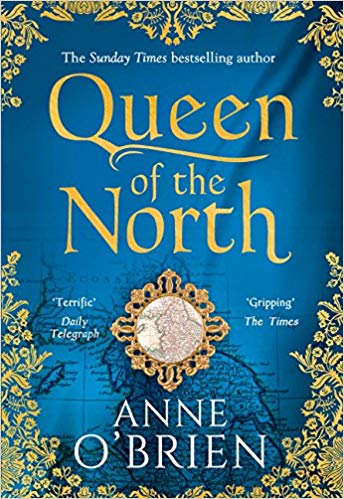
1399: England’s crown is under threat. King Richard II holds onto his power by an ever-weakening thread, with exiled Henry of Lancaster back to reclaim his place on the throne.
For Elizabeth Mortimer, there is only one rightful King – her eight-year-old nephew, Edmund. Only he can guarantee her fortunes, and protect her family’s rule over the precious Northern lands bordering Scotland.
But many, including Elizabeth’s husband, do not want another child-King. Elizabeth must hide her true ambitions in Court, and go against her husband’s wishes to help build a rebel army.
To question her loyalty to the King places Elizabeth in the shadow of the axe.
To concede would curdle her Plantagenet blood.
This is one woman’s quest to turn history on its head.
It’s 1399 and King Edward III’s descendant Elizabeth Mortimer is married to Henry Hotspur Percy, heir of the Earl of Northumberland. Richard II is king, and deposed by Henry Bolingbroke under dubious circumstances. Richard II had no heirs, but he did have someone ready to replace him until Henry IV takes his crown. That is where Elizabeth comes in.
Elizabeth expected her nephew Edmund Mortimer to take the throne, also a descendant of Edward III, a boy born of royal Plantagenet blood. Elizabeth’s family has just as good a claim to the throne as the new Lancaster king. Whenever there are multiple claims to a throne, blood is certain to follow.
Elizabeth is not a man who can go into battle for the Mortimer claimant. She is not a beautiful young princess to be traded by families and launched into power. Elizabeth is a smart noble woman, who knows her family has a valid claim, who has given her husband the children he needs, and, to history, should be left on the sidelines. But Elizabeth is not a woman who should be cast aside in the battles of men and the throne, for she has the knowledge, skill and education to make a difference in the Mortimer claim to the crown.
All sides the early battles had legitimate claims to the throne, and we have a viewpoint in Elizabeth which is valid yet undemanding, unlike the men who surround her. Real life Elizabeth is not a well-known figure of history, so the author has had to use historical detail of others, and weave Elizabeth into the story, which gives new life to an old tale. Percy takes the Lancaster’s side of the war and Elizabeth is rich in the blood of the Mortimers, and nobler than her husband. But what can a wife do in such challenges? Elizabeth is the wife of Percy, who holds the north. Whether it is from London or the Scots, the Percys have plenty of battles to face and Elizabeth is the northerners queen.
No sooner than choices are made, Elizabeth and Percy find they should be on the side of the Mortimer. Politics, treason and ambition are going to explode, and I am desperately trying not to write spoilers, but all I can say is you really need to read this book! Everyone knows what happened to Hotspur Percy at the Battle of Shrewsbury, part of a plot to overthrow Henry IV, but Elizabeth and her family’s claim carries on. The Bolingbrokes and the Mortimers are going to need to be friends if civil wars for the throne are to end, and greed is as powerful as blood. This book has historical accuracy combined with beautiful storytelling. I adored this novel.
As she helps to nurse the dying Queen Elizabeth, Frances Gorges longs for the fields and ancient woods of her parents’ Hampshire estate, where she has learned to use the flowers and herbs to become a much-loved healer.
Frances is happy to stay in her beloved countryside when the new King arrives from Scotland, bringing change, fear and suspicion. His court may be shockingly decadent, but James’s religion is Puritan, intolerant of all the old ways; he has already put to death many men for treason and women for witchcraft.
So when her ambitious uncle forcibly brings Frances to court, she is trapped in a claustrophobic world of intrigue and betrayal – and a ready target for the twisted scheming of Lord Cecil, the King’s first minister. Surrounded by mortal dangers, Frances finds happiness only with the precocious young Princess Elizabeth, and Tom Wintour, the one courtier she can trust.
I am a very big Tracy Borman fan. I did not angle for a review copy, instead I went to a store and purchased her first novel myself. The new release stand was full on release day, here on the other side of the world, a rare occasion for the books I tend to review.
The King’s Witch opens with poor old Elizabeth I, in her dying moments. The book follows Frances Gorges, an expert in healing and herbs. King James is now on the throne, a dramatic change for England. Women healing and using herbs and their developed skills, rather than that of a male doctor, are seen as evil, as devil’s work. King James is terrified of witches and witchcraft, so to be a woman with knowledge makes young Frances right in the firing line against puritanical opinions and fears. Frances does have allies, Tom, a courtier, and the Princess Elizabeth. Whether she can trust her own friends is never truly clear to Frances.
This novel starts slowly, showing Frances’ life, indeed lives for ‘normal’ people in this awkward time period in England. What I did see early on was that there would be a twist coming, which keeps you turning the page. Frances grows as their reader gets to know her, from a scared girl into a woman who gets to see behind the lavish exteriors of a royal court for what really lies in individuals.
When reading Borman, you know you are getting historical accuracy with your fiction (I swear some people only read to point out inaccuracies in fiction; you lot will be disappointed with this). It is nice to hear from a new voice, rather than through the eyes of characters done so often before. Being cast as a witch was simple in the 17th century, all a woman had to do was piss off the closest man and she would be accused. So being a woman with knowledge naturally scares the pants off men. While the king is determined to cast out all remaining Catholics in England, religion remains ingrained in all decisions made.
Frances’ biggest issue is that her friend Tom is Tom Wintour, one of the men in the gunpowder plot with Guy Fawkes (shout-out to all of us born on November 5!). Tom is ready to blow up parliament and the attention to the how’s and why’s rather than simply the actions taken in 1603 is beautifully told. The gunpowder plot men are generally thought of as crazies, when they actually had quite an elaborate plan and motive. While we all know what happened to the gunpowder plot, seeing it through the eyes of someone close to these men makes it painful to read through, knowing the conclusion.
I really enjoyed reading this book; I went in with high expectations and was not disappointed. Love, torture, witchcraft, what a combination to write about and get to muse over, knowing that the early 1600’s really was one hell of a cauldron of superstition. Frances’ uncle, the Earl of Northampton, makes an appearance as a sometimes friend, sometimes overly creepy uncle everyone doesn’t want visiting, and don’t forget Lord Cecil, a grump at the best of times, aiding the king’s paranoia for gain but harming Frances’ safety even more.
Some are witches being killed, others are being tortured and executed for trying to change the monarchy. You know it’s all going to end in tears but you can’t stop reading anyway. Thank you to Tracy Borman for humanising those in an often misunderstood piece of history.
These are the stories of women, famous, infamous and unknown, who shaped the course of medieval history. The lives and actions of medieval women were restricted by the men who ruled the homes, countries and world they lived in. It was men who fought wars, made laws and dictated religious doctrine. It was men who were taught to read, trained to rule and expected to fight. Today, it is easy to think that all women from this era were downtrodden, retiring and obedient housewives, whose sole purpose was to give birth to children (preferably boys) and serve their husbands. Heroines of the Medieval World looks at the lives of the women who broke the mould: those who defied social norms and made their own future, consequently changing lives, society and even the course of history.
Some of the women are famous, such as Eleanor of Aquitaine, who was not only a duchess in her own right but also Queen Consort of France through her first marriage and Queen Consort of England through her second, in addition to being a crusader and a rebel. Then there are the more obscure but no less remarkable figures such as Nicholaa de la Haye, who defended Lincoln Castle in the name of King John, and Maud de Braose, who spoke out against the same king’s excesses and whose death (or murder) was the inspiration for a clause in Magna Carta.
Women had to walk a fine line in the Middle Ages, but many learned to survive – even flourish – in this male-dominated world. Some led armies, while others made their influence felt in more subtle ways, but all made a contribution to their era and should be remembered for daring to defy and lead in a world that demanded they obey and follow.
I have spent a long time with my head in academic history books, so to read something that reads more like a story was a welcome relief. Heroines of the Medieval World is a book hard to get here in NZ, so when a copy generously floated my way, I grabbed it with both hands. The first thing I thought was – do we still use the word ‘heroine?’ Should it not just be ‘heroes?’ But then people may purchase and then get their egos crushed by finding out all the heroes are women. That only made me like this book more.
The book is great, separated into chapters about women from all over Europe. The book writes about the women of England and France, but also from Spain (yay!) and even as far east as Kiev. There are Warrior Heroines, Literary Heroines, Religious Heroines and Scandalous Heroines. You can read them in order, or however you like depending on your mood. I enjoyed how The Pawns weren’t simply bartering gifts, but smart women in their own right, and the Medieval Mistresses were more fleshed out (excuse the pun) than the simply fallen women ideal.
You won’t be confused between your Eleanors, your Matildas or your Isabels, and while you will read about well-known heroines, they are also great forgotten women given fresh air. The women are not viewed as heroines through 21st century eyes, rather they are simply celebrated for their strength in the time period while on their own crusades. They are heroines for all centuries. Putting together such a thorough assembly of women must have taken considerable time and energy, so treat yourself to the author’s hard work and gain further insight to the women that came before us. Heroines have far more skills and techniques than any hero.
July 1938 has all eyes on Valencia, Catalonia and Aragon, and yet in the south-west, the Mérida pocket is also suffering new battles. Extremadura, the most western area of Spain, was quickly taken by the Nationalists when the war broke out, but the Mérida pocket is the sole area held by Republicans, an area west of Mérida in the La Serena region in Badajoz province. Franco wants the Mérida pocket in his control to settle the entire region. If Republicans could take Mérida, then they could cut the Nationalist zone in Extremadura in half. While the Nationalists had quietly secured the frontline along the Zújar River in June, Franco implements a plan to circle all remaining Republican men and execute the whole lot, whose numbers could be as high as 10,000.
The Battle of the Ebro preparation is well underway. The Republican Ebro Army was formed on May 15 by the Republicans, in response to massive gains made by the Nationalists as they murder their way through the Valencia region. Lieutenant Colonel Juan Modesto took control of both the 5th and 15th Army Corps, which combined the 35th International Division (made of the XI, XIII and XV International Brigades), the 3rd Division (made of the 31st, 33rd and 60th mixed brigades) the 42nd Division (made of the 226th, 227th and 59th brigades), the 15th Army Corps (with the 16th Popular Republican Army Division of the 12th Army Corps) and the 3rd Cavalry Regiment. By mid-July many anti-aircraft weapons arrive along with 11th Division (made of the 1st, 9th and 100th mixed brigades), the 46th Division (made of the 10th, 60th and 101st mixed brigades) and the 45th Division International Division (made with the 12th”Garibaldi”, 14th “Marsellesa” and 139th mixed brigades).
July 13
The Republicans add more to their numbers with the 12th Army Corps, now led by Lieutenant Colonel Etelvino Vega. The 12th Army Corps was then made up of the 16th Division (including the 23rd and 24th mixed brigades) and the 44th Division (including the 140th, 144th and 145th mixed brigades). The 18th Army Corps bring Lieutenant Colonel José del Barrio to lead the 27th Division (including the 122nd “la Bruixa”, the 123rd and 124th mixed brigades), the 60th Division (with the 95th, 84th and 224th mixed brigades) and 43th Division (with the 72nd, 102nd and 130th mixed brigades). At its height, the Republican troops will number 80,000 men.
Republican soldiers at the Ebro, July 1938
July 15
The Nationalist army has been storming regions around the Ebro for months and have many huge battalions in the area. The Army of the North, controlled by General Fidel Davila, a powerful and successful group, are flanked by the 40th, 50th and 105th Divisions of the Moroccan Army Corps under vicious General Yague. Included in the Moroccan Corps are the Legionarios, Regulares, the Carlists and Falaganists and African mercenaries, all groups well-known over the past two years for wild slaughter, torture and rape of troops and civilians. General Rafael García Valiño’s Maestrazgo Army Corps, made of the 1st Navarra Division and the 74th, 84th and 13th Divisions are also very close by, having controlled the northwest Valencia region. The numbers the Nationalists have/can access is 90,000 experienced men.
Legionnaires on the Ebro, July, 1938
July 18
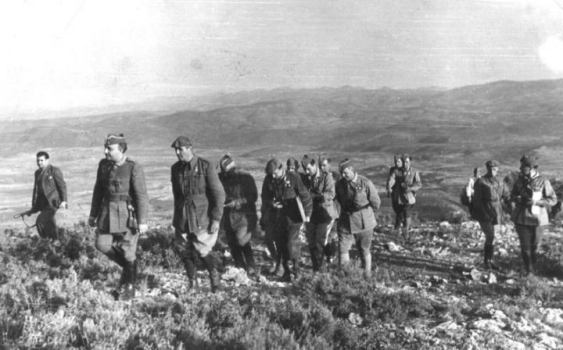
Today marks two years of civil war in Spain. The death tolls is already into the hundreds of thousands, with no spot in the country unaffected. Madrid continues to be held by the Republicans while surrounded by Nationalists, who still cannot get through the front-lines. Catalonia’s uprising with the rights of workers has long dimmed as the war nears their own streets, and the Aragonese anarchist lifestyle has been destroyed. Concentration camps have been set up to take Republicans, if they are not first executed. All major cities, except for capital Valencia, Madrid and Barcelona, rest in Nationalist hands. Europe is looking nervously at Hitler, yet not helping the people of Spain, already suffering Hitler’s power as Franco looks to join Hitler and Mussolini as Europe’s great fascist leaders. Precious few believe in the Republican cause now, which is the one card they have to play in the Battle of the Ebro, as they have the element of surprise on the Nationalist troops.
July 20
South in Extremadura, the Mérida Pocket is going to be closed by the Nationalists. General Saliquet, based in the northern area of the Badajoz region, marches his men south into La Serena, where the Republican front-line is strong. At the same time, General Queipo de Llano has been marching his men northwest towards La Serena. This makes the Republicans embattled at both their major front-lines, and are routinely pounded by gunfire for four days.
La Serena
24 July
The Republican divisions, the VII Army Corps with the 36th and 36th Divisions from Algodar to Zújar, and the VIII Army Corps with the 38th, 63rd and 51st divisions from Zújar to Guadalmellato, are completely overtaken by Nationalist troops. The battle ends with the massive slaughter of troops throughout the Don Benito and Villanueva de la Serena areas, murdering the whole Extramaduran Republican Army. This short battle is the largest slaughter of troops in the region (as civilian slaughter and imprisonment has been wholesale here since the outbreak of war). Nationalist men continue their march through the Mérida pocket of La Serena, eastwards into Toledo province, where the Republican 91st and 109th mixed brigades are trapped on every side. These remaining men are rounded up to be placed in the Castuera concentration camp 45 kilometres south, though most will be executed in the camp. Colonel Ricardo Burillo, leader of the Extremadura Army Corps, survives, and is dismissed after the bloody defeat of around 10,000, while the Nationalists have lost almost no one.
Republicans cross the Ebro
July 25
After a week of planning, the commanders of the 14th Republican Army Corps cross the Ebro river, to watch the Nationalists, taking their positions while other troops prepare river crossings. The Nationalists soon see what is happening, reporting to Franco that the Republicans and their International Brigades are on the bank of the river with rafts and pontoons. Franco is not concerned, aware of how weakened the Republicans have been in the area.
The early hours of July 25 are completely dark with no moon. Between Fayon and Benifallet, a 45 kilometre bend in the river, the commanders again cross the river and kill 50th Division Nationalist guards posted in the area. After fastening assault boats, the first of 90 boats cross, ten men in each boat, under darkness. All following troops then cross on pontoon bridges at daybreak. The Nationalists are totally unprepared for this wide attack, overcome in surprise. The International Brigade attack 40 kilometres south of Benifallet at Amposta, but are overpowered within the first 18 hours of combat, with the few survivors retreating back over the Ebro.
Around 4,000 Nationalist men of the 50th division are imprisoned, while some manage to desert. The Republican 15th Army Corps carry on, and advance three miles north, while the 5th Army Corps manage a huge 21 kilometres east.
July 26
The Republicans have marched 30 kilometres south to Gandesa, and now occupy 800 square kilometres, but cannot hold Gandesa, as the Nationalists’ 13th division have the town fortified. Franco frantically deploys more troops to counter the attacks, with an extra eight divisions, 140 bombers and 100 fighters sent to the Ebro. The Nationalists hold the dams at Tremp and Camarasa, which are opened, flooding the Republican pontoons, which take two days to repair. At the same time the German Condor Legion and Italian Aviazione Legionaria bomb the pontoon bridges, which can only be repaired at night. Due to the planes and the flooding, the Republicans have only got 22 tanks and minimal artillery over the bridges, leaving men exposed and without water and food.
International Brigades cross at Minveret
July 27
The town of Gandesa is a key target for the Republicans, which is 25 kilometres west of their first river crossing point. Gandesa is surrounded by hilly limestone terrain in the Caballs, Pandols and Fatarella ranges. The limestone hills have little shelter, leaving the men at the mercy of overhead bombers. But they push on, spread out over a 35 kilometre line, eager to take Gandesa, a pivotal town into Catalonia, so men and tanks are forced over the limestone hillsides.
Republicans in the hard terrrain
July 31
The leading Nationalist commanders want to hold their ground at Grandesa, keeping the town in their hands and stopping the Republicans, while also planning to attack them from the north. But Franco is unwilling to listen to this, as he is pleased to have the strength of the Republican army trapped within a 35 kilometre stretch. Regardless of the loss of life, Franco wants the Nationalists to regain all the ground they have lost, rather than holding Republicans in place. Franco wants them back over the Ebro and killed.
The International Brigades, who have been mixed with 15th Army Corps, have regrouped after their failed crossing at Amposta, and plan an attempt to take Hill 481, right outside the town of Gandesa. It will be a risky attack, with no cover from the air bombers. The battle still has four months to run.
British troops at Hill 481
~~
This is not a detailed analysis, just a highlight (lowlight?) of the month’s events. Things get lost in translation – Feel free to suggest an addition/clarification/correction below. The more the world remembers, the better. All photos and captions are auto-linked to source for credit, and to provide further information.