MY HEARTY COMMENDATIONS: THE TRANSCRIBED LETTERS AND REMEMBRANCES OF THOMAS CROMWELL NEW EDITION 2025

Wolf Hall 2: The Mirror and the Light – The Real Execution of Thomas Cromwell


Photo: BBC/Playground Entertainment

By now, you will have seen the final episode of The Mirror and the Light, when Thomas Cromwell was beheaded at Tower Hill, though if you haven’t seen it yet, and feel a bit squeamish, don’t fear. Cromwell’s execution has long been written about and portrayed (including by myself in fiction) as a bloody and botched execution. Fortunately, for those of us who love Cromwell, reality isn’t so awful. Here is a passage from my book on Cromwell’s letters, explaining the real execution –

While primary sources writing about 28 July 1540 offer sketchy detail, the works of Foxe, Hume, Cox, Galter, Herbert, and Hall all offer insights to the execution of a man completely dominate only two months prior. Cromwell may have only learned of his style of execution on the morning of 28 July from William Laxton and Martin Bowes, two sheriffs at the Tower, who came to him after breakfast, which he had just after dawn on a sunny summer’s day.  Hume wrote that one thousand halberdiers were there to flank Cromwell’s short walk from the Tower to the scaffold on the hill, because of an unfounded fear that Cromwellians would mount an escape bid among the immense crowd.

At Tower Hill, Cromwell met Walter Lord Hungerford, also destined to die, but for crimes of incest, buggery, and wife-beating, and had possibly lost his mind by the time of his death. A theory suggests that someone scheduled Hungerford’s death on the same day to bring shame to Cromwell, by dying beside such a horrid man, though Hungerford is a footnote in the tale. The men knew one another through their work for the king, and Foxe wrote that Cromwell tried to comfort the distraught Hungerford, saying, ‘there is no cause for you to fear. If you repent and be heartily sorry for what you have done, there is, for you, mercy enough from the Lord, who for Christ’s sake, will forgive you. Therefore, be not dismayed and though the breakfast which we are going to be sharp, trusting in the mercy of the Lord, we shall have a joyful dinner.’

Cromwell had to deliver a speech to cement his legacy and save his son Gregory, daughter-in-law Elizabeth and their three sons, Henry, Edward, and infant Thomas. Also foremost on his mind would be his nephew Richard, now in King Henry’s privy chamber, and Richard’s wife Frances, and their sons Henry and Francis. Also, Sir Ralph and Lady Ellen Sadler and their children Thomas, Edward, Henry, Anne, and Mary. On top of them were also Cromwell’s wide extended family, the Williams’, the Wellyfeds, and the Williamsons, Cromwell’s mother-in-law, Mercy Prior, and young Jane Cromwell.

Despite appearances, King Henry had granted the mercy Cromwell begged for; while a pardon could set a precedent and undermining the law of attainder, but rather than being burned as a heretic, or hanged, drawn, and quartered as a traitor, they would behead Cromwell at Tower Hill. The King would not afford a commoner such a death; Henry saw Cromwell as the earl he was, not the man he was born. In another act of mercy, Cromwell did not have to die alone; Henry allowed Sir Thomas Wyatt to walk up onto the scaffold behind Cromwell, Wyatt devastated to lose his friend. John Foxe chronicled Cromwell’s last words, in a similar vein to Edward Hall:

I am come hither to die, and not to purge myself, as some think peradventure that I will. For if I should so do, I were a very wretch and a Miser. I am by the Law condemned to die, and thank my Lord God, that hath appointed me this death for mine Offence. For since the time that I have had years of discretion, I have lived a sinner, and offended my Lord God, for the which I ask him heartily forgiveness. And it is not unknown to many of you, that I have been a great Traveller in this World, and being but of a base degree, was called to high estate, and since the time I came thereunto I have offended my Prince, for the which I ask him heartily forgiveness, and beseech you all to pray to God with me, that he will forgive me. And now I pray you that be here, to bear me record, I die in the Catholic Faith, not doubting in any Article of my Faith, no nor doubting in any Sacrament of the Church. Many have slandered me and reported that I have been a bearer of such as have maintained evil Opinions, which is untrue. But I confess, that like as God by his holy Spirit doth instruct us in the Truth, so the Devil is ready to seduce us, and I have been seduced; but bear me witness that I die in the Catholic Faith of the holy Church; and I heartily desire you to pray for the King’s Grace, that he may long live with you in health and prosperity; and that after him his Son Prince Edward that goodly Imp may long Reign over you. And once again I desire you to pray for me, that so long as life remains in this flesh, I waver nothing in my Faith.

Cromwell then went on to pray:

‘O Lord Jesus, which are the only health of all men living, and the everlasting life of them which die in thee; I wretched sinner do submit myself wholly unto thy most blessed will, and being sure that the thing cannot Perish which is committed unto thy mercy, willingly now I leave this frail and wicked flesh, in sure hope that thou wilt in better wise restore it to me again at the last day in the resurrection of the just. I beseech thee most merciful Lord Jesus Christ, that thou wilt by thy grace make strong my Soul against all temptations and defend me with the Buckler of thy mercy against all the assaults of the Devil. I see and knowledge that there is in myself no hope of Salvation, but all my confidence, hope and trust is in thy most merciful goodness. I have no merits nor good works which I may allege before thee. Of sins and evil works, alas, I see a great heap; but yet through thy mercy I trust to be in the number of them to whom thou wilt not impute their sins; but wilt take and accept me for righteous and just, and to be the inheritor of everlasting life. Thou merciful Lord wert born for my sake, thou didst suffer both hunger and thirst for my sake; thou didst teach, pray, and fast for my sake; all thy holy Actions and Works thou wrought for my sake; thou suffered most grievous Pains and Torments for my sake; finally, thou gavest thy most precious Body and thy Blood to be shed on the Cross for my sake. Now, most merciful Saviour, let all these things profit me, which hast given thy self also for me. Let thy Blood cleanse and wash away the spots and fulness of my sins. Let thy righteousness hide and cover my unrighteousness. Let the merit of thy Passion and blood shedding be satisfaction for my sins. Give me, Lord, thy grace, that the Faith of my salvation in thy Blood waver not in me but may ever be firm and constant. That the hope of thy mercy and life everlasting never decay in me, that love wax not cold in me. Finally, that the weakness of my flesh be not overcome with the fear of death. Grant me, merciful Saviour, that when death hath shut up the eyes of my Body, yet the eyes of my Soul may still behold and look upon thee, and when death hath taken away the use of my Tongue, yet my heart may cry and say unto thee, Lord into thy hands I commend my Soul, Lord Jesus receive my spirit, Amen.’

Cox wrote that Cromwell then turned to Wyatt and said, ‘fare you well, Wyatt,’ his friend deeply upset at this stage, and Cromwell added, ‘gentle Wyatt, pray for me.’ Cromwell removed his gown, gave forgiveness to his executioner, and prayed him to take his head with a single blow. Conflicting reports exist of what came next.

Thomas Cromwell on the chopping block in The Mirror and the Light

The news of the execution travelled Europe, changing with every letter. Hume wrote Cromwell’s head came off with a single blow. But Galton wrote that the axeman was a ‘ragged and butcherly wretch’ and that the first blow instead hit Cromwell’s skull, and that it took half an hour to cut through Cromwell’s neck, an impossible reality. But that story was what Cromwell’s enemies wanted to hear, of a horrid death, and the story has stuck, despite no eyewitness accounts stating there was anything except a straightforward beheading.

French Ambassador Marillac wrote at once after Cromwell’s death, telling Constable Montmorency, ‘Mr. Thomas Cromwell, heretofore condemned by Parliament, this morning was executed in the usual place for such executions,’ without any mention of a horrid execution.

From Madrid, Francisco de los Cobos, High Commander of Leon, wrote to Pedro Fernández Manrique, Marquess de Aguilar in Rome, that ‘the king of England beheaded Cromwell, who was his favourite. The cause was, they say, because he urged him to be a Lutheran. Please God, it may be a beginning of the King’s coming to a knowledge of his duty.’

On 16 August, Philip Melanchthon was woefully ill-informed in Germany, writing to two separate people that Cromwell had been hanged, quartered and burned by ‘the English tyrant, the English Nero.’

On 11 September, Cromwell’s long-time enemy Reginald Pole wrote to his secretary Ludovico Beccadelli, claiming, ‘I fear I was wrong in writing of Cromwell coming to his senses, for his last words as printed do not give the same impression as the narrative of those who told of his end and last words. The judgement of men belongs to Christ, who knows the hidden things of the heart.’

On 3 March 1541, Ambassador Marillac wrote to Paris, saying he and Ambassador Chapuys worried for King Henry, whose leg caused him anguish, that he ate and drank continually, leading to immense weight gain, and his mood had become ‘contrary even to itself’. Men fell foul for seeing through the king’s instructions, as instructions could change within the same day. The king blamed his ministers for all his troubles, and on occasions even, ‘reproaches with Crumwell’s death, saying that, upon light pretexts, by false accusations, they made him put to death the most faithful servant he ever had’.

All texts and sources come from The Letters and Remembrances of Thomas Cromwell. My publisher might come for you if you plagiarise.

Wolf Hall 2: The Mirror and the Light – Thomas ‘Call-me Risley’ Wriothesley, the True Traitor of Thomas Cromwell


Playground Entertainment/Nick Briggs

Welcome back to Wolf Hall 2: The Mirror and the Light true details about scenes in the latest episode, where Cromwell is arrested as a traitor to England.

In reality, in May 1540, King Henry was up to his usual tricks; hating on his own wife, romancing another lady (well, child) at court, and messing with religion just enough to upset literally everyone at home and abroad. In an inopportune turn of events, just as Cromwell’s chance to turn on the Catholic bishops had arrived, the king called Cromwell to court on 6 June, where Henry confessed his impotency with Queen Anna. Henry confessed this only to Cromwell and friend-turned-foe William Fitzwilliam. Cromwell had listened to Henry complain of his marriage to Anna multiple times over Easter, and again through Whitsun week in mid-May, but confirmation of the lack of consummation and Henry’s suggestion of annulment could not wait any longer, no matter Cromwell’s opinion. The alliance between England and Germany was non-existent, and the Emperor and France were not looking to go against England. Henry had no reason to hold on to a woman he did not like, no matter how much Anna was liked by others, or how suitable and well-chosen she was for England. King Henry had also been sneaking out of court to spend time with Lady Kathryn Howard at Stephen Gardiner’s Winchester Palace.

Cromwell travelled home to Austin Friars, where Thomas Wriothesley met him; Cromwell appeared exhausted and worn out by events. In Wriothesley’s own words, he asked Cromwell, ‘what one thing rested in his head which troubled him’. Cromwell, believing his home would afford him privacy, told Wriothesley the king’s marriage remained unconsummated. Wriothesley pushed the belief they could solve Henry’s issue, or ‘they should all smart for it’, but Cromwell replied it was a ‘great matter’. Wriothesley kept pushing his master, and Cromwell replied again it was a great matter, but stopped himself from revealing impotence. Still, the damage was done.

While Cromwell was at home feeling despondent and disillusioned, Stephen Gardiner prepared his attack. Since returning to England, he had reconnected with Thomas Wriothesley. Wriothesley claimed to be utterly loyal to Cromwell since late 1535 but was no such thing. Given how many people openly detested Wriothesley, it came as no surprise he would easily swap to old allegiances. Another Cromwell man, Edmund Bonner, who had bonded with Gardiner over their shared disastrous times as French ambassadors, turned against Cromwell, though, like Wriothesley, there appears to be no incident which caused a shift. Bonner’s position was likely his religious beliefs; Wriothesley was likely greedy. Wriothesley knew who else was close to the king and was happy to turn against Cromwell; William Fitzwilliam and his brother Anthony Browne, Master of the Horse. Both men were on the Privy Council and the king would readily listen to their opinions. With Wriothesley fresh appointed co-secretary to the king, and Fitzwilliam the only other person aware of the impotence besides Cromwell, Gardiner could easily collude with these men to destroy the new Earl of Essex.

Thomas Wriothesley, who had been just another man in Wolsey’s household, plucked to work alongside Stephen Gardiner, and then taken into the Cromwell household as one of his own, was only too eager to betray his noble master. Thomas Cromwell had overseen the grandest changes of Henry VIII’s reign. He destroyed the Catholic hold over England and ended the monasteries in favour of reformist colleges. He found the way to bring down Queen Katherine of Aragon. He beheaded Anne Boleyn so Henry could bat his eyelashes at Jane Seymour. Cromwell created the Church of England and made King Henry the supreme leader, ended paying taxes to Rome, and saw off threats from the Pope and Emperor Charles. Cromwell had engineered the execution of countless men, clergy and laity, when they did not agree with the king’s current mood, regardless of their innocence or guilt. He ensured the beheadings of noblemen who died for the king’s ever-grasping power and enriched Henry in a way not thought possible. Cromwell spent years in the background, learning, studying, and working with his legal skills while other courtiers fluttered around the king and whatever woman had Henry’s fancy. The English Bible was a reality because of all the endless work by Cromwell and Cranmer, two great men of learning trying to help the people of England, Wales, and Ireland. Cromwell endured years of taunts as a man walking around like Wolsey’s ghost behind the king, suspected of being a heretic for his learning, and was openly called a traitor for trying to advance the king’s desires. King Henry heard all these taunts, and defended Cromwell, even when 40,000 rebels called for Cromwell’s head. For over half of Cromwell’s time at court, he gained almost no personal advantage to himself, despite the enormous upheavals he created.

Yet one whisper of almost-impotence to Wriothesley at Austin Friars was enough for King Henry to forget every single one of Cromwell’s good deeds in His Highness’ name and sign an arrest warrant. Only Ambassador Marillac’s letters remain on the detail of the arrest of Thomas Lord Crumwell. On 10 June, it was recorded Cromwell arrived late to a Privy Council meeting after a morning in parliament. There was no reason for Cromwell to be late, it is more likely the Council was summoned slightly early without his knowledge. Among those in the Council were those close to Cromwell’s heart; Ralph Sadler, Thomas Cranmer, Thomas Audley, John Gage and John Russell. There were men there who had made Cromwell godfather to their children, the Duke of Suffolk, Edward Seymour, and Robert Radcliffe. Many enemies were present; Stephen Gardiner, the Duke of Norfolk, William Fitzwilliam, and traitor Wriothesley. Men who were like brothers or sons to Cromwell could only sit and watch as the nightmare unfolded. Sir William Kingston from the Tower was there with four guards to arrest Cromwell on arrival. Still dressed formally for parliament, wearing his Garter ribbons, collar of St George and his sable fur robes, Cromwell never got to say a word, nor realised anything was untoward before Kingston announced the arrest.

Shocked, Cromwell ripped his black cap from his head and threw it on the table and cried, ‘I am no traitor! Is this the reward for good service done unto His Majesty the King? I put it to your consciences; am I a traitor as your accusations imply? Well, no matter, for I renounce all pardons or grace needed, for I never offended the King, and it matters only if   the King himself thinks me a traitor, and he would never have me linger long!’ The words were not dissimilar to Wolsey’s eleven years earlier.

Fitzwilliam untied Cromwell’s garter from his leg while Norfolk took Cromwell’s golden collar. The intention was clear; an attainted man could not be a member of the Garter. This was not a spur-of-the-moment plan; Norfolk had spoken to King Francis in Paris of the plan to destroy Cromwell back in February. Cromwell was taken from a water gate at Whitehall to the Tower with relative anonymity and housed in the Queen’s apartments, just as Anne Boleyn had been four years earlier.

Wriothesley began the Council’s letters for around England and Europe, sharing the news before anyone at court or parliament even knew the arrest occurred.  In London, news of the arrest spread when Sir Thomas Cheyney (uncle of wife Jane Wriothesley) arrived at Austin Friars to confiscate the entire property. Cheyney had two dozen archers at his back for the occasion, despite the fact there would be no resistance at the surprise invasion. At the time, Mercy Prior still lived at the property, as did John and Joan Williamson and their children. The Williams and Wellyfed siblings likely had rooms at the house, as did loyal personal servants like Thomas Thacker. All would now be homeless, unable to access any of their belongings. All the servants, falconers, gardeners, dog handlers, stable hands for Cromwell’s 100 horses, would be left in limbo. The private items belonging to Gregory, his lost mother and sisters, and Cardinal Wolsey would be taken for their value. Cromwell’s daughter, Jane Cromwell, was hopefully away at Leeds Castle at the time of the arrest, though poor Gregory would have been in London for parliament and was likely staying at Austin Friars. Cheyney’s men knew what they wanted, and what they needed to find. Cromwell had 7,000l (almost £3,000,000 today) in coin on the property, plus silver plate and jewels all through the house. Rooms were decimated, from the linens, to bejewelled church relics in storage, to the vast armoury, whose inventory boasted 400 pikes, 272 handguns, 459 hooked halberds, 759 bows and armour for at least 600 men. Cromwell had shown Ambassador Castillion the armoury and boasted of his power; now it could look like a plan to destroy Henry.

Thomas Wriothesley was the King’s new secretary, and only because Cromwell had given him the role. Without Cromwell, Wriothesley had nothing, and yet had chosen to slither back to Gardiner and topple Cromwell for his own ends. Stephen Gardiner and Thomas Howard Duke of Norfolk had been dripping poison in the king’s ears for years about Cromwell, but one inferred comment about the king’s penis was enough for Henry to arrest his finest minister.

Wriothesley is portrayed as a quiet attendant with a hideous spotted fur over his shoulder in The Mirror and the Light, but in reality was a middling man of no special talent, who happened to fail upwards at the right moment, like so many around him. He went on to achieve little other than be the man to torture Anne Askew at the Tower, be sidelined by Edward IV, and then died alone, away from court. He lied about his allegiances and religious views at every turn, and yet history tends of forget all his bad deeds.

All sources come from The Private Life of Thomas CromwellMy publisher might come for you if you plagiarise.

Wolf Hall 2: The Mirror and the Light – How Dinner with Stephen Gardiner Destroyed Thomas Cromwell

BBC/Playground Entertainment/Nick Briggs

In episode 5 of The Mirror and the Light, it is all coming part for Thomas Cromwell. After finally finding a woman willing to marry King Henry, Anne of Cleves is delayed as she gets to England, and is not stunned into undying love when she sees her sub-par new husband. Henry’s ego is hurt, and the year is off to a bad start.

In reality, Henry not liking Anna of Cleves was borne out of fear, not Anna’s appearance. Her brother was Wilhelm of Cleves, who had just declared war against Emperor Charles over the German duchy of Guelders. By marrying Anna, Henry was essentially making himself an ally against the Emperor in war. Trade with the Low Countries had already been halted, and Cromwell had traded Eustace Chapuys for Thomas Wriothesley, Stephen Vaughan and Edward Kerne, who were held hostage by the Emperor’s sister, Queen Mary of the Netherlands. Marrying and sleeping with Anna meant preparing to go to war against Emperor Charles, and after Anna had not been particularly chatty or enamoured with Henry, he was livid at having married the beautiful, young duchess. Henry was trying to make the best of it, Anna was well-liked by everyone but her husband, and Cromwell was busy infuriating the Duke of Norfolk by closing Thetford Priory, where the Howard ancestors were all buried.

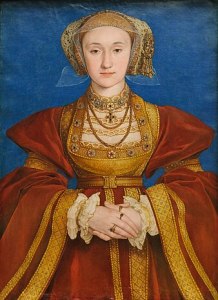
Anna of Cleves, 16th century hottie. Hans Holbein, Louvre INV 1348

The English bible was out and it was the law to preach the reformed religion in England. Henry, Cromwell and Cranmer all graced the cover of the new bible. But getting everyone to obey the reforms was near impossible. In March 1540, Bishop Stephen Gardiner had been preaching the old doctrine at St Paul’s. Days later, Cromwell’s old friend Robert Barnes did the same, preaching the reformed doctrine. King Henry heard of these outbursts and ordered Gardiner and Barnes to appear before him to explain themselves. It was not simply two men forced to explain themselves, as the king was ‘scandalised’ by their words. It was Gardiner’s words against Cromwell’s words, Barnes simply the mouthpiece. Henry, unhappy with his German marriage, could turn his anger against the Reformation instead of its real target, bringing Cromwell and Gardiner’s long-running feud to its bitter end. Everyone needed to be silent to appease the king’s current mood, so Barnes recanted his words in late March, and Cromwell made a concession; he invited Stephen Gardiner to dinner at Austin Friars.

If the Lambeth Palace banquet with the Duke of Norfolk was a flashpoint in Cromwell’s fortune, the Austin Friars dinner party would go one step further. What should have been two men finding a truce, instead turned into a bitter dispute, free of the civility of court. Rumours were already flying; people believed Cromwell would lose the Vice-Gerent and Lord Privy Seal positions. With Henry turning from the Reformation due to his marital bed problems with Queen Anna, Cromwell needed to defend all he had done, just as Gardiner felt he needed to defend the papacy.

A withering and acrimonious shouting match ensued at Austin Friars, with Cromwell screaming at Gardiner, ‘if the King would turn (from the Reformation), yet I would not turn! And if the King did turn, and all his people, I would fight in the field in my person, with my sword in my hand, against him and all others’. Cromwell, holding a knife (claimed Gardiner), added, ‘if this dagger was not thrust into my heart in battle, and if I would not die in that quarrel against them all, and I live one year or two, it shall not be in the King’s power to resist me’.

Cromwell had made a huge mistake, not unlike several inappropriate outbursts over recent months. A man who could have his enemies cornered before they realised the hunt had begun, suddenly began making missteps for no apparent reason. Cromwell was discussing a theological battle, not an actual war, and if he had a knife, it would have been no more than a dinner knife. The lack of actual danger to Henry must have been apparent, as  Gardiner kept this treasonous argument quiet, and Cromwell needed to get ahead of him. Cromwell surrendered the position of Secretary of State to the king, a job he held in an official capacity for six years. Secretary Cromwell was no more. The position that gave so much power beside the throne slipped away, but only just. The position would be divided between two people, a plan used regularly in the future, separating the immense power of the position. Ralph Sadler and Thomas Wriothesley were both given the job.

For a moment, things seemed to calm again but French Ambassador Marillac thought Cromwell was in trouble; Gardiner had not said anything, but Marillac, either listening to bad sources or simply sharing lies, wrote to King Francis, ‘Cromwell is tottering’. Marillac could not have been more wrong. On 17 April, King Henry astounded Cromwell and his friends and foes, telling him that he would become the 16th Earl of Essex (1st Earl, sixth creation), accompanied with a list of lands and manors five pages long. Henry Bouchier, whose family had held the Essex titles for eighty years, broke his neck after coming off his horse a month earlier, a sudden opportunity for Cromwell to be elevated. One day after this shock announcement, Cromwell was again bestowed with glory: the title of Lord Great Chamberlain, head of the royal household. The Earls of Oxford had held the role for the past 400 years, but John De Vere had died at home just a week after Henry Bouchier, leaving a vacancy at court.

But Gardiner had these words, spoken in anger at Austin Friars, coupled with the Duke of Norfolk’s French plan to remove Cromwell, were lying in wait, as the final traitor was about to reveal himself.

Wolf Hall 2: The Mirror and the Light – Did Thomas Cromwell attack the Duke of Norfolk over Cardinal Bainbridge’s Murder?

Norfolk and Gardiner – BBC/Playground Entertainment/Nick Briggs

Welcome to another installment of the details behind Wolf Hall 2: The Mirror and the Light. Thomas Cromwell’s fall from grace has long been seen as a sudden act – one minute he is being made the Earl of Essex, next he is dead, all because King Henry thought Anna of Cleves was ugly. None of that is true, and The Mirror and the Light shows the pivotal moment where Cromwell’s fall began, a full year before his death. However, the truth of the event is very different to what is shown onscreen.

In The Mirror and the Light episode 4, we see Cromwell at a banquet dinner held at Lambeth Palace by Archbishop Cranmer. All of the Privy Council attend, and Bishop Stephen Gardiner decides to stir up trouble by discussing the murder of Cardinal Bainbridge, talking of how he was poisoned by a priest, but instead veers into fantasy land and suggests Cromwell was the killer. Cromwell lashes out at Norfolk, who is off on another tangent complaining about how Cromwell isn’t good enough to be a nobleman, and conspires against everyone. This scene is a good show of research on Cromwell’s life, but bears no resemblance to the truth.

In 1514, Thomas Cromwell went to Rome, one of several trips he took during the decade, working on behalf of a private legal client to argue the Stratford Langthorne tithe dispute. Having seen the ‘factions and manners’ of the Italians for years, and able to speak fluent Italian and Latin, Cromwell was perfect for the job. In Rome, Cromwell stayed at the English Hospice, San Tommaso di Canterbury. The English Hospice at via Monserrato 45 (now The Venerable English College), sat a block from the Tiber river, and a two-mile walk to the Apostolic Palace. The hostel had been catering to English pilgrims to Rome for almost 200  years, and after renovation and reorganisation by King Henry VII, became an important hub for English diplomats visiting the city.

On his May stay, Cromwell met Lancelot Collins, nephew to the hospice’s master Cardinal Christopher Bainbridge, Archbishop of York, and resident English cardinal in Rome. This meeting between Cromwell and Collins would spark another genuine lifelong friendship, with Collins  considered one of the kindest and most generous men in England by even cynical men. Collins valued his friendship with Cromwell for over twenty years, even when, in later life, it would threaten his safety. But Cromwell had already left Rome by 14 July 1514 when Cardinal Bainbridge was poisoned by Rinaldo de Modena, one of Bainbridge’s chaplains, and rumoured lover who had suffered a beating from the cardinal. When interrogated, Modena confessed to planning the murder with Silvester de Gigli of Lucca, Bishop of Worcester and English ambassador in Rome, however, Modena was soon murdered in prison. Bainbridge’s executors, Richard Pace and John Clerk, wanted Gigli arrested for his part in the death, but Gigli swore that Modena was insane, and no charges were brought in Rome or in England.  Either way, Gigli was not charged and he died himself a few years later. Absolutely nothing in the case had anything to do with Cromwell or Wolsey.

Back to 1539, on 2 July, King Henry, already off on progress, commanded Archbishop Cranmer to host a banquet at Lambeth Palace, with both sides of the religious divide ordered to attend, as everyone remained in London. Henry did not attend, but Cromwell, starting to return to health after three full months, could attend his first public occasion. The banquet would go down in infamy. As a man freshly recovered from a torturous illness, Cromwell was far from the calculating, charming man he portrayed at court. Cranmer’s secretary Ralph Morice recorded the evening, which formed the basis of John Foxe’s later book detailing the event. Cromwell and Cranmer were warmest friends and allies, two leaders of the Reformation in England. Morice recalled a rarely recorded argument between the pair. Cromwell muttered to Cranmer:

‘you were born at a happy hour, for do or say what you, the King will always take it well at your hand. And I must needs confess that in some things I have complained of you unto His Majesty, but all in vain, for he will never give credit against you, whatsoever is laid to your charge, but let me or any other of the Council be complained of, his Grace will most seriously chide and fall out with us.’

Whether this uncommon, disrespectful, and candid complaint came before or after the main fireworks is unknown, as Cromwell again made a scene, publicly fighting with the ever-present, ever-meddling, Duke of Norfolk. Norfolk gave a speech about King Henry’s love for Cranmer, and compared Cranmer to Wolsey, calling Wolsey ‘a churlish prelate … who could never abide a nobleman … you know well enough Lord Crumwell, for he was your master …’ Morice then put down his quill, unwilling to record the awful things Norfolk insinuated about Wolsey and Cromwell. Cromwell, only just out of his sickbed, and already surrounded by enemies and a tense meeting of religious views, stood up to defend Wolsey. Cromwell told the room he did not regret his time with Wolsey, well-paid and well-provided for during their six-year friendship. Cromwell then roundly turned against Norfolk, giving him a caustic sixteenth-century dressing down, among other things, saying:

‘I was never so far in love with (Wolsey) as to have waited upon him in Rome if he had been chosen Pope, as I understand (Norfolk) would have done’.

The exchange does not sound hostile now, but it implied Norfolk was prepared to serve the Catholic faith and the Pope over his king, which would be treason. Norfolk bellowed a denial to the claim. Cromwell, through a lack of manners and a vast memory, told everyone Norfolk received 50,000 florins to transport Wolsey to Rome in 1523 when Wolsey was in place to become the Pope. The florins were proof of Norfolk’s plan to go to Rome with Wolsey. While Cranmer and others at the banquet diffused the screaming match, which was unquestionably complemented by bountiful wine and strong egos, the match had been lit between the men. Neither needed to wear the mask of courtesy again, as the peers of the realm had seen and heard all. Cromwell did not know it, but this banquet was the beginning of his ultimate downfall. The illness he suffered that caused him to miss the parliamentary session and the passing of the Six Articles would cause Cromwell to make numerous mistakes

All sources come from The Private Life of Thomas Cromwell. My publisher might come for you if you plagiarise.
Wolf Hall 2: The Mirror and the Light – Thomas Cromwell Quick Q+A

BBC/Nick Briggs

Welcome to part 4 of Wolf Hall 2: The Mirror and the Light facts about moments seen in Thomas Cromwell’s life at court. Today is a quick round-up of questions asked that don’t require a whole post of explanation on their own. So let’s start –

Wolf Hall is Jane Seymour’s home. What is The Mirror and the Light?

On 28 November 1538, Cromwell wrote a letter to Sir Thomas Wyatt (Harl. MSS. 282, f. 217), who was King Henry’s ambassador to Holy Roman Emperor Charles V, and travelling Europe with the Emperor’s court. Wyatt was not a good ambassador, and relations between the countries were started to deteriorate. Cromwell updated Wyatt on Henry Courtenay, Marquess of Exeter and Henry Pole, Lord Montagu, the Catholics traitors,  and asked Wyatt to get the Emperor  to intervene on several subjects were making trouble for London merchants. In the letter, Cromwell wrote of King Henry exercising his right as the supreme head of the church by burning Sacramentarian John Lambert a week earlier:

‘…undoubtedly [Emperor Charles] should have much marvelled at [King Henry’s] most high wisdom and judgement, and reputed him none otherwise, after the same, than in manner of the mirror and light of all other kings and princes in Christendom.’

King Henry is the mirror, and everyone and everything should reflect his brilliance. Henry is the shining light of princely splendour all should look up to. Being out of Henry’s light/favour is like being in the darkness. The letter is extremely flattering of Henry, since it would be read and repeated at the Emperor’s court, and could reveal nothing of reality, only a glowing picture of praise and perfection.

Was Thomas Cromwell the Lord Chancellor of England?

NO. Thomas Cromwell was never the Lord Chancellor. Thomas Wolsey was Lord Chancellor, followed by Thomas More, and then Thomas Audley. Cromwell assumed the role without title between more’s resignation in May 1532, and Audley’s appointment in January 1533, and was not always in a good mood about the position or workload. Audley was a puppet; he would do anything the king wanted, and he was easily intimidated, so Cromwell could yell at Audley whenever he made an error  and Audley would beg and grovel for forgiveness (Audley complained a lot, especially about his yearly salary of 800l or £350,000 today, plus bonuses. Cromwell always told him to shut it because it annoyed the king). Audley and his protégé Richard Rich really ran with Henry’s plan to dissolve monasteries when Cromwell didn’t want to move forward, but other than that, Cromwell had total control and authority over all matters. Audley never intervened in Cromwell’s business, despite technically being higher ranked until 1536. (Lord Chancellor was ranked second in the realm after the archbishops. In 1536, Cromwell became the Vicegerent of England, the new number one in order of precedence, putting Lord Chancellor down to third).

Thomas Cromwell was, in 1539, Lord Cromwell, Baron of Wimbledon the Vicegerent of England, Lord Privy Seal, Vicar-general of England, Knight of the Most Noble Order of the Garter, Principal Secretary, Chancellor of the Exchequer, the first-ever layman Dean of Wells, and Commissioner for the Peace in seven counties, Chancellor and High Steward of Cambridge University, Master of the Jewel House, Clerk of the Hanaper, and Steward of the Duchy of Lancaster, Essex, Hertfordshire and Middlesex, the Receiver of Petitions in the House of Lords, highest ranked man in the House of Lords, Warden and Chief Justice in Eyre, Prebendary of Salisbury, Steward of Westminster Abbey and Savoy Manor, Constable of Hertford Castle, Berkeley Castle and Gloucestershire Castle, Recorder of Bristol, Commissioner for the Subsidy to print the Bible, Lordship of Edmonton, Sainsbury, Hovering and Writtle, and  master of every single powerful man in the country of Ireland. By 1540, Cromwell was also the Earl of Essex and Lord Great Chamberlain. At that point that was basically nothing left for Cromwell to control, other than being the Lord Treasurer, but Norfolk held that role and seemed to live forever.

Sometimes people write Cromwell as Lord Chancellor because it is easier to understand in modern terms. Cromwell was the only person to ever be England’s Vicegerent, and no one person will ever receive that much power again.

Did Cromwell feel guilt over Anne Boleyn?

Certainly not that he ever mentioned where it would be recorded. It would have been insanity to have expressed guilt or sympathy. Archbishop Cranmer wrote to King Henry to make sure he didn’t go down with her, and so the Reformation would be safe without Anne on the throne. Cranmer was frozen out by the king for a while for this, and had his prime lands and manors confiscated, and given to Cromwell after Anne’s death. Mortlake Manor was the traditional home of the Archbishop of Canterbury since its construction 500 years earlier, and Crowmell relatives had worked there as servants. Cromwell then owned the property and made it grander than ever.

Cromwell did say to Ambassador Eustace Chapuys that Anne Boleyn handled herself well through her trial. Everyone knew she was innocent, but no one was stupid enough to say anything. I cover the whole period about Anne’s death in my book on the subject.

Did King Henry actually say he could make Cromwell the king after himself if he wanted at the Privy Council meeting?

No, that was just an imagined scene of the king flexing his power over all the nobles. Likewise, Cromwell and Fitzwilliam never came to blows like that at a meeting. It is another piece of fiction laid out to be reflected in later episodes. I will do a separate post about Cromwell and Fitzwilliam, as their relationship was very interesting.

BBC/Playground Entertainment/Nick Briggs

Did Cromwell spend time with Dorothea Wolsey?

There is no evidence of this; ‘Dorothea’ is a just a plot-point for Cromwell’s guilt. There are letters between Cardinal Wolsey’s three children and Cromwell. Most of the letters come from Thomas Wynter, Wolsey’s eldest son, born 1510 to Joan Larke, was always travelling in Europe, and always looking for money. Cromwell was one of Wynter’s financial babysitters, and felt sorry for Wynter after his father’s death. There are extensive papers showing Wolsey’s favour towards Wynter, and Cromwell got him set up in a comfortable life in the North in the 1530s, and he later became the Dean of Wells.

Dorothy was born in 1513, her mother also Joan Larke. Her surname was Clancey, the name of her adoptive family in Dorset. She was placed in Shaftesbury Abbey for her education and upbringing where many nobles sent their daughters, and just fell under Cromwell’s ban of no one being allowed to take holy orders from age 24 or younger in 1535. Cromwell soon changed the laws, so no one under 20 could enter the church, and Dorothy could technically  become a nun. The rich and well-appointed Shaftesbury Abbey was closed in 1539, and Dorothy Clancey was given a pension. She was never heard from again, and she certainly never met Thomas Cromwell.

Wolsey’s third child was Thomas Minterne (though his mother is uncertain), born in about 1516. Minterne grew up in Sherborne, ten miles from his sister Dorothy. Wolsey sent Minterne to New Oxford College and Cromwell ensured he was made a fellow at only 17 years old in 1533. Cromwell then sent Minterne to study in Europe in 1538, and when he returned to England broke in 1542, King Henry gave Minterne a cozy job at Salisbury Cathedral, which he kept for the next 20 years or so.

(Joan Larke married George Legh and had another four children, and then married Sir George Paulet in 1530, but died giving birth two years later, though her son William survived. Joan must have been quite young when having Wolsey’s children, maximum no more than 20 years old. Joan’s baby William Paulet was cousin of John Paulet, 2nd Marquess of Winchester, who married Elizabeth Cromwell, widow of Gregory Cromwell. These people really never moved around much).

All sources come from The Private Life of Thomas Cromwell and The Letters and Remembrances of Thomas Cromwell. My publisher might come for you if you plagiarise.