MY HEARTY COMMENDATIONS: THE TRANSCRIBED LETTERS AND REMEMBRANCES OF THOMAS CROMWELL NEW EDITION 2025

SPAIN BOOK REVIEW: ‘The Spanish Civil War: A Very Short Introduction’ by Helen Graham

Amid the many catastrophes of the twentieth century, the Spanish Civil War continues to exert a particular fascination among history buffs and the lay-reader alike. This Very Short Introduction integrates the political, social and cultural history of the Spanish Civil War. It sets out the domestic and international context of the war for a general readership. In addition to tracing the course of war, the book locates the war’s origins in the cumulative social and cultural anxieties provoked by a process of rapid, uneven and accelerating modernism taking place all over Europe. This shared context is key to the continued sense of the war’s importance. The book also examines the myriad of political polemics to which the war has given rise, as well as all of the latest historical debates. It assesses the impact of the war on Spain’s transition to democracy and on the country’s contemporary political culture.

Cover and blurb via Amazon

~~

The Oxford University Press has a series of short introductions to a vast array of subjects, and the Spanish Civil War version has been put together by Helen Graham, a professor at Royal Halloway, University of London. Putting together a short book on a massive subject would be no easy task. But when Paul Preston hails a book as ‘far and away the best short introduction to the Spanish Civil War’, the praise doesn’t get any higher. If a reader wished to start learning about the war, reaching for a hefty Preston, Thomas, or Beevor tome could be daunting, and the subject can drive even the most knowledgeable person to distraction.

A Very Short Introduction is cut into seven sections. The book lays out the foundation in a short slice, no easy task, and dedicates a chapter to the early days of the war, explaining the reality of executions on both sides of the conflict and the vigilante-style operations Spain was running in the quest for power and freedom. The book manages to cover Franco’s rise to prominence through a combination of will and luck, as well as how Spain was won through the help of Hitler and Mussolini. With all these aspects, and the huge array of groups pushing their own agendas, the war is impossible to simplify, yet the book gives the initial details without overwhelming readers. A Very Short Introduction lays out the people, the major events, the reality of Spain at the time, everything needed to help a newbie understand why Spain collapsed the way it did in 1936.

This book is written in a simple style, without a strong voice but rather an academic view of the facts. This book has drawn criticism, especially from being marked as biased (which I dared to read), and, 1 ) being unbiased about a Spanish Civil War is nigh impossible, and 2 ) those decrying the book as biased and rabidly left-wing seem to be free and easy with the facts themselves. The book may not jump up and down with a passion, and that is not its purpose; it is a clear and simplified version a horrendously difficult subject, and perfect for its initial goal. A Very Short Introduction was promised and delivered.

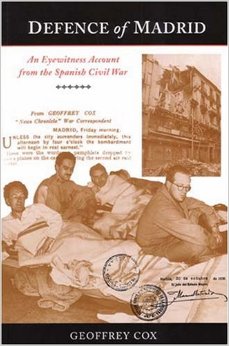
SPAIN BOOK REVIEW: ‘Defence of Madrid’ by Geoffrey Cox

COX

Goodies and baddies take some sorting out in this tale of the siege of Madrid by Franco’s right-wing forces supported by the Nazis and the fascist regime of Mussolini (the ‘rebels’), against the civilian population and its government representatives, just elected, who happened to be left-wing. Once sorted, Cox’s account of the city under attack, in one of the twentieth century’s first urban wars, has all too many echoes today. This new edition, with an introduction and selection of historical photographs, as well as samples of Cox’s journalism from the front, will confirm its position as one of the classics of twentieth-century reportage. Foreword  by Paul Preston, introduction by Michael O’Shaugnessy.

Cover and blurb for 70th anniversary edition from Amazon

~~

Geoffrey Cox’s Defence of Madrid (1937, republished in 2006) is the New Zealander’s eyewitness account of his time in Madrid from October to December 1936, during the siege of the city. In this brief six-week stint, Cox managed to see the fighting in Casa del Campo, the battles at the university and the bombing of everyday civilians.

Born in New Zealand’s South Island in 1910, Cox moved to study at Oxford in 1932 after a tour through Europe. With Europe under dramatic change in this time, he studied the political state of the continent, including spending time in a Nazi youth camp. Soon, journalism took over his desire for an academic life. In 1936, the News Chronicle had their Madrid-based correspondent taken hostage by Franco’s rebels, and a replacement was needed – Geoffrey Cox had the opportunity no one else wanted.

Defence of Madrid is a stark and honest account of Madrid during those early months of the war as Franco’s forces marched unabated through Spain. Cox landed in Madrid prepared for the rebel’s onslaught, only to land in a city in wait, a city far more complex than imagined, given the social and political state. Cox started writing down his account as soon as he arrived, every sight and sound recorded. Almost immediately, his account was being broadcast, as one of just two British correspondents holed up in the city. Cox soon became immersed in the air of Madrid and was the first writer of explain to the world what it felt like to be part of the war, and what everyday people were feeling and experiencing. The combination of the turmoil and collective desires to defend Madrid were published by Cox, who quickly became recognised as a good judge of character. While in Spain for just six weeks, Cox managed to cover major events before any other – covering the assault on the university and Casa del Campo as the Republicans fought back Franco’s army, honest accounts of the aerial bombings and covered the arrival of foreign volunteers in Spain to help the cause.

Defence of Madrid is the first in a long line of books by Cox, who went on to cover World War II and much more. The book is written with total honesty, a lack of bias, seen through eyes destined to tell the truth. Any author would be proud to be able to produce such work. New Zealanders participated in all aspects of the Spanish Civil War, most totally unrecognised. Geoffrey Cox should not ever be one of these.

Valencia Photos of the Month: Horchaterías in Plaza de Santa Catalina


Plaza Santa Catalina in 1837, 1860, 1895 and 2013. Horchatería Santa Catalina is on the left, across the church entrance and El Siglo is on the right just before the church entrance. 

Plaza de Santa Catalina (named after the Santa Catalina church), off Plaza de la Reina, located in the heart of Valencia since forever, is home to two of Valencia’s long-standing and iconic stores, all-but across the tiny pedestrian street from one another and selling the same product – horchata.

Horchata (orxata in Valencian) is the local beverage of the ages. The drink is made of tiger nuts, water and sugar; you can get substandard versions made from almonds or rice elsewhere, but Valencia is the home of the product. When the Muslims owned/ ran/ inhabited the city from the 8th-13th centuries, they perfected the drink, made from chufas (tiger nuts) in nearby Alboraia, outside the city area. It looks as if made from milk, but dairy-avoiders have no need to shy away from the drink. It is served ice-cold and has fartons (don’t poke fun of the name), long pastry delights dipped in for extra fun.

horchata gif

Right across from the entrance to the Santa Catalina church is Horchateria de Santa Catalina, which is decorated in the traditional tile design of the area. After several hundred years and multiple royal visits, they know what they are serving. Horchata, fartons, various pastries, churros and coffees are all available, and you can get your sugar on for just a few euros. It’s one of Valencia’s quiet icons, with a handy location to everywhere in the old town.


Across the tiny street is Horchatería El Siglo, who have been serving up horchata since 1836. The same products as across the street, though with a simpler setting, and some argue, better quality horchata. They also have a nice outdoor setting area. Again, for a few euros you can have all you want and chill with the locals. Or could, because as of 31 December 2014, thanks to a law changing rents in Spain, disaster has struck El Siglo. While the rent increases, put up to current market rates, have been coming for the last twenty years, they have now come into force. While many of the 9000 local family-owned stores in Valencia, the classic older stores of the city, managed to negotiate rents (going up thousands of euros a month!), some, like El Siglo have instead decided to close their doors and have the owners retire. Rents have been frozen, some for up to half a century, in Spain for the aid of businesses, and that helpful time has come to an end. After all this time, a law has closed El Siglo and we’ll be seeing some ugly generic Starbucks in there, even though they are everywhere like a plague. Thousands of stores around Spain will now disappear thanks to this law change. You will be seeing more franchises and generic stores over the beautiful lace stores, shoe stores, doll repairers (yes), antique shops, tailors, cafes, basket weavers, horchaterías et al, businesses handed down through generations. And that really sucks. The time for the rent freezes came to an end, and some argue it had to happen, however the face of Spain is being changed quickly, thanks to corporations who can afford the new rents.

 RIP El Siglo

Beautiful Drone Footage of Valencia, Spain

The Spanish powers-that-be hate drones. Why? Maybe because they are awesome. But here are some beautiful short drone videos over some of Valencia’s best landmarks. They are made by Aerial Valencia with a Phantom drone, giving people a chance to see Valencia’s well-known sights from a new perspective.

This video is done by Aerofilm HD, which drone around other Spanish locales, and this very special location 🙂

`

Aerial Valencia is on Twitter – @aerialvlc and on youtube – Aerial – VLC

SPAIN BOOK REVIEW: ‘Franco: Biography of the Myth’ by Antonio Cazorla Sánchez

Antonio Cazorla Sanchez

General Francisco Franco, also called the Caudillo, was the dictator of Spain from 1939 until his death in 1975. His life has been examined in many previous biographies. However, most of these have been traditional, linear biographies that focus on Franco’s military and political careers, neglecting the significance of who exactly Franco was for the millions of Spaniards over whom he ruled for almost forty years.

In this new biography Antonio Cazorla Sánchez looks at Franco from a fresh perspective, emphasizing the cultural and social over the political. Cazorla Sánchez’s Franco uses previously unknown archival sources to analyse how the dictator was portrayed by the propaganda machine, how the opposition tried to undermine his prestige, and what kind of opinions, rumours and myths people formed of him, and how all these changed over time. The author argues that the collective construction of Franco’s image emerged from a context of material needs, the political traumas caused by the Spanish Civil War (1936-1939), the complex cultural workings of a society in distress, political manipulation, and the lack of any meaningful public debate. Cazorla Sánchez’s Franco is a study of Franco’s life as experienced and understood by ordinary people; by those who loved or admired him, by those who hated or disliked him, and more generally, by those who had no option but to accommodate their existence to his rule.

The book has a significance that goes well beyond Spain, as Cazorla Sánchez explores the all-too-common experience of what it is like to live under the deep shadow cast by an always officially praised, ever-present, and long-lasting dictator.

Cover art and blurb from amazon

~~

I saw Franco: Biography of a Myth on the shelf and grabbed it while collecting other Franco books. Reading the little blurb on the back cover which states the book is part of a series of ‘engaging, readable and academically credible biographies’, I thought it would be worth a read. Then I read the chapters headings – Military Hero, Saviour of Spain, Man of Peace, Moderate Ruler, Bestower of Prosperity…. and I wondered what I had stumble onto. No one, other than those, let’s say, fanatical about Franco would use any of the terms to describe a man who killed and controlled with enjoyment. It was going to be hard to give a decent review after reading just the contents pages.

Biography of a Myth starts off with a an introduction, an overview of the man himself, and facts and perceptions of his rule. An excerpt from the book of Luis Bolin, Spain’s once-tourism minister, shows how opinion of Franco was perceived by those who believed in him – His ambition was to serve. All thoughts were for the people. He wished to improve the lot of the working man and the position of the middle classes, both of which had so many times been deceived by Republican promises…. This about a man who condoned the swift punishment of said people in the south of Spain, in an example detailed just one page earlier. This is a book written not from simply the facts, but the facts as they were handed down to the people.

The first chapter tells of Franco’s time in the army, not just as a man good at what he did, but as a man of opportunistic timing. The chapter talks of right up until the day civil war began, with Franco’s ‘crude opportunism’ and through a series of accidents, how his name would quickly become feared, when it could have easily been another man leading the charge in war. The second chapter tells of the civil war from the Nationalists point to view as Franco swept through the country, and how the propaganda machine was already at work. Franco’s name was kept out of stories where possible, instead focusing on others, or local heroes in publications. Once he was proclaimed Head of the Spanish State and Commander and Chief of the Army did the news stories change, to anoint him the illustrious Caudillo General Franco. People could only believe what they heard and all that was carefully planned. Each story on his victories was selected and mistakes neatly erased. History was already being written by those who decided what the future would believe. The book also touches on the sanitised versions of events printed in international news.

The book goes on to talk of the delicate peace created after the civil war. With starvation of the traumatised public, and corruption and ineptitude, these things didn’t hurt Franco, as underlings took the blame. Publications in ensuing years, including a 1947 article which claimed Franco had too been a victim of the Nazis, helped to preserve Franco’s prestige. The years described in chapter four, through the fifties and sixties, describes Franco as ‘a walking skeleton that refused to go into the closet of European history.’ Franco needed American and European opinion to sway in his favour, and propaganda was written to suit. As a result, through trade and negotiations, Spain was allowed to flourish, all based on what people knew of the man himself. The chapter titled ‘Moderate Ruler’ may ring true if you consider Franco a man with absolute power, and no idea what to do with it.

Chapter five talks of the calmer years under Franco’s reign as the country began to prosper, and his belief he had a successor in the form of Prince Juan Carlos, who would carry on his vision after his death. But with factions starting to speak out in the mid to late sixties, such as ETA, Franco’s grip on the nation, and the opinion of the people, started to wane.  Only with his death in 1975 did opinion change as new stories would emerge, giving a more realistic picture of Franco and his reign, as freedom to discuss the past opened wide. Perceptions are also opened, with details of publications made since his death, of who wrote what and why, and what perceptions are like today, based on propaganda.

When I started reading this book, I thought I was going to get a mouthful of Franco love, but Biography of a Myth is not that straight-forward. It swings between those who loved and hated Franco, though does brush over atrocities at an astounding rate (perhaps because it could be a subject for another book). The information on Franco is not new; anyone who knows anything of Franco’s history will find themselves in common territory. This book does spear off in a new direction, away from the likes of Paul Preston’s magnificent biography, but would make a good read for anyone looking for a different point of view. This book doesn’t talk about Franco from one side or the other, it talks of Franco through perceptions during his reign. In the end, the book tells us something we all know – history is the opinion of the winners.