MY HEARTY COMMENDATIONS: THE TRANSCRIBED LETTERS AND REMEMBRANCES OF THOMAS CROMWELL NEW EDITION 2025

This Week in Spanish Civil War History – Weeks 117 – 120: 1 – 31 October 1938

October 2

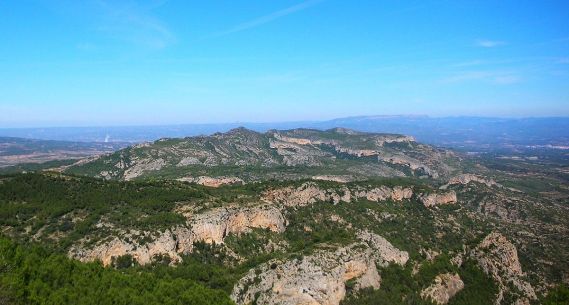
The Nationalists attack Hill 565 in the Sierra Pandols-Cavalls, taking the strategic post. The Republicans have held this high point since the start of the offensive. On this hillside is an old Moorish tower, which the XV International Brigades used as a general protection site, along with the many caves where men hid from sight during the fighting.  By now, most hill locations defended by the Republicans and International Brigades have been taken by the Nationalists, and many International battalions are starting to retreat from the battle, due to the command that all foreign fighters withdraw from Spain.

October 4

The intensely useless Non-Intervention Committee continues its withdraw of all foreign fighters in Spain. This is done in the hope that Franco and his fascists start to withdraw their 50,000 foreign men (and 30,000 Moroccan Legionnaires) from the battle – but why would they when they are making such sweeping gains? The Republicans start their withdrawal of the International Brigades, though many battalions have already fought their last battles and started their trek into Catalonia to leave Spain for good.

October 8

Sant Vicenç de Calders railway station, three kilometres outside the Catalonia village of  Sant Vicenç, is attacked from the air by the Italian Aviazione Legionaria. The station is an important one, where the junction lines between Barcelona to Madrid and Barcelona to Valencia meet. While the main village is nearby, the station itself is surrounded by the railway town. The bombing starts  as a civilian train from Tarragona is arriving at the station on its way to Barcelona. A single plane came from the sea, as the planes were based at Palma de Mallorca, and hit the train directly. The bombing killed 60 people and injured another 100, many trampled by the panic caused. It would not be the first attack on this strategic railway station, and is only 70 kilometres along the coast from Barcelona.

October 16

The Nationalists breach Hill 666 in the Sierra Panadols, the key point of the Pandols-Cavalls mountain range, which shall lead the Nationalists straight down to the Ebro itself. While the Republicans still hold the Sierra Pandols, they are now isolated pockets of men in caves, bravely holding out in the face of mass casualties. Some 50 kilometres north in the battle, the Republicans are also losing ground near Mequinenza, making the battle ever more difficult as the Spanish fighters are without any of their international men.

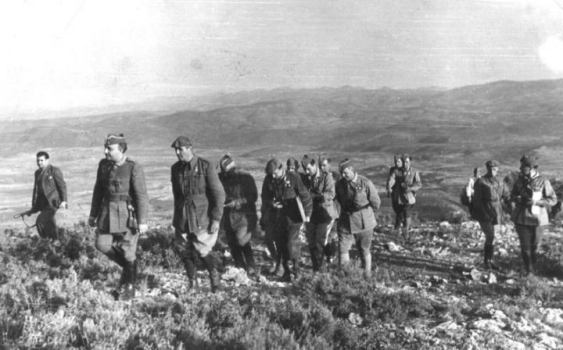
International Brigades near Falset (50 kilometres from the Ebro) 16 October as they prepare to leave Spain

October 29

The International Brigades have met their sad end after a bloody and brutal volunteer battle to save Spain. Around  10,000 foreign volunteers are still in Spain for the Republicans. The battles have had around 20,000 foreign fighters on the front-lines at their height, with some 35,000 total coming to Spain, with 15,000 killed and left behind. Of the 10,000 still in the country, half are exiles or refugees from Nazi Germany and Fascist Italy, and other European nations such as Hungary, Czechoslovakia, the Balkans, Austria, Poland, all which currently have right-wing governments, are annexed by, or under threat from, Germany.  Those remaining from Belgium and the Netherlands have lost their right as citizens for fighting for a foreign army. Those from countries not supporting the rising Fascism of Europe (England, France, the U.S and Canada, Ireland, Scotland, New Zealand, Australia, South Africa, Sweden, Norway, Denmark, Mexico, Cuba, Puerto Rico, Chile, Argentina, olivia, Ukraine, China, India, Japan, Mongolia, the Palestine Jews, Morocco, Algeria, Libya, Syria, Iran, Iraq – seriously, everyone came), were sent either immediately home, or were herded into camps north of the French border to either die there or eventually get home in time to suffer WWII. Those who chose not to return to their dangerous countries were drafted into Spanish battalions to stay on as Spaniards. Regardless of what country these men and women came from, their return home was not as heroes, as many suffered consequences of their decision to flee their countries to save Spain. None will be offered safe haven in Spain until the mid-1990’s.

Farewell parade in Barcelona 29 October

October 30

The Nationalist Army of the Maestrazgo is taken over by Morroccan General Mohammed Meziane, and they attack the Pandols-Cavalls sierra one more time, this time to end the battle to the river. Armed with the entire battalion, 100 aircraft from the Condor Legion and 175 guns, the Nationalists attack and take 19 fortified Republican positions, resulting in the deaths of 1,500 Republican troops and take another 1,000 men prisoner. With this, the Nationalists now can hike down the eastern side of the mountains to the Ebro, where its waters run along the border of Aragon in Catalonia. The Republicans are now in serious trouble, with a bloody Catalonia Offensive already planned by Franco.
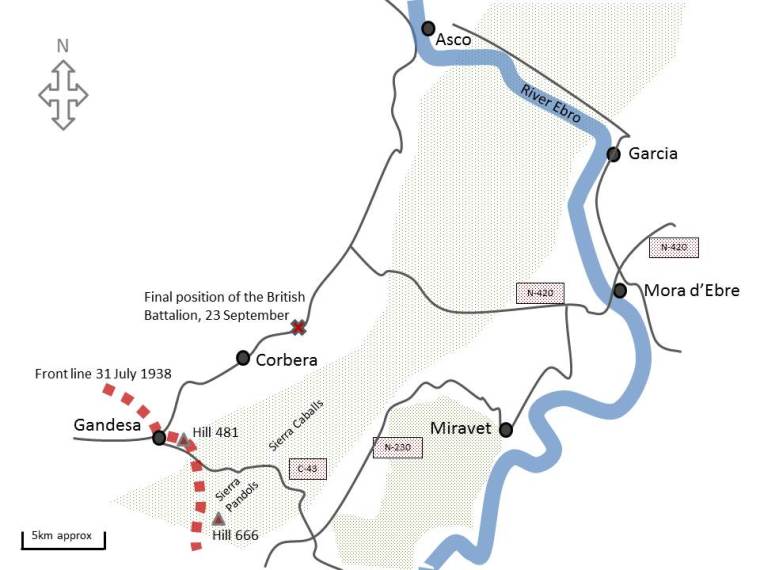
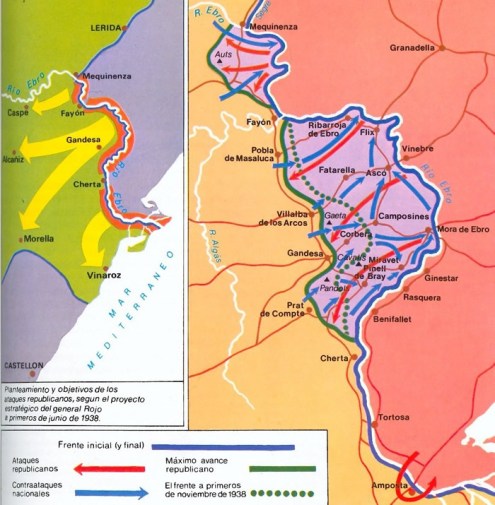
Click on this great map to go to Richard Baxell’s site to learn so much more about the battles than I could ever manage to write. Baxell is an A+ expert on the war and International Brigades.

*thank you for your patience with these posts while I was delayed with the release of my latest book. 

~~

This is not a detailed analysis, just a highlight (lowlight?) of the month’s events. Things get lost in translation – Feel free to suggest an addition/clarification/correction below. The more the world remembers, the better. All photos and captions are auto-linked to source for credit, and to provide further information.

This Week in Spanish Civil War History – Weeks 113 – 116: 1 – 30 September 1938

September 3

The Nationalist Maestrazgo Corps  arrive at the Ebro front, drawn away from their task of capturing Valencia, to help the advance through the Sierra Cavalls and Pàndols, and then another 10 kilometres north into Corbera. The mountain range is held by the 35th, 11th and the 43rd Republican divisions. The new Eastern front Nationalists counter-attack Gandesa with a reinforcement of German 88mm guns at the same time, putting pressure on the sparse Republican men.

September 4

The Nationalists easily take the town of Corbera, while the battle in the Sierra Cavalls and Sierra Pàndols mountains ends when the Nationalist manage to break through the 11th and 43rd divisions. Only the 35th division manages to hold on, resulting in another bloody battle on Hill 705, on the sides of the Sierra Pàndols highest point. General Modesto was desperate not to lose any further ground in the mountains as thousands were slaughtered. He gave a rousing speech about holding onto every metre of ground the Republicans still had, and countless died for it. Hill 705 has seen many battles and has changed sides dozen of times (one day in August saw the hill change hands eight times) and continues to be a powerful symbol for both sides of the battle.

Republican troops in the Sierra Pànadols

September 13

The 35th division returns to its original position low in the Sierra Pàndols, taking with them the remaining survivors of the 11th division. The Ebro battle has now seen tens of thousands of men dead on both sides. The Ebro is only six weeks old and yet the Nationalists have claimed some 120 square miles of land that the Republicans first took when the crossed the Ebro and Sangre rivers. The Republicans still hold the key crossings points and yet have no way of holding back the eventual crush they know they shall face from imposing Nationalist forces.

Hill 705 on the Sierra Pànadols

September 21

Republican Prime Minister Juan Negrin gives a speech at the League of Nations, regarding the Non-Intervention Committee. The  European countries in the Committee, which has done nothing but interfere with Spain either directly or indirectly, have aided the destruction of Spain  either by supplying weapons and people, or simply sitting on their hands and doing nothing. While wet-bus-ticket Chamberlain, UK Prime Minister, thinks that meetings on the Non-Intervention Committee have been successful throughout 1938, the Committee and its discussions have been a disaster. PM Negrin says he plans to withdraw all International Brigades from the war, as a show of contempt for the Non-Intervention Committee (not that the Non-Intervention sent these troops – rather these men were fearless volunteers, 30 percent of which were killed and left behind in Spain). Many of the International Brigades are now Spaniards, or men who cannot return home to their fascist home counties without being punished/killed for their efforts, but the time has come for the foreigners in battle to leave. At the same time, the UK makes an accord with Italy for them to also remove their men and artillery from Spain, after ignoring the Committee and fighting for the Nationalists for the entire war. The Republican International Brigades have ought many brave battles and now shall be removed in what looks like a sign of defeat against the Nationalists and their German and Italian allies. Even if the Nationalists lose the Italian troops and pilots, the Germans will remain backing Franco while they prep for the coming WWII (and being part of the Non-Intervention Committee!).

September 23

The International Brigades of the XI, XIII and XV battalions, all part of the 35th division fight once last battle at Hill 705 in an attempt to break through the Nationalists, so they can link up with the Valencian reinforcements which will never come. The Nationalists have not broken over the Ebro, but they have killed almost 15,000 Republicans in a battle which will choke on for several more months.

Welsh International Brigades

~~

This is not a detailed analysis, just a highlight (lowlight?) of the month’s events. Things get lost in translation – Feel free to suggest an addition/clarification/correction below. The more the world remembers, the better. All photos and captions are auto-linked to source for credit, and to provide further information.
This Week in Spanish Civil War History – Weeks 108 – 112: 1 – 31 August 1938

Sorry for the massive delay in posts as I published my latest book. All will be caught up in the next few days. HERE is July if you have forgotten the timeline.

August 1

The XV International Brigade and the Republican mixed 15th Army Corps launch their attack of Hill 481 outside Gandesa. The Republicans have large numbers but suffer massive casualties as the Nationalists have air support over the hillside into Gandesa. The Nationalists are prepared to defend Hill 481 at the expense of making any gains.

The battle lasts for several days, resulting in the Republican troops trapped along the edge of the Segre river. While crossing the river would give the Nationalists a free advance towards Barcelona, Franco orders the men to stay and ensure the slaughter of the Republican army.  The Republicans order their men to stand their ground, and are executed if they try to retreat. The Nationalists kill their way through the Republicans with solid artillery and air cover.

The early August battle is fought WWI western front style, with both sides battling in long trenches, neither gaining or losing significant ground while the casualty numbers pile up. In the first few days of the month, the Nationalists’ 500 cannons pound the Republicans with 13,000 rounds while their 200 aircraft dropped another 10,000 bombs. The Republicans had only machine guns and mortar fire, but refused to give up their access across the river.

Nationalist men heading towards the Segre

August 5

With the land rock-hard in the height of summer, and the temperatures hovering about 40C, water and food shortages begin to become another battle for Republican men. Bodies are piling up, and cannot be buried, while the wounded can only be sent over the river at night, causing the death count to rise further. The German and Italian air cover continue to fly dawn to dusk, only hindered by the Republicans’ 75 planes, half of which are poor quality aircraft. Over the past six weeks, the Republicans have lost half of their planes in battle and most of their Soviet pilots, the only ones trained in flying and fighting, had either died or retreated from battle. By August 5, the Republican crossings over the Ebro have been bombed, and supply lines all over the battle are destroyed, leaving men on barren hillsides to be bombed from the air, or shot from high points around the Sierra Cavalls.

A Republican cave hospital

August 6

After almost a week of defence and systemic bombing, the Nationalists launch their own counter-offensive, this time to retake Republican areas. The northern area of the Ebro battle, a 20-kilometre line between Mequinenza and  Fayón, is bombed by the German Condor Legion carrying 50 tonnes of bombs, over four days, to break their supply line and Republican defence. The Republicans have no way of defending themselves, with their airforce tied up at Gandesa.

The Nationalists outside Gandesa

August 11

The Republicans camped by the river outside Mequinenza are unable to cross back over the river, which marks the border between Aragon and Catalonia. Some 900 men are killed in the bombing and over 200 machine guns have been destroyed, leaving the stretch of river exceptionally vulnerable.  The attack then changes to attack the 11th division, lead by the Republican General Lister, who has no reinforcements or artillery to defend them, leaving the river further unprotected.

August 14

The Nationalists have the Ebro Army still battling to cross, while the Eastern front is ready to cross the Segre river into Catalonia. Yet Republicans still hold the Sierra Cavalls beside the river, though the Nationalists take the hilltop of the Santa Magdalena near the town of Vilalba dels Arcs, 40 kilometres south of Mequinenza, getting closer to the Ebro on foot.

August 18

The Nationalists, who have captured the northern dams, open the dams and flood the Ebro, which again washes away the Republican pontoons, leaving troops stranded and the supply line cut as they struggle to hold their ground in the mountains.

Franco in the Sierra Cavalls

August 19

The last five days of fighting has allowed the Nationalist General Yague to move his six divisions and the Condor Legion to the area of Gaeta, 10 kilometres north of Gandesa. The new Republican counter-offensive has now completely stalled, and yet the Nationalists are only making very slow progress. The weather conditions are making war near impossible on the rocky plains as the temperatures remains at 40C on a regular basis. The Republicans have had their crossings of the Ebro lost and yet the Nationalists are also not advancing into Catalonia.

August 29

In a fit of anger and frustration, Mussolini, who had been aided the Nationalists with men, planes, points, artillery and cash, is angry that the Nationalists have still not gained into Catalonia, and announces “today, 29 August, I predict the defeat of Franco. That man does not know to make war or doesn’t want to.” (if only!)

August 31

Nationalist General Valiño and his Maestrazgo Corps are ordered by Franco to head north to battle for the Sierra Cavalls. The highest point, Punta Redona, is held by the Republicans and only 12 kilometres from the Ebro. The whole mountain range is held by the 35th, 43rd and 11th Republican divisions, and the Nationalist Maestrazgo Corps bring in eight division with 100 tanks and 500 aircraft, ready to destroy the Republican area.

The Sierra Cavalls outside Gandesa

September and October 1938 will be done tomorrow.

~~

This is not a detailed analysis, just a highlight (lowlight?) of the month’s events. Things get lost in translation – Feel free to suggest an addition/clarification/correction below. The more the world remembers, the better. All photos and captions are auto-linked to source for credit, and to provide further information.

HISTORICAL BOOK REVIEW SERIES: ‘Women in Medieval England’ by Lynda Telford

This fascinating book explores the status of women in medieval England, both before and after the Norman Conquest.

The author starts by contrasting the differences in status between Anglo/Danish or Saxon women with those who fell under the burden of the feudal system imposed by the Normans. She covers such subjects as marriage and childbirth, the rights and responsibilities of wives, separation and divorce, safety and security and the challenges of widowhood. She also examines such issues as virginity and chastity and the pressures placed on women by religious groups.

At a time when women’s rights were minimal, the author charts their struggles against the sexual politics of the era, its inequalities and its hypocrisies. She also examines the problems of the woman alone, from forced marriage to prostitution. The lives of ordinary women are the centre of attention, painting a fascinating picture of their courage and resilience against the background of their times.

cover and blurb via amazon

~~

Resting on the theme of women in history is Women in Medieval England. My initial interest in this book was the pre-conquest women included. England and its rulers is so often detailed as post-1066, so someone like myself with limited knowledge of the Anglo-Saxon era found the overview and laws of the time useful. New leaders made for new husbands for noble women, who may not even be able to understand them, given language barriers. A nightmare of any woman, and to cap it off, not speaking your new husband/owner’s language is a scary thought.

What classified as marriage was quite different (as I’m sure everyone knows) which made for a messy history and difficult lives for the women traded to their husbands. The book even delves into what was birth control in the pots-1066 era, and lol-worthy concepts for cures for impotence. Life for women was exceptionally difficult, mostly due to the largely uncontrollable act of pregnancy, and the book shows just how damned awful it was for our predecessors to battle on creating a new generation.
Married life was all kinds of awful – as everyone knows the ‘rule of thumb,’ in that a man cannot beat his wife with anything thicker than his thumb. Though, in some ways, you read this and wonder how much life has altered for many women. This book digs through a realities of being a woman in the medieval period, where men are cast as sword-wielding heroes, women have been left standing in mud-floor huts. This shines a light on those women, who had the temperament of saints, strength tougher than any soldier, and bravery beyond that of a king. The world was a strange place for women; you could die of the plague, or you could survive an outbreak and clean up in the vacant jobs market.
This is no heavy book you will be reaching for when researching, it is a read on the lives of women in a world none of us would want to return to. There is plenty of information to be had in here, without feeling like you’re in a history lesson, a book for those who would like to read for pleasure, not study.

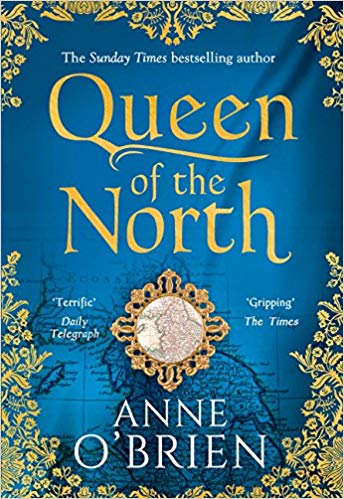
HISTORICAL BOOK REVIEW SERIES: ‘Queen of the North’ by Anne O’Brien

1399: England’s crown is under threat. King Richard II holds onto his power by an ever-weakening thread, with exiled Henry of Lancaster back to reclaim his place on the throne.

For Elizabeth Mortimer, there is only one rightful King – her eight-year-old nephew, Edmund. Only he can guarantee her fortunes, and protect her family’s rule over the precious Northern lands bordering Scotland.

But many, including Elizabeth’s husband, do not want another child-King. Elizabeth must hide her true ambitions in Court, and go against her husband’s wishes to help build a rebel army.

To question her loyalty to the King places Elizabeth in the shadow of the axe.

To concede would curdle her Plantagenet blood.

This is one woman’s quest to turn history on its head.

cover and blurb via amazon

~~

It’s 1399 and King Edward III’s descendant Elizabeth Mortimer is married to Henry Hotspur Percy, heir of the Earl of Northumberland. Richard II is king, and deposed by Henry Bolingbroke under dubious circumstances. Richard II had no heirs, but he did have someone ready to replace him until Henry IV takes his crown. That is where Elizabeth comes in.

Elizabeth expected her nephew Edmund Mortimer to take the throne, also a descendant of Edward III, a boy born of royal Plantagenet blood.  Elizabeth’s family has just as good a claim to the throne as the new Lancaster king. Whenever there are multiple claims to a throne, blood is certain to follow.

Elizabeth is not a man who can go into battle for the Mortimer claimant. She is not a beautiful young princess to be traded by families and launched into power. Elizabeth is a smart noble woman, who knows her family has a valid claim, who has given her husband the children he needs, and, to history, should be left on the sidelines. But Elizabeth is not a woman who should be cast aside in the battles of men and the throne, for she has the knowledge, skill and education to make a difference in the Mortimer claim to the crown.


All sides the early battles had legitimate claims to the throne, and we have a viewpoint in Elizabeth which is valid yet undemanding, unlike the men who surround her. Real life Elizabeth is not a well-known figure of history, so the author has had to use historical detail of others, and weave Elizabeth into the story, which gives new life to an old tale. Percy takes the Lancaster’s side of the war and Elizabeth is rich in the blood of the Mortimers, and nobler than her husband.  But what can a wife do in such challenges? Elizabeth is the wife of Percy, who holds the north. Whether it is from London or the Scots, the Percys have plenty of battles to face and Elizabeth is the northerners queen.
No sooner than choices are made, Elizabeth and Percy find they should be on the side of the Mortimer. Politics, treason and ambition are going to explode, and I am desperately trying not to write spoilers, but all I can say is you really need to read this book! Everyone knows what happened to Hotspur Percy at the Battle of Shrewsbury, part of a plot to overthrow Henry IV, but Elizabeth and her family’s claim carries on.  The Bolingbrokes and the Mortimers are going to need to be friends if civil wars for the throne are to end, and greed is as powerful as blood. This book has historical accuracy combined with beautiful storytelling. I adored this novel.