Wolf Hall 2: The Mirror and the Light – What happened to Gregory Cromwell?

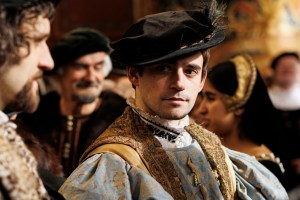
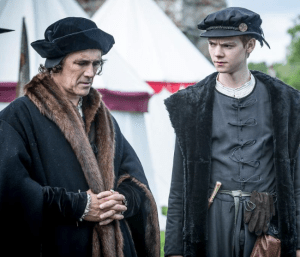
Gregory Cromwell in The Mirror and the Light. Playground Entertainment/Nick Briggs

Gregory Cromwell (c. 1520–1551) was probably the antithesis of his intelligent, well-travelled and fervent father. The character certainly got a glow-up of sorts in The Mirror and the Light.

Born around 1520, Gregory was the eldest of the Cromwell children, with Anne born c.1523 and Grace c.1527. The Cromwells lived in the heart of the Italian quarter of London on Fenchurch Street, before the family moved a few blocks north into Austin Friars in early 1523. It was a big household – Gregory’s grandmother Mercy Prior lived there, along with his paternal aunt and uncle Elizabeth and William Wellyfed and their three children Christopher, William, and Alice, and his maternal aunt and uncle Joan and John Williamson, and their daughter Joan. Also in the household were the Williams children Richard, Gregory and Walter with their father Morgan Williams, though they also had their own household as well until 1528. Added to that was Thomas Cromwell’s ward Ralph Sadler and his younger brother Nicholas. Gregory got to grow up in a large and wealthy family environment, and was away in Cambridge when sweating sickness struck London, killing his mother, and also away one year later when his sisters died. For Gregory, like his father, being away from home likely saved his life.

At age 7, Gregory, with his cousins Christopher Wellyfed and Nicholas Sadler, being similar in age were grouped together for their formal education, starting at home with John Palgrave, then moving to live with Prioress Vernon and being taught by John Chekying in Cambridge. Gregory’s years in education were largely unremarkable (except when Christopher Wellyfed was setting thigs on fire, costing his uncle a small fortune). By the time that Cromwell had got Anne Boleyn on the throne, it was obvious Gregory needed a different life away from formal education at Cambridge. Gregory began an annual routine of spending months away from home at a time, travelling the country and staying with friends of his father, visiting the countryside all around England and the Welsh marshes, a lifestyle similar to the king’s illegitimate son Henry Fitzroy. He even stayed with the Duke of Norfolk for a summer when the duke and Cromwell were briefly attempting to get along in 1536.

One of the most significant events in Gregory’s life was his marriage to Elizabeth Seymour in 1537. Elizabeth was the sister of Jane Seymour, Henry VIII’s third wife, making Gregory the king’s brother-in-law by marriage. He had his own household set up and paid for by his father, and it included Gregory’s half-sister Jane Cromwell, who had been born in 1530 to an unknown mother. Jane had grown up in the large Cromwell household at Austin Friars, but from 1537 onwards, lived with Gregory, alongside his new wife Elizabeth.

In late 1538, Thomas Cromwell had to deal with Gregory being punished by the church for sexual crimes. The event wasn’t hushed up, rather handled by clergymen who had no interest in embarrassing Elizabeth, the king’s sister-in-law. Gregory and Elizabeth were living at Lewes Priory, where Cromwell had set up them up with lands and manors that were large enough to host the king on progress, and his reputation was destroyed. Pregnant Elizabeth Cromwell and her infant son Henry were brought close to Cromwell at Mortlake, while Gregory lived separately from his wife, though they reconciled before Edward Cromwell was born in early 1539. They could not return to Sussex.

Gregory spent no time at court or worked for his father. Cromwell kept his adoptive sons Ralph Sadler and Richard Cromwell close, yet Gregory had no part in his father’s business. The only role Gregory had was to attend Queen Jane Seymour’s funeral, ride ahead of Cromwell’s mustered troops in 1539, and later welcome Queen Anna of Cleves to England, but these roles were also minor. When Cromwell was arrested in 1540, Gregory and Elizabeth Cromwell were at Leeds Castle, where Cromwell had set up a new life for them in 1539, where baby Thomas Cromwell was born in 1540.

King Henry was not in the habit of punishing the families of traitors (the Pole family excluded obviously). Gregory’s marriage to Elizabeth secured his social standing and protected him when his father fell from grace. Elizabeth wrote to her former brother-in-law the king, denouncing Thomas Cromwell after his downfall, and she and Gregory were allowed Launde Abbey, bought by Thomas Cromwell several years earlier. Gregory was also made 1st Baron Cromwell, making him appear worthy of the position of Prince Edward’s uncle, as he could not inherit any of his father’s titles or money.

Gregory and Elizabeth stayed quietly at Launde, having two more children, Katherine in 1541, and Frances in 1542. Gregory diligently attended parliament each year but achieved nothing, though did amass a large amount of lands, enough to make a tidy living. If anything, Gregory was one of those peers Cromwell never liked; those who were rewarded for their status rather than their effort. Gregory was also given permission to not fight in France when hostilities broke out, claiming his health was poor. Gregory has no political or religious beliefs or affiliations that linked to any cause.

In the late 1540s, Gregory’s fortunes continued to improve under the reign of Edward VI, who was influenced by Protestant reformers. He maintained his position as a member of the gentry, though he did not seek high office. Gregory was made a Knight of the Bath in 1547 by his nephew King Edward, but he spent no time at court.  But the disease that claimed his mother and sisters, sweating sickness, remerged in 1551, killing Gregory at age thirty, and also his son Edward, not yet a teenager.

Elizabeth quickly remarried, and young Henry Cromwell married his stepsister Mary Paulet, a granddaughter of one of the Grey sisters Cromwell once served, and produced a line of Irish Cromwells who lived with mixed success. Thomas Cromwell the younger went into English politics with Ralph Sadler and a friend, Seymour servant William Cecil, and served Queen Elizabeth with the level of skill, respect and intelligence shown by his grandfather. Thomas became a parliamentary historian, creating papers still useful in studying the Elizabethan era today. Of the Cromwellian grand-daughters, Katherine married John Strode of Devon and had six children. Frances Cromwell married a cousin of her sister’s husband, Robert Strode, but she sadly died after giving birth to her son, aged only 20.

After what happened in the mighty rise and fall of Thomas Cromwell, it is not surprising his sons and grandchildren were not so prepared to stick out their neck.
Wolf Hall 2: The Mirror and the Light – What happened to Richard Cromwell alias Williams?

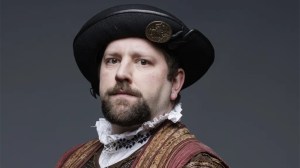
Richard Cromwell in The Mirror and the Light. Playground Entertainment/Nick Briggs

From The Private Life of Thomas Cromwell

Richard Williams was born around 1510, the son of Morgan Williams, a Welsh lawyer based in the Wandsworth/Putney area, and Katherine Cromwell (died 1517), the eldest sister of Thomas Cromwell. Initially, Richard and his brothers Gregory and Walter were all named Williams after their father, who worked for Thomas Grey, 2nd Marquis of Dorset and the wider Grey family. From about age 10, Richard worked with his father Morgan, and his uncle, fellow lawyer Thomas Cromwell, who had married Elizabeth Williams nee Wyckes. Morgan Williams died in 1528, likely of the same sweating sickness that killed Elizabeth Cromwell (and her daughters one year later). All three Williams children were part of the Cromwell household, as were their cousins Christopher, William, and Alice Wellyfed (children of Thomas Cromwell’s sister Elizabeth and her husband William Wellyfed), in London when the sweating sickness attacked the population.

By 1529, Richard was working for his uncle, and changed his surname to Cromwell, as did his brother Walter. Middle brother Gregory stayed as Williams, to avoid confusion with Thomas Cromwell’s son Gregory. Richard Cromwell rose in noble favour, liked and respected by all, working for Stephen Gardiner between 1530-1533 before going back to his uncle to see through the Dissolution of the Monasteries. In the process, Richard was awarded many great lands and homes, including the family manor in Hinchinbrooke. Richard married Frances Murfyn, stepdaughter of London mayor (and Cromwell family friend) Sir Thomas Denys in 1533, after initially looking to marry Catherine St. Leger of Anne Boleyn’s court (Anne  prevented her lady from marrying a Cromwell).

During the early 1540s, Richard Cromwell was at the height of his power, benefiting from the immense wealth and influence he had acquired through his family’s connection to the dissolution of the monasteries and King Henry’s personal favour. By 1540, Richard Cromwell had firmly established himself as a wealthy landowner and loyal servant of the Crown. But the dramatic downfall of his uncle Thomas on July 28, 1540, marked a turning point in Richard’s career. Richard had been named ‘the king’s diamond’ at the May Day celebration only one month before Thomas Cromwell’s arrest, and was given a knighthood. A painting celebrating the moment Richard was given a diamond from the king’s hand still remains today. This favour with Henry meant that when his uncle had to be destroyed to appease Emperor Charles, Richard Cromwell did not suffer the same fate as his uncle. Richard was not only in the king’s service because of his uncle and had created strong relations with powerful nobles at court on his own merit. His position remained secure, though he would have been acutely aware of the dangers of falling into royal disfavour.

Richard became the High Sheriff of Cambridgeshire and Huntingdonshire in 1541, and MP for Huntingdonshire in parliament again in 1542. King Henry loved to be bestow lands and buildings on Richard, including Huntingdon and St Neots Priories, the  Friary of St Francis, the Priory of St Helen Bishopsgate, Neath Abbey in near his family home in Glamorgan, Penally and Manobier manors, and the constableship of Goodrich Castle in the Welsh Marches. These properties each had valuations that ran into the hundreds of pounds back then, translating into being worth millions today. These all came thick and fast after Thomas Cromwell’s death, who had already ensured Richard gained many monasteries during dissolution in the 1530s. Richard soon became extremely wealthy, and was the only person allowed to openly mourn Thomas Cromwell at court. Life was not easy though, as Richard lost his wife Frances in early 1542, leaving behind only two surviving children, five-year-old Henry and newborn Francis.

By 1543, Henry VIII had turned his attention toward France, renewing hostilities that had long characterised Anglo-French relations. Richard Cromwell, an experienced soldier and a member of the gentry, played a major role in these military campaigns. In 1544, he joined the English army in the invasion of northern France, where Henry sought to reclaim lost English territories. Richard participated in the siege of Boulogne, a major English military success. This military involvement demonstrated his loyalty to Henry VIII and his commitment to securing favour at court. While he was primarily known as a landowner and administrator, his service in France reinforced his status as a capable and trusted nobleman. His involvement in these campaigns also reflected his continuing ability to navigate the complexities of Tudor politics despite the stain of his uncle’s downfall.

Sir Richard Cromwell’s life was cut short in 1544 aged only 34, possibly from illness likely picked up during the French campaign. His death did not lead to the downfall of his family; rather, his descendants continued to hold influence, with his great-grandson, Oliver Cromwell, rising to become Lord Protector of England in the mid-17th century, with catastrophic consequences for the Cromwell name. After Oliver Cromwell’s death, the family name was returned to Williams.

Wolf Hall 2: The Mirror and the Light – What Happened to Ralph Sadler?

Cromwell and Sadler in The Mirror and the Light. Photo: BBC/Playground Entertainment

From The Private Life of Thomas Cromwell

Thomas and Elizabeth Cromwell may not have had their own children in the early period of their marriage (just as Cromwell’s sisters did not), but they did take on a ward, young Ralph Sadler. Cromwell met Henry Sadler from Hackney, who worked with Morgan Williams for Thomas Grey, 2nd Marquess of Dorset. In 1517, Sadler’s wife Margaret died, leaving him with three young boys, Ralph, John, and infant Nicholas. Ralph, aged between seven to ten years old, went into Cromwell’s household and simply never left, becoming a son to Cromwell in all but name. Cromwell and Henry Sadler remained friends throughout their lives, the pair dying
just months apart, with Cromwell happy to aid the entire Sadler family. Ralph Sadler was Cromwell ward until 1527, when he started work as a clerk, first appearing in the paperwork on a murder case Cromwell was overseeing, the death of  Isabella Watson and her unborn baby.

Following the downfall of his patron and surrogate father, in 1540, Sadler managed to maintain his position at court, proving himself indispensable through his administrative expertise and diplomatic abilities. As co-Master Secretary to the king (with Thomas Wriothesley) since April 1540, Sadler came to grief alongside Sir Thomas Wyatt in early 1541, when the pair were arrested  on the king’s orders on very undefined terms. The king was still in a period of mourning Cromwell and yet suspicious of Cromwellians at court. The exact ‘crimes’ that Sadler and Wyatt committed go largely unrecorded. Sadler was given the chance to speak with Henry, and he managed to smooth-talk his way out of prison and remained in the privy chamber and Privy Council (Wyatt was sent to trial for speaking undefined slander and found innocent months later when Henry calmed down).

But Thomas Wriothesley, the great traitor, constantly bullied Ralph in his shared role as secretary. Sadler stayed out of Wriothesley’s way, and was one of the men tasked with overseeing the interrogation and execution of Queen Katheryn Howard in late 1541 and early 1542, alongside Thomas Cranmer. Sadler was removed as co-secretary in 1543 and given a figurehead role in the king’s wardrobe so he could remain close to the king, but his official position was to be a diplomat and advisor. Sadler did his best to make moves against Stephen Gardiner and the Duke of Norfolk throughout the rest of Henry’s reign in revenge for their behaviour against Cromwell. Both men continued to stir up trouble throughout the 1540s, and both men were committed to the Tower for all of King Edward’s reign.

Sadler came to grief in 1545, when his wife Lady Ellen’s first husband Matthew Barre reappeared, not dead after all, but the king had parliament ratify Sadler’s marriage and legitimise his children Thomas, Edward, Henry, Anne, Mary, Jane, and Dorothy through the Legitimation of Sir Ralph Sadler’s Children Act 1545 (37 Hen. 8. c. 30). The couple remained married for another 25 years until Ellen’s death.

After Cromwell’s execution, Sadler continued in the service of Henry VIII, who valued his experience in Scottish diplomacy. In the 1540s, he was sent as an ambassador to Scotland, where he worked to secure the Treaty of Greenwich (1543), which sought to unite England and Scotland through the marriage of Henry’s son, Edward VI, to Mary, Queen of Scots. The treaty ultimately failed due to Scottish resistance, leading to a period of military conflict known as the Rough Wooing. Sadler played a role in advising English commanders during this war, reflecting his continued importance in Henry’s foreign policy.

Henry VIII’s death in 1547 did not diminish Sadler’s influence. Under the rule of the young Edward VI, he remained active in government, supporting the Lord Protector, Edward Seymour, Duke of Somerset. He was involved in England’s ongoing military campaigns in Scotland, notably at the Battle of Pinkie Cleugh (1547). Sadler also took on key administrative roles, such as serving as Treasurer of the Army.

Following Somerset’s fall in 1549, Sadler’s career became more precarious. He briefly aligned with John Dudley, Duke of Northumberland, who took control of the government. However, when Mary I became queen in 1553, Sadler withdrew from public affairs due to his Protestant sympathies. Unlike many others associated with Edward VI’s Protestant government, he avoided execution, though he spent much of Mary’s reign in relative obscurity.

Sadler’s fortunes revived with Elizabeth I’s accession in 1558. As a Protestant, he was well-suited to serve the new queen. His deep knowledge of Scottish affairs made him invaluable during the tense negotiations between England and Scotland in the 1560s. He was again appointed as an ambassador to Scotland in 1559–1560, playing a role in securing the Treaty of Edinburgh (1560), which ended French influence in Scotland and helped establish Protestant control under James Stewart, Earl of Moray.

In the later years of Elizabeth’s reign, Sadler was tasked with overseeing the imprisonment of Mary, Queen of Scots. Though he had previously advocated diplomacy with Scotland, he recognised Mary as a potential threat to Elizabeth. In 1584, he was given the difficult role of Mary’s jailer at Tutbury Castle, though he treated her with kindness.

Sadler remained an esteemed elder statesman until his death in 1587, and he died as the richest commoner in England. His long career was marked by adaptability and discretion, allowing him to serve Tudor monarchs across a volatile period of English history. Unlike many of his contemporaries, he managed to navigate the shifting tides of court politics without suffering disgrace or execution.

The Life and Letters of Ralph Sadler will be published in 2026

OTD with Thomas Cromwell, 14 February 1537: Cromwell sends Princess Mary a Valentine

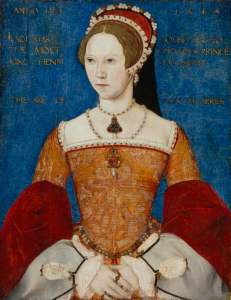
Princess Mary in 1544 by ‘Master John’, possibly Susanna Horenbout, NPG428

Only three years of Thomas Cromwell’s private bank account records still exist, and February 1537 hid a little piece of gossip. On 22 February, Cromwell’s private clerk made a note:

Lady Mary’s Grace, by Mr. Wriothesley, for by cause My Lord was her Valentine, 15l.

Never again, for any reason, is a Valentine mentioned in Cromwell’s paperwork. Cromwell had sent gifts and money to Princess Mary many times, and despite their extremely divided religious beliefs, they seemed to get along very well. Princess Mary’s letters to Cromwell were usually informal and kind, and they shared many godchildren, Cromwell’s grandson Henry included. Rumours that Cromwell would marry Mary had fallen from the lips of his enemies multiple times, all without basis of proof or merit, and it was used as part of the smear campaign in 1540 (along with Cromwell marrying Princess Margaret Douglas for some random reason).

Was the 15l (around £6,500 today) the gift itself, or did he spend 15l on something? A man could get a nice horse or two for that money. If it had been jewellery, it would have specified, as all of Cromwell’s payments to jewellers gave detail. Did Princess Mary need cheering up, so Cromwell sent her a gift? Her life had much improved by February 1537, reconciled with her father and Queen Jane, and spent Candlemas at Greenwich before moving onto Whitehall. Mary might have known Jane was newly pregnant, which significantly changed Mary’s life. Recently, the Pilgrimage of Grace had been calling for the king to make Mary his heir, or have her take the throne from her father, among many demands. The royal court needed to be seen as a solid unit that trusted one another, and that definitely included Cromwell’s need to be seen as in favour.

Or was the Valentine entry simply a joke? Had Thomas Wriothesley dropped off the gift to Princess Mary on St. Valentine’s Day and made a quip to Cromwell or Avery, who then wrote it in the ledger? or was the gift meant in a more simplistic pagan way, symbolising purification and health, or just the celebration of the start of spring? We have absolutely no way of knowing, but the comment was never crossed out of the ledger. Ledger entries were not always made on the day the bill was paid or money was received, so all detail is lost. But given that Wriothesley turned traitor against his master in 1540, perhaps the comment of Cromwell once sending a Valentine to Princess Mary was mentioned…

Cromwell’s ledgers are printed in full in The Letters and Remembrances of Thomas Cromwell

OTD with Thomas Cromwell 6 February 1530: Wolsey begs Cromwell’s help yet again

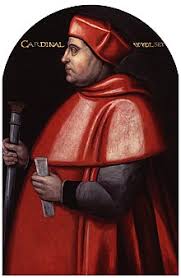
Thomas Wolsey c.1520. NPG32

On 6 February 1530, Cardinal Thomas Wolsey was looking to have his various vague charges of praemunire, and potential treason dropped by the king, after a blisteringly harsh parliament tried to have him convicted, the penalty being execution. Only Thomas Cromwell had spoken out in Wolsey’s defence, which had softened King Henry’s stance, and several others had tried to speak in Cromwell’s name to the king’s praising him and his courage, most notably Sir John Russell and Sir John Gage. Wolsey wrote many begging, pleading, woeful letters to Cromwell though the final months of 1529 and early 1530, begging for help and money, even though Cromwell visited Esher Place regularly, and paid wages and for supplies for the household.

On 6 February 1530, the king was close to caving and forgiving Wolsey for not securing an annulment, and several had gently tried to persuade the king to relent, catching Anne Boleyn’s anger in the process. Two letters from Wolsey survive, both attributed 6 February 1530, begging Cromwell to help him, as Cromwell had not recently visited Esher, due to the death of his wife Elizabeth. Wolsey was more concerned with himself than Cromwell’s retreat to Austin Friars in pain. Here is a portion of both letters, taken from my book of Cromwell letters, with my modern spelling and punctuation. Italics are all mine.

THOMAS WOLSEY TO THOMAS CROMWELL 6 FEBRUARY (Cott. App. XLVIII. 19)

“Mine only comfort, at the reverence of God leave me not now, for if you do I shall not long live in this wretched world. You will not believe how I am altered, for that I have heard nothing from you of your proceedings and expeditions in my matters… I hope you will not allow all your former labours to me to be cast away. I beg you to redub (restore) the matter, continue your accustomable goodness and sent me some comfort… Written this morning with a moste heavy heart, by your assured, Thomas Cromwell, we are miserable and unfortunate.”

  • This second letter is very mutilated and difficult to decipher. Wolsey tries to instruct Cromwell to speak to Secretary Stephen Gardiner and Treasurer William Fitzwilliam, and asks that Henry Norris and John Russell speak to the king on Wolsey’s behalf. He also requests John Arundell to travel to Esher and that Henry Percy was lying to the king about Wolsey. There was also a charge that Wolsey had coins minted with his face rather than the king’s which raised questions of further treason. It was Cromwell you spoke to the king on Wolsey’s behalf that following week, and got Wolsey’s charges all dropped.

THOMAS WOLSEY TO THOAMS CROMWELL 6 FEBRUARY 1530 (Cott. App. XLVIII. 18)

“Mine own good, trusty, and most assured refuge in this, my calamity. I am so encumbered with heaviness and anxiety that I cannot remember everything, but I trust to you to supply what we lack…  that you may be plain to Mr. Treasurer (Fitzwilliam), and specially Mr Steven (Gardiner), who, upon consideration thereof, may be the (person?) with the king in allotting and appointing of my pardon if he listen. No man can do me more good and you … yourself refer that his opinion was that I should have no less then 4,000l (£1.8 million today) yearly to live with, which mine… degree considered is with the lest, I could not forbear putting you in remembrance hereof, remitting the bettering thereof to your wisdom and good handling; and as touching the coin (where Wolsey had his face minted on a series of coins in 1526, which was seen as treason) with the letters and badge in the same, you may for your better knowledge refer to Robert Amadas and other officers (of the mint )… learned how the usage has been (done in this way for centuries)… I would gladly have (lawyer and attendant John) Arundell (here)… (Henry Percy, Earl of) Northumberland’s untrue and wrong information … meant mean betwixt him (and I?) … Mr. Norris, Sir John Russell … my good and ever be greatly to my comfort.”