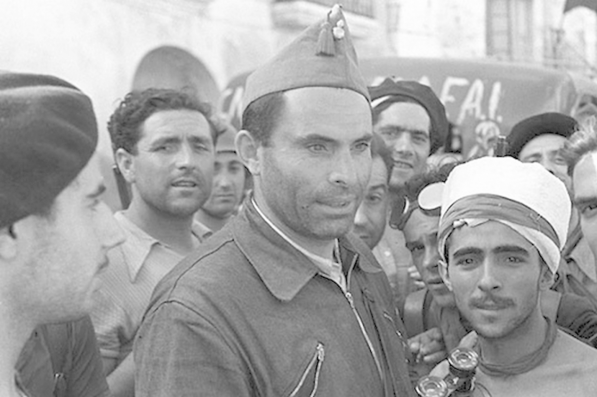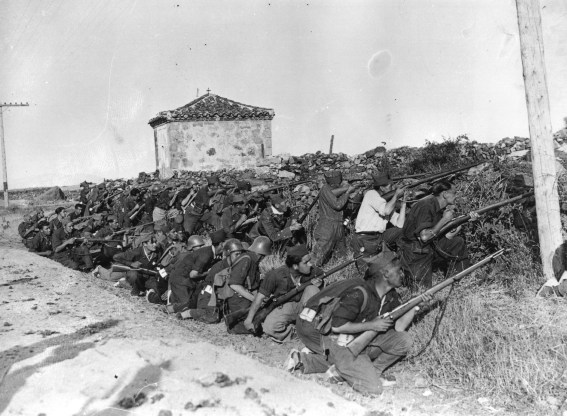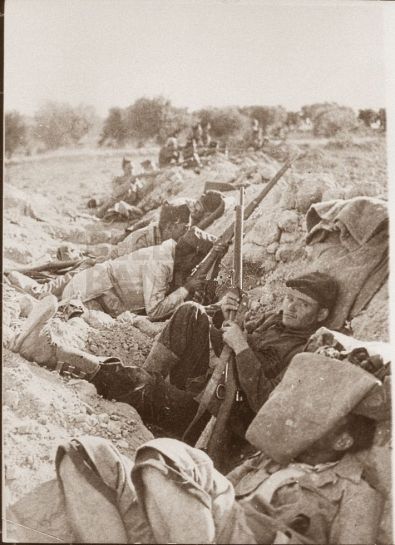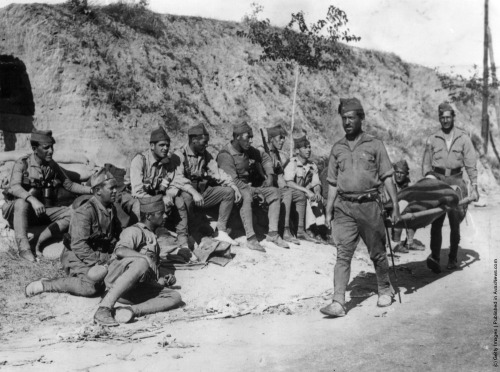
This Week In Spanish Civil War History Extra: José Antonio Primo de Rivera Executed

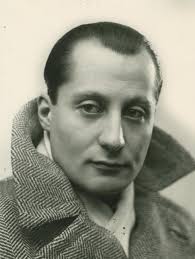
Would you look at this creep? Was there a vampire lookalike contest in Madrid?

José Antonio Primo de Rivera y Sáenz de Heredia, a mouthful of a name for a man who, at first glance, had a standard rich boy’s life, then got himself in with an equally awful man and got his name into history.

Born in Madrid on 24 April 1903, he got to inherit the noble title 3rd Marquis of Estella, from his father Miguel Primo de Rivera, Spain’s dictator through the 1920’s. He started with a typical aristocratic lifestyle, learning from home while being raised by his aunt, riding horses on the rich family’s estates, and then stumbled through university. Over six years, he received an excellent bachelors and doctorate in law while running a group opposing education policies. He graduated the same year his father became Spain’s dictator, assuming he could a better job than politicians. The sense of entitlement was huge in this family.

Baby Rivera went to do his one-year military service while Daddy Rivera started imposing his will on the country. Baby Rivera then got court-martialed for punching his superior officer. The officer had written a letter against Daddy Rivera and his son felt that violence would be the answer. But, naturally, a dictator’s son can hardly receive much of a punishment. (To be fair, the officer was Gonzalo Queipo de Llano, a nasty human being in his own right).

By 1925, Baby Rivera was back to being a lawyer in Madrid, working quietly in his office. With Spain going down the toilet for a variety of reasons, Daddy Rivera was forced to give up his hold on the country in early 1930, and died in Paris shortly after. Now, Baby Rivera was ready for politics.

Spain was in turmoil by the time of the 1931 election, and Rivera strangely ran for office as a monarchist for the Unión Monárquica Nacional party, and also oversaw (which was in opposing competition) the Agrupación al Servicio de la República. The monarchy fled Spain, and Second Republic was born. Rivera was on the wrong side of history. He managed to get his first arrest a year later in the 1932 Sanjurjo coup (also a failure).

But this young fascist was no quitter. By 29 October 1933, he launched his new Falange Española party in Madrid. His opening speech included his feeling that violence was important and democracy… not so important. He stressed that change could not come by elections, but by force. Despite a lack of serious numbers to the party, they could be noticed by the ‘right’ people (meaning rich and mean).

A month later, Rivera ran for office in the election again, for the Unión Agraria y Ciudadana, part of the CEDA (Confederación Española de Derechas Autónomas) group of parties. This time he won, to represent Cadiz in the far south. In February 1934, the Falange merged with the Juntas de Ofensiva Nacional-Sindicalista, and they became known as the Falange Española de las Juntas de Ofensiva Nacional-Sindicalista, with Rivera as leader. Then things really went south.

In early 1935, the Falangists started attacking Jewish stores, believing that violence was acceptable, because both Jews and Freemasons had too greater influence. Any meetings or rallies involving Rivera and the Falange were the scene of constant fighting and racism. The country was becoming a whirlpool of disaster – perfect for a violence-loving man like Rivera.

February 1936 saw another election, with the left-wing Popular Front winning. The Falangists only gained a mere 0.7% of the vote. But hate was on Rivera’s side. Despite the appalling turnout, right-wing sympathisers flocked to the tiny fascist party in the wake of the election, with 40,000 haters quickly signing up to the Falange. Suddenly the amount of voices spouting fascist rubbish was growing, stability was at nil, and the Falange were telling everyone to obey their leaders and prepare for burden.

Rivera hated everything. He spouted fascist rhetoric from Germany and Italy, despised democracy, had a thirst for war, believed women were useless, that people shouldn’t even be allowed to vote, and generally sounded like the Trump of his time. He liked to write poems, mostly about Spain being saved in its hour of truth, ruling with iron fists, blah blah.

Rivera got arrested in Madrid on 14 March 1936, on a charge of illegally possessing a firearm. They held him in custody for nine weeks and shipped him off to Alicante on the eastern coast. Sadly, things were too relaxed there and Rivera could still work with his party to be part of the group planning a military coup against the government. Rivera also wrote with General Franco, and had guns and ammo in his cell.

July 17 saw the outbreak of the Spanish Civil War, the Falange party standing alongside the rebels as the military rose up and killed thousands. Rivera remained behind bars, now in solitary confinement doing nothing while Spain burned. Franco was busy taking over a country with violence, but Rivera languished in jail. Franco never liked Rivera (calling him a foppish playboy) and Rivera played no role in the uprising. The Republicans even tried to swap Rivera for one of their prisoners, and Franco didn’t want him back. Franco took the rhetoric, took the support, and left Rivera to rot.

As Spain heaved through immense pain, it wasn’t until October 3 that Rivera got officially charged with conspiracy against the Republic and military insurrection. As a lawyer, he defended himself, with another failure on his part. He was convicted on November 18, and executed at dawn on November 20.

The Falange party was small, but they did one thing for Franco – while the soldiers were fighting on the front lines, the fascist nut-jobs were running in among the population, carrying out murders to aid the war. Franco had the army, and the fascists, the carlists and the monarchists, the churchmen and their followers, on his side, in every town and city. The Falange party was swallowed in 1937 when Franco killed their new leader, Rivera’s deputy, and gave the job to his brother (talk about a booby-prize). But Franco used Rivera, and his death, as propaganda. A facsist leader, embodying all the evil behaviour necessary to be a right-wing leader, was a great symbol for the haters who fought for Franco. Dead Rivera was named the 1st Duke of Primo de Rivera. When the war ended in 1939, Franco had Rivera’s body put in the royal El Escorial temporarily, and then moved in to Franco’s own super tomb, Valle de los Caídos, in 1959 at its grand opening. Franco also died on November 20, making the day a real super-freak anniversary.

Check out the anniversary of Franco dying  – The Beginners Guide to the 40th Anniversary of Franco’s Death

Check out the 80th anniversary of the death of someone great instead – 80 Years Since The Death of Buenaventura Durruti – 20 November 1936

~~

This is not a detailed analysis, just a highlight of Rivera’s life. Unlike most posts, there is no room for comments, as I don’t want to talk to anyone who supports fascism. I also do not want any more photos of him, his work, his Falange symbols or anything else on my site.

This Week in Spanish Civil War History – Week 18: 14 – 21 November 1936

Week 18: 14 – 21 November 1936

Simplified if you don’t read Spanish –

Numbers are labelled by position of where which column (group) is located on November 16-17. Blue squares are Nationalist, Red are Republicans, and orange are French (and associated supporters) supporting the Republicans. Grey lines – front line. Stars – volunteers in position. Blue arrows – Nationalists making their attack. Spotted blue arrows – aircraft flights, with bombs dropped (blue dots).

November 15

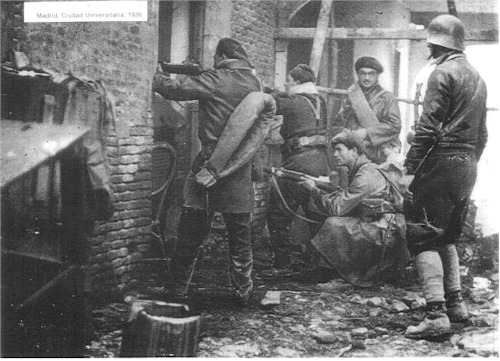
Nationalist soldiers (Morrocan regaulres and Legionaires)  cross the Manzanares River and take over in Ciudad Universitaria (University City). The XIth International Brigade for the Republicans men counter attacks at the ‘Hall of Philosophy and Letters’, however the whole column make it over the river. The Republican factions take the Hall and force the Nationalists to either be killed or run for cover, with over 85% being killed as they flee.

Nationalist soldiers make it as far as  Plaza de la Moncloa inside Madrid, some as far as  Plaza de España in central Madrid before being attacks by the Durruti Column and forced out again. At this point, most bridges over the Manzanares River are now destroyed.  The Nationalists build the ‘pasarela de la puerte’ (passageway of death), a makeshift bridge, which comes under machine gun from the university all day long.

November 17

The Nationalists take the Asilo Santa Cristina Hospital. The Republican Durruti Column attack them, and stretch out to fight in University City and the Casa de Campo. But the  Durruti Column does not have enough supplies and need to retreat back to University City.

November 18

Italy and Germany both recognise Franco as the head of the new Spanish ‘government’. After over a week of battling over Madrid, the leaders all expect Madrid to be taken. Franco is ready to take all the credit but has barely lifted a finger himself in the bloody battle for control.

German aircraft are still bombarding Madrid. This is done to weaken the Republican government into surrendering (though the official government has already gone), and to hurt civilians. The Germans are throwing everything at Madrid in a bid to strengthen their ties to the new Spanish government led by Franco.

The attack north of central Madrid in University City is now three days old and is at breaking point. The Anarchist Durruti Column from Barcelona has been at the front line the whole time, and now their 3,000 strong column is down to only 400 men. The Nationalist side too have lost 1290 men. The University City suburb is largely cut off from central Madrid but neither side have any advantage.

November 19

The Durruti Column launches its dramatic big assault in University City. The Nationalists have taken the hospital and the Buenaventura Durruti men launch an attack.  The Republicans are under prepared and have little supplies; the Nationalists are not used to combat in urban areas. Fighting results in 262 Nationalist killed with no ground gained at all. The Nationalist leaders, Colonel Yague and Colonel Mola are both close to losing faith as they do not want to fight in close quarters, a fight they cannot win.

The Nationalist and Republican/International Brigades fight for control if the Hospital Clínico in the east of the University City. After heaving fighting, the sides fight with grenades and bayonets, one room and floor at a time. Both sides suffer heavy losses.

The outskirts of the city

Buenaventura Durruti is shot while on the front line in the early afternoon in the Casa de Campo.  A bullet pierces his right lung, possibly entering through his back. No one knows (or claims to not know) what actually happened. Which weapon shot him is unknown, and some speculate he was shot by his own side rather than the enemy. The true story will never be definitively uncovered.

NB: There will be a ‘This Week in Spanish Civil War History; Extra’ on Durruti on November 19, including eye-witness accounts of his death and the ‘cover-up’ story.

November 20

Buenaventura Durruti dies at 6 a.m, 16 hours after being shot in the chest. He is aged just 40 and it strikes not just a blow to end his life but also to the end of the propaganda surrounding the Durruti Column, a huge blow to the Anarchists. Durruti dies in the Ritz Hotel, which is now a makeshift hospital, and the bullet is not taken out of his heart. No autopsy is performed.

Buenaventura Durruti – anarchist fighter (and character in my next SCW novel)

November 20

Another 294 Nationalists die while fighting to take Carabanchel and Vertice Basurero to the south of Madrid. Again no gains are made in the urban assault, weakening the entire plan to take Madrid  by force.

José Antonio Primo de Rivera, son of former Spanish dictator Miguel Primo de Rivera is executed in Alicante, two days after being sentenced. Primo de Rivera has been a prisoner there since the start of the war. The Communists holding him decide to try him in a civil court before a Communist governor, as they can no longer wait a decision from the government. He is the leader of the fascist Falange party, and is killed by firing squad at dawn.  Spanish PM Largo Caballero is angered at the Communists for taking their own action, but the Republicans rely so heavily on Soviet supplies and men. The Spanish Communist party is continuing to strengthen and is becoming a state within a state.

NB: There will be a ‘This Week in Spanish Civil War History; Extra’ on Primo de Rivera on November 20.

Jose Antonio Primo de Rivera – Fascist leader

November 21

The Nationalists attack the Model prison and Don Juan barracks. Using bases by the Asilo Santa Cristina Hospital and Dr Rubio Research Institute, they manage to get as far as Parque del Oeste, but are bombed by their German counterparts.

The Commune de Paris column fighting for the Republicans recapture the Hall of Philosophy and Letters Building. Books are used to protect themselves inside. It takes around 350 pages to stop a bullet.

The siege is now days away from its end.

Books as protection seen by Robert Capa

~~

This is not a detailed analysis, just a highlight (lowlight?) of the week’s events. Feel free to suggest an addition/clarification/correction below. All photos are linked to source for credit

This Week in Spanish Civil War History – Week 17: 7 – 14 November 1936

Week 17: 7 – 14 November 1936

(see Week 16: 1 -7 November 1936 for the Madrid lead-up and maps)

Republicans orange, Nationalists blue

November 7

The attack on Madrid begins. All major bridges are attacked by Nationalist troops, most taken easily on the first day of fighting. General Varela attacks from the north, and troops pour into the Casa de Campo and through Ciudad Universitaria. Nationalist troops fight Republican militia in man-to-man combat, and killing occurs one building at a time as Nationalists swarm the city. The death count rockets on both sides. Despite their soldiers’ training and weapons, Colonel Yague sees over 300 of his Legionnaires Moroccan troops killed on day one. Franco expects the Nationalists will have won within a day, unaware the International Brigade troops are one day from arriving from east, along with the Durruti Column anarchists from Barcelona, in time to back up huge number of Spanish militia and hold back the conquering of Madrid.

The start of the massacres in Paracuellos del Jarama, a small area in the north of Madrid. Political prisoners, most soldiers and priests arrested at the outbreak of war, are taken out of the city to be executed. Between November 7 until December 4, the 5,000 prisoners are moved, as the Republicans don’t want hostile Nationalist prisoners inside the city. Some are moved away from the front, but Paracuellos del Jarama is the site of multiple executions. Over the first few days, 1,000 prisoners, all Nationalist sympathisers, will be shot. The death toll will be unknown; many say 2,000-3,000, some up to 12,000.

International Brigades in Casa de Campo

November 8

The major launch on Madrid begins. General Mola attacks with 20,000 soldiers, mostly the Moroccan troops. The Condor Legion from Germany launches air strikes on the city. German officer Wilhelm Von Thoma leads German tanks alongside light amour support from Italy.

The Republicans have more men, and send 12,000 to Carabanchel, but the larger force of 30,000 heads to Casa de Campo. The problem lies in the detail; the Republican men have had little or no training at all, and have only ten rounds per rifle. Only sheer numbers hold off the Nationalists. Small groups of Moroccan regulares soldiers manage to get over the Manzanares River to Model Prison, which is the set target for the onslaught. One of the Republican leaders, General Miaja, took his scared men forward himself to try to force the soldiers back. Radios all over Madrid repeatedly called the classic ‘­­¡No pasarán!’ (they shall not pass!) slogan, calling everyone to help in the fight against the siege.

By evening, the first International Brigade arrives, the XIth battalion, from Albacete in the east. There were small in numbers, but they provided morale and back-up for the fighting Madrileños. The men had not finished their basic training. They were greeted on Gran Via as a Soviet Union battalion, though they were a mix of German, Polish, Italian French and small numbers of other countries.

Telegrams are sent to the War Ministry in Madrid, congratulating Franco on his victory; no Nationalists are in Madrid, and neither side has won anything.

Nationalist soldiers at the front

November 9

The Nationalists focus on taking the southern Carabanchel suburb. The Moroccan soldiers are trained in open-country fighting and not the urban battle they need to fight. Republicans, who work and live in the area, have the home ground advantage, and there are many Nationalist casualties as the Republicans again hold the enemy back.

The XI International brigade, 1,900 men, start their fighting in Casa de Campo alongside Republicans in the evening. Heavy fighting sees 2/3 of the Internationals killed, though the Nationalists do not advance into Madrid. Fighting will last for several days, with both sides suffering losses. The Nationalist no longer see Casa de Campo as a way into Madrid, though this is not just due to international fighting, but their presence is good for propaganda.

The San Fernando bridge, which flanks the left of the Nationalist-held area over the Manzanares River, is retaken by the Republicans.

Air strike damage

November 10

Ciudad Universitaria in the city’s north is under Republican control, though the Nationalists are prepping the take the area. Around 150 Nationalists are killed on the front line around the north of the city, a total of 2,369 casualties since the start of the siege.

The Durruti Column, a group of 3,000 anarchists from Barcelona, arrive in Madrid, ready to help defend Casa de Campo. They had been marching to Zaragoza to recover the city from the Nationalists, but had no success and carried on to Madrid to help. They are led by famous anarchist Buenaventura Durruti.

University City area held by Republicans

November 11

Another 1,000 Nationalist prisoners are killed in the Paracuellos del Jarama reportedly by the Fifth Column, a communist led group of Spanish militiamen, who are well-organised and well-trained, unlike most in the area. The prisoners, all taken from the Model Prison in inner Madrid, are shot and bodies are dumped, in retaliation for the Nationalists attacking the city. The killings are one of the Republicans’ sides most vicious single-acts against civilians.

The arrival of the Durruti column causes some discontent as the placement of the men is up for debate, as the anarchists and Madrid-based militia try to work together. Regardless of any tensions within Madrid, the Nationalists are still held outside Madrid for another day.

Refuge from bombing in the Madrid subway

November 12

The XII International Brigade arrives in Madrid and launches an attack on Cerro de los Ángeles hill, south of Madrid, only just taken by the Nationalists. This is to ensure the Nationalists cannot advance east of Madrid and claim the road to Valencia. The attack fails, but the road to Valencia is still secure. The brigade of Spanish, French, German and Austrian fighters are suffering from lack of training and supplies, and communication trouble, but the 1,500 strong brigade returns to the safety of Madrid, with minimal losses.

The children of Madrid

November 13-14

The battle continues in Carabanchel, and man-to-man fighting continues right in the military hospital, with the Republicans losing many men but still holding the area.

Fighting along the south and west of the city continues, with air strikes on the city combined with close combat fighting. The Nationalists are preparing to take Madrid via the northern Ciudad Universitaria area, as Casa de Campo and Carabanchel manage to hold safely. The International Brigades are basing themselves in the north now to hold the Nationalists back.

Republicans at the front

~~

This is not a detailed analysis, just a highlight (lowlight?) of the week’s events. Feel free to suggest an addition/clarification/correction below. All photos are linked to source for credit

This Week in Spanish Civil War History – Week 16: 1 – 7 November 1936

Week 16 sees the starts of the Siege of Madrid, which will last until the end of the war in 1939. Also, the Republican government leaves Madrid for Valencia

November 1

The Nationalist army, which has been marching north from Seville since the outbreak of war, has now reached the outskirts of Madrid. Around 90% of Republican fighters in Madrid are civilian militia, and the government has little control, as they have been set up by the trade unions and communist groups. All the small towns surrounding Madrid have now been taken by Nationalists and the Republicans are now backed into the city. Nationalist numbers are at now 25,000 but the Republicans have double the men. But the Nationalists are highly trained and battle ready, while the Republicans are not soldiers or have proper weapons and supplies. Propaganda leaflets are dropped over Madrid city by Italian planes, warning the public that Madrid will be wiped off the earth if they do not rise up and take the city for Nationalists.

The government has no faith in their side and expect General Mola and his Nationalist men to take the city, and plan to evacuate, including the Prime Minister. General Mola states to the English media that his four columns of regulares soldiers and Moroccan fighters will take the city, despite the difficulty of surrounding Madrid, and his fifth column, of powerful Spanish right-wingers, already in the city, will take inner Madrid. This strikes paranoia in the inhabitants, and starts killings between civilians as ‘traitors’ need to be found and executed.

tumblr_mvq9t063nn1t00990o1_500

Troops in the city’s north of Ciudad Universitaria

November 2

The Republicans finally get air defense over Madrid. Russian Chatos planes have arrived just in time and start air strikes over surprised Nationalist ground troops. The public are unsure of the air strike and do not take cover. Several Russian planes are shot down by Italian retaliation for the Nationalists. The Madrid public fear German planes, and when a Russian pilot parachutes to safety after a strike, he is killed by a mob when he is mistaken for a German Condor Legion pilot.

The town of Brunete, only 15 miles west of central Madrid, is the scene for a battle between opposing sides. The Republicans lose the stronghold, giving the Nationalists a chance to get even closer to the city from the west.

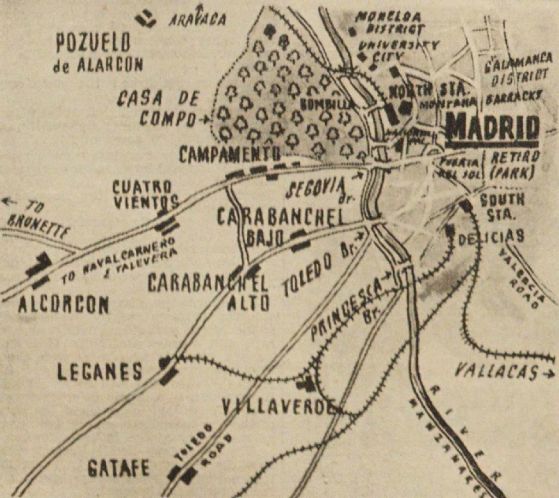
The Republicans have one advantage. The Manzanares River runs through the city, providing a barrier, keeping the Nationalists from walking directly into the west and south of the city. The Casa del Campo, an open park area on the west of the city centre, is chosen as the main strike area, with forces crossing the Puente de los Franceses (Bridge of the Frenchmen). Republicans are already defending their bridge. The northern Ciudad Universitaria (University City) area of Madrid is also prepared for an attack, likewise Carabanchel in Madrid’s southwest, which has only a  small river defense.

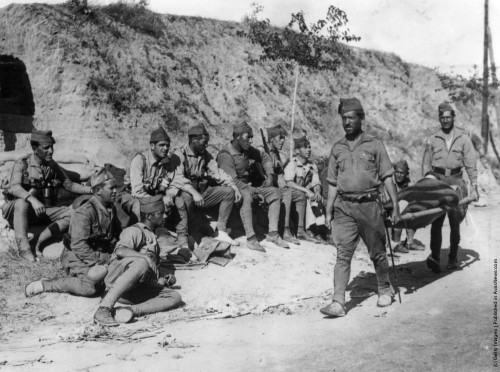
Nationalist troops retreat with their wounded

November 4

The anarchists now join the Republican government, with four ministers involved. As the anarchists are the largest group of civilian militia fighting for the Republicans country-wide, they need their voices in government. The Republicans must reply of all factions coming together to save their country.

The south Madrid suburb of Getafe is occupied by the Nationalists. It is at the basin of the Manzanares River, giving easier access to troops. The Moroccan troops attack, with tanks and overhead air strikes, crushing the Republican protectors. Vicious General Verela, a man leading so many massacres, is proud to tell the media that he shall have destroyed Madrid within the week.

Only 115 Nationalists are killed in the Getafe battle, but southern suburbs are working class and heavily populated, meaning it is not a good place to engage in street battles. Verela instead plans to attack Ciudad Universitaria in the north, where the population have fled for the safety of the inner city.

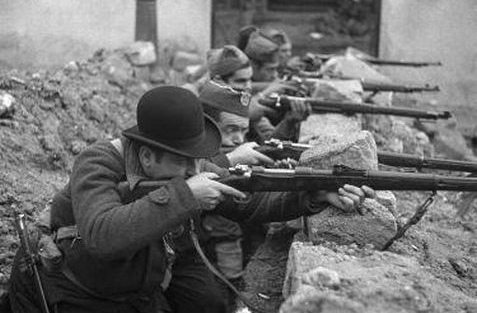
Republican militia defend their barricades in the south

November 5

The Republican reinforcements of Russian planes and pilots have some success when they bomb surrounding Nationalist troops, and an impeding northern assault of the city is beaten back.

tof-01-057

The Republicans defend the outskirts of the city

November 6

The Nationalist troops continue their southern assault under cruel Colonel Yague, and conquer Carabanchel and take the Cerro de los Angeles hill, the geographical centre of Spain, and prime lookout area over the plains around southern Madrid. The Nationalists are now all-but in the inner city of Madrid, with Republicans ever squeezed into the capital. The new Junta de Defensa de Madrid (military government team) is set up under General Miaja and is ready to take Madrid.

Propaganda is rife

The Republican government flees to Valencia, 350kms to the east on the coast. While this means men in ‘power’ are safe, as well as the government itself, the civilians and fighters of Madrid are left to face the Nationalists, with their German and Italian fascist back-up, on their own.

A simplified map of the Madrid suburbs

November 7

The attack on Madrid begins. All major bridges are attacked by Nationalist troops, most taken easily on the first day of fighting. General Verela attacks from the north, and troops pour into the Casa del Campo and through Ciudad Universitaria. Nationalist troops fight Republican militia in man-to-man combat, and killing occurs one building at a time as Nationalists swarm the city. The death count rockets on both sides. Despite their soldiers’ training and weapons, Colonel Yague sees over 300 of his Legionnaires Moroccan troops killed on day one. Franco expects the Nationalists will have won within a day, unaware the International Brigade troops are one day from arriving from east, along with the Durruti Column anarchists from Barcelona, in time to back up huge number of Spanish militia and hold back the conquering of Madrid.

The attack begins

~

This is not a detailed analysis, just a highlight (lowlight?) of the week’s events. Feel free to suggest an addition/clarification/correction below. All photos are linked to source for credit

SPAIN BOOK REVIEW SEPTEMBER: ‘­­¡No Pasarán! Writings from the Spanish Civil War’ by Pete Aryton

Hope, resignation, despair, sadness, humour, confusion, ruthlessness, compassion, kindness, generosity and love inhabit Pete Ayrton’s anthology of writings from the Spanish Civil War: there is little sense of certainty and still less of triumphalism among the bewilderingly diverse Republican and Nationalist coalitions, all shades of which are represented here. Previous collections privileged the writings of the International Brigades over those of the Spanish, sometimes excluding them altogether. ¡No Pasarán! corrects the balance: by far the largest contingent of its thirty-five writers are Spanish, including Luis Buñuel, Manuel Rivas, Javier Cercas, Arturo Barea, Joan Sales and Chaves Nogales. The remainder offer contrasting perspectives of participants in the conflict from America (among them John Dos Passos, Muriel Rukeyser and Langston Hughes); Italy (Curzio Malaparte and Leonardo Sciascia); France (Jean-Paul Sartre, André Malraux and others); Germany (Gustav Regler); Russia (Victor Serge); Great Britain (including Arthur Koestler, George Orwell and Laurie Lee); Cuba, Argentina and Mexico.

Pete Ayrton brings together hauntingly vivid stories from a bitterly fought war. This is powerful writing that allows the reader to witness life behind and at the front lines of both sides.

cover art and blurb via Amazon – released 2016

~~

¡No Pasarán!: Writings from the Spanish Civil War, is a selection of texts, mostly from Spanish writers, all brought together by Pete Aryton. The story of the SCW is so often told by foreign journalists and writers, and through the eyes of the International Brigades. This time it is a far more Spanish view of the war.

The book makes a strong start with Luis Buñuel with My Last Breath, which forms part of his autobiography. The chapter tells of when Franco arrives in Spain, when Buñuel was in Madrid. While Buñuel longed for revolution, the initial siege between Spaniards in Madrid is shocking for the artist. The book goes a long way to describe all the groups on the Republican side (Anarchists, Socialist, Communist, etc,) trying to come together to fight a far more organised enemy. Importantly, what the anarchists wanted for Spain – their own utopia-like society is explained and discussed. Buñuel is one, if not the best, voice in the book and the one who explains the war the best, from the beginning, and from the ideas of multiple sides.

A great piece of writing is that of Dulce Chacón. Her chapter -The Missing Toe’, part of her novel The Sleeping Voice, is about a female prison, Prisión de Ventas in Madrid. The prison is run by guards and nuns and is vicious place to be.

One advantage of this book is the voice of José María Gironella, who fought for Franco and was Catholic. This way, the destruction of churches and burning of priests can be explained from the religious-minded and the destruction (in this particular case) by Communists. The Republican crimes aren’t glossed over in this book.

One excellent read is a part from Forbidden Territory by  Juan Goytisolo. In a rich part of Barcelona, Franco supporters hide in wait for safety. The writer’s family themselves are affected and killed. While Barcelona during the war is so often centred on the controlling Anarchist/Republican factions, an insight to the enemy side is confronting and sad.

A portion taken from The Wall, by Jean Paul Sartre, is short but essential. Pablo Obbieta is a Nationalist prisoner, threatened with death unless he tells info to his captors. But as Nationalists never keep prisoners and leave only bodies, nothing can end well.

The eternal voice of Arturo Barea is naturally included, ‘The War is a Lesson’ from The Clash. It focuses on the portion where Barea needs to leave Madrid for his safety, though never wants to leave the besieged Madrid, the centre of the battle for his country.

This collection by Pete Aryton is an essential read. It not only beings together Spanish voices, it can also be a literal reading list of other writers to look for, voices often forgotten in SCW reading lists. Other notable voices included are Lee, Orwell, Rivas, Cercas and Soler, while including lesser mentioned authors Rororeda, Atxaga, Fraile, Etchebáháre and many more, a total of 38 writers. Everybody needs this book.