This Week in Spanish Civil War History – Week 28: 22 – 29 January 1937

Week 28: 22 – 29 January 1937

January 22

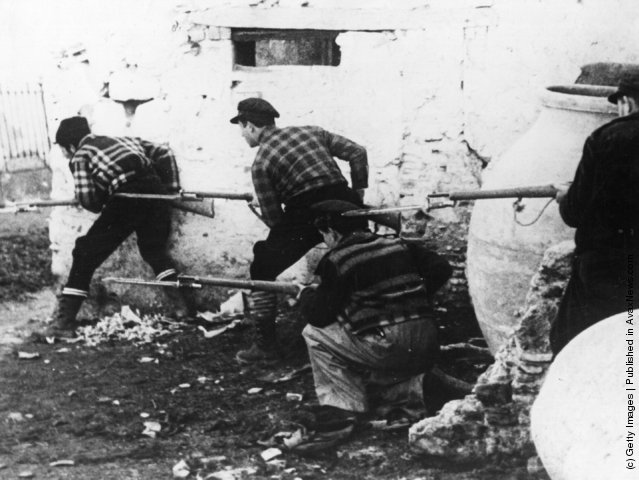
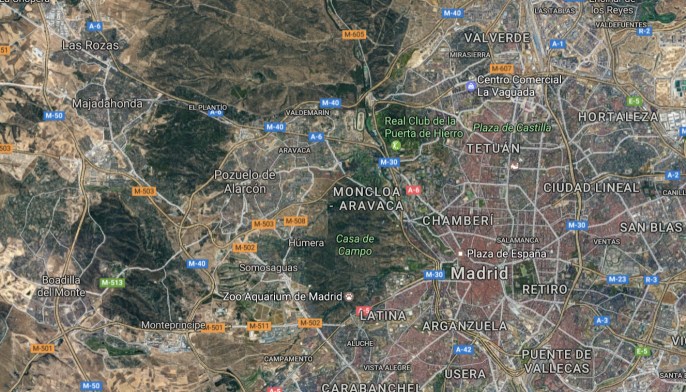
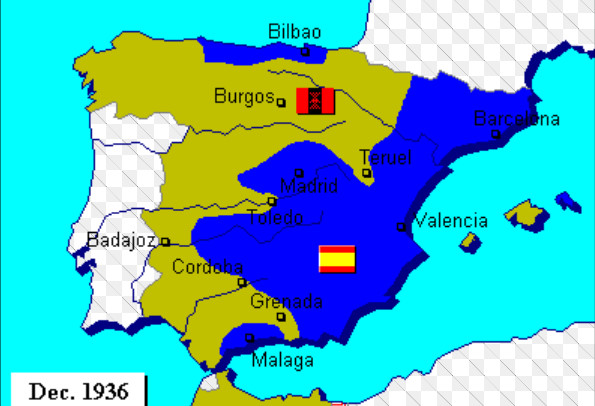
The Nationalists forces have been constantly battling to take Madrid since early November and still not able to get into the city. Franco decides its time to change tactics and attempt to cut off the city  by crossing the Jarama river, south-east of the city. This will cut off Madrid’s communications with Valencia to the east, which is the temporary Spanish capital. Franco groups together General Mola, General Varela and General Orgaz, and plans an attack 7 miles south of Madrid, with 25,000 troops and heavy artillery. The German Condors are also called in to help, while Italian troops plan an attack on Guadalajara at the same time. They plan to attack in early February.

Nationalist forces in the Jarama region

January 25

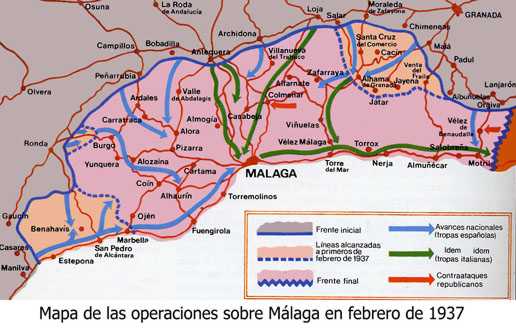
The newly formed Army of the South is still marching towards Malaga in the far south. The city is still in Republican hands, but their inland areas are slowing being eaten away by incoming troops left and right, while Italian troops march in to meet them in Malaga. The troops will take the remaining 10 miles left inland around the city in every direction as they face no resistance from unarmed Republicans.

January 27

The Basque Statute of Autonomy in the north is still holding, after being formed in October. The city of Bilbao is filled with civilians who have fled to the far north to find safety from Nationalist forces. But the Nationalists have been striking the city from the air repeatedly, to outcries from both sides. The Basques/Republicans are mostly civilians trying to stay safe, and there are prison-ships parked in the city where Nationalists are being held, now in danger by their own side. Over January, 224 are killed.

January 29

The workers’ militia are still controlling Barcelona, and most of the Catalonia region; most workers belong to the CNT/FAI. These militias have been working with the Catalonian government since the uprising in July, though the workers unions have control of the area. They have around two million members, plus the allies from the UGT union with one million members, and the Communists have just a few thousand. Regardless of numbers, everyone has equal representation.

Through some of the Catalonia region, and through much of the neighbouring Aragon region, militias have established an anarchist-led movement based on freedom and lack of government, working with the locals. While these sides in Barcelona are opposed to the Nationalist invaders, the Republican government in Valencia also sees these people as enemies, as the movement promotes freedom from government. As the situation continues to evolve, the CNT maintain control, with some representation from the Communists. The anarchists have opposition to all supervisory positions.

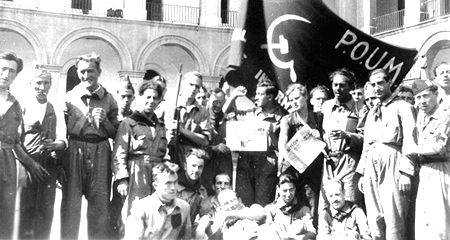
But trouble is starting to brew as so many factions working together is running into constant problems. The anarchists cannot work closely with the Socialists, Communists and Catalan nationalists (as in wanting independence from Spain, not the rebel Nationalists). Barcelona also has the communists splitting into different factions, some supporting Spain and the Soviet Union, the others supporting the Catalonian independence groups. Also now gaining traction are the Marxists, who formed the POUM (including famous writer George Orwell), who believe in war to gain social revolution, like the anarchists.  But the Marxists are also flaring up against Trotsyists. With all these groups working and living together, while trying to set up a new social order and hold back the Nationalist troops trying to conquer the area, things are getting heated and shaky in the northeast. They are more looking at each other rather than their common enemy.
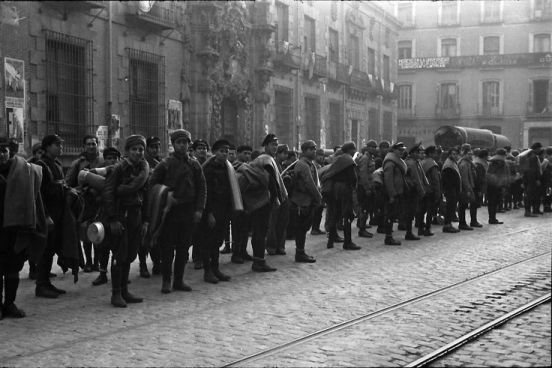
XV International Brigade volunteers arrive in Barcelona, January, 1937

~~

This is not a detailed analysis, just a highlight (lowlight?) of the week’s events. Things get lost in translation – Feel free to suggest an addition/clarification/correction below. The more the world remembers, the better. All photos are linked to source for credit.
This Week in Spanish Civil War History – Week 27: 15 – 22 January 1937

January 15

The third battle of Corunna Road ceases. The Nationalists have convincingly won the first and second waves of battle, and now both sides are exhausted. The XII International Brigades do not have the men or supplies to take back any of the northwest Madrid areas, and the Nationalists can’t get any further with their numbers. Both sides are now exhausted and give up in their plans. The Corunna Road route is still technically open and supplies still have a chance of getting through to Madrid, though now the city will have to rely more on the roads coming from Valencia and Aragon in the east/northeast.

Routes of soldiers prior to the battle: Spanish/Moroccans blue, Italians green, Republicans resistance red

January 17

The Nationalists form a plan to take Malaga on the southern coast. The huge losses at the Battle of Corunna Road have made the Nationalists keen to redirect their offensive, and decide to focus away from Madrid. The Nationalists have had 10,000 fresh troops arrive from Italy to the port of Cádiz, and are sent towards Malaga with their light tanks and armoured cars. Columns of Moroccan troops mixed with Spanish Carlists troops, around 15,000 men,  are sent from Seville and Granada. The Nationalists have four cruisers, the  Canarias, Baleares and Velasco ready to bomb Malaga from the sea, and the German Admiral Graf Spee is brought into the area.

The troops form the new Army of the South, run by Captain Queipo de Llano, who brings in men from the west while Antonio Muñoz Jiménez brings in men from the northeast. The Republicans hold a stretch of coastline around 25 miles long, with the port city of Malaga in the centre. In the first week, the advance of the Nationalist troops is 15 miles into the Republican held area, as the Republicans are poorly armed.

As Nationalist troops march through the Malaga region, the Republicans fail to see the groups of Nationalists are all heading directly for Malaga, so the city is not notified or prepared for the huge coming attack. Malaga is run by around 12,000 anarchist CNT militia, though only 8,000 are armed. There are rumblings between the allied CNT and communist militias, and none of the men in the area have been trained for warfare, though are keen to fight for their home. The Republicans have little ammunition, have no trenches dug, no roadblocks in place and nothing to protect them from the air.

The lack of preparation from the Republicans means the large civilian population of Malaga are now under serious threat, and a massacre is imminent.

Defence at Cerro de los Angeles

January 19

General Enrique Líster based in Madrid is in control of more International Brigades, which are going in numbers and more men are becoming trained, or are now already battle-worn. The Republicans are in short supply of both men and ammunition. General Lister leads a column of International Brigades to try to recapture Cerro de los Angeles, just south Madrid. The Nationalists took the overlooking area of Madrid in November and have been using the hill as an artillery base to shell the city. Lister and his foreign volunteers claim the hill for the Republicans are a day of fighting. Madrid is in need of this respite from constant bombardment.

Republicans atop Cerro de los Angeles, once a religious site


~~

This is not a detailed analysis, just a highlight (lowlight?) of the week’s events. Things get lost in translation – Feel free to suggest an addition/clarification/correction below. The more the world remembers, the better. All photos are linked to source for credit.

This Week in Spanish Civil War History – Week 26: 8 – 15 January 1937

Anarchist supporters in Barcelona

January 8

The Popular Executive Committee of Valencia is dissolved. The Committee is one of eight main groups set up to look after regions (broken into almost smaller 600 collectives) which have been participating in the Spanish Revolution, an anarchist-driven change in way of life for workers of their regions. Aragon was the main driver of this movement, along with neighbouring Catalonia and Valencia regions. Workers unions were collectivised and land is redistributed between workers to create a new, more equal society. At its peak, between five to seven million people were involved in participating in this enormous and ambitious change. Now through three main phases of its operation, the end is coming to much of the programme, which is suffering for a myriad of reasons (this post could go on for months if I get too detailed). The Popular Executive Committee of Valencia, which set laws and rules in the region, is taken over by the Republican government, which can now take control of anarchist popular militias. The militias now have to join the Popular Army and fight officially for the Republicans and fight under the command of professional army officers (anarchist principles are against hierarchy). While the revolution is huge and successful many places, the collapsing of major collectives such as the Popular Executive Committee signals the beginning of the end for the anarchist revolution. (Click on the above or below photos captions to read more about the collectives and revolution)

Examples of anarchist money coupons issues in some collective areas. Other areas did away with money completely

January 9

The second battle for Corunna Road outside Madrid is coming to a close. In one day, the Nationalists take seven miles of the road between Las Rozas and Puerta de Hierro. The Republicans and International Brigades have all been killed, and a handful have managed to flee, leaving the Nationalists to control the critical supply road into Madrid.

The Garabaldi battalion, part of the XII International Brigade

January 10

The XII International Brigades (mostly Spanish volunteers, along with Italian, Franco-Belgian and Albanian volunteers) enter the region from Madrid to start the third Corunna Road battle. The next five days of fighting shall see them fight to recapture the northwest Madrid areas of Majadahonda, Villanueva, Pozuelo and Boadilla, all areas taken during the Corunna Road battles. The heavy fog has dropped on the region again making fighting cold, wet and difficult.

January 11

The Nationalist forces, which have only just finished the battles killing so many Republicans, have lost up to 15,000 men themselves (the same as the Republican side) and take cover in trenches in the under siege Madrid areas, as they are suffering from their casualties and lack of supplies.

Republican forces lying in ambush in a village near Madrid

January 15

The third battle of Corunna Road ceases. The Nationalists have convincingly won the first and second waves of battle, and now both sides are exhausted. The XII International Brigades do not have the men or supplies to take back any of the northwest Madrid areas, and the Nationalists can’t get any further with their numbers. Both sides are now exhausted and give up in their plans. The Corunna Road route is still technically open and supplies still have a chance of getting through to Madrid, though now the city will have to rely more on the roads coming from Valencia and Aragon in the east/northeast.

~~

This is not a detailed analysis, just a highlight (lowlight?) of the week’s events. Things get lost in translation – Feel free to suggest an addition/clarification/correction below. The more the world remembers, the better. All photos are linked to source for credit.

This Week in Spanish Civil War History – Week 25: 1 -7 January 1937

January 1

By the 25th week of the war, neither side would be able to say their plans had been executed the way they hoped. The Nationalists had hoped to invade, take Madrid and rule the nation within weeks or months. The Republicans came together, multiple factions with similar principles, hoping to oust the fascists. At no stage were they prepared enough to see through their goals. 1937 would see Franco’s plans to take Spain become more established. Franco had much help from Hitler and Mussolini, while the Republicans still had the Soviets on their side, due to the large Communist faction in Spain. But with Republicans made up of many groups and no one clear leader, divisions were one of the main forces at play in the war, with Anarchists and Communists splitting constantly from the Socialists and workers’ militias. As with all wars, the regular people were constant losers.

January 3

The third battle for Corunna Road, just northwest of Madrid city, commences.  General Orgaz Yoldi has gained more Nationalist reinforcements and begins the offensive, known as the Battle of the Fog. The Nationalists retake the town of Boadilla del Monte, as the Republicans are still suffering from their earlier losses. The Republican have five divisions working together, along with the XIV International Brigades, but have little ammunition and have to surrender the town and that portion of the crucial supply route of Corunna Road.

January 4

With surging numbers of Nationalist soldiers coming from the right, the Republicans have to retreat even further away from Boadilla del Monte and also lose the town of Las Rozas, just 11km north of Boadilla del Monte. The weather is at freezing point all day and night and the fog continues to make battle ever more difficult.

The Republicans deploy more units from Pozuelo, ten kilometers west of Madrid city. The Modesto division, a brigade of four units combined, manage to secure the front while other units retreat from advancing Nationalists. The fog continues to thicken, aiding to secure the front for the Republicans and keep the Nationalists at bay, though the strategic towns have been lost. But once the fog lifts, the Republicans know they are in trouble.

Some of the Thaelmann battalion prior to battle

January 5

As the fog lifts, the Nationalists, with 18,000 troops and air support, attack Pozuelo, where many Republican forces are in retreat. The Republicans run out of ammunition, including for the T26 tanks from Russia, which have destroyed 25 German tanks throughout the day. The Republicans have to scatter, without weapons or communication, being split by the attack. Republican General Miaja tries to get the German Thaelmann battalion of the XIV International Brigade back together, along with Lister’s Communist unit, in order to try to regroup. The Nationalists continue to widen their hold over Corunna Road and also take the opportunity to bomb the city of Madrid, mostly by day.

All of the XIV International Brigades are forced far back from Boadilla del Monte and the Nationalists have Corunna Road. They meet up with other Republican groups and are ordered to retake Las Rozas, but they lack the men or firepower to do so. Among the young foreigner volunteers was untrained machine-gunner 17-year-old Esmond Romilly, nephew of Franco-sympathiser Winston Churchill. (It was rumoured that Romilly was Churchill’s own son, Churchill having bedded his wife’s sister. The sisters’ mother was a notorious cheater, and their real father(s) is unknown. Several men are options, one being the grandfather of young Romilly’s wife – meaning the young couple were first cousins. The rich do like to make their own rules, and the family is fascinating/bizarre.)

January 7

The Nationalists bomb Las Rozas from the air, destroying the town and killing almost all the Republicans and International Brigades huddled nearby for safety. The locals of the town have already long fled, hiding in caves in the Hoyo de Manzanares mountains nearby. All but 35 Republicans are killed, those not killed manage to retreat wounded. Those foreigners who survived, such as young Romilly, are sent home with wounds and illness. Romilly went on to write a book named Boadilla, all about the slaughter of  the battle. The Nationalists are in total control of the area, and ready to begin their final push to control all of Corunna road. Both sides have now lost around 15,000 men each.

I’ll will post a review when I get the chance

~~

This is not a detailed analysis, just a highlight (lowlight?) of the week’s events. Things get lost in translation – Feel free to suggest an addition/clarification/correction below. The more the world remembers, the better. All photos are linked to source for credit.

This Week in Spanish Civil War History – Week 23 and 24: 19 – 31 December 1936

Heart of the heartless world,
Dear heart, the thought of you
Is the pain at my side,
The shadow that chills my view.

The wind rises in the evening,
Reminds that autumn is near.
I am afraid to lose you,
I am afraid of my fear.

On the last mile to Huesca,
The last fence for our pride,
Think so kindly, dear, that I
Sense you at my side.

And if bad luck should lay my strength
Into the shallow grave,
Remember all the good you can;
Don’t forget my love

John Cornford, English volunteer killed one day after his 21st birthday.

This Week in Spanish Civil War History – a round-up to the end of the first deadly year. Week 23 and 24: 19 – 31 December 1936

bandicam-2016-12-21-15-57-18-301

December 20

The Nationalist Aceituna Offensive through Andalusia in Spain’s south continues –

The Nationalist troops are controlling small towns throughout southern Spain. Around 4,000 men, all Moroccan soldiers and Spanish troops, take the town of Bujalance, right in the centre of southern Spain, near Córdoba.

The Nationalists are still trying to occupy the town of Boadilla del Monte, in constant battle with the XII and XIV International Brigades, just outside Madrid. General Orgaz Yoldi leading the Nationalist troops decides to end the stalemate and retreats, leaving the Corunna Road into Madrid again in Republican hands.

December 22

The same troops who occupied Bujalance move on to take control of the nearby towns of Pedro Abad and Villafranca de Córdoba. This leads the Republicans to set up the new Army of the South under General Fernando Martínez-Monje Restoy, with International Brigades dispatched to the Córdoba front.

Thousands of Italian volunteers arrive in Nationalist-held Cádiz, ready to help the Nationalists’ hold on the south of Spain.

International Brigades in December 1936

24 December

Some 600 men of the 9th company of the XIV International Brigade battle Nationalist troops at the town of Villa del Rio in Córdoba, and 400 volunteer men are killed. The remaining men move on to the nearby town of Montoro.

December 25

Thousands of Spanish fighters and international volunteers spend  Christmas  in trenches. The country is awash with refugees fleeing continuous violence all over the nation and hide through the Christmas period in refugee camps or in subway stations, many in bitter conditions.

Nationalist troops take the town of Montoro, after fighting off and killing many left from the 9th company of the XIV International Brigades.

Christmas being ‘celebrated’ on the Basque front

27 December

The two-day Battle of Lopera begins. The tiny town in the Jaén province sees the XIV International Brigades attack to take control of the area. The initial attack fails and 300 of the 3,000 initial force are quickly killed, another 600 seriously wounded. General Walter’s men have not had time to be trained in Albacete and have no communication and no air or ground support. Still, they battle the 4,000 Nationalists who have machine guns and other artillery.  Fighting continues for 36 hours before the International Brigades are forced to retreat, after gaining no ground, though 200 Nationalists are killed.

The English 10th battalion of the XIV International Brigades lose 78 of their 145 men, including Ralph Winston Fox, a British journalist, novelist and historian, famous for writing the biography of Genghis Khan. Also among the dead is poet John Cornford, great-grandson of Charles Darwin and well-known communist, just a day after he turns 21. The bodies of the volunteers still remain buried on the lonely hillside where they died.

John Cornford

The French Marseillaise 12th battalion of the Brigade have their commander, Major Gaston Delasalle, detained by André Marty, the Political Commissar of the International Brigades, and leading man in the French Communist Party. Marty accuses Delasalle of gross incompetence, resulting in the decimation of his men. Without evidence, Delasalle is also accused of being a fascist spy and of cowardice during battle. Marty arranges a quick court-martial and Delasalle is executed by firing squad. While no one speaks in Delasalle’s defence, Marty has many afraid of him and his ‘mentally sick’ behaviour, though he is regarded by most as a hero and revolutionary.

30 December

General Orgaz Yoldi receives reinforcements after the battle of Boadilla del Monte a week earlier, and readies another attack, which will become known as Battle of the Fog in early January. During this period, the Republican and the International Brigades are trying to regroup after heavy losses, and have little in the way of help.

Author George Orwell enlists himself in a Republican POUM (Workers’ Party of Marxist Unification) militia to fight against fascism.

pho_02

POUM training in December

31 December

The town of Pocuna, of around 5,000 people, isolated 50km from Córdoba and 40km from Jaén, is taken by the Nationalists. Due to taking this prime location in the olive-growing region, they are able to slow their advance for a quick break as the Republicans are overwhelmingly losing the region.

Famous Spanish writer and professor Miguel de Unamuno dies at home in  Salamanca, where he has been under house arrest for speaking against Franco at Salamanca University months earlier. Both of his sons, Fernando and Ramón de Unamuno, instantly sign up to fight the fascists.

Miguel de Unamuno’s being taken from the university, where he was arrested. It was his final public outing

From January 1, posts will return to weekly.

~~

This is not a detailed analysis, just a highlight (lowlight?) of the week’s events. Things get lost in translation – Feel free to suggest an addition/clarification/correction below. The more the world remembers, the better. All photos are linked to source for credit.